Category Archives: Nature

Coffee sector seeks govt support for re-plantation

City: Chennai

With a large majority of coffee plantations having turned old and unproductive, coffee sector is seeking a Colombian-model re-plantation support from the government.

Abysmally low yield, lower price realisation and high levels of debt have been restraining the sector from taking up re-plantation on its own.

Re-plantation is long overdue for 65-70 per cent of India’s coffee farms. About 65 per cent of plants are more than 40 years old and for those varieties, the maximum yielding age of the plants is 35-40 years. Some of the better-yielding newer varieties have a shorter life of around 25 years and a good number of these newer varieties are also due for re-plantation, said AL RN Nagappan, coffee committee chairman of UPASI.

By retaining the older plants, both production and yield has been coming down. Coffee production, especially arabica production has been falling year-after-year in the past five years. From 120,000 tonnes, it has dropped below 90,000 tonnes.

The yield too is abysmally low. “We cannot even compare our yield with that of Brazil or Colombia. If an acre of coffee plantation provides 1.5 tonnes of coffee in Brazil, it would hardly produce 300 kg in India,’ said Nagappan. Inability to mechanise the plantations due to the hilly and rocky terrain also has been affecting the yield. According to Ramesh Rajah, president of the Coffee Exporters Association, coffee growers in the India are not in a position to take up the task of such large-scale re-plantation as most of the growers are incurring losses due to lesser price realisation and higher input cost.

“If the input cost on an acre is around Rs 70,000, the income would be around Rs 40,000 to Rs 45,000. The grower is incurring a loss of around Rs 30,000 on an acre of coffee plantation,” said Boje Gowda, chairman, Coffee Board of India.

The growers have been relying on the pepper vines to make up for the losses. “But the pepper prices too are down this year,’ added Nagappan.

According Gowda, almost 80 per cent of the growers have defaulted on their loans and the non-performing assets of the coffee plantation have become a burden for the banks.

In such a scenario, the sector is looking forward for support from the part of the central and state governments. “The government should take a leaf out of the re-plantation scheme being provided for growers in Columbia. The government has been providing financial support for the past few years and now the country has been able to enhance its production significantly,” said Rajah.

Since 2009, Colombia has been replanting around 85,000 hectares of coffee plantations every year. The government has been providing subsidy for the every replanted coffee.

“We have been requesting both central and state government to provide subsidies on the inputs like fertilizer electricity and machines,’ said Gowda.

As the grower has to forego the income during re-plantation, he also wants financial support during that critical period. “We are also expecting an interest waiver for the loans so that the growers can pay back at least the principal,” said Nagappan.

source: http://www.mydigitalfc.com / mydigitalfc.com / Home> Miscellany / by Sangeetha G

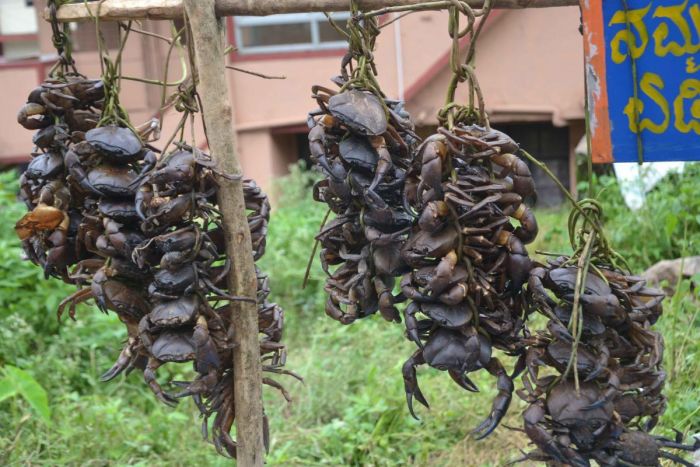
Demand for crabs, bamboo shoots rises in Madikeri

Crabs kept for sale beside a road in Madikeri.

It is the time of the year when people in Madikeri throng to purchase crabs and bamboo shoots.

Crabs, bamboo shoots and “Marakesu” have already entered markets in the district.

People consider crab as good for generating heat in the body which helps in braving the chill during monsoon.

The crab sellers collect 30kg to 40kg of crabs from H D Kote, Bheemanahalli and come to Madikeri to sell them. A bundle of crab (12 crabs) are priced at Rs 300. Crab fetches Rs 250 per kg.

In the past, crabs were available in plenty in paddy fields and water bodies. Now in spite of an increase in demand, there are a few people who sell it.

The availability of crabs has also declined, said crab seller Kumar.

Even the tourists who come here during weekends purchase bamboo shoots while returning home. The bamboo shoot is sold for Rs 40 to Rs 50 for half a kg.

The demand for “Marakesu” leaves also increases during the monsoon. The leaves are used for the preparation of “pathrode” and “bajji.”

The monsoon delicacies are served not only at home but at homestays and resorts as well.

There is a good demand for crab curry, crab fry, bamboo shoot pickle and bamboo shoot dry curry, said homestay owner Suyog.

source: http://www.deccanherald.com / Deccan Herald / Home> State> District / by DH News Service , Madikeri / June 24th, 2018

Karnataka: God’s own forests watch over Kodagu

Devara Kadu, or sacred groves, are a binding force between families and different communities of Kodagu district. Of late, encroachments are depleting this forest cover

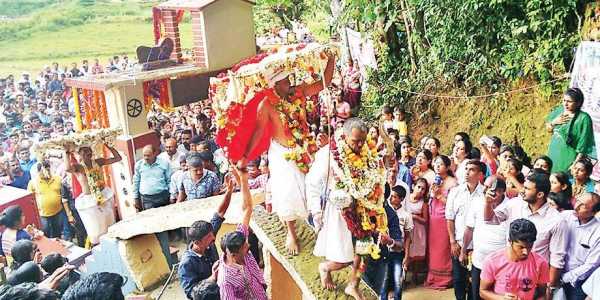
Rituals being conducted during a Devara Kadu festival

Mangaluru :

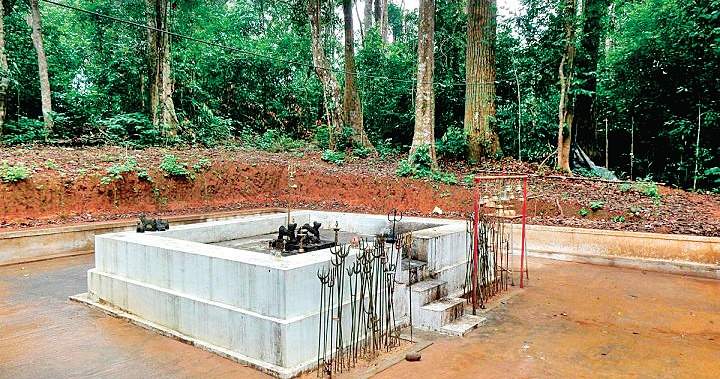
Rumbustious, uncut, proud, magnificent trees; a plinth on which idols of folk deities sit alongside miniature terracotta sculptures of cattle, a harmless silence taken over by tweets of birds and insects – welcome to Devara Kadu temples situated amidst thick, unkempt forests of Kodagu. Ecological havens in every village of the district, Devara Kadu or the sacred groves are a binding force between families and different communities of the district.

The Malnad region is dotted with such sacred grooves. While Devara Kadu fall under the protected forests, they are treated as sacrosanct by the people resulting in the prohibition of felling, lopping or clearing of trees and even weeds. Light, water, air, earth, wind – the five elements — are glorified at these abodes of nature and paganism (nature worship) is revered and celebrated once a year at these groves.

‘Kadu Aiyappa’ is one of the ancient deities worshiped at Devara Kadu. “He (Kadu Aiyappa) chose solitude and a simplistic life in the wild, which is why he is till date worshiped amidst the virgin forests,” explains historian Bacharaniyanda Appanna.

Kottialu Eshwara Devara Kadu at Garakeri

Bhadrakali, Bhagavathi, Naga, Aiyappa, Eshwara, Ajappa are the common deities worshipped in Devara Kadu and each deity has a folk story connecting them closely to the villagers. The folk deities are revered as protectors and guardians of villages they are nestled at. “The place of Hathur, which is on Gonikoppal-Mysuru highway, has been a witness to many accidents. But these accidents have not killed a single person as Goddess Vana Bhadrakali of Hathur Devara Kadu, has protected them all,” says Kokkanda Belliappa, a villager of Hathur who like others here believes in the power of the Goddess.

Currently, there are nearly 1,214 Devara Kadu in Kodagu covering an area of 4,614 hectares and, 18 native communities are involved in worshiping 165 folk deities. “There have been a lot of encroachments. The deities are not as feared as before leading to these encroachments. However, the forest department is vigilant towards these offenders and we have taken several measures against such encroaches,” explains DFO Manjunath.

Nevertheless, in the past decade, Devara Kadu have been reduced to less than 9,000 acres from the original 15,000 acres, according to a survey on Devara Kadu.The ‘Devara Kadu Habba’ or the sacred grove festival, which takes place mostly between April and July (some annually and others biannually), is helping preserve the groves. “The ‘Eeroli Bana’ at Thaaka village of Cherambane is a Devara Kadu of Lord Aiyappa and is spread over 800 acres. It is believed that Kadu Aiyappa Swamy had stayed at this grove for two days. The grove is highly revered by the villagers and the fear of god is still existent, which has prevented encroachments. During the annual Devara Kadu festival, the villagers take a holy dip at the stream flowing in the grove. Entry to this grove is banned otherwise. A team of medical students had visited the grove in 1982 to conduct some research, but they could not proceed into the grove after a certain point,” says Appanna, a villager.

During the Devara Kadu festivals, the virgin groves echo with the praise of the deities. The spirit dance, sacrifices, ex-voto offerings (an offering given in order to fulfil a vow), grandeur god dance are just a few highlights. Prema, a resident of Hathur village, enters the Devara Kadu of Vana Bhadrakali with a trident. She explains, “I am offering the trident to the goddess as a thanks-giving for granting my wishes. People offer cattle to the goddess too.” The spirits of the folk deities are invited into the human body and these spirits listen to the problems of the villagers and provide solutions. The spirits also offer guidance to the village heads to help lead the village towards betterment, the villagers believe.

Even though Kodagu has one sacred grove for every 300 acres, the highest in the state, the groves are still depleting. The pressure of economic returns from plantations has resulted in their depletion. Yet, to some extent, the spiritual connections with these ecological havens are keeping them alive.

History
Granting of sacrosanct status to forests dates back to the Indus Valley civilisation. In Kodagu, kings considered a stretch of forest sacred and cared for the folk deity who in return protected his land. Devara Kadu of Kodagu falls under the tropical evergreen forest belt

Beliefs
Felling, lopping, clearing of fallen branches, plucking of weeds, pruning or burning of trees is prohibited in Devara Kadus. It is believed that offenders will be punished with death by the folk deity. Spirit dance, sacrifice, ex-voto offerings are common practices followed during Devara Kadu festivals.

Depletion
In all, 15,000 acres of Devara Kadu have today reduced to less than 9,000 acres due to continuous encroachments reported in the past decade. Immigration and economic returns are seen as major causes for encroachments.

source: http://www.newindianexpress.com / The New Indian Express / Home> States> Karnataka / June 17th, 2018

Rampant land conversion in Kodagu leads to reduced flow of water in Cauvery

Kodagu district is the major watershed and catchment for the Cauvery and has witnessed rampant conversion of not just forest land but also wetlands and coffee plantations.

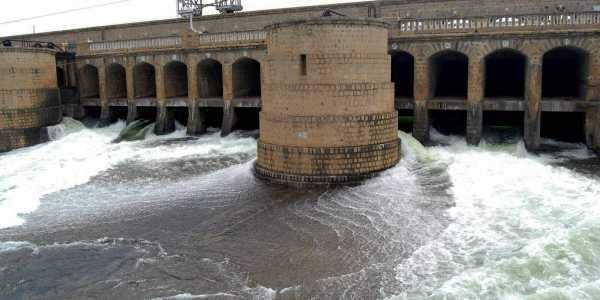
Water flowing from a dam across the Cauvery river. (File | EPS)

Bengaluru :

With 2,800 acres of land converted for commercial purposes in the last decade in Kodagu district, environmentalists decry the continuing change in land use and say it has decreased the annual flow of water in the Cauvery.

Kodagu district is the major watershed and catchment for the Cauvery and has witnessed rampant conversion of not just forest land but also wetlands and coffee plantations.

The statistics revealed by the district authorities are shocking as between 2005 and 2015, more than 2,800 acres of paddy field, coffee plantations and highlands were converted to residential layouts, sites, commercial complexes and resorts.

Col C P Muthanna, president, Coorg Wildlife Society said, “We have received this data from the district authorities as a reply to our RTI application. This is a matter of grave concern as the tiny district is the lifeline of not only south Karnataka but also Tamil Nadu. The river’s catchment areas have made way for buildings … the district has also been losing its tree cover to infrastructure projects, high tension power lines and railway lines.”

The Coorg Wildlife Society has met the district authorities in this regard and submitted a memorandum highlighting how large scale conversion of wetlands/highlands without even getting a NoC from the gram panchayats have taken off and legalised later by paying bribes. They have requested the authorities concerned to carry out a site inspection in the three taluks and a proper assessment on conversions. Col Muthanna adds, “The DC has tentatively agreed to our request. Further, we have requested for a study on carrying capacity of tourism in Kodagu that may finally result in policy measures for sustainable tourism.”

Environmental activist Sundar Muthanna, who has started an online petition ‘Stop the two railway tracks to Kodagu and Save Cauvery River’ and addressed it to PM and 14 others says, “Implementing the two railway lines will involve cutting of lakhs of trees in the catchment region. Kodagu has already lost 54,000 trees for a high tension power line to Kerala and now hundreds of fresh applications for conversions are pending with the department. Land conversion seems to be the government term for ‘ecological suicide’.”

Railways and highways are being planned to promote tourism and business. “When tree-holding agricultural land is converted for commercial purposes, the trees are cut for construction activities. In river catchment area, less trees is … simply put … less river. The Cauvery went completely dry in Kodagu in March this year … we don’t seem capable of understanding the many warnings that nature is giving us,” Muthanna says.

Environmentalists say a study done by researchers of Indian Institute of Science has already revealed the decreasing water flows to the Cauvery from the catchment areas of the district. Prof T V Ramachandra, head of Wetland and Energy Research Group, IISc headed this study — Modelling Hydrologic Regime of Lakshmanthirtha Watershed, River Cauvery. The study outlines how change in land use in Kodagu has decreased the flows into Cauvery. The assessment showed that out of five watersheds, four had high deficiency of water for over three months.

Kodagu DC was not available for her comments.

source: http://www.newindianexpress.com / The New Indian Express / Home> States> Karnataka / June 13th, 2018

Codavas On A Mission To Nourish Cauvery Back To Health

Snapshot

Codavas are seeking living entity status for Cauvery – the lifeline of South Karnataka-Tamil Nadu.
______________________________________________________

As politicians try to gain political mileage out of the controversy over the sharing of Cauvery river water between Karnataka and Tamil Nadu, Codavas – the original inhabitants of Kodagu – have embarked on a novel journey. This could one day give Cauvery river, the lifeline of South Karnataka and Tamil Nadu, the ‘living entity status’ like Ganga, Yamuna and Narmada. It will be also on the lines of the special status that Whanganhi River of New Zealand, which is very dear to the original inhabitants Maori tribe, enjoys.

Called “Codavas separatists”, these inhabitants have been demanding a separate state since 1957. In fact, Kodagu enjoyed ‘C’ Grade statehood before Independence. Consecutive state governments in Karnataka have not protected the antiquity of Codavas and did nothing to give them special status despite being a miniscule minority in terms of population, allege the Codava National Council (CNC) activists.

Several times they had objected to the way river Cauvery is being abused and overexploited for socio-political and economic reasons. “We have been pointing out to the government that Cauvery river is not in her full health and we need to take corrective measures, but none of the governments did anything. Which is why we have organised a vehicular jatha, a convoy of vehicles with Codavas and Codavathis (women Codavas) from Talacauvery (birthplace) of Cauvery river to the last point of the river in Poompuhar in Tamil Nadu. This is an awareness campaign to let people know how the Cauvery is shrinking and how to nourish her back to her pristine beauty and girth,” said CNC president N U Nachappa.

River Cauvery is one among seven sacred (sapta nadi) rivers of the Vedic period and they are Ganga, Yamuna, Sindhu, Saraswati, Narmada, Godavari and Cauvery. Thankfully, other rivers are now under rejuvenation process with Prime Minister Narendra Modi pledging his full support to the rejuvenation and cleansing of Ganga. This has motivated the states like Haryana, Punjab, Gujarat, Andhra Pradesh, Goa and Maharashtra to take up rejuvenation of their rivers seriously.

However, Karnataka has not done anything to protect Cauvery river despite the river losing girth and inflow steadily. At many places, it is being polluted. “This apathy has hurt us, and after many failed appeals we have decided to kickstart a people’s movement to save Cauvery. She takes birth in our district and nourishes several lakhs of hectares of land and quenches the thirst of the crores of people. It becomes our responsibility to let the people know her condition. She nourishes our crops and has two southern rice bowls for India, one in Mandya in Karnataka another in Thanjavur, Tamil Nadu. She is the lifeline of the south,” says Nachappa.

There are already instances where the governments in Uttarakhand, Madhya Pradesh and even New Zealand are giving rivers a new lease of life by according “living entity” status. River Saraswati disappeared centuries ago and such a thing should not happen to Cauvery, say Codavas, who took part in the expedition.

The CNC has urged the governments of Karnataka and Tamil Nadu, the United Nations Organisation and the International Water Dispute Tribunal to accord special status to the Cauvery river. The five-day jatha to Poompuhar from Talacauvery also witnessed visits to temples of Tamil Nadu that are built along the course of the Cauvery river. “It was not just evoking the divine grace for the river’s welfare but we also talked and engaged with the local people on the importance at Salem, Rasipuram, Tiruchirapalli, Thanjavur and Myiladuthurai.”

As per the legends, great Sage Agastya had his seat of learning in Kodagu on the banks of Cauvery. Until 1956, Kodagu was politically a powerful C grade state of the Indian Union. Codavas consider the reorganisation of states under the State Re-organisation Act, 1956 a great geo-political catastrophe of the 20th century for them. Cauvery and Kodagu were synonymous with each other.

R Sridhar, a scholar on Cauvery in Bengaluru, analysed why Cauvery is losing girth. “In the name of development, we have reduced the value of our rivers, which is a general situation. In the Cauvery basin, we have killed many tributaries like Arkavathi and Kanva rivers. While Arkavathi was killed at its source in Bengaluru by drying the river and creating housing projects, Kanva river has been reduced to a rivulet, and most part of the year except in monsoons, it is dry. I remember the Tamil Nadu government making a case with the Supreme Court stating that the Cauvery river was contaminated with sewage and industrial effluents and chemicals. But I still think the Cauvery river gets an inflow of 740 thousand million cubic feet (TMC) water during a typical monsoon season. But the utilisation of river water has trebled in the last 20 years, which is why Cauvery has slendered down in girth. Check dams have been constructed in many districts along the Cauvery’s course in Karnataka and Tamil Nadu to store water, another reason for it to become slender. But it is never too late for taking up a drive like the CNC has taken up, which is laudable.”

However, things are presently fluid as the governments have demanded constitution of a Cauvery river water management board of which shape of things to come is not certain, Sridhar said.

President of the Delta Farmers Forum at Tiruchirapalli, Pandit Ramdas, hailed the expedition. “This is the first effort that has kindled hopes of better future for the river Cauvery and also to the users of her waters. I am sure the governments will take notice of it. Codavas are not only martial heroes but also die-hard conservationists of their heritage land, their efforts to conserve the river Cauvery was a heroic event just like their innumerable wars with invaders which they won”.

*Route Map of the Mission on Cauvery was Talacauvery in Kodagu – Mysore, Hogenakkal, Dharmapuri, Mettur Dam, Salem, Rasipuram, Namakkal, Paramathiveleur, Mohnaur, Tottiyam, Musiri, Mukkombu, Srirangam, Tiruchirapalli, Thanjavur, Ayyampettai, Papanasam, Kumbakonam, Mayiladuthurai, Sempanarkoil, Mudikandanallur, Melayur and Poomphar (Cauvery Pattinam) the final destination.

*Cauvery jatha as they called it was fascinated by the site where world’s first dam built over sand by the legendary Tamil emperor Karikala Cholan during 1st century AD. This grand Anekat, dam is built across river Cauvery Vennar at Kallanai and still stands.

*With this expedition the Codavas have begun a new people to people friendship with Tamil Nadu, while the politicos on both states choose to take the political route to the Cauvery water sharing and in the bargain foment and fuel inter-state unrest.

*What is living entity?

The concept of river being given the same rights and duties as a human being is new to India, the first to do was Equador in South America its constitution provided this right to many rivers within in its geographical area, recently New Zealand gave such rights to Whanganui River. The river will have all the rights and duties that a citizen has. The rivers endowed with such status will not be treated as property of the state or a nation but will have right to exist, persist, maintain and regenerate its vital cycles. The river will have its own identity and will get the same protection that the human beings get.

Raghuram hails from coastal Karnataka and writes on communal politics.

source: http://www.swarajyamag.com / Swarajya / Home> Ideas / by M Raghuram / June 03rd, 2018
‘No ban on women climbing Brahmagiri Hills’

Kodagu district administration says personal opinion of astrologer is not official decision

The Kodagu district administration has scotched rumours that women will be barred from climbing Brahmagiri betta from Talacauvery temple, the spot where the Cauvery takes its birth.

Satish Kumar, Additional Deputy Commissioner of Kodagu, said the personal opinion of an astrologer from Kerala, who was invited for the ritual of ‘Ashtamangala Prashne’ held at Talacauvery, was construed as an official decision of the government-appointed temple committee. ‘Ashtamangala Prashne’ is part of an astrological tradition and entails answering queries raised to find solutions to problems.

“The temple committee is vested only with the responsibility of routine administration and cannot take unilateral decisions outside the purview of its prescribed duties. Besides, the Talacauvery temple is administered by the Muzrai Department of the State government and is not a party to the opinion stated by an astrologer,” said Mr. Satish Kumar.

“I sought a report from the temple’s executive officer, and he reported that it was the personal opinion of the mystic and has nothing to do with the temple committee,” Mr. Satish Kumar added.

There was a furore after the priest said that only men, girls below 10, and women above 50 years will be allowed to climb Brahmagiri Hills between Tula Sankramana day and Vrushabha Sankramana day.

source: http://www.thehindu.com / The Hindu / Home> News> States> Karnataka / by Special Correspondent / Mysuru – May 25th, 2018

Mini hydel project in Kodagu gets green signal

A mini hydel project across River Kumaradhara which was constructed and commissioned in 2014 in pristine forest lands of Kodagu district has now got the green signal.

Bengaluru :

A mini hydel project across River Kumaradhara which was constructed and commissioned in 2014 in pristine forest lands of Kodagu district has now got the green signal. The Regional Empowered Committee (REC), south zone, Ministry of Environment and Forests, has cleared the project but questioned the state government’s decision to allot forest land for non-forestry purposes and further directed them to furnish a report.

The Kodagu Hydel Projects Pvt Ltd was sanctioned in pristine semi-evergreen and evergreen forest land in the Pushpagiri hill ranges of Kumaralli village, Madikeri division for implementing the 3 MW capacity Beedalli Mini Hydel Project. After the project took off in 2014, the DCF, Madikeri division issued notices to the company to submit the proposal for diversion of forest land under Forest (Conservation) Act, (FCA),1980 and to stop work till the necessary approval is obtained. Further, the CCF, Kodagu division reported that though the company was granted two acres, it was occupying more than 2.35 acres excluding the road, building and transmission lines.

Meanwhile, the company filed a writ petition in the Karnataka High Court and the court noted that the then DC, Kodagu district in 2007, had granted two acres of land in Survey No. 1/9 of Kumaralli village in Somwarpet taluk for establishing this hydel project. So, on the directions of the HC, the company submitted a proposal under FCA, 1980. Further, the state government was directed to process the application and send it to the central government as the company had already spent `13 crore on the project.

Joint Inspection Report

The report submitted by the joint inspection team clearly says the state government had violated all rules while allotting the land. Further, as per the DSS analysis done, the proposed area is inviolate as it violates hydrological rules. The area proposed for diversion comes under 250 metre buffer area of river Kumaradhara, a major water body in Kodagu.

Added to this, the findings of DCF (Central) states that the proposed forest area falls under Eco-Class 1 (dense forest). The area where the power house is built and official buildings are constructed had thick riverine vegetation and now some remnants are left in the field. Many known and rare species are found here.

source: http://www.newindianexpress.com / The New Indian Express / Home> States> Karnataka / by Meera Bhardwaj, Express News Service / May 12th, 2018

In the land of tigers and elephants, voters matter little

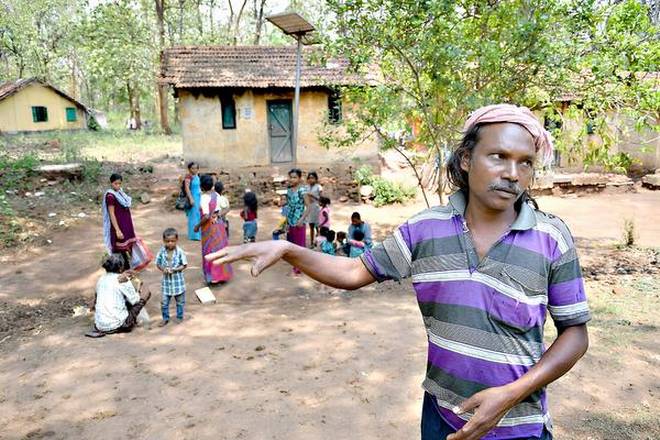
Neglected: A tribal hamlet at Kollangere in the Nagarahole National Park where no candidate has campaigned for votes.   | Photo Credit: M.A. SRIRAM
Neglected: A tribal hamlet at Kollangere in the Nagarahole National Park where no candidate has campaigned for votes. | Photo Credit: M.A. SRIRAM

Few candidates want to invest their time and resources to reach interiors of Nagarahole forests to seek votes from Jenu Kurubas.

The dense jungles of the Nagarahole National Park, 60 km from here, are an unlikely setting for the heat and dust of an election campaign.

The national park where nearly 90 tigers and 800 elephants roam free in their natural habitat is a no-go area for the general public, except for the guided safari. But there are about 1,250 Jenu Kurubas — an indigenous tribal community — still living in the national park and approaching them is inevitable during election times when every vote matters. But few candidates want to invest their time and resources to reach the forest interior, given the lack of easy access to the hamlets and the distance to be commuted.

Kolangere — a tribal hamlet of about 25 families — is a case in point. It is located about 20 km from the Veeranahosahalli checkpost gate at the entry of Nagarahole from the Hunsur side and around 35 km from Nanchi gate from the Kutta side.

The meandering potholed road is open only from 6 a.m. to 6 p.m. during which there is limited access to vehicles. There are 29 votes in this hamlet which falls under the Virajpet Assembly segment in Kodagu district. The nearest polling booth is at Moorkal, about 6 km by walk through the jungles, but there is a motorable road leading to it.

“No MLA has visited any of the tribal hamlet so far, but their representatives approach us for votes once in five years,” said Muthanna, a Jenu Kuruba.

The adivasis subsist on roots and minor forest produce. Though their needs are few, they work in coffee plantations in Kodagu to earn a living.

“All we seek is a settlement on the forest boundary along the elephant-proof trenches but our requests are rejected,” said Mr. Muthanna whose community has refused to relocate away from the forests.

Political awareness

It is the same scenario at Nagarahole, Nanachigadde Haadi, Gonigadde, Kolle Haadi, Tattekere or Kumbarkatte. But not withstanding the indifference of politicians, political awareness among the tribal people has increased over the years.

“Jenu Kurubas have traditionally supported the Congress. But the new generation has different views,” said Sanappa, head of the tribal community who relocated from the forests to Nagapura at Veeranahosahalli. Drinking water scarcity, lack of basic health care and educational facilities, and unemployment plague them even after relocation. The tribal people who volunteered to be relocated in 1998 were promised 5 acres of land as compensation, but 20 years on, it is yet to be fully implemented. “Yet there is no talk of boycott as we are hopeful that the government will act,” said Kalappa, a resident of Nagapura.

Survey under way

But a section of the adivasis of Nagapura whose patience is running out, launched an agitation on January 26, 2018, which lasted 75 days, forcing the authorities to take up a survey to demarcate the land. “We have now adopted a wait-and-watch policy on whether to boycott the polls or not in view of the ongoing survey,” said M.B. Prabhu, a tribal leader spearheading the agitation.

Tribals in Hunsur threaten poll boycott

Jenu Kuruba tribals from six hamlets in Hunsur have threatened to boycott the elections if their long-pending demands for proper rehabilitation and land allotment are not fulfilled.

The hamlets come under Hunsur Assembly constituency and banners announcing poll boycott have come up in some of them. There are about 300 families in these six hamlets and they account for at least 1,000 votes. The boycott threat indicates their frustration, according to Sreekant of Development Through Education, an NGO working for uplifting tribals. “Their language betrays their feelings and it is the successive governments that are to blame for the sad state of affairs as [the tribals] are left begging and pleading for basic amenities,” he said.

The hamlets that have called for election boycott include Hebbala, Neralakupe B. Haadi, Billanahosahalli and Chikkejejjur. Though the local authorities have been directed to prevail upon the tribals not to boycott the polls, DEED has sought the intervention of the Assistant Commissioner to end the impasse.

“He should visit the hamlets affected, understand the condition of these communities and list out the pending works for their comprehensive rehabilitation. Though most of the demands are outside his immediate purview, the Assistant Commission can make recommendations to improve their living conditions,” Mr. Sreekant said.

The demands include land allotment as part of the rehabilitation package that was promised to the tribals when they were shifted from Nagarahole and clearing land encroachment reported in 10 hamlets.

Tribal communities threatening to boycott elections is not something new, and they always end up exercising their franchise, according to DEED. But the larger message being sent out is the failure of the authorities to fulfil the promises made decades ago.

source: http://www.thehindu.com / The Hindu / Home> Elections> Karnataka 2018 / by R. Krishna Kumar / Mysuru – April 30th, 2018

Youngsters clean River Cauvery at Srirangapatna

Around fifty youths mostly professionals at various sectors volunteered themselves to clean up the Cavuery River at Srirangapatna taluk on Sunday

Mysuru:

Around 50 youngsters, mostly professionals in various sectors, volunteered to clean the Cauvery at Srirangapatna on Sunday.

Uniting under the banner, ‘Yuva Brigade’, the youngsters assembled bear the Sri Ranganathaswamy temple, and cleared the river of plastic and cloth dumped in the waterbody.

Members from the Mysuru-based NGO Swachanda also participated in the programme.

“We arrived at the banks of the river around 6am, and started to fish plastic and cloths from the Cauvery. This went on till 11am. We cleared around two truckloads of garments dumped by devotees in the river. The waste removed from the river was transported to the designated dumpyard,” Swachanda member BK Purushotham told TOI.

Members of the ‘Yuva Brigade’ led by social activist Chakravarthi Sulibele, have initiated a campaign to clean the Cauvery starting from Talacauvery to Srirangapatna. The campaign started on April 12.

The campaign is called ‘Jeeva Nadige Jeeva Thmbi (Infuse life into the river that is our lifeline)’. On Thursday, cleaning started at Siddapura, while the river was cleaned at Kushalnagar on Friday, Ramanathapura on Saturday, before the activists proceeded to Srirangapatna on Sunday.

source: http://www.deccanherald.com / Deccan Herald / Home> City News> Mysore News / Times News Network / April 16th, 2018

A symbiotic bond with tribal communities

For 38-year-old S Thanaraj, a visit to study the impact on the lifestyle of Paliyar tribal community due to globalisation in 2006 was a life changing moment. He was impressed by how tribal communities embrace nature and live in forests complementing each other.

A native of Radhapuram in Tirunelveli, he shifted to Madurai to pursue law. Being a dalit, Thanaraj has witnessed caste discrimination at a very young age. He always stood against it and had the tendency of helping others since childhood. This came true after his formal education, when he turned an activist. The law graduate has worked in various areas like youth empowerment, environment and total prohibition by joining hands with various organisations including CESCI, Ekta Parishad and People’s Education for Action and Liberation.

Thanaraj became an Adivasi activist after he extensively worked with the Paliyars, educating them about the Forest Act which ensures their right over forest land. The Scheduled Tribes and Other Traditional Forest Dwellers Act passed in 2006 promises tribal rights over agriculture land which traditional belonged to them, accessing forest produces and right to protect and manage the forest, which had been denied for long.

“I went to educate them, but ended up learning so many things from them. Their life is an exemplary one in conserving forest, which needs to be learnt by all. I have taken these lessons to over 1.5 lakh school and college students so far,” Thanaraj said.

For instance, Adivasis do not kill pregnant animals for meat. When they collect roots, they plant more and they never cut living trees, they only use dead trees. They treat woman equally and encourage widow remarriage. There is no dowry system either, said Thanaraj.
While he worked for Paliyars till 2008, he expanded his horizon and started working for various communities like Kadar in Valparai and Anaimalai, Malasar in Amaravathi, Udumalaipettai and Anaimalai, Muduvan in the interior forests of Theni and Valparai forests and Mahamalasar from Anaimalai and Topslip.

Thanaraj’s has a strategy in empowering the Adivasi community. To create leaders among them, unite them to retrieve their rights over forest and defend themselves from exploitation, he along with the organisations he works for help Adivasis in various areas in the state by getting them housing facility and agricultural land. Only recently, Kadar tribe from 24 villages in and around Valparai in Coimbatore received 10 acres of land after several stages of protest.
Thanaraj has taken part in various national-wide protests carried out to ensure the rights of Adivasis. He has also organised many state-level protests demanding total prohibition. He has also extensively worked in the Tsunami rescue and rehabilitation throughout the TN coast. He also played active role in the protests against Sterlite and Koodankulam nuclear plant.

Thanaraj was lucky to get married to a like-minded person like K M Leelavathi, a daughter of a tribal leader from Coorg, in 2010. An MSW graduate, she too joined him in the work towards helping deprived communities. Recently, he joined the Centre for Justice and People and continues his work towards Adivasi empowerment.

source: http://www.timesofindia.indiatimes.com / The Times of India / Home> City News> Madurai News / TNN / April 11th, 2018