Category Archives: Nature

Awareness programme on forest fire

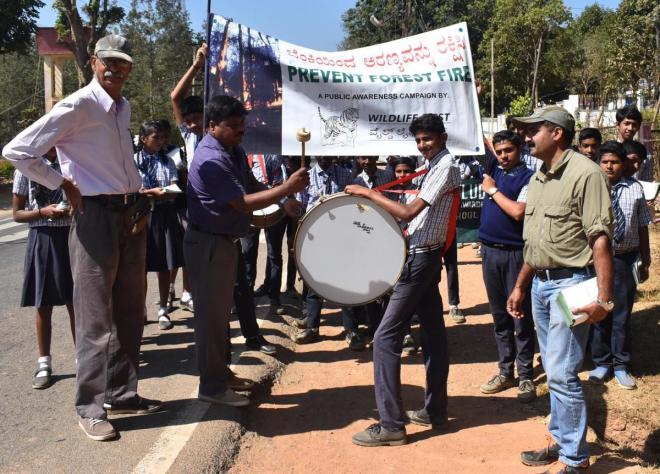
An awareness rally on forest fire was held in Gonikoppa.

A forest fire is not a natural incident. There are always human hands behind the accident, said Wildlife First president K M Chinnappa.

He was speaking during the flagging-off of an awareness rally conducted by Wildlife First and the Aided High School at Gonikoppa to create awareness against forest fires.

Negative impact

“A forest fire not only results in the loss of valuable flora and fauna but also increases the temperature levels. This will further result in less rainfall and depletion of groundwater level. The amount of rainfall is diminishing year by year as the forest cover is depleting. If this continues, drought will be the most common phenomena,” Chinnappa said.

Dependence on forests

Inaugurating the rally, Titimati Assistant Conservator of Forests Sripati said that the existence of all organisms depends on the existence of forests. “Everyone should, therefore, extend their help towards preserving forests and wildlife,” he added.

Around 3,000 handbills on forest conservation were distributed among citizens on the occasion. Up to 50 students took out a procession and raised slogans on conservation of forests.

Science teacher and Tiger Pug Nature association coordinator D Krishna Chaitanya was present on the occasion.

source: http://www.deccanherald.com / Deccan Herald / Home> District / DH News Service, Gonikoppa / February 05th, 2018

A 270-km cycle trip to save Cauvery

CycletripKF28feb2018

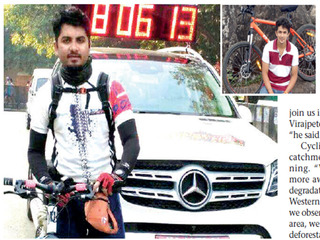
The skies are not opening up as expected and the state is likely to witness drinking water crisis next summer. In an attempt to protect the environment and raise awareness, especially about the Cauvery catchment area, two cyclists Ashish Muthappa, a second-year interior design student at Jain University in Bengaluru, and his friend Chengappa Chekkara, an HR consultant, also based in Bengaluru, will cycle from Bengaluru to Virajpete on August 12.

Muthappa told BM, “Cauvery is the lifeline of South India. It provides water to over 80 million people and 600 major industries across the region. The food, water and economic security of southern India depend largely on Cauvery. Trees were axed for a high-tension power line from Mysuru to Kozhikode in Kerala. There is a proposal to expand the railway network and four-laning of national highways through Kodagu. The weather is already changing and it is becoming humid. The projects will indeed cause large scale destruction of several thousands of precious trees that guard the Cauvery catchment area. Do we really need this development at the cost of water?”

In the past, the duo participated in several cycle expeditions in Bengaluru city for a cause. Ashish said,”“We hope to leave Bengaluru at about 1am so that we reach Mandya early in the morning. We are looking forward to interacting with farmer groups there. We hope to video-record our interactions with famers. We are approaching cyclists in Mysuru. Cyclists from Coorg are expected to join us in Mysuru, Gonikoppa and Virajpete were the expedition ends, “he said.

Cycling 270 km to protect the catchment area is just the beginning. “We would like to spread more awareness on environment degradation by cycling through the Western Ghats stretch soon. When we observe the Cauvery catchment area, we have noticed that massive deforestation is taking place and no afforestation,” they said.

source: http://www.bangaloremirror.indiatimes.com / Bangalore Mirror / Home> News> State / by Deepthi Sanjiv, Bangalore Mirror Bureau / August 02nd, 2017

Karnataka halts Kerala in its tracks, saves Kodagu

CoorgKF28feb2018

Says it has not approved the Thalassery-Mysuru rail link

A burgeoning environment movement across Kodagu was put to halt — albeit breifly — by the state government on Wednesday.

Putting an end to the rising levels of anxiety among thousands of Kodavas and green activists, the state government clarified that it has not approved the controversial rail link connecting Thalassery (Kerala) with Mysuru (Karnataka) via Kodagu. Further, the state government clarified that it would not even allow preparation of detailed project report (DPAR) for the proposed rail link as the project would jeopardise the fragile ecosystem of the pristine Western Ghats.

Allaying the fears of thousands of people, RV Deshpande, Minister for Large and Medium Scale Industries and Infrastructure, told the state legislature that the government expressed its opposition for the project. Drawing the attention of the state government, BJP MLA from Virajpet KG Bopaiah alleged that both Karnataka and Kerala already met once and agreed to carry out survey for the proposed rail link amidst stiff opposition from the local population.

Deshpande acknowledged that a meeting between secretaries of Karnataka and Kerala did take place recently, however, the Karnataka government had not consented for the project. “Holding a meeting does not ensure our approval for the project. We have not consented for the rail link project. Further, the project is yet to be approved by the Railway Board and thereafter a formal request has to be made by the Kerala government. Only then, we will be able to take a decision,” Deshpande revealed.

Going further, Deshpande stated, “We already had discussion about the project at government level. Our forest department has not only expressed reservations but also opposed the project as it would jeopardise the green cover and affect elephant corridor through which the rail link passes. Hence, the state government in principle has not consented for the project.” According to Bopaiah, as per the Railway minister’s reply in the Lok Sabha in December 2017, a joint meeting between Kerala and Karnataka secretaries had resolved to take up survey along the route only if the Kerala government submits a proposal to Karnataka provided it does not cause disturbance to wildlife areas. Interestingly, the rail link spanning more than 200 km would pass through Wyanad of Kerala and enter Kodagu at Kutta to pass through thick forest regions like Balele-Nittor-Canoor and Thithimati to reach Mysuru.

Perturbed that the new railway line with a project cost of Rs 6,685 cr would result in clearing of about 40 per cent of Kodagu’s forest, Kodavas, including retired defence officials, planters, environmentalists and public had staged massive protest rallies recently at Kutta and Madikeri. Fighting against the projects that would spell doom over the fragile eco-system of Kodagu where the River Cauvery originates, people from Kodagu, Mysuru and Bengaluru had launched Save Kodagu and Cauvery campaign led by Coorg Wildlife Society. Col (Rtd) Muthanna had even accused Kerala political leaders, including Congress parliamentarian KC Venugopal, of misusing his office as the Congress in-charge in Karnataka by leading Kerala delegations to push for destructive projects cutting through Kodagu benefiting Kerala.

source: http://www.bangaloremirror.indiatimes.com / Bangalore Mirror / Home> News> States / by Niranjan Kaggere, Bangalore Mirror Bureau / February 08th, 2018

Kodavas to observe ‘Kakkada Padinet’ today

Several rituals are associated with the Kodavas from time immemorial. One such ritual is ‘Kakkada Padinet.’

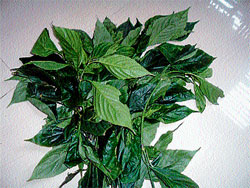
‘Kakkada Padinet’ is 18th day of the month of Kakkada in Kodava calender and is a significant day in the lives of Kodavas. It will be observed across Kodagu on August 2. It is said that the 18th day of Kakkada month of the calender is associated with medicinal values. As the per the traditions, the paddy seedlings are transplanted in paddy fields on the day. Later, they prepare a sweet dish made of ‘Madhubana’ leaves or ‘maddu soppu.’

KakkadaPattinetKF28feb2018

On the 18th day of Kakkada, the leaves are said to contain 18 medicinal values. The leaves grown in the wild are plucked and boiled in water to get the aromatic juice, which has thick and unique flavour and has dark violet colour. The leaves are used either for preparing sweet or rice. It is said that consuming the leaves on the 18th day of Kakkada will be useful for the health of an individual.

The Gowda community members prepare payasa, kesaribhath or ghee rice made of this leaves on the day of newmoon in the month of Aashada.

‘Marakesu’ soppu which is widely grown during monsoon are used only in the month of Aashada. It is believed that the use of the leaves are good for health. People prepare ‘Pathrode’ from Marakesu leaves.

source: http://www.deccanherald.com / Deccan Herald / Home> District / Shanivarasanthe, DHNS / August 01st, 2012

Don’t make a killing

Elephant01KF05feb2018

A documentary film about the elephant-man conflict in Karnataka posits that solutions to loss of life due to elephant attacks can only come through co-existence. Not everybody agrees, though. We look for some answers.

There is a moment in Elephants in the Coffee when Naveen Cariappa (his family has farmed an area in Coorg for more than three generations) talks about how media, officials and conservationists rush to the site of an elephant death, but remain silent when a coffee plantation worker is killed as a result of conflict with the very same elephants. The lament encapsulates the kernel of the 58-minute documentary – that the solution to such man-elephant conflict lies not in taking sides, but in pursuing solutions that encourage a peaceful co-existence between both parties.

Created by author, documentary filmmaker and cultural explorer Bhaskar Krishnamurthy and journalist-turned-educator Tom Grant, Elephants in the Coffee looks at the fragile relationship between elephants and humans, and has been shot mainly around Nagarahole National Park and the coffee estates skirting it.

Krishnamurthy, who was in the city for the screening (he is based in the US) says this, his first film on the subject, was born out of a desire to understand what happens as human population grows and elephant habitat shrinks. “Are we at the threshold of cutting our relationship with animals? The more plantation workers die as a result of this conflict, the more tolerance for wildlife is going to reduce. And that doesn’t bode well,” he says. Grant adds: “Cariappa represented an important duality, or internal conflict, among farmers. He loved elephants and nature. He worked with people in the national park to help improve the situation for elephants. But when they began destroying his crops and threatening his workers, he had to seek solutions. He found no reasonable measures by which he, as a small farmer, could protect his farm from crop raiding elephants. In our minds, he is a symbol of the Indian farmer who is being forced to change his attitude toward an animal he once saw as a benevolent god. Now he, as many others, see the elephant as a menace that must be addressed.”

There are others. PC Bopanna, a farmer describes how he survived after an elephant pelted him to the ground, but today, hobbles along on a crutch, his leg badly damaged in the incident, even multiple surgeries later.

Then there is the other side – of elephants losing their habitat, of majestic creatures being robbed of their homes and reduced to residents of tiny spaces once they’re marked as violent and aggressive and eventually, captured. Krishnamurthy speaks with feeling of the 60 elephants housed in captivity in Karnataka, and how they may be alive, but living regimented lives like that for the rest of their days “is no life at all”.

Fences have not worked, as illustrated by viral videos of an elephant slipping under a railway crossing barrier at Chapramari Wildlife Sanctuary earlier this year.

Elephants in the Coffee also shows how elephants outsmart all kinds of barriers, trampling them with ease. As the film makes clear, ‘If you make a 20-foot-long moat, the elephant will walk till the 21st foot and cross over there’. Successful models have been few, such as the SMS-based warning system developed by Dr Anand in Valparai to warn workers when an elephant is in the area, or the SMS messaging system at Tata Coffee, demonstrated in the film by biologist Karthic Krishnan.

Conservationist Padma Ashok is also of the opinion that co-existence is the only way forward. She opines that solutions need to be thought of by people local to the area, by taking into consideration the topography, landscape and geographical features of the area. “From the elevation to the length of the river in that area, everything matters. And you need a combination of two-three solutions to tackle the problem, because elephants are able to outsmart most,” she says.

Not everyone agrees, though. Praveen Bhargav, former member of the National Board for Wildlife, believes harmonious co-existence is “one of the greatest myths in conservation”, a utopian idea that “rarely works in the long term with most conflict-prone large mammals”. He advocates “site-specific solutions driven by scientific knowledge and a deep understanding of the social context”. He adds: “Loss of a family member is tragic but it must be seen in perspective. In Karnataka alone, more than 10,000 people have lost their lives in road accidents in 2015 while around 15 people have died due to elephant conflict. Large swathes of elephant habitat have been fragmented/lost due to agriculture, human settlements, encroachments, dams, highways, resorts etc which is a major driver of conflict.

There is no magical solution but conflict can be minimised by spatially separating humans and large wildlife to the extent possible by deflecting developmental projects, preventing ad-hoc grants of public lands by the revenue department, incentive-driven voluntary resettlements and innovative ideas for creating viable buffers around reserves involving local communities. In some specific cases, marooned, isolated population of elephants may have to be moved out to minimise conflict.”

Krishnamurthy believes the biggest problem is a lack of education. People have no idea what impact a cup of their coffee is having in the wild. He suggests the promotion of sustainable wildlife products, say by giving “a premium to the coffee you drink”. “At least that way a part of it will go back to wildlife conservation.” He would also like more stringent requirements for ownership of coffee estates and homestays that have mushroomed indiscriminately in these areas over the past few years. “So many of them are owned by people living, say, in Bengaluru. Maybe one way to minimise the number of such estates is to lay down laws that owners have to have strong roots in Coorg,” he explains. And to ensure better welfare of the captured elephants, mahouts need to be treated better and paid more. “Otherwise they’re losing interest and daily wage labourers who are paid a pittance and have no interest in forming a relationship with the animal, are taking their place.” The best answer, though, he believes, is technology. “Even the SMS warning service is eventually a human intervention. Instead, I’m sure that in Bengaluru we can develop technology to identify elephant movement and tracking, where there is no need at all for a person to physically go out there and do it.”

For Grant, the solution also lies in people considering the cost of their cup of coffee. As he puts it: “Americans drink an average of three cups of coffee each, but they have little idea how coffee is grown. India is one of the top exporters of coffee. And now Tata has a joint operating agreement with American coffee giant Starbucks. Yet no one in America who drinks coffee knows that India’s elephants are locked in a struggle for survival with the people who grow coffee.”
The answer isn’t that people stop drinking coffee, he emphasises.

Rather, “if every coffee drinker gave a penny for elephants with every cup, we could solve this problem in an instant”.

source: http://www.bangaloremirror.indiatimes.com / Bangalore Mirror / Home> Opinion> Sunday Read / by Sowmya Rajaram, Bangalore Mirror Bureau / April 30th, 2017
Native spices get a new gene bank

SpicesKF16jan2018

Kozhikode :

The immense effort that goes into setting up a gene bank is such that it can be termed as a mission. And when a group of farmers here came together to start one, it turned out to be a worthy venture. And ‘spicy’ too.

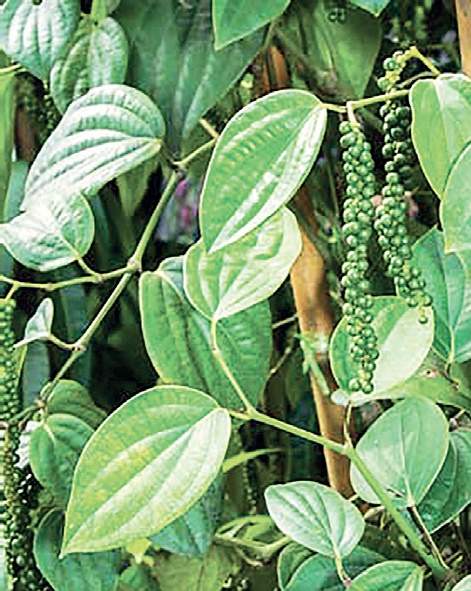
The Koorachundu Sugandhavila Karshaka Samithi realised it was high time they set up a gene bank to conserve the native varieties of spices, after they found that imported and hybrid varieties have become popular among farmers. They decided to begin with pepper and the Indian Institute of Spices Research (IISR), Moozhikkal, which got enthusiastic about the idea, decided to help the farmers collect a wide variety of local pepper plants.

Unlike the research institutes where spices are conserved in labs and experimental farms, the Samithi members will grow local varieties in their farms. As of now, the farmers are conserving 11 pepper varieties, including Arakulam Munda, Chomala, Pottanadan, Thulamundy, Kaniyakkadan and Nedumchola.

“The idea came up when we thought about the Western Ghats’ conservation and peaceful co-existence of farmers and wild animals,” said Samithi secretary P T Thomas.The Samithi, which began its gene-bank mission a month ago, plans to expand its basket to include clove, nutmeg, mace, cardamom and cinnamon in the coming days. It has 30 farmers, who own around 90 acres. Each farmer will collect a specific spice and grow it in his farm.

“Landraces of many crop plants are getting eroded due to a variety of reasons. Conservation of the landraces, which harbour many useful genes, is mostly a government effort. However, if people-participatory or farm conservation can be effected, it’ll help conserve landraces in their natural habitat,” said IISR’s crop improvement and biotechnology division head B Sasikumar.

The native varieties of pepper have the capacity to survive in the Western Ghats and can be cultivated at a low cost. Farmers can plant it under a jackfruit tree without the need for a support system, said Thomas. In contrast, imported and hybrid varieties need a proper support system.

The Samithi members are hopeful the gene bank will become fully functional in 18 months’ time. “The yield from native varieties can be an influential thing among farmers as the yield influences the farmer to decide whether to continue with the cultivation or not. However, at the Samithi, we’re planning to go forward without considering the yield from native varieties,” said Thomas.

source: http://www.newindianexpress.com / The New Indian Express / Home> States> Kerala / by K C Arun / Express News Service / January 01st, 2017

Elephants In The Coffee To Be Screened At BNHS

The growing coffee industry in India has given rise to conflicts between humans and elephants leading to deaths of both humans and these huge mammals.

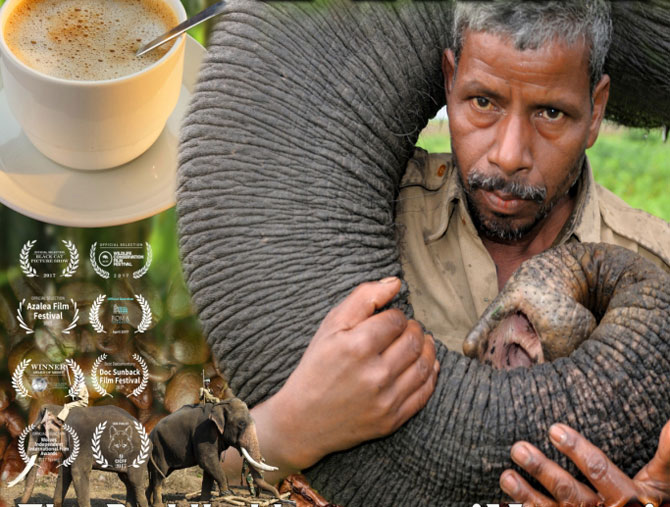
Poster of the movie 'Elephants in the Coffee'
Poster of the movie ‘Elephants in the Coffee’

Having a cup of coffee is a routine activity for many. Have you ever thought is your cup of coffee fatal for anyone? The growing coffee industry in India has given rise to conflicts between humans and elephants leading to deaths of both humans and these huge mammals. A documentary by international photographer, author and explorer D. K. Bhaskar and journalist Dr Thomas Grant ‘Elephants in the Coffee’ offers an insight into this topic. The screening of this internationally acclaimed documentary has been organized at BNHS Hornbill House on Friday, 19th January at 6:00 PM followed by a discussion with Mr. Bhaskar.

The Documentary:
Celebrated as the elephant God in India, elephants are now seen as a ‘menace’. ‘A god that became a menace’ reads the tagline of this documentary which is catchy and strong yet could implore an array of ideas. Shot mainly around the Nagarhole National Park in Karnataka and surrounding coffee estates, this 58 minute documentary sheds light on the relationship between humans and elephants.

The documentary explores and highlights the views of all involved stakeholders including villagers, coffee estate owners, naturalists, government and even the mahouts or elephant care takers. This documentary has garnered national and international appreciation and multiple awards at film festivals.

‘Elephants in the Coffee’ has been produced by CLIC Aboard, a non-profit organization established by Mr. Bhaskar which works to connect students in US and India through photography.

The team which worked on this documentary included three student associates from CLIC apart from Dr. Grant, Mr. Bhaskar and others. For more details regarding the film, visit http://www.elephantsinthecoffee.com/

The documentary will be screened at BNHS on Friday, 19th January at 6:00 PM. Mr. Bhaskar would later engage in a discussion session to throw light on the film, the human-elephant conflict and related topics. The screening is free and open to everyone.

Details in a nutshell:
What: Screening of ‘Elephants in the Coffee’
When: Friday, 19th January
Time: 6:00 PM
RSVP: Siddhi Shelar – s.shelar@bnhs.org / 022-22821811

source: http://www.mid-day.com / Mid-Day / Home> Mumbai / by mid-day online correspondent / January 10th, 2018

The lure of Nishani Motte

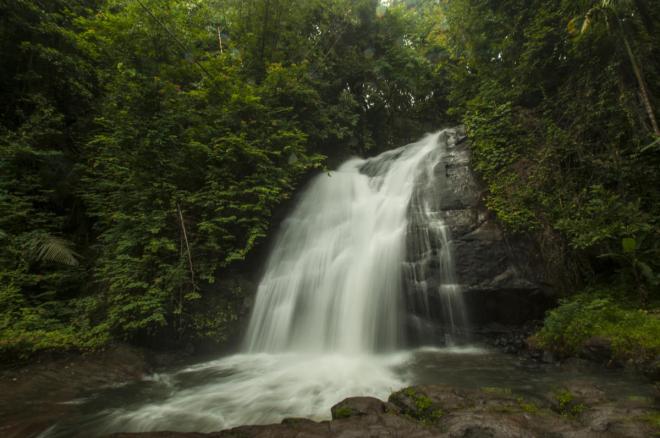
Devaragundi Falls
Devaragundi Falls

Travelling to Nishani Motte and hiking there was on our bucket list for a long time. We had heard that the place is also called the ‘Leech Kingdom’ as it is surrounded by a large number of leeches during the Monsoon.

On a Saturday early morning, I left Bengaluru with four of my friends for this interesting journey. We took the Hassan Road which is good to drive during the Monsoon months.

The first stop we planned was the Devarakolli Falls, which is a few km after Madikeri on Madikeri-Mangalore Road.

The Falls lie parallel to the main road and there are some shops for the travellers to have snacks. You can’t take bath in the Falls but it is a great place to shoot some good pictures.

After the short break, we hit the road for beautiful Devaragundi Falls, which is exactly 13 km from Sampaje, and located in a village called Thodikana. You need to park the vehicle two km before the Falls and do a small trek of two km on a flat jeep track to reach the Falls, which is so majestically placed inside the forest and is easily accessible.

To say the least, it was beautiful and gushing at the peak of Monsoon. Until January end, there is water for taking bath in the Falls but it gets dry during the peak of summer.

However, one should keep an eye on the kids as the water gushing area is steep. We were informed about this by the local villagers.

After a refreshing bath, we reached Mayura Cauvery in Bhagamandala to stay the night over.

The rooms were decent enough. We had our dinner in the small village of Bhagamandala.

Next day morning, we visited the forest office in Bhagamandala and got permission from the department to trek to Nishani Motte after paying a nominal entry fee and guide charges.

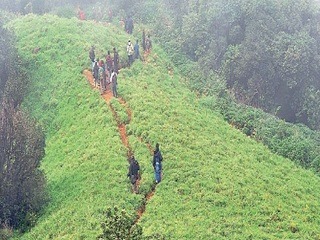
There was also another group who joined us in the trek. The Nishani Motte trek is around five km in total. One has to hire a jeep or travel in their own vehicle to the base from the forest office. The base is around five to six km from the forest office. We started our trek around 9 am.

The initial trek was a mild climb through estates and huge trees. In 20 minutes, we could see the grasslands and the leeches too. No wonder this place is called the ‘Leech Kingdom’ as thousands of leeches jumped over us.

Two hours through the trek, we reached the peak which was misty and foggy. We enjoyed every minute of the trek exploring the greenery and escaping from the leeches.

It started to rain during the last leg of our trek but it was an amazing experience to completely get drenched and enjoy the walk with friends.

Finally, we reached the other side of the base. We had our jeep waiting for us to drop us back to the Forest Department office. We reached the forest office around 2.30 pm, had a great lunch and finally visited the Thalacauvery Temple which is just a 15-minute-drive from Bhagamandala.

After visiting the Thalacauvery Temple, which is interestingly the birthplace of river Cauvery, we started our drive back to Bengaluru with lovely memories to cherish forever.

(The author can be contacted at kavinkishore85@gmail.com)

source: http://www.deccanherald.com / Deccan Herald / Home> Supplements> MetroLife / by Kavin Kishore/ January 03rd, 2018

‘Preserve the sanctity of Brahmagiri’

Coffee planter Manavattira Dore Somanna warned the district administration of locking up the entrance of Brahmagiri if the entry of public is not banned within a week.

He further added that the Brahmagiri, the birthplace of river Cauvery has been converted into an abode of illegal activities. “Tourists have been spoiling the sanctity of the place by littering it with garbage. This will affect the purity of river Cauvery.”

He said that the district administration should also ban the illegal shops near Talacauvery. Tourists should be banned from discarding the food leftovers at the Triveni Sangama in Bhagamandala. CCTV camera should be installed to monitor the activities of people. Additional staff should be deployed at the spiritual destination to perform the religious rituals smoothly. Also, the temple should conduct the ‘Ashtamangala Prashne’, he added.

Badumanda Muttappa, Padiyammanda Yogish Monnammaiah, Manavattira Papu Changappa and Manavattira Harish Biddappa were present in the press meet.

source: http://www.deccanherald.com / Deccan Herald / Home> District / DH News Service / Napoklu – January 01st, 2018

River Cauvery safe in Karnataka, say experts

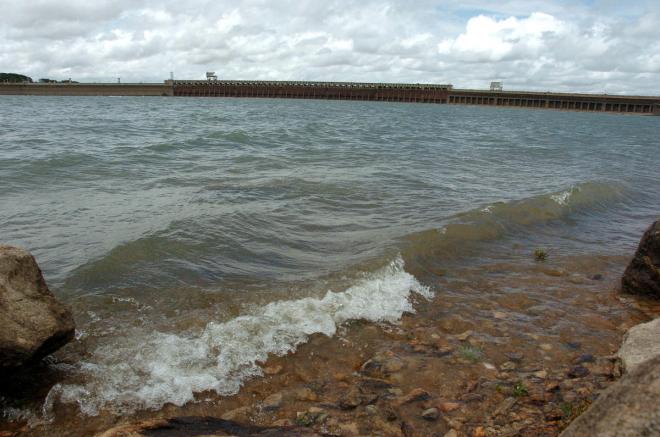
The backwater of the KRS dam. According to a KSPCB official, Cauvery river water in Karnataka falls under 'C' grade, which means it is safe for drinking after treatment. DH FILE PHOTO
The backwater of the KRS dam. According to a KSPCB official, Cauvery river water in Karnataka falls under ‘C’ grade, which means it is safe for drinking after treatment. DH FILE PHOTO

Environment experts claim that the report on River Cauvery published by Anna University, Tamil Nadu, may be partially true, but, the river water is safe for consumption in Karnataka.

S Srikantaswamy, professor in Environmental Science, University of Mysore (UoM), said, the pollution level at River Cauvery will be high during summer as water flow is less. The professor, who had conducted a study on River Cauvery two years back, said, “We cannot ignore the report, but, the pollution level in the river varies at different points in time.”

“It is true that the river, which has its origin at Talacauvery, in Kodagu district, receives wastewater from the starting point itself. The river flows amidst coffee plantations and the coffee pulped water is directly let into the river without any treatment. Similarly, the industries located along the river discharge wastewater (including toxic effluents) without treatment,” he said.

An official of the Karnataka State Pollution Control Board (KSPCB) said that he is unaware about the parameters of the study conducted by Anna University.

“The water in Karnataka comes under ‘C’ grade, which means it is safe for drinking after treatment. The report might be true as the river might be more polluted in TN,” he said.

In TN, a large number of small and medium textile dyeing industries, paper and sugar mills are located besides the river, and this could be the reason for high pollution levels. The pollution level during summer will be high as self-purification is low due to less volume of water flow, he said.

In Mysuru district, except sewage water in a few places, no industry releases wastewater into the river directly. The authorities monitor the quality of water every month at various places, commencing from Kodagu district up to the border of Karnataka, and the river water quality is good, he claimed.

Claiming that the River Cauvery in Karnataka is not polluted as much as River Ganga, he said, as per the physical appearance itself, the river is not much polluted.

source: http://www.deccanherald.com / Deccan Herald / Home> District / by Ranjith Kandya / Mysuru – DH News Service / December 25th, 2017