The construction of the state’s first goat milk producing and processing unit is in full swing at Byadagotta near Kushalnagar.
Animal husbandry minister A Manju had in February laid foundation stone for the unit which will come up on 112 acres of land. It is estimated to cost Rs 5 crore of which the state government has released Rs 2 crore.
Veterinary Department deputy director Padmanabha said it has planned to buy Jamalapuri, Seroy, and beetle breeds of goats from Maharashtra which provide upto 3 litres of milk per day.
He said an expert team has been formed to purchase 200 goats for rearing. At later stages, goat milk producers unions will be established at village levels. He said the milk will be sent to Bengaluru for marketing and in later stages, the unit will pack the milk in sachets and sell in local markets too. Goat milk has a good demand in the state where it is sold at Rs 70 per litre.
The department has also planned to grow grass for goats here and manure produced by goats will be sold to farmers.
The government will appoint an assistant director, a doctor, technician, an agriculture officer, 50 labourers for the milk producing unit. The unit will also generate direct employment for 50 locals and provide indirect employment to hundreds of farmers, he said.
Farmer Ganesh said dairy farming is a good idea for farmers to boost their incomes. He said the area has greenery which provides fodder for goats.
Byadagotta village is situated just 8 kilometre from Kushalnagar and has potential for development. The state government also planned to construct a mini airport at Aluvara. Mangaluru university has already established a PG centre in Aluvara.
source: http://www.msn.com / MSN.com / Home> Headlines> News – The New Indian Express / December 26th, 2017
District wants to follow on Nilgiris’ footsteps, urges Payment for Ecological Services fund for the benefit of farmers and region’s ecology
Worried about the increasing tourism activity in Kodagu district, greens have urged the government to follow the Niligiris district administration and impose a green tax on tourist vehicles entering the district.
Recently, the Nilgiris district administration announced that tourist vehicles entering the district via the Burliar, Kakkanallah and Nambiar Kunnu checkposts will be charged a green tax of Rs. 20, which will be used for the maintenance of the district’s ecology. It is expected that the fee will be used by the administration to carry out restoration works and maintain the fragile Nilgiris landscape.
Sundar Muthanna, Bengaluru Co-ordinator for Coorg Wildlife Society, welcomed the move by the Nilgiris district administration and said this should be implemented at all entry points to Kodagu district too.
“Collecting a cess or tax from tourist vehicles is important at the entry points because tourism has a very negative foot print on the ecology. Some of the damage can be undone by the tourism industry itself. They cannot go on exploiting the land endlessly and they have to give back,” he said.
He said the money generated should be used for tree planting and rejuvenating the existing water sources. “The money thus collected must go to the Payment for Ecological Services (PES) fund. The idea for PES comes from the belief that a rich and diverse ecology is equal to economic capital for the state and the nation.
Through PES we can help the people of Malnad preserve the ecology they live in. A well-preserved ecology will encourage rainfall locally in the Malnad and in the neighbouring regions,” he said. The fund could be used to provide subsidies for Malnad’s planters and farmers, he said.
Paddy cultivation could be encouraged with this fund, as rice fields contribute richly to the streams and rivers, and help to make them perennial, or flow through the year. Cottage industries such as pepper processing, canning, coffee processing can be set up in each taluk of the districts of Malnad.
The entry point to Kodagu district is from Hassan, Mysuru, Dakshina Kannada and Kerala.
Dinesh Holla, convener Sahyadri Sanchaya, said uncontrollable damage has already taken place in the Western Ghats region of Kodagu and Chikkamagaluru. “Rainfall has reduced. The government talks about only development, but when environmentalists approach the minister requesting him to procure helicopters so that in case of forest fire, quick action can be initiated, we are told that we are not living in a foreign country. It is time that the youth come forward, raise their voice and protect whatever little is left behind in the fragile Western Ghats,” he said.
source: http://www.bangaloremirror.indiatimes.com / Bangalore Mirror / Home> News> State / by Deepthi Sanjiv, Bangalore Mirror Bureau / December 21st, 2017
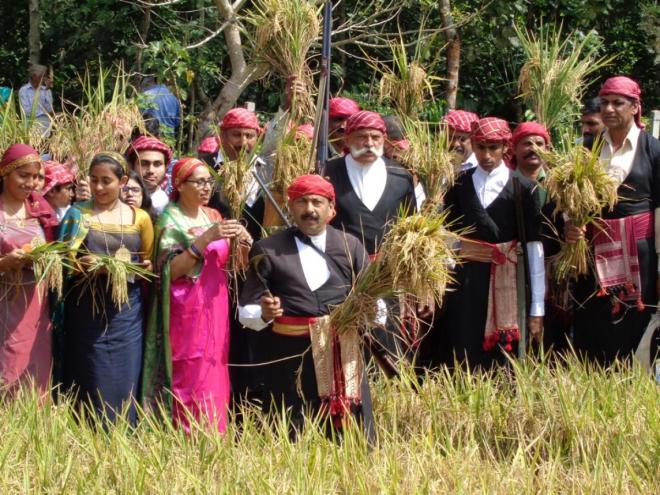
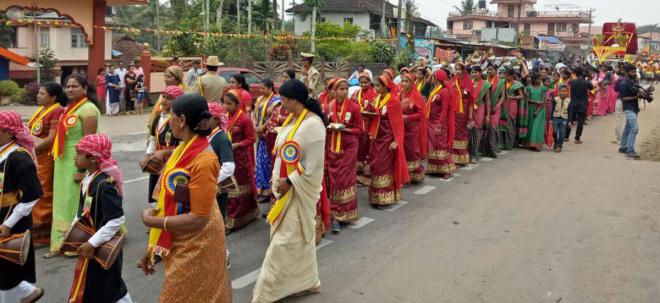
CNC President N U Nachappa and CNC members observed Huthari festival by cutting paddy sheaves in the filed of Uthappa at Chikkabettageri near Kushalnagar on Sunday.
The Codava National Council (CNC) led by its president N U Nachappa celebrated Huthari, the harvest festival of Kodagu, at a paddy field of Nandineravanda Uthappa, in Chikkabettageri village near Kushalnagar in Kodagu on Sunday.
By cutting paddy sheaves in the paddy field of Uthappa, the members celebrated the festival in a traditional manner.
The members offered prayers to the gods and began the Huthari celebrations with ‘Nere Kattuvo’ ritual. The leaves of mango, jackfruit, “Arali”, “Kumbali” and cashew nut trees were used in the ritual.
After the ritual, the participants walked in a procession to paddy fields accompanied by the ‘Dudikottpat’ (Dudi is a small drum of Kodavas).
After firing thrice in the air, the paddy sheaves were cut and brought home in a procession.
The CNC members performed traditional Kolata, Pareya Kali and Chowkata on the occasion. People relished Payasa, “Thambittu,” “Kadubu”, “Pandikari” and other delicacies on the occasion.
Speaking on the occasion, the CNC President urged the government to include Kodava language in the 8th Schedule of the Constitution.
He said that the government should accord tribal status to Kodavas.
The central government should declare a holiday for Huthari festival.
The CNC is continuing its struggle for an autonomous Kodava land and Kodava land should be declared a union territory. The culture and tradition of Kodavas should be included in the Intangible Cultural Heritage of Unesco, he said.
source: http://www.deccanherald.com / Deccan Herald / Home> District / by DH News Service, Kushalnagar / December 03rd, 2017
We recently decided to travel to Madikeri and surrounding areas with our relatives Uday Kumar and Bharathi.
They had arranged our stay in a resort surrounded by thick forest.
How did we go?
We left Bengaluru on Friday morning by car. Our main destination was Madikeri and Kodagu but we touched other places along the way.
What did we do?
We took the NH 275 and our first halt was at Kokkare Bellur. We observed some pelicans perched on a few trees. Our next halt was Balmuri waters, the manmade bund over Kaveri river. The water and scenery were good but the surrounding was spoilt by the heavy flow of tourists. It was a brief stopover and we soon left Balmuri.
We entered Nagarahole National Park and headed towards Virajpete. Virajpet is a small town tucked inside forested area, hills and coffee plantations. We stopped for tea and headed to Club Mahindra Virajpet, located inside a forest at a distance of 13 km from Virajpet. The road passed through coffee plantations and entered a forested area, wherein the resort is built.
On looking through the window of our cottage, I found that the flower and fruits of a wild banana growing in reverse direction! The flower and fruits were growing upwards, which was interesting. I also took a photograph of a wild orchid flower growing on an old arecanut tree trunk just outside the cottage.
Next morning we headed to Nalknad Palace, which was a hiding place for Chikkaveerajendra, the last king of Kodagu who was arrested by British East India Company in 1834. To reach the place, we had to manoeuvre several steep curves through coffee plantations and forests and after passing Kakkabe, we reached Nalknad Palace. The renovated building is a Mangalore tiled structure with four secret dark rooms where the Raja used to keep fugitives and his opponents. The wall paintings on Nalkand Palace are also interesting. After his arrest, he was deported to Vellore at first, then to Varanasi by the British and ‘Coorg Nest’ was the building where he was kept along with his wives and assistants. Nalknad palace was the last hideout for Chikkaveerarajendra, who was arrested by the British on the charges of atrocity he committed in his kingdom.
Located high in the mountains, the Nalknad Palace is a very interesting place to see. There are several homestays and resorts near Nalknad Palace, all tucked inside several forest nooks. On returning from Nalknad, we went to Iguthappa Temple, which is nearby. The recently-renovated temple is located on a small hillock and is frequently visited by the Kodava people.
After spending about thirty minutes there, we headed to Abbey Falls. The view of the falls is a sight to behold. We returned to Madikeri and the first thing we did was to find a good place for lunch. After lunch, we roamed in Madikeri Fort which is still in good condition. It is interesting to observe that the Palace of Madikeri Raja is still being used as offices of Government of Karnataka. The old church at the entrance of the fort is converted to an archaeological museum.
At 5 pm we visited Onkareshwara Temple, which looks good with its reflection in the temple pond located just in front of the temple. At around 6 pm, we went to see Raja Seat. The sunset from Raja Seat is a colourful affair with the evening rays filling up the entire valley below, as the spot is located on the edge of a mountain.
Next morning, we headed towards Dubare Elephant camp. Dubare is located on the banks of Kaveri river and Government of Karnataka is managing an elephant training camp. River rafting is something one should experience.
After spending an hour in Dubare, we went towards Bylakuppe, which is near Kushalnagar and Bylakuppe is a well-known Tibetan settlement. The settlers were hardworking and earned livelihood by cultivating forest lands and woollen business. They built a colourful Golden Temple as per Tibetan architecture. The mythological drawings depict the stories as per Tibetan tradition and makes a interesting sight. After spending some time in this Buddhist temple complex, we had lunch at Kushalanagar and headed towards Bengaluru.
source: http://www.deccanherald.com / Deccan Herald / Home> Supplements> MetroLife / by Shashidharan Halady / November 29th, 2017
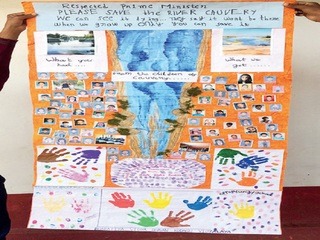
A group of children in Kodagu have written — rather drawn — to Prime Minister Narendra Modi, requesting him to protect river Cauvery which is under threat because of unplanned development activities. Instead of the usual way of writing a letter, the children opted for a scroll which has a series of paintings which depict the current state of the river.
Meena Cariappa, a social worker associated with the Opportunity School in Madikeri and wife of Air Marshal Cariappa (rtd), told Bangalore Mirror, “it is a scary situation the way river Cauvery is facing. While environment activists are working towards protecting the river, the children of Kodagu have joined hands in this mission and have attempted to draw the attention of the prime minister himself.”
She says if PM can look into the issue, the river can be a role model for the entire country itself.
She said, “Apart from a tweet to the Prime Minister’s Office, we have sent a six-ft–long scroll to the Prime Minister’s residence, hoping that he would look at it and there could be some change. There are many things happening in the name of development which is destroying the river, the lifeline of South India.”
The scroll reads: Respected Prime Minister, Please Save the Cauvery. We can see it dying and it won’t be there when we grow up. Only you can save it. There is a photograph of the Cauvery flowing in the centre. There are two photographs of the river on either side — one stating ‘what you had’ and another ‘what we get’. The entire text is handwritten on a recycled paper. It has pictures of about 100 students, though nearly 1,000 kids participated.”
“We have sent this scroll to the Prime Minister’s residence as part of Children’s Day celebration. We are hopeful that that he will respond to the students’ request. We are waiting,” Meena said.
source: http://www.bangaloremirror.indiatimes.com / Bangalore Mirror / Home> News> State / by Deepthi Sanjiv, Bangalore Mirror Bureau / November 23rd, 2017
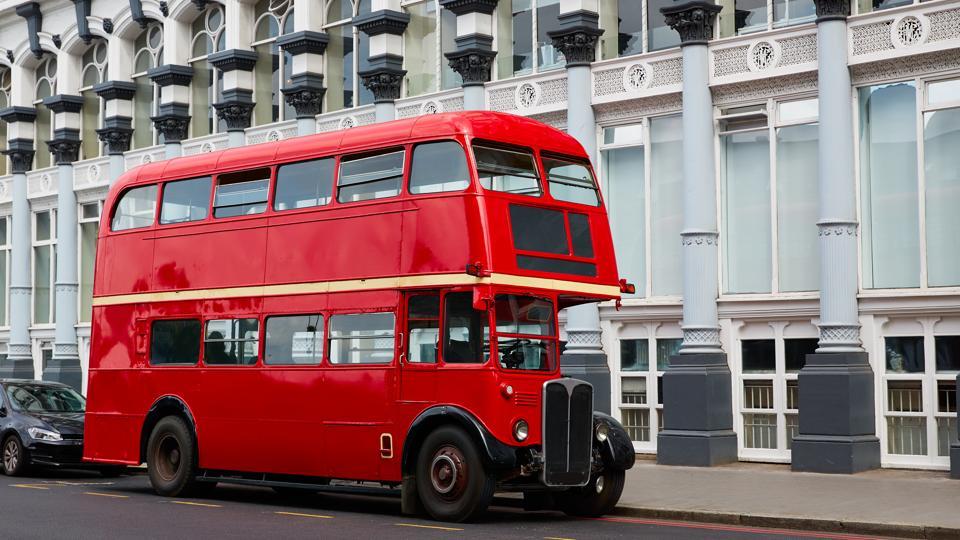
A new biofuel, which contains part coffee oil, is being added to the London bus fuel supply chain where it can be used without the need for modification.
Transport for London has been turning to biofuels to curb carbon emissions, trialling a fuel made with used cooking oil from the catering industry.(Shutterstock)
Waste coffee grounds will be used to help fuel some of London’s buses, Royal Dutch Shell and clean technology company bio-bean said on Monday.
A new biofuel, which contains part coffee oil, is being added to the London bus fuel supply chain where it can be used without the need for modification, the companies said in a statement.
Bio-bean and partner Argent Energy have so far produced enough coffee oil to power one bus for a year, if used as a pure-blend for the 20 percent bio component and mixed with mineral diesel to form a B20 fuel, they said.
Transport for London has been turning to biofuels to curb carbon emissions, trialling a fuel made with used cooking oil from the catering industry, the transport operator said on its website.
Bio-bean said the average Londoner drinks 2.3 cups of coffee a day, producing over 200,000 tonnes of waste a year. It collects waste grounds from high street chains and factories, which are dried and processed to extract coffee oil.
“It’s a great example of what can be done when we start to reimagine waste as an untapped resource,” bio-bean founder Arthur Kay said.
The coffee fuel technology has been supported by Shell.
source: http://www.hindustantimes.com / Hindustan Times / Home> World / by Reuters, London / November 20th, 2017
There was a festive atmosphere at Ponnampete on the border of Kodagu district in Virajpet taluk, which is hosting a two-day district-level Kannada Sahitya Sammelan. A large number of students participated in the Kannada literary meet, which commenced on Saturday.
Inaugurating the meet, writer Dr Siddalingaiah said that there is a need to protect Kannada in Kodagu. “A few Malayalam name boards are found in the district. Kannadigas should be awake in the district.
There is no need for a Malayalam name board in Kannada land,” he said.
Stating that there are ample opportunities for promotion of tourism in the district, he said that the state government should chalk out programmes to safeguard the culture and uniqueness of the district along with the promotion of tourism.
Highlighting the importance of Kannada in the district, he said Kodagu Commissioner Cubbon had removed Lakshminarayanayya from the post of Diwan of Kodagu in 1838. He had written a letter to Governor General in Kolkatta highlighting the injustice met on him in pure Kannada.
Siddalingaiah said, “there is a need to restrict the purchase of land in the district by people from outside the district to protect the culture of the land.”
“Field Marshal Cariappa, General Thimmaiah not only brought fame to Kodagu but also the entire country. The people of the district not only guard the border but also protect the language.”
Kaveri nadi pradhikara
In her presidential address, Kechamada Subbamma Thimmaiah demanded the setting up of Kaveri nadi pradhikara.
She said “the test reports have confirmed that the water from river Cauvery at several places is not potable. The garbage and sewage from various places enter the river and pollute it. Cauvery is the lifeline of the state. There is a need to check dumping of garbage into the river. If left untreated, it could choke the river flow, ” she warned.
“The Kodagu district is the land of warriors and culture. There is a need to protect the culture of the land.”, she added.
A group of Bengalureans are out on a mission to restore the Kaveri catchment area in Kodagu to protect its biodiversity.Sheshadri, a conservationist and member of the Bengaluru-based group Forest First Samithi (FFS), believes that the word ‘conservation’ would not have existed in the English dictionary if people knew how to stay connected with nature. “It is because of our apathy that we have reached this pathetic state, where we fight with each other for even water,” he says.
Sheshadri along with IT professionals Meera Rajesh, Uma, Anil Panolil Chirikandoth and Dhandapany, formed this group in 2008 and they began their conservation work in Wayanad. They started working in Kodagu six months ago. The team works in association with Kodagu Model Forest Trust with an aim to conserve over 100 indigenous tree species of Western Ghats such as Saraca asoca, Mammea suriga, Garcinia talbotii, Dysoxylum malabaricum and Bridelia retusa. The team does rain water management to ensure maximum percolation to improve the ground water levels. People from the community equally participate in the conservation of the biodiversity
They encourage community participation as well. About eight people are working on this project. They are paid `8,000 per month from the funds that the team receives through online crowdfunding and friends. “A few IT professionals also contribute `5,000 from their monthly salary towards this cause,” he says.
Meera adds, “During the British Raj, the forest conservators were actually exploiting our forests for commercial benefits. We aim to make a headway in real time conservation of forest and ecology. It’s only then that our generation and posterity shall stand to gain and prosper.” The team is picking up some degraded patches of land across Kodagu with an attempt to protect them from cattle grazing and wild fires. Sheshadri says, “We clear dry grass and convert them to manure, hence, preventing wildfires from spreading.”
Funding is a major challenge for the project. The team is raising `7.30 lakh for this work through crowdfunding. If you wish to contribute for the cause, visit www.bitgiving.com. For further details about the team, log on to www.ffs.org.
source: http://www.newindianexpress.com / The New Indian Express / Home> Cities> Bengaluru / by Express News Service / November 14th, 2017
Categories at the marathon include one-mile run, 10 km, 21 km and 42 km
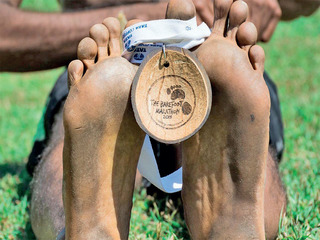
The third edition of the world’s first barefoot marathon will be held at the Tata Coffee Sports Ground at Pollibeta in Kodagu on Dec 10.
Cheppudira Nikki Ponappa, professional golfer, coach and founder of Coorg Wellness Foundation, said the event is being organised with Milind Soman as part of the Coorg Reconnect Initiative by Coorg Wellness Foundation.
Ponappa said, “Barefoot marathon is an initiative through which we want the people of Kodagu as well as anyone who is a nature and wildlife lover to reconnect with mother earth and the best way to do this is by being barefoot. Through this event, we are trying to spread awareness about the rehabilitation of the elephant habitat and we want to replant the 54,000 trees that were chopped from Kodagu for a power grid. So, through the event, we hope to create awareness for planting native fruit trees in an eco-sensitive area like Kodagu. Our wildlife and elephants need to stay in the forest and enjoy their homeland.”
The organisers are expecting about 500 runners to participate from all over the country. “While for the natives of Kodagu, cash prize is awarded, outsiders who win prizes take home produce such as coffee and pepper. We want people to come and experience Kodagu and take back Kodagu with them. The entire event is an eco-friendly event with a ban on plastics. Even water is served in coconut shells. There are no loud speakers nor do we use electricity. The warm up begins with the folk music known as the ‘Vallaga’ and people will have to warm up by dancing the traditional Kodava dance,” Ponappa said.
Ponappa said the categories include one-mile run, 10 km, 21 km and 42 km.
source: http://www.bangaloremirror.indiatimes.com / Bangalore Mirror / Home> News> State / by Deepthi Sanjiv, Bangalore Mirror Bureau / November 10th, 2017
EXHILARATING Bathing and feeding sessions are the most popular among the activities at Dubare and Sakrebailu elephant camps. PHOTOS BY AUTHOR
Everyone loves elephants. Whenever we see them, they bring out the child in us, with a craving to touch, photograph and ride on them, and if possible, take a selfie with them.
Elephants also play an important role in some of our religious festivals. We see the sculptures of elephants in heritage places as well. The best places to get close to these awesome pachyderms are Dubare Elephant Camp in Kodagu and Sakrebailu Elephant Camp in Shivamogga district.
Dubare Elephant Camp
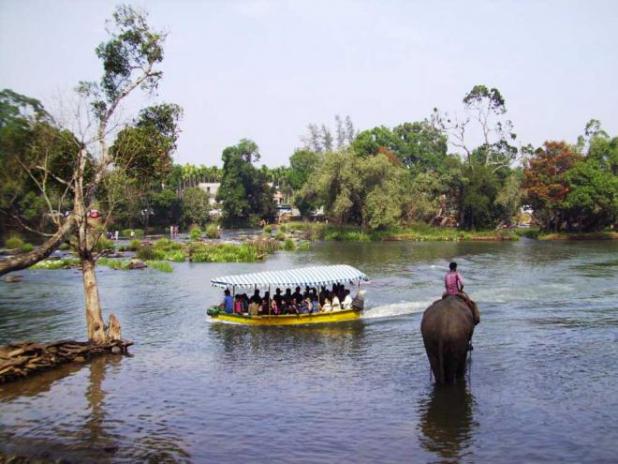
Dubare Elephant Camp is located amidst lush green forest, on the picturesque banks of River Cauvery, about 14 km from Kushalnagar in Kodagu district. This is a project undertaken by the Karnataka Forest Department and Jungle Lodges and Resorts. There are more than 22 elephants in the camp at present. All of them are tamed and trained, but are allowed to roam free in the forest in the afternoon and night. The elephants return to the camp for their bath and feeding sessions. Here, the visitors can not only observe and learn but also participate in various activities involving elephants through the ‘elephant interaction programme’ arranged by the naturalists of the Forest Department.
Driving down from Kushalnagar, we reach the bank of River Cauvery and have to cross over in small motor boats. The view of the river is breathtaking, with the water flowing gently over rocks and bushy trees hanging over the water’s edge on both sides. The chirping of different birds provides a pleasing background music. It is an open, seamless forest area and the only man-made constructions here are for training and feeding the elephants. Trained naturalists explain the various aspects of elephants like their history, biology, personality and food habits. They also facilitate our intimate interaction with the animals. This camp is said to have been started during the British era for taming and training wild elephants to be used for transportation and in war. Some of the trained elephants from this camp participate in the Mysore Dasara procession and other temple festivals.
The most enjoyable part of our visit was joining the mahouts in bathing the elephants. Every morning, the animals are taken down to the river for their bath, which lasts for an hour. It is a pleasure to see them lying down in the river and splashing water, with their trunks, all the while enjoying their bath. Visitors who are bold enough can roll up their sleeves and pants to give the mammoths a scrub. The bath is followed by an elaborate feeding session, in which we could also lend a hand. We can feed them with balls of ragi, jaggery, sugar cane, banana and coconuts provided by the Forest Department.
Elephant rides are arranged thereafter. It is an hour-long journey around the forest and this makes for a memorable experience. If we are lucky, we can catch a sight of animals like peacocks and Sambar deer during the safari.
There are places to stay near the elephant camp. Additionally, the elephant camp also conducts river rafting in the upper part of River Cauvery. In addition, coracle rides are provided for those who wish to ride the river in a different way and enjoy the blissful wilderness along the way. Boat rides and trekking are also possible for bird lovers as the forest is home to a variety of birds, which can often be seen flying across the river.
Sakrebailu Elephant Camp
Sakrebailu Elephant Camp is located about 14 km from Shivamogga town on the Thirthahalli road. This is also run by the Karnataka Forest Department for training wild elephants. Set amidst thick forest on the bank of River Tunga, this ecotourism centre attracts wildlife enthusiasts and tourists in large numbers. Here, also the elephants are taken to the river every morning for their elaborate bathing session.
Visitors are allowed to help in the bathing and feeding sessions. It is a pleasure to watch the giant animals enjoying themselves in the river. After feeding, all the animals are left free to roam in the forest. This an ideal place to enjoy a day out with the elephants.
Elephant rides and trekking are also allowed in this camp. An aane utsava is also held at the camp in the month of October.
Both the camps are open to the public throughout the year. When the waters of River Cauvery become very rough during the time of peak monsoon, the Dubare Elephant Camp closes down the route through the river for the public as it is not safe for people to go across in small boats. However, it can also be reached via road. But for obvious reasons, the bathing sessions are not held during rainy days.
Dubare Elephant Camp is open to the public from 9.00 am to 12.00 pm and 4.00 pm to 5.00 pm on all days. On the other hand, Sakrebailu Elephant Camp is open only in the morning, between 8.30 am and 11.00 am, on all days. September to June is the best time to visit as the elephants love to spend more time in the river when it is not raining and when the weather is humid and hot.
It is suffice to say that Dubare and Sakrebailu are a must visit locales for nature enthusiasts and those who love to have intimate encounters with the elephants.
source: http://www.deccanherald.com / Deccan Herald / Home> Supplements> Spectrum / by K Karunakaran / October 17th, 2017
WELCOME. If you like what you see "SUBSCRIBE via EMAIL" to receive FREE regular UPDATES.
Read More »