The Management of Kodava Samaja, Mysuru, has decided to celebrate Puthari Namme (harvest festival) on Nov.20 in the premises of Kodava Samaja in Vijayanagar I Stage. Earlier it had been decided to celebrate the festival in the premises of Sree Cauvery Educational Institutions in Kuvempunagar.
Now due to incessant rains since a week and also keeping in mind the forecast of rains for 4 more days, the Samaja has decided to change the venue. The celebrations will commence at 5 pm at the Samaja premises. All traditional Kodava dances will be performed on the occasion by both the men’s and women’s teams.
Arrangements have been made to distribute Kadh (new paddy crop) on that day. All the members are requested to note the change of venue and cooperate in the celebrations, according to a press release from Malachira M. Ponnappa, Honorary Secretary, Kodava Samaja.
source: http://www.starofmysore.com / Star of Mysore / Home> In Briefs /November 19th, 2021
Coffee Board CEO and Secretary K.G. Jagadeesha, on Tuesday, visited the rain-hit coffee estates of Mudigere taluk and interacted with the coffee planters about the problems they had been facing in recent days.
Heavy rains in parts of Chikkamagaluru and Hassan districts have impacted the yield. The growers have not been able to harvest the yield. Those, who have harvested the crop, are finding it difficult to dry coffee beans.
The officer visited an estate at Balur, owned by B.R.Balakrsihna, president of Mudigere taluk of Coffee Growers’ Association. The growers also submitted a memorandum to the officer.
Karnataka Growers’ Federation president H.T.Mohan Kumar, former presidents D.B. Subbe Gowda, B.S. Jairam and others were present.
source: http://www.thehindu.com / The Hindi / Home> News> States> Karnataka / by Special Correspondent / Hassan – November 16th, 2021
With rainfall still continuing to lash parts of Kodagu, the growers are faced with a herculean task of picking the beans in the rain.
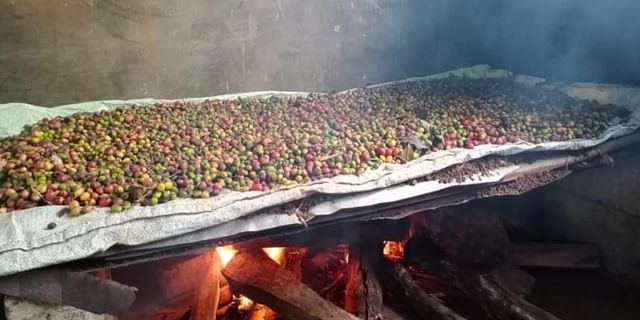
The wood fire installed by coffee grower Vikas to dry beans.
Madikeri :
The change in the weather pattern has increasingly affected the coffee growing sector in Kodagu. As rainfall continues to lash the district in November, the coffee growers are struggling to save what is left of the coffee yield.
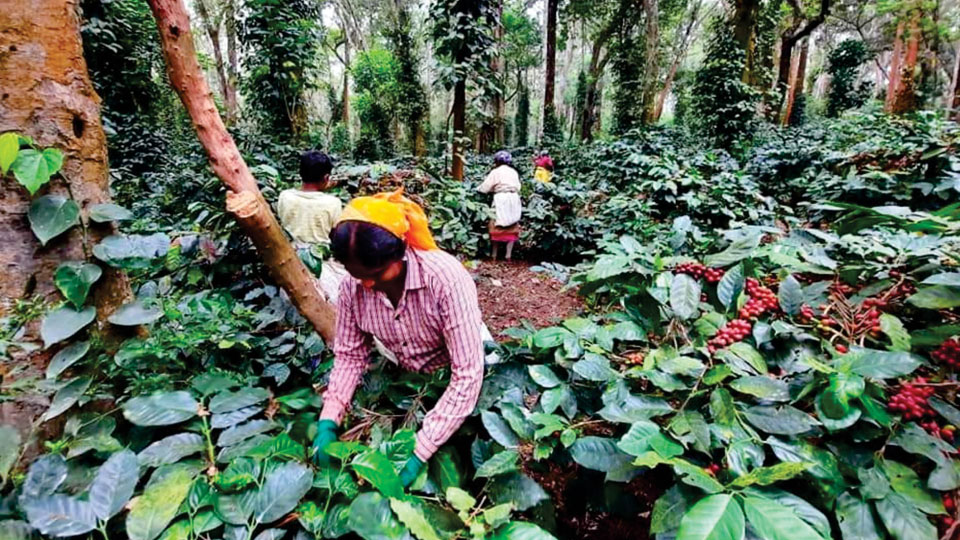
The coffee picking season for Arabica variety begins in November and the picked ripened beans are to be dried under the sun. However, with rainfall still continuing to lash parts of Kodagu, the growers are faced with a herculean task of picking the beans in the rain. Further, the collected beans cannot be dried in the rainfall and many growers are building make-shift stoves to save the ripened beans.
K Vikas, a coffee grower in Makkanduru village has raised a make-shift stove to dry the ripened coffee beans. Coffee beans, which are usually dried under the sun, are now being dried on a wood fire stove. “The bad weather condition has forced us to take this non-traditional method of drying coffee beans,” Vikas explained.
Meanwhile, the ripened beans without drying do not possess any demand in the market and are not bought by the traders due to the existing risks concerning the weather. “The coffee curing centres will not accept yield that has a mixture of ripened and unripened beans; the cost of separating these two beans cannot be managed by the growers in the current scenario. The curing centres are also sceptical about purchasing un-dried coffee following the present weather condition,” explained BN Ramesh, a coffee trader in the district.
The unseasonal rain had already inflicted heavy loss to many growers as the coffee plants witnessed increased droppings and rotting. The continuation of rainfall in the month of November is now threatening to wipe out what is left of the crop damage.
source: http://www.newindianexpress.com / The New Indian Express / Home> States> Karnataka / by Pragna GR, Express News Service / November 14th, 2021
Here is a chance for coffee growers to get additional cash from their plants throughout the year apart from income from the sale of beans. Mysuru-based Central Food Technological Research Institute (CFTRI) has developed a technology to prepare a value-added product from coffee leaves that packs in health benefits too.
Coffee is only harvested for a few months every year, depending on the country’s harvest season. This can leave a number of producers and workers without work (and income) for a significant portion of the year.
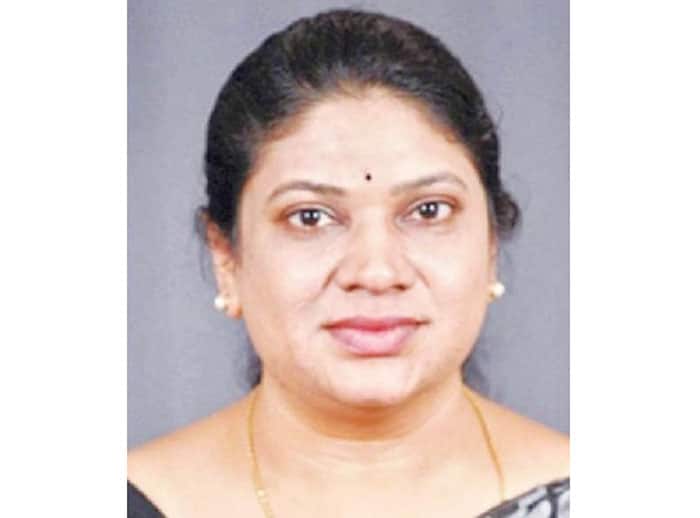
Pushpa S. Murthy
However, some producers have decided to diversify the crops that they grow and sell. As coffee leaves are constantly being produced, growers can harvest them in the off-season if there is demand, according to Pushpa S. Murthy, Principal Scientist (Spice and Flavour Science Department) of CFTRI.
This technology follows a CFTRI project on the development of value-added products from coffee leaves taken up in 2019. The project was funded by the Union Ministry of Food Processing Industries.
If farmers can use the leaves which can be harvested during the off-season or during pruning, without interfering with coffee bean growth, it will have a great impact on the social elevation of coffee farmers, she said.
Around 70 percent of the coffee industry is unemployed or underemployed during nine months of the year due to the nature of the growth cycle of the coffee beans. The project aimed to provide a year-round sustainable process for the coffee farmers.
With CFTRI technology, the brew can be prepared with water, allowed for a few minutes to steep, filtered and consumed. The institute has initiated the transfer of this technology to the coffee industry, and a few industry participants have already extended their consent, she said.
The leaf brew does not really taste like coffee, according to Murthy. “The brew is subtle with less caffeine compared to coffee or tea,” she said. On the nutritional value of the beverage, she said coffee leaves are rich in phenolic acids with potential health benefits. A coffee leaf contains around 17 percent more antioxidants than green tea. The beverage should be consumed plain.
The beverage accords health-promoting polyphenols like chlorogenic acid and mangiferin which help in reducing blood glucose levels, inflammation and blood pressure, she said.
Leaf drink ‘kuti’ and ‘kahwa daun’ popular in Sumatra, Ethiopia
Coffee leaf tea has been consumed in Sumatra, Ethiopia, Jamaica, Java and Sudan for centuries. From the 16th century to the 19th century, Ethiopian farmers set aside their harvested coffee for trade or consumption in special ceremonies. As a day-to-day drink, the Harari people in Ethiopia instead enjoyed ‘kuti’.
‘Kuti’ tea was made by boiling coffee leaves in hot water, sometimes with a pinch of salt or some sugar. It was generally boiled for at least 30 minutes, as it was believed that the longer the leaves were boiled for, the sweeter the resulting brew would be.
Coffee leaf tea bears some similarities to green tea, but it is more earthy and sweeter. It is lower in caffeine than green tea, and thanks to its high levels of antioxidants, it has historically been believed that it cures or relieves cold symptoms.
In the 19th century, Dutch colonists transported coffee plants to designated farming regions in Indonesia. Workers on the coffee plantations were forbidden from consuming the coffee they harvested, so they drank something called “kahwa daun” instead.
‘Kahwa daun’ was made by drying coffee leaves in the sun to reduce their bitterness. The leaves were then smoked and roasted for a few hours. Finally, they would be steeped in boiling water, and then served in a coconut shell.
source: http://www.starofmysore.com / Star of Mysore / Home> Top Stories / November 14th, 2021
The Kodava Samajas of Ponnampet and Virajpet have banned cake cutting and champagne sharing by newly-wed couples of the Kodava community during weddings at community marriage halls.
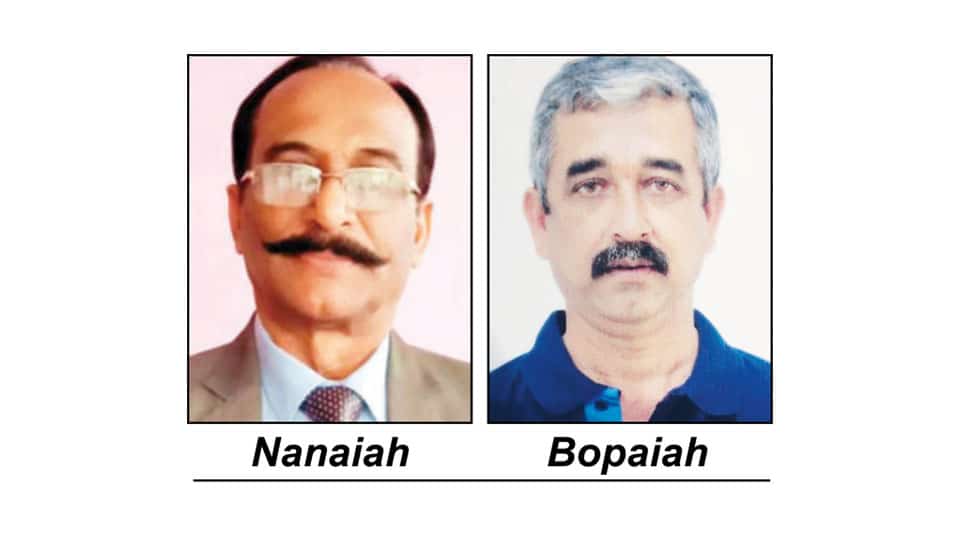
At the recently held meetings of the Samajas, Ponnampet Kodava Samaja President Chottekmada Rajiv Bopaiah and Virajpet Kodava Samaja President Vanchira Nanaiah have taken a decision along with Samaja administrative board and members that practices that do not represent Kodava culture will not be permitted inside the community marriage halls.
The related resolutions of the Virajpet Kodava Samaja were unanimously passed during its 99th general body meeting on Sunday that was attended by 15 directors and 357 members.
Apart from banning cake cutting and champagne sharing after the groom opens the bottle as a celebratory gesture, the Samajas have decided to strictly adhere to Kodava customs and rituals. For example, the trend of grooms sporting a beard during weddings has been banned.
According to Kodava custom, a beard is sported only when someone dies in the family and growing a beard is part of the ‘pinda pradhana’ ritual after a close family member passes away. Also, women have been told not to enter the auspicious Muhurtha area with their hair let loose as according to customs, hair is let loose only during funerals and funeral-related ceremonies.
Other decisions include, no bursting of firecrackers during Ganga Puja, no showering of flower petals during ceremonies, no playing of ‘Devaata’ tune by drummers (volaga troupe) during weddings as the tune is limited to only temples. If Kodava girls marry boys from other communities, the latter should not be allowed to wear Kodava dress and the bride’s mother should not put the traditional ‘Pathak’ ornament on the bride.
Not Kodava culture
Reacting on the issue, Chottekmada Rajiv Bopaiah said “Kodavas have their own distinct culture. We can survive only if our culture survives. Cutting cakes and sharing champagne by new couples during marriage ceremonies is not our culture. The decision has been taken in this regard in our annual meeting.”
“Ever since the decision was taken, I have been flooded with congratulatory phone calls and messages. We have to pass on our culture to the next generation. Champagne celebration won’t serve the purpose, rather it will misguide the younger generations,” he said.
Also, sporting a beard is against the tradition of Kodavas. There is a ritual in which the beard will be taken off. Likewise, the women can’t come on stage with their hair let loose, which is against our tradition. The meeting has discussed the issue and we are planning to implement it in the coming days,” he added.
When asked how the younger generations of the Kodava community reacted to the ban, Rajiv said they are supporting the move and many organisations have also come forward to create awareness on the matter. “The problem seems to be with people who are in their 50s. They encourage cake cutting and champagne sharing during marriages,” he added.
MAJOR DECISIONS
Bridegroom should have a clean-shaven face.
Women who bless the newly weds on stage should not let their hair loose.
No bursting of firecrackers during Ganga Puja; no uncorking of champagne bottles.
If Kodava girls marry boys from other communities, the groom should not wear Kodava dress and bride’s mother should not adorn the bride with the traditional ‘Pathak.’
source: http://www.starofmysore.com / Star of Mysore / Home> News / November 11th, 2021
A new website featuring the unique culture of Kodavas, documenting the customs and traditions of the community, has been launched. The website www.kodavas.in has been put together by journalist and author B.T. Bopanna.
“My main intention is to document the customs and traditions of Kodavas, a microscopic minority community, which is slowly losing its moorings in Kodagu. Most of the younger Kodavas, who have been brought up in cities like Bengaluru and Mysuru, are unaware of the essence of Kodava culture. I felt a website was the best medium to increase awareness of the culture and help preserve it”, Mr. Bopanna said in a statement.
Mr. Bopanna, who has also pieced together five websites including his first www.coorgtourism way back in 2005, said the new website will “come in handy for someone wanting to know about the rituals involved in ceremonies connected with birth, wedding, death etc”.
In order to ensure that the content in the website was authentic, Mr. Bopanna said he took the help of Boverianda Chinnappa and Nanjamma Chinnappa, who had researched and written about Kodava culture.
“Much of the content in the website has been taken from the book Pattole Palame, compiled in 1924 by Nadikerianda Chinnappa, where the Kodava language folksongs, proverbs and riddles are transcribed in Kannada script and Kodava customs and traditions are described in Kannada language. The Pattole Palame was translated into English by Boverianda Chinnappa and Nanjamma. I have also borrowed content from their book ‘Ainmanes of Kodagu’”, Mr. Bopanna said.
The topics covered in the website including the origin of Kodavas, their customs, related to birth, wedding, death and their festivals, the religion of Kodavas, Kodava language, Jamma land tenure, their passion for the game of hockey, guns in Kodava culture, their ‘ainmanes’ etc. Mr .Bopanna said the website also contains video clips related to some of the topics on Kodava culture.
The site has been designed by Bhakti Saraswat-Devaiah, he added in the statement.
source: http://www.thehindu.com / The Hindu / Home> News> States> Karnataka / by Special Correspondent / Mysuru – November 12th, 2021
The Airi community will organise Mulleirira Cup Cricket Namme, a family cricket tournament, at Murnad Bachetira Lalu Muddaiah Stadium on November 13 and 14.
The tournament was postponed due to natural calamities and the Covid-19 pandemic in the past, said Mulleirira Cup Cricket Committee president Mulleirira D Gopal.
The winning team will get Rs 15,000 cash and a trophy.
MLA K G Bopaiah will inaugurate the tournament.
source: http://www.deccanherald.com / Deccan Herald / Home> State> Mangaluru / by DHNS, Madikeri / November 10th, 2021
Kodagu Ex-Servicemen Welfare Association, Mysore East, held its 7th Annual General Body Meeting (AGM) at Sri Venkatesh Resorts on Bannur Road recently coinciding with Kannada Rajyotsava (Nov.1) celebrations.
Addressing the members, Association President and Army Veteran Kanjithanda Aiyappa (Mani) said that even though the name of the association is ‘Kodagu Ex-Servicemen Welfare Association’ one of the main objectives of the Association is to take up the common causes of ex-servicemen suo moto irrespective of military veterans’ caste, creed, religion and region they belong to.
Citing an example, Aiyappa stated that even in the Indian Army many Regiments are named after certain regions of the country and communities such as Madras Regiment, Sikh Regiment, Bihar Regiment, Dogra Regiment and 37 Coorg Medium Regiment, etc. However, the only objective of the entire Regiments in the Indian Army is to protect the integrity and sovereignty of the country from external aggression and internal disturbances and also to help the civil administration during natural calamities.
He also mentioned that as per the suggestion of the members, the Association has submitted an application to Mysuru Urban Development Authority (MUDA) for the allotment of a Civic Amenity site (CA site) as per the recent notification of MUDA inviting applications for CA sites.
While discussing various agenda points during the AGM, a widow of an Army veteran had sought a clarification from the Honorary Legal Advisor of the Association, Air Veteran Mandetira N. Subramani, whether widows of ex-servicemen could wear military medals during military functions.
Subramani, who is also the President of Mysuru-based NGO VeKare Ex-Servicemen Trust, said that there is no bar on Veer Naaris and widows of ex-servicemen proudly wearing their deceased husbands’ authorised military medals on their chest in a befitting manner while attending meaningful military functions, Army / Navy / Air Force Days and during National Festivals such as Republic Day and Independence Day.
He further said that Veer Naaris and widows of ex-servicemen wearing military medals on such occasions would send a strong message that their husbands’ life/youth were sacrificed for the nation.
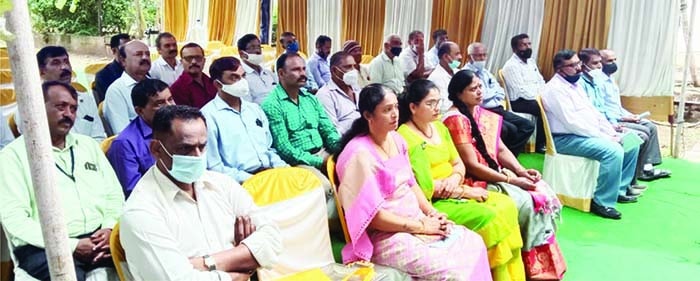
A section of audience at the AGM of Kodagu Ex-Servicemen Welfare Association
Office-bearers elected unanimously
Army Veterans Kanjithanda Aiyappa, K.U. Bheemaiah, Appachangada Motaiah, Basappa, and Kangira Achaiah were unanimously elected as President, Vice-President, Secretary, Joint Secretary and Treasurer respectively for another term. The various Committee Members were also unanimously elected.
Philanthropist Dr. V. Puttalingamma, a retired scientist from DFRL, made a surprise visit to the venue of AGM and handed over a cheque for Rs. 25,000 to the President as donation for the welfare activities of the Association.
While addressing the gathering Dr. Puttalingamma urged the military veteran to save enough money from their own earnings for themselves and for their wives to meet their needs during their old age and not to depend on their children for financial help when they are working away from home or abroad.
Appachangada Motaiah welcomed. Veteran Basappa proposed a vote of thanks.
source: http://www.starofmysore.com / Star of Mysore / Home> News / November 10th, 2021
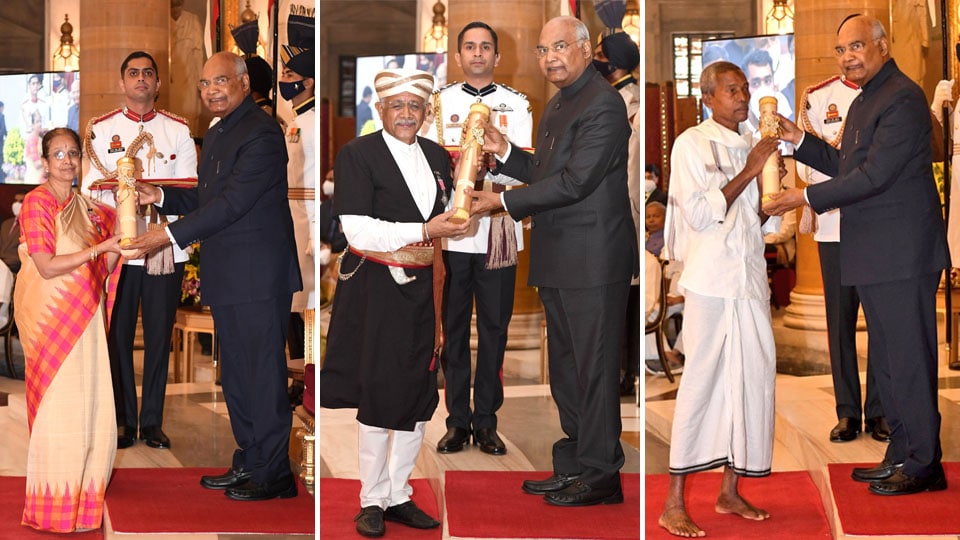
Vidushi K.S. Jayalakshmi, Editor of the world’s only Sanskrit daily newspaper published in Mysuru, Hockey player Dr. M.P. Ganesh of Kodagu and Harekala Hajabba, an orange vendor from Mangaluru who built a primary school with his earnings, were among 119 persons who received Padma Awards from President Ram Nath Kovind at Rashtrapati Bhavan yesterday.
Padma Awards are one of the highest civilian honours of India announced annually. The Awards are given in three categories: Padma Vibhushan (for exceptional and distinguished service), Padma Bhushan (distinguished service of higher order) and Padma Shri (distinguished service).
A total of 119 Padma Awards comprising 7 Padma Vibhushan, 10 Padma Bhushan and 102 Padma Shri Awards were presented. 29 of the awardees are women, 16 posthumous awardees and 1 transgender awardee.
Padma Vibhushan
Late playback singer S.P. Balasubramaniam (Posthumous) in the field of Art and Dr. Belle Monappa Hegde for Medicine, Former External Affairs Minister Sushma Swaraj (Posthumous) are among seven persons, who were presented with the Awards.
Padma Bhushan
Chandrashekhar Kambara for Literature and Education, Tarun Gogoi (Posthumous) for Public Affairs, Ram Vilas Paswan (Posthumous) for Public Affairs and Keshubhai Patel (Posthumous) for Public Affairs among 10 others.
Padma Shri
Vidushi K.S. Jayalakshmi for Literature and Education (Journalism), Hockey Olympian Dr. M.B. Ganesh for Sports, Matha B. Manjamma Jogati for Arts, Harekala Hajabba for Education, Vijay Sankeshwar for Trade and Industry, Rangaswamy Lakshminarayana Kashyap for Literature and Education and actress Kangana Ranaut are among 119 persons who were conferred with the Award.
Awardees’ Profile
Vidushi K.S. Jayalakshmi, wife of late K.V. Sampath Kumar, took over as the Editor of ‘Sudharma,’ the world’s only Sanskrit daily newspaper published in Mysuru. The paper was started in 1070 by Varadaraja Iyengar and following his demise in 1990, the newspaper was taken over by his son K.V. Sampath Kumar and his (Sampath Kumar) wife Jayalakshmi. Jayalakshmi took over the reins after the demise of Sampath Kumar in June this year.
Mollera Poovaiah Ganesh, aged 73, a resident of Suntikoppa in Kodagu, was the captain of the Indian hockey team and won the Arjuna award in 1973.
Ganesh began his sports career with football and later switched over to hockey after he joined the Army. He represented the Services (defence services) in the National Hockey Championship from 1965 to 1973. He found a place in the Indian team in 1970. Ganesh played for India at 1972 Munich Olympics, finishing third. He was one of the coaches of the Indian team that won a gold medal at the 1980 Olympic Games in Moscow.
He twice represented India in Asian Games (Bangkok-1970 and Tehran-1974). Both the times India returned home with a Silver medal. He was in the Indian team that won Bronze at the first World Cup at Barcelona in 1971 and captained the team that won Silver at the next World Cup in Amsterdam. He also played for World XI in 1972 and Asian XI from 1970 to 1974. Ganesh last played for India in 1974 after his career was cut short by a knee injury. At present, he is serving as the CEO of SAI National Hockey Academy in New Delhi.
Harekala Hajabba, 66-year-old orange vendor, received this award for bringing a revolution in rural education by constructing a school in Harekala-Newpadpu village in Mangaluru. The school currently has 175 underprivileged students from the village. Hajabba, who sells oranges at Mangaluru bus depot since 1977, has never been to school.
source: http://www.starofmysore.com / Star of Mysore / Home> News> Top Stories / November 09th, 2021
The toilets constructed by the Madikeri CMC in front of Kaveri Hall in Madikeri still remains unutilised.
Though Kodagu won an open defecation free award in 2016, the tribal haadis in the district are still devoid of toilet facilities.
There is a lack of public toilets in urban areas as well. Because of this, there are still miles to go before the district becomes open defecation free in reality.
Owing to the lack of public toilets, the tourists who visit the district are inconvenienced.
Toilets are still not used in the tribal haadis in the district. About 65,000 individual toilets have been constructed under the Total Sanitation drive, Nirmal Bharat Abhiyan and Swaccha Bharath Mission since 2006 in the district.
According to officials, 90% of the toilets have been constructed in 104 Gram Panchayats in the district.
In 2020-21, out of 537 individual toilets, 250 have been completed. The work on the remaining 287 toilets are in progress, said officials.
Financial assistance of Rs 12,000 is given for those poor in the general category for the construction of individual toilets, while SC/ST beneficiaries get a grant of Rs 15,000.
However, beneficiaries feel that the amount is sufficient only for the toilet pits. With the rise in the price of construction materials, there is a need to increase the amount given under financial assistance.
The labourers from outside the state and district residing in line houses of coffee estates still defecate in open. The toilets constructed under Sulabha Shauchalaya are in a dilapidated condition.
Though funds have been utilised fully for the construction of toilets in tribal haadi, they are unutilised by the tribals. The tribals still defecate in open.
There are more than 250 haadis in Kodagu. However, only a few haadis have seen development.
Those residing inside Nagarahole forest and on Paisari land do not have toilets.
In spite of residing in the forest land for generations, title deeds are still not given to them. As a result, they did not get any benefit under Swaccha Bharat Mission.
Sandesh, a resident of Madikeri, said, “There is a lack of public toilets in tourist places. As a result, visitors are inconvenienced.”
Mahesh, a resident of Somwarpet, said, “The financial assistance for the construction of toilets is meagre and is not sufficient for the construction of a toilet.”
Shortage of water
J R Subramani, a tribal leader from Devarapura haadi, said, “There is an acute shortage of water for the use of toilets. Gram Panchayats have not supplied water to the haadi. The forest department is not providing permission to lay the water pipeline. As a result, the haadi residents still fetch a pot of water from rivulets and other water bodies that flow in the nearby area. The water from open wells is not potable.”
Zilla Panchayat former member P R Pankaja said, “The toilets constructed in tribal haadis cannot be used. As a result, they are now covered in weeds due to lack of maintenance.
source: http://www.deccanherald.com / Deccan Herald / Home> State> Mangaluru / by Adithya KA and J Somanna , DHNS, Madikeri/Gonikoppal / November 07th, 2021
WELCOME. If you like what you see "SUBSCRIBE via EMAIL" to receive FREE regular UPDATES.
Read More »