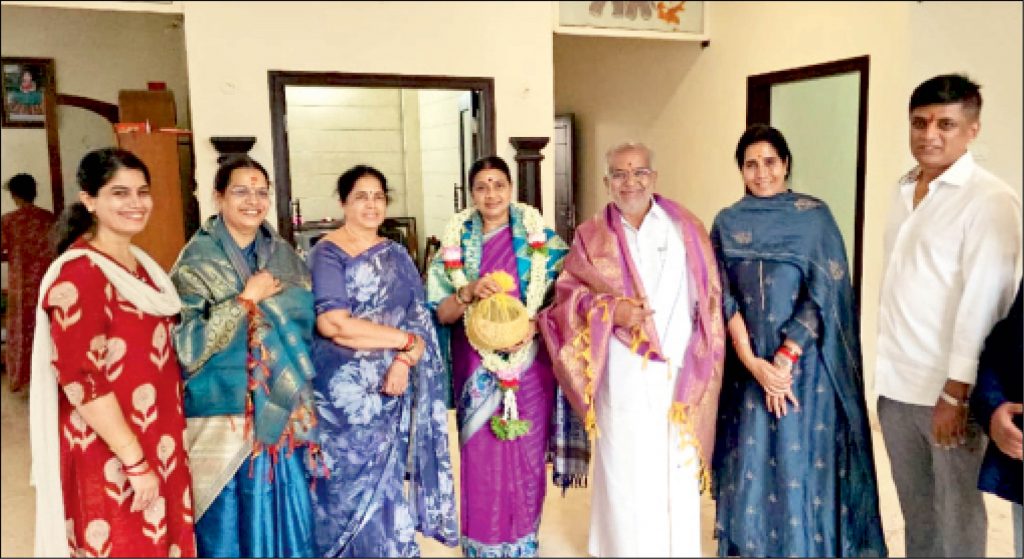
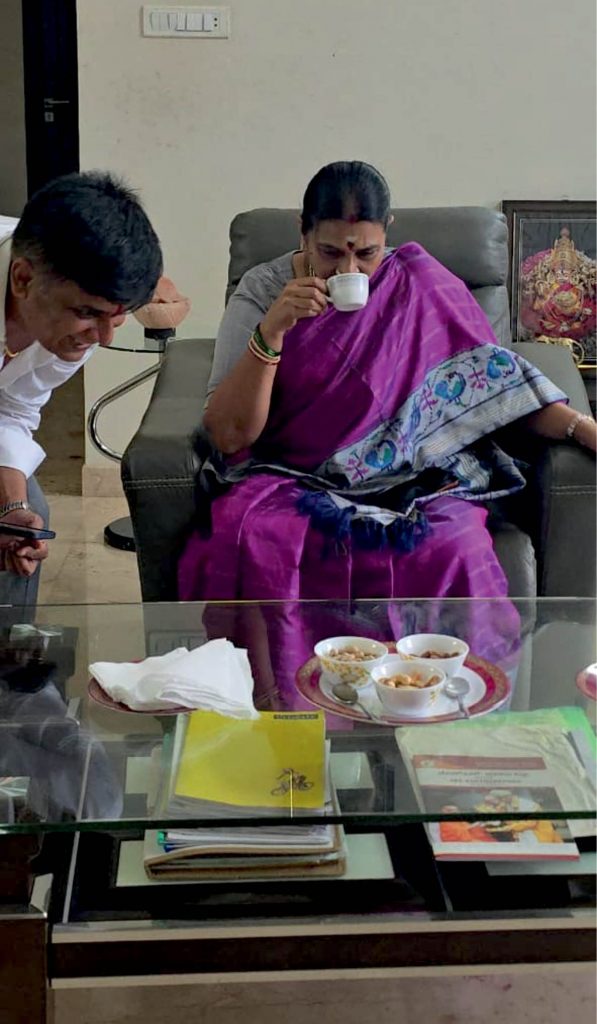
Caption: Former Tamil Nadu Chief Minister M.K. Stalin’s wife Durga Stalin (centre) called on Chamundeshwari MLA G.T. Devegowda (GTD) at his residence in V.V. Mohalla yesterday evening as GTD’s daughter Annapurna, Durga Stalin’s sister Jayanti, GTD’s wife Lalitha Devegowda, GTD, former Tiruvallur MLA Rajendran’s wife Indira Rajendran and Annapurna’s husband Vishweshwaraiah alias Babanna look on.
Mysuru :
Former Tamil Nadu Chief Minister and DMK President M.K. Stalin’s wife Durga Stalin, called on Chamundeshwari MLA G.T. Devegowda (GTD) at his residence in V.V. Mohalla yesterday evening, where she was accorded a warm welcome.
While Stalin and his son Udhayanidhi Stalin travelled from Kodagu to Tamil Nadu, Durga Stalin remained in Mysuru for a few hours, keeping her visit low-key and away from political engagements.
GTD’s daughter D. Annapurna and her husband Vishweshwaraiah, popularly known as Babanna, a businessman, share a long-standing acquaintance with the Stalin family. Annapurna, accompanied by her family, personally received the guests.
Arriving from Kodagu, Durga Stalin, accompanied by her sister Jayanti, Indira Rajendran, wife of former Tiruvallur MLA Rajendran and an aide Rajkumar, began the day with breakfast at a hotel on the Outer Ring Road.
They later visited Nimishamba Temple in Srirangapatna and Sri Chamundeshwari Temple atop Chamundi Hill in Mysuru.
Annapurna told Star of Mysore this morning that Durga Stalin contacted her over the phone and informed her that she was in Mysuru and would visit the family after offering prayers at the temples.
After lunch at Radisson Blu Plaza Hotel, the group visited GTD’s residence in V.V. Mohalla at around 3.30 pm. Members of Devegowda family extended traditional hospitality and presented a memento.
In a light-hearted moment, Durga Stalin reportedly remarked to GTD, “I am former, you are current,” referring to her husband M.K. Stalin’s former status.
GTD responded warmly, wishing her and her family all the best in the days ahead.
GTD’s wife Lalitha Devegowda and other family members were present on the occasion. Former Corporators Prema Shankaregowda and Bhagya Madesh were also in attendance.
Before concluding her brief stay in Mysuru, Durga Stalin visited the Karnataka Silk Industries Corporation (KSIC) showroom, where she purchased Mysore Silk sarees. The group later departed from Mysore Airport in the Chennai-bound flight at 7 pm.
source: http:www.starofmysore.com / Star of Mysore / Home> News> Top Stories / by Star of Mysore / June 02nd, 2026
For the Kodavas, weapons are treasured links to their ancestry, identity and a martial tradition.
Why weapons are still part of Coorg’s culture and traditions? AI- generated image
Walk into a traditional ancestral home in Kodagu, Karnataka, and you might notice something rather unusual- guns, daggers and swords displayed alongside family photographs and heirlooms. For the Kodava community, these aren’t simply weapons. They are tangible reminders of ancestry, identity and a martial tradition that has been passed down through generations.
Why are weapons part of Coorg’s family heritage?
Why Coorg families preserve these historic Heirlooms AI-generated image
The Kodavas are an ethno-linguistic community native to Kodagu (Coorg, Karnataka), with a long-standing association with hunting, agriculture and warfare. Their customs place a strong emphasis on ancestor and nature worship and their history has shaped many of their customs, where weapons continue to have a place in both everyday heritage and ceremonial life.
The relationship is particularly visible during Kailpodh (translated to festival of weapons), the Kodava festival associated with arms, traditionally observed after the agricultural season. It is said that families bring out their guns and traditional weapons, clean them and offer prayers. The festival also marks the beginning of the traditional hunting season, with gunshots forming part of the celebrations. Weapons also feature during Huttari, the harvest festival. Even important family milestones have been marked by gun salutes, including the birth of a child and the death of a family member.
Among the community’s best-known traditional weapons is the peeche kathi, an ornate dagger traditionally worn at the waist with the kupya chale, the distinctive Kodava traditional attire. The odikathi, a larger curved blade historically associated with warfare, has also found a place in ceremonial life. For instance, at Kodava weddings, the groom traditionally carries the odikathi as part of his wedding attire.
Historically, Kodavas have enjoyed a special exemption from certain firearms licensing requirements, allowing eligible members of the community to possess firearms under specific conditions. The roots of this arrangement go back to the British period, when the colonial administration formally recognised the Kodavas’ longstanding martial traditions.
Today the weapons are said to be more about what they represent. An old gun may have belonged to a grandfather; an ornate dagger may have been carried at wedding generations ago or a ceremonial sword may have its own family story.
source: http://www.indulgexpress.com / The Indian Express, Indulge Express / Home> Society / by P Sangeetha / September 10th, 2026
A total of 5,902 participants took part in the mega marathon, organised jointly by the Ashwini Sports Foundation (ASF), KALS, NEB Sports Entertainment and the State Tourism Department, according to a statement.
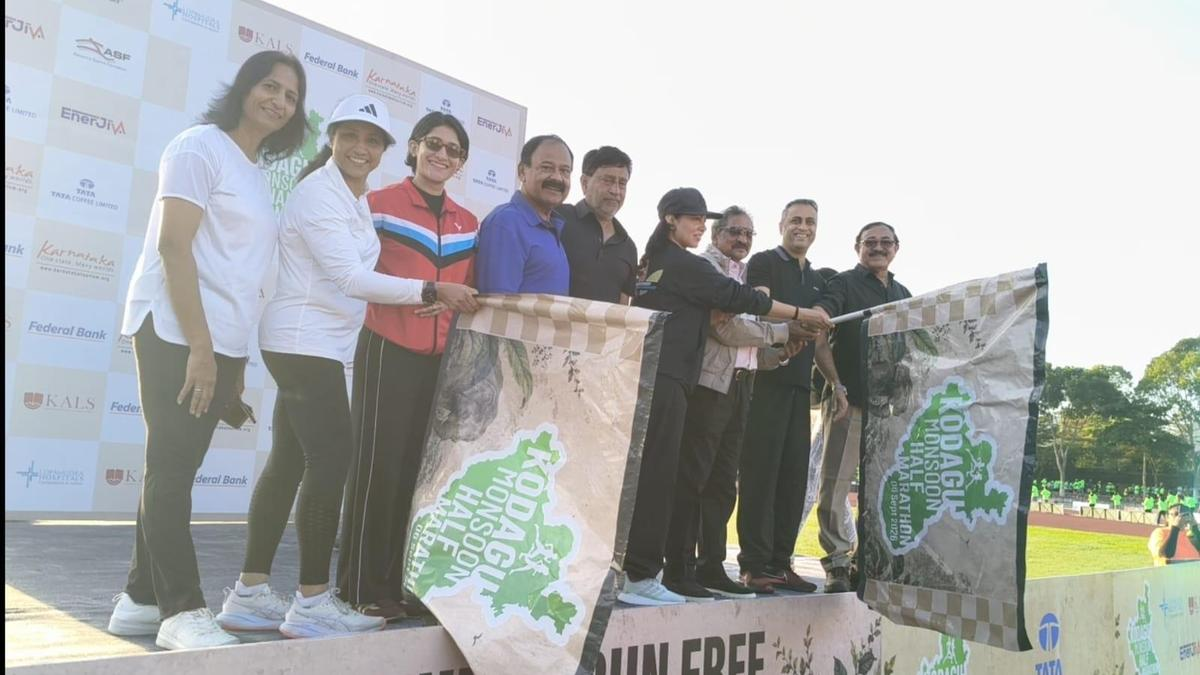
Minister for Energy and Tourism K.J. George flagging off the Kodagu Monsoon Half Marathon at the KALS school campus in Gonikoppal on Sunday (September 6) | Photo Credit: Special Arrangement
Energy and Tourism Minister K.J. George flagged off the Kodagu Monsoon Half Marathon at the KALS school campus in Gonikoppal on Sunday (September 6).
A total of 5,902 participants took part in the mega marathon, organised jointly by the Ashwini Sports Foundation (ASF), KALS, NEB Sports Entertainment and the State Tourism Department, according to a statement.
The event featured 21-km and 10-km categories, besides a special 5-km ‘Maja Run’.
Mr. George said Kodagu was known for sports and called upon the youth to make a mark at the national and international levels through sports.
He said youngsters could make a name for themselves internationally by giving greater importance to sports alongside their studies.
Referring to a recent World Cup football face-off, Mr. George recalled that it was noteworthy that a small country such as Spain had defeated Argentina.
The Minister appreciated the enthusiastic participation of hundreds of people, including children and adults, in the marathon held at KALS School.
A.S. Ponnanna, the Chief Minister’s Political Secretary and MLA, who was also present on the occasion, said the conduct of such a sporting event in Kodagu, regarded as one of the finest sporting districts in the country, was a reflection of the sporting spirit of the people and the encouragement they extend to sports.
“Many outstanding sportspersons who have made a mark at the national and international levels have emerged from Kodagu,” he said, wishing all those who participated in Sunday’s competition a good sporting performance and success.
Sports Authority of Karnataka vice-president Arun Machaiah, institution head Ashwini Nachappa and others were present.
source: http://www.thehindu.com / The Hindu / Home> India> Karnataka / by The Hindu Bureau / September 06th, 2026
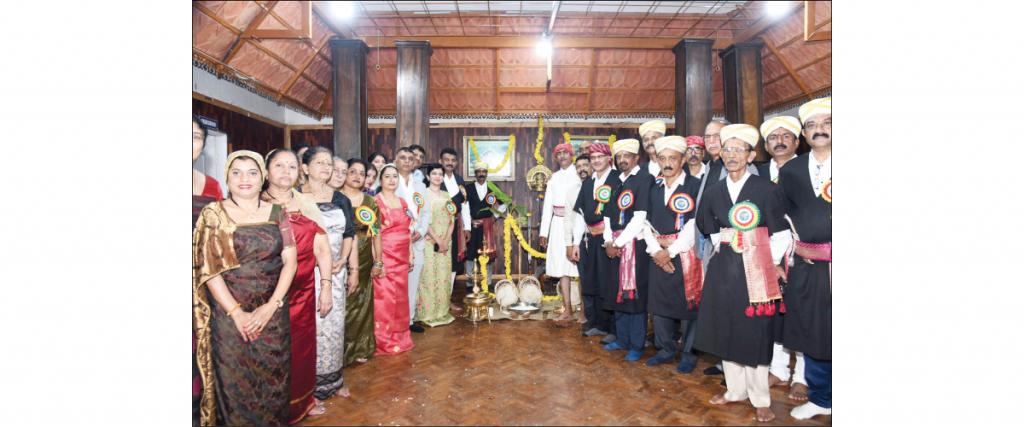
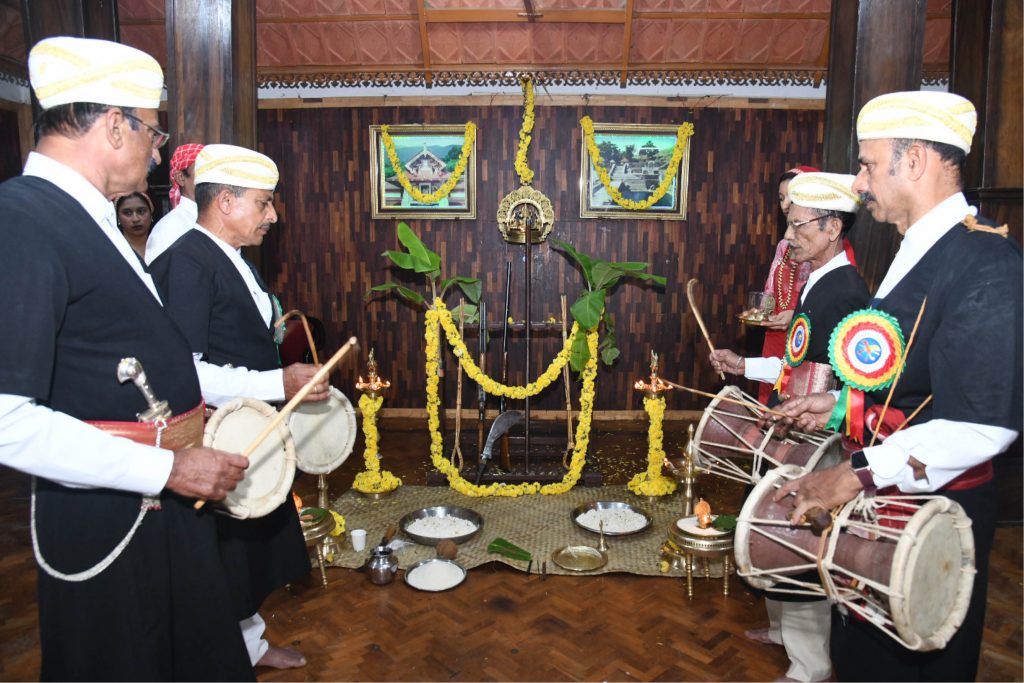
The Annual Kail-Poldh Festival-2026 get-together was held at Kodava Samaja premises in Vijayanagar 1st Stage here today.
The day-long event comprised Ayudha Puja, Sports and Games, Lucky Dip, honouring eminent Kodavas and distribution of scholarship to Kodava students.
Devanira Preeth Ganapathy, Additional Commissioner of Income Tax, Bengaluru, Chiriapanda S. Suresh Nanjappa, President of Kodava Samaja, Bengaluru and Ajjinikanda Mahesh Nachaiah, Chairman of Karnataka Kodava Sahitya Academy, were the chief guests.
pix02
Samaja President Ponjanda A. Ganapathy, Vice-President Machimada P. Nanaiah, Hon. Secretary Ketolira A. Belliappa, Joint Secretary Padeyanda Sumita Gopal, Hon. Treasurer Kottangada P. Pemmaiah, former President B.M. Nanaiah, former Corporator M.U. Subbaiah were present on the occasion.
source: http://www.starofmysore.com / Star of Mysore / Home> News / September 06th, 2026
The push to get Kodava into the Eighth Schedule has revived old arguments over scripts, censuses, and what a language needs to survive.
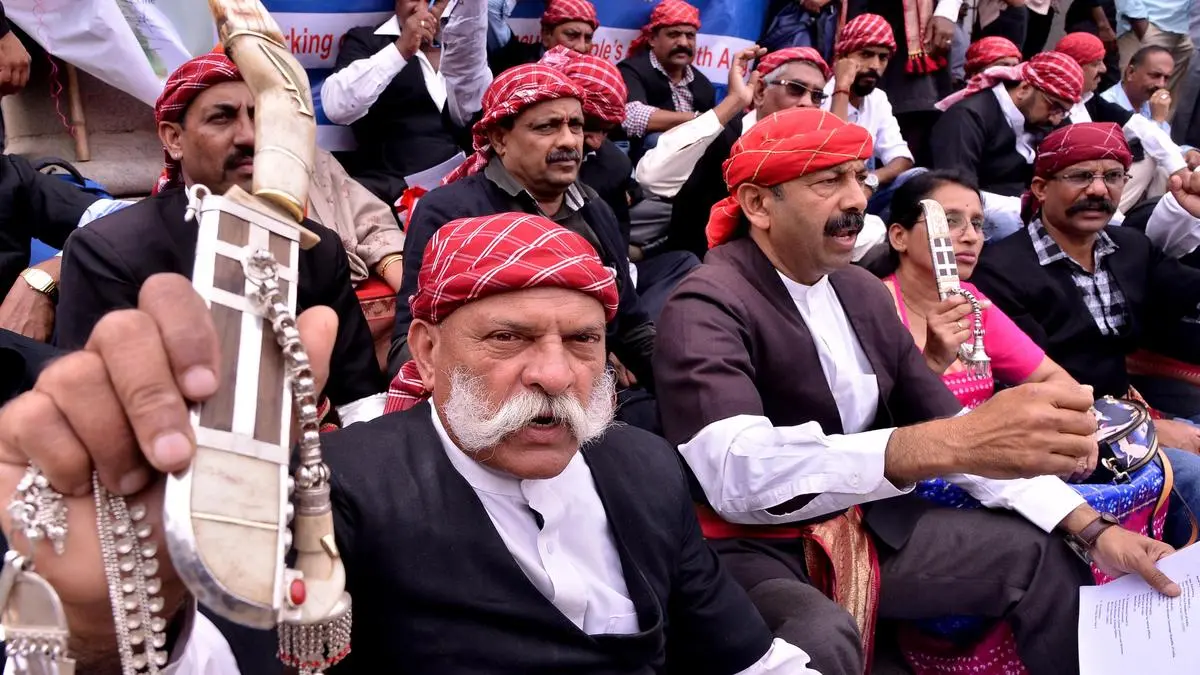
Members of Codava National Council demonstating at Town Hall on the World Indigenous People’s day, demanding an autonomous Codava Union Territory Land on August 9, 2018. | Photo Credit: V Sreenivasa Murthy
______________
SUMMARY
The Kodava language, native to Kodagu, is a Dravidian language facing a decline in speakers. Despite its rich history and unique linguistic features, it is not among India’s 22 official languages. Organizations like the Codava National Council (CNC) and Karnataka Kodava Sahitya Akademi are actively campaigning for its inclusion in the Eighth Schedule of the Constitution. This status would provide crucial Central government funding for preservation, promotion, and allow its use in education, competitive exams, and official communication, addressing concerns about its diminishing presence and cultural distortion.
Key Questions & Insights(AIⓘ)
What is the primary goal of the Codava National Council (CNC) and the Karnataka Kodava Sahitya Akademi?
From which language family does Kodava descend, and how is its age compared to other Dravidian languages?
Who was among the first to identify Kodava as a separate Dravidian language?
What is the current trend in the Kodava-speaking population, according to recent censuses?
What unique linguistic features does the Kodava language possess?
Who are some notable personalities associated with the Kodava language and culture?
What is the significance of the 14th-century inscriptions found in Bhagamandala and Palur?
What was the historical medium of writing in Kodagu, and when did Kodava newspapers emerge?
Who is considered the earliest known poet and playwright of the Kodava language?
What is a common misconception about languages and their scripts?
How many scripts have been invented for Kodava in the past 150 years?
What benefits would Eighth Schedule status bring to the Kodava language?
_________________
India is home to hundreds of languages and tens of thousands of dialects but recognises only 22 as official, listed in the Eighth Schedule of the Constitution. The Codava National Council (CNC) and the Karnataka Kodava Sahitya Akademi have been striving to get Kodava added to that list. The Kodava language descends from the Tamil-Kodagu branch of the Dravidian language family; scholars such as Prof. M. B. Emeneau of the University of California, Prof. P. S. Subrahmanyam of Annamalai University and Prof. Boverianda Nanjamma Chinnappa consider it older than Malayalam and Badaga but younger than Tamil, Kannada, Tulu, and Telugu.
It was probably the linguist Robert Caldwell (1814-1891) who first identified Coorg (Kodava) as a separate language within the Dravidian family. Further studies followed, including Coorg Songs (1869) by A. Graeter and An Elementary Grammar of the Coorg Language (1867) by Captain Rob Cole. Even after European scholars had identified Kodava as a separate Dravidian language, laymen continued to treat it as a dialect of Kannada—although it was not intelligible to Kannada speakers. Richter’s 1870 Manual of Coorg, recognised as a Gazetteer, notes on page 373 that “in Nalkanad, Canarese [Kannada] is scarcely understood; the people speak Codagu [Coorg or Kodava], Tulu and Malayalam”.
Kodava is both the name of the language and of the largest community that speaks it at home. Native to Kodagu (Coorg), the language is also called Kodagu, Coorg, Coorgi, Kodaga, and Kodava thakk (speech of the Kodavas). In Kodava, Kodagu or Coorg is itself known as Kodavu. Originally, 21 castes and tribes—among them the Kodava tribe, the Kodagu Heggades, the Kudiyas, the Kembattis, the Airis, the Ammas, the Medas, the Gollas, the Koyuvas, and the Boonepxattas—claimed the language as their mother tongue. Today, their numbers have reduced to 17 communities. The 2001 and 2011 censuses both show a drastic drop in the Kodava-speaking population, driven by a declining birth rate and the voluntary adoption of Kannada or Malayalam within households.
The Kodava language has unique words and vowels found in no other language. Hindi speakers call the father’s elder brother tau; Kannadigas call him doddappa; the father’s younger brother is Chacha in Hindi and Chikkappa in Kannada. In Kodava, the father’s brothers are addressed as Thadiyappa, Balliappa, Bojappa, Kunjappa, and Cheriappa, in order of age.
A Kodava speaker typically learns three or four languages out of necessity, picking up Kodava at home before Kannada, English, or both, depending on medium of education. Historically, upper-class, urban Kodavas learnt English at convents, while lower-class, rural Kodavas learnt Kannada in government schools. Many then pick up Hindi or Malayalam as convenience demands.
Field Marshal K.M. Cariappa was fluent in Kodava, English, and Kannada but knew extraordinarily little Hindi. Educated in Madikeri, he learnt English and Kannada at the government Central School, where the Kannada poet Panje Mangesh Rao was the headmaster. Rashmika Mandanna, who became a pan-Indian star after the success of the film Pushpa (2021), has worn the regional sari-draping style and spoken Kodava on social media. Her marriage to Telugu filmstar Vijay Deverakonda brought fresh attention to her Kodava roots. Bengaluru-born Kodava actor Gulshan Devaiah made his acting debut in 2010 with That Girl in Yellow Boots, and has since worked mainly in Hindi-language films and television series—until his 2025 Kannada debut in Kantara: Chapter 1.
The earliest traces
The earliest inscriptions found in Kodagu date to the ninth century and are in Kannada. But researchers found two 14th-century inscriptions in two temples—Bhagandeshwara in Bhagamandala and Mahalingeshwara Palurappa in Palur—in a different script and language, and dismissed them as a mixture of existing scripts and languages. This author considers the “mixture” homogeneous, and argues it is a separate script derived from older ones. Having isolated the letters from these inscriptions, I have labelled the alphabet thirke, the Kodava word for a temple. This script is related to the present-day Tulu-Tigalari script and descends from the South Indian Grantha script.
The first known Kodava word used in an inscription is Kadanga, a name for the native trenches unique to Kodagu, used for protection against elephants and enemy soldiers, and as pathways for kings, chieftains, and messengers on horseback. An 888 CE stone inscription in Biliyur village records the word.
Kodagu was a separate principality between 1633 and 1834. Under the Rajas, writing was not in vogue among the Kodavas, who were largely unlettered paddy cultivators and cattle herders. But they composed and taught folk songs to their children across generations—one for every wedding, funeral, harvest, and temple festival. Men sang them in batches of four, keeping the beat with small drums called dudis.
The British annexed Kodagu in 1834 and named the province Coorg. In 1947, the Union of India comprised 28 states: nine Part A states, or governors’ provinces (Assam, Bombay, East Punjab, Madras, and West Bengal, among others); eight Part B states, the former princely states (Hyderabad, Jammu and Kashmir, Mysore, and Travancore-Cochin, among others); ten Part C states, formerly Chief Commissioners’ provinces (including Ajmer, Bhopal, Delhi, Manipur, and Tripura); and a single Part D state, the Andaman and Nicobar Islands. Coorg was a Part C state under a chief commissioner. In 1956, during the States reorganisation, it became part of Mysore State. In 1973, Mysore was renamed Karnataka, and Coorg reverted to its old name, Kodagu.
For most of its history, Kannada was the medium of writing in Kodagu, while Kodava remained a spoken language. Even personal letters that Kodavas wrote to family members on blue inland cards, once popular, were in Kannada, although Kodava was always spoken at home. When the language was put to writing at all—rare before the rise of Kodava newspapers in the 1980s—the script used was invariably Kannada. Two prominent weekly newspapers in Kodava now circulate in and outside Kodagu: Brahmagiri and Poomale. The Akashvani (All India Radio) station at Madikeri broadcasts a daily bulletin in Kodava, valued by people in the hills of Kodagu as a source of news during the long power failures and heavy monsoon rains that cut off newspaper deliveries; the bulletin also announces deaths in the district. Filmmakers, too, have made a sizable number of Kodava-language films over the decades.
Haradasa Appaneravanda Appacha Kavi can be called the earliest known poet and playwright of the Kodava language. Four of his Kodava plays, written in the Kannada script, survive; the rest of his work, in both Kannada and Kodava, is lost. Between 1904 and 1908 he wrote three plays—Yayati, Sri Subrahmanya, and Sati Savitri—and in 1918 published Kaveri. Subedar Nadikerianda Chinnappa compiled the Kodava folk songs of Kodagu in his 1924 magnum opus, the Pattole Palame, again in the Kannada script; his grandchildren, Boverianda Nanjamma and Chinnappa, translated the work into English in 2003.
Does a language need a script?
It is a common misconception that a language must have a script of its own. Several widely spoken languages have none. English, Spanish, French, German, Italian, Portuguese, Swedish, Turkish, Indonesian, Swahili, Hausa, Igbo, Quechua, Nahuatl, Guarani, Hawaiian, and Samoan, spoken across Europe, Asia, Africa, Oceania, and the Americas, all use the Roman script. Vietnamese and Yoruba use modified versions of the Latin script. Even many Indian languages use Devanagari (Hindi, Nepali, Marathi, Sindhi, Kashmiri, Konkani), the Persian-Arabic script (Urdu, Kashmiri, Sindhi), or Roman (Konkani, again)—although some, such as Nepali and Marathi, had their own scripts in the past: Newar and Modi, respectively.
Eighth Schedule status would allow schools in Kodagu to teach Kodava. | Photo Credit: SPECIAL ARRANGEMENT
In the past 150 years, scholars and enthusiasts have invented at least five scripts for Kodava. Koravanda Appayya, a doctor in the Mysore Durbar, devised a fifty-letter alphabet in 1887. Dr I. M. Muthanna invented an alphabet in the 1970s, later taught to students in Kodagu. Appaneravanda Kiran Subbaiah, a Mysore-based sculptor, invented another script in 1980 and, in 1983, recommended a variant of the Kannada script for writing Kodava. The German linguist Gregg Cox invented the Coorgi-Cox script in 2005. In 2008, Charles Henry Kumar, a teacher from Mandya, introduced yet another script. Meanwhile, other scholars have tried to adapt the Roman script: in 2003, Professor Ponjanda Appaiah used Roman characters with his own transliterations in his Kodava-English dictionary.
Boverianda Nanjamma and Chinnappa identified four unrounded (half- or semi-) vowels, in short and long forms, and a nasal sound unique to Kodava, and introduced five diacritical marks to represent them—a system developed in consultation with the Dravidian scholar Prof. P. S. Subrahmanyam of Annamalai University. Dr Boverianda Uthaiah published a Kodava arivole (dictionary) in the Kannada script in 2017, using only 35 of Kannada’s 49 letters for Kodava words.
In February 2022, the Karnataka Kodava Sahitya Akademi invited scholars to discuss the various scripts used for the language. Schools in certain districts already teach Konkani and Tulu, and Mangalore University offers a master’s degree in Kodava at FMC College in Madikeri—though few enrol, since the qualification leads to few jobs.
In January this year, the Karnataka Kodava Sahitya Akademi prepared a report seeking Eighth Schedule status for Kodava and submitted the proposal to the concerned Karnataka MLA and to the Union government. The Karnataka State Government (around the same time, January 2026) had proposed to make Tulu the second official language in addition to Kannada. In February, after the Karnataka government’s recognition of the Tulu language, the CNC wrote to the Chief Minister of Karnataka and the Minister for Kannada and Culture, seeking that Kodava be declared a State language. The CNC has said the names of Kodava villages and festivals in Kodagu have been distorted in Kannada. Around the same time, on International Mother Language Day (February 21), the CNC held a protest outside the Deputy Commissioner’s office in Madikeri and submitted a memorandum demanding that the government make Kodava a Scheduled Language—as with Konkani, and as earlier proposed for Tulu. Such status would allow schools in Kodagu to teach Kodava and the district administration to use the language in official work.
Eighth Schedule status would also bring Central government funds for the language’s preservation, promotion, growth, and study. Students could write competitive examinations such as the Union Public Service Commission (UPSC) exam in Kodava, and MPs and State Assemblies could use the language while addressing the House. Official documentation and communication in government offices and law courts could be conducted in Kodava. A Central Sahitya Akademi would be founded for the language, offering literary awards, funding translation work, and running linguistic promotion programmes.
Nitin Kushalappa was born in Coorg and raised in Bangalore. He is an author, engineer, and entrepreneur who has published ten books largely about local histories, cultures, folklore, and biographies.
source: http://www.frontline.thehindu.com / Frontline / Home> Society> Language Preservation / Digital Exclusive / by Nitin Kushalappa / August 12th, 2026