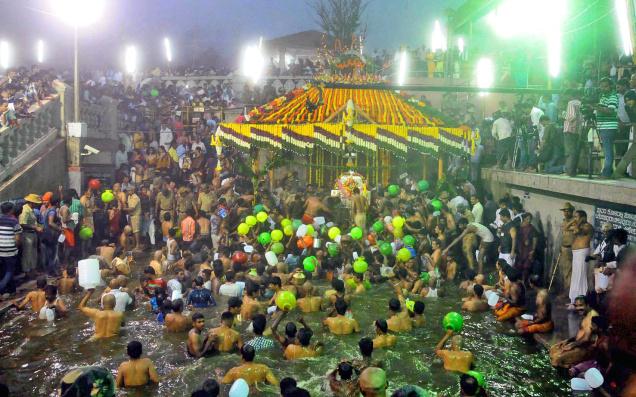
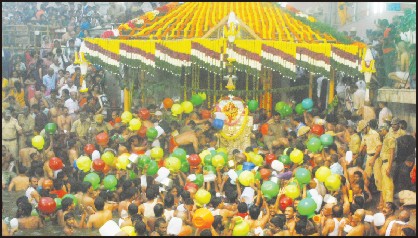
Devotees trying to get a glimpse of the ‘Teertodbhava’ at the Talacauvery at 6.04 p.m. on Friday.
Amidst a religiously surcharged atmosphere, relentless chanting of Vedic hymns by a group of priests and frenzy of devotees, the famous ‘Teertodbhava’, the annual spectacle, occurred at Talacauvery at 6.04 p.m. on Friday, at the foothills of the mighty Brahmagiri mountains in Kodagu. Thousands of people witnessed the event.
The holy water (teertha) sprang up from the tiny pond ‘Brahmakundike’ even as the priests started pouring out the ‘teertha’ on the devotees who jumped into the main pond to get the glimpse of the occurrence and collect it in containers. Wafting wind and passing mist across the mighty hills lent a special aura to the whole episode in which the devotees basked in the glory of reverence. Goddess Cauvery, the presiding deity of Kodavas, Kodagu in general, is said to emerge as holy spring during the occasion.
The occurrence will also signal the beginning of the month-long Cauvery jatra during which devotees throng the Triveni Sangama — confluence of Cauvery, Kannike and Sujyoti rivers — to take holy dips and offer puja at the Sri Bhagandeshwara temple complex. Later, they will proceed to Talacauvery.
As usual, men with tonsured heads jumped into the main pond to gather in front of the Brahmakundike minutes before the occurrence. The “prabhavali” at the sanctum sanctorum close to the Brahmakundike was bedecked with grand floral arrangements. Kodava men in uniform rendered traditional ‘dudikottpat’ (dudi is a small drum).
Kodagu district in-charge Minister K.J. George, Law and Parliamentary Affairs Minister T.B. Jayachandra, Irrigation Minister, M.B. Patil, and Madikeri MLA, M.P. Appachu Ranjan, were among those who attended the event.
Free food arrangements were made at the choultry near the shrine and other locations. Police had a tough time managing the surging crowd and steady flow of vehicles.
The stretch of road from Bhagamandala-Talacauvery was illuminated. Cultural programmes were organised at Talacauvery.
source: http://www.thehindu.com / The Hindu / Home> National> Karnataka / by K. Jeevan Chinnappa / Bangalore – October 17th, 2014
Thousands of devotees from Karnataka and neighbouring States thronged Talacauvery in the district, the birth place of River Cauvery yesterday to witness the annual Theerthodbhava.
On witnessing the holy water springing from the Brahma Kundike at 6.04 pm in the auspicious Meena Lagna, Thula Sankramana Muhurtham, the devotees went ecstatic shouting ‘Jai Kaverammna’ ‘Jai Jai Matha’, ‘Jai Jai Cauvery Matha’ etc., in praise of Goddess Cauvery, which reverberated along the Brahmagiri Hill range, as the priests collected the ‘theertha’ gushing out from the Kundike and sprinkled it over the crowds. Some devotees even jumped into the bathing pond breaking Police barricade.
The rituals at Talacauvery began after 4 pm, with the bringing of flowers and silver ornaments from Bhagandeshwara Temple at Bhagamandala, as per the tradition. A puja was offered to the Brahma Kundike by Talacauvery temple priests Narayana Achar, Prashanth Achar, Krishna Upadhyaya, Gopalakrishna Achar.
Devotees from across Karnataka and neighbouring States of Andhra, Tamil Nadu and Kerala, thronged Talacauvery in thousands from early morning.
The Maha puja and Mahamangalarathi took place at 5.50 pm ahead of the Theerthodbhava at 6.04 pm, which was 3 minutes earlier than the stipulated time of 6.07 pm.
The Kannada and Culture Department had organised bhajans and cultural events at Talacauvery. Kodava men in traditional attire, rendered the traditional ‘Dudikott pat.’
Mass feeding was arranged at the choultry near the shrine and other locations. The stretch of road from Bhagamandala to Talacauvery was illuminated. The KSRTC operated special buses from Mysore and Madikeri for the benefit of devotees. The Police had made tight security arrangements at Talacauvery, with the deployment of Home Guards, KSRP and DAR platoons.
Kodagu District in-charge Minister K.J. George, Law and Parliamentary Affairs Minister T.B. Jayachandra, Irrigation Minister M.B. Patil, Madikeri MLA M.P. Appachhu Ranjan and other dignitaries were present on the occasion.
Govt. moots construction of overbridge at Bhagamandala
“The Government is planning to construct an overbridge at Bhagamandala, which loses contact with the outside world during the rainy season,” according to Irrigation Minister M.B. Patil.
Speaking to press persons here yesterday, the Minister said Kodagu District in-charge Minister K.J. George had appealed for construction of an overbridge, following which Chief Engineer Srinivas Murthy has been assigned the task of preparing a blue print for the project.
However, the project will be executed so that the sentiments of locals would not be hurt. Chief Engineer Srinivas Murthy will make a spot inspection and will discuss with the local people, following which the project will be finalised, Patil said.
source: http://www.starofmysore.com / Star of Mysore / Home> General News / Saturday, October 18th, 2014
The first ever joint press meet of Karnataka Tulu, Beary, Konkani, Kodava Sahitya academy and Karnataka Arebashe Sanskriti and Sahitya academy presidents was organized at Hotel Srinivas, here on Monday October 13.
All cultural associations came together and explained their mission and vision of preserving the culture and languages of the state collectively.
B A Mohammad Hanif president of Karnataka Beary Sahitya academy briefed the press regarding the activities of Sahitya academy and their importance in the present society. He said, “Karnataka government has established seven language academies and six cultural academies in the state. It is a prime responsibility of these academies to promote and save the culture and languages of the state. Tulu, Beary and Konkani Sahitya academies are centred in and around Mangalore and Kodava Sahitya academy and Karnataka Arebashe Sanskriti and Sahitya Academy are deep rooted in Madikeri”.
“District administration has included Tulu, Beary, Konkani, Karnataka Arebashe Sahitya academy in the decision making committee and asked our collaboration in Karavali Utsav which is indeed a very good news. We also request to district administration to include Kodava Sahitya academy in decision making committee?.
“We have planned to organize joint cultural Utsav and programmes in Madikeri, Sullia and Puttur regions in the coming days. Government of Karnataka has also asked our opinion in shortlisting the candidates for Rajyotsava awards, the second highest civilian honour award of the state”.
“We are also planning to have a joint ‘Convention 2015’ a cultural extravaganza next year in month of April or May in Mangalore. To mark unity and togetherness for the coming years of working together, we have organized the first ever joint press meet today”, he informed.
Roy Castelino, president of Karnataka Konkani Sahitya academy, said, “The government has allotted Rs 65 lac for Sahitya academy to organize cultural programmes. If the government raises the funds to Rs one crore, we can reach to all parts of Karnataka and effectively organize the programmes. We have also shortage of permanent staffs. We appoint many on temporary basis during the events. This is the reason why funds are not fully utilized”.
Janaki Brahmavar, president, Karnataka Tulu Sahitya academy, Biddathanda Thammaiah, president of Kodava Sahitya academy and Girish Kollya Karnataka Arebashe Sanskriti and Sahitya academy president and members of Karnataka Tulu, Beary, Konkani, Kodava Sahitya academy and members of Karnataka Arebashe Sanskriti and Sahitya academy were also present during the press meet.
Talacauvery, the birth place of River Cauvery, is all set for the annual Theerthodbhava on Oct.17 with rituals and filling the ‘Akshaya Patra’ with grains taking place at Bhagamandala’s Bhagandeshwara temple on Tuesday.
The rituals took place in the presence of Sri Bhagandeshwara-Talacauvery Temple Committee members and others.
Temple Committee President Manu Muthappa, speaking on the occasion, said the Theerthodhbava will take place at 6.07 pm on Oct.17 in the auspicious Meena Lagna. The Kodagu district administration, the Temple Committee and other Associations involved are making hectic preparations for the all important event, he said.
As the Theerthodbhava is taking place in the evening and with mist engulfing the hilly area, street lights (1500 tubelights) are being erected along the Bhagamandala-Talacauvery road. Also, 33 CCTV cameras are being installed at Talacauvery at a cost of about Rs.12 lakh, he said and added that mass feeding will commence in the afternoon of Oct.17.
The Police Department has erected barricades at necessary points for crowd control and about 400 Policemen will be deployed at the spot.
Elaborate arrangements are being made for providing drinking water to the devotees. The Health and Family Welfare Department has deputed a team of doctors and an ambulance for any health emergencies.
LED screens are being installed for the devotees to witness the Theerthodbhava, he said and added that the Kannada and Culture Department has erected a platform for musical programmes.
source: http://www.starofmysore.com / Star of Mysore / Home>General News / Thursday , October 16th, 2014
The High Court has upheld the order of a maintenance tribunal which had directed three sons of a 88-year-old woman to provide her a maintenence of Rs 3,000 each every month.
In an order which provides a ray of hope to people abandoned by their children, the High Court recently upheld the tribunal order, considering that she cannot earn her own living due to old age.
H S Subramanya, a native of Cherla Srimangala village of Chethalli, Somwarpet taluk in Kodagu district had moved the court, challenging the tribunal order directing him and his brothers H S Ganesh Kumar and H S Thimmappaiah, to pay maintenance to his mother H S Lakshmi, who is residing with her widowed daughter H S Mangala Gowri at Hosakeri village in Somwarpet taluk.
The trio had inherited their father H S Srinivasa’s property after he executed a will in their favour by dividing the property. Srinivasa, who died in June 21, 2002, had also stated in his will that each of his sons should pay a sum of Rs 500 each to their mother.
The sons abided by the will, paying her money till 2010. She moved the tribunal in Kodagu district and obtained an order in her favour. Subramanya and Kumar moved the High Court, stating that they stopped paying maintenence because their other brother has not paid any maintenence and also has taken their share from her.
Justice Abdul Nazeer upheld the verdict of the tribunal and asked the sons to pay maintenence. He observed, “Ageing has become a major social challenge because of the decline of the joint family system. A large number of elderly persons, particularly widowed women, are not being looked after by their families. They are forced to spend their twilight years alone, are exposed to emotional neglect and are not provided financial support,” the court observed.
The Court, which dismissed the petition, said, “There is a need to pay more attention to the care and protection of older persons.”
source: http://www.deccanherald.com / Deccan Herald / Home> City / Bangalore- DHNS, October 12th, 2014
The hockey academy in Kushalnagar isn’t one among those where players eat, drink and sleep hockey. It is a movement that stirred a community’s emotions and gently persuaded it to bond with the game it loved.
What began as a practice session between former international hockey player and coach Len Aiyappa and a local boy who just couldn’t part with his hockey stick is now a training centre that houses around 50 boys in the 8-14 age group.
Coaches, trainers, officials, helpers are all from the neighborhood — former players or enthusiasts who have not only allowed their boys to play the game but contributed generously to the cause.
The academy might not have drastically changed the game’s fortunes but its impact has been telling in a town that had switched to cricket and football, despite being the cradle of hockey once upon a time.
It all started with Len moving to Kushalnagar for a short period late last year to tend to his mother who was battling cancer.
Playing football with his friends at the Government Middle School ground one evening, Len noticed a young boy with a hockey stick watching them from the sidelines. He joined them for a game before asking Len whether anyone would help him sharpen his hockey skills.
“This boy, Trishul, loved hockey. He was forced to play football only because there was no one interested in hockey,” Len told TOI. “I told him I would teach him the basics.”
Practice sessions began in January this year. “Trishul would reach the ground at dawn much before I did. Watching his commitment, two of his friends joined him. The number grew to 10 and within a few weeks I had about 50 young boys training with me.”
As the number grew, so did the demands.
The first — a bigger ground for practice — was met when the Government Junior College physical trainer offered his institution’s facility provided Len trained the hostel students. Len was only too glad to accept the quid pro quo.
Then came the challenge of providing sticks, balls and a healthy morning snack for his trainees. While his contacts helped him get the hockey kit, Kushalnagar residents chipped in to meet the other needs.
“Trishul’s father Ganesh said he was ready to manage the centre. Having trained at the state academy in Kudige, he was confident of being a tutor. I gave him the basic programme and we began sharing the work. We have a trainer too, Yogesh, a retired Border Security Force employee,” Len said.
A few other hockey players from the neighborhood volunteered to help when the number swelled to around 100 during the summer vacation in April-May. “We didn’t charge a penny. It was a grassroots initiative and we realized there were players from modest backgrounds. There were others willing to contribute and that helped us tide over critical times. It was a new Kushalnagar that I saw.”
Once the vacation was over, Len realized he had to put a proper coaching programme in place. He approached former India captain Jude Felix, whose academy in the city had impressed him. Felix helped his boys with basic kitting and held refresher courses at Kushalnagar.
“Len is keen that we run his centre. But we need additional manpower and resources for that. We are keen to help him as our ideologies match. We do it for an orphanage while Len is doing for the masses without expecting any returns,” said JFHA head coach Shanmugham.
Incidentally, Len’s centre does not have a name. “I haven’t felt the need to find a name. Why should a collective cause be named after anybody? It is a community drive and it will remain the same forever. Our aim is to popularize hockey. My first trainee, Trishul, is now in the Kudige state hostel. That has come as a big boost to my confidence.”
source: http://www.timesofindia.indiatimes.com / The Times of India / Home> City> Bangalore> Namma Metro / by Narain Swamy, TNN / October 13th, 2014
Tennis – Bopanna will split with Qureshi and partner a multiple Grand Slam winner next year
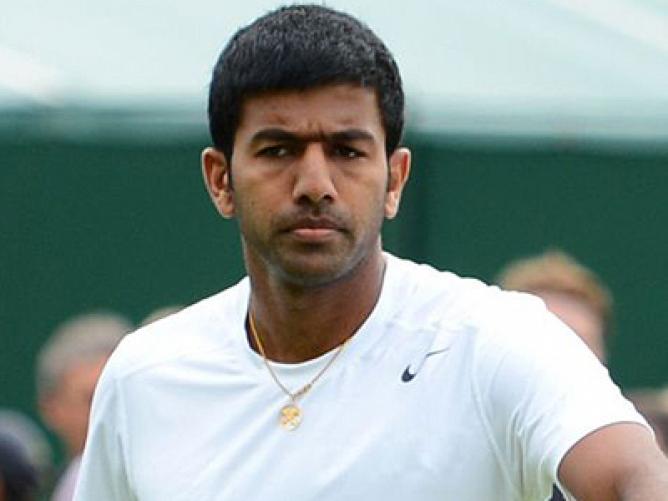
Tennis – India’s Rohan Bopanna will partner Canada’s Daniel Nestor during the start of the 2015 season on the ATP doubles circuit, confirming his split with Pakistani partner Aisam-Ul-Haq Qureshi.
Bopanna and Qureshi have struggled in recent months with the Indian dropping to No. 35 in the rankings while Qureshi has dropped to No. 28. Both players are in Shanghai this week for the ATP Masters event there but are playing with different partners this week.
Qureshi has not yet decided on who his partner will be. Bopanna told Indian daily The Times of India that the duo, who are good friends off the court as well, spoke with their coach Scot Davidoff and came to the conclusion that their partnership on the court was not working and hence it would be better to part ways.
While Bopanna is still looking for his first Grand Slam doubles title, 42-year-old Nestor has won eight Grand Slam doubles titles in his career. Nestor is currently ranked No. 4 in the world and has been playing this season with Serbia’s Nenad Zimonjic.
source: http://www.tennisworldusa.org / Tennis World / Home> Indian Tennis / by Prakash / October 10th, 2014
Prices steam up on fears over the LatAm country’s crop; planters here expand acreage
Chennai :
Your favourite cup of filter coffee or latte or cappuccino is set to get costlier as domestic bean prices have surged to record highs. This follows a rally in the global market on the back of the Brazilian crop running into problems due to dry weather.
Corporates owning coffee estates such as Tata Coffee and Amalgamated Bean Coffee Trading Company – which runs Café Coffee Day – could gain as a result. Nestle and Hindustan Unilever, which source coffee, could be shelling out more for their products.
Record prices
Currently, farm gate prices of Arabica parchment are quoting at a record of over ₹12,000 for a 50-kg bag, while robusta parchment is ruling near ₹8,000.
Robusta cherry is being quoted around ₹3,750 per 50-kg bag. Robusta cherry accounts for over 40 per cent of coffee exports totalling three lakh tonnes in the last couple of years.
Brazilian output
“We are looking at a scenario which we last saw in 1977 when a disastrous frost affected the crop in Brazil. Dry weather earlier this year affected coffee production in Brazil. The crop this year has been estimated at 40.1 million bags (60 kg each). Now, Met forecasts of the crop’s blossom shower being delayed have fired up the market,” said Anil K Bhandari, a planter and former president of United Planters’ Association of Southern India.
Rains are crucial during September-October for the Brazilian coffee crop. But forecasts say that no showers are likely till the end of the month. This means, the already stressed coffee plants could be weakened further and production could be hit next year too, said Bhandari.
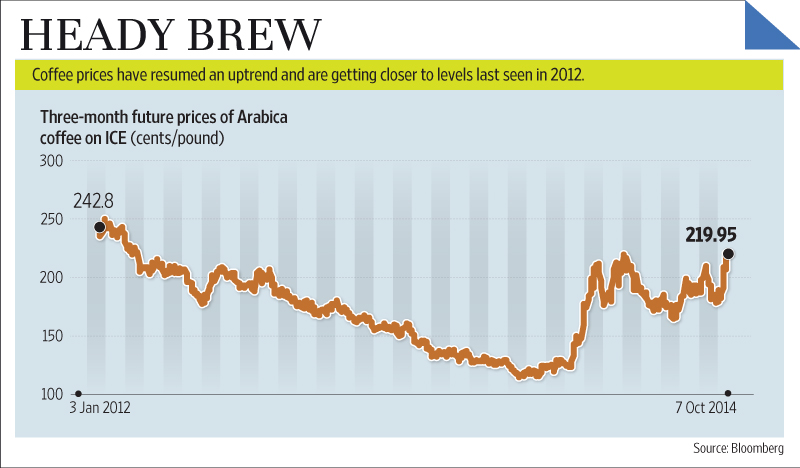
Coffee trade across the globe now fears that next year’s crop could be lower than 40 million bags. This has resulted in prices surging to near 30-month high of $2.20 a pound. On Thursday, coffee on ICE US for delivery in December ruled at $2.175 a pound.
“Domestic prices are high in line with global prices. Availability is low since we are at the fag end of the season,” said Ramesh Rajah, President of Coffee Exporters’ Association.
“But, there are no buyers in view of the high prices,” said Bose Mandanna, a grower from Kodagu and former Vice-Chairman of the Coffee Board.
“Since the market is volatile, buyers are staying away. They don’t want to take risk. Once the market stabilises, they will return. Also, coffee prices cannot continue rising and lose consumers,” said Bhandari.
Few deals have been signed for the new crop, said Rajah. “Not much business has been done for the new crop in view of the problems we faced with the crop last year,” he said.
Domestic crop situation
Last year, the Coffee Board had initially projected production of 3.47 lakh tonnes but finally, it turned out to be 3.04 lakh tonnes as the crop was affected by unseasonal rains.
“Indian Arabica is expensive in the global market as also the Robusta. But when Brazil is short, there will be demand for the Indian produce,” said Rajah.
“Coffee export value can increase this year in view of the high prices,” said Bhandari, adding that the key was the new crop that is shaping up well.
“Arabica has suffered loss due to the borer menace but Robusta has shaped up well,” said Bhandari.
“Harvest has begun in Tamil Nadu and in Karnataka, it will start next month,” said Mandanna. “The crop is much better than last year. Robusta will be 10-15 per cent higher, while Arabica has been affected by the white stem borer,” he said.
Rajah said coffee production this year will be in line with the Board’s projection. According to the Coffee Board’s post-blossom estimates, production this year could be a record 3.44 lakh tonnes with Robusta making up 2.39 lakh tonnes and Arabica the rest.
Area expands
Higher prices this year and forecast of the rally continuing next year have resulted in growers expanding the area under coffee.
According to sources, nurseries have run out of coffee plants in view of demand.
“Coffee is being planted on large plantations where the borer menace has resulted in lot of vacant space being available. Some growers are shifting to coffee from crops such as cardamom,” said Mandanna.
Sources said coffee plantations in Karnataka are now extending to plains such as Piriyapatna in Mysore.
“We will have to see how far it can be sustained. Such a development took place in 1977 also,” said Bhandari. “The problem is coffee will take time to give returns. People should be able to sustain till then,” he said.
source: http://www.thehindubusinessline.com / Business Line / Home> Agri-Biz / MR Subramani / Chennai – October 09th, 2014
Ranee Vijaya Kuttaiah talks about the intense relationship of her Kodava community with food, her quest for recipes across two States, and reveals secrets of the early years of food styling in India
Bursting with ideasRanee Kuttaiah has collected recipes from households of different communities in Karnataka / Photo: Bhagya Prakash k. / The Hindu
Avid golfer. Kalakshetra student. Bharatanatyam and Kathakali dancer. Great grandmother. Lived the good life in the Nilgiris. Travelled the world giving performances. Anjaneya bhakt. Ford Motors PR in New York. Writer. Food stylist. Lecturer. Hotel manager. A very good cook.
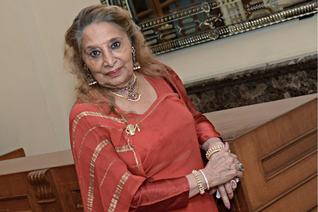
Ranee Vijaya Kuttaiah is so many things rolled into one, it’s difficult to keep pace with this energetic Kodava matriarch as she flits from one story of her life to another. She can hold forth on anything from how politics is dirty to why prostitution should be legalised. And from how to boil lobster just so, to how to make ice cream that won’t melt under bright lights. All this coming from a woman who, when she got married, didn’t know how to make a cup of tea.
“I used to write for The Hindu when I lived in the Nilgiris with my husband. I’m a Kalakshetra dancer. My husband died when he was young. I was just too heart broken and swore never to wear my anklets and dance again. I started writing short stories, started a company called Shadow Light Co-ordinators and we would do high-end food and fashion shoots in Bangalore,” says Ranee, of the beginnings of how she came to write about food.
ITC Windsor and Sterling Paperbacks re-launched a revised edition of her famous recipe book, Cuisine from Karnataka with her other classic Cuisine from Coorg this week at an evening that saw the who’s who of Coorg and Ranee’s friends bond over food and wine. Talking of the strong bond that her Kodava community has with food, she points out: “We worship our ancestors with liquor! On any occasion, we first offer a little bit of whatever we cook in front of the photos of our ancestors. We are a kshatriya race used to good food, and we are big agriculturists.”
While studying for her masters in the United States in the 1960s, during her summer break she chanced upon a food styling course in one of the hotels. She signed up for it and a whole unknown world was revealed to her. “Cooked food doesn’t style well. It creates a mess. Food is best shot uncooked. I’ll tell you a secret. You can’t photograph steam. So when I had to shoot a hot, steaming kettle, I would blow out smoke from a cigarette just in time for the photographer to shoot. Mind you I don’t smoke. Ice-cream melts under lights. So we would whip paint and freeze it to look like ice cream! I would par-boil lobsters and then paint them with lovely orange oil paints before setting it up on a silver platter.” When she styled food for the famous Sangeeta Khanna cookbook, her present publisher appreciatively ate a meal in her house and asked her to write a book on Coorg cuisine. Ranee turned to her mother for the classic recipes of Coorg. It’s a book that’s been going into reprint for the last 14 years.
One book led to another. Having lived 30 years in Tamil Nadu and having performed all over the State, she recalls taking down recipes whenever she travelled in Madurai, Ramnad, Thirunelveli and Thanjavur, recording recipes of Nadar and Thevar cuisine, which featured in her book Cuisine from Tamil Nadu. Her own personal favourite, though, is Syrian Christian non-vegetarian food from Kerala, she pipes in.
She decided to write about Karnataka cuisine because — “it’s my State and largely ignored” she says, with a mix of pride and hurt. “It’s was as if holige and bisi bele bhath were the only things Karnataka had to offer,” she says talking of the limited popularity of food from the state then. She had close friends in political circles like Ramakrishna Hegde. “Many of the ministers were Lingayats and Gowdas. I would travel to Mandya and Maddur, visit the homes of the Gram Panchayat chiefs and ask their wives what they cook at home. I would collect four to five recipes from different families of the same dish, come home and try them in my kitchen and arrive at what I thought was the best of them.” Her book on Karnataka covers food from the Lingayat, Gowda, Bunt, and Madhwa Brahmin community (into which her sister was married).
source: http://www.thehindu.com / The Hindu / Home> Features> MetroPlus / by Bhumika. K / October 17th, 2014
International coffee prices rose sharply this week, as fears resurfaced that Brazil’s crop could get adversely affected by a drought
A thin harvest may be bad news for Brazil but is good news for growers in other countries. Indian coffee producers are seeing firm crop trends in 2014-15. Photo: Bloomberg
International coffee prices rose sharply this week, as fears resurfaced that Brazil’s crop could get adversely affected by a drought. This comes just a fortnight after Brazil’s agricultural organization Conab released its September estimate, which had assuaged market fears and even saw prices drop.
But on Monday, the three-month forward Arabica coffee contract rose by 9.2% intra-day, according to The Wall Street Journal, and closed the day with a gain of 6.9%. This marked a two-and-a-half-year high for this contract. On Tuesday, its level was unchanged. If the news on the weather from Brazil continues to support higher prices, then this uptrend could be sustained. But recent months have seen volatile price movements; so, there is risk of a reversal, too.
The International Coffee Organization’s price data show the prices of all grades of Arabica coffee have moved up, in sync with Brazil. Though Brazil’s effect is felt more by the Arabica variety, even the lower Robusta grade has perked up in October. It has recovered losses sustained in September.
A thin harvest may be bad news for Brazil but is good news for growers in other countries. Indian coffee producers are seeing firm crop trends in 2014-15. The country’s coffee crop is estimated to increase by 13.2% to 344,750 tonnes. The Arabica crop is expected to increase by 3.2%, while Robusta, which is the main local crop, is expected to rise by 18.3%.
Thus, one can expect the plantation business of growers such as Tata Coffee Ltd and CCL Products India Ltd to post good results. But this uptrend poses a challenge for coffee marketers such as Nestlé India Ltd and Hindustan Unilever Ltd (HUL). Rising input costs will force them to hike prices, which can hurt volume growth.
source: http://www.livemint.com / Live Mint / Home> Money / by Ravi Ananthanarayanan / Tuesday – October 07th, 2014
WELCOME. If you like what you see "SUBSCRIBE via EMAIL" to receive FREE regular UPDATES.
Read More »