Food Friday | The best-kept secrets of Kodava cuisine

The iconic Pandicurry is the most emblematic and popular food people identify from Coorg. But the kadi (good food) and kudi (liquor) of the Kodava region in Karnataka are as wide and wild as they could get.
Food Friday | The best-kept secrets of Kodava cuisine
The Kodava Cuisine

“Pandicurry please!”

The allure of the tangy-spicy curry keeps calling me back to Coorg, every time. Of course, I am a lover of coffee too but if I were baring my heart to you, I would tell you that pork takes precedence every time I visit the Scotland of South India. No other style of pork has made such an impact, not even the sorpotel!

Let’s agree that the iconic Pandicurry is the most emblematic and popular food people identify from Coorg. But the kadi (good food) and kudi (liquor) of the Kodava region in Karnataka are as wide and wild as they could get. From wild mangoes and mushrooms to tender bamboo shoots, the food here is full of organic ingredients that establish its supremacy over other cuisines emerging from the state.

Food Friday  The bestkept secrets of Kodava cuisine
Wild Mushrooms

In this context, it’s important to mention that Coorg was in fact a state itself, landlocked and rich with biodiversity that attracted foreign attention almost immediately when the British came to India. Ruled as a kingdom established originally by the Nayakas, the state was self-sufficient and housed a clan-based community of warrior tribes. It was the hunted boar, that actually led to the pandi curry’s foundation.

For centuries Coorg was quite inaccessible, a landlocked region. It explains the heavy reliance on locally sourced ingredients. On a recent visit to the Evolve Back Coorg which sits pretty in a 300-acre coffee plantation and traces the traditions of the valley efficiently, I found peppercorn growing carelessly creeping around jackfruit, silver oak and mango trees among the robusta coffee the estate produces.

Food Friday  The bestkept secrets of Kodava cuisine
Robusta Coffee

For the uninitiated, Coorg is also the rice bowl of Karnataka, it grows in abundance here thanks to plenty of rains and rich soil composition. Upon finding The variety of rice items alone is quite humbling at The Granary, the main restaurant at Evolve Back so I had to turn to a specialist who could explain better. Sudhansu Sekhar Jena, the senior sous chef helps me out – “Kadambuttu, Thaliya Puttu, Paaputtu, Noolputtu, Koovale Puttu and various seasonal pickles are signature dishes of Coorg cuisine, just to name a few,” he explained.

While small dumplings of steamed broken rice make the KadambuttuNoolputtu is a fine lump of pressed rice noodles and what makes Paputtu stand out is the addition of coconut milk and a dash of shredded coconut which is steamed together with rice. With this newly acquired knowledge, I settled for lunch with paputtus and a delicious koli curry (chicken curry).

Food Friday  The bestkept secrets of Kodava cuisine

Sudhansu Sekhar Jena , Senior Sous Chef – F&B Production, Evolve Back Coorg, shares the recipe of Paputtu and also tells the detials of the dish.Paputtu is generally known as palputtu ( pal means milk and puttu is steamed rice cakes). It’s made of akki thari (coarse ground rice rava), grated coconut, salt and water. It’s steamed in a special kind of steamer called sekala and goes very well with non-veg curries.

Ingredients:

2 cups thari or coarse rice rava
1 – 1 1/2 cups fresh grated coconut
2 cups whole milk / light coconut milk
2 cups water
1 tsp cardamom powder
Salt to taste
Oil to grease

METHOD:


Wash the rice thari and soak for 1/2 an hour in the 2 cups of water. Add the milk, cardamom and salt and mix well. Squeeze the freshly grated coconut to extract a little milk and add it all to the mixture. Grease the plates with little oil. Pour the prepared mixture into the greased plates till two-thirds full to allow room for the thari to expand. Divide equally between plates and steam for 25-30 minutes or until done. The puttu should look firm, with no soggy bits in the centre. Cover the plates with a clean tea cloth and allow the puttu to cool a little before cutting them into pieces.

JENJI MASALA (Mud crab curry)

Ingredients Unit Quantity
Crab ( Jenji) Grams. 1000
Garlic Chop Grams. 50
Ginger Julienne Grams. 20
Mustard Seeds Grams. 10
Onion Slice Grams. 250
Ginger Paste Grams. 25
Garlic Paste Grams. 25
Tomato Slice Grams. 200
Green Chilly Slit Nos. 15
Coriander powder Grams. 75
Chilly Powder Grams. 60
Turmeric Powder Grams. 5
Salt Grams. To Taste
Oil Ml 200
Coconut Paste 1 whole
Curry Leaves Grams. 50
Red Chilli Whole No. 3-4

Procedure:


Clean & wash Crabs, add salt, and turmeric powder, and keep aside. In a vessel heat oil, add chopped garlic, mustard seeds, ginger julienne, slit green chilli, and curry leaves. Then add onion slice and fry till light brown, add sliced tomato and all Masala powder, salt and little water and sauté till oil comes up. Now add coconut paste & simmer gently, cooking till coconut paste is well cooked. Then add Crabs and salt, and bring to Cooked. When Crabs are tender, remove them from the fire, add temper and serve.

For tempering:

Heat a little oil and add mustard seed, curry leaves, and red chilli whole. when mustard seed crackles pour into the Crabs Masala. Serve hot.

Monsoon brings even more joy for the tribe that used to be reliant on hunting-gathering in forms of mud crabs and fresh fish from the opulent rivers running through the forests of Kodagu. Mahseer, rohu, tilapia, katla, giant gourami are some of the fish which can be caught in river Cauvery, India’s fourth largest and the lifeline to this side of the peninsula.

Anjali Ganapathy, a Chef who calls herself an armchair ethnographist, has been tracing and presenting Coorg cuisine at her estate home, after running a successful catering service in Bengaluru for years. I reach out to her for more information and trivia.

“Traditionally we were hunters”, Ganapathy affirms.

“Our farms and forests had no boundaries and weaponry such as firearms and machetes were a part of every household. They were used for protection as well as hunting to provide for the family,” she tells me. It was the norm.

Meat from wild boar, venison and wild fowl came from the forests according to Ganapathy and though fast disappearing, mud crabs, river and paddy-field fish can still be found in a Coorg home kitchen, she informs. Bush meat has been replaced by commercially available chicken, mutton and pork.

I wanted to taste the Kaad Maange curry (wild mango curry) but Sudhansu informed me that the season just got over. Ruefully I decide that it’s never too late to plan another visit to Coorg. So I head to the Sidapur Coffee & Culture Museum to sharpen my coffee knowledge instead, since it is housed within the property. Welcoming a group of excited guests, Jenny starts her session with a smile and a question – “How many of you know the difference between Arabica and Robusta?

Food Friday  The bestkept secrets of Kodava cuisine

Assisted by a very skilled Barista, we embark on an aromatic journey of coffee produced in the estate, presented in a variety of concoctions including the famous Moroccan Nous-Nous (half and half) edition and Vietnamese Cold Coffee (with condensed milk to sweeten it). The beauty of a great coffee is not the design you see, but the firmness of the froth that doesn’t allow a spoon to dip, Jenny informed us with a demonstration. After six shots of coffee, I am convinced that I shall never have instant coffee again.

I still don’t know what makes the curry of the pandicurry, so I head back to Peppercorn, the specialty restaurant by the lake at Evolve Back to sit down with the sous chef.

What follows is a deep dive into the organic ingredients that make Kodava cuisine a secret.

A unique souring ingredient, Kachampuli, (Coorg’s version of a Balsamic/black vinegar) is extracted from the ripe fruits of the Garcinia Gummi Gutta tree, commonly known as Brindle berry or Malabar tamarind. The fruits are usually placed in baskets over large vessels to allow the juice to gently drip down (over a few days) as the fruit gradually becomes pulp through natural fermentation. The extract is then reduced over a woodfire to make the vinegar like black smokey sour liquid.

“It is typically used towards the end of the cooking process in many Kodava dishes (including the Pandi curry) and accentuates the flavours of the meat and the colour of the dish,” shared Jena.

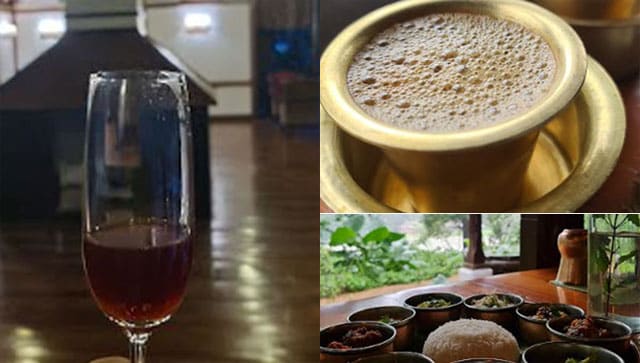
Enriched with this information, I wander into the reading room where the resort serves free coffee all day long. Looking over the rice fields being pattered with relentless rain, my mind wanders to the visual of an Ainmane, the Kodava-style clan house. I can almost smell the Baale Nuruk (a fritter made with rice flour and ripe bananas) in the kitchen in my virtual visit when my thoughts are interrupted by a gentleman dressed in khakis. I take him to be a naturalist at the resort. Sweetly he offers a glass of ‘Coffee Wine’, a dark amber-coloured liquid kept at the coffee counter. Intrigued, I take a sip and instantly, a wave of delight hits my throat. It smells of coffee and leaves the aftertaste of pepper, a unique combination indeed.

Food Friday  The bestkept secrets of Kodava cuisine
Coffee Wine

“Pigout has helped me achieve a deeper understanding of how the cuisine took shape, its evolution and a study of how to preserve and as well as prepare for what could possibly be the future holds for a micro cuisine, that is rooted in a wild landscape”, shared Ganapathy.

She has been running Pigout Coorg Kitchen from her family home (also an AirBnB) since the pandemic. “Your best bet at trying fresh ingredients with homegrown produce would be in someone’s home,” she chimes.

On my last day in Coorg, walking around the pool villa with a glass of Chukku Kaapi (also known as Bella Kaapi – coffee made with jaggery and ginger extract) I made a vow to come back to this wild land of delectable fares, soon enough.

source: http://www.firstpost.com / FirstPost. / Home> Arts & Culture / by Chandreyi B / August 12th, 2022


MN Srinivas views on religion and society among Coorgs

Mysore Narasimachar Srinivas was born in 1916 in Mysore. He belonged to a Brahmin Family and studied various areas like caste, society, religion and so on. He brought up various ideas related to sociology.

He published a book called ‘Religion and Society among the Coorgs of South India’. It put forward a new approach to study Hinduism. Srinivas took two aspects to distinct various sociological aspects. These distinctions are – field view and book view. He advocated field view which helps in observing and examining things more clearly.

According to him, we cannot isolate religious beliefs completely from our life. Religious factors always correlate with social norms and values. No religion is autonomous or eternal. He provides an approach for those who do not regard religion as pure and society as corrupt. They have blind faith in intangible things which are not practically accepted. For him, Hinduism is not solitary and inseparable. According to regional transformation, it goes on changing. This field view of his ideology gives a perfect picture of how religious practices and norms are making everybody more engaged with societal norms especially in the case of Coorgs.

His second distinction, i.e., the book view of Hinduism has many impediments. This view was accepted by almost every believer. This was based on our historical texts. But those texts are away from the real picture of religion and give false understanding. Those texts were based on idealism but in reality away from realism. Whereas the field view takes us closer to the actual practices prevalent in reality, like caste and joint family.

Study of local Coorgs

The book concentrates on the rituals and cultural structures among Coorgs. Kodagu also is known as Coorgs is a rural district situated in Karnataka. They are known as descendents of Arabs or Greeks and famous for coffee production. They worship nature and do not have any deity like Brahmins. They live in mountainous regions with specific language and customs.  M.N. Srinivas focused on festivals and customs that are performed by coorgs. He personally spent a lot of time among a Coorg joint family and provides an empirical view of coorgs and Indian society He argues that puranas are responsible for complete Sanskritization of culture and he gives the example of Coorgs. In this, he illustrates that educated Coorgs want to identify the village gods with Shiva and they also explain why gods start liking liquor and meat due to losing their caste when they were crossing Malabar. He states that how they want to preserve social structure using local customs.

His sociological perspective of religion is based on religion skepticism rather than faith. Even after the efforts of Srinivas more than 50 years ago, the religious sociology as a discipline has not been established in India as it has been in the West. His sociology of religion is based on examining the norms, practices and faith structure according to societal needs. The critical analysis of religion through his lens is based on kinship, economics and politics factors. After independence when he established his theories on Coorgs, it hardly received any opposition. But there is also one more reality that his empirical study about Hinduism is not used further by many sociologists in India. It is very irrational for many philosophers to judge the values of any religion objectively. But for the betterment of society, implementation of every reform based on meaningful assessment is necessary.

Undoubtedly, Hinduism is an ancient philosophy prevailing for thousands of years. Thinkers like Srinivas do not condemn its theological aspects. His appraisal was totally based on practical and logical standards. He wants it to be a religion of tolerance but not a religion of hierarchy. Certain practices like untouchability, caste system, women oppressions, etc. must be denounced for the growth and advancement of society. Using religion as an excuse to continue such practices deserve criticism.

Reference:

https://www.telegraphindia.com/opinion/religion-and-society-in-hinduism-the-principle-of-hierarchy-clashes-with-that-of-tolerance/cid/1017191

source: http://www.sociologygroup.com / Sociology Group / by Kiran

Write spirit

This journalist-turned-author talks about his new book Round and About with PT Bopanna, and his journey as an author.

Bengaluru :

Taking a leap of faith and moving to Mumbai 40 years ago, without a job or a plan worked out for PT Bopanna, veteran journalist and author of books such as Dateline Coorg and Are Kodavas (Coorgis) Hindus?. Growing up, Bopanna had no idea that he would become a journalist, and moved to Mumbai from Kodagu in search of better prospects. “I never thought I’d become a journalist, I never had a flair for writing. But when I was in college, I realised that journalists had the power to change the world, that’s what made me want to become a journalist,” he says.

forward to today, Bopanna’s newest book, Round and About with PT Bopanna, is a compilation of lighthearted articles written by the author. What’s special about this book is that Bopanna is able to tap a lighter, more humorous vein in this book, which he hasn’t been able to do in his other projects. The title of the book was inspired by the daily column, ‘Round and About,’ by Behram “Busybee” Contractor, a humour journalist. When Bopanna understood that journalism was his calling, he enrolled in a journalism course at Bhavan’s College in Mumbai. “Even though I wasn’t great at writing when I was younger, I always enjoyed reading the newspaper and books.

I was intrigued by ideas such as Marxism and rationalism,” says Bopanna. Since he also saw the rise of the Dravida Munnetra Kazhagam (DMK), he was also influenced by Periyar EV Ramaswamy Niacker’s ideas, who started the DMK. When Bopanna went back to Kodagu, he started working as a part-time correspondent for a newspaper, he was past the age of 30, which points to the fact that one is never too old to follow their passion. Bopanna was working at another newspaper when he started reading the astrological columns.

“I didn’t believe in astrology, but it did pique my interest. Once, the astrology section said that if I were to start a website, it would do well. After I read that, I compiled some of the information I was putting in my columns, and started my website coorgtourism. info.com in 2005, and after that, there was no looking back,” says Bopanna. However, the traffic on his website wasn’t as much as Bopanna wanted it to be. So he thought, “Why don’t I download all this material and bring it out in the form of a printed book?” This is how Bopanna’s career as an author started, with the release of his first book, Discover Coorg.

Writer C P Belliappa came up with the title of the book, and also wrote the foreword. Most of Bopanna’s books are about Kodagu, his home, and he writes about the rich cultural and political history of the region. “My book, Are Kodavas Hindus? was inspired by sociologist M N Srinivas’ work, who went to Oxford for his PhD and wrote his thesis on religion and society in Coorg,” Bopanna says of his journey as an author. Hence, what started as a dream to change the world, was fulfilled by an astrological prediction. Bopanna says a journalist’s profession can be a quite disappointing, however, the key is to ‘wait for the good tidings to come.’

source: http://www.newindianexpress.com / The New Indian Express / Home> Cities> Bengaluru / by Fia Majumdar, Express News Service / August 10th, 2022

Plans for mini planetarium, sub-regional science centre in Kodagu gains traction

These will help promote scientific temper and popularise science in the society

The Deputy Commissioner of Kodagu B.C. Satish has said that a master plan for the proposed mini planetarium and sub-regional science centre in the district will be prepared soon to get the project started.

The mini planetarium and the sub-regional science centre is the project of Karnataka Science and Technology Promotion Society (KSTePS) and will help promote scientific temper and popularise science in the society.

He recently attended a meeting pertaining to the implementation of the project and later said that the master plan will take into account the unique geological conditions and terrain of the district and come up with a suitable design to house the centre.

While the sub-regional science centre will come up at an estimated cost of ₹4 crore, the mini planetarium will cost around ₹5.75 crore for which administrative approval has already been granted by the government, according to the Deputy Commissioner.

Though foundation stone for the centre was laid at Stewart Hill some time ago, it has been abandoned due to land slips in the region. Hence the new location has been identified on the outskirts of Karnangeri village where 3 acres of land has been sanctioned for it, according to Mr. Satish.

The DC asked for suggestions from all stakeholders to take forward the concept of the centre and promote science and technology among students. The officials were also directed to visit other sub-regional science centres in the State at Gouribidanur, Dharwad and Mangaluru to ascertain the salient features and implement the same in the Kodagu centre.

It was also mooted that the new centre would be a hub of all scientific activities to benefit the students and regularly conduct exhibitions, science and technology related quiz programmes, organise science conferences for students etc.

source: http://www.thehindu.com / The Hindu / Home> News> India> Karnataka / by Special Correspondent / Mysuru – August 08th, 2022

Rudresh Mahanthappa’s Hero Trio Will Make NYC Debut In August

Saxophonist Rudresh Mahanthappa’s Hero Trio will make their NYC Debut this August to celebrate Charlie Parker’s Birthday at Smoke Jazz.

Located at the junction of 106th and Broadway (aka Duke Ellington Boulevard), Smoke Jazz Club is one of New York City’s premier live music venues. Renowned for offering top-notch programming of accessible, timeless jazz featuring legendary performers, modern masters, and rising stars, Smoke stands apart with its candlelit dining room, stellar acoustics, and classic American cuisine.

Rudresh Mahanthappa’s Hero Trio also includes bassist Harish Raghavan and drummer Rudy Royston. Their performance will set on Thursday and Sunday at 7 and 9 p.m., and on Friday and Saturday at 7, 9 and 10:30 p.m.

Hero Trio earned high praise for its eclectic 2020 self-titled debut and the 2022 follow-up Animal Crossing.  Animal Crossing is a digital-only EP featuring four new songs, each an unlikely addition to the canon of jazz standards which is also the titular theme from the wildly popular video game.

At Smoke, Mahanthappa will explore Parker’s compositions, classic standards, and modern covers with the Raghavan and Royston. “The idea behind Hero Trio was to turn the idea of playing a set of standards on its ear and freshen up the idea,” the saxophonist explains.

Rudresh Mahanthappa is widely known as one of the premier voices in jazz of the 21st century as well known for his exellent alto saxphone performances. He has been recognized by multiple jazz magazines including DownBeat Magazine, Jazz Journalists’ Association,and  JazzTimes Magazine. He has also received the Guggenheim Fellowship and the Doris Duke Performing Artist Award, and is currently the Anthony H. P. Lee ’79 Director of Jazz at Princeton University.

For information visit https://www.smokejazz.com/calendar/.

source: http://www.nysmusic.com / NYS Music / Home> Blues-Jazz> NYC Metro> Upcoming Shows / by Savanna Tong / August 07th, 2022

Gulshan Devaiah talks about his role in the series ‘Shiksha Mandal’

MX Player recently launched the first look of its upcoming original series, Shiksha Mandal. The show is a hard-hitting narrative inspired by true events that revolve around incidents in the educational system of India. The lead actor, Gulshan Devaiah, shares, “They say teaching is the most noble of all professions and having been a teacher myself, for a brief period in my life, I truly believe in that.”

He adds, “The story of Shiksha Mandal is about an education scam that brings to light the motives of certain unscrupulous people and their network of scoundrels, who conjure up scams for their personal profits and ruin the life of many talented, honest and hardworking students of this nation. It’s no exaggeration to say that many such scams have been happening around us and we may have even heard of one in the news recently.”

Mincing no words in encouraging people to take responsibility to avoid such incidents that destroy the fabric of society, Gulshan says, “If the young students are the future of India, then we are its present and must take the responsibility of creating an education system that operates on merit and is free of any corruption. Education can be a business, but it cannot be a corrupt business.”

source: http://www.tribuneindia.com / The Tribune / Home> Lifestyle / August 08th, 2022

Coorgi Kachampuli: The Secret Of Kodava Cuisine

The essence of Madikeri, this signature ingredient is at the heart of Coorg’s culinary tableau

Coorgi Kachampuli: The Secret Of Kodava Cuisine

One of the most underrated profiles in the world’s taste arsenal is sour. Too often associated with unpleasant tastes, it takes a lot of finesse to balance sour flavours and make them shine. Luckily, this is something that India excels at. Whether it’s tamarind, lemon, vinegar or tomatoes, many of our regional cuisines employ souring agents as a standard part of their flavour profiles. For the Southern town of Coorg in Karnataka, there’s a very unique addition to this sour family in the form of Kachampuli.

Also known as the Malabar Tamarind or Kudam Puli, Kachampuli is a deep, dark vinegar native to the region made from the ripe fruits of the Garcinia gummi-gutta tree which are commonly found in the evergreen forests of Coorg. The fruit is a member of the mangosteen family and has a distinct sharp sour taste and a lingering aftertaste that is totally unique among the common souring agents in India. It’s an essential part of Kodava cuisine, especially when cooking meat due to the amylase enzymes it produces that help to break down proteins, but it can also find its way into fish and vegetarian dishes too. 

It can be used in its fresh form, soaked and then cooked in a similar way to tamarind. It can also be converted into a type of vinegar by slightly fermenting the fruit and simmering it down to a dark reddish-purple liquid which retains its signature tartness while also lending fruity overtones.

The main characteristic of Kodava cuisine is the use of local and seasonal ingredients. The forests and paddy fields of the Coorg region are verdant and lush, ensuring that there’s always plenty of fresh produce available throughout the year. Foraging is also an integral part of Kodava traditions and Kachampuli is an essential ingredient in many of their signature dishes including the famous Pandi Curry. 

Kachampuli has plenty of benefits beyond being a great taste enhancer. Like many acids, the fruit can be a great digestive and some consider it to be an effective appetite suppressant and weight loss aid. It also has Hydroxy citric acid (HCA) which is thought to boost metabolic rates and combat lipid peroxidation, thereby maintaining liver health.

If you want to take your tastebuds on a trip to Coorg and experience the magic of Kachampuli, here’s a quick and easy recipe that lets the ingredient shine.

Typical Coorgi Pandi Curry with Kadambuttu / Image Credits: edible.travelssk_/Instagram

Ingredients:

Masala Blend

  • 2 tbsp oil
  • ½ tsp mustard 
  • ½ tsp jeera
  • curry leaves
  • 1 finely chopped onion
  • 1 green chilli finely chopped
  • ½ tsp turmeric 
  • ½ tsp salt
  • 1 tsp roasted gram powder
  • 1 tsp Kachampuli vinegar or fresh kachampuli
  • ½ tsp jaggery

For Serving

  • 2 cups puffed rice
  • 2 tbsp finely chopped onions
  • 3 tsp roasted gram powder
  • 2 tbsp finely chopped tomato
  • 2 tsp coriander leaves, finely chopped
  • A handful of sev mixture

Method

  • In a large pan heat oil and add mustard, jeera and a few curry leaves. Let it splutter.
  • Next, add the finely chopped onion and green chilli. Sauté well till it turns almost golden.
  • To this, add turmeric and salt. Sauté for another minute.
  • Add the Kachampuli and the jaggery.
  • Saute this mixture for 3 minutes.
  • Next, add roasted gram powder and mix well.
  • In a large mixing bowl take 2 cups of puffed rice, add in ¼ cup of the prepared masala blend, 2 tbsp onions, 2 tbsp tomato and 3 tsp roasted gram powder. Mix it lightly.
  • Serve garnished with a few coriander leaves and the sev mixture

source: http://www.slurrp.com / Slurrp.com / Home> Articles / by ShireenJamooji / August 05th, 2022

Kodagu: 21 flood-hit people shifted to Koynadu relief camp

Debris, including logs, has blocked free flow of rainwater

The houses of five families consisting of 21 people in Koynadu near Sampaje in Kodagu were flooded after heavy rains on Monday night. The flood waters entered the houses after debris consisting mainly of wooden logs that swept away in flash floods blocked Kindi bridge in Koynadu, flooding nearby houses.

Virajpet MLA and former Speaker K.G. Bopaiah, Deputy Commissioner B.C. Satish, tahsildar and others visited Koynadu and gave directions for shifting the affected families to the relief camp. The MLA and the DC also told the Forest Department officers to immediately clear the debris that has blocked free flow of rainwater.

On the occasion, five flood-affected families of Koynadu, two families of Sampaje and two families of Chembu were given relief cheques of ₹10,000 each by the district administration.

The affected families have taken shelter in the relief camp.

The relief camp at Sri Ganapathi Temple’s Kala Mandira at Koynadu that was closed recently was reopened to accommodate the flood affected families. “Basic facilities for the families have been arranged,” the authorities said in a press release here.

Meanwhile, teams of NDRF and the Forest Department conducted a joint operation of clearing wooden logs that have blocked free flow of water at Kindi bridge.

source: http://www.thehindu.com / The Hindu / Home> News> India> Karnataka / buy Special Correspondent / August 02nd, 2022

The Unique Vacuum Syphon Coffee Is A Must-Try In Coorg And Here’s Why

Coffee is the most consumed beverage in the world. Cold, hot, or roasted there are plenty of variations. It has become an essential part of many people’s lives. There are many cultures around the world that serve coffee using different ingredients and techniques. From Dalgona coffee to quirky vacuum Syphon coffee. If you want to try this unique Syphon coffee then head to this Big Cup Café in Coorg.

Read this article to learn about the intricate art of making vacuum Syphon coffee.


What makes Vacuum Syphon Coffee Different Than The Rest

If you are a coffee lover you should definitely try this vacuum syphon coffee. The technique used behind this coffee is quite difficult as it is based on the concepts of physics. Siphon coffee has the advantage of altering the flavour of coffee to the point where flavours are more apparent than pour-over techniques. Siphon allows the coffee’s flavours to develop more fully and it brings out some notes that you wouldn’t be able to detect in other methods. The first thing you’ll taste in a freshly made cup of Syphon brewed coffee is the flavour profile.

https://www.instagram.com/accounts/login/?next=/aishwarya_karkera/

https://www.instagram.com/accounts/login/?next=/reel/CeDuj97jfNf/

Coorg’s Big Cup Café

Big Cup Café offers this unique vacuum Syphon coffee, which is as amusing as it is delicious. This café is located in Coorg, Karnataka the coffee bowl of India. The café is run by planter families based in the town. They have owned and managed coffee plantations for generations and Big Cup is the fusion of expertise in farming and hospitality. The café’s mission is to provide quality coffee, harvested right from its estates and provide a world-class coffee experience to its guests in a relaxed and calming atmosphere.

Big Cup Café is located in 3 different spots in the country. The Flagship café is in Coorg, followed by Sharjah and a recent addition in Bhubaneshwar, Odisha. They are planning to open their café in Chennai and Bangalore.

Head to this café in Coorg and devour this unique vacuum Syphon coffee.

https://www.instagram.com/accounts/login/?next=/bigcupcafecoorg/

source: http://www.curlytales.com / Curly Tales / Home> CT Discovery> Food / by Khushi Rastogi / August 03rd, 2022

Digital traceability: Know the history of your coffee bean from birth to boiling water

Do you know where your coffee bean is from? How do you know that your Robusta is what it says it is? How can you trust what the brand says about its coffee?

Coffee is the latest trending ingredient in skincare.
Image used for representational purposes

Reyansh Chaturvedi, a techie in Bengaluru, spends seven minutes grocery shopping, and 20 minutes choosing his jitter juice at the store’s speciality coffee section. Before buying, he first checks the packaging. Then he pulls out his smartphone and scans the QR code on the packet to learn if the Arabica bean he loves did indeed come from Barbara Estate in Chikmagalur, Karnataka, as it claims. Coffee digital traceability is a must for millennial addicts of liquid energy—coffee with credibility. 

Coffee digital traceability involves a lot of questions. Do you know where your coffee bean is from? How do you know that your Robusta is what it says it is? How can you trust what the brand says about its coffee? Digital traceability of coffee helps customers get right under the skin of the bean, say Anil Nadig and Srivatsa Sreenivasarao, co-founders of the Bengaluru-based TraceX Technologies, a blockchain tech company that promises to outlay the entire ‘bean to cup’ odyssey. All buyers have to do is scan the barcode on any coffee packet, which will take them right to a web page with a product summary, geographical location of the coffee estate, quality data, information on production, procurement and processing, and dispatch. It also sends links to videos and photographs.

There is also hot news brewing that the current session of Parliament will take up the repeal of the Coffee Act of 1942. For the last 80 years, coffee production and distribution in India have been under the purview of an outdated Colonial law. The draft Coffee (Promotion and Development) Bill, 2022 is expected to position India as one of the world’s top coffee-producing and exporting countries. Nadig says, while the Bill could open up the market, quality control is crucial.

“Coffee is a premium product and Indians are pulling out all the stops to lay their hands on new speciality coffees. They want to know where their coffee is grown, the altitude, location, drying duration, how it was roasted, processes it underwent, whether it was ethically sourced, fair-trade coffee from a farmer’s collective without involving child labour and the distance and time spent in transit,” he adds. In simple terms, this technology helps you understand the boxes the coffee bean has ticked before it arrives in your cup. A report published by Markets and Markets in March 2022 indicates that the food traceability market is projected to grow at a CAGR of 9.1 per cent with its estimated value reaching $26.1 bn by 2025.

Srivatsa says when global markets opened up over the last five years,  causing a coffee export wave, technology became necessary to ensure transparency. In May 2022, the firm started dealing with 3,500 coffee farmers in Araku Valley near Visakhapatnam, Andhra Pradesh. They roped in Technoserve, an NGO working on improving the crop value chain. 

TraceX staff through Technoserve personnel send instructions to the farmer’s cellphone in the local language. The platform also sends SMS alerts on actionable points in eight Indian languages, which go to TechnoServe’s crop advisors and field officers simultaneously. It partners with premium Indian coffee brands to track every stage of the process, the cost of which could go up by 13 per cent if brands decide to pass these expenses to the consumer. Some companies, however, don’t resort to this as they believe it’s part of their transparency ethic. Knowledge is power. And your brew may taste better knowing where it came from. 

Why blockchain traceability?
✥ The data collected acts as a single source of truth.
✥ It captures real-time data, right from the sourcing of raw materials to input usage and sustainable practices. 
✥ The post-harvest module captures and streamlines the production processes, inventory and batch management, and boosts operational efficiency.
✥ Understanding the data generated to help 
reduce losses due to wastage in the supply chain and provide better insights for stakeholders to make informed decisions. 

source: http://www.newindianexpress.com / The New Indian Express / Home> Lifestyle> Food / by Manju Latha Kalanidhi, Express News Service / July 31st, 2022