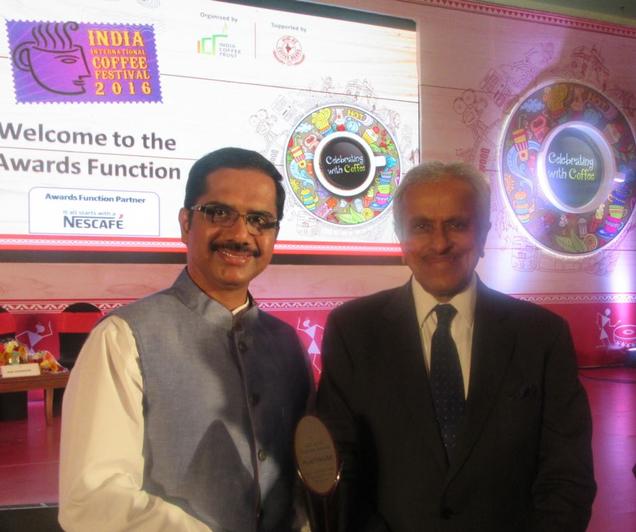
R Nagaraja Rao (on left), Executive Director, Bayar’s Coffee, with R K Krishna Kumar, Trustee of the Tata Trust.
Bengaluru :
Bayar’s Coffee, a leading coffee manufacturing company from Bengaluru, has bagged the ‘Best Roasters Platinum Award-2016’ instituted by the Coffee Board of India and the India Coffee Trust.
The award was presented for adoption of food safety standards, implementation of new technology, and for producing high quality coffee blends.
The award was given at a glittering ceremony held at Mumbai, presided over by Leena Nair, Chairperson of the Coffee Board. R K Krishna Kumar, Trustee of the Tata Trust, felicitated R Nagaraja Rao, Executive Director, Bayar’s Coffee, with the “Best Roasters Platinum Award-2016”.
Expressing his happiness over the award, Nagaraja Rao said, “We have introduced a variety of speciality coffee blends in tune with customer needs. We are happy that Bayar’s Coffee has bagged the award four times in a row. Our responsibility to provide high quality coffee to our customers has increased.”
source: http://www.thehindubusinessline.com / Business Line / Home> Companies / by Anil Urs / Bengaluru – January 27th, 2016
It was in December 1946 that a Constituent Assembly was constituted and it took 3 years for the august body to draft the historic document which enshrines the guiding principles of this country. Members who were active in the freedom movement were inducted through indirect elections from the Central and Provincial Assemblies to represent a broad cross-section of the country.
C.M. Poonacha
The Assembly was further strengthened by inducting legal luminaries such as Dr. B.R. Ambedkar, Dr. K.M. Munshi, N. Gopalaswami Ayyangar, K.T. Shah et al, even though they did not participate in the freedom movement. My father C.M. Poonacha, a leading freedom fighter from Coorg, who was the District Board President at the time, represented Coorg. At 36 years of age, he was one of the youngest members in the Constituent Assembly.
One of the earliest decisions taken was to avoid the Constitution being written only by technical experts or the elite-bureaucracy (Pakistan took this route, and their Constitution has been re-written three times!). The Indian Constitution was drafted through a combination of ‘democratic-consensual’ and ‘elite-bureaucratic’ approach. This has resulted in a resilient and all-inclusive document which has stood the test of time for 66 years.
Another unique feature in drafting the Constitution was to pass every resolution unanimously after extensive consultations and debate. Thus, every clause in the Constitution was discussed until all the members of Committees and Sub-Committees agreed without dissent. None of the resolutions were put to vote to avoid ‘tyranny of the majority.’
Final draft
The final draft of the Constitution of India was signed and adopted on 26th November 1949. C.M. Poonacha was one of the 299 signatories to this revered document (see the last signature in the image). The Constitution of India was brought into force on 26th January 1950 when India was declared a sovereign Republic.
One more distinctive narrative in the Constitution of India is that the nation expects excellence from every citizen. Unfortunately, that is least practiced in recent years, especially by the elected representatives!
Now, the tricycle!
During the course of his duties in the Constituent Assembly, my father took us to Delhi a couple of times. My age was in single digit and my sister was an infant. However, I have vivid memories of Delhi at the time.
Most of the Constituent Assembly members, who came from other parts of the country, were housed in the ‘Constitution House’ on Janpath Road (It does not exist any longer). The accommodation was modest — a studio apartment in a double-storied building complex.
One evening we were window shopping in Connaught Place when a toy-shop attracted my attention. I peeled off and stood watching in awe the colourful toys. I then spotted a tricycle which had a wooden horse head and a horn with a rubber bulb, mounted on its handle. I gingerly asked my father if he could buy it for me. “No, No, it’s expensive and I don’t have the money for it,” he said. My eyes welled-up and I beseeched him again.
Just then, the shop-keeper sidled up to us. ‘Your little boy likes the tricycle sir,’ he said to my father and subtly encouraged me. My parents wanted to distract me and exit the shop as soon as possible. Emboldened by the shop-keeper, I started howling and held on to the tricycle. No amount of cajoling would make me relent. Finally, my father tried to pacify me by saying that we would return the following day with the cash.
But I stuck to my guns and yelled, ‘Nakkikkabondu’ (I want it now!) My sister too joined me in crying. Soon we attracted the attention of others in the shop and my parents were thoroughly embarrassed. I kept hollering ‘Nakkikkabondu…’
The clever shop-keeper suggested that the tricycle could be taken and the payment made the following day. My father had no other option! I proudly pedalled my new possession right from the shop to the tonga we took back to the Constitution House!
Back in the Constitution House, I happily rode all along the corridors. Many luminaries framing the Indian Constitution would tousle my hair, chat me up and admire my tricycle!
About the author: C.P. Belliappa writes humour, history and human interest stories, and is a regular contributor to newspapers, websites and magazines. He holds a Master’s degree in Chemical Engineering from Stevens Institute of Technology, USA. Belliappa currently lives in Coorg.
source: http://www.starofmysore.com / Star of Mysore / Home> Feature Articles / February 19th, 2016
The adivasi (primitive tribe) community is largely sidelined by political parties in the panchayat elections.
In spite of their population of 2.5 lakh in nine districts, the community is given only two zilla panchayat tickets.
The JD(S) has fielded one adivasi candidate in ZP Gonebeddu constituency in Mudigere (Chikkamagaluru district) and a primitive tribal is the Congress nominee in Hanagodu constituency in Mysuru district.
The BJP and the JD(S) have fielded one candidate each in taluk panchayat constituencies.
Adivasis have to be content with just six tickets in taluk panchayat elections.
The community is scattered over Mysuru, Chikkamagaluru, Dakshina Kannada, Chamarajnagar, Kodagu and Ramanagara distrricts.
Heggadevanakote has a population of 20,000 adivasis, Chamrajnagar about 15,000, Kodagu 40,000 including 25,000 in Virajpet taluk and Ramanagaram 15000.
Their leaders Dr Made Gowda and Konare Gowda and others knocked on the doors of big political parties seeking at least eight zilla panchayat and 30 taluk panchayat tickets. But their efforts have not yielded expected results.
Though, there was scope to field adivasis in Lokanahalli, Kawdhahalli, Haradanahalli in Chamrajnagar district, they were not considered.
All the three major political parties have given a good number of tickets for scheduled tribe constituencies to the dominant Nayaka community.
In Kodagu P K Muthu, a tribal leader is contesting in a general constituency and the JD(S) has fielded Muthappa in taluk panchayat polls.
Vivekananda Foundation Director Mallesh said the only consolation is that JD(S) has fielded a tribal for Yaragambahalli seat.
Development Through Education (DEED) president Sreekanth said non-forest tribes have managed to get a lion’s share of ST constituencies as political parties prefer dominant, financial strong and political active communities.
source: http://www.newindianexpress.com / The New Indian Express / Home> States> Karnataka / by K. Shiva Kumar / February 09th, 2016
In Bollywood, Nidhi Subbaiah was last seen in the romcom outing Ajab Ghazab Love. From playing a cool chic, it was time for her to move into a rustic zone with Direct Ishq, a film which has been set in Banaras. In an author backed role where she plays the part of a wannabe rock-star from the holy city, Nidhi knew that she had to look and act the part.
However, she wasn’t prepared for the hardships that were on the way to glory.
“You make it sound really scary, though trust me, I enjoyed every bit of it,” say Nidhi, who is said to have delivered her most ‘bindaas’ performance ever in the romantic musical entertainer, “Yes, Direct Ishq is by all means the toughest role of my life. The weather conditions were really tough.”
Considering the fact that she also had to be seen in rockstar attire for a major part of the film, leather pants and boots were everyday outfits.
Laughs Nidhi, “Yeah, and I got a dose of that pretty early in the day once I was called to shoot for my introduction song – Ganga Maiyya. Swati (Sharrma) has sung it really well and I had to make sure that I get that energy on screen as well. I had to be the kind of rockstar that Dolly Pandey (name of my character) is supposed to be in the film.”
The first step in this direction was to prepare for the role, which means developing the kind of body language that goes with a rockstar.
“I went to YouTube and checked out many videos of live performances. I kept referring to notes for almost 25 days of the shooting. I designed a particular look for myself too. However, if this required good work, there were excruciating weather conditions to deal with as well. With the temperature touching 53 degrees, you can well imagine how it must have felt to shoot outdoors,” sighs Nidhi.
It was all in good time though for Nidhi.
“Not just ‘Ganga Maiyya’, I had to stress myself for Mera Kissa as well. I must have given my body so much pain while shooting these rock tracks that my neck was sprained in a matter few days. However, when I look back at the results, it was all worth it,” she says.
One looks forward to the results on screen once Direct Ishq, with Rajniesh Duggall and Arjun Bijlani as the leading men, releases all over this Friday.
source: http://www.movietalkies.com / MovieTalkies.com / Home> Bollywood News / by Shalini Burman, MovieTalkies.com / February 15th, 2016
Educational Multimedia Research Centre (EMRC), attached to University of Mysore, won two national awards for the documentary film titled ‘DGWT – A cause for Concern,’ in the recently held 6th National Science Film Festival organised in Mumbai. The institute won the Silver beaver award which carries a trophy, a citation and Rs. 50,000 cash prize and also the best graphics award carrying a trophy, a citation and Rs. 30,000 cash prize.
The documentary was directed by Syed Kaleem, Senior Producer of EMRC, Mysuru and Former Director of EMRC, Odisha. This is the second National Award won by Syed Kaleem. The first one was in 2001 for the film on the life of Kodava’s titled ‘Kodavas, The highlanders.’
The best graphics award was received by Chandra Kumar, graphic artiste of EMRC, Mysuru. The film was photographed by Keerthi Kumar, sound effects by Badrinarayana and Somashekar was the Technical Director. The narration of the film was done by Beliappa.
The film highlights the grave danger caused due to depletion of ground water and its long time impact on ecology and environment.
source: http://www.starofmysore.com / Star of Mysore / Home> General News / February 15th, 2016
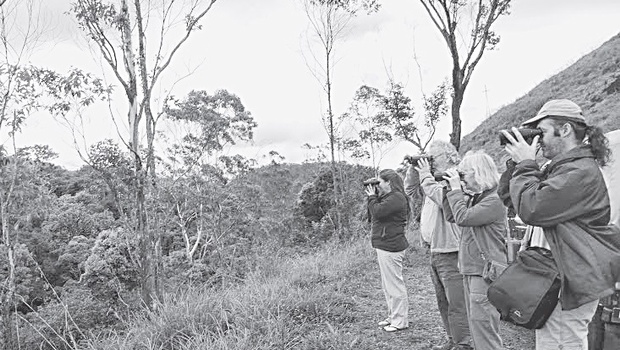
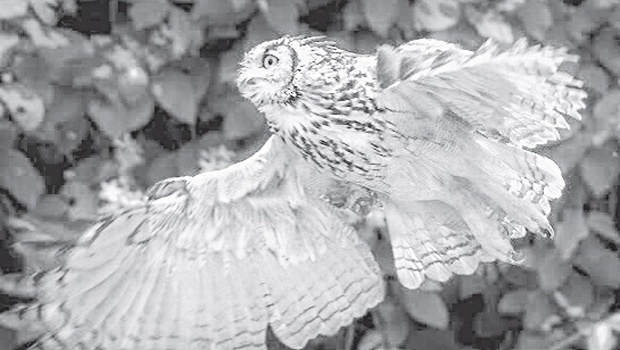
(From left) A kingfisher bird in flight; tourists clicking wildlife; Bopanna Pattada, and a rare sight of flying owl
Bengaluru :
Photographing birds, especially the rare ones in the wild, and spending time outdoors are Bopanna Pattada’s passions. He quit his job as software engineer at Wipro to make his passion a profession. When he realised that he is not the only one in love with birds and Nature, he decided to start India Birding Adventures. Now, Bopanna finds places where photography enthusiasts can get good wildlife and avian shots and arranges trips to these locations. His clients vary from engineers to doctors to businessmen. “I plan one-day trips around Bengaluru. Sometimes we also go on longer trips to Ooty, Masinagudi, Bandipur, Mysuru, Nagarhole and Coorg,” he says. He also takes nature enthusiasts to places like Corbett National Park and Pangot at the foothills of Himalayas.
The best places to spot birds in Bengaluru according to him would be Nandi Hills for winter migrants, Hoskote lake for waterbirds, Ramdevarabetta for vultures, Bannerghatta for forest birds.He doesn’t take more than three to four members at a time. “Firstly, with smaller groups, it is easier to give personal attention and secondly large groups scare the birds away,” he says.
“As a trained photographer and naturalist, I instruct people on photography – what settings to use in which situation, and also help them in spotting birds and wildlife.” The job, for him, is an escape from a sedentary life.
“It takes me closer to nature,” he says. It can be challenging to click birds in flight. Bopanna suggests that the best time to click pictures is either in morning or evening, when they are most active. “Birds tend to be shy. They don’t let you get very close for photographs. Part of my teaching is on how to get closer to birds to take better photographs and also how to position yourself so that the photograph has a nice backdrop.” Bopanna’s images were featured in Sanctuary Asia Magazine and Bombay Natural History Society calendar-2015.
He specialises in photographing birds flying or in action.
Photography enthusiasts can reach Bopanna through his website www.indiabirding.com or bopannap@gmail.com
source: http://www.newindianexpress.com / The New Indian Express / Home> Cities> Bengaluru / by Pratima Shantaveeresh / February 10th, 2016
Coffee growers in Kodagu, Chikkamagaluru and Hassan districts are, however, apprehensive.Many want to know the measures taken to protect small and marginal farmers, who constitute 90% of growers in Karnataka.
Bengaluru :
When coffee growers in Karnataka were going through a rough patch due to labour shortage, elephant menace and unprecedented fall in prices, the Centre in November last year allowed 100 % FDI in five plantation crops: Coffee, rubber, cardamom, palm oil and olive oil. The decision, meant to rejuvenate the sector, is expected to have a huge impact on Karnataka, which accounts for 70% of India’s coffee production.
As of now, 100% FDI is allowed only in tea plantation. “Relaxed FDI norms will help coffee and cardamom growers since it is expected to bring in big overseas investors and retail giants besides enhanced technology utilization, automation, research, management and production of value-added products. Permitting foreign investment will also boost India’s coffee exports offering better prices for growers here, ” says Coffee Board chairperson Leena Nair.
Coffee growers in Kodagu, Chikkamagaluru and Hassan districts are, however, apprehensive. Many want to know the measures taken to protect small and marginal farmers, who constitute 90% of growers in Karnataka. Some coffee growers’ associations are holding talks to oppose the move as they fear small growers would be forced to sell their estates to foreign investors. Their entry may prove detrimental for small coffee planters, who may not be able to match the wages and technology of foreign players.
“The Centre should have held consultations and allayed fears before allowing FDI. But they have done in it in a hush-hush manner and kept us in the dark, making us believe that there is a hidden agenda,” says NK Pradeep, a Coffee Board member from Chikkamagaluru. Former Coffee Board vice-chairman Sannuvanda Kaverappa says a parliamentary committee that visited Chikkamagaluru last year to interact with coffee growers left in a huff. Nair allays all fears of growers saying: “The small-grower segment need not worry as enough safeguards have been provided and the Centre and the state government can always reject any FDI proposal in their segment.”
A Coffee Board executive says FDI will benefit coffee growers. The measure is expected to make the coffee industry vibrant like the tea sector, which opened gates for foreign investments in 2002. “Rather than starting a new venture, foreign investors may partner with existing plantations or trading companies. FDI will help boost developmental activities such as replanting, rejuvenation and R&D that need huge funding. It may also help in upgradation, modernization and automation of coffee-processing, curing, marketing,” he adds.
source: http//:www.retail.economictimes.indiatimes.com / ETRetail.com / Home> Industry / February 12th, 2016
K. Byrappa, Vice-Chancellor of Mangalore University, said that the dictionary, which was being printed, would probably be released in Kodagu itself.
A minority language unfamiliar to many in the State will finally have a comprehensive dictionary of its own with meanings in Kannada and English.
Kodava vocabulary will be captured in Kodava Arivole, which will be published by Mangalore University in March.
Boverianda C. Uthaiah (77) and wife B.U. Thangamma (66) joined forces and compiled the Kodava-Kodava-Kannada-English, which has about 11,000 words.
Mr. Uthaiah is a former professor of agricultural sciences.
According to the UNESCO, Kodava is a ‘vulnerable’ language, said Lokesh K.M., coordinator, Kodava Samskritika Adhyayana Peetha at Mangalore University.
Those knowing Tulu and Malayalam can grasp Kodava takk (language) better as it has common words with these two languages, as well as Persian.
Though the latest statistics on how many speak Kodava takk is not available, according to the 2001 census, only 92,193 people speak the language, Mr. Uthaiah said.
A handicap he faced was trying to include 2,000 words in the lexicon as no one knew their meanings.
Mr. Lokesh, also a professor of History at Mangalore University, said the lexicon has some rare words such as ‘kaju’ (gold) and ‘aarayu’ (water). It has social and cultural terms, and words relating to folk traditions such as ‘jamma’ (a land tenure system in Kodagu with long-standing hereditary rights held by clans), and ‘okka’ (Kodava clan, all of whom have descended from a common ancestor). The dictionary also has botanical and zoological terms.
Mr. Lokesh said though two Kodava dictionaries have been published earlier, they are not comprehensive. I.M. Muthanna’s Kodava Nudi Artha Kosha, the first dictionary published in 1988, gave the meanings of Kodava words in Kannada. In addition, Karnataka Kodava Sahitya Academy brought out a handbook Kodava-Kannada-English Kaipudi in 1988.
K. Byrappa, Vice-Chancellor of Mangalore University, said that the dictionary, which was being printed, would probably be released in Kodagu itself.
source: http://www.thehindu.com / The Hindu / Home> National> Karnataka / by RaviPrasad Kamila / February 12th, 2016
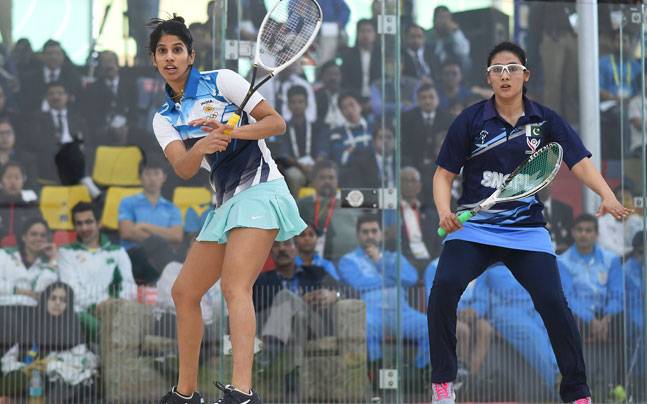
Top seed Joshna Chinappa came back from behind to beat second seeded Toorpaki Wazir of Pakistan to clinch gold at the South Asian Games on Monday.
Star player Joshna Chinappa clinched the gold in women’s individual squash after beating Maria Toorpaki Wazir of Pakistan in a tense and ill-tempered summit clash to make up for India’s disappointment in the men’s event on Monday.
Top seed Chinappa, ranked 14th in the world, recovered from one set down to beat second seeded Wazir 10-12 11-7 11-9 11-7 at the brand new squash facility at the R G Baruah Sports Complex here.(Wrestlers make India proud at SAG)
With Chinappa’s gold, India has so far won three medals in squash with Sourav Ghosal and Harinder Pal Singh Sandhu having grabbed a bronze each after losing to their Pakistani opponents yesterday.
Chinappa, one of the few top Indian players to have opted to play in the SAG, thus gave some solace to the team management after men’s players failed to reach the final.
The women’s final match had all the drama which was witnessed during the men’s semifinals with Chinappa expressing unhappiness to the match officials with the “aggressive” play of Wazir who was seen as trying to be a bit physical with the top-ranked Indian.
Wazir, ranked 50th in the world, won the first set 12-10 after a neck-and-neck contest but she got injured midway in the second set at 7-7 as blood came out of her left eyebrow region after contact with Chinappa and play was stopped for a while to get her treated.
The Pakistani was immediately given first aid and she resumed play after a few minutes. It looked like the break gave Chinappa time to ponder on her game and the glamorous Indian started dominating the match from there on.
Wazir looked tentative just after coming from her injury break and Chinappa did not take much time to take the second set 11-7 and level scores at 1-1.
The third set saw Chinappa taking a 5-2 lead but Wazir came back with some superb shots to make it 6-6 and then 8-6. By then there was tension among the crowd at the stands, but a calm Chinappa just went about her job and brought the score to 9-9 and then 10-9 before taking the set.
In the fourth and final set, Wazir gave some fight initially but later frittered away as Chinappa won it 11-7 to give India the first gold in squash in this edition.
Chinappa later made it known that she was not happy with the way the referees handled the match and that she did not enjoy playing the match as her opponent was “very aggressive” and “not playing fair”.
“Wazir is a good player but she was very aggressive. Fortunately, I won the gold but I did not enjoy playing the final. I play in the professional circuit and there, these kind of things, likes lot of interference and blocking (by rival player) does not happen,” she said after the match.
“I tried to keep myself calm but I had to let them (match officials) know what was happening on the court. I cannot let things happening all the time,” said Chinappa, who argued with the referee on a couple of occasions.
“I am a kind of player who plays fair, without these interfering and blocking etc. Doing all these is not nice for the spectators and also for the game,” she added.
Asked if the referees should have handled the situation better, she said, “I don’t want to be in trouble again but I feel it is their job to control the match and stop all those things. They should have done better.”
source: http://www.indiatoday.intoday.in / IndiaToday.in / Home> News> Sports> Other Sports / PTI / Guwahati – February 08th, 2016
Ace quartermiler MR Poovamma and Asian champion shot putter Inderjeet Singh will spearhead a 68-member Indian athletics team at the 12th SAF Games to be held in Guwahati from February 5-16, Athletics Federation of India (AFI) said today.
Poovamma, who won gold in the women’s 4x400m relay at the 2014 Asian Games, and Inderjeet, a gold medallist at the Asian Athletics Championships in 2015, will be part of the Indian squad which also includes Olympian shot putter Omprakash Singh Karhana.
The Indian athletics team, comprising 36 men and 32 women, will compete in the track and field tournament of the SAF Games which is scheduled be held from February 9-12.
India topped the medal tally in athletics in the previous edition held at Dhaka in 2010, winning 29 medals overall, including 10 gold medals, 11 silver and 8 bronze. The Indian team is expected to face competition from Sri Lanka, which finished second in the medal tally in track and field in the 2010 Games.
This time, the athletics competition will witness 20 events in men and 17 in women respectively at the Indira Gandhi Athletics Stadium, Sarusajai Sports Complex, Guwahati.
AFI President and Olympian, Adille J Sumariwalla said: “The 12th SAF Games is special because it’s being hosted in Guwahati and we hope to notch up maximum number of medals at home.
Though the competition is being held at a time when our elite athletes are in the midst of their training for 2016 Olympics, we’ve tried to select the best possible team under the situation. The team is a good mix of experience and youth and we hope they will return with a rich haul of medals from the 2016 SAF Games.”
Meanwhile, the preparations are in full swing at the various National camps and a number of elite athletes who have qualified for Rio, are also expected to be part of the action at the SAF Games.
The National campers for quarter miles, 400m hurdles and 4x400m relays for both men and women under coach Yuri Ogorodnik returned from a 69-day training stint in Turkey and will reach Guwahati from their present camp in Thiruvananthapuram.
The leading long and triple jumpers in the country who are currently training under Romanian coach Bedros Bedrosian in Thiruvananthapuram are scheduled to participate first in the SAF Games and next at the Asian Indoor Championships to be held at Doha from February 19.
Asian champion Inderjeet Singh is scheduled to reach Guwahati directly from his training centre in the US. However, the organisers have not received enough entries to conduct the men’s hammer throw event, and therefore the event is uncertain till now.
source: http://www.thehindu.com / The Hindu / Home> Sport> Other Sports / PTI / New Delhi – February 01st, 2016
WELCOME. If you like what you see "SUBSCRIBE via EMAIL" to receive FREE regular UPDATES.
Read More »