Reigning CWG champ says life hasn’t changed much despite historic gold in Glasgow
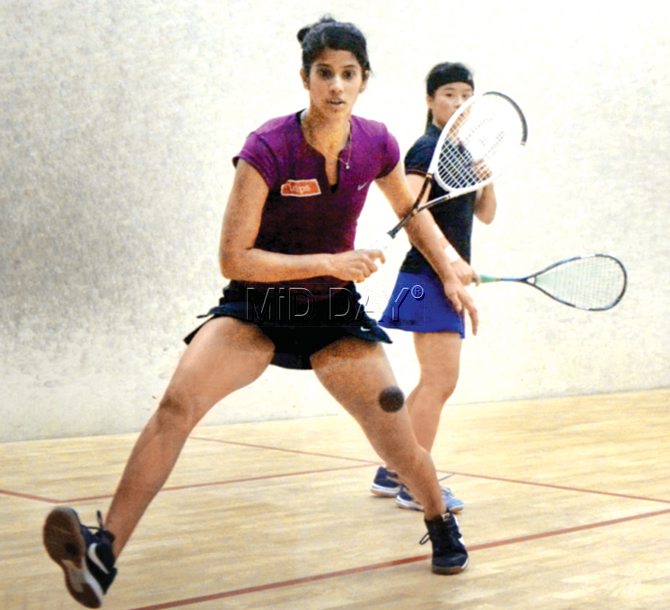
Despite creating history by winning India’s first Commonwealth Games gold medal in women’s doubles squash last year, struggles still continue to be a part of Joshna Chinappa’s life. India’s Joshna Chinappa returns to Hong Kong’s Lee Ka in the women’s singles quarter-finals of the JSW Indian Squash Circuit at NSCI, Worli yesterday. Pic/ Pradeep Dhivar
In the CWG final, the fifth-seed pair of Chinappa and Dipika Pallikal had beaten the top-seeded English pair of Jenny Duncalf and Laura Massaro 11-6, 11-8 in Glasgow.
Yesterday, Chinappa spoke to mid-day on the sidelines of the JSW Indian Squash Circuit event at the National Sports Club of India, Worli.
“I don’t think my life has changed after winning the CWG gold as my struggles still continue. Despite being the No 2 player in the country, funding remains a problem. If you look at a sport like badminton, for example, the system helps players travel abroad for tournaments alongwith their coaches. In squash though we have to pay for everything. The only change that has come post the Asiad and CWG medals is that the government has started providing top squash players some funding.
In our country funding comes easily only if an athlete plays an Olympic sport. But there are players from sporting disciplines like squash and cue sports, who have represented India and achieved a lot, but it’s not good enough to merit funding equal to those who represent play Olympic sports,” said the 28-year-old, who entered the semis of the JSW meet yesterday with a 11-5, 11-7, 9-11, 11-2 win over Hong Kong’s Lee Ka.
source: http://www.mid-day.com / Mid-Day / Home> Mumbai News> National> Columnist / Sports News> Other Sports News / by Sundari Iyer / September 05th, 2015
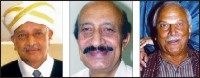
Kodava Federation and Kodava Heritage Centre 1) M.N. Belliappa 2) M.C. Nanaiah 3) K.C. Cariappa
[Continued from August 22]
For a good friend, one would make a journey of a thousand miles and my visit to Bengaluru too was such a journey. A 50th wedding anniversary followed, a day later, by a wedding.
For the couple blessed with 50 years of married life, I wrote in the Visitor’s Book: “50 years of togetherness with understanding and the bliss that comes with it. Great. Here is wishing another 50+ years of wedded glory. — From friends of Dr. Sanmathi and Dr. Nitya.”
This was at Tamarind Tree Resort on the outskirts of Bengaluru on Kanakapura Road. The wedding too was on the same road at a Kalyan Mantap with a mythological name ‘Panchavati Pavilion,’ so far away, roads so bad. A friend asked me at the wedding, ‘Hey, couldn’t they find any other place in such a big Bengaluru?’ I merely grinned, still striving to overcome the tension that gripped us while driving at night to this place. Suffice to say it was a great wedding of the kind only few could afford or organise or spend. Apparently, an exclusive place, far away from the madding crowd, was needed for the wedding to be an extravaganza !
The following day, I found time to meet another friend at the other end of Bengaluru — Vasanthanagar. Mallengada N. Belliappa, Dada to his friends and family. A swashbuckling young Kodava entrepreneur since 1960s in Bengaluru, now a matured senior with commendable record of social service to the people where he lives and to the Kodava community in Bengaluru. A talkative person, he is also a doer bursting at the seams with energy even at this age.
A great philanthropist, every good cause will have him respond instantly and positively. It was under his initiative the first Coorg Public School (1996) at Gonikoppa, Kodagu, was set up, which has become a much sought after residential school. It was again under his initiative that Coorg Institute of Technology (an engineering college), again a first for Kodagu, was established in Ponnampet, South Kodagu (1999).
However, my interest was in the Federation of Kodava Samajas that was set up, again under his initiative, in the year 2000 at Balugodu, off Telllicherry (Thalassery) Road, 3 kms from Virajpet, Kodagu. As one occupied 24X7 as a coffee planter and a builder of many years in Bengaluru and now in Mysuru, Belliappa indeed has a vision for the good of Kodagu and its people. “For Kodagu to be saved from the present exploitation of its land and environment, all the original inhabitants of Kodagu of the days of the Rajas must come together and fight. Specially the prosperous communities — Kodavas and Kodagu Gowdas. The Britishers, known for their divide and rule policy, divided these two communities in 1937 at the time of Amar Sulya rebellion against the British occupation,” says Belliappa. I agree. He smiles and hopes this ‘coming together’ will happen for the greater good of both the communities and Kodagu as a unique geographic area tucked away under the shadow of Western Ghats with rain forests.
I go back to his pet project ‘Federation of Kodava Samajas’ and he goes off at a tangent telling, nay, re-telling the initial trials and tribulations in getting the land, the support extended by the former Minister M.C. Nanaiah etc. The then Chief Minister of Karnataka B.S. Yeddyurappa and the present Chief Minister Siddharamaiah have both generously given substantial amount of money that enabled the Federation to construct the buildings. He regretted that donations from the Member-Samajas and individual donors were not encouraging considering the size and scope of the project.
Belliappa then narrated an incident where a sum of about Rs. 94 lakh that was sanctioned to the Federation by the Union Ministry of Tourism with the help of the then Tourism Secretary, Rathi Vinay Jha, IAS (now retired). I am told that she is the sister of the famous Kodava of Codanda family, late C.G. Somiah, Comptroller and Auditor General of India (CAG). Here is how the Federation lost that grant as told to me by Belliappa.
It appears, Rathi Vinay Jha had come to Virajpet, Kodagu, to inspect the land of the Federation at Balugodu before releasing the grant. After the visit, she stayed overnight as a guest in the house of her relative, a retired high-ranking Army Officer. Well, the next news Belliappa heard was that the grant was diverted to a new entity, conceived by the host Army Officer, called ‘Kodava Heritage Centre’ to be set up in the District Head Quarters Madikeri where it will have maximum exposure, including from tourists, unlike at the Federation site away at the border of Kerala State near Virajpet.
Personally, I thought there was some sense in the idea though Belliappa may not agree. In fact, when the idea of a Federation was first mooted I had told Belliappa that it must be at Madikeri. However, I was told there was no land available in Madikeri, hence Balugodu was chosen.
In retrospect, I wonder, how come the District authorities, who could not find land for the Federation near or around Madikeri, could now find 5 acres of land at K. Badaga village near Madikeri for the Kodava Heritage Centre? Now I learn that the Centre will get another 10.68 acres of land as well. Well, where there is a political and bureaucratic will, there is a way. Where Belliappa and his friends failed, the high-ranking Army Officer, all by himself, succeeded.
M.C. Nanaiah, then MLC, Appachu Ranjan, then (now also) MLA and Air Marshal K.C. Cariappa (retd.), who are members of this Kodava Heritage Centre, should do some introspection on the issue of the Federation not being able to get the land for its establishment in and around Madikeri. Great iconic institutions have always born first in the minds of visionary leaders. Did these leaders lack that kind of vision for locating an important institution of Kodavas like the Federation in right place? I do not know.
Here I must salute Air Marshal K.C. Cariappa (son of Field Marshal K.M. Cariappa) for speaking out on the issue like shooting straight from the hips, as they say. At the meeting held on 24.6.2010 in the Deputy Commissioner’s Office, Madikeri, to discuss about the Kodava Heritage Centre with the DC in the chair, there were members and officials numbering 15 as per the minutes of the meeting. It was only Air Marshal K.C. Cariappa, who had the gumption and honesty to ask, “As I know, a plan is afoot to construct a Kodava Heritage Centre at Balugodu by the Federation of Kodava Samajas and, therefore, what is the purpose of constructing another separate Kodava Heritage Centre in Madikeri? Is it required?”
Surprisingly, M.C. Nanaiah parried the question like a typical politician saying, ‘Since this project is financed by the Central aid, it is not wise to make any change in the project (location).’ I learn, M.C. Nanaiah knew that this Central aid was originally meant for Balugodu project of Kodava Heritage Centre. If so, why did he not support Air Marshal K.C. Cariappa? Of course, Rathi Vinay Jha’s reasoning was sound and sensible when she said that for such a project Madikeri, the District Head Quarters was the ideal location as it would get maximum exposure. It was the very reason why I was asking Belliappa to bide the time to start the project till land is available in or near Madikeri.
How I wish the Federation got this 5+10 acres of land near Medikeri in the year 2000 so that every iconic Kodava-centric project like the Kodava Heritage Centre, Library, Hall of Fame, Kodava War Room, etc., could be located in one place.
Be that as it may, so far the PWD has been given Rs. 153.54 lakh for the construction of this building and Rs. 9.38 lakh is lying without being spent. The total cost has been revised to Rs. 2.68 crore from the original estimate of Rs. 1.45 crore. The Central Tourism Department has released another Rs. 1 crore on 16.2.2015 to the account of the DC. Now, money is no constraint for completing the project, it is the will to complete.
I am left wondering how some good projects lose proper direction because of indifference or ego on the part of the decision-makers as in this case.
Finally, an effort should be made by all concerned to bring this Kodava Heritage Centre, Madikeri, under the umbrella of the Federation of Kodava Samajas. May be, it is possible, if Rathi Vinay Jha co-operates. After all, the ship is greater than the crew! Did you get me Steve?
e-mail: kbg@starofmysore.com
source: http://www.starofmysore.com / Star of Mysore / Home> Abracadabra….Abracadabra / by K.B. Ganapathy /Saturday – September 05th, 2015
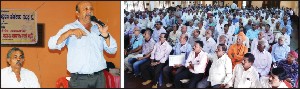
MCCCS Convenor Mookonda Bose Devaiah is seen addressing the Society’s General Body meeting at CITB choultry in Hebbal this morning as Society’s Liquidator C. Girish looks on. Picture right shows a section of members who attended the meeting. Mysuru :
The General Body Meeting of Mysore Coffee Curing Co-operative Society (MCCCS), KRS Road, was held at CITB Choultry in Hebbal here this morning after a gap of 17 years.
The meeting began in the presence of Liquidator C. Girish, with 223 members of the MCCCS attending the General Body, much more than the 115 members required for the quorum.
As soon as the meeting began, the members alleged that the six Liquidators appointed by the Government since 1999, following the ceasing of functioning of the Society in 1998, worked for the downfall of the Society rather than working for reviving it by taking appropriate measures.
The members unanimously demanded the government to recall the Liquidator and restore the composition of the Society which was in place between 1953 and 1998 when it functioned.
Liquidator Girish, who is currently in charge, recorded the proceedings of the General Body and said that the same will be sent to the Registrar of Co-operative Societies for due consideration. It is upto the Government to take further decision on the revival of the Society, he added.
The MCCCS Members Welfare Committee Convenor Mookonda Bose Devaiah, Co-convenors Kolathanda Subramani, K.B. Hemachandra, Alamengada Bose Mandanna, s.p. prasanna, Mathanda c. poovaiah, Kolera Jaya Chengappa, Mahesh, Thirumallesh, Nandu Subbaiah, Arun Machaiah and others were present.
A total of 223 members of the Society from Hassan, Kodagu, Chikkamagalur and Mysuru districts attended the meeting.
Society’s history: Coffee growers of Kodagu, Hassan, Mysuru and Chikkamagalur districts got together in 1953 to establish the MCCCS by procuring 10 acres and 23 guntas of land along KRS road in Mysuru.
The Society, with 1,159 members, functioned normally for many years and had also constructed several godowns. However, when the sale of coffee was freed from restriction and free market was allowed, the Society began to incur loss and gradually ceased functioning in 1998, following which the State Government appointed a Liquidator.
Later on, subsequent Liquidators auctioned 5 acre, 23 guntas of land, besides bringing down the 9 godowns built in the premises, in order to clear the Society’s debts and for various other reasons.
Despite having cleared the Society’s debts and meeting other obligations, the Liquidators tried to dispose off the remaining 5 acres of landed property belonging to the Society, through a public auction, when the members moved the High Court seeking a stay.
The High Court, which heard the Society’s plea, granted a stay on July 9, 2015 against the auction of the remaining landed property which is estimated at more than Rs. 20 crore.
source: http://www.starofmysore.com / Star of Mysore / Home> General News / September 01st, 2015
The Regional Director, Sports Authority of India (SAI), Southern Centre, M. Shyam Sunder, visited Ashwini’s Sports Foundation (ASF) at the Karumbiah’s Academy for Learning and Sports (KALS) at Gonikoppa in Kodagu recently.
Accompanied by other SAI officials, he inspected the Ashwini’s Sports Foundation facility and the synthetic athletic track work which is in progress.
Shyam Sunder expressed happiness over the excellent sports and academic infrastructure and said the ASF environment was an ideal place for national campers to undergo training.
The campus was professionally planned and conveniently located, Shyam Sunder said and appreciated the efforts of all the coaches and athletes on the occasion, encouraging them to enhance performance by using the services of SAI. The SAI and the ASF had partnered with each other for the benefit of sport and community at large, he said, according to a press release from KALS Principal Gouramma Nanjappa.
About ASF: Ashwini’s Sports Foundation (ASF), founded in 2010 by Ashwini Nachappa, one of India’s best known sprinters, is based in Kodagu and shares a 25-acre campus with KALS, a school that she and her husband run. An Asian Games medallist and having represented India at the 1984 Olympics, Ashwini realised the dire need to create a system that will nurture potential athletes consistently. ASF is focussing not just on athletics but also on hockey, once considered India’s national sport.
source: http://www.starofmysore.com / Star of Mysore / Home> General News / August 31st, 2015
The world has a dark fascination about war and particularly the Second World War. The last of the war action may have ended in 1945, but our imagination never seems to stop wondering about the large scale hostilities and the repercussions that wars have come to represent.
Every new book or movie about the Second World War opens us to some aspect of that war not known to people.
Raghu Karnad’s book, Farthest Field – An Indian Story of the Second World War, is what the title suggests and much more. It not only takes us through a journey of three men lost to war, but talks about India’s role in the Second World War and throws in snatches from the country’s nationalist movement that ran concurrently with the war.
Death, we have often believed, has an element of finality. But Karnad says people have two deaths. The first death occurs when they die, and the second when all those who remember them also die. Beautifully put.
The second death is the farthest field from which no one returns, says Karnad, and so the name of his book.
But war, says Karnad, brings the two deaths close, because it “chooses young people most deliberately to die”. A life barely lived, most of these young people lost in wars often end up as photographs.
And it was photographs of three young men that stood on table tops in his grandmother’s house that prompted him to prise open a history unknown not only to him, but to a whole generation of Indians.
These youngsters who stood in the photographs — Bobby Mugaseth, Manek Dadabhoy and Ganny or Kodandera Ganapathy — had their lives intertwined with each other through marriage and through their involvement in World War II. Bobby’s sisters had married Ganny and Manek. Ganny was Karnad’s maternal grandfather, while Manek and Bobby his grand-uncles (his mother’s uncles). Bobby’s sister Nugs (the author’s grandmother) was married to Ganny.
The book opens in Calicut, at the residence of Mugaseths, and follows the personal stories of these three men, a story recreated by the author with the help of research, conversations, chronicles and his own creative mind’s eye.
In the process of recreating the story that started unfolding 80 years ago, Karnad also had to understand the role of Indian Army in the Second World War and the country’s own nationalist movement that was playing out at the same time.
India’s broader role in the Second World War is that it had the largest volunteer army fighting the war for the British Empire. As per Karnad’s estimates, more than two million men and women served in it.
“As a part of the British Empire, India had won its war. Then, ceasing to be a part of the Empire, it won its independence,” says Karnad in his book. To a large extent, one was born of the other and yet India’s part in the world war is absent from its own history, he says.
Bobby’s journey took him to Roorkee training camp and then to Iraq and later to the Burmese frontier to defend India against Japanese forces. Bobby’s life was hell during the last few months with death staring at him daily, but he died of a shot from his own revolver. The gun went off in error was the explanation given. The truth was that nobody would know what caused that death. That was 1944.
By the time Bobby was gone, his brothers-in-law Manek and Ganny were already lost to war. Manek joined the Indian Air Force as a fighter pilot and died in 1943 when he crashed into a mountainside in Manipur. Ganny became an army doctor in North-West Frontier and died in 1942 of bronchitis, at the frontier. “The farthest field is not just a conceit about Bobby’s death but one that applies to all those Indians who were lost to the Second World War,” says Karnad in his afterword to the book.
Undoubtedly, Farthest Field opens up India’s forgotten role in the Second World War and at the same time helps the reader to refurbish memories about the war itself and the events unfolding at home in the country that led to its independence from Britain. The author’s brilliance is evident in the fact that the reader is not only transported to that era, but helps to stay connected with the book until the end.
Delving into the effortless storytelling ability of the book, one can fathom the kind of work the author has put in to bring out this book, probably prompting readers to say that Karnad is a writer to watch out for in the years to come.
source: http://www.deccanherald.com / Deccan Herald / Home> Supplements> Sunday Herald Books / by Latha Venkatraman / August 30th, 2015
Bengaluru’s swish set got to check out interesting fashion over canapes and special concoctions at a cocktail party organized by Jyotiee Balani, beverage enthusiast and food writer co-hosted by Sheraton Grand Bangalore Hotel at Brigade Gateway at their lounge Durbar.
Spotted at the event were actresses Shubra Aiyappa and Tina Ponnappa, along with some of the party regulars.
source: http://www.timesofindia.indiatimes.com / The Times of India / News Home> Entertainment> Kannada / TNN / August 03rd, 2015
Kushalnagar, which is popularly known as the commercial centre of Kodagu district, has many historical monuments which are in a deplorable condition and crying for attention.
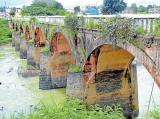
One such structure is the Praserpett Bridge built across River Cauvery, 167 years ago. The bridge, situated near the Kushalnagar Tollgate is 200 metre long and rests upon eight stone pillars of 40 feet wide each. Every pillar is 30 feet far from each other. The specialty of the pillars is that they have been plastered with a ground mixture of sand, eggshell and lime. The pillars from the ground level, are built in the shape of towers.
Every pillar contains valves so as to release the excess water during floods. When River Cauvery is in full spate, people drop by to watch the splendorous scene at the bridge.
The protective walls built on either side of the bridge are built to resemble the constructions in palaces and are intact to this day. The bridge dates back to the regime of Madras Presidency. The then Superintendent of Kodagu W C Hanslow, laid the foundation for the bridge on January 1, 1846. The construction of the bridge was completed in 1848.
The then Madras Governor George Markawis of Twidel and the then Mysore Commissioner Major General Mark Cubbon left the bridge open for public on May 12, 1848. The name of the bridge has been inscribed in English as well as Kannada on marble stone slabs, on either sides of the bridge.
But, after the new bridge was built, the old Praserpett Bridge was completely neglected.
Peepul trees have grown on the protective wall and pillars of the bridge. The people have urged to protect the historical monuments such as Praserpett bridge, Tippu’s Fort and the Old Inspection Bunglow.
Bar Association, Kushalnagar, president R K Nagendrababu urged that the Archeological Dept take an initiative and protect the bridge.
source: http://www.deccanherald.com / Deccan Herald / Home> District / Khushalnagar – DHNS, August 25th, 2015
They have worked in the tea gardens of Assam but in Madikeri they are tending the Coffee plants. Labourers from Assam working in coffee plantations in Kodagu have become a common sight since the past two years.
It is in south Kodagu that more number of Assamese labourers find work in houses and estates.
A few days ago, nearly 200 people arrived from Assam and were divided in teams to meet the demands of the local agents.
According to the labour department officials, there are seven labour camps in and around Kodagu where these people stay.
A few big planters will host some of the Assamese labourers in their own camps in the estates.
In Kodagu, over the years, shortage of labourers have been very severe and existing workers have been demanding more salary and benefits. In 2011, the acute shortage of labour and the high demands of local labourers had put the planters in a spot.
Earlier, the planters were getting labourers from Sullia in Dakshina Kannada and Arasikere in Hassan district, but the Assamese labour comes much cheaper than the usual lot, the officials added.
A labour contractor from Dakshina Kannada, Rajappa Gowda, who takes labourers from Sullia and Puttur every week, says Kodagu has a heavy demand for labourers.
Many escape the labour work in the estates and get into more cozier jobs as servants at home-stays.
But the migrants tend to stay for longer as they get all the benefits, from schooling for their children and higher social security.
Former vice-chairman of Coffee Board of India, Bose Mandanna, told Express that though Assamese workers do not know the scientific work of coffee cultivation, those who settle here learn how to spray, borer tracing and other works. Since all migrants show records like BPL cards, voter IDs and other records, it is the responsibility of the officials to trace fake cards, he says.
However, according to Codava National Council president N U Nachappa, these workers are all Bangaldeshis possessing fake documents. He recalled the protests held early this year urging officials to verify the labourers’ antecedents.
A coffee planter from Gonikoppa told Express, “Since we are getting Assamese labour, demand for more salary from workers who come from far away places cease.”
Another planter from Suntikoppa in Somwarpet taluk said many estates would run into trouble if the Assamese labour did not flow into Kodagu.
The police department have asked all coffee growers to check the documents and collect photos of workers and their family members and submit copies to them without fail.
source: http://www.newindianexpress.com / The New Indian Express / Home> States> Karnataka / by Express News Service / August 24th, 2015
The rain deficit in Kodagu, the origin of Cauvery river, has become a major cause of worry for the farmers here.
As far as the monsoon is concerned, the rainfall seems to be following an erratic pattern.
Heavy rain lashed the district in the beginning of the monsoon causing havoc. Later, it slowed down causing a drought-like situation.
Generally, in the 90-day monsoon season, the rainfall was sufficient for farmers as it was enough to fill the Harangi reservoir. But this year, the situation is different.
Though Harangi is full, Krishna Raja Sagar (KRS) reservoir is yet to be filled as the crest gates in Harangi were opened only once.
Kodagu district received 60 cm of rain in the first 10 days of the monsoon causing floods.
In July and August, rainfall was deficient by 70 and 60 per cent respectively.
Cloud seeding was taken up in Kodagu six years ago, but it was not conducive with the weather here.
According to figures available with Express, the average expected rainfall in January was 5 mm, but the district received 0.3 mm; February – 3.2 mm (5.6 mm expected); March – 37.4 mm (14.7 mm); April – 133.4 mm (73.5 mm); May – 191.4 mm (146 mm); June – 804 mm (486 mm); July – 366 mm (938 mm) and till August 20 – 164 mm (250 mm).
This erratic rainfall seriously impacted the water requirements of paddy, coffee and pepper crops.
The total average rainfall from January to August should have been 2,100 mm, but Kodagu has recorded 1,710 mm. The district is facing a deficit of 300 mm rainfall.
A minimum of 600 mm rain is required on a weekly basis to fill the reservoirs in Kodagu.
source: http://www.newindianexpress.com / The New Indian Express / Home> States> Karnataka / by B C Dinesh / August 24th, 2015
Tourism Department Assistant Director V Phanish has said that there is a need for better facilities at tourist spots all over the district.
“About 30 lakh tourists visit Kodagu district every year and business transactions of Rs 700 crore take place in the district due to tourism related activities. With the completion of work on the Kannur international airport, the inflow of tourists to the district is only expected to increase,” he said.
The official was speaking after inaugurating the Kodagu District Tourist Vehicle Owners’ and Drivers’ Association.
Listing out the tourism-related work carried out in Kodagu, Phanish said, “In the last two years, works worth Rs 12.29 crore have been taken up in the district to support tourism. A proposal of Rs 5.19 crore has been submitted to develop the road leading to Mallalli waterfalls in Somwarpet. The work on the concrete road worth Rs 3.19 crore has also been taken up. A sum of Rs 40 lakh has been released to provide basic facilities at Mallalli waterfalls. In addition, Rs 60 lakh has been released to develop the road leading to Makkala Gudi Betta at Kiragandoor, while Rs 1.53 crore has been released to develop Kodava Heritage to introduce culture and tradition of the Kodagu people.”
Development work on the road and footpath on the Abbey Falls stretch will be taken up at a cost of Rs 20. Senior Motor Vehicle Inspector B S Rajashekar said that an insurance scheme for drivers of private commercial vehicles has been launched by the government.
source: http://www.deccanherald.com / Deccan Herald / Home> District / DHNS – Madikeri, August 23rd, 2015
WELCOME. If you like what you see "SUBSCRIBE via EMAIL" to receive FREE regular UPDATES.
Read More »