Tag Archives: Baba Budan – Indian Sufi Saint

Meet Black Baza, winner of the Speciality Coffee Association Sustainability Award

Arshiya Bose, the founder of this Bengaluru-based “activist company”, traces its genesis, journey and what this award could mean for the smallholder coffee farmers in the country.

Coffee being dried in a remote hamlet | Photo Credit: Special Arrangement

Arshiya Bose feels that a conversation she had in Coorg, back in 2011, when she was pursuing her PhD at Cambridge, was a “pivotal moment” in her journey towards creating Black Baza Coffee. During her fieldwork to understand the impact of global sustainability certifications on farmers, she met the mother of a local grower from India’s coffee cup. “She asked me if I was going to do anything useful after my PhD,” recalls Arshiya, who soon recognised that while it was wonderful to be so deeply immersed in an academic project, “it can be selfish if that was where it stayed.”

This comment made her realise that much could be done to make coffee cultivation more sustainable — something that is increasingly becoming an important aspect of the industry’s long-term viability, considering both the environmental impact of conventional coffee farming and the fact that the bean is particularly vulnerable to climate change. In 2014, after completing her PhD, she returned to India, going on to start Black Baza two years later, naming the brand after a small, migratory raptor with “its own kind of cult following amongst birders, because it displays such interesting behaviours”.

The beginnings were small: 100 kilograms of coffee bought from four different farms. “Now, of course, that number has grown multifold, and we now work with around 650 farms (mainly in Palani, Wayanad and BR Hills),” says Arshiya of the Bengaluru-headquartered “activist company,” which has just won the Speciality Coffee Association (SCA) 2025 Sustainability Awards in the ‘For Profit’ category. This annual award, by the world’s largest global coffee trade association, recognises “excellence in product innovation, design, and sustainability across the industry” with the winners (Fairtrade International won the ‘Nonprofit’ category) being formally recognised for their achievement at Speciality Coffee Expo in Houston in April.

A selection of Black Baza’s coffees | Photo Credit: Special Arrangement

Standards for sustainability

Admittedly, the word ’sustainable’ is a multifaceted, somewhat indefinable concept, with every organisation, brand, company, Government or country understanding the much-used term differently. “Therefore, we had to almost set our own standards for how we wanted to do things,” says Arshiya.

Black Baza only works with smallholder farmers who have already been growing organic coffee and are committed to maintaining and improving the native forest cover on their farms. “The average landholding on where we work is half-to-one-acre parcels of land in very remote parts of the country, with many belonging to tribal communities… people who’ve been historically marginalised and are vulnerable,” says Arshiya, who has a background in community-led conservation. She adds that Black Baza also helps farmers with the post-harvest process, working very closely on building capacity to produce better quality, speciality coffee, both arabica and robusta.

A coffee training programme being conducted | Photo Credit: Special Arrangement

According to her, considerable care was taken to bring in a system of fair, transparent pricing, placing a premium on the coffee’s quality and the farming practices followed, including the attention paid to preserving the local biodiversity. Making coffee farms friendly to local flora and fauna, she says, is an especially crucial mandate of Black Baza since most coffee-growing areas are in places that are also rich in biodiversity. “That is true across South and Central America, parts of Kenya, Uganda, Indonesia, Malaysia, Thailand, Laos, Vietnam, and the Indian Western Ghats too,” she says.

Keeping with this focus on biodiversity, the names of all of Black Baza’s coffees, which are sold in compostable and degradable packaging, are inspired by various indicator species: organisms whose presence or absence offer insights into overall ecosystem health. Think potter wasps, lion-tailed macaques, otters, Indian moon moths, or the Malabar whistling thrush, “species symbolic of the kind of farming practices we like,” she says.

One of Black Baza’s partners with her produce | Photo Credit: Special Arrangement

The coffee conundrum

The popular belief is that coffee came to India in the 17th Century surreptitiously, smuggled from Yemen by the Sufi saint Baba Budan. “It is a sweet story, but that is not really how coffee became a full-fledged plantation industry. It was a colonial project,” says Arshiya, who, as part of her PhD work, spent a lot of her time in the British Library looking at archives to understand how coffee spread in India. “We know that it was the British East India Company that set up an experimental plot in Thalassery, Kerala, and expanded coffee across India from there.”

This expansion, however, came at a considerable ecological cost, with the British clearing vast hills to grow this coffee, later replanting the land with exotic species like silver oak, once they realised that coffee grew better in shade. “And when they left, they handed over their plantations to their favourite people. And that is where this land inequality came about,” she says. While coffee continues to be grown in large plantations, many coffee farmers cultivate coffee on very small tracts of land, making them especially vulnerable to the vagaries of Nature, including climate change, since coffee is especially susceptible to rising temperatures and rainfall pattern fluctuations. “Smallholder farmers are always more vulnerable in the face of any kind of natural disaster, and that is true of coffee as well,” she says.

Arshiya Bose | Photo Credit: Special Arrangement

Working with more farmers, therefore, is high on the list of Black Baza’s priorities, and Arshiya hopes that the recent SCA recognition can help them achieve this goal. “One of the ways we think of doing this is to develop a green coffee programme, and I think something like SCA enables us to now try to look for partners overseas,” she says, adding that getting into coffee exports would allow them to work with even more farmers. “We have also started expanding beyond coffee into other products that our farmers grow, including cardamom and pepper, and hope to open a couple of cafés soon, as well.”

To know more, log into https://blackbazacoffee.com/

source: http://www.thehindu.com / The Hindu / Home> News> Cities> Bengaluru / by Preeti Zachariah / April 16th, 2025

Indian Coffee Brews Global Demand

India’s relationship with coffee dates back centuries. The story begins in the 1600s when Baba Budan, a revered holy saint, brought seven Mocha seeds to the hills of Karnataka. This simple act of planting seeds in his hermitage courtyard in Baba Budan Giri marked the beginning of India’s rise as a significant coffee producer. Over the years, coffee cultivation has transformed from a modest practice into a booming industry. Today, India stands as the seventh-largest coffee producer in the world, with exports reaching an impressive $1.29 billion in the fiscal year 2023-24. This figure is nearly double the $719.42 million recorded in 2020-21.

Growing Global Demand for Indian Coffee

The surge in India’s coffee exports can be attributed to the increasing global demand for its rich and unique flavors. In January 2025 alone, India exported over 9,300 tonnes of coffee, with major buyers including Italy, Belgium, and Russia. Approximately 75% of India’s coffee production consists of Arabica and Robusta beans, primarily exported as unroasted beans. However, there is a notable shift towards value-added products, such as roasted and instant coffee, which is further driving the export boom.

The rise of café culture, coupled with higher disposable incomes, has led to a growing preference for coffee over tea among Indian consumers. This trend is evident in both urban and rural areas. Domestic coffee consumption has increased from 84,000 tonnes in 2012 to 91,000 tonnes in 2023. This shift reflects a broader change in drinking habits, as coffee becomes a staple in daily life for many Indians.

Coffee Cultivation in India: A Rich Heritage

India’s coffee is primarily cultivated in the ecologically rich Western and Eastern Ghats, known for their biodiversity. Karnataka leads the nation in coffee production, contributing 248,020 metric tonnes in 2022-23, followed closely by Kerala and Tamil Nadu. These regions are home to shaded plantations that not only support the coffee industry but also play a crucial role in preserving the natural environment. They help maintain the ecological balance of these biodiversity hotspots.

The Coffee Board of India has launched several initiatives to enhance coffee production and meet the growing domestic and international demand. The Integrated Coffee Development Project (ICDP) focuses on improving yields, expanding cultivation in non-traditional regions, and ensuring the sustainability of coffee farming. These measures are part of a comprehensive strategy to strengthen India’s coffee industry, increase productivity, and enhance its global competitiveness.

Empowering Communities Through Coffee Farming

A prime example of successful coffee farming is found in Araku Valley. Here, nearly 150,000 tribal families have collaborated with the Coffee Board and the Integrated Tribal Development Agency (ITDA) to increase coffee production by 20%. This achievement is supported by loans from the Girijan Co-Operative Corporation (GCC). It demonstrates how coffee farming empowers communities and aligns with the vision of Aatmanirbhar Bharat, or self-reliant India.

These initiatives, along with export incentives and logistical support, play a vital role in expanding India’s coffee industry. They not only improve domestic production but also enhance global competitiveness. As India continues to establish itself as a leading player in the global coffee market, the future looks bright for this beloved beverage.

source: http://www.observervoice.in / Observer Voice / Home> News> National / by Shalini Singh / January 21t, 2025

A Smuggled Secret: Indian Filter Coffee

Jnanendra Das gives an account of the trajectory of coffee in the Indian Subcontinent as Filter Kaapi makes it to the TasteAtlas’ list at number 2!

Indian Filter Coffee or Kappi was ranked second best on TasteAtlas’s list of the best-rated coffee drinks in the world last month. Among the top three were Espresso Freddo from Greece in the third spot, while Cafe Cubano from Cuba grabbed the top spot. But how did coffee reach India?

Legend has it that coffee reached India in the late 17th century hidden inside the beard of Hazrat Shah Janab Allah Magatabi popular by his Sufi name Baba Budan. During his Hajj at that time, Baba Budan was exploring Yemen on his way back to India. In a port city there, he found people drinking this refreshing beverage that he found kept him sharp and awake. He went to find it was made from the beans of a plant. Unfortunately, the city authorities allowed people to take out only the roasted beans so that they couldn’t be germinated and planted elsewhere.

The name of the port you ask? Al Mokka (hence, mocha) in Yemen. The enterprising gentleman smuggled 7 beans (a number considered sacred in Islam) which he planted in a Chikmaglur (Karnataka) hill that later was named after him, Baba Budangiri or the Budan Hills. Coffee spread to Karnataka and commercial estates came up, gradually gaining popularity in India.

Even before this, ground coffee had reached India via the Mughals, creating a thriving café culture in the 16th century. Inspired by coffee traditions in Islamic cities like Damascus and Istanbul, “qahwa-khanas” or coffee houses sprang up in Old Delhi. Coffee, like the famous sticky-sweet brew at the Arab Serai (built in 1560 by Emperor Humayun’s wife Hamida Banu), became integral to the city’s cultural life.

There, poets and thinkers gathered to sip coffee and engage in animated discussions. However, visual records of these coffee houses are sparse, though Rembrandt, inspired by Mughal art, sketched scenes of coffee-drinking men from India. [Source: Spilling the Beans: The Islamic History of Coffee, by Neha Vermani]

In Southern India, coffee was popularised by the British sometime in the 1800s. First, it was commercially grown by the British for export and later became a choice of the Indian elites. Coffee gained nationwide popularity sometime in the mid-1940s, with the Coffee Board of India establishing the Indian Coffee House (ICH). Indians faced exclusion from British-run coffeehouses. In 1936, the Indian Coffee House (ICH) opened in Churchgate, Bombay [now Mumbai], to address this exclusion, bringing coffee culture to the masses.

Thankfully, instant coffee wasn’t an option back then, so coffee was made from freshly ground, roasted beans, capturing the full depth of flavours and essential oils that make it truly unique. Roasting coffee beans triggers the Maillard reaction, which releases over 800 flavour molecules. This includes pyrazines for a nutty, roasted aroma; aldehydes, adding sweet, fruity, and floral notes; and ketones, which create buttery, caramel-like scents. The South Indian coffee filter method preserves these flavours and essential oils better than other brewing techniques—such as the espresso maker, Aeropress, or pour-over—where paper filters can absorb some of the oils.

To this day, ICH across the country uses the filter coffee method to prepare their coffee beverages.

Coffee has a longer history in India than tea. By the early 20th century, large-scale cultivation had taken root in places like Coorg and Chikmagalur, helped by the rise of South Indian Brahmins, a new social elite in British bureaucracy, who championed filter coffee as a cultural staple. Ironically, while filter coffee became associated with this elite class, it was also blended with chicory, a practice introduced by the British to stretch coffee supplies during shortages. Rather than being seen as “adulteration,” however, chicory gained acceptance for the woody, caramel-like notes it added, creating a distinct flavour that sets filter coffee apart from espresso-style drinks.

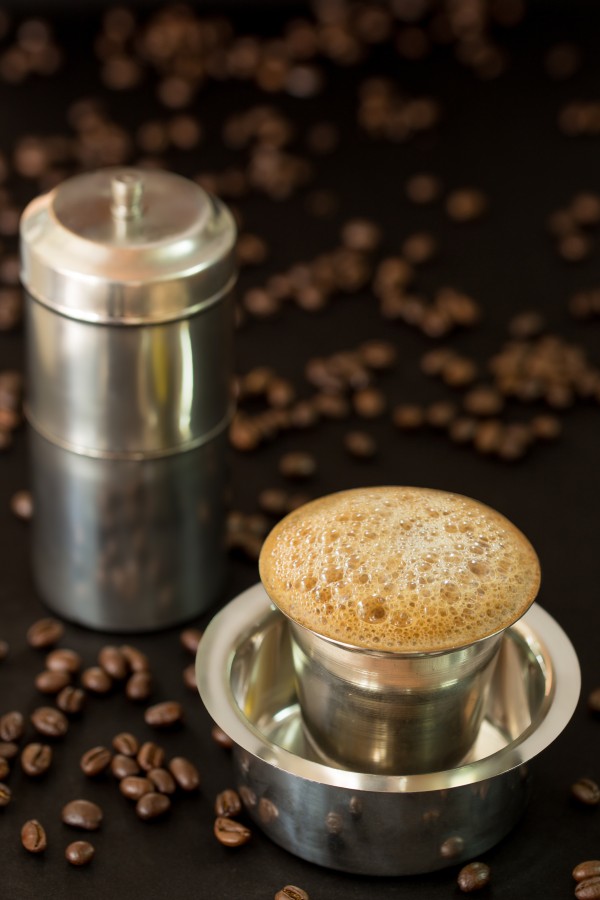
Indian filter coffee (as the TasteAtlas ranks) is a preparation technique in which coffee is brewed with the use of a two-chambered coffee filter. The upper one with a perforated bottom is used to hold ground coffee and the bottom one in which brewed coffee is slowly dripped just by the force of gravity. No electricity or external force is required. There is also a tamper or a press that comes along with the filter set.

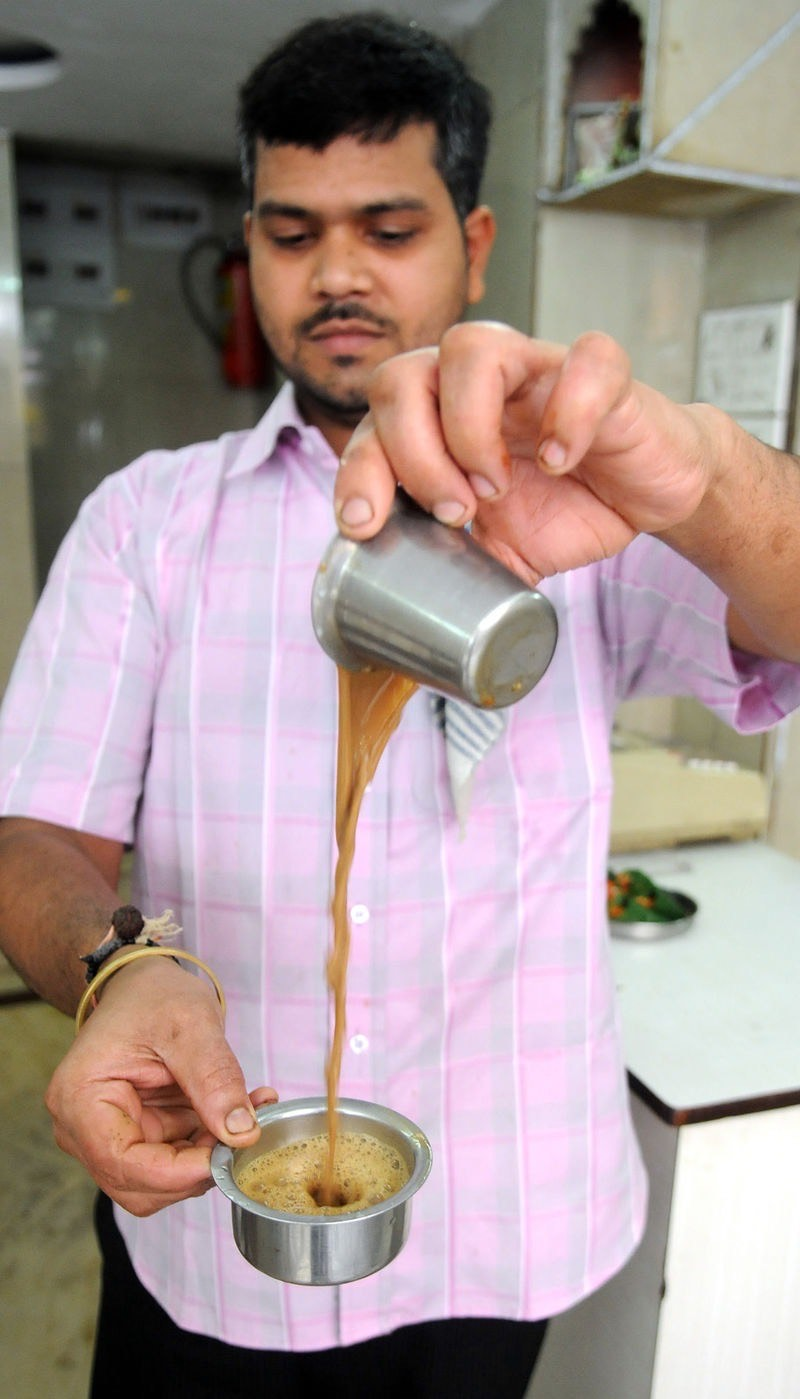
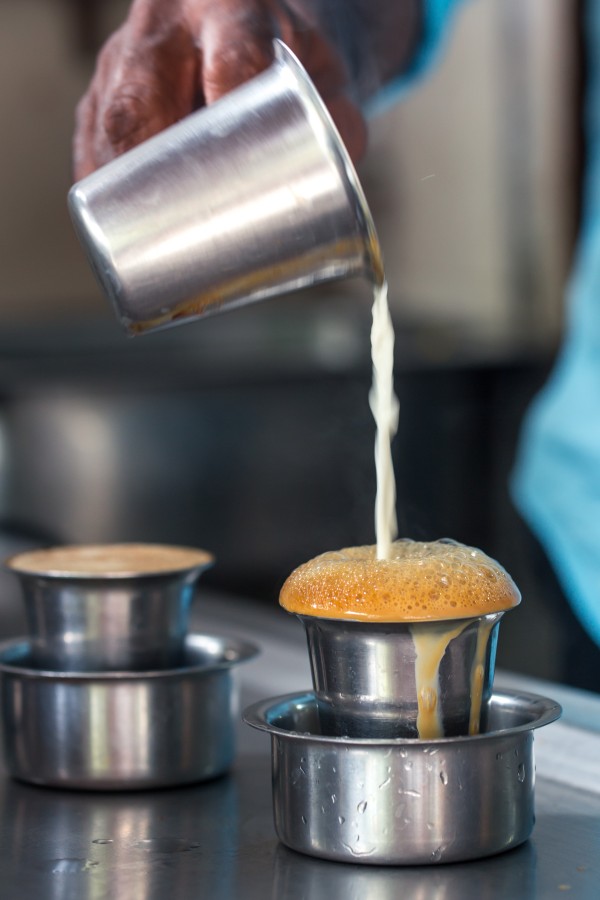
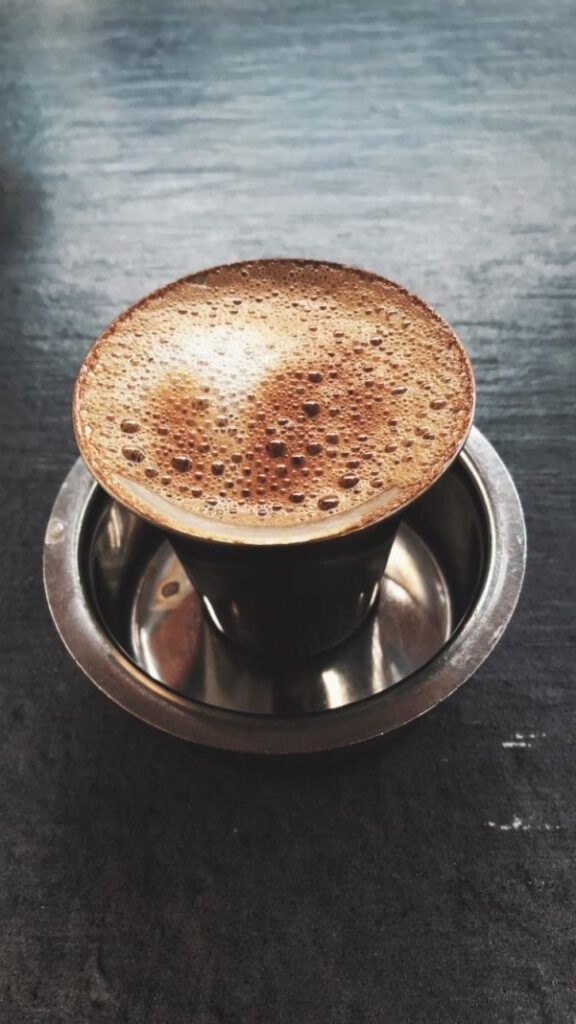
This brewing technique results in a richly-flavoured, full-bodied coffee that is usually mixed with milk and sweetened with sugar. It is traditionally served in a tumbler with an accompanying saucer (davara). Sometimes, the combination of coffee and warm milk is continuously poured from one vessel to another until it is aerated and becomes frothy.

Here’s a quick and simple recipe that many southern Indian households follow for authentic filter coffee, traditionally made with a mix of coffee and chicory (ideally an 80:20 ratio).

Ingredients (Serves 2)

1. 4 tbsp ground coffee

2. 200 ml boiling water

3. Sugar (optional)

4. Hot milk

Brewing Method

Step 1: Pack 4 tbsp ground coffee in the upper perforated chamber of your coffee filter, press it with the tamper and let it sit there.

Step 2: Slowly pour boiled water into the top chamber and let gravity do its magic.

Step 3: Wait 15–20 minutes for the decoction to collect in the lower chamber.

Serving

  1. Add 1 tbsp of sugar to your tumbler, if desired.
  2. Pour the decoction into the tumbler until it fills about one-third of the way.
  3. Top up with warm milk. If you prefer it black, you can replace the milk with warm water for a bold, undiluted taste.
  4. Pour the coffee back and forth between the tumbler and saucer to mix and create froth.

Enjoy your strong, frothy filter coffee, crafted with care and tradition!

There is life before and after you filter coffee. Once you have had great filter coffee, it is nearly impossible to go back to instant coffee. Coffee is a complex subject where every little thing matters but ‘Indian Filter Coffee’ makes it simple where you don’t have to buy expensive brewing kits or gadgets.

Finding a traditional filter and davara in Meghalaya may be challenging, but they’re available on various online stores for under a thousand rupees. As for the coffee itself, Meghalaya is blessed with altitudes over 4,000 feet and a unique climate, making it ideal for cultivating distinctive, high-quality coffee. Local brands like Smoky Falls Tribe Coffee, endorsed by the Meghalaya Basin Development Authority, are bringing Meghalaya’s indigenous coffee to the global stage. Other notable North Eastern brands like 7000 Steps and Naga Coffee are also producing some of the region’s finest coffee blends.

Consumption of caffeine should be in moderation. The Mayo Clinic recommends that most healthy adults consume less than 400 milligrams (mg) of caffeine per day. This is roughly the amount of caffeine in four cups of brewed coffee.

Over centuries, coffee has seamlessly woven itself into India’s social and culinary fabric, where its preparation has become an art form, encapsulating flavours, aromas, and a distinct frothy texture that makes it unique. Today, Indian filter coffee is an evolving taste offering coffee lovers worldwide a simple yet deeply satisfying brew.

Image Links: https://upload.wikimedia.org/wikipedia/commons/thu

source: http://www.theshillongtimes.com / The Shillong Times / Home> Sunday Pullout / by Staff Reporter / November 10th, 2024

India: the tea-loving country with a taste for coffee

It’s the crack of dawn, and the tranquil lanes of Bangalore are gearing up for the incoming hustle and bustle. Along with the rays of sun that seep through the canopy of trees, the whiff of freshly brewed filter coffee, commonly referred to as filter kaapi, infiltrating the air marks the beginning of the day. 

While studying in Bangalore, filter kaapi became my sole source of caffeine owing to its potency and affordability. A trip to the coveted neighbourhood Darshini, an eatery serving all-day breakfast and other South Indian vegetarian delicacies, easily fell into my morning regime. I was one of the thousand patrons visiting this institution regularly for golden dosas, crispy vadas, fluffy idlis and, of course, the pièce de résistance, a strong cup of coffee served in a dabara set (brass tea cup and tumbler).

Filter kaapi is made through quite a different process from Western filter coffee. Image: Kaapi Melbourne

How did the tea-loving nation inculcate coffee into their daily life? 

The answer dates to the 16th century when Baba Budan, an Indian Sufi saint, chanced upon these aromatic beans in Yemen during his pilgrimage to Mecca. The Arabs safeguarded these beans to maintain a monopoly of the growth and export and sold them only in their roasted form, disabling buyers from growing coffee on their home grounds. The Sufi saint is claimed to have smuggled seven coffee seeds to India, with his beard as the vessel. He then planted them in the Chandragiri hills of the Western Ghats, where coffee plantations flourished.

For nearly two centuries, the consumption of bean juice was limited to the surrounding area of the hills. It wasn’t until the 1830s, when the British arrived on the fertile soil of Coorg in South India that coffee became cultivated on a larger scale. Apart from the still-standing architecture, the British also left behind the knowledge of coffee farming, which evolved as it seeped through generations. In 1854, an Englishman named John Fowler developed the first coffee plantation in Coorg. Since then, almost every Kodava (locals of Coorg) household started growing their own Arabicas and Robustas, perfecting them over the years. 

According to legend, coffee beans in India were first planted in the Chandragiri hills of the Western Ghats. Image: Fidha Fathima

Amongst the belts of Western Ghats, parts of Karnataka, Tamil Nadu, Kerala, and Eastern Ghats of Andhra Pradesh and Odisha, the fertile soil and shade-filled surrounding is perfect for growing coffee beans. As a result, coffee consumption in South India grew exponentially, and India became one of the leading producers of coffee. For many decades and even today, the familiar sounds in South Indian kitchens are the morning whistles of the pressure cooker accompanied by a faint trickling of the coffee in the brewer. 

How is it different from the Western filter coffee? 

While the idea behind filtering coffee is the same as the Western filter coffee, the difference in the process is worlds apart. A special cylindrical steel apparatus with two components is used to make the coffee; the first component has a perforated bottom and a plunging disc to press the coffee down, allowing it to drip-feed, and the second collects the coffee decoction. The mighty decoction is topped with boiling-hot milk and frothed manually, often theatrically with long high pours between two cups. A copious amount of sugar is added, creating a potent cup of delectable coffee that will jolt a lightning-quick wave of caffeine in your nervous system and is probably capable of waking up a sedimentary rock. 

The difference lies not just in its process, but in the beans used, which are usually medium to dark roast. Most coffee roasters package a blend of coffee and chicory; this practice started in France to stretch limited supplies and was adopted globally. Over time, this resulted in the birth of Scottish ‘Camp Coffee,’ a syrup made of coffee and chicory essence infused with sugar. The infusion was a timesaver for the Scottish regiment in the British Army; who has the time to brew coffee when you have a nation to demolish? The consumption of Camp Coffee extended to the British and Indian soldiers, who slowly acquired a taste for coffee made from syrup. Today, as we have elevated our coffee game, the blend continues to stay and is quite popular owing to the added flavour and benefits of chicory. 

Image: Kaapi Melbourne

What are the different variations of kaapi, and how can I have it in New Zealand? 

Akin to our food, coffee took many forms and shapes as it crossed state and regional borders. Coffee connoisseurs also sought different ratios of coffee chicory blend, 80:20 being the most popular. Coorg is famous for Bella Kaapi, black coffee made with jaggery to combat the bitterness, and Sukku Kaapi in Kerala and Tamil Nadu is black coffee with palm sugar, dried ginger and ground coriander, a common remedy for cold and cough. Tamil Nadu is also home to Kumbakonam degree coffee, made with fresh milk straight out of the cow. Under the South Indian filter coffee umbrella, the variance lies in the coffee chicory ratio, type of beans used, additional ingredients and the brewing process. 

As a filter coffee fanatic, the hunt to find one in New Zealand was eminent, and many Sundays were spent scouring the best South Indian filter coffee. Like stale eggs in a pot of water, my search brought a handful of eateries to the surface. However, it did have a silver lining. Along with filter coffee, the search brought to light authentic dosa, idli, vada, and kesari bath (a sweet dish made of semolina) accompanied by bowls of coconut chutney and sambar. Here’s where you can sink your teeth into them:

Saffron and Maya’s South Indian Bistro: Both well-known institutions in the South Indian circle, and the queues outside the venue on Saturdays and Sundays are a testament to that. On weekends, they serve a South Indian-style breakfast buffet, both delicious and a bargain. A small cup of filter coffee is offered at the end to finish the meal.

RRK’s Madras Café: A new kid on the colourful block of Sandringham that is quickly turning out to be one of the top-notch South Indian restaurants in Auckland. The unassuming eatery specialises in food from Tamil Nadu; their Chicken Kothu Parotta, chicken and flaky paratha chopped up into pieces with a coveted blend of spices, is worth braving the heat, and their filter coffee is highly recommended.

Sahana South Indian Restaurant: Another hit amongst the circle, the eatery serves homely South Indian fare all day long. The weekend vegetarian buffet features a diverse range of breakfast and lunch items with new weekly off-menu specials. Pro tip: Call ahead and make a reservation for flawless service.

Other mention-worthy eateries to get your caffeine fix are Saravanaa Bhavan and Satya Chai Lounge in Auckland, South Indian Bala’s Kitchen in Hamilton, and Dosa Etc in Dunedin.

For those who wish to master this at home, Malgudi Days in Australia holds an inventory of coffee beans sourced all the way from South India, the filter coffee-making apparatus and even the dabara sets for you to have that wholesome experience of savouring a cup of filter coffee. Click here to check out their brewing guide.

– Asia Media Centre

source: http://www.asiamediacentre.org.nz / Asia Media Centre, Asia New Zealand Foundation / Home> Features / by Anusha Kulal / November 01st, 2023