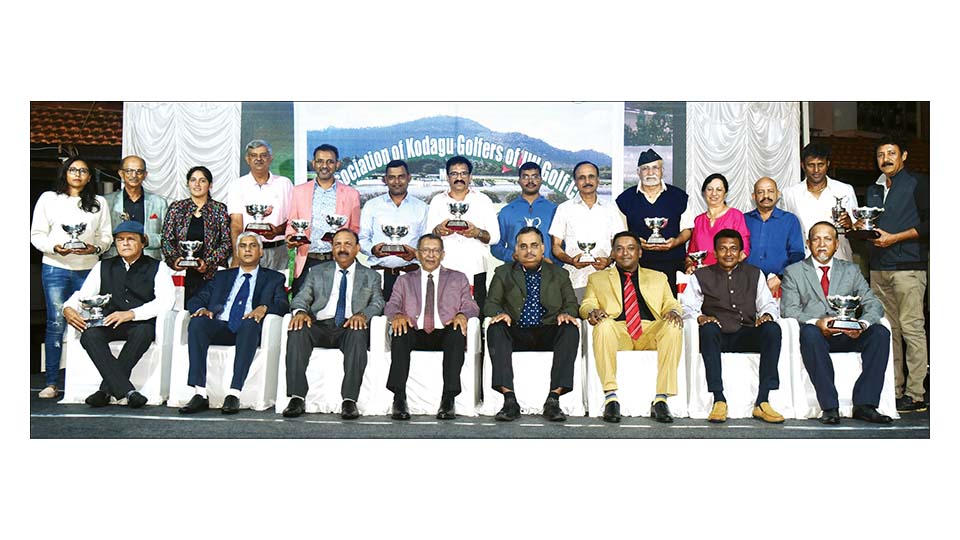
Following are the prize winners of the 23rd Edition of Kodagu Golf Open Championship-2024 held at J.W. Golf Club, Mysuru, on Nov. 30 and Dec. 1:
Strokeplay Gross – Field Marshal Cariappa Memorial Trophy, sponsored by K.C. Biddappa: Shridhar Singh (74 Gross) – Winner; K.A. Anil Kumar (77 Gross) – Runner (Better Back 9 Over M.C.S. Manohara).
Strokeplay Net (H/C 0 to 12) – Gen. K.S. Thimmaiah Memorial Trophy, sponsored by Mandovi Motors: I.K. Anil (68 Net) – Winner (Better Back 9 Over Sonam Chugh); Sonam Chugh (68 Net) – Runner (Better Back 9 Over M.C.S. Manohara).
Strokeplay Net (H/C 13 to 18) – Sqn. Ldr. M.B. Chittiappa Memorial Trophy, sponsored by Mallengada B. Nanaiah: J.N. Arjun (62 Net) – Winner; Ram Kevalur (68 Net) – Runner (Better Back 9 Over K.C. Vishwananda Bhat & Janardhan Babu).
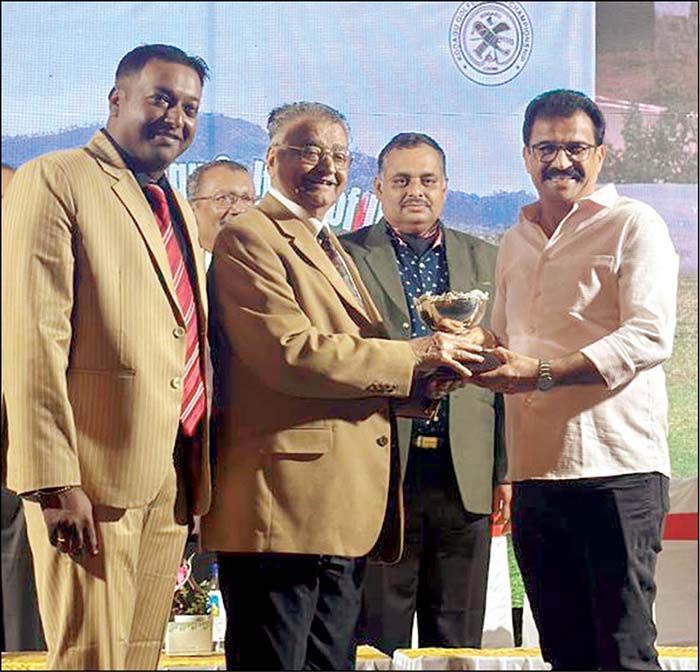
K.B. Ganapathy, Founder-Editor, Star of Mysore and Mysuru Mithra, seen presenting the trophy to K.C. Vishwananda Bhat (38 Points), runner of Stableford Net (H/C 0 to 18) – Kodagu Warriors Trophy sponsored by Star of Mysore, as others look on.
Stableford Net (H/C 0 to 18) – Kodagu Warriors Trophy, sponsored by Star of Mysore: Dr. T.M. Prashanth (39 Points) – Winner; K.C. Vishwananda Bhat (38 Points) – Runner (Better Back 9 Over Janardhan Babu).
Stableford Net (H/C 19 to 24) – Kodagu Challenge Trophy, sponsored by P.C. Naren Uthaiah: B.S. Sathyanarayan (40 Points) – Winner; Madhushree Srinivasan (38 Points) – Runner (Better Back 9 Over A.S. Somesh, K.N. Theerthananda & M.B. Nanaiah).
Stableford Net (H/C 0 to 18) – Kodagu Warriors Trophy, sponsored by Star of Mysore: Dr. T.M. Prashanth (39 Points) – Winner; K.C. Vishwananda Bhat (38 Points) – Runner (Better Back 9 Over Janardhan Babu).
Stableford Net (H/C 19 to 24) – Kodagu Challenge Trophy, sponsored by P.C. Naren Uthaiah: B.S. Sathyanarayan (40 Points) – Winner; Madhushree Srinivasan (38 Points) – Runner (Better Back 9 Over A.S. Somesh, K.N. Theerthananda & M.B. Nanaiah).
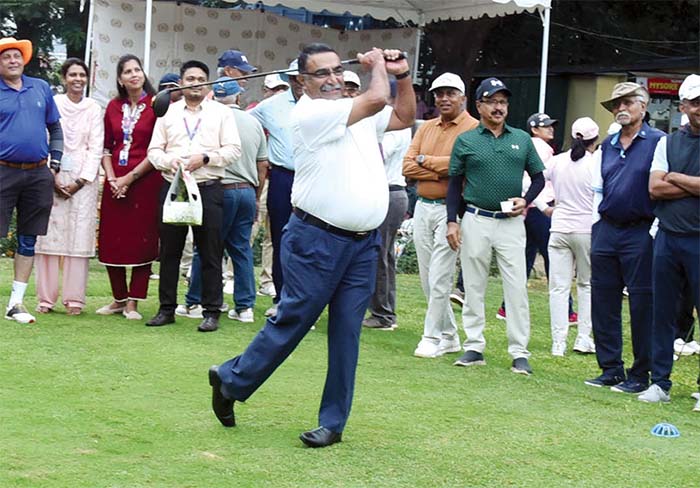
P.M. Ganapathy, Senior Member, Association of Kodagu Golfers of JWGC, teeing of the Kodagu Golf Open Championship-2024 on Nov. 30.
Best Lady Golfer – Stableford Net (H/C 0 to 24), sponsored by C.B. Changappa: Priya Kushalappa (36 Points) – Winner.
Fortunate Golfer – Sponsored by Brig. N.N. Madappa: M. Ramesh – Winner.
Nearest to the Pin – 2nd Hole – Sponsored by Col. C.P. Medappa: A.S. Somesh (7 Feet 2 Inches) – Winner.
Nearest to the Pin – 6th Hole – Sponsored by Travel Parkz: Dr. Anthony Fernandes (8 Feet 5 Inches) – Winner.
Nearest to the Pin – 12th Hole – Sponsored by Praveen Chengappa: Ram Kevalur (11 Feet 10 Inches) – Winner.
Crooked Line – 16th Hole – Sponsored by K.B. Kushalappa: Rick Van Vliet (On The Line) – Winner.
A total of 270 golfers took part in the Championship, according to a press release from Tournament Sub-Committee Chairperson Sonam Chugh and Hon. Secretary V.G. Achar.
source: http://www.starofmysore.com / Star of Mysore / Home> Sports / December 03rd, 2024
Coorg’s lush landscapes are evolving, with century-old coffee plantations now sharing space with thriving rows of avocado trees, writes GYANESHWAR DAYAL
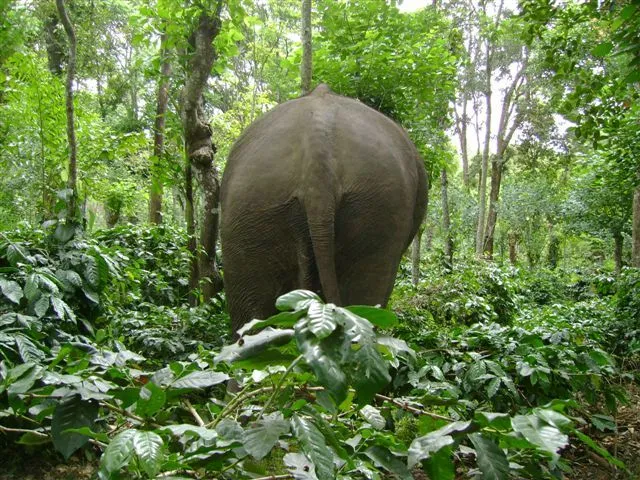
As I pack my bags in Delhi the AQI is reading staggering 430, the smog has dawned on the city and there is heaviness in the air, eyes burning, breathing is an effort to be undertaken. The touchdown in Kempegowda International Airport Bengaluru is smooth the temperature is almost at par with Delhi but air is breathable. The five hours journey to Coorg is tiring but relaxing scenery changes from rocky to green to lush green, on the way you get to see the Gabbar Singh’s den, the place where Sholay film was shot some 40 years back. On the way we have elephant family waiting for us by the roadside and snake crosses the road as drives pushes the brakes. Yes, all of us have right to live, even snakes!
It is night already and the day is done without much fuss as we retire in 140-year-old property a British bungalow now a tata property -Taneerhulla in ama coffee trail. The morning view from the window is fascinating, Delhi smog has given way to Coorg fog, and AQI has dropped to 43! I take a deep breath, as if to store this purity and carry it back home.
Coorg, or Kodagu as it is known in Kannad is nestled in the heart of the Western Ghats, has a fascinating history shaped by its strategic location, natural resources, and the allure of its spices. This region has been a magnet for traders, rulers, and explorers, each drawn by its bounty and beauty.
The history of Coorg dates back to ancient times, with its mention in early Indian texts like the Sangam literature. The region was originally home to indigenous tribes like the Kodavas, who developed a rich culture centered around nature and agriculture. Kodavas are known for their martial traditions, unique customs, and close-knit community life, which continue to define Coorg’s identity today. Over centuries, Coorg saw the rise and fall of several South Indian dynasties, including the Cholas, Gangas, Hoysalas, and Kadambas. These rulers left their imprint through temples and forts, which stand as silent witnesses to the region’s historical significance.
By the 15th and 16th centuries, the fame of the Western Ghats and their riches spread beyond India’s borders. The spice trade was the primary lure, as Coorg, along with other parts of the Western Ghats, became a significant source of black pepper, cardamom, and other exotic spices. The Portuguese were among the first Europeans to set sail for India, with Vasco da Gama’s arrival in 1498 marking a new era of trade and conquest. Soon, Dutch, French, and British traders followed, vying for control of spice routes. Coorg, though a landlocked region, became an integral part of these trade networks due to its fertile hills and spice plantations.
In the early 19th century, the British annexed Coorg after defeating the local ruler, Chikka Veerarajendra, in 1834. Recognising Coorg’s agricultural potential, the British transformed its economy by introducing coffee cultivation alongside spices. This was the beginning of coffee plantation on commercial scale in Coorg and has stayed that way since. Coffee thrived in the region’s climate, and Coorg became one of India’s premier coffee-producing areas. The planters were of course the British who lived near their plantations. Their Bungalows dot the place and the one we stayed was of course belonged to a British. The British also admired Coorg’s natural beauty. Coorg is often referred to as the “Scotland of India” for its rolling hills, misty valleys, and temperate weather. Under British influence, the Kodavas were granted special privileges, including exemption from the Arms Act, which allowed them to retain their traditional firearms-a legacy still continues.
The Western Ghats, a UNESCO World Heritage Site, are among the most biodiverse regions on the planet. Stretching over 1,600 kilometers from Gujarat to Kerala, these ancient mountains are home to an astonishing variety of flora and fauna.
In Coorg, the Western Ghats reveal their most enchanting side. Dense forests, gurgling streams, and cascading waterfalls dominate the landscape, making it a paradise for nature enthusiasts. The forests host an incredible range of plant species, from ancient trees to medicinal herbs. They are especially known for sandalwood, teak, and bamboo. The Western Ghats are a haven for wildlife, including tigers, elephants, gaurs, and numerous endemic species like the Lion-tailed Macaque and Malabar Civet. The Ghats are also critical for the region’s agriculture, providing a fertile environment for growing coffee, spices, and now avocados.
Coorg’s history is a blend of ancient traditions and modern influences. Its spice heritage continues to thrive alongside its renowned coffee plantations. Now, with the introduction of avocado cultivation by Westfalia Fruit, Coorg is stepping into a new chapter of agricultural innovation.
Tourists visiting Coorg can trace its history through ancient temples, forts, and colonial-era bungalows, all while enjoying its natural beauty and rich culinary traditions. The intertwining of the Western Ghats’ biodiversity with the cultural tapestry of Coorg makes it one of India’s most enchanting destinations.
Coorg’s identity is deeply intertwined with its coffee plantations, which have been the backbone of its economy for decades. Introduced by Baba Budan in the 17th century, coffee found an ideal home in Coorg’s rich soil and temperate climate. Today, the district is one of India’s leading coffee-producing regions, renowned for its Arabica and Robusta beans.
The plantations, often set against misty hillsides, not only produce world-class coffee but also create picturesque landscapes that attract tourists. Coffee estate tours allow visitors to learn about the journey of coffee beans from farm to cup, making them an integral part of the Coorg experience.
Located in southwestern Karnataka, Coorg is a verdant hill station known for its cool climate, scenic views, and pristine environment. It is part of the UNESCO -listed Western Ghats, one of the world’s biodiversity hotspots. The region’s dense forests, cascading waterfalls and diverse wildlife make it a haven for eco-tourism and outdoor activities such as trekking, birdwatching, and nature photography.
Some must-visit spots include the Abbey Falls, Raja’s Seat, Dubare Elephant Camp, and the Brahmagiri Wildlife Sanctuary. The Kaveri River, originating from Talakaveri in Coorg, adds to the district’s charm, serving as a lifeline for the southern states of India.
While coffee remains Coorg’s hallmark, the region is now witnessing a burgeoning avocado revolution, led by Westfalia Fruit, a global leader in avocado production. Recognising Coorg’s favourable climate for cultivation, Westfalia has established a state-of-the-art avocado nursery in collaboration with Sam Agri and Dvori-Or Nursery. The initiative focuses on growing high-quality Hass and other commercial avocado varieties.
The saying, “Where tea and coffee grow, avocados can grow better,” perfectly describes Coorg’s potential. Its tropical climate, high elevation, and fertile soil make it an excellent location for avocado farming. Westfalia’s meticulous approach to planting, nurturing, and harvesting ensures that the avocados meet global quality standards.
Westfalia has already contributed to planting over 500 acres of avocado farms across India, with a target to exceed 1,000 acres by 2026. The Coorg nursery plays a critical role in supplying premium rootstock and planting material, ensuring sustainable practices and high yields. For coffee farmers, avocados offer a promising diversification crop, creating additional income streams and contributing to rural development.
Westfalia, in partnership with the World Avocado Organisation (WAO), is driving efforts to educate Indian consumers about the health benefits and culinary versatility of avocados.
Campaigns like “Avocado Ki Paatshaala,” led by celebrity chef Sanjeev Kapoor, have been instrumental in popularising the fruit.
We get hands on lessons on avocado grafting and cloning the techniques Westfalia is introducing in Coorg for avocado plantation sooner than later Coorg avocados would be available across the country. Avocados is one of the healthy diet options which can served in several avatars from avocado-on-toast to guacamole and even avocado shake and ice cream. This is going to benefit the local farmers as well as they can four to five times the amount they make on coffee.
Coorg’s transformation from a coffee giant to a hub for avocados signifies its adaptability and progressive approach to agriculture. Visitors to Coorg can now enjoy not only a cup of freshly brewed coffee but also a taste of locally grown avocados, blending wellness with indulgence.
Whether you’re exploring its lush landscapes, learning about coffee cultivation, or witnessing the avocado revolution, Coorg offers a unique journey through nature and innovation. This jewel of Karnataka remains a must-visit destination for travellers and a shining example of India’s agricultural potential.
As the time to leave draws near, I find myself reflecting on the air of Delhi and take one last, deep breath of Coorg’s pure, refreshing atmosphere. The aroma of spices beckons us to the local market, where we gather handfuls of fragrant treasures and, naturally, Coorg’s signature Arabica and Robusta coffee. With our bags filled with spices, coffee, and the newfound delight of avocados, we bid farewell to this enchanting land and set out on the highway to Bengaluru. As we journey home, our hearts are brimming with memories that promise to call us back. Coorg is a place one longs to return to-sooner rather than later.
source: http://www.dailypioneer.com / The Pioneer / Home> Sunday Edition> Agenda> Travel / by Gyaneshwar Dayal / December 01st, 2024
Having nearly doubled its India footprint over the last 12 months to reach 75 stores across 30 cities, Jaipur-based Nothing Before Coffee has now set its sights on international growth.
World Coffee Portal speaks to two of the brand’s co-founders, Akshay Kedia and Anand Jain, about balancing affordability with a premium experience, launching in Europe and why the time is right to seek external investment.
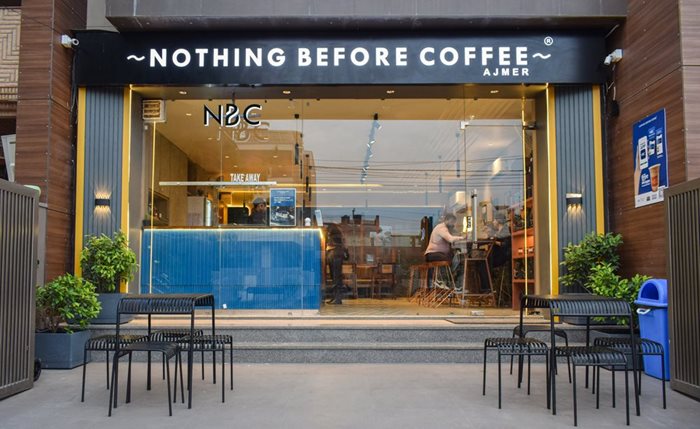
A Nothing Before Coffee store in Ajmer, Rajasthan, India | Photo credit: Nothing Before Coffee
Founded in 2017 by school friends Akshay Kedia, Anand Jain, Ankesh Jain and Shubham Bhandari, Nothing Before Coffee (NBC) is now raising investment to scale its 75-store presence in India and begin the next chapter of its international journey, which began with an outlet in Portugal in April 2024.
The value-focused coffee chain sources coffee from Chikmagalur and Coorg in India’s southern Karnataka state and roasts in-house to supply its growing store portfolio and direct-to-consumer channel. Today, Indian-grown coffee also supplies NBC’s recently opened store in Porto, Portugal, and will travel even further to planned sites in Spain, the UAE and Indonesia.
NBC recently celebrated its seven-year anniversary, tell us about your journey so far.
Akshay Kedia (AK): The journey from four school friends to founders of a growing brand like NBC has been nothing short of incredible. Our seventh-anniversary celebration was truly special, filled with love and joy from our customers. To show our gratitude, we rolled out a special offer – any beverage for ₹99 ($1.18) – and we saw a record-breaking 36,000 transactions during the anniversary weekend on 31 August–1 September 2024, which was four times our usual Saturday and Sunday volumes.
Additionally, our app crossed 100,000 downloads and we were ranked among the top five food & beverage apps on iOS and top 15 on Android in India. These milestones demonstrate the strong connection we’ve built with our audience.
Of course, challenges were part of the journey too. Expanding to over 70 outlets across India and internationally comes with the need to maintain consistent quality and customer experience, which has required constant innovation and rigorous operational standards. However, these challenges have only strengthened our commitment to delivering exceptional coffee experiences.
How has the Indian branded coffee shop market developed over the last seven years and how is NBC responding to these dynamics?
Anand Jain (AJ): Coffee has become an integral part of people’s daily routines in India, whether it’s solo coffee dates, work meetings, or the increasing trend of working from cafés. What was once predominantly a Tier 1 city phenomenon has now expanded to Tier 2 and 3 cities, where coffee is seen as a lifestyle statement and an aspirational product.
At NBC, we’ve aligned ourselves with these changes. We’ve made it a priority to expand into all the major cities while ensuring that we provide high-quality coffee at the right price. The key is to stay connected with our core customers – primarily urban consumers aged 18-35 – by maintaining consistency in both quality and experience.
We position NBC as a mass-premium brand, offering high-quality products at accessible prices, which allows us to appeal to both young professionals and older coffee lovers alike.
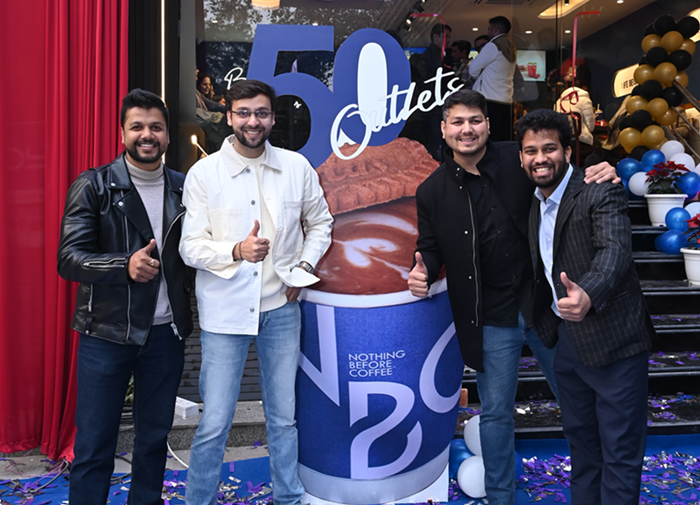
Left to right: NBC co-founders Ashkay Kedia, Ankesh Jain, Anand Jain and Shubham Bhandari | Photo credit: Nothing Before Coffee
Are Indian consumers becoming more receptive to premium coffee?
AJ: The future of India’s branded coffee shop market is a mix of both value-focused and premium experiences. We see a diverse range of consumers – some prioritise affordability and value, while others are increasingly willing to spend more for a premium coffee experience. This shift is driven by a growing appreciation for specialty coffee and unique offerings, especially in urban areas where consumers are more discerning and seek out quality.
At the same time, there’s still a strong demand for value-driven options, particularly in smaller cities. The key for brands is to strike a balance, catering to both segments without compromising on quality.
Why is now the right time for NBC to seek external investment for the first time?
AK: We’ve mapped out a clear expansion plan with an aim to open 100 new outlets by 2025 and external investment will play a crucial role in achieving that growth. After successfully establishing our brand across India, the timing is ideal to scale further and enter new markets. We’re confident in our model, our products and the demand for premium yet affordable coffee experiences, making this the right moment to bring in investors to fuel our next phase of growth.
“We see Europe as a key region in our global expansion”
What attracted you to the Portuguese market?
AK: Portugal was an exciting choice for our first international outlet due to its vibrant coffee culture and the country’s growing appreciation for unique coffee experiences. We saw a great opportunity to introduce our signature beverages to a market that values both tradition and innovation in coffee.
Over the past five months, the store has exceeded our expectations. We’ve seen strong customer engagement, and our products have been well received. The positive response has reinforced our belief that our blend of quality, affordability, and innovation resonates across different markets, and it has given us confidence as we continue expanding globally.
Can you tell us more about your plans for Europe?
Our launch in Porto, Portugal, has given us valuable insights into the European market and the response has been very encouraging. Europe has a rich coffee culture and an appreciation for high-quality, crafted coffee experiences, which aligns perfectly with what NBC offers. We see Europe as a key region in our global expansion, and our plan to open 150 outlets will allow us to establish a strong presence. Alongside Europe, we’re also expanding into markets like the UAE and Indonesia, where we see similar opportunities to introduce our unique offerings and build a strong customer base.
NBC is one of the few Indian coffee chains to expand internationally. Do you expect more to follow in your footsteps?
AJ: Expanding internationally can be challenging for Indian brands due to differences in market preferences, operational complexities, and the level of investment required. Many focus on solidifying their presence in the domestic market before looking abroad. However, with Indian consumers’ increasing exposure to global trends, there’s a growing confidence in Indian brands to succeed overseas.
I do believe more Indian brands will venture abroad in the coming years. As the quality of Indian offerings improves and more brands embrace innovation, we’ll see a stronger push towards international expansion, much like what we’re doing at NBC.
This article was first published in Issue 22 of 5THWAVE magazine.
source: http://www.worldcoffeeportal.com / World Coffee Portal / Home> India> News / November 29th, 2024
Dr. M. Senthilkumar, Director of Research, Coffee Board of India, says that India need not worry too much about losing coffee by 2050.
“Of course, climate change is happening not only in India, but around the world but this is not going to make much impact on Indian coffee, when compared with other countries like Brazil and Vietnam. We are a country that does not grow coffee in an open condition. Most of the coffee in India grows in a shaded condition. We are pushing our farmers to grow more traditional and conventional shade trees at the coffee estates – that is deciduous and evergreen trees, which will help create a microclimate that will facilitate comfortable growing of coffee,” Dr. Senthilkumar explained.
India has rainfall from June to September usually, followed by a drought period of 70 days. “Due to climate change, there is a possibility of drought period being extended. If it extends farmers will have to use methods of artificial irrigation encoring more expenditure,” he added.
“By 50-100 years from now, climate change can cause problems at any given point as the temperature is increasing by 1.5 degrees centigrade every year. But again, not for Indian coffee. Indian coffee may benefit because of climate change, as other countries will stop producing coffee. But that does not mean we should stop worrying about climate change,” Dr. Senthilkumar said.
source: http://www.thehindu.com / The Hindu / Home> News> Cities> Bengaluru / by Yemen S / November 29th, 2024
The design and layout of the ground will follow the model of the famous Dharamshala cricket stadium in Himachal Pradesh, though it will be slightly larger than Bengaluru’s Chinnaswamy Stadium
Madikeri:
After decades of persistent demand, the long-awaited dream of having a dedicated cricket ground in Kodagu district is finally being realized. Construction work has begun on an international cricket stadium near Palemadu village, situated in the scenic Madikeri taluk. This marks a significant milestone for the region, which has long yearned for a sporting facility capable of hosting major cricket events.
The Kodagu district administration has earmarked 12 acres of land for the construction of the stadium, with the project estimated to cost around Rs 50 crore. The design and layout of the ground will follow the model of the famous Dharamsala Cricket Stadium in Himachal Pradesh, though it will be slightly larger than Bengaluru’s Chinnaswamy Stadium. This ambitious project will involve leveling half of a nearby hill, a complex and costly process to create a world-class sporting venue.
The construction of this stadium has been met with both excitement and opposition. For years, there were protests against the proposed location, primarily due to the presence of a graveyard on the land. Local residents from Paisari village, in particular, were firm in their stance, demanding that no cricket ground should be built over the graveyard. Despite the protests, the project had to be put on hold for some time. However, the issue was eventually resolved when former District Collector Dr. BC Satish intervened and convened a meeting to find a solution. It was decided that one acre of land would be set aside for the cemetery, while the rest would be used for the cricket ground.
Though some residents still insisted on reserving two acres for the cemetery, the Karnataka State Cricket Association (KSCA) was determined to move forward with the project. Their resolve to build the ground regardless of the protests has finally borne fruit. With all hurdles cleared, construction work has now commenced, with heavy machinery such as JCB and Hitachi excavators already working to level the land.
The project is expected to be completed within the next four years, bringing a major sporting facility to the district.
A boon for local sports enthusiasts.
This stadium will be a game-changer for the region, providing a much-needed infrastructure for local sports enthusiasts and opening doors to higher levels of competition. Currently, Kodagu boasts an astro turf hockey stadium, but there has been a glaring absence of facilities capable of hosting even state-level sports events. The new cricket stadium will not only enhance the region’s sports infrastructure but also serve as a hub for aspiring athletes.
While the construction of the cricket stadium is a significant step forward, sports enthusiasts in the district are also calling for the development of other key sports facilities. In particular, there are increasing demands for the creation of an athletics stadium, similar in scope and scale to the upcoming cricket ground, to accommodate track-and-field events and other athletic competitions.
The lack of such facilities has been a hindrance to the growth of athletics in the region, and many believe that the creation of a dedicated athletics venue would be the next logical step in the district’s sporting evolution.
Once completed, the international cricket stadium is expected to attract attention from national and international teams, potentially putting Kodagu on the map as a major sporting destination. It could host not only first-class cricket matches but also training camps, junior cricket tournaments, and a variety of other sports events, providing ample opportunities for local players to showcase their talent. Moreover, the stadium will have a significant economic impact on the area, boosting tourism, creating employment opportunities, and contributing to the development of infrastructure such as hotels, transportation, and sports-related businesses. The local community is expected to benefit greatly from the influx of visitors and sports professionals.
As the work on the cricket ground progresses, the residents of Kodagu have a reason to celebrate, as they will soon have a venue that will foster local talent and bring national-level events to the region. However, the demand for more sports facilities remains strong, and local authorities will likely have to address the call for an athletics stadium and other sporting infrastructure to meet the growing needs of the district’s sports enthusiasts.
In the coming years, Kodagu’s landscape will be transformed into a thriving hub for sports, creating opportunities for youth, bringing pride to the community, and fostering the next generation of athletes. The international cricket stadium is just the beginning.
source: http://www.thehansindia.com / The Hans India / Home> News> State> Karnataka> Bengaluru / by The Hans India, Hans News Service / November 30th, 2024
Renaissance Hotels, part of Marriott Bonvoy’s global portfolio of over 30 extraordinary hotel brands, celebrated its 10th annual Global Day of Discovery on November 19, 2024. In celebration of this special occasion, over 170+ Renaissance Hotels properties around the world came together to reimagine their Evenings at Renaissance program with a unique Evenings Market, spotlighting local retailers and businesses.
Over the past ten years, Global Day of Discovery has been the one day in the year when all 170+ Renaissance Hotels around the world activate an elevated, on-property experience – underscoring Renaissance Hotels as one that connects locals and travelers to the DNA of the neighborhood through its unexpected design, experiential entertainment, and spontaneous discovery. Global Day of Discovery 2024 continues to demonstrate Renaissance Hotels’ promise to making measurable impact through supporting local – not just on Global Day of Discovery, but every day – with the launch of R Finds, a global digital marketplace designed for local discovery.
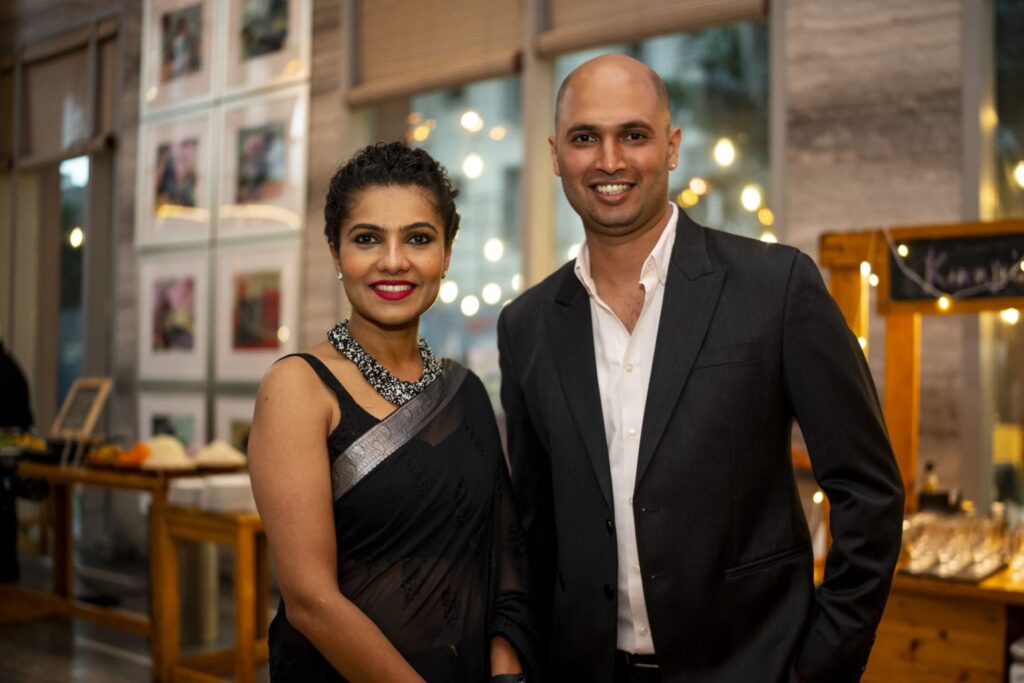
General Manager Sita Lekshmi and Rishwin Devaya
The event at Renaissance Bengaluru Race Course Hotel featured a journey to the sprawling coffee estates of Coorg , curated by the Riverside Coffee Co. and its founder Rishwin Devaya. An immersive Evening Market experience, guests indulged in the finest manual brew coffees, a meet-and-greet with Rishwin, and a special coffee cupping session.
Guests were also treated to expertly crafted coffee-based cocktails by Shyam Kumar, Bar Manager at R Bar and his team of mixologists.
The Culinary team led by Executive Chef Somasundaram G. and Pastry Chef Manivannan G. delighted everyone with a selection of decadent coffee-inspired desserts, creating a perfect fusion of local craft and culinary artistry.
The event concluded with guests connecting over their shared love for coffee, cocktails and discovery, leaving with a deeper appreciation for Coorg’s coffee culture and the hotel’s commitment to championing the local community.
The Global Day of Discover and the launch of R Finds, our very own global digital marketplace is a joyous moment and one to take immense pride in. Through interactive brewing sessions, exquisite coffee-inspired cocktails, and engaging conversations, we created an evening that blended the warmth of local flavors with the spirit of discovery—a true reflection of what Renaissance Bengaluru Race Course Hotel stands for,” said Sita Lekshmi, General Manager, Renaissance Bengaluru Race Course Hotel.
source: http://www.apnnews.com / APN News / Home> Tourism> Hospitality / by NS / November 21st, 2024
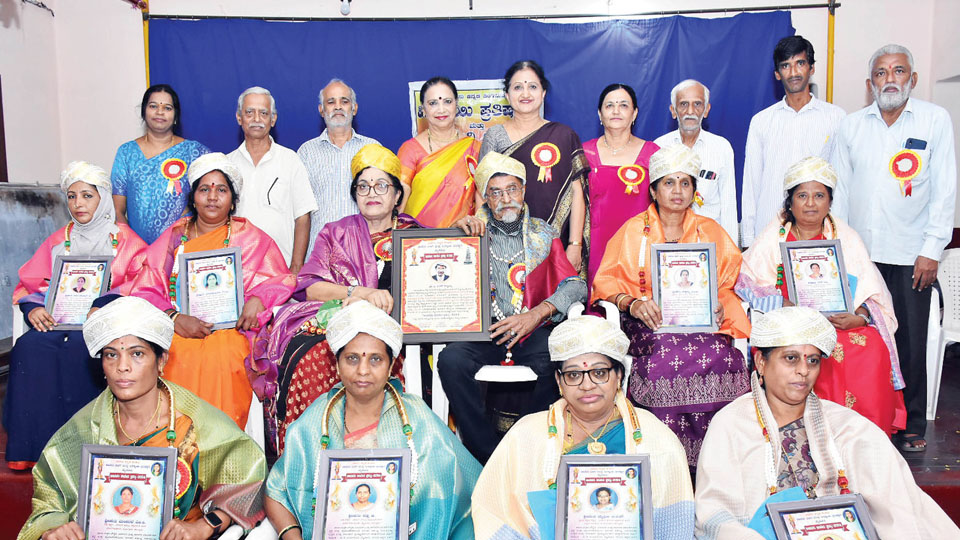
Ten teachers were felicitated and presented ‘Jeevanadi Cauvery’ awards in memory of Nambiyapanda Gowru Ponnavva at a function held in the premises of Akkana Balaga School in Agrahara in the city on Tuesday. The award presentation function was jointly organised by Cauvery Balaga and Hiranmayi Pratishtana.
Speaking at the function, writer Bannur K. Raju said it is essential that education and health must be provided to everyone without any bias like in many developed countries.
“Unfortunately in our country, both these vital sectors are in firm grip of private organisations which has deprived both education and health to poor and middle class people,” he regretted saying it has become essential that these two sectors be nationalised in the interest of majority of people in the country.
Teachers S.N. Janaki of Alanahalli Government Lower Primary School, H.D. Kote taluk; M.P. Manjula, Hunsur Govt. Lower Primary School; K. Parveen Taj, Arenahalli Govt. Urdu Lower Primary School, Periyapatna taluk; G. Ratna, Beeregowdanahundi Government Lower Primary School, Mysuru taluk; M.T. Akkamma, Ammathi Govt. Higher Primary School, Virajpet taluk; M. Rani, Head Mistress, Bharati Sthree Samaja Higher Primary School, Yadavagiri in Mysuru; T.S. Maithili, Physical Education teacher, Government Higher Primary School, Vysarajapura, T. Narasipur taluk and M.T. Saralakumari, Head Mistress, Kajoor, Somwarpet taluk were felicitated at the function with ‘Jeevanadi Cauvery’ awards.
City’s renowned Sculptor Appaneravanda Kiran Subbaiah was given a special award. ana
Noted Danseuse Dr. Tulasi Ramachandra, retired teacher A. Sangappa and artist Dr. Jamuna Rani Mirle spoke at the function.
President of Cauvery Balaga and retired teacher N.K. Kaveriamma, President of Hiranmayi Pratishtana A. Sangappa, Jnana Vignana Samiti District President H.V. Muralidhar, Art teacher Manohar, Social activist Malini R. Palaksha and teacher Anupama were present.
source: http://www.starofmysore.com / Star of Mysore /Home> News / May 23rd, 2024
‘Vijay Shrankla Aur Sankritiyon Ka Maha Sangram’ celebrated
Mysuru/Mysore:
Marking 75 years of Independence as also 50 years of India’s victory over Pakistan in the 1971 war leading to the creation of Bangladesh, the National Cadet Corps (NCC) is celebrating the occasion as ‘Vijay Shrankla Aur Sankritiyon Ka Maha Sangram’ across the country from Nov. 28 to Dec. 19 this year.
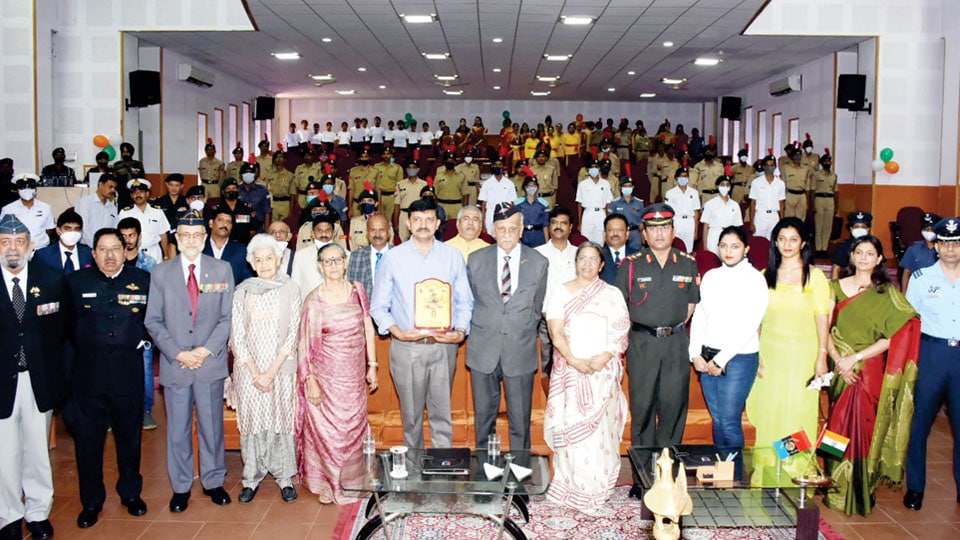
As part of the celebrations, the Mysuru NCC Group felicitated the Next of Kins (NoKs) of the two martyrs — Flying Officer K.P. Muralidharan of 20 Air Squadron and Risaldar B.M. Kaveriappa of the 66 Armoured Regiment — at a programme held at Cauvery auditorium in Karnataka State Open University (KSOU) premises on Hunsur Road here this morning.
The NoKs who were felicitated are Lalita Krishna Kumar, sister of Flying Officer K.P. Muralidharan and B.M. Machaiah, son of Risaldar B.M. Kaveriappa.
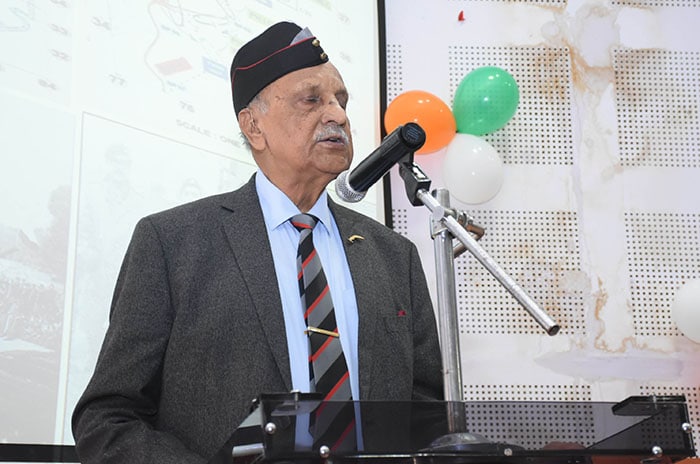
Maj. Gen. (Retd.) C.K. Karumbaya, SM, was the chief guest. Maj. Gen. (Retd.) S.G. Vombatkere, VSM was the guest of honour.
As part of the celebrations, 75 NoKs of martyrs of 1971 war will be felicitated at 75 locations across the country.
Defence Officers, Junior Commissioned Officers and Other Ranks posted locally at Mysuru including NCC Group Commander Col. R.R. Menon, NCC cadets and Associate NCC Officers, Air Veteran Mandetira N. Subramani, President, VeKare Ex-servicemen Trust, Mysuru were present on the occasion.
About Flying Officer K.P. Muralidharan: Flying Officer Kotteiezath Puthiyavettil Muralidharan hailed from Nilambur Kovilakom in Mallapuram district of Kerala. Born on Oct. 6, 1945, he was commissioned into the India Air Force on Oct. 29, 1966 at the age of 21. During the 1971 Indo-Pak War, Muralidharan was serving with 20 Sqn. known as ‘Lightnings’ and was based at Air Force Station in Pathankot. He took off in his Hunter (A-462) for a mission from Pathankot and was involved in a dog fight with enemy aircraft. He was last seen flying north of Peshawar in combat with a PAF Sabre and was shot down by the enemy Sabre. His aircraft crashed inside the enemy territory.
Risaldar B.M. Kaveriappa: Born on Feb. 4, 1931 at Kadangamarur in Virajpet of Kodagu district, Kaveriappa joined the 66 Armoured Regiment in September 1969 and was appointed as a Troop Leader which he served till the last day of his life.
Kaveriappa was in command of 1 Troop Bravo Squadron. While moving to reinforce 3 Troop, his tank was hit by an enemy RCL Gun and he along with his crew were killed.
source: http://www.starofmysore.com / Star of Mysore / Home> News / November 30th, 2021
In my previous article, I featured an Ethiopian coffee export company who ran her business based on trust. This is factored in two ways; dealing with her farmers and clientele. In this day and age, we can learn a thing or two by understanding the wisdom behind why some people do the things they do, treading a harder path and not resort to shortcuts. They are in it for the long term, not focused on the short term gains. I have nothing but high regard for individuals like Medina.
Continuing a similar conversation, I have been focusing on what exactly is happening at the farm level by getting in touch with the producer directly. In this article, I talk to the owner of a coffee estate farm based in India. Sumaira gives us an insight about how her family’s coffee estate started in the late 18th century, processing techniques employed on her farm, the specialty coffee movement in India, and much more.
source: Rasulpur Coffee Estates
Can you tell me a bit about yourself and Rasulpur Coffee Estates?
I am Sumaira, the owner of Rasulpur Coffee Estates & Roasters . We are located in the Rasulpur village, Coorg district, in the hot spots of the Western Ghats, India. My entrepreneurship journey has had its shares of ups and downs. I took up a career as an interior designer and worked as a business head for a furniture empire in India. Later on, I moved to the UAE and explored the real estate industry and the coffee sector. I envisioned starting up something of my own, being from a family of coffee planters and having the self-confidence and determination to start my own business. Something clicked the moment I realized how the coffee industry is growing day-by-day.
To add, I am a fifth generation coffee planter who introduced specialty coffee at our estate. We introduced better equipments and techniques, and new processing and fermentation methods which I’ll get into a little later. A laboratory is set up for roasting and cupping to create different roast profiles and new blends at our estate. We believe in helping and encouraging our coffee community, especially the neighboring small and marginal coffee growers to analyze their coffees, and improve their harvesting and processing methods to fetch a better price for their coffee.
The journey of Rasulpur Coffee Estates started in the late 18th century when our ancestors migrated to the Western Ghats of India i.e. Coorg at the time of the British rule, as their main occupation was trading in coffee and spices. They travelled to different parts of Coorg, as they developed a liking towards coffee estates and the greenery, purchased plenty of estates, learnt the methods of coffee cultivation, and started exporting coffee to foreign countries. England was one of the major countries to which coffee was exported to from our estates in that period with the help of the Coffee Board.
We named the estate and brand ‘Rasulpur Coffee’ after the village, Rasulpur, which is on the banks of the Kaveri river in Kodagu district is named after Mr. Rasul Khan, our first generation planter. He cleared the land, started cultivation, built dams for irrigation, made the place livable and initiated agricultural works. Looking at his abilities and progress, the government named this village after him.
In time, our second, third and fourth generation planters purchased more coffee plantations and improved the methods of cultivation, processing, and introduced pulping and irrigation. An R&D team was also set up and a variety of experiments are conducted to this day. The goal here is to enhance the quality of the crops, and advance the processing and post harvesting methods. Our coffee is featured in auctions, supplied for projects, sold locally and exported to wholesalers, cafes, and restaurants. We also ferment micro lots as per requirements from our roasters and young entrepreneurs who are venturing into the coffee industry.
What kind of processing is done on the farm?
Processing on our farm is done in three different ways along with few specialty processing methods, all of which change the sweetness, body and acidity of brewed coffee. These are natural/sun dried, washed, and honey processed.
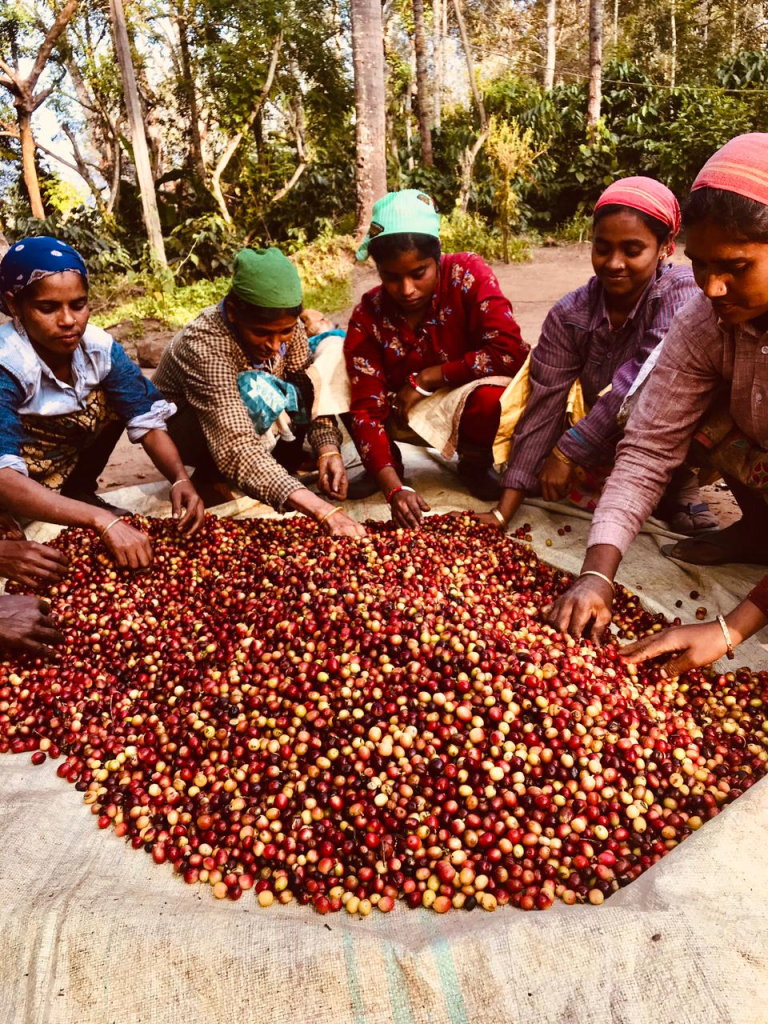
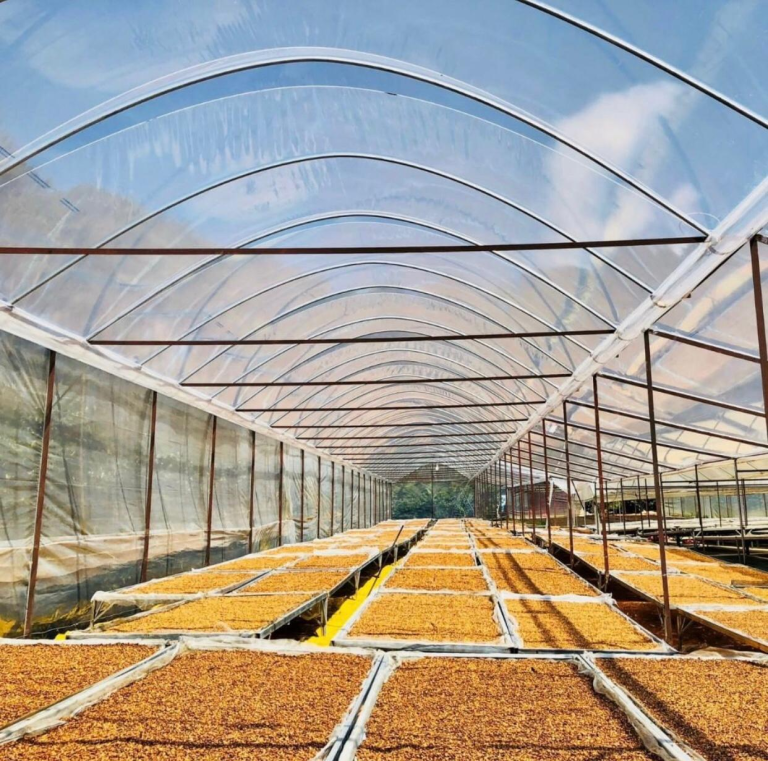
Natural/sun dried process. A natural processed coffee, also referred to as dry processed, is a traditional yet common way to process coffee today. Originating in Ethiopia, it involves drying out freshly picked coffee cherries with the seed still inside. To do this, we place the cherries on drying beds in the sun. These beds are either patios or raised drying tables. The cherries have to be rotated and turned to prevent mold, and takes about seven to eight days to ferment. During this time, the sugars and mucilage (the sticky substance that coats the seed) will latch onto the seeds, develop flavours and make them sweeter. Once the coffee is dry, a machine separates the pulp from the seed. Natural coffees are heavy bodied, and have deep, complex tasting notes. This development comes from the way the cherry ferments differently. Natural processed coffees can be difficult to replicate because of the inconsistencies in fermentation. However when done right, these coffees can also be some of the sweetest you’ll taste. It is juicy, syrupy and well worth the extra effort.
Washed process. Unlike natural, washed processed coffees are called the opposite, i.e. wet processed. In this scenario, machines called pulpers remove the seeds from the cherries before drying them. However, it is not just any cherry that gets the seed removal treatment. These cherries must have the perfect amount of ripeness to make sure they are sweet enough. To accomplish this, they go through a sorter and are segregated according to density. Once these pulpers remove the skin and pulp from the seeds, they are placed in tanks full of water. The water separates the rest of the mucilage and fruit caked onto the seed. Finally, the seeds are dried on the beds in the sun. Washed processed coffees have cleaner, and more crisp tasting notes when compared to natural processed coffees. The body of a brewed washed coffee is lighter. There is typically more brightness as well, because of a cleaner acidity that balances out the sweetness of the coffee. They are just as fruity as natural coffees, but the flavor notes are easier to differentiate.
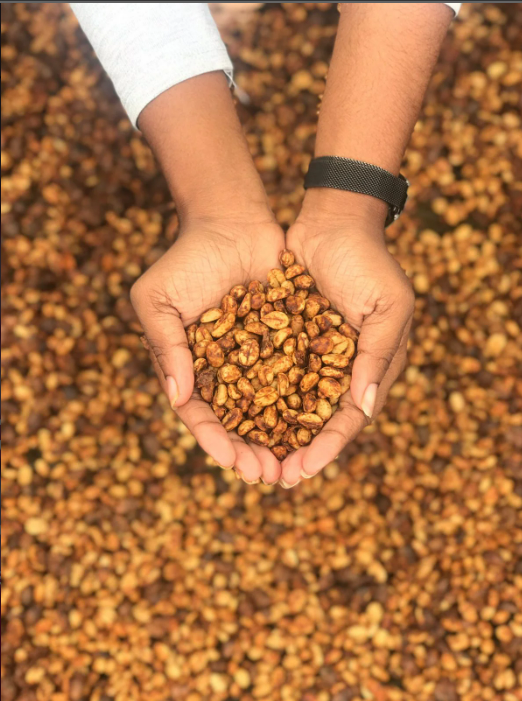
Honey processed. This method is a combination of both natural and washed. It is a rare and demanding method, and not as commonly practiced as the previous two. However, it produces a unique cup of coffee, with flavours similar to both of the previously described processing methods. During honey processing, a pulper removes the seed from the cherry before it undergoes a drying process. However, it does not go into washing tank to remove the mucilage. That mucilage, which is what the ‘honey’ refers to stays on the seed and is now dried in the sun. The amount of mucilage left behind determines the sweetness, and there are even machines to control the amount on the seed. Like natural process, the seeds are dried on beds. The flavor components of honey coffees are varied and complex. Like washed coffees, they have lighter body and are very syrupy and sweet. Acidity is present but more mellow when compared to washed coffees.
Specialty processing. This is an emerging field and we use unique methods like anaerobic, aerobic, natural fermented, and fruit fermented to name a few. We ferment our coffee in a temperature controlled environment, with or without oxygen, followed by controlled drying to bring out unique and funky flavors out of the coffee.
source: Rasulpur Coffee Estates
What is the current state of the specialty coffee industry in India?
The coffee culture in India has evolved over the past decades. The nostalgia-inducing coffee houses were popular meeting grounds until the 1980’s. In the 90’s, cafe culture took over the country and coffee became the trendy drink to try.
Cafes are becoming the primary hangouts for youngsters and coffee found an emerging and appreciative audience. In the past two decades, we have seen a surge of cafes all over the country. They have materialized as a central hub for meeting, whether casual or business, and also doubling up as co-working spaces.
The 2020 pandemic impacted the industry In multiple ways and its effects were manifold. Logistics of coffee exports are pretty bad even today. Traditional coffee plantation owners who supply heavily within India and export to Europe are left with excess stock of coffee that could no longer be shipped to international markets.
Coming to the Indian coffee space, in recent years, the spotlight is on specialty coffee. This movement is picking up speed with many brands and roasters setting up shop. Analysis gives us a deeper understanding on how speciality coffee has emerged as the current buzzword in coffee circles. Current generation and millennials have emerged as the major chunk of consumers of specialty coffee within India.
Increased awareness and interest about coffee augmented by growing exposure to worldwide trends due to rising international travel and social media saw many of them exploring specialty coffee and manual brewing techniques. Lockdowns put a halt to the possibility of exploring cafes and thus many coffee consumers in the country turned to home brewing.
Many retail specialty coffee brands saw skyrocketing sales in 2020 as consumers invested in manual brewing equipment ranging from French Press, Moka Pots, Chemex and Aeropress. The new generation of coffee consumers respect the people behind the product, want to better understand the ‘farm to cup’ journey and are willing to invest in educating themselves on all nuances of coffee.
A few years back, this was largely unheard of. Farmers were just one aspect of the coffee supply chain, but hardly ever found the spotlight on them. Now plantation owners are keen on sharing their stories and experiences, information on their crops and the work they put in to make that perfect cup of coffee.
One can safely say that specialty coffee will not just be a passing trend, but en route to becoming one of the mainstays of the Indian coffee space in the coming decade.
I think there is a lack of communication between the consumers and farmers. I know some of the consumers, including me, have started to pay attention to where exactly the coffee is coming and from which farm. What do you think can be done to fill this gap?
The missing ingredient is awareness. People need to be educated about Indian coffee. The new-generation farmers need to collaborate with the Coffee Board of India and conduct events to promote coffees originating from India within the country and internationally.
Joint efforts need to be made by all coffee enthusiasts to encourage the consumption of coffee by making people understand the benefits of drinking coffee. The government has to support and help promote farmers to come forward and establish their own brands.
Being honest and transparent ensures the consumers and clients knows about the past, present and the way you are going to build a future. Bringing credibility to the table builds trust factor for the brand with the consumers.
I know some of the issues the farmers are facing currently are the increasing production costs, what steps are you employing to change that? Have you increased the price of your coffee to reflect that?
Whether we like it or not, coffee is getting more expensive. It’s important to look at some of the reasons why this is happening, before you potentially do one of the following:
Buy less sustainable and ethical coffee because it’s cheaper or
Lay blame on the wrong people for higher prices.
There are many factors influencing the cost of coffee from climate change, disruptions to global shipping, consumer demand, and packaging cost. While the need to use more environmentally-friendly packaging for coffee cups and bags is real, so too is the cost for shops switching to compostable or recyclable materials. We have also witnessed fluctuating shortages of packaging stock forcing some companies to find more costly short term solutions to packaging which comes at a higher cost.
Lastly, coming to the cost of quality, producing coffee of higher quality simply costs more. Coffee must be cared, harvesting and processing is hard work. It requires time and physical effort if you want to achieve the highest quality standards. You can’t have it both ways.
source: Rasulpur Coffee Estates
What are your thoughts on transparency? Has it benefitted you in any way?
Yes, by ten-fold. Transparency has improved our overall trust factor in this industry. It solves many problems and even stops disasters before they happen. It expands relationships, increases productivity, strengthens innovation, and improved our revenue.
What is the future of specialty coffee?
By far, the most interesting and exciting coffee segment of the moment is specialty coffee. It is rapidly expanding in India and across the globe as consumers continue to seek out the best cup of coffee to enjoy.
When it comes to coffee quality, specialty coffee is the ‘cream of the crop’ and is likened to fine wines due to its distinctive characteristics and delicious flavour that can only be achieved under certain growing conditions.
In today’s market, specialty coffee has become an intricate science and a global phenomenon that is seeing rapid growth across all sectors. More estates are coming into this specialty game, that will give ‘Indian specialty coffee a lot of mileage.’
What do you do in terms of R&D on Rasulpur Estate
We are currently doing research on developing a hybrid plant which is resistant to white stem borer and leaf rust. These are the two biggest pests and diseases faced by all Arabica growers throughout the world. International Coffee Organization (ICO) is working with different countries to find a solution for this.
This R&D program has been ongoing for the past four years on a 40 year old, 30 ft tall, Arabica plant labelled by us as Rasulpur Arabica. So far, the results look promising and it is resistant to these diseases. We have propagated progenies of this plant by clonal cutting, seed and tissue culture, and cross-bred this plant with other varieties of Arabica.
source: Rasulpur Coffee Estates
About Rasulpur Coffee Estate
Rasulpur Coffee Estates & Roasters is based out of Rasulpur village in Coorg district in the hot spots of the Western Ghats, India. The Estate is run by Syeda Sumaira, a fifth generation coffee planter and entrepreneur.
Fun fact: Coffee farms are the best place to get first hand knowledge about the beverage, how it is grown, harvested and processed. Rasulpur Coffee Estates organizes coffee tours, get in touch with them to find out more.
source: http://www.fltrmagazine.com / FLTR / Home> Insight> People / by Naveed Syed / August 11th, 2022
Fabriano in Acquarello is the international artistic convention dedicated to water color painting. International Exhibition FabrianoIn Acquarello will be organized with the participation of InArte – International Watercolour Sociaty, Italy and in cooperation Municipality Fabriano, Fondazione Carifac, Fondazione Fedrigoni Istocarta, Rotary and Lions club from 23rd to 26th April 2015 with the participation of the most important watercolor communities from around the world that will allow Italian and foreign watercolorist demonstrate, share and discuss their work in a unique context.
Water Color Society of India, founded by Amit Kapoor in 2013 at New Delhi, a part of International Water Color Society functioning with the aim to promote and popularize water color/water media in every country and to bring the hidden Indian talent at International platform. The society has identified the water color painting of Shri Aimanda Rupesh Nanaiah, resident of Maragodu Village of Kodagu district. Aimada Rupesh Nanaiah is one among the 20 artists representing India for the Fabriano in Acquarello 2015 exhibition at Italy scheduled for April-May 2015. Shri Aimanda Rupesh Nanaiah was born on November 19, 1976. He did his Primary Education at St. Anne’s Convent, Siddapur and Secondary at Siddapur High School, Pre-University at Murnad Pre-university and Bachelor of Fine Arts in Applied arts 1995-2000 at CAVA Mysore.
A Special Cover was released to felicitate water colour painting of Shri Aimanda Rupesh Nanaiah selected for Fabriano in Acquerello 2015 on 14th February 2015 at Madikeri (Special Cover approval no. KTK/28/2015). The cover illustration depicts the water color painting selected for the exhibition with the title “Pathukutti-The Fish Seller”, and scenes of paddy transplantation, Madikeri Town, and other village scenes of Kodagu. The reverse of the cover also features paintings of tractor alongside paddy field and a Kodagu township. The cover was released by Senior Post Master, Madikeri. The cover was received b the Artist Shri Rupesh Nanaiah who and whose family were felicitated on the occasion. The event was held at the Madikeri Head Post Office Premises. The artist also gave a demonstration of sketching by sketching the post masters caricature. My stamp depicting the painting was also launched on the occasion.
Courtesy: Viswas Menon, Madikeri
Special Cover on Kodagina Gowramma – 14th February 2015.
Mrs. B. T. Gopal Krishna (b. 1912 – d. 1939), better known as Kodagina Gowramma, was an Indian writer who wrote in Kannada and lived in Kodagu. She was also a feminist and a supporter of the Indian Freedom Movement. Gowramma was born in 1912 and married to Mr. B. T. Gopal Krishna of Gundugutti village of Somwarpet taluk in Kodagu, then known as Coorg, a province in British India. She invited Mahatma Gandhi to her family house, during his campaign in Coorg, and donated all her gold ornaments towards the Harijan (Dalit) Welfare Fund. She died young, drowning in a whirlpool, at the age of 27, on April 13, 1939.
Gowramma wrote in Kannada and on the feminist ideology using the pen name ‘Kodagina Gowramma’. The stories that she wrote, such as “Aparaadhi Yaaru” (Who is the criminal), “Vaaniya Samasye”, “Aahuthi” and “Manuvina Raani”, were modern and progressive.
On the occasion of 10th District Kannada Sahithya Sammelana, a Special cover was released on Kodagina Gowramma on 14th February 2015 at Madikeri. (Special Cover approval no. KTK/27/2015). The Special Cover depicts the portrait of Gowramma, and photos of her two important books in Kannada “Kambani” and “Chiguru” and the special cancellation depicts the map of Karnataka and the Karnataka mate with 10th District Kannada Sahithya Sammelana in a circle.
Courtesy: Viswas Menon, Madikeri
source: http://www.indianphilately.net / Indian Philately Digest / Home> News> News Archive 2015> February 2015
WELCOME. If you like what you see "SUBSCRIBE via EMAIL" to receive FREE regular UPDATES.
Read More »