All posts by admin

Bring back the glory years of Kodagu hockey

A file image of Kodava Hockey Festival. 
(Twitter)

The next time you sip on a piping hot filter coffee that touches your soul, make sure you thank the Kodavas from Kodagu for producing one of the finest blends of Arabica and Robusta beans in the country.

Such is the craze and demand for this particular product from Kodagu that the small region close to Bengaluru produces 130,000 MTs of coffee per year, which is 40% of India’s entire production. To say that coffee runs in their veins won’t be a wrong statement to make, but maybe an incomplete one. The only missing link here would be hockey, which just like the coffee, is something that Kodavas immensely pride themselves on. 

So with that coffee mug in hand, scroll through the pages of Indian hockey’s history, and you’ll find that Kodavas, for generations, have been the pillars of the supply chain to the national team, producing over 50 players for the country. That is huge for a clan with a population touch over 3.5 lakh. Right from the ’70s, it wasn’t a rare sight to see two-three Kodavas make a distinct place for themselves in the team. The magic that Olympians MP Ganesh and BP Govinda weaved on the field for the country is something that the grandfathers would tell the kids back home, which would inspire the gen-next, MM Somaya and AB Subaiah, to pick up the hockey stick. The baton would then pass on to Arjun Halappa, who would later groom players of the caliber of VR Raghunath and SV Sunil. In short, an Indian team was incomplete without the expertise, skill, aggression, artistry, and dominating presence of a Kodagu player. 

Coorg, an anglicized version of Kodagu, is also home to the world’s grandest hockey tournament, the Kodava Hockey Festival, which sees participation from over 200 teams across age groups. The tournament, a brainchild of former banker late PM Kutappa, was kick-started in 1997 with the dual purpose of paying rich tribute to the sport in the region, and bringing together players in thousands, only to identify the best talents for the country. Close to two decades later, the deep-rooted hold of Kodagu players had only become stronger in the national team. There was a period from the start of Asia Cup 2013 to the Rio Olympics 2016, where five Kodava players — Raghunath, Sunil, SK Uthappa, Nikin, and Nithin Thimmaiah were regulars on the Indian side. 

Unfortunately, the times have changed drastically now. While there is enough stimulus for the coffee production in the region to grow, not much progress has been made on the hockey front. No new players have emerged from the region, good enough to be a part of the national setup; the others have now retired or are just past their prime. The team that won the Junior World Cup in 2016, in Lucknow, had no Kodava player. Even as the senior team was able to shed the tag of not being able to win an Olympics medal since Moscow 1980 — by clinching a bronze in Tokyo 2020 — no Kodava was part of history being made. Forward Sunil, who had been a prolific scorer for India, missed the flight for Tokyo as an untimely injury made him unfit for selection. 

Hockey India recently announced a 30-member core group for the national camp in Bengaluru, which did not feature any Kodagu player either. With Sunil announcing his retirement last week, there isn’t a player from the region — it looks like — who would get a chance to represent India anytime soon. Now call it unfortunate, unexpected, or unprecedented, that is the harsh reality, and will take some time to get used to. With the Indian team on a high after the Tokyo victory, all is certainly well for Indian hockey, but it is the long Kodagu legacy that has taken a hit; a legacy, where it was said: Throw a stone, and it will either hit a soldier or a hockey player. 

Look at Punjab. Since time immemorial, the state has been producing players of high repute in bulk, way above what the other states have done, put together. But there was always a need for a specialized center, where all the budding champions from Punjab could be groomed under one roof. Responding to the need of the hour, the state helped establish the Surjit Singh Academy, Jalandhar, in 2005; the academy where eight players from the victorious Tokyo 2020 team learned the tricks of the trade. It is only beyond one’s imagination, how much it would have added to the team’s advantage, to have such a large chunk of players from one academy. 

In the East, we have Odisha, which has a rich tradition of producing solid defenders for the country. Sundergarh, a small town in the state with a population of over 45,000 only, has a hockey tradition second to none. This Olympics too, Birendra Lakra and Amit Rohidas, were in the Indian team and kept up the tradition of the land that has produced athletes of the class of Dilip Tirkey, Ignace Tirkey, Lazarus Barla, Jyoti Sunita Kullu, and Sunita Lakra. Deep Grace Ekka, the senior-most defender in the women’s team, showed in the quarterfinal against Australia, why is it practically impossible to get past her. All this is a result of systematic planning by the concerned authorities in the state, who are now looking at expanding infrastructure to produce more hockey players. Sundergarh alone has three academies, and as per a report, all the 17 blocks in the district will get a synthetic turf soon. Plus, the Odisha government has been investing heavily in the Indian hockey teams — both men and women — and has been maintaining the best hockey ground — Kalinga Stadium. 

Even though there is no dearth of raw talent in Coorg, it is the outlook towards hockey, sports in general, that is hampering the returns, believes BJ Kariappa, the coach of the national junior team. Back in the ’80s and the ’90s, while hockey was a compulsory sport in schools, it is not the case now. “Back in the day, all the schools had hockey teams. But the immense academic pressure had reduced the focus on hockey considerably,” Kariappa tells SportsCafe in an exclusive interaction. 

Explaining the issue, Kariappa added, “these days even the parents don’t want their wards in hockey, and the emphasis is only on getting good grades, which in turn would help them get good jobs. That was not the trend during our times. If at all any sport is considered, is cricket. The financial aspect makes it worth pursuing. Also, the lack of state-level or district-level tournaments has done the damage.”

Visibly so, a host of factors have brought Kodagu hockey, to where it is today, but the Tokyo bronze medal could just be the change the sport in the region demands or so hopes Kariappa. “I think one way to look at the medal is that the interest in hockey will come back. The coaches here too will put in additional efforts, and there will be a few more tournaments happening hopefully. Even the state and the Centre are putting in efforts to revive hockey in Coorg. So let’s hope the results will come in the future.”

Without an iota of doubt, 2008 has to be the darkest phase for our hockey when the national team had failed to qualify for the Olympics for the first time in 80 years. But to pick up bits from there, and get a medal in 12 years’ time was truly special. Even though the severity of this, and the hockey crisis in Kodagu could be at different levels altogether, but there certainly is learning, which could help put Coorg on the hockey map of India once again.

source: http://www.sportscafe.in / SportsCafe / Home> Hockey> National> Feature /by Madhav Agarwal / October 20th, 2021

Musings On Annual Report Of An Education Fund

A couple of days back I received the Annual Report of the Coorg Education Fund, Madikeri, Kodagu, like in the past few years. Though I hardly go through it, it is a reminder that I am a Life Member of this Fund.  I don’t even remember when and how I became a Life Member. Let it be.

However, my first connect with this Fund was probably in 1957-58 when I was a student in Madikeri First Grade College, as it was known then. For some reason, may be connected with sports, I was to have a blue-blazer but I did not have the courage to ask my father. A classmate told me that I could approach, with an application, the Coorg Education Fund, the Office of which was in Madikeri itself. Looking back, I guess the  procedure to get the money, a sort of loan, was rather simple. And I got the required Rs. 150 and the blazer which I wore with a sense of pride — walking around like a cockerel! Of course, I forgot about the loan and in time the blazer too. 

Many years passed. I was in Mumbai as a journalist and I received a letter from my father saying the Coorg Education Fund had sent me (or him) a notice claiming refund of the amount. Mercifully, he also mentioned that he had settled that account in full. After all, it was a question of his prestige in the society. He did not, however, forget to write that I had taken that money without his knowledge.

Time passed, nearly 20 years. I returned to Mysuru, the border district of Coorg, as the Publisher and Editor of this newspaper and the sister publication Mysuru Mithra. Simultaneously, I was also writing books in English and Kannada as a pastime. One book was about Coorg and the efforts of Protestant Christians to convert the local Kodavas — a historical fiction titled ‘The Cross and the Coorgs.’

Surprisingly, the Fund decided to honour me for my effort at its Annual Meeting. Aware that I owe no money to the Fund borrowed while a student, I agreed to attend. I don’t know if I donated any a money but surely I must have become a Life Member. Otherwise how would I get the invite for the Annual Meeting.

This year the meeting is on 30.10.2021 and with its President Koothanda P. Uthappa, at the helm, it is going to be a great year of noble service as in the past. By the way Koothanda P. Uthappa has been steering this ship of Fund for the past 21 years with great elan. No wonder the corpus fund for the year 2020 was Rs. 9,05,68,877 as against Rs. 61,13,935 in 2000-2001. A quantum leap indeed and multiple three-cheers to K.P. Uthappa and his team. And the greater glory is that as on 11.9.2021 the corpus is Rs. 11,82,14,382. Should one say more? Funds are in safe hands and as per  Report, appropriated  properly for the noble service of supporting the cause of education among the community.

Another person who was the President of the Fund for the longest period so far was Chendanda P. Appanna (Appi), a big planter whom I had seen and spoken to. He was the President from 1974 to 1997, 23 years. May be, K.P. Uthappa will in the next three years beat the record of Appanna. And we can look forward for a treasury flush with a few more crores.

As I remember, some members of the community had made a request to the Coorg Education Fund to establish a Medical College in Kodagu with its corpus fund of a few crores  as the initial capital etc. But the idea was not accepted by the then President. I guess, in retrospect, it was a good decision by the President and the Fund is pursuing the objective of its Founders most honestly with passion even after 158 years.

The genesis of this Fund was in the Mercara School Endowment Education Fund started in the year 1863. The British were ruling Kodagu at the time after dislodging the King Chikkaveera Rajendra in 1834.

This Fund was created by 11 noblemen of Kodagu, all Kodavas, at a time when concern for Education was not a priority in the country generally. That Fund was rechristened, I imagine, in the year 1916 as Coorg Education Fund and has been rendering its service to the community since then.

I know K.P. Uthappa since over a decade because of Bharatiya Vidya Bhavan (BVB) which he was heading in Kodagu and I was the Vice-Chairman of BVB Mysuru. I found him to be a good speaker, always touching upon matters spiritual, metaphysical and holy scriptures. No wonder of all the Annual General Body Report I receive, of the few Associations and Organisations I am a member, ONLY the Report of this Fund is different from others. Apart from matters pertaining to the Agenda of the meeting as per the law, the Report has writings relating to ethics, morals and noble acts of service to mankind. Well, if the President is a person of K.P. Uthappa’s thinking about life and service, apparently steeped in spiritual consciousness, I figure, that it is inevitable such writings too must form part of such Annual Reports. And so it is here.

He has given the vision of Coorg Education Fund in the following words:

“The progress of any community in society depends on the education of their children. It is, therefore, our endeavour that all boys and girls should become graduates, doctors, engineers, CAs and excel in other professions.”

“It is such a vision that can serve the society, the community and the country at large.”

It is obvious there is a patriotic, nationalistic fervour in this precept prescribed by the President of the Fund. I think this dose of discourse is needed so that we may not despair despite challenges. Of the moral lessons and some quotable quotes, let me reproduce here one interesting episode connected to Winston Churchill:

Masonic contribution

The poor Scottish farmer’s name was Fleming. One day, while working in the field, he heard a cry for help coming from a nearby marshy land (bog). He dropped his tools and ran to the marshy land.

There, mired to his waist in black muck, was a terrified boy, screaming and struggling to free himself. Farmer Fleming saved the lad from what could have been slow and terrifying death. The next day, a fancy carriage pulled up to the Scotsman’s sparse surroundings. An elegantly dressed nobleman stepped out and introduced himself as father of the boy farmer Fleming had saved. “I want to repay you,” said the nobleman. “You saved my son’s life.”

“No, I can’t accept payment for what I did,” the Scottish farmer replied waving off the offer. At that moment, the farmer’s own son came to the door of the family hovel. “Is that your son?” the nobleman asked.

“Yes,” the farmer replied proudly.

“I’ll make you a deal. Let me provide him with the level of education my own son will enjoy. If the lad is anything like his father, he’ll no doubt grow to be a man we both will be proud of.” And that he did.

Farmer Fleming’s son attended the very best schools and in time, graduated from St. Mary’s Hospital Medical School in London, and went on to become known throughout the world as the noted Sir Alexander Fleming, the discoverer of Penicillin.

Years afterward, the same nobleman’s son, who was saved from the marshy land, was stricken with pneumonia.

What saved his life this time?

Penicillin.

Who was the nobleman?

Lord Randolp Churchill.

Who was his son?

Sir Winston Churchill.

[Both Winston and Alexander were Freemasons]

‘Let noble thoughts come to us from every side,’  a verse from Rigveda, is the motto of Bharatiya Vidya Bhavan (BVB). Indeed, K.P. Uthappa is much influenced by the ideals of BVB.

[voice@starofmysore.com] 

source: http://www.starofmysore.com / Star of Mysore / Home> Columns> Abracadabra / by K.B.Ganapathy / October 18th, 2021

37 Coorg Medium Regiment Celebrates Cauvery Sankramana

The Officers and ladies of 37 Coorg Medium Regiment (situated in forward army base in Western Sector) celebrate all Kodava festivals by following the customs and traditions of Kodavas.

Incidentally, there is no Kodava Officer in the Regiment at present.

Picture source: Veteran Sergeant of IAF Mandetira N. Subramani, Hon. Advisor, Kodagu Ex-servicemen Welfare Association, Mysore East

The above group photo of the 37 Coorg Medium Regiment Officers and ladies, all attired in traditional Kodava dress (men in kupya, chele, peeche kathi and women in Kodava podiya or Coorgi style saree), was taken on Oct.17 on the occasion of Cauvery Sankramana.

source: http://www.starofmysore.com / Star of Mysore / Home> Photo News / October 19th, 2021

Chorus To Accord Third Language Status For ‘Kodava Thakk’ Grows

To help the inclusion of language in Eighth Schedule of Constitution

Mysore/Mysuru:

Stating that the demand for third language status for ‘Kodava Thakk’ (language) is being considered at the Government level, Virajpet MLA K.G. Bopaiah observed that such a status will help include the language in the Eighth Schedule of the Constitution.

He was speaking after inaugurating  the seminar on “Inclusion of Kodava Language in the Eighth Schedule of the Constitution” and a book release programme jointly organised by Karnataka Kodava Sahitya Academy and Kodava Samaja, Mysuru at Kodava Samaja auditorium in Vijayanagar First Stage here this morning.

Observing that those who left Kodagu district to settle elsewhere must not forget their native land and  mother-tongue, Bopaiah, who is also a former Assembly Speaker, said that natives of Kodagu, especially the youths, should take pride in Kodava language and culture wherever they stay.

Stressing on the need for saving Kodava language and culture for generations to come, the MLA assured that he will extend all support for inclusion of the language in the Eighth Schedule of the Constitution. He also called for a much organised and united effort for pursuing the cause with the Government.

Karnataka Kodava Sahitya Academy Chairperson Dr. Ammatanda Parvathi Appaiah said that Kodava language must be declared as the third language in Karnataka and a resolution must be passed in the Assembly.

Noting that Kodava is a Dravida language having its own culture, identity and history, Parvathi Appaiah regretted that the language has not been included in the Eighth Schedule despite meeting all the requirements. 

“The primary reason for this is the small numerical strength of the community and lack of political power. When former Bengaluru Mayor Prema Cariappa was a Rajya Sabha member, she had taken up the cause. But after her term ended, no one pursued the cause,” she noted.

She said that the Academy has been collecting and collating all available records in support of the demand for inclusion of the language in the Eighth Schedule. Stating that Mangalore University is already offering certificate and diploma courses in Kodava language, she said that the Academy is making efforts to teach Kodava language to PG students.

Ajjinikanda Mahesh Nachaiah, Editor of ‘Poomale’ weekly, who delivered a talk on the seminar topic, said that though Kodava is a language spoken by a small group of people, it has succeeded in retaining its importance and significance, besides its own identity.

Contending that Kodava language has found mention even in mythology, he said that Kodavas are a population which grew and prospered in Cauvery valley civilisation. Asserting that Kodava has its own place in Indian folklore, he opined that the influence of Kodava language began to wane after Kodagu was merged with Karnataka. Noting that there are 22 official languages in the Eighth Schedule, he said that the Government must not delay in the inclusion of the language, considering the fact that the language has its own identity.

Four books that were released are: ‘Meedi Beppo’ by Ithichanda Ramesh Uthappa, ‘Nallame’  authored by Monnanda Shobha Subbaiah, ‘Ponnrantha Thakk’ authored by Chotteyanadamada Lalitha Cariappa and ‘Sampoorna Mahabharata – Chod Chodya’ by Bachamanda Gowramma Madammaiah.

Karnataka Western Ghats Conservation Task Force Chairman Shantheyanda Ravi Kushalappa, Dr. R. Chalpathi of Centre of Excellence for Studies in Classical Kannada (CESCK), Kodava Samaja Mysuru President Kekada M. Belliappa and others were present.

source: http://www.starofmysore.com / Star of Mysore / Home> News / October 20th, 2021

Leelavathi From Kodagu Is TN SC/STs Commission Member

Chennai:

Tamil Nadu Chief Minister M.K. Stalin has announced the appointment of former Madras High Court Judge Justice Sivakumar as the Chairperson of the newly-constituted State Commission for SC/STs.

Punitha Pandian is the Vice-Chairperson, while Kumaradevan, Ezhil Elangovan, K.M. Leelavathi Dhanraj from Kakkabe in Kodagu, P. Elanchezian and K. Raghupathy are the Members and they will have a  three-year term.

The Commission will suggest appropriate legal and welfare measures to be undertaken by the Government for the upliftment of people belonging to Scheduled Castes and Scheduled Tribes. The Commission’s Office is located at Pollachi in Tamil Nadu.

Leelavathi Dhanraj hails from Yavakapadi village near Kakkabbe in Kodagu and is the daughter of Kudiyara Muthappa and Kaveramma couple. She is married to Dhanraj, a resident of Radhapuram in Kanyakumari.

Leelavathi studied at Kakkabe and at St. Joseph’s College in Madikeri. She pursued her Bachelor of Social Work (BSW) degree in Mangaluru and completed her MSW from Annamalai University.

source: http://www.starofmysore.com / Star of Mysore / Home> News / October 20th, 2021

Devatparambu martyrs remembered

Codava National Council members pay tributes to the martyrs of Devatparambu.

On the commemoration of the genocide of the Kodava people by Tipu Sultan, tributes were paid to the martyrs at Devatparambu by Codava National Council (CNC).

‘Bott Kutva’ and ‘Naivedya’ was offered to the souls, by the CNC members.

CNC president N U Nachappa said that Devatparambu, the place where the Kodava people were killed, should be declared as a national memorial.

CNC leaders Kaliyanda Prakash, Lt Col B M Parvathi, Pattamada Kusha, Mandapanda Suraj, Mandapanda Manoj, Chiyabera Satish, Sullimada Sutan, Alamanda Jai, Bollarapanda Machaiah, Karavanda Sarasu, Areyada Girish, Katumaniyanda Umesh and Kaliyanda Subbaiah were present.

‘Award tribal status’

Codava National Commission has submitted a memorandum, urging National Commission for Scheduled Tribes (NCST) to place the demand before the government, to award tribal status to the Kodavas.

The CNC also urged the commission to collect the data on the origin of the Kodava community, in order to safeguard the interests of the Kodava people.

A study in this regard which was initiated earlier was not carried out properly. The study should be conducted again, they said.

Nachappa expressed his concern about the diminishing population of the Kodava community.

There is a need to protect the community, he said.

“Kodava people are eligible for the tribal status, as per the recommendations by Lokur Committee report. Kodavas have their own language, food, culture, civilisation, mode of worship and folklore. They are also dwelling amidst forests and hilly regions.

The delegation was led by the CNC, comprised of High Court advocate Lakkavalli Manjunath, Kaliyanda Prakash, Lt Col B M Parvathi, Alamanda Jai and others.

NCST member and former MP Anant Naik, commission secretary Tawang Singh and officials were present.

source: http://www.deccanherald.com / Deccan Herald / Home> State> Mangaluru / by DHNS, Madikeri / October 19th, 2021

Cultivation chits distributed to 32 families

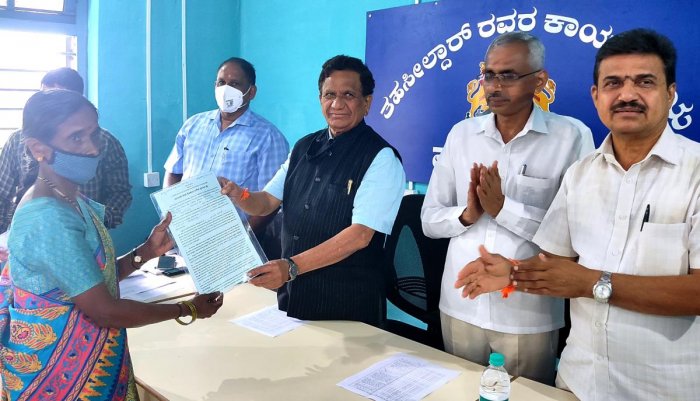
MLA K G Bopaiah distributes a cultivation chit to a beneficiary coming under the Virajpet Assembly constituency in Madikeri taluk.

MLA K G Bopaiah distributed cultivation chits to 32 families under the Akrama Sakrama Scheme. 

The cultivation chits were handed over to eligible beneficiaries from Sampaje, Bhagamandala hobli, Peraje, Hakathoor, Chembu, Made, Kolagadalu, Bettathooru, Korangala, Kaggodlu, Bengoor, Karugunda, Tavoor and other villages. 

Speaking on the occasion, Bopaiah said that the cultivation chits have been distributed to those who have been cultivating on the said land for several years.

The land should not be sold. The land can be used for the construction of houses and carrying out agriculture activities, he said. 

Madikeri Taluk Akrama Sakrama Samiti president Nagesh Kundalpadi said that owing to the efforts of the MLA, the cultivation chits could be distributed. 

source: http://www.deccanherald.com / Deccan Herald / Home> State> Mangaluru / by DHNS, Madikeri / October 09th, 2021

Rural girl makes her mark in the world of art

S R Akshata’s artworks are adorning the walls of govt schools, offices.

A talented girl from a remote rural area in Kodagu district is now been becoming famous in the region, through her artistic skills.

S R Akshata, an artist from Navagrama village in Kodlipet Gram Panchayat limits in Shanivarasanthe, has been pursuing her passion while doing her regular studies.

Artworks created by her have adorned the walls of government schools and offices, drawing everybody’s attention.

Akshata is the daughter of wood sculptor Ramesh and Kavita.

She developed an interest in drawing since her primary school days. However, she could not carry it out seriously until she joined Morarji Desai Residential School in Aluru Siddapura.

Art teacher D P Satish identified her talent, encouraged her and honed her skills.

She was so much involved in arts that she chose to carry out her degree education in art, in Mahalasa School of Visual Arts in Mangaluru.

Currently, she is in the second year of her degree. She has been mastering pencil art, poster colour art, 3-D art, pencil shading, acrylic art and so on.

In a humble gesture, during holidays, she spreads her knowledge to the students of government schools by teaching them drawing and painting.

She also creates artworks for the schools. The initiative was taken by ‘Nammura Kalakaliya Vedike’ set up by D P Satish, of which she is a part.

Apart from teaching art to the students, she also contributed her own artworks to the schools in Navagrama and surrounding villages. 

Her artworks are now adorning the walls of five schools, a Gram Panchayat and three libraries.

Teacher D P Satish said that her talent should be appreciated in the state and the nation.

source: http://www.deccanherald.com / Deccan Herald / Home> State> Mangaluru / by DHNS, Shanivarasanthe / October 10th, 2021

Avid Birder’s Wildlife Message Cards-2021

Mysore/Mysuru: 

Dr. S.V. Narasimhan

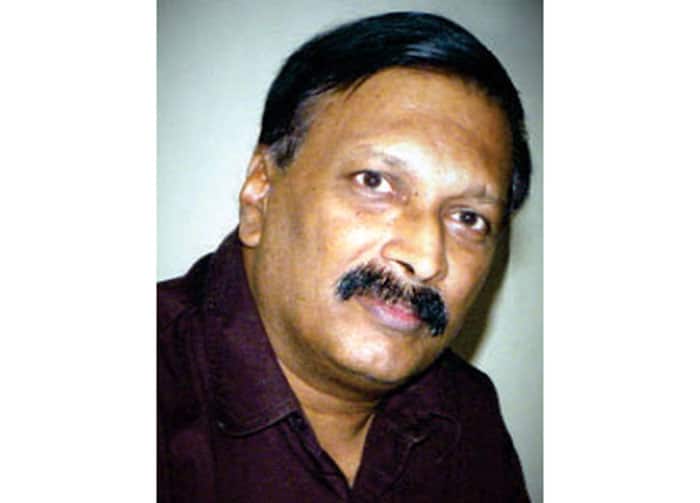
Dr. S.V. Narasimhan, a family physician based at Virajpet in Kodagu, is an avid birder, nature lover, adept at computers, Karnatak music and astronomy.

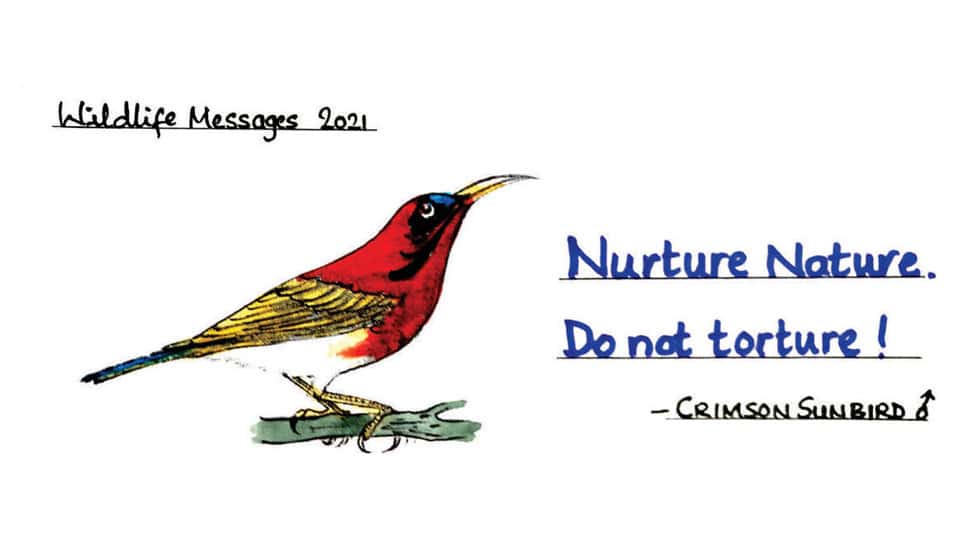
Author of Feathered Jewels of Coorg, a field-guide to 310 species of birds found in Coorg, Dr. Narasimhan is the pioneer in spreading wildlife conservation messages through his unique hand-painted Wildlife Message Cards that are sent free to individuals throughout the world to mark Wildlife Week (Oct. 2 to 8).

Total number of hand-painted cards made by him this year is 2,630; in 37 years, 75,285 cards.

Total recipients this year including Star of Mysore – 1,284; in 37 years — 13,387 persons.

The Special Wildlife Messenger this year is Rufous Woodpecker (Micropternus brachyurus) which is a medium sized, brown coloured bird, with short beak and a short strong tail. Male birds have a red patch under the eyes. They feed on insects, ants and flower nectar. Their call is a sharp nasal, three-note, Knk-Knk-Knk. The most surprising fact is that they make their nest within the carton nests of Crematogaster ants and the young also feed on the eggs and larvae of the ants!

source: http://www.starofmysore.com / Star of Mysore / Home> News / October 11th, 2021

Kudloor industrial area bereft of basic facilities

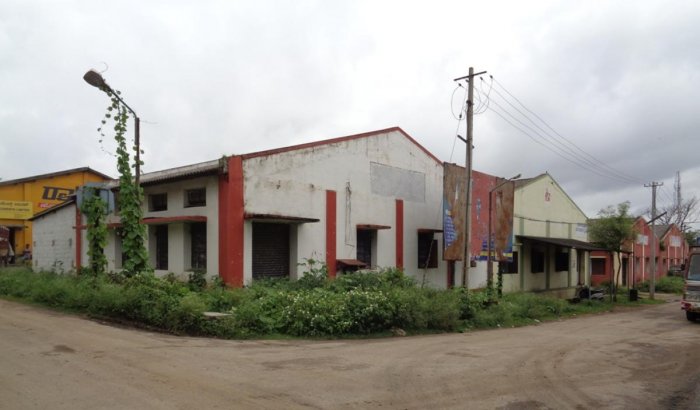
The industrial area in Kudloor.

The industrial area in Kudloor. The first and the only KIADB industrial area in Kudloor in Kushalnagar is facing a lack of basic facilities. The layout is devoid of facilities and people are eagerly waiting for its upliftment.

Owing to the efforts of then chief minister Gundurao, the industrial area had come up at Kudloor in 1984.

There are more than 60 industrial units related to coffee, pepper and others that have come up in the industrial area. About 40% of them are related to coffee and its processing. Some of the food industries including ice cream, hollow bricks, iron and other industries are functioning. The annual turn out from coffee-related industries is Rs 4,000 crore, said Kudloor Kaigarikodyamigala Sangha president A N Praveen.

The industrial area has been completely neglected over the years. Owing to the pressure from the industrialists, pothole-ridden roads have been developed in the area.

According to KIADB officials, the government had sanctioned Rs 10 crore for the development of the industrial area. All the roads leading to various industrial layouts in the vicinity have been developed. The basic facilities will be improved in a phased manner.

Though 250 acres of land was acquired for industrial area, the khata of only 100 acres has been handed over. The remaining 150 acres has no khata. It is not even registered in the name of KIADB. As a result, several industrialists are denied facilities from the government, said, industrialists.

The industrial area has a lack of streetlights. As a result, people are scared to move around at night. Even drains are not constructed by the side of the road. Weeds have grown on either side of the roads.

There is an allegation that only coffee-related industries are set up in the industrial area. As a result, the employment generation is restricted and youth have been migrating to cities in search of greener pastures, said local residents.

There is even a lack of security in the industrial area. Theft cases too have been reported in the nights.

Department of Handlooms and Textiles assistant director Guruswamy said the department had submitted a proposal on setting up a mini power loom park at the industrial area in Kudloor. The deputy commissioner has given approval for the same.

Beeralingeshwara power loom will be set up in the future which will provide employment to women and men, he added.

Industries centre joint director Shankaranarayana said that a meeting to discuss the problems faced at the industrial area will be convened shortly at Koodumangalore Gram Panchayat hall. The officials from KIADB and others will attend the meeting.  

Meanwhile, MP Pratap Simha has submitted a proposal to set up an ESI Hospital in Kodagu. Even land has also been identified for the hospital at Kudloor.

However, the process for the setting up of the hospital has not been initiated so far.

Vanijyodyamigala Sangha, Kodagu, president M B Devaiah said, “We have appealed to Union Minister Rajeev Chandrashekar to help in the generation of employment in the district.

source: http://www.deccanherald.com / Deccan Herald / Home> State> Mangaluru / b y DHNS, Kushalnagar / September 30th, 2021