All posts by admin

Coorg plantation wins award for most romantic resort

Mumbai :

The Tamara resort in Coorg recently won the award for most romantic resort at a travel awards show hosted by a Hindi business channel. It is listed in the top 20 honeymoon destinations by Conde Nast Traveller India.

This is a luxury 56-key resort located in the hills of Coorg near Madikeri. It has been set up within an estate of 170 acres that produces coffee, cardamom, pepper and honey, and claims to be one of the few places in the world that is built inside a functional coffee plantation.

Its promoters say that it is set on a slight slope, and offers a breathtaking view of the Western Ghats and lush green forests along with two waterfalls flowing within the premises. Tourists either head out on guided treks and nature trails, or opt for a plantation tour with the coffee experience.

A bridge overlooking one of the waterfalls serves as a multi-cuisine restaurant. The resort is in the second phase of development that will have new luxury cottages and premium suites apart from sit-out decks at a height of 3,600 sq ft overlooking the hillside. An indoor private jacuzzi and spa is also on the anvil.

source: http://www.timesofindia.indiatimes.com / The Times of India / Home> Business> India Business / by Bella Jaisinghani, TNN / July 06th, 2013

Tryst with the goddess

Gustasp & Jeroo Irani encounter the Cauvery in the forests of Karnataka.

A deep trench, meant to keep elephants away from the lush coffee plantation, had the imprint of a large footprint. An elephant had just lumbered past. “He is in the vicinity,” whispered Ganesh, our naturalist-guide.
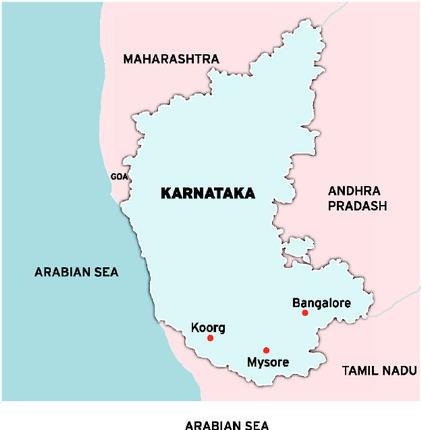
CoorgMapKF05aug2013

As we soldiered on through the Dubare Forest in Kodagu or Coorg, Karnataka, past stands of dead bamboo and soaring rosewood and sandalwood trees, the jungle resonated with an air of menace. “Shhh! He’s there, not too far away!” Ganesh said, as our hearts beat a harsh tattoo against our chests. We were in search of the legendary river Cauvery and it seemed like in the process we would be trampled by an elephant. We stood as still as the tall matti trees from whose sturdy trunks tribals draw water to drink. And then, to the huge relief of our group of four, we heard the lone tusker tramp away in the opposite direction.

Parting thickets of leaves and dry twigs that clawed at us, we trod up and down red paths to suddenly arrive at a clearing. An expanse of emerald-green waters, rippled below, tripping over smooth boulders… the Cauvery at last! The mythical maiden river had played truant even with Sage Agastya who fell in love with her. Legend says the sage asked a disciple to keep an eye on his beautiful wife Cauvery and put her in a vessel. The mischievous and self-willed lady was upset and started to flow away. When the young lad protested, she went underground. That is why, it is said, the river disappears from her source at TalaCauvery, high in the Western Ghats in Coorg, to re-emerge at Bhagamandala, a few kilometres away where a charming temple is dedicated to her.

In the land of her birth, the river is worshipped as a living goddess. Every Coorg or Kodava home is adorned with a photograph or oleograph of the Cauvery and a heavy brass lamp is lit every morning and evening to honour the ancestors. We, however, washed our faces in her life-giving waters and splashed it on one another, while Ganesh sang a song to Ma Cauvery, his voice riding over the sound of the rushing river.

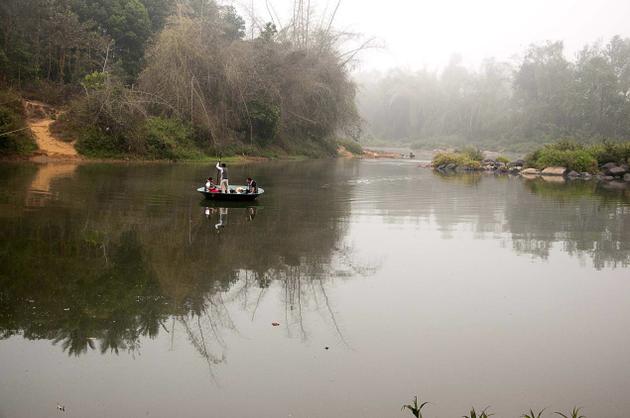
When we were there recently, the river was fairly shallow but coracles bearing locals drifted along its length to the various villages. We too twirled down the river in a coracle to the riverside village of Karadigodu, with trusty Ganesh, when the fragrance of freshly-baked local bread wafted over the slowly-awakening hamlet. Children were getting ready for school, cramming into an auto rickshaw that doubled as a school bus, while grandmothers packed tiffin boxes with lunch for their men-folk on their way to work in the coffee plantations. Mothers swung infants on ample hips and waved to older children heading for the nearest college, heaving backpacks on frail backs.

The village has an aura of sleepy prosperity. / Photo: Gustasp and Jeroo Irani / The Hindu

The village had an aura of sleepy prosperity. Neat little cottages were strung in rows, painted in vivid shades of pink, purple, mauve and green and, in some, TV sets played out the latest South India soaps. We stopped at a local stall (grandly called The Riverside Hotel) for some South Indian filter coffee, fresh sweet bread and smoke-flavoured onion bhajias that had just been whipped off a wood fire. And in front of the village flowed the mercurial Cauvery which, when it is in spate, can break its banks and flood the hamlet and the first row of houses! Yet when we took part in harvesting coffee berries in a plantation, we began to understand how the locals feel an almost mystical attachment to the river.

“Without the river and the land that it waters, we are nothing,” said one of the women coffee pluckers whose nimble technique of prying coffee berries off the bush, we tried hard to imitate. “Ma Cauvery is our goddess!” she exclaimed.

After coffee harvesting ends in February, pepper is culled and so it goes on till June when, with the rains, the Cauvery brims with revitalising waters again, the soil sprouts anew and the cycle of life is renewed.

We met the river goddess again in Kabini, a three-hour drive away, past fields of ripening corn, sugar cane and paddy. The forests of Nagarahole were a dark-green tangled smudge beyond the coiling river Kabini which, incidentally, is a tributary of the Cauvery!

As our boat put-putted down the Kabini that circles the south-eastern edge of the Nagarahole National Park, we saw a couple of wild elephants, long tusks grazing the ground, a marsh crocodile sunning itself on a bank, as still as a log of wood, an iridescent kingfisher that dived for his meal and emerged triumphant. All around us was a world as fresh as at the dawn of time and we thanked Ma Cauvery for her life-nurturing presence which even embraces the wilderness.

source: http://www.thehindu.com / The Hindu / Home> Features> Sunday Magazine / by Gustaspjeroo Irani / July 13th, 2013

Nishan to romance Keerthi

nishanKF05aug2013
Geethanjali :

Actor Nishan will romance Keerthi in the upcoming film Geethanjali. The film is directed by Priyadarshan and has Mohanlal doing the role of Dr Sunny, a psychiatrist. Nishan will be the second lead after Mohanlal in the film.

The actor is elated that he has bagged a role in his favourite director Priyadarshan’s film and is looking forward for the shooting to begin.

source: http://wwwq.nowrunning.com / Home> Malayalam / Monday – July 15th, 2013

Kodagu district minister assures grants for relief works

Kodagu District In-Charge Minister Dr. H.C. Mahadevappa is seen inspecting the damaged Mysore-Madikeri road yesterday. Former Minister T. John, MP H. Vishwanath and others are seen.

Madikeri :

Kodagu District In-Charge Minister Dr. H.C. Mahadevappa, who visited the district yesterday, inspected the damaged road at Boikeri village linking Mysore and Madikeri. He also visited Thayagaraja Colony in Madikeri town where houses were damaged due to heavy downpour.

Later, speaking to press persons at Sudarshan Guest House, Dr. Mahadevappa, who holds the PWD portfolio, said that as per the preliminary report submitted by the district administration, the district has incurred a loss of at least Rs. 24 crore due to heavy rainfall. Based on the consolidated report, the government is committed to sanction funds to take up relief works, he said.

Stating that the district had received more than double the amount of rainfall than last year by this time, he said that the average rainfall this year till date was 219.79 cms (86.54 inches), while it was 91.67 cms (36.03 inches) last year. “I am aware the heavy downpour has adversely affected normal life. I have directed the DC to undertake relief work on a war footing,” he said.

Gabion technology for Madikeri road repair

Karnataka Road Development Corporation Limited (KRDCL) Managing Director R. Srinivas, speaking to press persons here yesterday, said that there were two options to repair the massive breach in Mysore-Madikeri road at Boikeri village – either build a concrete retaining wall or use the Gabion technology. “Senior officials have been told to inspect the spot and submit a report, based on which repair work will be undertaken,” he said.

The highway work between Sampaje and Maani, which is progressing in a slow pace, will be expedited to complete by May 2014, Srinivas said.

What is Gabion technology

A gabion is usually a box filled with concrete or sometimes sand and soil for use in civil engineering, road building, and military applications. A gabion wall is a retaining wall made of stacked stone-filled gabions tied together with wire. Gabion walls are usually battered (angled back towards the slope) or stepped back with the slope rather than stacked vertically. The most common civil engineering use of gabions is to stabilise slopes against erosion. Other uses include retaining walls, temporary floodwalls and silt filtration from runoff.

source: http://www.starofmysore.com / Star of Mysore / Home> General News / July 29th, 2013

Kodagu Mahila Sangha conducts free health camp in city

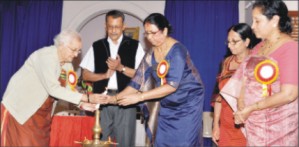
Sree Kaveri Kodagu Mahila Sangha’s Advisor Parwati Cariappa (extreme left) and Sangha President Sarasu Nanaiah are seen lighting the lamp at the inauguration of the free health camp in city yesterday as chief guest Dr. P.A. Kushalappa, Sangha Organising Secretary Gowri Mandanna and Hon. Secretary Lovely Appaiah look on.

Mysore :

A free health check-up camp was held under the aegis of Sree Kaveri Kodagu Mahila Sangha at the Kodagu Sahakara Sangha premises in Jayalakshmipuram yesterday.

The camp was inaugurated by dermatologist Dr. P.A. Kushalappa and Mahila Sangha’s Advisor Parwati Cariappa.

The health camp was held in memory of late Ursula Kariappa, wife of Karthamada Kariappa.

Sangha President B. Sarasu Nanaiah presided. Hon. Secretary P. Lovely Appaiah welcomed.

A large number of people availed of the opportunity at the camp in which Physician Dr. Latha Muthanna, Dr. Padmini Kaveriappa, dentist Dr. Manasa Sendil, Paediatrician Dr. Jyotsna Prasad, Dr. P. P. Aiyanna (Ayurveda), gynaecologist Dr. Kamalamma, orthopaedic surgeon Dr. Ajay Hegde and Dr. Rajesh of Vasan Eye Care participated.

Sangha Vice-President Bollamma Appanna and the guests presented mementos to the doctors who participated in the camp.

Treasurer Jyothi Kashi, Joint Secretaries Bollamma Kuttappa and Kavya Kuttappa, Organising Secretaries Gowri Mandanna and Sumi Gopal and other members were present on the occasion.

source: http://www.starofmysore.com / Star of Mysore / Home> General News / July 29th, 2013

Tatas to focus on beverages ‘power brands’

TataKF03aug2013
The brands that will be given a global push are Tetley, Tata Tea, Himalayan and Eight O’ Clock Coffee

The beverage arm of the $100-billion (Rs 6 lakh crore) Tata Group has prepared a blueprint that will see it devote its attention to four “power brands” in its quest to achieve a turnover of $5 billion (Rs 30,000 crore) in the next three years.

The list will include products such as Tetley, Tata Tea, Himalayan and Eight O’ Clock Coffee, which will be given a global push. At the same time, the Rs 7,271-crore Tata Global Beverages (TGB) will not take its eyes off regional products either, pushing these aggressively in their home markets. On this list are brands such as Kanan Devan, Chakra Gold and Gemini in South India, Vitax in Poland and Joekels in South Africa.

The blueprint, explains TGB Managing Director Harish Bhat, is in keeping with company Chairman Cyrus Mistry’s vision to invest significantly behind the firm’s brands. At the company’s recently-concluded annual general meeting in Kolkata, 44-year-old Mistry, who became chairman last year, said that the foundation for investment behind the firm’s products had been laid. “It is crucially important to grow our brands in India and overseas. There is also a need for innovations which need funds,” he said.

TGB derives 65-70 per cent of its revenues from international markets and the balance from India.

Tetley, one of the products on the global power list, already sells in a number of markets outside its home turf of the UK. This includes India, where it competes with Twinings and Brooke Bond Taj Mahal from Hindustan Unilever. Tata Tea, an Indian product, meanwhile, has been taken to markets such as Canada and West Asia, while plans are afoot to take Himalayan packaged water, also an Indian product, which was acquired in 2007 by the company, to Southeast Asia in the near term.

Bhat declines to indicate whether new products would be added to the global or regional list through new acquisitions. Outgoing Vice-Chairman R K Krishna Kumar, at the TGB AGM, had hinted that the company was looking at a new acquisition. He had said, “TGB will make a major acquisition and be a truly worldclass company, not in the tea or coffee space but in new beverages.”

As things stand, TGB derives nearly 70 per cent of its revenues from tea, 20 per cent from coffee and five per cent from water. The plan is to take the contribution of water and coffee to 10 per cent and 25 per cent, respectively, in the next three years, Bhat said. Tea’s contribution, on the other hand, would come down to about 60 per cent, he added.

TGB proposes to achieve this by pushing its joint ventures with PepsiCo and Starbucks aggressively in the next few years. “A total of 18 stores have been opened so far by Tata Starbucks in Mumbai and Delhi. This count will go up as we move forward,” he said.

On the joint venture with PepsiCo (called NourishCo), Bhat indicated that in-house brands Tata Water Plus and Tata Gluco Plus were doing well.

“Tata Water Plus has seen higher growth than Himalayan packaged water (in the June quarter). But this is in the markets of Tamil Nadu and Andhra Pradesh, where the brand is currently present. The plan will be to take it to other markets in the country,” he added.

source: http://www.business-standard.com / Business Standard / Home> Companies> News / by Viveat Susan Pinto / Mumbai – August 03rd, 2013

Set for World Championship

Ashwini Ponnappa
Ashwini Ponnappa

Ashwini Ponnappa, the glamourous Bangalore shuttler, is gearing up for the World championships to be held in Guangzhou, China, from August 5 to 11.

Ashwini, who won the Commonwealth Games gold partnering Jwala Gutta, now has a new doubles partner in Pradnya Gadre of Maharashtra.

She launched the Banga Beats Indian Badminton League team from her home city but quite shockingly, wasn’t picked up by them. In the player auctions, it was Pune which bagged her for a sum of $25,000.

The IBL has decided not to have women’s doubles in the championships and as such, Ashwini will have to only depend on the mixed doubles apart from the women’s singles, if she is in the fray for that event as per the decision of her team.

But on a positive note, according to her, whatever controversy that has been generated, is good for Indian badminton. “Rubbing shoulders with top players will give us a lot of benefits. The experience of playing them will remove the psychological barrier when we meet them in bigger events. Also, the game in the country will get a big boost. Not often do big names come and play here. So people will get a very big opportunity to watch them in action. I am sure Indian badminton is poised for a big leap,” said Ashwini.

Championship preparation

With the World championships coming a lot before the IBL, she has a huge advantage at the moment as she can concentrate on doing well in a championship that matters the most. Certainly, a lot more than any national league or Grand Prix in the World.

“In the past few days, the IBL distraction did disrupt my training but now I am back on court and practising hard for the upcoming World Championships. I am training in Bangalore right now while my doubles partner, Pradnya Gadre is training in Hyderabad. We hope to put in some work together soon. Having played with each other earlier, we know our games well and combining with her should be no problem,” Ashwini said.

According to her, the preparation has been good and she is working on her fitness more than any other aspect. “I have always taken one match at a time. It does not make sense predicting things, so I am concentrating on the first round right now. We have a tough first round, let’s first clear it. We will be facing Damkjaer Kruse and Marie Roepke from Denmark and we have not played them earlier. So it is going to be a very important game for us,” said the shuttler who won the bronze in the 2011 World championships with Jwala to become only the second Indian to do so after the 1983 singles bronze that the legendary Prakash Padukone won way back in 1983.

“I am partnering Tarun Kona in the mixed doubles and there I think we will meet a Japanese pair – Hirokatsu Hashimoto and Miyuki Maeda – in the first round. Let’s see how it goes,” said Ashwini.

source: http://www.newindianexpress.com / The New Indian Express/ Home> Cities> Bangalore / by S S Shreekumar / ENS – Bangalore / August 01st, 2013

Permission to sell Kodagu’s Jamma lands could lead to ecological disaster

The tiny hill district of Kodagu (Coorg) in Karnataka is facing an ecological disaster with the President of India giving his assent to a controversial legislation which allows the disposal and sale of Jamma lands in Kodagu located in the fragile Western Ghats. It is feared that the resultant denudation of the forests in the region could trigger an environmental damage with unpredictable consequences.

The repercussions of the legislation — The Karnataka Land Revenue (Third Amendment), Act, 2011, which received Presidential assent early this year after the bill was referred to the President by the Karnataka governor last year, will not only be severe on the Western Ghats region, considered as one of world’s bio-diversity hotspots, but will also take its toll on the customary laws, traditions and culture of the indigenous communities.

Jamma land tenure is unique to Kodagu district and it is estimated that the extent of ‘Jamma Baane’ land in Kodagu is around 2.55 lakh acres in possession of the local people — Kodavas, Amma-Kodavas, Heggades, Airis, Koyavas, Moplas and Gaudas. Jamma lands consist of wetland for growing paddy and the accompanying Baane land, initially used for cattle grazing and held free of assessment, now converted into coffee estates.

According to Sir J B Lyall, a British expert on tenures in Coorg who traced the origin of Jamma, it was originally a military tenure held on payment of half the assessment in consideration of military service. Jamma was granted under ‘sanads’ largely by the Coorg Rajas (1600 AD to 1834 AD) and to a smaller extent by the British till 1895 to the local inhabitants.

Hitherto, there was a ban on the sale of Jamma lands as the cultivator was only a ‘deemed owner’. The new legislation will confer the title of ‘occupant owner’ and allows the sale of land. The legislation, it is feared, will legitimise large scale denudation of trees and the formation of human settlements on Jamma Bane lands as there will be heavy influx of population from the neighbouring states. The presence of increased human habitation will have its impact on the adjoining forest land, its flora and fauna.

For generations, the life of the local communities, centered around the cultivation of the Jamma lands, the principal tenure in Kodagu. The Jamma lands could not be alienated as there was no provision for transferring the title of the property. The ownership was jointly held by the clan and it was managed by the head of the clan (Pattedara).

The issue went before the Karnataka high court and a full bench of the court held in its judgement delivered in October, 1993 that Jamma Baane landholders had limited privileges for cattle grazing, supply of firewood and timber for the domestic and agriculture purposes, but had no right to exploit the trees for commercial purposes, unless the holder had paid full timber value to the government. The court also held that the land-owner had no right to the sub-soil.

Customs and traditions

Once the ban on the sale of Jamma lands is lifted, the indigenous communities will be removed from their traditional Jamma holdings which formed the basis of their customs and traditions. The ‘ain-mane’ or the ancestral houses of the clans, was the focal point of all festivities and religious usages. It is feared that once the Jamma lands are sold to outsiders, the new land owners could lay claim to the ‘ain-manes,’ considered sacred to the local communities. This could lead to social tensions and law and order problem.

The biggest threat will come from the real estate mafia who were eyeing the Jamma lands all these years. With tourism boom in Kodagu, the local communities will be under pressure to sell their lands as the state will not have any control over them. It is learnt that already Jamma lands are being sold in anticipation of the new law taking effect.

The amendment to the Jamma tenure was effected during the previous BJP regime. The amendment was politically motivated and passed in haste without much debate in the Legislative Assembly, reportedly at the instance of the then Speaker K G Bopaiah who wanted to take political advantage. One of the reasons for Bopaiah’s re-election from the Virajpet constituency was on account of the political mileage he gained by getting the amendment passed.

The new amendment will create more problems than it hopes to solve. Those who drafted the amendment bill have failed to recognise the fact that apart from Jamma Baane lands, there are other types of Baanes — ‘Hithlu’ and ‘Sagu Baane’ lands.
Advocate K Sarojini Muthanna, who is knowledgeable on Jamma tenure matters, has suggested that the government should carry out further amendments to the Karnataka Land Revenue Act, 1964, devoting a separate chapter for the Jamma lands of Kodagu. The main support for the amendment has come from Akhila Kodava Samaja, representing a small section of the Kodavas. The president of the Samaja, Mathanda C Monnappa, opined that the amendment removed ‘irritants’ by way of government circulars which gave the impression that the land belonged to the government.

A large section of people, however, feel that in the interest of preserving the culture of Kodagu, and maintaining the ecological balance in the Western Ghats, the Siddaramaiah government should not give effect to the amendment to the Jamma land tenure.

source: http://www.deccanherald.com / Deccan Herald / Home> Panorama / by P T Bopanna / July 24th, 2013

Coffee Board ups output forecast to 3.47 lakh tonnes

CoffeeBlossomKF03aug2013
‘Crop to drop by 20% due to weather-related problems’, says KPA
Bangalore :

Despite rampant white stem borer (WSB) menace and long days of dry period after blossom, coffee production is set to increase by 28,800 tonnes (9.05 per cent) over the final estimate of previous year 2012-13 (3,18,200 tonnes).

The Coffee Board, which released the post-blossom crop forecast, said for the year 2013-14, coffee production is estimated at 3,47,000 tonnes.

Of the total estimate, the arabica and robusta break up is 1,11,000 tonnes and 2,36,000 tonnes respectively. Arabica production has shown an increase of 12,400 tonnes (12.88 per cent) over the final estimate of 2012-13, while robusta increased by 16,400 tonnes (7.47 per cent).

By the states, the production gain has mainly come from Karnataka to the tune of 18,890 tonnes (8.21 per cent) and non-traditional areas (NTA) with 1,780 tonnes (28.57 per cent) while Kerala has shown an increase of 6,350 tonnes (9.89 per cent) and Tamil Nadu by 1,755 tonnes (10.10 per cent) compared to the previous 2012-13 season’s final estimate.

“Due to the drought like conditions (April-May), the crop setting in arabica and robusta has been severely effected. Also there were many incidences of WSB in arabica plantations.

The Karnataka Planters’ Assocation (KPA) estimates that there will be a drop of 20 per cent due to this weather-related problems, said Nishant R. Gurjer, Chairman, KPA.

In Karnataka, all the three districts recorded increase in production over the previous year with an almost equal share of arabica and robusta. Kodagu district recorded the highest increase of 14,420 tonnes (12.02 per cent) which is mainly accrued from robusta (11,620 tonnes or 11.77 per cent) and arabica gained by 2,800 tonnes (13.15 per cent).

Hassan district recorded an increase of 3,535 tonnes (10.84 per cent) which has come from both arabica (2,635 tonnes or 14.02 per cent) and robusta (900 tonnes or 6.52 per cent).

While Chikmagalur showed an increase of 935 tonnes from Arabica, the robusta production showed a decline of 2,940 tonnes (-7.30 per cent) over the previous year final estimate.

“Due to prolonged and unprecedented drought of over 50 days, there has been a spurt in the WSB pest that has devastated the arabica plants. We have also been unable to carry out the regular operations like spraying and manuring on time due to lack of rains in May. As for robusta, due to severe constraints of power and water resources, we were unable to cover our entire area for blossom and backing irrigation. We feel the blossom estimate may have to be revised further downward in view of prevailing conditions,” said Sahadev Balakrishna, Partner, Netraconda Estates, Chikmagalur.

“The arabica production regained in 2013-14 season in Karnataka mainly because of the biennial bearing nature of arabica as last year’s final estimate was low,” said the coffee board official.

The blossom showers are reported to be normal in all most all the coffee growing zones, while there was a delay in backing showers in certain pockets were reported. “In general good crop condition and better husbandry practices have helped to invigorate production in Karnataka. The crop forecast for Karnataka is placed at 86,735 tonnes of arabica and 1,62,380 tonnes of robusta totalling 2,49,115 tonnes,” the official explained.

Kerala coffee zones also have received adequate and timely blossom and backing showers. There was no adverse effect on crop was reported.

Accounting this, the post-blossom estimates for the 2013-14 is placed at 70,550 tonnes, which is an increase of 9.89 per cent (6,350 tonnes) over the previous 2012-13 final estimate of 64,200 tonnes.

Tamil Nadu post-blossom forecast is placed at 19,125 tonnes which also showed an increase of 1,755 tonnes (10.10 per cent) mainly in Pulneys and Shevroys region against the previous year final estimate of 17,370 tonnes.

In non-traditional areas of Andhra Pradesh and Orissa and north eastern region, the post-blossom forecast is placed at 8,210 tonnes against previous final estimate of 6,405 tonnes.

The higher forecast has come mainly from Andhra Pradesh and Orissa due to increase in bearing area.

2012-13 production was 3,18,200 tonnes

The final coffee production 2012-13 estimate is 318,200 tonnes, an increase of 2,700 tonnes (0.86 per cent) over the post monsoon estimate of 315,500 tonnes and an increase of 4,200 tonnes (1.34 per cent) over the previous year’s 2011-12 final estimate of 314,000 tonnes.

The Coffee Board, which released the final crop estimate for 2012-13, said of the total final estimate, the share of Arabica is 98,600 tonnes and that of Robusta is 219,600 tonnes.

The production of Arabica has shown a marginal decline of 1625 MT (-1.62 per cent) while Robusta increased by 4,235 tonnes (2.01 per cent) over the post-monsoon estimate made before crop harvesting in 2012. The loss in Arabica production and the production gain in Robusta has mainly come from Karnataka.

The final crop estimate for Karnataka is placed at 230,225 tonnes with a break up of 77,425 tonnes of Arabica and 1,52,800 tonnes of Robusta. The final production in Karnataka has shown a marginal increase of 3,020 tonnes (1.33 per cent).

The Arabica production has marginally declined in Chikmagalur (-1.32 per cent), Kodagu (-1.87 per cent) and Hassan of (-1.96 per cent) districts, while Robusta production shown an increase in Chikmagalur (8.33 per cent), Kodagu (1.15 per cent) and in Hassan (0.55 per cent) districts.

In Kerala, the final estimate of 2012-13 is placed at 64,200 tonnes with an increase of 375 tonnes (0.59 per cent) from the post monsoon estimate of 63,825 tonnes.

Tamil Nadu final production of 2012-13 is placed at 17,370 tonnes which is a marginal decline of 380 tonnes over the post monsoon estimate of 17,750 tonnes.

In the Non-Traditional Areas and North Eastern Region, the final estimate of 2012-13 is placed at 6,405 tonnes against post monsoon estimate of 6,720 tonnes which showed a marginal decline of 215 tonnes in Andhra Pradesh.

source: http://www.thehindubusinessline.com / Business Line / Home> Industry> Agri-Biz / by Anil Urs anil.u@thehindu.co.in / Bangalore – July 22nd, 2013
Mangalore University to offer five new courses

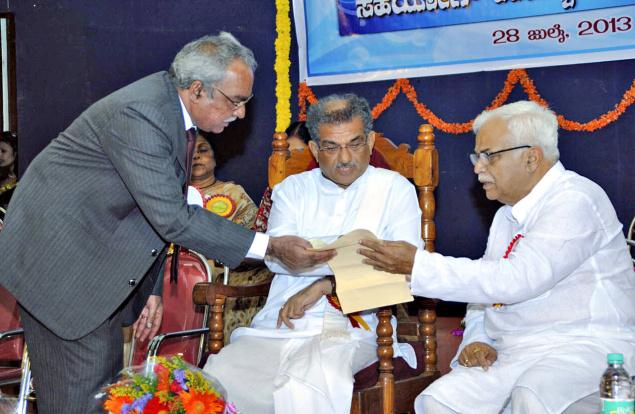
Vice-Chancellor T.C. Shivashankara Murthy, Dharmasthala Dharmadhikari D. Veerendra Heggade, and Higher Education Minister R.V. Deshpande at inauguration of a job fair at SDM Business Management College in Mangalore on Sunday. / Photo: H.S. Manjunath / The Hindu

Extend last date for admissions for the courses till August 15, says Minister for Higher Education and Tourism R.V. Deshpande

Minister for Higher Education and Tourism R.V. Deshpande said here on Sunday that the government has permitted Mangalore University to offer five new courses, including post-graduate, diploma and certificate, from the academic year 2013-14.

Addressing presspersons, the Minister said the university has been permitted to offer post-graduate courses in Bharatanatyam (Master of Arts) and Food Science and Nutrition (Master of Science), certificate courses in radioisotopes in biological science and visual arts, and diploma and post-graduate diploma courses in Kodava language and culture.

Field Marshal K.M. Cariappa College, a constituent college of the university at Madikeri, would offer the diploma and post-graduate diploma in Kodava language and culture. Any other colleges affiliated to the university can come forward to offer the two post-graduate courses. The certificate courses would be offered by the university.

Mr. Deshpande said that as the admissions for the current academic year at the university would close on July 31, he had directed the university to extend the last date for admissions for the five courses until August 15 as they were sanctioned recently.

According to P.S. Yadapadithaya, Registrar (administration) at the university, the University Science Instrumentation Centre (USIC) on the university campus would offer three-month certificate course in radioisotopes in biological science. N.G. Pavanje Chair in Fine Arts, an endowment chair, would offer a 16-week certificate course in visual arts. The diploma and post-graduate diploma in Kodava Language and Culture were of one-year duration each. The college would also offer a six month-certificate course in Kodava Language and Culture. The post-graduate courses were of two-year duration, but the university would not offer them in the current academic year.

Another official at the university said the university was yet to receive the formal approval letter to this effect from the government.

LOAN MELA

Mr. Deshpande said that 53 lakh students aged between 18 years and 25 years were out of higher education in the State and only 17 lakh were pursuing further studies. To increase the enrolment ratio of youth to higher education, the government would organise educational loan melas to provide financial support to youth to purse higher education. He did not make it clear when and how many such melas would be organised.

Earlier, he addressed a gathering at a job fair organised by the Department of Collegiate Education to graduates of government degree colleges of Dakshina Kannada, Udupi and Kodagu districts in the city.

source:http://www.thehindu.com / The Hindu / Home> News> Cities> Mangalore / by The Hindu, Special Correspondent / Mangalore – Julu 29th, 2013