All posts by admin

Off the beaten track in Somwarpet

A nondescript town in the lap of the majestic Pushpagiri mountain, Kumarahally’s geography makes it the perfect place to look for some solitary adventures, writes B V Prakash

Not all those who wander are lost, said a great man once; it surely must be the love of adventure. During my latest visit to Coorg, I decided to give the usual sights a miss and filled with an urge to explore the unseen, I deviated towards Somwarpet to drive through the primitive villages spread across the mountain ranges of the majestic Pushpagiri.

The destination was the nondescript town of Kumarahally. Also called Kumarally (in short), this town has nothing to boast of as a tourist destination; it is just one of the many small towns with similar names such as Shantalli, Kundalli, Bidalli and Bachalli through which one has to pass. However, it serves as a good base from which you can foray into a couple of interesting and exciting locales.

Leaving Somwarpet by afternoon, I headed north-west, breezing past the lush coffee estates and the green fields shining bright in the afternoon sun. After about five kilometres, a deviation to the left led me to a rustic settlement. Named Abbi Matha, this settlement is a religious place where devotees come for worship. But for others, it is a popular picnic spot thanks to the presence of the Abbi Matha Falls. The two-tier cascade may not steal the show, but it is impressive in its austere simplicity — surely an interesting diversion to break the 20-km journey to Kumarally. A dilapidated mutt premises can be visited here. Getting back on the track, I continued my journey towards Kumarally; the remaining journey was covered in half an hour and before dusk, I had reached my destination. The homestay at Kumarally — there is only one — is the ideal place to spend the night before exploring the locales nearby.

The nearest and most sought after sight here is the enchanting waterfalls of Mallalli. If you take the kuchcha road that goes beside the homestay, within a little less than three kilometres, you reach the famed waterfalls. However, driving on the slippery muddy stretch into the valley is indeed a torture. Mornings are the ideal time to visit the falls which are a sight to behold during sunrise. So at dawn, while still dark, I headed for the falls. After driving two kilometres on the treacherous path, I chose to walk the remaining way which proved to be a pleasant experience thanks to the fresh air and the sweet call of the birds. As I reached the edge of the wide gorge, I was left dumbfounded by the sheer beauty of the white cascades rolling down gently. I had all the time in the world to admire its beauty and also walk down all the way to its base.

From the front, the two distinct falls, each with its own form, appeared even more charming. The river Kumaradhara, which flows from here, tumbles down over short drops at a couple of places before joining the Netravathi at Uppinangadi. Rejuvenated from the astounding beauty in front of me, the tough climb back hardly mattered. On the way, I remembered the suggestion of my host Ponnappa and traced a trail through the coffee estates to see an unknown little falls which he said was called the mini-Mallalli falls.

Back at the homestay, after relishing a typically Coorgi breakfast of Votti (rice chapathi) and a cup of refreshing coffee, I drove up to Heggademane, a sleepy town six kilometres away. These places are familiar to trekkers as the trek to Pushpagiri begins from here. But you don’t have to be one to enjoy the panoramic view of the tall rounded peak rising into the blue sky from a lush forest. The Shantamallikarjuna temple here is worth visiting. In recent times, it has undergone a thorough improvement. The 850-year-old Champaka tree in the backyard is something that must not be missed.

Another interesting spot nearby is a hilly tract called Pattepare, which has some strange heaps of stones. Placed in triangular cairns of pebbles with a small opening, these were used as hideouts by erstwhile soldiers in times of battles, according to Ponnappa. There are also caves with narrow entrances. Though the whole place looked bizarre, it did evoke a feeling of belonging to a bygone era. With the sight of the mountain peak, the charming falls, the temple and clusters of age old cairns, Kumarally had me captivated.

How to get there

Kumarally is 20 kilometres from Somwarpet which is well connected with other cities. Though buses go to Kumarally it is easy to visit the spots with own transport in a day. The only homestay here provides food and accommodation.

source: http://www.deccanherald.com / Deccan Herald / Home> Supplements> Spectrum / by B V Prakash, DHNS / July 30th, 2013
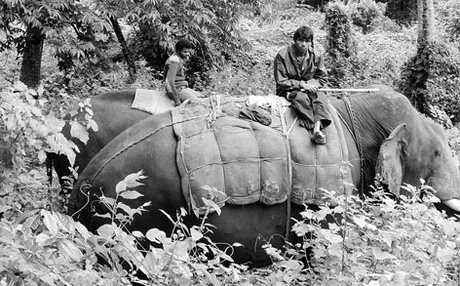
Forest officials drive back elephants into Kodagu forests

The two-day operation to drive wild elephants back into forests by the forest department in South Kodagu in progress | Express photos

The two-day initiative of the Forest Department to drive wild elephants back into the forests came to an end on Saturday.

On Friday, the operation commenced in the presence of chief conservator of forests, Kodagu circle, Brijesh Kumar Dixith, Deputy Conservator of Forests (DCF), Virajpet division, Malathi Priya, Deputy Conservator of Forests, Nagarahole wildlife division, Gokul, assistant conservator of forests and range forest officials and staff from all the forest department divisions of Kodagu district.

14 Jumbos Driven Back to Forests

The teams were able to chase away 14 elephants from Devarapura and Nokya Gram Panchayat limits, ACF Belliappa told Express.

On Saturday, the teams were unable to spot even one elephant.

He said the teams will continue to ensure the elephants do not return.

“The operation will be continued next week in Pollibetta areas. Movement of vehicles and people will be restricted through publicity arrangements,” he said.

Belliappa added that most elephants entered South Kodagu either from Mauvkal or Nagarahole forests.

Need for Public Help

The operation involved tamed elephants, special task force staff, wildlife staff from Nagarahole, Virajpet division forest officers and staff along with watchers. General public and police also extended required assistance to the department.

Chief conservator of forests, Kodagu circle, Dixith told reporters here on Saturday that as per the elephant census taken last year, as many as 6,000 elephants were located in the state. In Kodagu region, covering Gonikoppa, Thithimathi and Maldaare areas, as many as 100 wild elephants are troubling people, he said.

“Another 32 elephants are permanent residents of BBTC coffee estates in Siddapura. These should be captured and shifted,” he said. However, before their capture, a few technical and legal aspects need to be addressed, he said.

In Bramhagiri wildlife sanctuary, 30 elephants on the Kodagu-Kerala border have been identified that need to be captured and sent back into forest cover, he said. All these issues have been brought to the notice of Forest Minister Ramanath Rai, Dixith added.

source: http://www.newindianexpress.com / The New Indian Express / Home> States> Karnataka / by Express News Service – Madikeri / July 29th, 2013

Ashwini wants all icon players to be treated the same

(What irks Ashwini is that…)

Badminton player Ashwini Ponnappa was aghast when she was sold at much lesser than her base price at the auction for the upcoming Indian Badminton League (IBL).

Pegged at a base price of $50,000, Ashwini fetched just half of that when she was sold to the Pune Pistons, despite being among the icon players of the tournament.

While the IBL will pay her the differential, what irks Ashwini is that there was no communication about lowering the price. “I wasn’t informed about it. Even if there is no women’s doubles event, it doesn’t explain their actions because Jwala (Gutta) and I’ve been performing very well. In the mixed doubles arena, my partner Tarun Kona and I have the highest international ranking.”

Does that mean that she won’t be a part of the tournament? “I will keep my commitment to play the league, irrespective of whether they keep up their end of the bargain or not,” she says.

Saina Nehwal and PV Sindhu, meanwhile, got their base price. “All icon players need to be treated the same. If you are calling a player an icon, it must have been based on performance, and Jwala and I have been performing consistently. There is no need to discriminate between players based on price,” she says.

source: http://www.articles.timesofindia.indiatimes.com / The Times of India / Home> Sports> More Sports / by Taniya Talukdar, TNN / July 25th, 2013

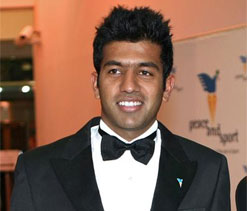
World No.1 ranking and a Slam is priority now: Rohan Bopanna

Rohan-BopannaKF31jul2013
New Delhi:

Rohan Bopanna is content that the sacrifices he made in his tennis journey paid off as he became world number three but the Indian tennis star`s hunger for success has only increased and he now wants to become number one besides notching his first Grand Slam trophy.

Bopanna`s career graph has how a steady rise and in the last two years, he has emerged as a force to reckon with in the doubles arena.

Of his eight titles, six have come in the last three years. Season 2012 was remarkable when he made six finals and won two titles with compatriot Mahesh Bhupathi. In 2011 he won all the three finals with Pakistan`s Aisam-ul-haq Qureshi.

“Discipline has been a key factor to my success. I have always made sure that I put my game ahead of anything else, sometimes even before friends and family. The journey has definitely not been easy but all the sacrifice has paid off very well in terms of my performance on-court. When you get better at your sport, the sacrifices you`ve made in that part don`t really count,” Bopanna said.

Courtesy his semifinal appearance at the Wimbledon, Bopanna, nicknamed `Bofors` for his powerful serve, climbed to number three in rankings early this week, behind formidable American twins Mike and Bob Bryan.

“The number one spot is of priority for me. Though there is no catching up to the Bryan Brothers this year, I am working hard to ensure that I reach the number one spot soon. That ranking is important to me and to get our country up there will certainly be a dream come true,” he said.

Bopanna (5335) is realistic in his calculations as the gap between him and the Bryans is a huge 9125 points. Hence his immediate goal is to add that elusive Grand Slam trophy to his eight ATP Tour titles.

He came close to doing that in the 2010 US Open but ended runners-up with Qureshi to Bryan brothers.

“Right now I have my eyes set on a Grand Slam win. Having reached so far, I want to go all the way and win a Grand Slam for the country,” he said.

Often it is said that Indian players peak late. In fact, Bopanna himself turned pro in 2003 but four of his eight titles have come in the last two years. Asked if at 33, success has come late to him, He said, “Better late than never.”

“As an athlete, success is not just about winning, it is about working hard and giving it all you have. I have always taken one match at a time and worked hard, when I succeeded I worked further on the aspects of the game which worked for me; when I failed, I listed out my weaknesses and worked on them. So, if you look at the bigger picture every game has been a learning curve,” he said.

Bopanna has always played under the shadow of India`s two most remarkable stalwarts — Leander Paes and Bhupathi — who were the team to beat in the late 1990s and early 21st century before parting ways.

They also have an enviable unbeaten run in the Davis Cup since 1997, winning 23 doubles rubbers.

Now that Bopanna has created his own space in the tennis world, does he feel ready to take the baton from Paes and Bhupathi?

“I have been representing the country for more than a decade. My performances have clearly improved leaps and bounds and if this means I am to take the baton on, I am ready.”

Bopanna also said he has worked hard on his game and that has shown on the court.

“My fitness and volleys have definitely improved over time with a lot of practice. For me, I make sure that I have not just played a match, but learned from it as well ensuring a certain degree of improvement in my game from the last match that I`ve played.”

Bopanna has changed a lot of partners. This season alone, he is set to play with his eighth partner in Germany`s Andre Begemann after a successful experiment with Edourad Roger-Vaselin at Wimbledon.

What forces Bopanna to change partners so frequently?

“Vaselin is concentrating on singles and will only be available to play once the Cincinnati Open starts, so I am partnering with Andre Begemann in the meantime. As a doubles player you have to get the right partner to make sure you yield good results and so I have been changing partners frequently.”

“If finding the right partner means trying out different players and tweaking your game, you have to adjust. It`s all about finding out what works best for you.”

Last year his pairing with Bhupathi was tremendous. They won two titles (Paris and Dubai) and were runners-up at six other events. However, after a failed campaign at London Olympics they could not repeat their performance.

“We had been playing well together for quite some time and when you are playing together for long you tend to understand what works out and what doesn`t.

“We took the decision of changing partners keeping in mind that performing our best was one of the most important aspects of being an athlete. So, I paired up with Vasselin and luckily it worked well for us,” he said.

Does he feel tempted to play with Qureshi, with whom he caught attention of the world by forming the Indo-Pak express that won three titles in 2011 and made 2010 US Open final?

“Aisam and I were a great team and we have moved on from there. Whether or not we pair up again is a question that only time can answer.”

Bopanna, who tied the nuptial knot with Supriya recently, said life has “indeed changed for better” after marriage.

“Supriya accompanies me to different tours and keeps me company. She has also been an incredible support system, encouraging me through and through, helping me perform better.”

PTI
source: http://www.zeenews.india.com / ZeeNews.com / Home> Sports> Tennis / by PTI / Sunday – July 28th, 2013

Kodagu Mahila Sangha conducts free health camp in city

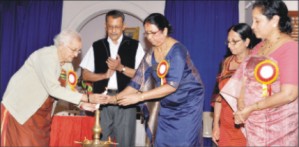
Sree Kaveri Kodagu Mahila Sangha’s Advisor Parwati Cariappa (extreme left) and Sangha President Sarasu Nanaiah are seen lighting the lamp at the inauguration of the free health camp in city yesterday as chief guest Dr. P.A. Kushalappa, Sangha Organising Secretary Gowri Mandanna and Hon. Secretary Lovely Appaiah look on.

Mysore :

A free health check-up camp was held under the aegis of Sree Kaveri Kodagu Mahila Sangha at the Kodagu Sahakara Sangha premises in Jayalakshmipuram yesterday.

The camp was inaugurated by dermatologist Dr. P.A. Kushalappa and Mahila Sangha’s Advisor Parwati Cariappa.

The health camp was held in memory of late Ursula Kariappa, wife of Karthamada Kariappa.

Sangha President B. Sarasu Nanaiah presided. Hon. Secretary P. Lovely Appaiah welcomed.

A large number of people availed of the opportunity at the camp in which Physician Dr. Latha Muthanna, Dr. Padmini Kaveriappa, dentist Dr. Manasa Sendil, Paediatrician Dr. Jyotsna Prasad, Dr. P. P. Aiyanna (Ayurveda), gynaecologist Dr. Kamalamma, orthopaedic surgeon Dr. Ajay Hegde and Dr. Rajesh of Vasan Eye Care participated.

Sangha Vice-President Bollamma Appanna and the guests presented mementos to the doctors who participated in the camp.

Treasurer Jyothi Kashi, Joint Secretaries Bollamma Kuttappa and Kavya Kuttappa, Organising Secretaries Gowri Mandanna and Sumi Gopal and other members were present on the occasion.

source: http://www.starofmysore.com / Star of Mysore / Home> General News / July 29th, 2013

Tata Coffee – Change in Directorate

Tata Coffee Ltd has informed BSE about the following changes have been made to the Company”s Board:

1. Mr. R. K. Krishna Kumar, Chairman and Director of the Company has relinquished office as a Director on his attaining the age for superannuation.

2. Mr. Harish Bhat, Director has been appointed by the Board of Directors as Chairman of the Board with effect from July 26, 2013.

3. Mr. T. Radhakrishnan has been appointed as Executive Director- Instant Coffee Operations with effect from July 26, 2013.

source: http://www.moneycontrol.com / Home> Moneycontrol> Markets> Announcements> Plantations> Tea & Coffee / Source: BSE / July 26th, 2013

Coffee Board’s forecast for 2013-14 surprises planters

Board has projected an all-time high crop of 347,000 tonnes in current year

At 3,47,000 tonnes, the Coffee Board’s post-blossom crop forecast for 2013-14 has come as a surprise for planters and exporters in Karnataka. The board has projected a nine per cent rise in production, compared with the final estimate of 3,18,200 tonnes for 2012-13. Karnataka accounts for 70 per cent of India’s coffee output.

The board has pegged robusta production at 2,36,000 tonnes and arabica production at 1,11,000 tonnes—7.5 per cent and 12.9 per cent higher than the final estimates for 2012-13, respectively. In 2012-13, 98,600 tonnes of arabica and 2,19,600 tonnes of robusta were harvested.

According to the Karnataka Planters’ Association (KPA), the board’s estimates were too high, considering the growing regions were in the grip of a prolonged drought and high temperatures during the pre-blossom period of February-April. KPA has pegged production at 2,90,000 tonnes.

“There are three main factors affecting production this year. We have seen prolonged dryness, owing to very high temperatures in March and April and the occurrence of white stem borer in arabica plantations. Third, this is an ‘off-year’ for robusta. We cannot have two consecutive years of high production. As a result of the drought, bean development was low this year in major growing regions in the Chikmagalur, Hassan and Kodagu districts,” said Nishant R Gurjer, chairman, KPA.

In fact, robusta production would be 25 per cent lower this year, especially in Karnataka, he added.

Exporters, however, neither agree with the board, nor with planters. “If the Coffee Board’s estimates come true, it will be an all-time high production in India. But it is unlikely to happen, considering various factors. Robusta has seen good rains in April and this year’s crop would certainly be better than last year’s. I think a little over 3,30,000 tonnes looks reasonable,” said Ramesh Rajah, president, Coffee Exporters’ Association of India.

Gurjer said the incessant rains in most growing regions in the last three weeks would have an adverse impact on production. Many planters have already reported fruit dropping and rotting. “There are stray incidents of ‘kole roga’ (a rotting disease) in many areas due to heavy rains,” he said. This year, production could be 2,90,000-3,00,000 tonnes, he added.

The United States Department of Agriculture has projected India’s coffee production at 3,12,000 tonnes.

A Coffee Board official said sampling had been carried out in April-June and the post-blossom estimates were in accordance with the sampling. Realistic production figures would only be released when post-monsoon estimates were prepared in October, he said, adding, “We will take into account all factors, including the impact of heavy rains, when we prepare the post-monsoon estimates.”

source: http://www.business-standard.com / Business Standard / Home> Markets> Commodities> Food & Edible Oils / by Mahesh Kulkarni / Bangalore – July 25th, 2013

The house with a storybook view

Jade Hill cottage
Jade Hill cottage

Every home is born first in the imagination, in the longing for the culmination of a dream. Only in some homes, the dream-like quality never really leaves, long after the walls have sprung up and every roof tile, every brick, pillar and window has found its place. The first time you see the Jade Hill cottage in Coorg, it is easy to disbelieve your eyes. So is there a house, really, atop a steep hill, shinning in the evening wilderness like a jewel? Well, yes, there really is.

But before we trek towards the home, it is time for a flashback. As narrated by architect Kavya Thimmaiah Prasanna, “My dad (Rajyutsva award winning architect HC Thimmaiah) was orphaned at an early age. He and his three siblings spent their childhood between various relatives’ houses in Coorg, the one constant being their grandmother. Her death split up the family and dad moved to Delhi, then Mumbai and finally to Chennai for his first job. One of the first architects to come from Coorg, he finally moved to Bangalore where he set up his own practice and started his life. But always, there was a hankering for what he had lost. The childhood home among the coffee plantations that he enjoyed so fleetingly. So 40 years after he left Coorg, when he got the opportunity to build a hill home, it was the culmination of a life-long dream, something he had always yearned for, without even admitting to it.”

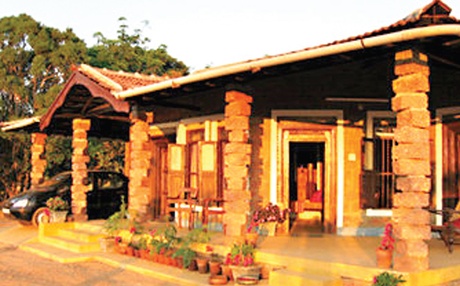
So that then is the history of Jade Hill, the house on top of the mountain that HC Thimmaiah built with his daughter. The cottage, when you reach it, spreads out languidly as if it were part of the hill rather than built on it. And that is because the Thimmaiahs used stone and laterite found in the region and kept the structure organic and simple with a wrap around verandah where the design quirk is the twisted brick pillars. The flooring throughout the house is red oxide though it isn’t just red but blue and yellow and green and embedded with decorative tiles.

Part of recreating nostalgia was to literally salvage it, so Thimmaiah sourced doors and windows and a lot of wood and even tiles from old traditional homes that were being demolished all across Coorg. Kavya says, “Yes, my parents decided to use only recycled materials in the construction. Scrap-yards were scoured and doors, windows and pillars bought in a decrepit state and refurbished lovingly. Hundred-year old tiles for the roof and burnt-orange, laterite walls completed the construction.” To keep the house as green as possible, the use of new wood was kept to the minimum and concrete built-ins were created to serve as beds while a few pieces of antique furniture lend a sense of history.

Even in the bathroom, a mosaic was created out of broken tiles that would have been thrown away otherwise. Building the house though was not easy. Recalls Kavya, “When my parents bought a piece of land in this remote, relatively unknown part of Coorg, most people thought that they were plain crazy. Who would want to live in a village so windy that it was called Galibeedu or ‘Windy Village’? A place with rainfall so high, that nothing grew on the slopes? Least of all, that Coorg staple, coffee. To a Kodava, any land that coffee can’t be grown on is pretty much useless. ‘If you must build a house there, don’t build on top of the hill,’’ they said and added, ‘Build it in the valley, where it is sheltered, and to hell with the view!’’ But my dad, the recalcitrant person that he is, said, “Top of the hill and nowhere else.’’ So top of the hill it was. A house built into the hillside, overlooking the valley, with a deck facing a storybook view and sunsets.”

Most visitors couldn’t locate the house at first. Says Kavya, “This house with the old doors and windows couldn’t be it, they thought. One visitor even went around the back, searching for the ‘new’ house till we had to tell him that this was it! Many years and monsoons later (there were dire warnings of monsoons so severe that they would blow the tiles off the roofs), the house stands as proudly as before. Resorts and home stays have sprung up in and around Galibeedu and this once forgotten place now commands one of the highest, real-estate values in Coorg. For us, the house on the hill has become a favourite family getaway. Sitting on the deck, watching the sun set over the green forests below, we can’t imagine the house being anywhere else.”

But more than just making an architectural statement, the house, says Kavya, represents the history of a man, “who left Coorg penniless, and returned proudly to re-claim a part of it. On his terms, beholden to no one.”

(Reema Moudgil is the author of Perfect Eight, editor of unboxedwriters.com and an RJ)

source: http://www.newindianexpress.com / The New Indian Express / Home> Education> Student / by Reema Moudgil – Chennai / July 22nd, 2013

Paddy transplantation begins in Kodagu

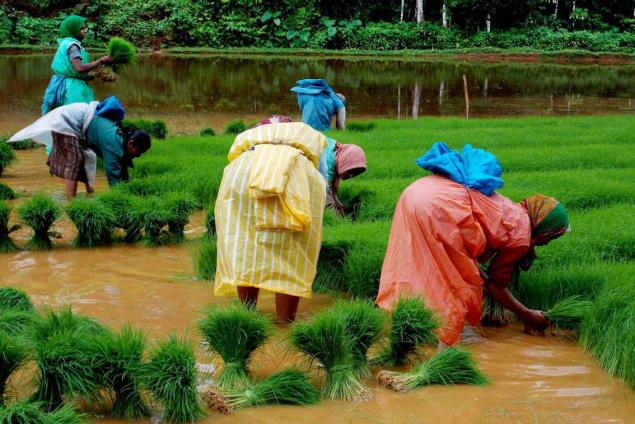
Women readying paddy seedlings at a nursery in Napoklu in Kodagu for transplantation./ The Hindu

Paddy transplantation has begun in the right earnest in Kodagu district, thanks to the copious rainfall which has far exceeded last year’s figures in the corresponding period.

Many farmers are steadfastly continuing the avocation against odds such as expensive labour, high input costs and irrational prices.

Transplantation has started in Napoklu and surrounding areas. Paddy seedlings are ready for plucking in the district and the works are expected to gather momentum in a couple of days, says Deputy Director of Agriculture, Kodagu, Ramakrishna. The target for paddy cultivation was 35,000 hectares of which 1,360 hectares had been covered till date, he told The Hindu.

Farmers in remote villages still depend on agriculture in Kodagu though it is not financially viable for most of them. However, the sheen associated with paddy transplantation where a large group of men and women sang to chorus to mask the tiredness of work cannot be seen any longer.

One would compete with the leader to match his speed of transplantation even if it rained hard. A big column in the middle of the paddy field would be left vacant to facilitate the ‘Nati Vota’, wetland sprint, in which youth would take part with great glee. It used to be the custom in the past. Not many indulge in ‘Nati Vota’ these days. The vacant column used to be covered up with seedlings after the sprint.

According to Monnanda Somaiah, a farmer from Napoklu, expensive labour costs, apart from the shortage of workers, had made many farmers give up agriculture in villages. Many of them had sold off cattle and some had converted fields into housing sites.

Farm mechanisation was a process yet to catch up in the district, though a few progressive farmers had discovered its utilities. Elephant attacks would result in destruction of paddy crops in the district in the recent years.

Fertilizer had replaced cow dung and other leafy manures that were organic, says Subbaiah, another farmer from the same region.

Paddy transplantation would pick up in Virajpet taluk, which had the largest areas in terms of coverage, in a few days as seedlings were ready for plucking, Mr. Ramakrishna said.

Not so long ago, the extent of paddy fields was considered a sign of high social status. Coorg mandarin (orange) cultivation had become popular enhancing one’s social status later onwards.

Coffee holding now symbolises the social status in Kodagu. Paddy crop is seen as goddess Lakshmi as the ‘Puttari’ of ‘Hutri’, the harvest festival for the people of Kodagu, is directly connected with it.

Cutting the paddy sheaves and taking home by chanting ‘Poli poli deva…’ meant appeasing goddess Lakshmi to give them a bountiful crop and abundance. Decrease in the paddy cultivation has robbed the harvest festival of its glory, says, Mr. Somaiah.

Kodagu received 1,602.1 mm of rainfall from January this year till 8 a.m. on July 18. It is more than last year’s figure of 732.89 mm.

Madikeri taluk received 2,372.24 mm, the highest among three taluks, in the same period this year. It was 1,049.2 mm last year. Virajpet taluk received 1,146.61 mm (622.19 mm) while Somwarpet taluk received 1,287.4 mm (527.27 mm).

source: http://www.thehindu.com / The Hindu / Home> News> National> Karnataka / by K. Jeevan Chinnappa / Mysore – July 21st, 2013

Where myth, history and beauty meet

A blend of mythology, history and scenic locales, Madikeri is every traveller’s dream. Nothing like a weekend trip here to rejuvenate your tired soul, writes Swapna Dutta

It is a sluggish, cloudy morning. We are on our way to Madikeri, a place known for its calm, cool, peaceful and pollution free atmosphere. The very word Coorg spells wooded slopes and colourful scenery. Also, coffee and cardamom; black pepper and honey. The landscape is somewhat rugged but the misty mountain ranges that comprise ridge after ridge of lush, green forest reaching out to the bright blue sky is a sight to behold. The road is remarkably smooth and well-maintained and we are hardly aware that we have been climbing up steadily. It is easy to understand why Coorg was one of the places the British chose to settle down and continued to occupy it for over a hundred years; it was their ‘ Scotland of India’.

Madikeri, the charming capital of Coorg district, is located at an elevation of 1,525m above sea level. As we look around, breathing in the refreshing mountain air, we see the red-tiled bungalows that dot the hillside and a bustling market place at the heart of the city. There are acres and acres of tea and coffee plantations, orange groves, and undulating paths — all in all, a breathtaking view. The place also has a distinct old world charm about it.

Madikeri or Mercara, as it was called earlier, was founded in 1681 by Muddu Raja, a prince from the Haleri dynasty. It was originally called Muddurajakeri and was later shortened to Madikeri. Apart from being one of the most picturesque hill stations in South India, it is also the place from where the river Cauvery originates. It is generally believed that Coorg was ruled mainly by chieftains and local princes until the 17th Century. A number of inscriptions and copper plates found in different parts of the state denote that it was under different dynasties at different times; the Gangas, the Haleris, the Kadambas, the Cholas, the Kongalvas, the Changalvas, the Hoysalas and the Nayakatas being the most prominent ones among them.

The main sights of Madikeri town include the charming well-tended park in the heart of the city known as the Raja’s seat. It is said to be the place from where kings watched the setting sun along with their queens. The pavilion offers a gorgeous view of towering hills, green valleys full of paddy fields and forests and the road that looks like a curved ribbon lying way down below.

We next visit the Omkareshwara temple built by Lingarajendra Wodeyar II in 1820. The temple that has a beautiful tank in front is a mixture of Gothic and Islamic architecture. The Madikeri fort, an imposing structure that can be seen from almost the entire town, was originally built as a mud fort by Mudduraja along with a palace in the 17th Century. It was later rebuilt with granite by Tipu Sultan. When the British took over, they added a portico and a clock tower to the building. The fort building now houses a prison, a temple, a chapel, a museum and assorted government offices.

There are a number of tombs and memorials of historical importance in Madikeri. There is the Raja’s tomb which is a beautiful structure. The others comprise the tombs of Lingarajendra built in 1820 by his son, the tomb of a royal priest Rudrappa built in 1834 and the tombs of two brave soldiers who died fighting with Tipu Sultan.

The next day we make our way to the Talacauvery, located 44 km away from Madikeri on the slope of the Brahmagiri hills where the Cauvery originates. It is one of the important sacred places in Karnataka and is always full of pilgrims.

The place is marked by a tirtha kundike or a tank where the river emerges as a perennial spring and flows underground again, emerging a short distance away. From Talacauvery there are steps leading to the peak of the Brahmagiri from where one can get a panoramic view of the whole place.

How to get there

Madikeri does not have an airport; the nearest one is in Mangalore from where one can hire a taxi to get there. KSRTC runs a number of buses to and from Madikeri which are quite comfortable. Depending on where you live, hiring a taxi or going by car is also a good option as it is difficult to find local transport for sightseeing. From Bangal­ore it takes just under six hours to get there.

Stay is not a problem as there are a number of budget hotels, homestays, medium range and luxury hotels as well as resorts. But it is always advisable to book in advance as the place could well be full of tourists and pilgrims just when you plan to visit it.

source: http://www.deccanherald.com / Deccan Herald / Home> Supplements> Spectrum / by Swapna Dutta / July 16th, 2013