All posts by admin

Prajwal Poovaiah another Coorgi Comes!!

Kannada cinema and Coorg are inseparable. Coorg is such a rich place for Kannada film makers and the exotic mist filled shots and hilly region, lush greenery is always available here for film makers.

The land known for warriors, hockey is also famous for giving good talent to Kannada cinema. We have Daisy Boppana, Nidhi Subbaiah, Harshika Poonachcha and new addition is Prajwal Poovaiah.

Although Prajwal Poovaiah was seen at ‘Cotton Pete’ muhurut she was selected

by top director N Omprakash Rao for ‘Bheema Thiradalli’. Prajwal Poovaiah attended 40 days of shoot for her debut film.

Before coming to cinema Prajwal Poovaiah studied in Whistling Woods International Acting School of Subhas Ghai in Mumbai.

Prajwal Poovaiah plays the village belle in ‘Bhima Thiradalli’ while the mod role goes to Pranitha in that film. Vijay is the hero of this film.

Offers came pouring in for Prajwal Poovaiah when she was shooting for her debut film. Producer K Manju, Yogish Hunsur and two Tamil film offers came to her.

After completing ‘Bhima Thiradalli’ a big budget cinema of producer Anaji Nagaraj actress Prajwal Poovaiah picked Tamil films – Otthe Naneyum, Vipareethan and Viludu Maleyudum are the films she has signed as of now.

I want to act under all major director films is the ambition of Prajwal Poovaiah.

source: http://www.m.zimbio.com / from Cinejwala.com / February 22nd, 2012

Robin Uthappa Lead Bangalore To A Win In K.S. Subbiah Pillai Trophy

Bangalore:
Bangalore riding on fine century by the skipper Robin Uthappa thrashed Hyderabad by 103 runs in the K.S. Subbiah Pillai Trophy played here at the Jain Residential School Ground, on Friday.

Uthappa who scored a 99-ball 120 which included 11 boundaries and five massive sixes helped his side to post a mammoth 343 in their stipulated 50 overs. The huge win earned them a bonus points and now have 13 points to their credit whereas Hyderabad stayed a point behind. (116b, 11×4, 2×6) went in vain. The 103-run victory gifted a bonus point and boosted Karnataka’s tally to 13 while Hyderabad stayed at 12.

Losing the toss and put in to bat first, Bangalore openers started off on a cautious note and piled 58 runs for the first wicket. After Mayank was out for 29, it was Ganesh Satish and helped out his captain in his onslaught. It was however sad for Ganesh to miss out a century as he was out for 90.
After Satish’s wicket the middle order came in chipped with useful cameos.

Later, Ronit More wrecked havoc and scalped five Hyderabadi wickets to upset their run chase. Bangalore received some resistance from Ravi Teja who scored 110, but it went in vain.

Meanwhile in other matches, Tamil Nadu defeated Kerala by 61 runs and Andhra picked up a four-wicket victory over Goa.

The scores: Karnataka 343 for seven in 50 overs (Robin Uthappa 120, Ganesh Satish 90) bt Hyderabad 240 in 44 overs (Ravi Teja 110, B. Sandeep 38, Ronit More 5 for 31).

Tamil Nadu 284 for eight in 50 overs (Anirudha Srikkanth 82, Arun Karthik 56, P. Prashanth 3 for 54) bt Kerala 223 in 48.3 overs (Robert Fernandez 86, V.A. Jagadesh 32, R. Jesuraj 4 for 29, C. Ganapathy 4 for 35).

Goa 383 for seven in 50 overs (Rohit Asnodkar 139, Reagan 68,) lost to Andhra 385 for six in 48.4 overs (Y. Venugopala Rao 115 n.o., A.G. Pradeep 104, Ganesh Narvekar 4 for 56).

source: http://www.IndianSportsNews.com / Friday, February 24th, 2012

Emerging prototypes of Indian coffee drinkers

The Kitty Party Ladies
They are women in all shapes and sizes, bumbling in post lunch, in tittering groups of 10-15. Mostly, they’ll troop in for a mocha or hot chocolate when they can combine retail therapy with a meal. Experts say safety is paramount for this category so location is
critical: a shopping centre or high-street channel. They usually stop by for a longish stint — lunch or high-tea and are generally not seen in the CCDs but in the Costas/Big Chills. “Coffee is a lifestyle, tea is a beverage. If the boss comes home, you’ll serve him coffee, but if a neighbour drops by, you’ll give him tea,” says Harish Bijoor

The Corporate kind

“The café culture in India is an exploding lifestyle for the young, upwardly mobile middle-class,” says Anil Bhandari of India Coffee Board. Easily spotted with their spiky gelled hair, formal/semi-formal attire and a cappuccino by the side, they typically hold business meetings with clients or work on their laptops. “The entrepreneur, who may not have a large office, uses the coffee shop as a meeting place given the certain quality of ambience,” says Costa’s Santhosh Unni. He/she frequents a café more than a casual customer for whom coffee is an ‘impulse’ category, say experts. This lot includes insurance and sales people making client pitches, office-goers taking a break, interviewers quizzing potential candidates and, in rare cases, those networking with other customers in the café. The corporate segment is key for a brand like Costa that targets the age group of 21-28.

Lovespotting

Move over parks, cafes are the new couple haven. Experts say food and beverages are incidental to this category — they choose cafés for the space and privacy. Even matrimonial meets have trickled in here as cafés turn into lounges. “The key difference in India is that they take espresso with milk, and spend time with their coffee. In Italy, you enter, have an espresso shot and leave,” says Lavazza’s Attilio Capuano. “In India, people like small sizes unlike in the west,” says Mohammad Feroz of The Coffee Bean & Tea Leaf.

Meet-Ups

These are the offline get-togethers — hobby groups, informal clubs/associations, bloggers, Tweet-ups etc — where members opt for cafés as the preferred hangout. Meeting schedules are made on social networking sites. Brands such as Costa are looking to cash in on this trend by designing activities such as performances, book-reading sessions, exhibitions, blog sessions, debates etc. These groups typically order more finger-food and a mix of hot/cold coffees. Also, in India, it’s more about food than beverage so most cafés prefer to localise tastes.

The Anna Wintour Latte

These fashion-conscious/socialites appreciate coffee and are particular about having it sans milk or sugar. Knowledgeable and westernised, the well-heeled have the relevant exposure and know their espresso from their filter. Incidentally, espresso is the least drunk version in India. “Of the total consumption, 57% is instant coffee while 43% is roast and ground (filter). Instant coffee consumption in non-south is growing,” says Bhandari. Some sections of the elite have even started installing espresso machines at home.

Coffee Snobs

The coffee snobs may ‘pish’ at the widely available variants. Mostly educated abroad, they get their gourmet coffees from other sources. In Delhi, Devan’s Coffee and Tea has been around for the last 50 years where the owner blends and roasts 10-12 varieties. Known by word of mouth, stores like these boast of a loyal clientele. “Coffee becomes a part of culture when it turns into a habit,” says Bhandari. Typically spotted with an espresso, macchiato or risotto, these snobs, clearly, are the
keepers of the high coffee culture.

‘Ek Chai Latte Lana’

Reading their HTs and Hindus, meeting old friends for a chinwag or just stopping by after a walk, the older generation that used to earlier perhaps meet at an udipi, now walks in for their mid-morning or evening break to a coffee cafe.
Sometimes a grandchild may accompany them for an odd treat or a math lesson. The elderly prefer a robust cup of masala tea or chai latte over coffee, says Unni, since “they don’t belong to the new coffee generation and don’t need to be snooty about their choice of
beverage”.

The Intellectual/Arty Ones

Generally found in off-beat cafes such as those in Delhi’s Hauz Khas Village and book cafes like Café Turtle. These include
writers, poets, journalists, artists, filmmakers etc… mostly seen smoking on the café’s balcony/terrace, discussing philosophy or art over a cup of cappuccino going cold. The category also includes the kurta-pajama-jhola type who prefer the simple and nostalgic hangouts such as Indian Coffee House in Delhi’s Connaught Place, Koshi’s in Bangalore etc say experts.

Smells Like Teen Spirit

“Fifteen years ago, a 20-something didn’t have a safe place to hang out in other than a pub. Today, the ones driving this café culture are the urban people aged between 16 and 40: university crowd, young professionals and entrepreneurs. Trendy in their lifestyle, education, travel and fashion, it’s the generation that’s driving the white goods market and Indian tourism outside of the country,” says Bhandari. An iPod, chewing gum, braces, colourful slippers and choice of an unusual flavour of beverage or coffee-dessert will mark out the teenage prototype. It’s the largest target group for most cafés. “Close to 25% of CCD’s clients are less than 25 years,” says Ramki. It’s an important segment for café brands given it’s the group’s first transition to a coffee shop, which in the next ten years is set to become fairly large when they start working.

The Expat

Backpack on an empty chair, a book in hand, either reading or observing people while sipping an espresso or macchiato in a quiet corner. Whether it’s a tourist or a sophisticated business traveller to India, he/she will generally seek out international café brands for their caffeine fix. A sense of comfort with certain processes and hygiene being in place drive this choice say experts. “Expats who are already settled in metros and/or are familiar with the city will venture to try home-grown book cafes such as Café Turtle,” says Unni. Keshav Devan of Devan’s Coffee and Tea adds that coffee is more of a winter beverage in India unlike in the west where people consume coffee 365 days a year, every morning. “The look and feel of our stores (Costa) is more vibrant than in Europe since India is a warmer country,” explains Unni.

source: http://www.HindustanTimes.com / Features / February 25th, 2012

Looking out for the destitute

Mysore:
Unlike other business administration postgraduates, these two graduates have opened a non-government organization to help the needy. They provide food, shelter and rehabilitate mentally-challenged persons and the destitute in Mysore.

Meet 28-year-olds, B Manu and Vinod Kumar, who have rehabilitated around 109 mentally-challenged destitutes since the inception of their NGO two years ago. They aim to rehabilitate the destitute and reunite them with their family members.

They earn by organizing rehabilitation camps for individuals, who are addicted to alcohol and drugs and use the income to help poor orphans, who are suffering from diseases. So far, this NGO has rehabilitated more than 300 people, including destitute, drug and alcohol addicts.

Speaking to TOI Manu said, “I had been to Himalayas three years ago and I found many people who had left their families and were suffering from psychiatric problems. This inspired me to help mentally-challenged orphans. We don’t collect any donations from people but we accept even old clothes, food grains and other necessary things.”

Presently, doctors, psychiatrists, and nurses in this center are treating 11 mentally-challenged orphans for free of cost.

Manu and Vinod, who run the NGO-Wee Care Hospital-have formed a rescue team. Whenever the NGO gets a call from the public regarding mentally-challenged people suffering from diseases from any place of Mysore district, they visit the area and bring them to the NGO on T Narasipura road for treatment.

Two destitutes who were rehabilitated here are now working as security guards at their place. They are getting good salary too.

Manu was residing with his father Bal Gopal, a businessman and mother Shobanna. But for the past year, both Manu and Vinod are residing on the hospital premises to provide better service. Vinod’s parents K A Bojappa, a coffee planter and K B Kamala, are in Kodagu.

“Nowadays people are depressed for various reasons, so we have started working from the grassroots level. We have started organizing training programmes in schools to build self-confidence among children,” says Vinod Kumar.

Self-confidence training programmes have been organized in 33 schools. Soon similar kind of programmes will be organized in rural areas.

source: http://www.Timesofindia.indiatimes.com / City> Mysore / Home> City> Mysore / by Pavan M V / TNN / February 25th, 2012

Community classes get children to learn native language

Since last month, Surajit Pal, a professor at the Indian Statistical Institute in Chennai, has been spending one day every month teaching Bengali to children from his community. Pal’s daughter, who is in class 8, is one of the students.

“We are trying to introduce our children to Bengali culture and literature,” says Pal. His wife and her friends are among the volunteer-teachers . The free classes began two months ago in the Bengali Association in T Nagar.

February 21 was celebrated as ‘International Mother Language Day’ across the city, and several organisations are trying to popularise regional languages among youngsters of their communities.

“We hope more students will join the classes. Most Bengali children in Chennai cannot read or write the language. That’s a pity because Bengali is so rich,” says Anjan Prasad Chakraborty, president of the Bengal Association.

The Kerala government has made a concerted effort to encourage Malayalis outside Kerala to learn their mother tongue by starting the Malayalam Mission. “We have learning centres in various cities where volunteerteachers , mostly housewives, teach the language,” says M Nanda Govind, president of the Malayalam Mission in Tamil Nadu.

With 150 centres and 2,650 students in Chennai, the Malayalam Mission will soon extend to Coimbatore , Madurai, Tirupur, and the Nilgiris. “We are overwhelmed by the response and that is why we are expanding,” says Govind.

Other regional associations are also trying to popularise their languages, albeit with a little less success. The Punjab Association has an arrangement with the University of Madras for students to learn Punjabi. “But there aren’t many takers. It could be because Punjabi families in Chennai feel that knowing Hindi is enough,” says Ramesh Lamba, general secretary of the Punjab Association of Chennai.

The Coorgi community may not have set up formal classes, But the community members try and get their children to imbibe the culture by speaking the language at home, says Smitha Kuttaya, who has been living in Chennai for the past 11 years. “We do not have a script, but we get our children to speak the language,” she says.

The community that seems most worried about the younger generation’s lack of interest in the culture is the Sindhis. “Hardly any of the children want to learn to speak or write the language. They think speaking Hindi is more than enough. We don’t know how to tackle this,” says Prakash Vaswani, member of the Sindhi Hindu Mandal Association.

source: http://www.articles.timesofindia.indiatimes.com / City> Chennai / Home> Collections> Regional Languages / by Kamini Mehta / TNN / February 22nd, 2012

Akshay Kumar to star in Mahesh Manjrekar’s movie


Akshay Kumar and Mahesh Manjrekar are joining hands for a socially relevant film. The duo is all set to work in the remake of Marathi film Shikashanachya Aaicha Gho.

Shikashanachya Aaicha Gho was directed by Mahesh Manjrekar himself in Marathi. It is an anti-education movie, which was recently made in Tamil and Telugu as Dhoni. The story is about an aspiring kid, who wishes to make his career as a cricketer but against his father’s wish.

It is said that Mahesh Manjrekar’s first choice was his friend Salman Khan. But as the actor is busy with other projects, the filmmaker decided to go with Akshay Kumar. The movie is reportedly made on Akki’s home banner and Kannada actress Nidhi Subbaiah is playing one of the female leads in the movie.

source: http://www.entertainment.oneindia.in / Entertainment> Bollywood> Gupshup / Wednesday, February 22nd, 2012

Coorg – The Kashmir of Karnataka & Scotland of India


Coorg the modern name for Kodagu is a unique and beautiful hill station in the Western Ghats of Karnataka. Coorg is a small district covered with dense forests and picturesque valleys and enchanting waterfalls. This is one of the closest experiences one can have with Mother Nature. Coorg is a famous tourist destination for both Indian and international tourists. This quaint and scenic hill station is commonly known as the Kashmir of Karnataka & the Scotland of India.

Coorg is the largest producer of coffee in India. It is recognized for its vast and magnificent coffee tree plantations all over India. It is said that the fragrance of coffee fills the air of Coorg . The gorgeous plantations are spread over the slopes of the hilly regions. Besides, coffee plantations Coorg and its cities are famous for spices like cardamom and pepper. Apart from buying coffee, lot of tourists buy the best and natural honey manufactured in Coorg as its souvenir.

Do you love animals and wildlife? Coorg has many wildlife sanctuaries and national parks and is known to be prosperous in wildlife.

It is recommended that wildlife lovers must visit Coorg to explore and experience the adventurous elephant safaris organized by national parks. One can also, catch a glance of wild bears, deer’s, tigers and many interesting and charming birds. It is said that there are hundreds of different species of birds found in the paradise – Coorg.

Tourists can take part in adventurous sports like river rafting, trekking, and angling. Coorg is the best place to listen to your adventurous spirit and enjoy yourself to the fullest. There are many places to visit including the Abbey Falls, Raja Seat, Nisargadhama and the Tibet Monastery are the main attractions. One can also, visit wildlife sanctuaries like Brahmagiri Wildlife Sanctuary, Rajiv Gandhi National Park and Pushpagiri Wildlife Sanctuary. There are many historic and divine places including temples of Lord Shiva & Lord Vishnu –Omkareshwara which make the marvelous district heavenly.

Coorg has very pleasant summers and winters. However, it is recommended that tourists must avoid the monsoon season from May to October. A two to three day trip is good enough to experience the beautiful scenery of the captivating and serene Coorg.

Coorg homestay is the finest option for accommodation adding to the splendid experience. Coorg accommodation includes all types of housing which are available within one’s favorable budget. Coorg cottages are another great option to relax and unwind oneself and feel close to nature. Cottages in Coorg are known the best to experience the calm and mystical blue skies and mountains. Bird chirping sounds and unpolluted fresh air unlike big cities rejuvenates one’s body & mind. The resort in coorg has beautifully furnished cottages for both couples and families. Coorg also, has many hotel options near the capital.

Coorg is known to be the ‘Heaven on Earth’ and a numinous paradise which one must visit to explore its lush green mountains, enthralling waterfalls, wildlife & rich culture.

source: http://www.ZaraHutke.in / Home> Blog / February 23rd, 2012

Army man wins his wings

New Delhi:
When SV Sunil suffered a knee injury that required surgery in early 2010 and kept him out of action the whole year, few would have expected that two years on, he would become one of the keystones that Indian hockey’s Olympic dreams would be built around. Putting both personal and physical pain behind, Sunil has emerged as the most recognised face at the ongoing Olympic qualifiers. The fact that he isn’t flamboyant or outgoing like some of his teammates makes his recognition all the more special.
In every game so far, the 24-year-old Junior Commissioned Officer (JCO) with the Indian Army has left the opposition stranded with his speed, stamina and skills. His attacks have been so relentless that sometimes the rest of the Indian team has problems keeping pace. “I know,” smiles Sunil — he hardly ever laughs out loud — “and I have been advised to hang on for just that extra second inside the striking circle to allow others to come up as support. But I have a good understanding with Shivendra Singh and Gurvinder Singh Chandi and they understand that this is my strength. We just try and make sure that I don’t get stranded up front,” he adds.

The Sunil one saw before his comeback in 2011 — he was called up for the preparatory camp in New Delhi, ahead of the Sultan Azlan Shah tournament – was vastly different. “It was a confidence issue,” he admits. “Earlier, I was hesitant to go all out. I always had the speed but thought of being without support upfront, and was not too sure of being able to dodge past the opposition defenders in case I got stuck because of their physical superiority. But now I have been told to just play my natural game.

“The coach has told me not to worry about the opposition or think of getting stuck. Most importantly, he hates back passes, so we are always encouraged to go and attack. That has given me more confidence,” he adds.

Though the Coorgi player admits he was below par against Canada in India’s last game, he is no longer affected by the odd poor performance on field, unlike earlier when he used to think too much of his game.

Having lost his father, a furniture carver, during the 2009 Azlan Shah tournament in Malaysia – where India won gold after 12 years – Sunil is now the sole bread-earner of his family that includes his stepmother and three younger siblings. And he admits he has changed in his approach to both the game and life since then.

“Responsibility ke saath maturity aa jati hai, bachpana khatm ho gaya hai (with responsibility comes maturity, the childishness is gone),” he smiles. “ Earlier I used to play hockey because I liked it and it helped me get a job. There was a time (in 2010) when I thought my career was over. It was very bad year – I had missed three big competitions — the World Cup, the Commonwealth Games and the Asian Games — two of them at home. But then I realised that my family survives on my performance. So now it’s a much more serious thing,” he adds.

With so much responsibility on and off the field, it helps that he has an easygoing roommate in Kannadiga VR Raghunath. “He puts on music that we both enjoy. It helps me relax. I also talk to my family at least once a day to know that they are fine. It keeps me grounded,” he says. The polite smile finally gives way to a gentle laugh when asked about his marriage plans. “Not before my sister. She is in her first year of graduation, a few years from marriage. Only after that,” he says. Till then, he will be happy running circles around the opposition defence.

Friday’s matches:

(Men) Canada vs France

Singapore vs Italy

(Women) South Africa vs Canada

Ukraine vs Poland

Live on Ten Sports:

India vs Italy (Women) 5.50 PM

India vs Poland (Men) 7.50 PM
____________________________________________________________

Indians in comfort zone

While India have booked their place for Sunday’s final, the opponent they play on Sunday will be decided by the results of the games on Friday. Depending upon the result of the Canada-France match earlier in the day; India’s win, loss, or draw against Poland will throw up a different finalist. “We don’t mind any team in the final,” insisted coach Michael Nobbs after a hectic training session on eve of the game against the team on second position on the table. The focus of the workout was on the goalkeepers. “They haven’t been tested so far in the competition so this was needed,” Nobbs explained. ENS

source: http://www.expressindia.com / Story / by Uthra G. Chaturvedi / posted February 24th, 2012

Coorg, a green escape in Karnataka

If you find Ooty, Kodaikanal or Munnar a bit too touristy and crowded a destination in southern India, Coorg is that perfect holiday spot in Karnataka that is sure to please toddlers, youth and the old alike.

Not that this hill station needs to be chosen for a sojourn by eliminating other similar destinations in the vicinity. Just a three-hour drive from Mysore, 150 km away, Coorg district on its own has much to offer, beyond its coffee, cardamom, pepper and beetelnut estates.

There is much to see, admire and soak in at this hill station, which the locals call Kodagu, on the slopes of the Western Ghats, what with some pristine trekking trails, picnic spots, waterfalls, wildlife, woods, forests, valleys and some mouth-watering cuisine.

Situated at a height of 1,525 metres, Madikeri or Mercara is the capital of Coorg, with a nice bazaar, quaint houses with red-roofs and liberal use of teakwood reapers for doors and furniture, so common among homes and clubhouses in Indian hill stations.

It may come as a surprise to some that Coorg has one of the largest settlements of Buddhists in India, just about 30 km away from Madikeri, with their own Namdroling Monastery built in 1963, which the locals call the Golden Temple.

Once you enter the monastery, you feel transported into some other world in the Orient, packed as it is with some 5,000 monks in bright yellow and red robes, with some soothing Buddhist chants, smell of incense and breathtaking sights of pagodas.

After seeing those large golden statues of the Buddha and Tara, the intricate murals and Tangkha paintings, don’t forget to taste some authentic Tibetan food here, especially the delectable momos and the subtle thugkpa, their noodle soup.

One is told it is the largest teaching centre of Nyingmapa – a major lineage of Tibetan Buddhism in the world – and the present Dalai Lama gave its shorter name, as opposed to Thegchog Namdrol Shedrub Dargyeling that this mesmerising place was called originally.

Before dwelling further, where to stay is a question that is bound to crop up. While there are plenty of hotels and resorts, including the Orange County, that can even set you back by as much as Rs.25,000 per day, it is best to opt for a home stay.

There are some 35 of them in and around Medikeri in a range of Rs.1,000 to Rs.5,000 per day where one gets not just to retire but also taste authentic Coorgi food and take some refreshing strolls on their plantations that grow coffee and other cash crops.

As far as the season goes, October to March — like most places in India — are the best months. The weather is pleasant with that welcome nip in the air. But Coorg during monsoons can be equally mesmerising and enchanting.

There are also plenty of places one can go to. There is Abbey Falls, not far, where one has to make his or her way through some dense woods, dotted with coffee bushes, trees and creepers, to suddenly find a cascading gush of water.
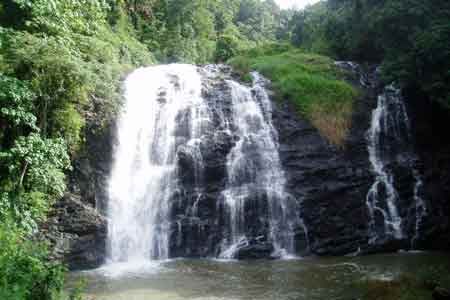
Abbey falls, among the many in Coorg, with cascading water
Then about 80 km away is the Iruppu Falls, right next to the Rajiv Gandhi National Park, also called Nagarhole, which is famous for its elephants, with a lot of other game and some 50 species of birds.

Children, especially, are certain to enjoy a visit to Dubare Forest, around an hour and a half from Medikeri. A ferry there takes you across to an elephant camp where one can see the pachyderms being bathed and fed, after which they are ready for a joy ride.

Talacauvery, around an hour away, is the source of the river Cauvery, with a temple to pay homage to this main source of water for some parts of Karnataka and Tamil Nadu. Not far is Bhagamandala, the confluence of three rivers: Cauvery, Kanika, and Sujyothi.

Another must-see is Tadiyendamol, which is the tallest peak in Kodagu and gives a breathtaking view of the entire Coorg, apart from the distant Arabian Sea. There is also the Naalkunaadu Palace built by Kodagu king Dodda Raja Veerendra in 1792.

After all this exploring, a bungalow at the plantation is perhaps the best place to retire. Toddlers can chase butterflies, and a hammock and freshly brewed coffee are sure to be at hand!

How far: Around 150 km from Mysore and 260 km from Bangalore

How to reach: By bus or car from Mysore. Closest airport is in Bangalore; the airport in Coimbatore in neighbouring Tamil Nadu is another alternative.

Cost: Around 35-40 home stays in Coorg ranging Rs.1,000 to Rs.5,000 per day

source: http://www.articles.timesofindia.indiatimes.com / Home> Collections> Coffee / Life & Style> Travel / by IANS / February 21st, 2012

Big fat Kodava-Greek wedding

Bangalore boy and actor Gulshan Devaiah of Shaitan fame tied the knot with Greek beauty Kallirroi Tziafeta in a quiet ceremony

The Kodava community has been claiming a Greek connection for centuries. Firmly reaffirming the heritage was Kodava boy Gulshan Devaiah who recently tied the knot with long-time girlfriend and actress Kallirroi Tziafeta. Gulshan has been making waves in Bollywood — first with Rohan Sippy film Dum Maro Dum, followed by Bejoy Nambiar’s Shaitan and Anurag Kashyap’s That Girl in Yellow Boots and was nominated for best supporting role and best actor in a negative role by various film awards this year, including the Film Fare award. The two met nearly two years ago — quite by chance — when Kallirroi, who studied acting at London International School of Performing Arts, came to India to meet friends and bumped into Gulshan, who was working on a play with Rajat Kapoor. In an earlier interview to this writer, Gulshan said that there were no instant sparks and that it took a couple of days for the duo to start chatting with each other. “I was ill when I met her, it was only later that we got chatting and we realised that we really really liked each other. We’re really serious and will get married sooner or later.” It turns out that Kalliroi, originally from Greece, soon moved to Mumbai. She has acted in several theatre productions in Mumbai, including Nostalgia Brand Chewing Gum, directed by Bangalore-based director Vivek Madan and performed in Jagriti a year ago.

The wedding hasn’t been a secret, but there’s been no publicity blitzkrieg either. In keeping with Gulshan’s low-profile image, the ceremony was attended only by close friends and family. For Kalliroi and her family, the tragic events unfolding in Greece (rioting and arson after austerity measures were introduced to combat the crumbling economy) were offset by the joy of being part of an authentic Indian wedding. The venue was a Kalyana mantapa in Bangalore (North) and the wedding had the Kodava community of Bangalore in attendance.

Gulshan was dressed in authentic Kodava wedding costume, including the headgear and black jacket. The cynosure of all eyes at the wedding, however, was the bride, dressed in bright red sari, in Coorgi attire. What’s more, Kallirroi had nearly 20 of her relatives who had specially flown down from Greece to be part of the joyous occasion. Friends said that among her relatives was her 85-year-old grandmother. Cousins, aunts and even Kallirroi’s mother wore Indian outfits.

Actress Kalki Koechlin took part in the wedding with her family. The only close friends Gulshan had with him at the wedding were his designer friends from NIFT and his theatre friends from Bangalore and Mumbai. If the wedding was a traditional affair with banana stalks being cut and pots balanced on the head of the bride, the post-wedding party was an informal affair with Gulshan dressed in designer black, waist coat, black shirt and trousers while Kallirroi chose a short black and beige dress. Kalki, friends and music composer Naren Chandavarkar played hosts at the party and ensured that everyone had a good time.

As for the thousands of women, who voted for Gulshan as one of the most eligible bachelors in an online poll last year, eat your hearts out for he’s now taken.

source: http://www.BangaloreMirror.com / Bangalore / Home> Entertainment> South Masala> Story / Thursday, February 16th, 2012