The campaign covered several major pilgrimage centres and tourist locations, including Talacauvery, Omkareshwara Temple, and Bhagamandala.
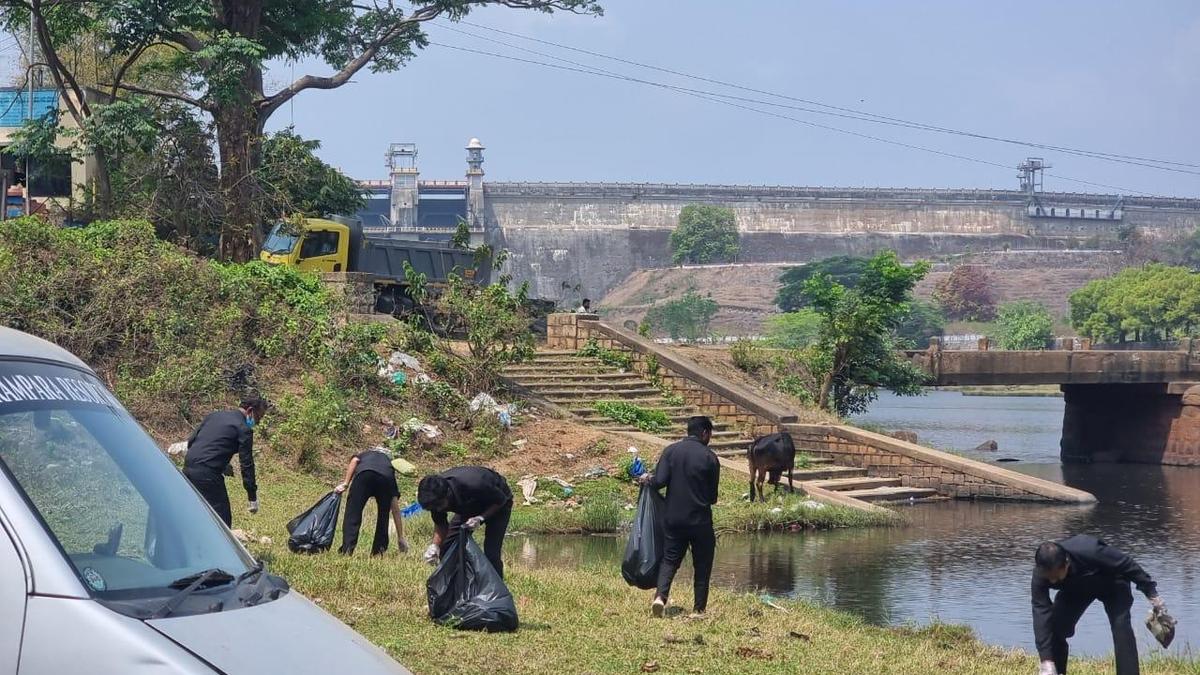
Volunteers participating in a cleanliness drive near Harangi reservoir in Kodagu district on Monday. | Photo Credit: SPECIAL ARRANGEMENT
A cleanliness drive under the ‘Clean Kodagu-Beautiful Kodagu’ campaign was held across the district on Monday, covering its tourist destinations and pilgrimage centres, besides district and taluk headquarters.
The drive jointly organised by the Kodagu district administration, Kodagu Zilla Panchayat, Forest and Tourist Departments and tourism stakeholders was inaugurated at Raja Seat in Madikeri by City Municipal Council (CMC) president P. Kalavathi.
Speaking on the occasion, Ms. Kalavathi said that half-litre and one-litre bottled water has been banned in Madikeri city, which has helped curb plastic usage to a large extent. She stressed that efforts should continue in the same direction and that plastic usage must be gradually reduced.
The campaign covered several major pilgrimage centres and tourist locations, including Talacauvery, Omkareshwara Temple, Bhagamandala, and tourist spots such as Abbey Falls, Nalknad Palace, Raja’s Seat, Raja’s Tombs, Madikeri Fort, and Chelavara Falls in Madikeri taluk.
In Kushalnagar taluk, the drive covered Dubare River Rafting centre, Cauvery Nisargadhama, Harangi Reservoir, Harangi Garden, the Elephant Camp, backwater adventure sports areas, and Chiklihole reservoir. In Somwarpet taluk, the campaign was conducted at Honnamana Kere, Makkalagudi Hill, Kotebetta, Surlaabi Falls, and Mallalli Falls.
Similarly, in Ponnampet taluk, cleanliness activities were carried out at Barapole River Rafting centre and Iruppu Falls.
In Madikeri town, the drive covered stretches of about two km along Virajpet Road, Bhagamandala-Talacauvery Road (Mangaluru Road), Madikeri-Siddapur Road, and Madikeri-Mysuru Road.
In Kushalnagar, the campaign was conducted from Koppa Gate to the KSRTC bus stand; from Someshwara Temple via Konamaramma Temple Circle to IB Road and the KSRTC bus stand; from Tavarekere to the KSRTC bus stand; and from Ayyappa Swamy Temple to the KSRTC bus stand, said a statement here.
As part of the campaign, around 50 volunteers, with the cooperation of Cauvery Nisargadhama NTC, Coorg River Resort and forest officials, carried out cleaning activities along both sides of the road from Cauvery Nisargadhama towards Guddehosur.
In view of the large heaps of garbage found along the roadside, the stakeholders suggested that if the respective gram panchayats install garbage bins at designated locations, the problem could be addressed to some extent.
They pointed out that steps should be taken to install bins at designated locations to address waste management, as tourism in Kodagu was expected to attract more visitors in the coming days, which could in turn lead to an increase in waste generation.
source: http://www.thehindu.com / The Hindu / Home> News> India> Karnataka / by The Hindu Bureau / March 17th, 2026
Skewed sex ratio: Of 78 elephants in 8 camps, 64 are males, 9 are females, 5 are female calves
Mysore/Mysuru:
Elephant camps in Kodagu and Chamarajanagar districts that supply elephants for the Mysuru Dasara festival are facing a noticeable shortage of female elephants.
According to data available with the Forest Department, of the 78 elephants housed across eight camps, 64 are males. There are only nine females, pointing to a significant gender imbalance. There are five female calves in two elephant camps.
Data with Star of Mysore shows that several camps have very few or no female elephants, raising concerns about breeding and the long-term sustainability of the captive herd.
At the Dubare Elephant Camp in Kodagu, the largest camp in the region, 30 elephants are housed, 25 males, two females and three calves, reflecting one of the sharpest imbalances. Similarly, the Harangi Elephant Camp near Kushalnagar has six elephants, all of them males, with no females or calves. At the Mathigodu Elephant Camp on the Mysuru-Kodagu border, there are 16 elephants, including 12 males, two females and two calves.
At the Bheemanakatte Elephant Camp near Periyapatna, both the elephants housed there are males. In the Nagarahole region, the Doddaharave Elephant Camp has one female elephant, while the Balle Elephant Camp has two elephants, one male and one female.
The Ramapura Elephant Camp, also known as Ainooru Maarigudi Camp near Bandipur Tiger Reserve, houses 20 elephants, including 17 males and three females. At the K. Gudi Elephant Camp near Biligiri Ranganatha Tiger Reserve, there is only one elephant and it is a male.
Skewed ratio, musth condition
With only nine female elephants across all camps, the male-female ratio is heavily skewed. The problem becomes more serious when male elephants enter musth.
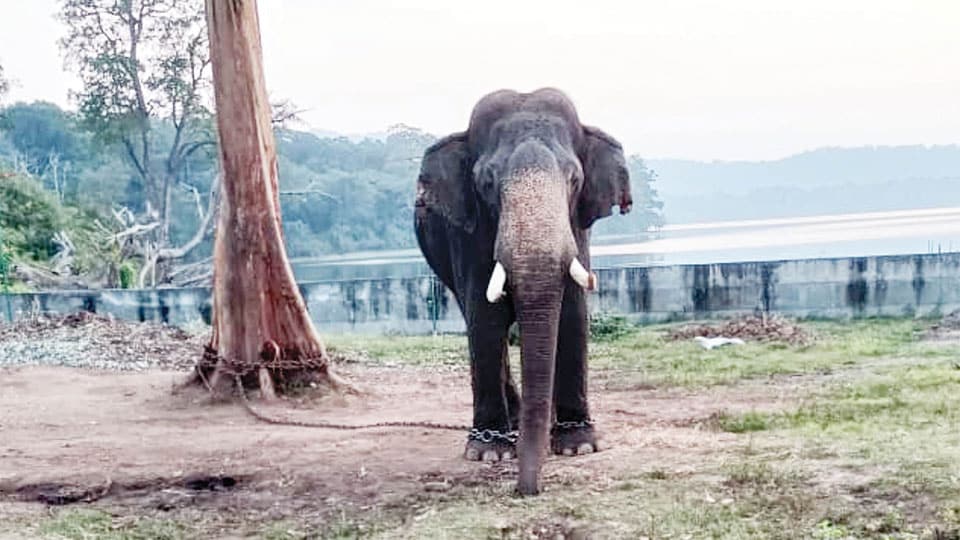
Currently, four of the six elephants at Harangi Elephant Camp are in musth. At Dubare, three elephants are in musth, while one tusker at Bheemanakatte is also undergoing the phase.
Elephants in musth experience a surge in testosterone, leading to heightened aggression and a strong urge to mate. The shortage of female elephants during this period can lead to conflicts between bulls for dominance and cause them to behave unpredictably.
Mahouts say controlling elephants in musth is extremely challenging. During this phase, the animals often injure themselves by rubbing against large tree trunks or driving their tusks into them. To prevent accidents, elephants in musth are usually chained and kept isolated. Even other elephants instinctively avoid them. “No one dares to go near a musth elephant. They also refuse to eat and lose weight rapidly,” said J.K. Dhobi, an experienced caretaker who has worked with elephants for more than 50 years.
Calming effect
“Female elephants act as a calming influence on males and are not meant only for mating. That is why the Dasara Howdah elephant is always accompanied by two female elephants on either side during the Vijayadashami procession so that it remains calm. Earlier, the ratio between male and female elephants would be equal at all elephant camps. Now that is not the case,” Dhobi explained.
Wildlife activist Joseph Hoover said that the 64:9 male-to-female ratio is worrying. “Tourists should not be allowed inside elephant camps when male elephants become unpredictable due to the absence of females. The Forest Department must take steps to address the issue,” he said.
Two females to be shifted: DCF
Deputy Conservator of Forests (DCF), Madikeri Division, Abhishek said, steps are being taken to manage the situation.
“We release elephants in musth into the forest in a controlled and monitored manner so that they can mate with wild females. A proposal to shift two female elephants from Ramapura Elephant Camp has been approved. One female will be immediately moved to Harangi Elephant Camp, while the other will be shifted either to Dubare or Mathigodu,” he said.
source: http://www.starofmysore.com / Star of Mysore / Home> News / March 15th, 2026
The Minister said the mandate for production, development, research and domestic marketing of spices other than cardamom is vested with Ministry of Agriculture & Farmer’s Welfare.
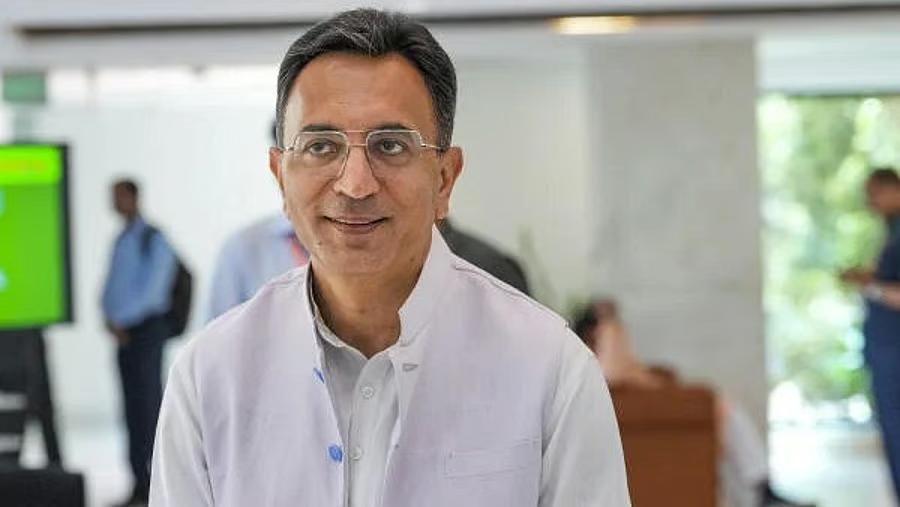
Union Minister for Commerce and Industry Jitin Prasada / Credit: X/@JitinPrasada
New Delhi:
Union Minister of State for Commerce and Industry Jitin Prasada on Tuesday said that black pepper production in Kodagu may increase by about 16 per cent in 2025-26 compared to 2024-25.
Replying Yaduveer Wadiyar question, the Minister said the mandate for production, development, research and domestic marketing of spices other than cardamom is vested with Ministry of Agriculture & Farmer’s Welfare. The Ministry informed that it has conducted a quick pre-harvest survey in Kodagu district which indicates that black pepper production in Kodagu may increase by about 16 per cent in 2025-26 compared to 2024-25, he said.
Spices Board under the “Sustainability in Spice Sector through Progressive, Innovative and Collaborative Interventions for Export Development (SPICED)” scheme provides assistance to the growers of spices, including pepper growers of Kodagu district for post-harvest improvement by providing pepper thresher, graders /cleaners etc, conducting capacity building programmes and undertaking market linkage initiatives organizes buyer seller meets, he said.
He further said at present the import policy for pepper is ‘Prohibited, with a provision permitting import only if the Cost Insurance & Freight (CIF) value is Rs. 500. per kg or above. The said MIP of Rs. 500/kg continues to remain in force and is not applicable to imports under Advance Authorization Scheme for export production, imports by 100% Export Oriented Units (EOU) and units in Special Economic Zones (SEZ) and imports for extraction of oleoresin for re-export by manufacturer-exporters, subject to applicable policy conditions, he said.
source: http://www.deccanherald.com / Deccan Herald / Home> India> Karnataka / by Ajith Athrady / March 11th, 2026
From studying hornbills to restoring degraded rainforests, tropical ecologist Dr. Divya Muddappa has dedicated nearly three decades to conservation in the Western Ghats…
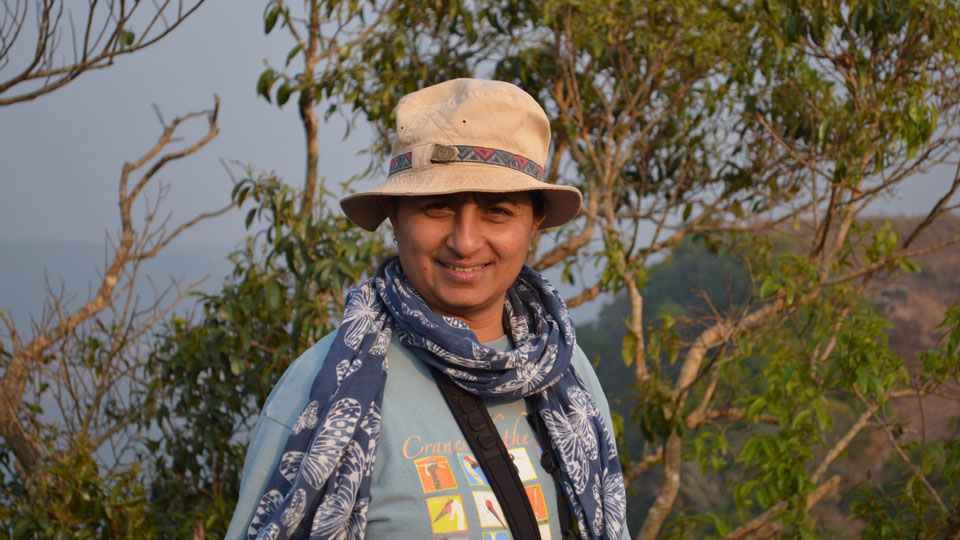
Dr. Divya Muddappa, Senior Scientist at the Nature Conservation Foundation, Mysuru, has spent nearly three decades studying and protecting the rainforests of the Western Ghats. Her work in tropical ecology spans areas such as restoration ecology, conservation biology and plant-animal interactions, including seed dispersal and frugivory.
She began her research journey with the Malabar Grey Hornbill during her Master’s at the Salim Ali School of Ecology, Pondicherry University and later spent years studying hornbills across the Western Ghats, tracking their nesting patterns, distribution and the effects of rainforest fragmentation.
In a conversation with Star of Mysore, she says while her work in the forests has been deeply rewarding, the real challenge lies in convincing society, from the general public to policymakers, about urgency of conservation, especially when it comes into conflict with development and infrastructure projects. —Ed
SOM: What first sparked your interest in tropical ecology? Was there a moment when you knew forests would become your life’s work?
Dr. Divya Muddappa: That’s an interesting question because we rarely look back and think about where it all began. For me, the turning point was a visit to Topslip in the Anaimalai Tiger Reserve, where one of my seniors was working. She took me on a walk into the forest.
It was my first time in a dense evergreen rainforest. Hearing the sounds of animals, seeing so many birds, especially hornbills, and standing among those towering trees was simply fascinating. It captured my imagination.
At the time, I was doing my Master’s and trying to decide on a topic for my dissertation. That visit eventually led me to begin my work on hornbills. Looking back, that was the moment my interest in rainforests truly began.
SOM: Can you describe your current field of work?
Dr. Divya: My work focuses on protecting and restoring tropical forests, particularly in the Western Ghats. A large part of it involves studying carbon sequestration and biodiversity conservation in landscapes already shaped by human activity.
I’m also involved in conserving globally threatened tree species through ecological restoration, especially in fragmented plantation landscapes. Another important aspect of our work is restoring degraded rainforests and abandoned plantations and monitoring how these ecosystems recover over time.
SOM: What was your specialisation in your dissertation?
Dr. Divya: I did my Master’s in Ecology and Environmental Science at Pondicherry University. For my dissertation, I studied the Malabar Grey Hornbill, a species endemic to the Western Ghats.
However, my work is not limited to hornbills. My broader area of interest is tropical forest ecology, particularly plant-animal interactions such as seed dispersal and frugivory. Hornbills, for instance, are important frugivores that play a key role in dispersing seeds across forests.
I later went on to study the brown palm civet, another endemic species of the Western Ghats, which is also largely frugivorous. My research looks at how different species interact with forests and contribute to ecosystem processes.
Currently, my partner, our team and I are working on restoring rainforests in fragmented landscapes in the Anaimalai region of the Western Ghats.
SOM: You’ve spent years working in remote rainforests. Looking back, what have been some of the toughest challenges you’ve faced in the field?
Dr. Divya: Personally, working in the rainforests of the Western Ghats has never felt like a challenge. I come from Coorg, so being in forests and observing plants and animals is something I deeply enjoy. The bigger challenge lies in conservation itself. One of the hardest tasks is convincing people that protecting nature is just as important as protecting our own future.
There are also larger pressures such as rapid development, habitat loss and the climate crisis. These make conservation far more complex. Ultimately, the challenge is helping people rethink their relationship with nature. Not seeing it merely as something to exploit, but as something we must learn to live alongside and care for.
SOM: Field research can be physically and emotionally demanding and unpredictable. Are institutions in India doing enough to make field science safer and more supportive for women?
Dr. Divya: Field research can certainly be demanding, perhaps more emotionally than physically, especially when you are young and starting out. But passion and the desire to conserve these ecosystems keep you going.
When I began working in this field, society was already quite gender-biased. But we were so driven by our interests that we rarely stopped to think about whether formal support systems existed. We simply carried on with our work. I’m happy to say that things have improved in recent years. Thanks to greater awareness and better policies, many institutions now have systems that offer support and protection. In many cases, these are gender-neutral policies that safeguard everyone.
That said, we still have a long way to go. Many challenges women face come not from institutions but from broader social attitudes. Addressing those requires bigger behavioural and cultural change.
SOM: From when you began your career to where you are today, how do you see the journey of women in Indian wildlife science?
Dr. Divya: The journey has been encouraging. Compared to many other scientific fields, wildlife science has generally been more welcoming to women. Even when I started, women were working in the field, perhaps not many, but certainly some.
We were also fortunate to have strong role models. Some of my professors were women who influenced my work greatly and there were inspiring women scientists globally as well.
Today, it is also encouraging to see more women officers in the Forest Department, something that was far less common earlier. The bigger challenge is often whether women are able to continue their careers over the long term.
SOM: Wildlife biology requires patience and long-term commitment. Do women bring a different perspective to conservation work?
Dr. Divya: We are definitely seeing more young women entering the field today. In many academic programmes, the numbers are almost evenly split between women and men. I do think women bring a different perspective to conservation work. It is not necessarily better or worse. Just different, and that diversity is valuable. People observe and interpret nature in different ways.
Some studies suggest that women tend to make very detailed behavioural observations, particularly when studying social animals such as primates or elephants. Qualities like sensitivity, empathy and openness can shape how we observe and understand wildlife. In my experience, women may also be less driven by competition in a negative sense and more inclined towards collaboration, which is very important in conservation work.
SOM: What do you tell young women who are passionate about ecology but unsure about taking it up as a career?
Dr. Divya: Ecology and wildlife conservation are fields where the line between a hobby and a career can sometimes be very thin. For many people, it begins as a hobby and gradually becomes a profession.
But I often say that you don’t necessarily have to make it your career to contribute to conservation. You could be a lawyer, doctor or engineer and still make a meaningful difference through the choices you make and the way you live.
What matters most is having a genuine connection with nature. That connection can exist whether you are a professional in the field or simply someone who loves and respects the natural world.
SOM: On International Women’s Day, how do you define leadership in science and conservation, especially in the Indian context, where some fields are still viewed through a gender lens?
Dr. Divya: Leadership, in my view, is not about gender. It is about the qualities a person brings to the field. Traits such as empathy, sensitivity, determination, patience and the ability to collaborate with the team or group are essential for good leadership.
These qualities are not limited to any one gender. Rather than asking whether men or women make better leaders, the real question is whether a person possesses the qualities needed to lead effectively.
Ultimately, I hope more people recognise the importance of protecting nature and maintaining a clean and healthy environment. Because our own survival depends on it. I also hope more people come together to protect the natural ecosystems we still have left.
source: http://www.starofmysore.com / Star of Mysore / Home> Feature Articles> Top Stories / by B C Thimmaiah / March 12th, 2026
Demonstrators blocked the highway after expressing anger over the delay in the arrival of Chief Conservator of Forests, Sonal Virshni, whom they had demanded to meet.
BJP workers lay siege to the forest department office in Madikeri. Photo | Special Arrangement
Madikeri :
Kodagu district BJP workers on Friday laid siege to the forest department’s Aranya Bhavan office and blocked the Kushalnagar–Madikeri National Highway over the rising incidents of human–wildlife conflict.
The protest turned tense as party workers attempted to enter the forest department office, accusing officials and the state government of failing to address the increasing wildlife attacks in the district. Police personnel deployed at the site stopped the protesters from entering the premises and later warned of legal action when demonstrators blocked the highway.
The protest began around 11 am and continued until about 2 pm. Demonstrators blocked the highway after expressing anger over the delay in the arrival of Chief Conservator of Forests, Sonal Virshni, whom they had demanded to meet.
Police used barricades to prevent protesters from entering the office building, leading to heated exchanges between demonstrators and the police. After repeated warnings through loudspeaker announcements, protesters allowed vehicles to pass and continued their demonstration by the roadside.
Virshni later arrived at the spot around noon under police security as protesters tried to block her vehicle. Once she entered the office, the protesters submitted a petition listing several demands to the forest department and the state government.
The demands included Rs one crore compensation for families of victims who died in wild elephant attacks, implementation of scientific measures to prevent wildlife from entering villages, filing of FIRs against the forest department in cases of deaths caused by wildlife, and withdrawal of orders related to the takeover of C and D category land.
Several BJP leaders, including former MLAs Appachu Ranjan and K. G. Bopaiah, and MLC Suja Kushalappa, participated in the protest. They questioned the forest department about the utilisation of funds sanctioned to address wildlife conflict in the district.
The leaders also criticised the ruling Indian National Congress government in the state and warned that a district-wide bandh would be called if the issues related to wildlife conflict are not addressed.
source: http://www.newindianexpress.com / The New Indian Express / Home> Karnataka / by Marchn 13th, 2026
A teacher and a student of Coorg Public School, Kodagu, won individual medals in recently held Karnataka State Police Run-2026 organised by Kodagu District Police in Madikeri recently.
While teacher C.B. Susheel won the first place in the Open Women’s 5K category, student Nivaan Nanaiah secured third position in the U17 5K category.
source: http://www.starofmysore.com / Star of Mysore / Home> Sports / March 12th, 2026
Mysuru MP Yaduveer Wadiyar met Union Finance Minister Nirmala Sitharaman in New Delhi on Thursday and submitted a request seeking a waiver of interest payable by the Kodagu Coffee Growers’ Cooperative Society Ltd. to the Coffee Board of India.
During the meeting, Wadiyar highlighted the financial strain on the cooperative society and urged the minister to intervene in the interest of protecting small coffee growers.
He requested that the Centre consider waiving the interest dues in line with an assurance reportedly given in 2015. According to the MP, such a move would help safeguard the livelihoods of thousands of coffee growers and workers in Kodagu while sustaining a cooperative institution that has served the region for nearly seven decades.
Wadiyar also raised concerns regarding taxation issues affecting tobacco growers and other stakeholders.
He emphasized the need for a balanced policy approach that protects the interests and livelihoods of farmers dependent on the tobacco sector while ensuring regulatory compliance.
source: http://www.indiancooperative.com / Indian Cooperative / Home> Coop News Snippets / by Amit Amana / March 06th, 2026
As the Beyond Reach Premier League (BRPL) continues to position tennis-ball cricket within a structured framework, former Indian cricketer Robin Uthappa shared his reflections on how the format shaped his own journey as a batter.
Recalling his childhood days, Uthappa highlighted how tennis-ball cricket was more than just a pastime; it was foundational to his development as a batter, according to a release.
“I’ve played different forms of tennis-ball cricket. We’ve played leg cricket, hand cricket, and cricket in small 30-40 yard spaces,” Uthappa said during a conversation with Sushil Sharma, Co-Founder & CEO of BRPL.
“We had a road on the off side, a road on the leg side, and houses in front and behind. You could score only on the roads, and if you wanted to hit a four or six, you had to clear the house in front, which even had a window pane,” he added.
According to Uthappa, those unconventional playing conditions directly shaped his batting strengths.
“By virtue of playing there, my game developed in that fashion. I like playing down the ‘V’, hitting straight over the top. My attacking shots are always straight, trying to put your foot in long-off and long-on. That instinct was built by playing tennis-ball cricket,” he explained.
He further emphasised that tennis-ball cricket is far more technical than many assume.
“It depends on the kind of tennis ball you’re playing with. Some are dense, some less dense, and the lighter ones are actually harder to hit. Today, you even get tennis-ball bats. There’s a whole science to this. It’s not just haphazard anymore,” said Uthappa.
BRPL is open to aspiring and semi-professional cricketers aged 18-40, welcoming participants from 28 states and 8 Union Territories across India. (ANI)
(This content is sourced from a syndicated feed and is published as received. The Tribune assumes no responsibility or liability for its accuracy, completeness, or content.)
source: http://www.tribuneindia.com / The Tribune / Home> Sports / by ANI / March 01st, 2026
WELCOME. If you like what you see "SUBSCRIBE via EMAIL" to receive FREE regular UPDATES.
Read More »