Category Archives: Uncategorized

Rewritten India’s Coffee Story – from Shade to Standards

As the Central Coffee Research Institute (CCRI) marks its centenary, India introduces new certification standards INDICOFS that will shape the global sustainability landscape for Indian coffee

In celebration of its 100th anniversary, the Central Coffee Research Institute (CCRI) has launched the Indian Coffee Sustainability Standards (INDICOFS) through the Coffee Board of India. This initiative is more than just a certification scheme; it represents a significant shift in how agricultural sustainability is defined, measured, and valued in international trade.

For the first time, a major coffee producer from the Global South has created comprehensive sustainability standards that are rooted in its own ecological and social contexts while also incorporating insights from various global frameworks. The new standards present a fresh opportunity for Indian coffee on the world stage — a new identity for everyone’s daily cup.

Indian coffee is predominantly produced by smallholder farmers, with over 95 per cent of coffee holdings belonging to small and marginal growers. This coffee-centric farming system plays a vital socio-economic role by providing consistent employment for rural communities and significantly reducing migration from rural to urban areas. As an export-oriented crop, most of India’s coffee is sent to international markets, with Europe being a key destination.

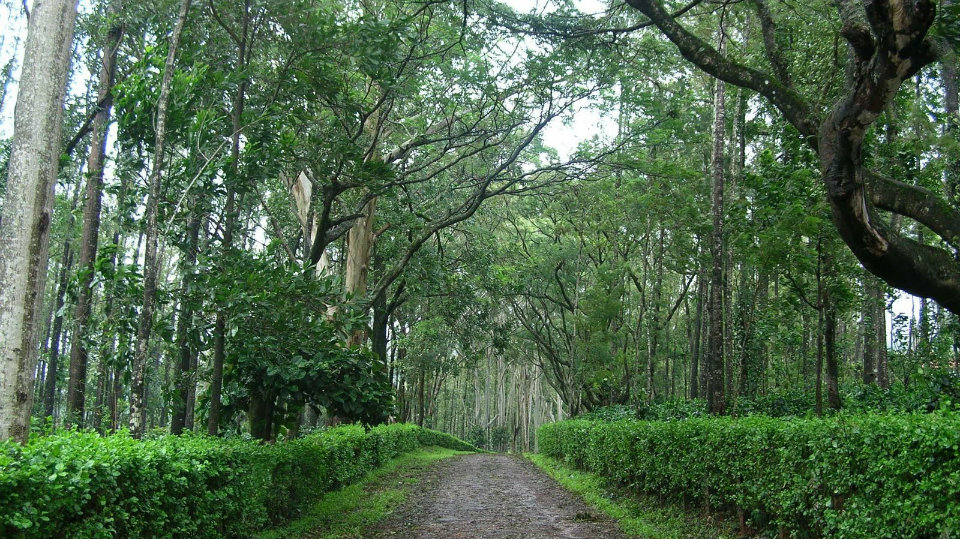
Unlike conventional plantations, Indian coffee is cultivated under dense shade in regions such as the Western Ghats, Eastern Ghats, and the north-eastern part of India, which is home to unique biodiversity hotspots. Our coffee farms resemble managed forests; birds nest among the shade trees, elephants traverse traditional corridors and multiple crops grow in harmony. This is more than agriculture; it is agroforestry refined over generations.

The INDICOFS framework is primarily designed to capture the ecological value of Indian coffee systems. Farmers who have practiced sustainability for generations will find that INDICOFS reflects their established practices. INDICOFS enriches the sustainability conversation by ensuring compliance with regulations like the EU Deforestation Regulation and by recognizing essential ecosystem services. The carbon sequestered by shade trees, protected watersheds, and the biodiversity present in these landscapes are all acknowledged within INDICOFS.

The three-tier structure of INDICOFS promotes continuous improvement, with each level building toward world-class sustainability performance.

Democratizing Sustainability: One of INDICOFS’s most significant innovations is making sustainability certification accessible to small and marginal farmers. The current global certification landscape can be challenging for smallholders due to high costs and requirements that do not always reflect the realities of small-scale farming. By enabling Coffee Board assessments for small farmers at Level 1, INDICOFS expands access to sustainability premiums. This recognizes that sustainable agriculture often occurs at small scales, managed by farmers with extensive ecological knowledge but limited financial resources.

Institutional Innovation: The development of INDICOFS showcases the enhanced institutional capacity of Indian coffee research. As CCRI enters its second century, the Core Technical Committee brings together diverse expertise—scientists, sustainability professionals, and certification experts—and incorporates feedback from farmers, exporters, and trade associations through consultation. The resulting framework balances rigor with practicality, ambition with achievability.

Technology as an Enabler: INDICOFS harnesses India’s digital infrastructure to enable new possibilities not available when international standards were established. Satellite monitoring, blockchain traceability, and mobile connectivity facilitate cost-effective verification and direct engagement with farmers. This integration with evolving digital systems creates an ecosystem where sustainability verification becomes part of everyday business rather than an additional burden. This systematic approach could represent India’s contribution to global sustainability practices.

Market Realities: The ultimate success of INDICOFS hinges on market recognition. The framework is designed to complement existing certification systems while addressing the specific needs of Indian coffee cultivation. As consumers increasingly seek transparency in sustainability claims, a government-backed framework grounded in scientific principles offers additional credibility and assurance.

Broader Implications: The significance of INDICOFS extends beyond coffee. It demonstrates that sustainability standards can originate from producing countries, enriching the global dialogue on sustainable agriculture. The shade-grown coffee gardens of Coorg offer valuable lessons in sustainable farming for the world. INDICOFS embodies this contribution.

The launch of INDICOFS marks a pivotal moment when India began to define what sustainability means for its unique coffee systems. In the second century of organized coffee development, this shift toward sustainability could transform the future of Indian coffee.

source: http://www.newindianexpress.com / The New Indian Express / Home> Xplore / by Anil Jauhari, Y Raghuramulu, Keerthi D’Souza / December 27th, 2025
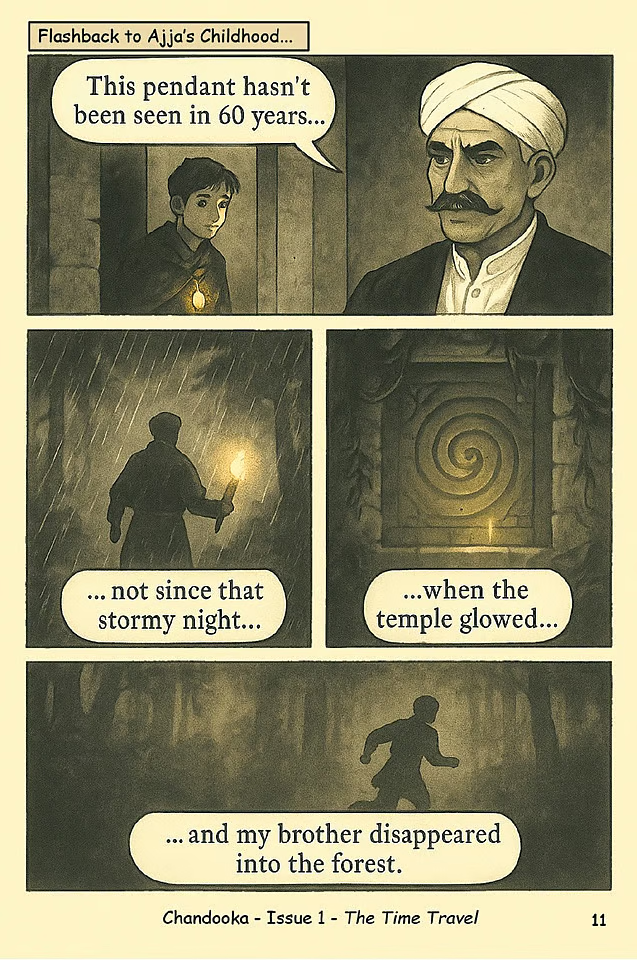
Kodava folklore now in comics

A full-time bank employee who is also well-versed in digital marketing, Somanna is open for collaborations.

Madikeri :

Amar Chitrakatha, Phantom, Mandrake. Tinkle, Chacha Choudhary, Chandamama, Pinki and many other popular comics have become a thing of the past, but gladly have reappeared in their new avatar in digital forms.

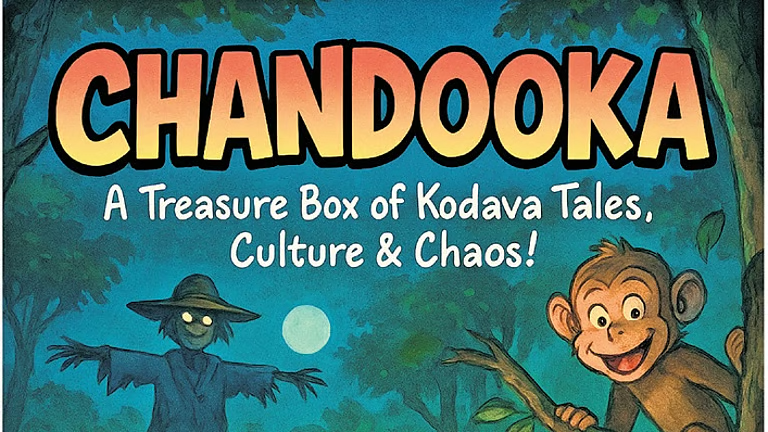
An artist from Kodagu is trying to reintroduce the magic of comics among chi ldren through his ‘Chandooka’. In Kodava, ‘Chandooka’ means a traditional wooden box in which valuables are kept.

So, what’s special about Chandooka? Written, illustrated, designed, edited and published by Manavattira Somanna, it celebrates and promotes legendary Kodava folklore and the unique tradition and culture of the community. Somanna wants to introduce this to Gen Z and Gen Alpha in the era of AI.

“As a kid from the 1990s, I grew up hearing Kodava tales f rom my grandparents. Now, kids no longer live in their native land with their grandparents and stay away, but also from the cultural practices of the community,” he said. While it was easy for millennials to know their cultural roots, it is not the same with Gen Z and Gen Alpha.

“The best way I could reach them without being preachy or boring was through comics,” he said. ‘Chandooka’ is an enjoyable read for non-Kodavas too who want to know more about the community’s unique culture and tradition.

“I want to show to the world Kodagu is not just about booze, hills and coffee,” he said. The first edition of ‘Chandooka’ was released in September and its second in December. It garnered the interest of several children and parents alike.

A full-time bank employee who is also well-versed in digital marketing, Somanna is open for collaborations. ‘Chandooka’ has several sections, including culture, history, current status, adventure, festival and Kodava lipi (script) sections. It includes sections from the historical ‘Pattole Palame’ book by Nadikerianda Chinnappa, where the festivities, ornaments, rituals and other unique practices of the community are detailed.

The festivities and other rituals are explained in the most interesting format, which will help children get hooked to it, Somanna said. “One can learn everything about the Kodava community bit by bit.” From learning Kodava language to trekking across the hillocks of the district, ‘Chandooka’ has found its niche audience who have offered positive feedback.

“Stories do not fade because they are weak. They fade because we stop returning to them. If we do not remember, who will tell our kids? One day, we will be elders and what will we pass on? Chandooka is not just a comic book, but a time travel story that helps connect kids with their roots,” he said.

source: http://www.newindianexpress.com / The New Indian Express / Home> Good News / by Prajna GR / December 28th, 2025

Theft of coffee and pepper: Kodagu police issue advisory to traders

Superintendent of Kodagu district police K. Ramarajan pointed to the registration of cases at various police stations about theft of harvested coffee and pepper from storage locations during the on-going harvesting period.

Workers in a coffee and pepper plantation in Kodagu district of Karnataka. | Photo Credit: File photo

The Kodagu police have issued an advisory to coffee and pepper traders to collect complete details of sellers in view of complaints of theft of the commodities from the storage locations.

In a statement, Superintendent of Kodagu district police K. Ramarajan pointed to the registration of cases at various police stations about theft of harvested coffee and pepper from storage locations during the on-going harvesting period.

Hence, as a preventive measure, instructions have been issued to the local police station officials to hold meetings with the coffee and pepper traders, provide them with appropriate guidance, and collect complete details of all the coffee and pepper traders in the district.

“All coffee and pepper traders in the district are required, at the time of purchase, to collect and maintain complete details of the sellers, including name, address, mobile number, transaction details, weight, and amount. If any suspicion arises during purchase, traders should take photographs of such individuals, verify the background of the sellers, and conduct transactions with due caution”, according to the statement.

Collecting details made mandatory

It is mandatory for coffee traders to obtain and maintain the above details. According to the statement: “If any suspicion arises during sale or purchase, the matter must be immediately reported to the local police station. If, during inspection, local police officers find that traders have failed to maintain the required records, information will be forwarded to the GST Department.”

“Further, engaging in transactions without maintaining records will be treated as intentional purchase of stolen goods at a low price, and action will be initiated against such traders under Section 317(2) & (4) of the Bharatiya Nyaya Sanhita (BNS) Act. Offenders may face imprisonment ranging from 3 to 10 years, along with a fine, as ordered by a competent court”, the advisory stated.

Emergency helpline

If coffee and pepper growers suspect any person during sale or purchase transactions, they are requested to call the emergency helpline (112) and provide information.

Police personnel will immediately reach the spot and take appropriate action. Similarly, if any suspicious persons are noticed in public places or around residential areas, people are requested to inform the local police station or the emergency helpline 112, or share information through the KSP digital platform, and cooperate with the police.

According to the statement, the identity of persons providing information about illegal activities will be kept confidential.

source: http://www.thehindu.com / The Hindu / Home> News> India> Karnataka / by The Hindu Bureau / December 24th, 2025

Kodagu: MP seeks quick installation of battery sets for mobile towers

Yaduveer Krishnadatta Chamaraja Wadiyar, Mysuru–Kodagu MP, has emphasised the urgent need to strengthen telecommunication facilities in Kodagu district and requested Union Minister for Communications Jyotiraditya Scindia to fast-track the installation of battery sets for mobile towers.

During his meeting with the Minister in New Delhi on Friday, the MP also sought speedy processing of the proposal to allot 15 power plants for the region.

Recalling the recent heavy rains in Kodagu, Mr. Wadiyar said several poles had collapsed, severely disrupting communication networks and causing major inconvenience to the public. He added that he had earlier written to the Minister pushing for improvements to the district’s telecom infrastructure.

“Today, I met the Minister once again and requested him to expedite the process,” he said.

According to the MP, Mr. Scindia assured that the matter would be reviewed at the earliest and necessary action would be taken.

source: http://www.thehindu.com / The Hindu / Home> News> India> Karnataka / by The Hindu Bureau / December 12th, 2025

Assembly clears Bill on ‘Jamma Bane’ lands

Resolves unique land ownership issues in Kodagu, introduces appellate mechanisms

Belagavi: 

The Karnataka Assembly on Tuesday passed a Bill to amend the Karnataka Land Revenue Act, 1964, to resolve long-standing land ownership issues linked to the ‘Jamma Bane’ tenure system in Kodagu district.

The Bill, introduced in August to enable modern recognition of land rights under the traditional ‘Jamma Bane’ system, was earlier referred to a select committee on the advice of Virajpet MLA Ajjikuttira S. Ponnanna and Madikeri MLA Dr. Mantar Gowda.

It was reintroduced in the House yesterday by Revenue Minister Krishna Byre Gowda after the legislative sub-committee held five rounds of consultations to address concerns raised by landholders in Kodagu.

Explaining the rationale, Krishna Byre Gowda said the amendment accounts for the peculiar nature of ‘Jamma Bane’ lands, which were governed by the Coorg Land Revenue and Regulations Act, 1899, before the enactment of the Karnataka Land Revenue Act in 1964.

Some provisions of the 1899 law continued in practice despite not being explicitly incorporated in the later Act, leading to legal and administrative complications.

No clear entries in revenue records

According to the Statement of Objects and Reasons, ‘Jamma Bane’ tenure is a distinct form of landholding prevalent only in Kodagu, traditionally enjoyed by joint families based on customary rights, often without clear entries in revenue records.

The absence of explicit provisions to record the rights of joint family members has resulted in difficulties in mutation, registration, inheritance and alienation, triggering disputes and prolonged litigation.

The amendments seek to provide statutory recognition to the ‘Jamma Bane’ system by allowing the inclusion of joint family members’ particulars in mutation registers, mandating the reporting of acquisition of rights by joint family members, empowering revenue officials in Kodagu to recognise such rights and ensuring that details relating to family trees, survivorship, inheritance and associated privileges are recorded in land records.

‘Bhoomi’ complications resolved

The Bill also addresses the complications that arose after the introduction of the ‘Bhoomi’ land records software in 2000, when ‘pattedars’ were included under Form 9, leading to confusion over ownership, difficulty in land transactions, inter-generational transfers and an increase in court cases.

Krishna Byre Gowda said the present amendment is the outcome of nearly two years of consultations to resolve these issues.

Tahsildar Adalats

MLA Ponnanna told the House that the lack of clarity over ‘Jamma Bane’ ownership had adversely affected land sales, bank loan approvals and inheritance.

He stressed the need for careful implementation of the law and appropriate framing of rules to ensure the issue is effectively resolved.

Leader of the Opposition R. Ashok sought clarity on how the Government would deal with land records reflecting names of four to five generations of owners.

In response, Krishna Byre Gowda said local tahsildars would conduct adalats to hear objections before land records are modernised and finalised.

He added that the system would include an appellate mechanism to safeguard landowners’ rights.

source: http://www.starofmysore.com / Star of Mysore / Home / December 17th, 2025

6-A-side Kids Hockey Tournament

Bengaluru:

Jayanagara Kodava Sangha President and Sports Committee has organised 6-A-side Kids Hockey Tournament to commemorate 100 glorious years of Indian Hockey on Dec. 21 at Turf City, Jp Nagar 7th   Phase, Bengaluru.

The tournament will be inaugurated by chief guest V.R. Raghunath, Indian Hockey Player, Olympian and Arjuna Awardee, at 9 am.

source: http://www.starofmysore.com / Star of Mysore / Home> Sports / December 19th, 2025

Events tomorrow – DEC. 20: Kodagu Model School and Sri Kavery Kodava Association, Mysuru East

17th Annual Day Celebrations, ‘Janapadha Loka-  The World of Folk Culture’, M. Prakash, BEO Mysuru (Rural) and D.N. Geetha, BRC Co-ordinator, Mysore Taluk (Rural), chief guests, Naina Achappa, Principal, Shishya Play School, guest of honour, K.M Belliappa, President, Kodagu Model School, presides, school premises, Vidyashankara Layout, 3 pm.

source: http://www.starofmysore.com / Star of Mysore / Home> Events Tomorrow / December 19th, 2025

Planning to watch the Geminids meteor shower? Starscapes announces camps in Kausani, Mukteshwar & Coorg — here’s all you need to know

Experience the Geminids Meteor Shower this December with Starscapes! Join exclusive camps in Kausani, Mukteshwar, and Coorg for expert-led stargazing, cozy winter comforts, and breathtaking meteor views. Perfect for astronomy lovers, families, and photographers.

Witness the dazzling Geminids Meteor Shower at Starscapes camps in Kausani, Mukteshwar & Coorg this December—an unforgettable night under the stars!

Astro-tourism is on the rise in India, with destinations across the country enhancing the stargazing experience. From the Himalayas to the Aravallis, privately owned observatories are encouraging travellers to stay in cosy hotels and homestays, making the magic of the night sky accessible to all.

This December, India’s skies are set to dazzle like never before. The Geminids Meteor Shower, one of the brightest and most dependable celestial events of the year, will peak on December 13–14, 2025. Astronomy enthusiasts, adventure travellers, families, and photographers alike won’t want to miss this spectacular show.

To celebrate, Starscapes, India’s leading astro-tourism company, is hosting immersive two-night meteor-shower camps across Kausani, Mukteshwar (Uttarakhand), and Coorg (Karnataka).

If you’ve ever dreamed of lying beneath a sky filled with stars while multicoloured meteors streak overhead, these exclusive dark-sky camps promise an unforgettable winter escape—perfect for creating memories that last a lifetime.A Celestial Show Unlike Any Other

The Geminids are famous for producing up to 120 colourful meteors per hour under ideal dark skies. This year, the shower arrives on a moonless, crisp December night—perfect conditions for uninterrupted viewing.

Imagine watching meteors blaze across the heavens with the Himalayas as your silhouette in Kausani and Mukteshwar, or the lush Western Ghats as your backdrop in Coorg. Far from city lights and digital noise, these camps offer a rare chance to reconnect with nature and the cosmos.What Awaits You at the Starscapes Geminids Camps

Each camp blends scientific exploration, cosy winter comforts, and the thrill of celestial magic:

Expert-Led Meteor Watching: Knowledgeable StarGuides will walk you through the night sky using sky maps, constellation pointers, and fascinating stories about the Geminids and their origins.

Telescopic Stargazing: Before the meteor shower peaks, powerful telescopes will unveil spectacular deep-sky objects—star clusters, nebulae, Jupiter, Saturn, and more.

Cosy Winter Vibes Under the Stars: Enjoy hot chocolate, warm snacks, and peaceful silence, wrapped in blankets and crisp mountain or hill air.

Handpicked Dark-Sky Viewing Zones: Each group will be driven to a carefully selected, zero light-pollution spot—ensuring a front-row seat to the night sky’s most spectacular performance.Why These Locations Are Perfect for Meteor-Watching

When it comes to catching the Geminids at their brightest, location matters—and these three destinations offer some of the clearest, darkest skies in India. From Himalayan heights to the lush Western Ghats, each spot creates the perfect natural stage for a spectacular meteor show.

Kausani & Mukteshwar (Uttarakhand): High altitudes, dry winter air, and minimal light pollution make these Himalayan destinations ideal for observing faint meteors and star fields.

Coorg (Karnataka): Known for its misty hills and sprawling forests, Coorg offers wide, open horizons and stable winter weather—excellent for southern-sky viewing.When to Watch the Geminids

The meteor shower peaks on the night of December 13–14, 2025.

Best viewing time: 12:00 AM to 4:00 AM, when the radiant is highest in the sky.

During this window, the sky comes alive with a steady burst of glowing meteors—some slow, some bright, and many leaving long, colourful trails.The Experience: A Night You’ll Remember Long After It Ends

Step away from screens. Breathe in the cold winter air. Listen to the quiet.  Under a sky filled with stars, you’ll:

  • Sip steaming hot chocolate.
  • Share stories with fellow sky-watchers.
  • Capture long-exposure shots of meteors.
  • Watch the sky transform into a celestial fireworks display.

Whether you’re travelling solo, with friends, or with family, it’s a wholesome, grounding experience—one that takes you back to the simple joy of looking up.Temperature Guide for December 2025: What to Expect at Each Location

A night under a meteor-lit sky sounds magical—just remember, the winter air will be part of the experience too. If you’re travelling to Kausani, Mukteshwar, or Coorg for the Geminids, expect the kind of crisp, soul-stirring cold that makes hot chocolate taste even better.

Advertisement

In Mukteshwar, the sun offers a gentle warmth with daytime temperatures hovering between 14–17°C, but once night falls, the mercury dips to a chilly 3–7°C—perfect for a snuggly jacket and a warm fire.

Kausani is just as wintry, with 15–17°C during the day and a sharper 3–5°C after dark—ideal for stargazing but definitely jacket weather.

Further south, Coorg trades Himalayan chill for a softer southern breeze. Days stay comfortably warm at 22–27°C, but nights cool down to 10–16°C, giving you the perfect balance between cosy and crisp.What to Pack

A magical night under the stars feels even better when you’re prepared. Here’s everything you’ll want to carry for a comfortable and unforgettable Geminids experience:

  1. Warm clothing: Thermals, a fleece jacket, gloves, and a scarf to stay cosy during late-night and pre-dawn meteor watching.
  2. Comfortable footwear: Trekking or closed shoes for walking across uneven or dimly lit terrain.
  3. Photography gear: A DSLR or phone camera along with a tripod to capture long-exposure shots of meteors and star trails.
  4. Light source: A torch or headlamp—preferably with a red filter—to preserve night vision during stargazing sessions.
  5. Essentials: Water bottle, lip balm, and moisturiser to stay hydrated and comfortable in the crisp winter air.

How to Register

Eager to experience the Geminids Meteor Shower firsthand? Find all camp details, registration information, and the full itinerary here.

source: http://www.moneycontrol.com / MoneyControl / Home> Travel / by Priyanka Roshan / December 08th, 2025

AICRP on Sorghum & Small Millets & ICAR–IIMR, Hyderabad empower Tribal Farmers with Millet Bakery and Roti Unit

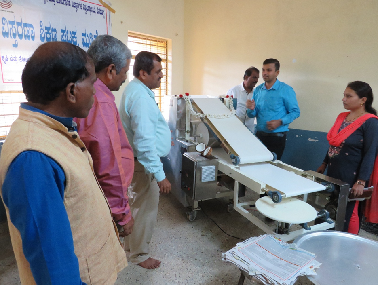
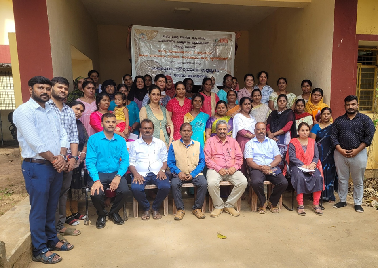
The AICRP on Sorghum and Millets & ICAR–Indian Institute of Millets Research, Hyderabad, in collaboration with the College of Forestry, Ponnampet, UAS, Mandya, established a Millet Bakery and Millet Roti Units at the Kodagu Agribusiness Incubation Centre of the campus. An awareness cum Millets training program organized to women members to enhance the millets utilisation. This initiative under TSP component of AICRP- Sorghum & Millets, is an innovative step toward promoting the consumption of nutritious millet-based foods among forestry college students, farmers while demonstrating practical millet value-addition technologies through an incubation-driven entrepreneurial environment.

The unit was initiated to integrate millet-based diets into hostel kitchens and provide students with healthier and nutrient-rich alternatives as part of their daily meals. With the efforts of Dr. Laxmi Balaganoormath, Assistant Professor & Principal Investigator of the project began by supplying Jowar rotis to hostel students during lunch. Encouraged by the positive response and increasing popularity among students, the initiative rapidly expanded its product portfolio to include finger millet cakes, millet biscuits, millet chikkis, and a variety of millet-based baked snacks. These products are made using millets, ensuring high nutritional value, freshness, and support for regional agriculture.

Beyond the hostel community, the Millet Bakery and Roti Unit at the Kodagu Agribusiness Incubation Centre has added broader value to the campus ecosystem. It provides hands-on training opportunities and skill development in millet processing, baking, and entrepreneurship for students and aspiring agripreneurs. The initiative also ensures a steady demand for local millet growers, thereby strengthening the local value chain and supporting climate-resilient agriculture. Furthermore, this incubation-based model serves as a demonstration platform for schools, community organizations, FPOs, and enterprises interested in adopting millet-based food systems.

Through the strong partnership between AICRP on Sorghum & Millets, ICAR–IIMR, Hyderabad, and the College of Forestry, Ponnampet, this initiative has become a role model for nutrition-focused and sustainability-driven food interventions in educational institutions. The Millet Bakery and Roti Unit is not only nourishing young minds and bodies but also fostering a culture of innovation, self-reliance, and community well-being powered by the simple strength of millets.

(Source: ICAR–Indian Institute of Millets Research, Hyderabad)

source: http://www.icar.org.in / ICAR