Category Archives: Uncategorized

The ‘Ass Festival’ Against the Upper Caste

Men and boys celebrate Kunde Habbe, Devarapura, Kodagu, May 2024. Photo: Deepa Bhasthi

The subversive Kunde Habba in rural Kodagu, India bears disturbing signs of the carnivalesque-grotesque

Monsoon in the Western Ghats in South India is a force, perhaps the single most important event in the economic and political calendar of a still largely agrarian country. The big wet winds usually make landfall in Kodagu district (where I live) by early June. Just before this, thousands of Indigenous peoples, or tribals, gather in villages in the interior of the region to hurl the choicest of abuses at their god and fellow community members. It is an act of subversive irreverence that, every summer, disrupts the mainstream Brahminical diktat of fear- and hierarchy-based worship of deities confined to temple monuments or stuck within shimmering photo frames. Unlike mainstream Hindu festivals, whose dates, decided by astrological charts, are wildly different each year, Kunde Habba (literally, ‘ass festival’) is observed on the fourth Thursday in May. It is also a perfect example of Mikhail Bakhtin’s carnivalesque-grotesque theory. According to Bakhtin, the carnival is a moment between the reality of life and art when displays of grotesqueness, excess, perhaps even violence, are not just permissible, but expected. In the Indian context, carnivalesque grotesque helps in the understanding of caste, power and the institutionalised oppression of some the poorest, most vulnerable communities in this coffee-growing region.

There are about two dozen different Indigenous peoples living in the southern parts of the district (and sharing community, gods and belief systems with tribes in the High Range region of neighbouring north Kerala). Legend is that Ayyappa, a forest deity of the Kurubas (the mountain-dwelling Betta-Kurubas, who harvest produce from the forest for a living, and Jenu Kurubas, honey gatherers, being two of the prominent subtribes), was on a mission in the forest with many tribespeople in tow when he became distracted by Bhagavathi, a forest goddess. His subsequent abandonment of the ancestors is remembered by the tribals when they curse him each year. The scolding as prayer is a dialogue with the god, for demands unmet, for negotiations and confessions, for letting off steam, no holds barred. It must help, too, to be able to vent frustrations and let loose on family, friends, neighbours and employers – these last nearly always wealthy coffee-plantation owners on whose lands the Indigenous peoples work for a daily wage, sometimes effectively as bonded labour – for one day of the year.
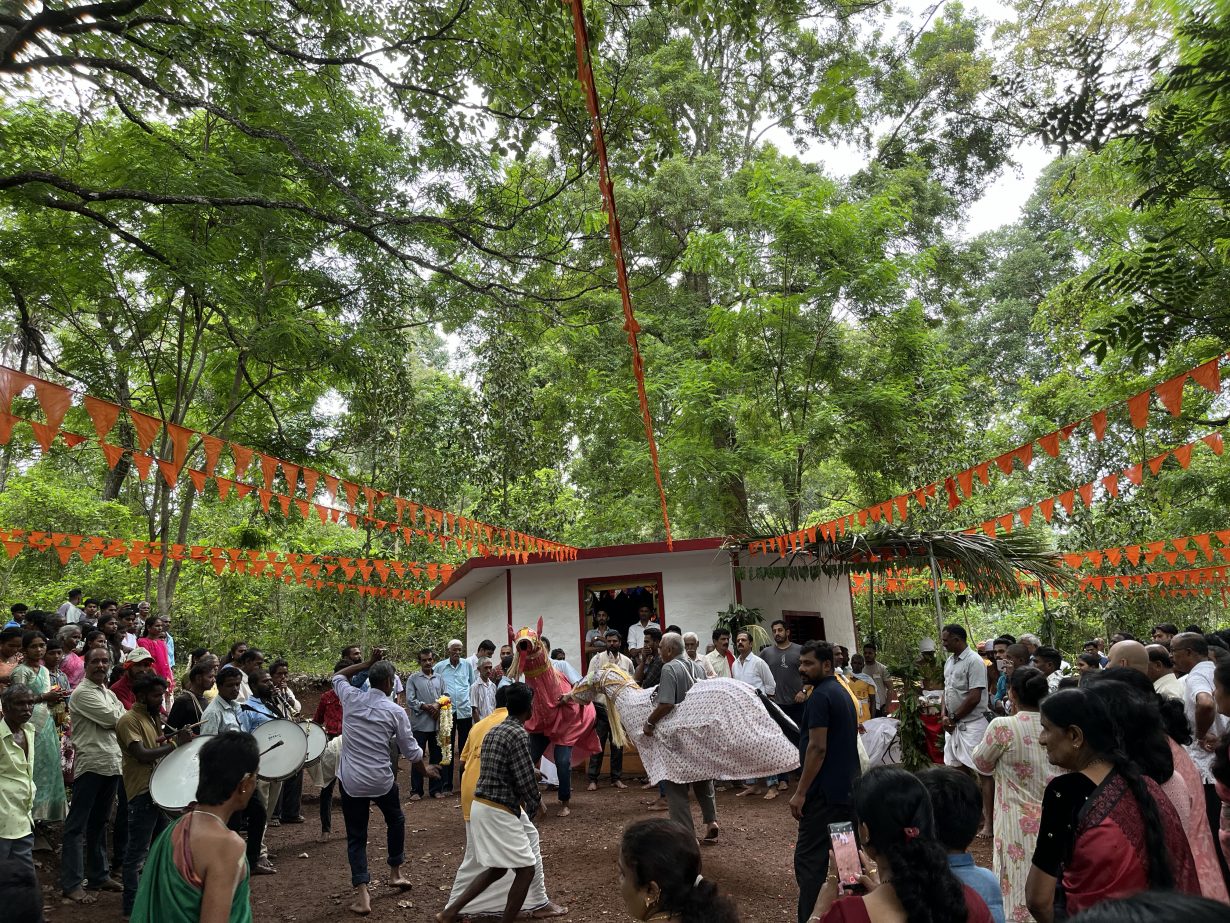
Kunde Habbe, Devarapura, Kodagu, May 2024. Photos: Deepa Bhasthi

On the day of the festival, boys and men dress in drag and dance to bawdy lyrics that feature the refrain “kunde, kunde”, engaging in a mostly friendly exchange of abuses and rude gestures with other groups. Drums are made out of old tin-boxes or cut from broken blue storage-barrels. Silver-painted bodies are dressed in ingeniously repurposed gunny sacks or umbrella cloth, or in miniskirts, bralettes and long dresses borrowed from wives, sisters and daughters. Flowers are affixed to underwear; people wear bright face paint, slapdash makeup, a party wig, a Money Heist mask. In this transgression of the self, men, under a vow to the forest goddess, dress like women for a few hours. At Devarapura, a tiny village where celebrants congregate after collecting money from shopkeepers and passersby in nearby towns, the atmosphere is that of a carnival. The music is loud, the dancing is risqué and stunned chickens are sporadically thrown into the air as sacrifice. In the background, some elders fulfil the more ritualistic aspects of the festival, including a horse dance and mainstream acts of prayer with flowers, bells and chants. Elsewhere in the district smaller versions of the same festival are celebrated in prayer under trees, or to stones in shrines deep in the forest. Here in Devarapura there is a large, well-kept temple for Bhagavathi. As in any village fair, there are ice cream trucks, snack shops, cheap clothes for sale and plastic and soft toys for the children. Women participate as the audience. The performance of the festival is an all-male revelry.

By dismantling the unequal power equations between themselves and their gods, and between themselves and their employers, and by speaking across this divide in words and tones otherwise disallowed, the tribals access, however momentarily, a state of utopian freedom and social equality. The alternative world summoned by this pageantry is a humorous, creative and annually rejuvenating critique of the staid religious practices that mainstream Hindutva-forward systems prescribe, where god must be approached with fear, not friendship.
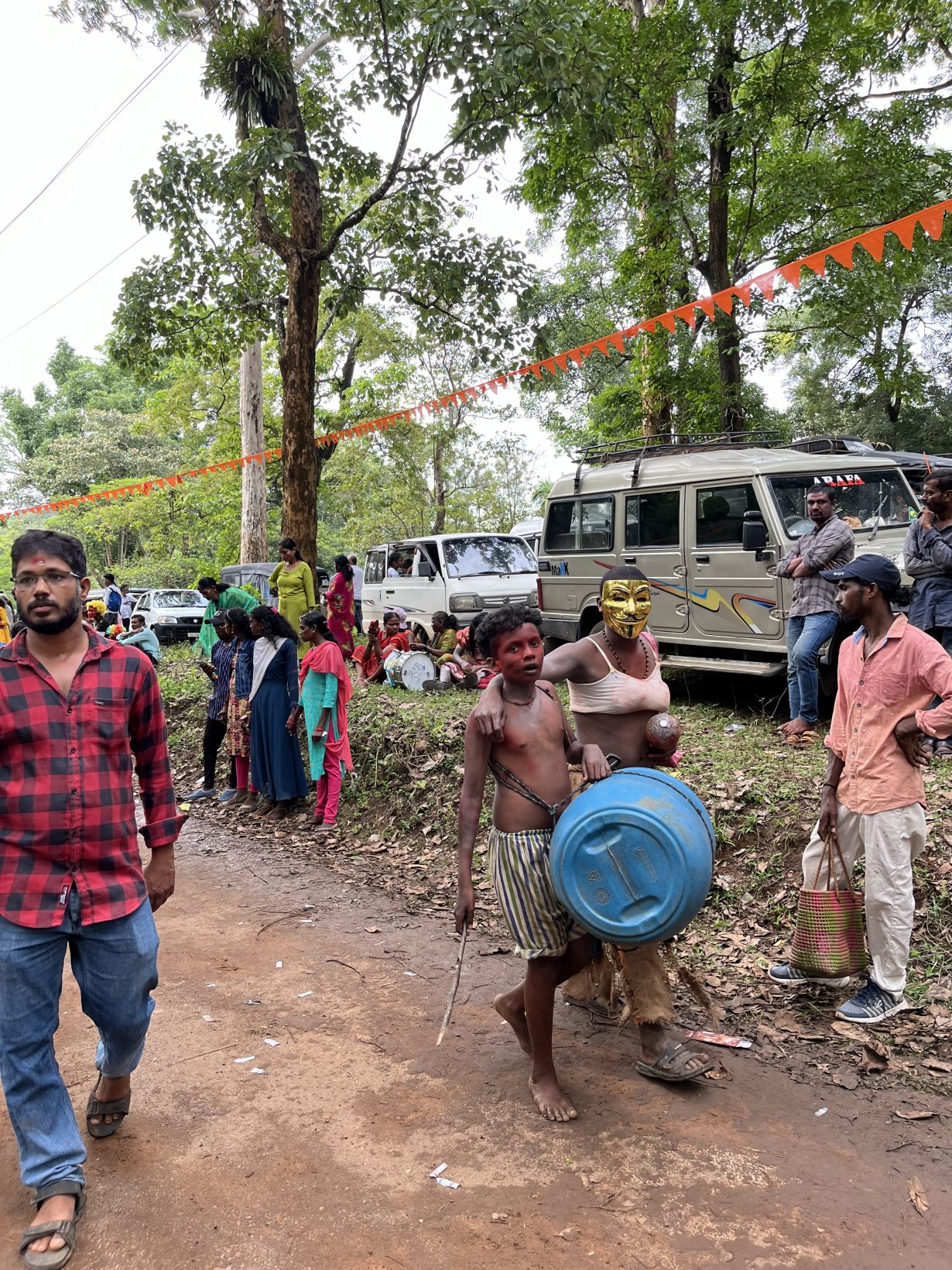
Kunde Habbe, Devarapura, Kodagu, May 2024. Photo: Deepa Bhasthi

Bakhtin points out that while the carnivalesque is able to temporarily weaken feudalism and caste-based oppression, it does not have the political heft to overthrow such age-old practices. In fact, in contemporary India there are signs that Kunde Habba’s performance of subversive protest is being subsumed into dominant religious cultures. This was my first visit to the festival in nine years, and saffron buntings now fill the village (colour is intensely politicised in India: saffron for a radical version of Hindu, blue for the Dalits, green for Muslims). Local families of Kodavas, an Indigenous community that prefers to side with mainstream Hinduism while shying away from acknowledging the tribal nature of its cultural practices, seem to have a more visible role in the management of the festival and temple in Devarapura than in past years. Murmurs of complaint can be heard regarding the ‘unnecessary vulgarity’ of throwing abuses; the festival’s name has been sanitised as ‘Bedu Habba’, meaning ‘prayer, or asking festival’, in the media. Now, alongside the irreverence, hundreds of tribals pay to line up and offer special prayers at the temple; a priest as middleman presides.

In the story of Kunde Habba as it has come to be told today, Shiva and Parvati, prominent members of the Hindu mythological pantheon, have been made protagonists. This isn’t necessarily wrong: myths are not set locations in history, and must change constantly if they are to survive. However, considering that Indigenous peoples are routinely oppressed by policy, social conditioning and systemic violence in India and elsewhere, any such overt departure from a tribe-led festival for something more palatable, more commercial even, calls for scrutiny and critique.

Whether a new restraint in the grotesqueness of folk humour during the festival is the result of a country hurtling towards forced homogeneity in sociocultural practices or simply a natural progression of time that, thanks to political intervention, dilutes the purported problem of alterity and encourages assimilation, I cannot quite tell. Nonetheless, it is always a good idea to leave carnivals like Kunde Habba alone. They are among the last cultural sites that offer a strong counter to the upper caste and class that gatekeep religious and social relationships. A necessary reminder, in these years of majoritarianism, that alternatives are not just possible, but also available for proliferation.

Deepa Bhasthi is a writer based in Kodagu

source: http://www.artreview.com / Art Review / Home> Opinion> Art Review Asia / by Deepa Bhasthi / July 25th, 2024
Ritz Ponnu’s Last Supper

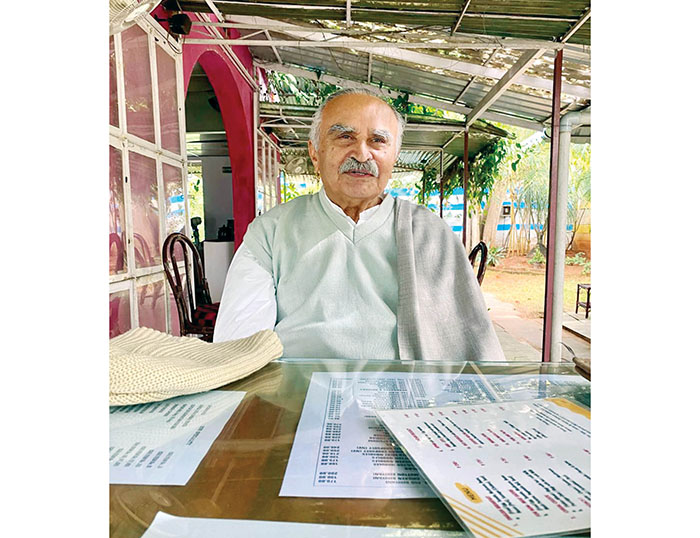
On Friday around 11 am I got a call. The message was disturbing, unpleasant, “Ponnu uncle passed away.” It was about the death of Ponnu Muthanna, known simply as Ponnu to his friends, the man behind the Pelican Pub, popular eatery and beer pub, on Hunsur Road in Jayalakshmipuram. He was 86.

The news twanged my heart string with a sense of guilt for not seeing him while in the hospital, no matter there were reasons. For some time thereafter I was recalling memories of Ponnu I knew, not very closely but primarily as a known hospitality Guru of Mysuru city since early 1970s. If one wanted to drink and dine it was the iconic Ritz Hotel on Bengaluru-Nilgiri Road. And Ponnu presided over its affairs for many years.

I had first met him in that hotel in the 1970s. I had gone there with my late brother Dr. K.B. Subbaiah and his wife Swajie, who were known to him. We went to see him in his office and I found him poring over an english novel that I had read. It gave me a chance to engage him in conversation. But he was a man of few words. Very soft spoken that one must be very attentive to hear him. When I said ‘beg your pardon,’ he merely brought a faint smile on his rotund face with eyes twinkling. Indeed a gentle soul, I thought.

Later while we were having our dinner he materialised again as from nowhere, holding the same book and spoke to my brother and sister-in-law and left as quietly as  he came. Years passed. Then I learnt he had quit Hotel Ritz and set up a new eatery near my house in Kuvempunagar with an exotic, or call it swanky, name — “Grub House.”

Probably Ponnu’s journey towards becoming a pioneer in setting up hotels was at a time when there were no “consultants” or “experts” in the field. As I could remember he was the idea man and the founder-promoter of some of the later day hotels in Mysuru. And he was known for naming them like no one could imagine. One was “Dew Drop Inn” in Yelwal on Hunsur Road. I was one of the invitees for the evening gala of its inauguration. A generous, persuasive, attentive host. It was an Inn, a new concept like the Motels of America, and the name Dew Drop…. let your imagination go romancing.

He was too caring to his guests and for his attire he wore only Khadi, as if paying tribute to Mahatma Gandhi. When I made discreet enquiry about his sartorial preference, the answer was that he was a staunch nationalist (left-liberal intellectual elite may pardon him) and a philosopher-hotelier. I was amused.

However, it did not take many years for me to see him in a new avatar, so to say. He began to wear blue jeans and tucked in shirt. I did not venture to find out from others why this transformation. I asked him this question myself and his answer was a gentle, winning smile that made me shut my mouth. I used to meet him occasionally in some gathering and our conversation would end abruptly after exchanging pleasantries.

Next I heard of him as being engaged in setting up a new hotel in the central district of the city on Sri Harsha Road, again with an apt name “Parklane Hotel,” the hotel being in front of a park, in association with a rich city businessman. The speciality here was the dancing floor, with psychedelic lights et al with loud music for the young boys and girls who bunk classes! Ponnu was the innovative brain behind this venture. He did not forget to invite me for the inaugural. Thank you Ponnu. This hotel became a roaring success but he had to leave it too.

As I know it was time for him to enter the big-league. “The Green Hotel,” formerly the famous Premier Studio on Hunsur Road with the Chittaranjan Palace, as the Director. Indeed he had a midas touch with hotels but seemed to be experimenting. I do not know of other hotels he had fathered but I know that he remained a bachelor all his life.

Probably, the last one he promoted and partnered, this time successfully, was the “Pelican Pub” on Hunsur Road, Jayalakshmipuram. It became a rendezvous for young and beer gulping of our city.

I have heard despite his entrepreneurial pursuits in the field of hospitality industry, in his personal life he had his own philosophy, principles, values, fads and foibles that he would not compromise. In his Ritz days his name was synonymous with the hotel so much so he was known as Ritz Ponnu, the ladies’ man. He was living in a low-ceiling shelter with minimum creature-comfort hoisted on stilts in Hinkal farmland. His friends called it ‘Ponnu’s Adda.’ Did you get me Steve? It was only when he opened the Pelican Pub he came to be known as Ponoo, a good Samaritan. I know and will vouchsafe for his ascetic ways and ability to renunciate when the attitude of his business partners did not resonate in a just and fair manner. I think this kind of self-denial to make others happy is rare. But, that was the Ponnu I knew.

Ponnu, a teetotaller, seemed to me more of an Osho Rajneesh freak. This controversial Guru had said ‘live life like a sanyasi without wearing the saffron clothes.’ Ponnu seemed to be living that kind of a life since his Ritz days.

Be that as it may, the last    time I met Ponoo was before the Parliamentary election-2024. He came to my office unannounced. I was surprised no end. He was worried about the voters not exercising their franchise as a duty to our country. He made some suggestions. I gave my commitment to follow his advice and kept my word.

It was because of Ponnu Muthanna I was able to mobilise a few intellectuals and professors of our city and hold a meeting in the Rani Bahadur Auditorium on Hunsur Road. I was amazed at Ponnu’s concern for our country at a time we find businessmen and entrepreneurs concerned about themselves rather than the country.

I may well imagine that Ponnu in his life’s journey must have met with interference, ingratitude, insolence, disloyalty, ill-will, denials and selfishness. But he had the wisdom to bear with them all as due to the offenders’ ego and ignorance of what is just, good or bad.

Having said this, the right way to describe Ponnu Muthanna, a mere hotelier to the outward world, is by borrowing the words of William Shakespeare: “His life was gentle; and the elements so mixed in him, that Nature might stand up and say to all the world, this was a man!”

RIP dear Ponnu. Om Shanti.

e-mail: voice@starofmysore.com

source: http://www.starofmysore.com / Star of Mysore / Home> Columns> Abracadabra / by K B Ganapathy / June 23rd, 2024

Cheers & Goodbye

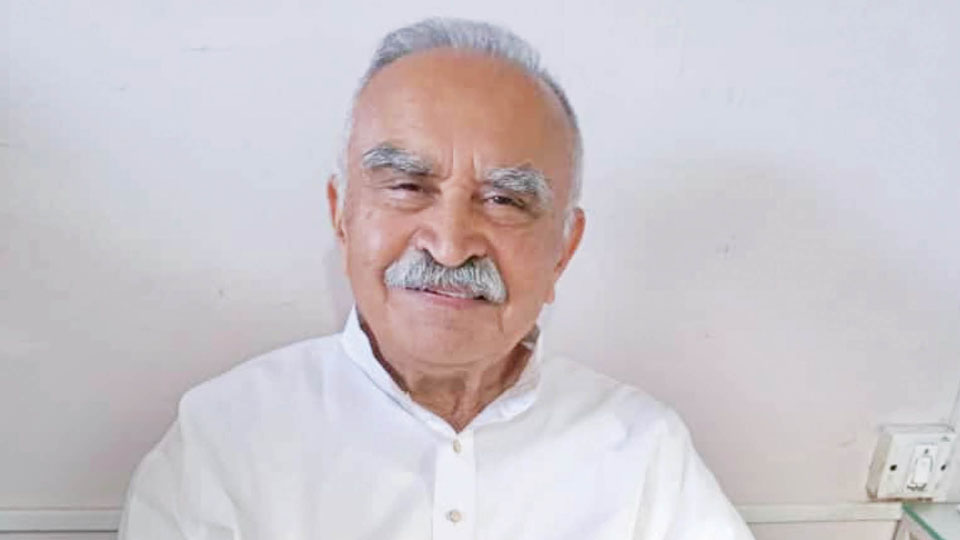
The last true ‘restaurateur’ of Mysuru, Ponoo Muthanna, affectionately known to many Mysureans in their late 20s, 30s and 40s as Ponoo Uncle, passed away yesterday.

Ponoo was the beloved proprietor of the Pelican Pub, a watering hole he transformed into a sanctuary like no other in Mysuru, back when it was still Mysore.

Pelican Pub was the place where we met old friends, made new ones, laughed until our sides hurt, cried over broken hearts, fell in love and cheered our favourite sports teams to victory. For many, it was the place where we had our ‘first drink.’

In a town where pubs could be intimidating, Pelican was a haven. It was the safest pub in Mysuru, where even single women could enjoy a beer and read a book without the fear of drunks behaving badly.

It was a melting pot where the well-heeled and the not-so-well-heeled mingled, treating each other with the same respect. ‘Class’ didn’t matter here; all that mattered was that you had class — in how you behaved, that is.

This unique atmosphere existed because of Ponoo’s watchful eyes. He was kind, witty, charming, decent and immensely respected. Clad in his all-white attire, he would personally visit each table and ask, “Is everything okay?” He did this even if you’d been a regular for decades.

If everything was not okay and he noticed you were in a sombre mood, Ponoo had a knack for offering words of wisdom without ever being preachy. If you were a regular, he might order you a mug of beer and suggest a book, usually something by Osho, to soothe your soul.

If you were on a date and hoping for romance, he’d crack a few mischievous jokes, playing the perfect elderly wingman.

If you were happy, he’d simply leave you to your exuberance with a smile and a, “I’m glad you’re living in the moment.”

Many joked that Ponoo Uncle was like a proton, always in a positive state of mind because he was a lifelong bachelor. But it wasn’t that. He was a lifelong practitioner of ‘living in the now.’

Long before words of affirmation became an Instagram trend, Ponoo filled Pelican Pub with affirmations and smart Alec jokes. One table sign read: “Between yesterday’s mistakes and tomorrow’s hope, there is a fantastic opportunity called Today — Live it, Love it! This day is yours.”

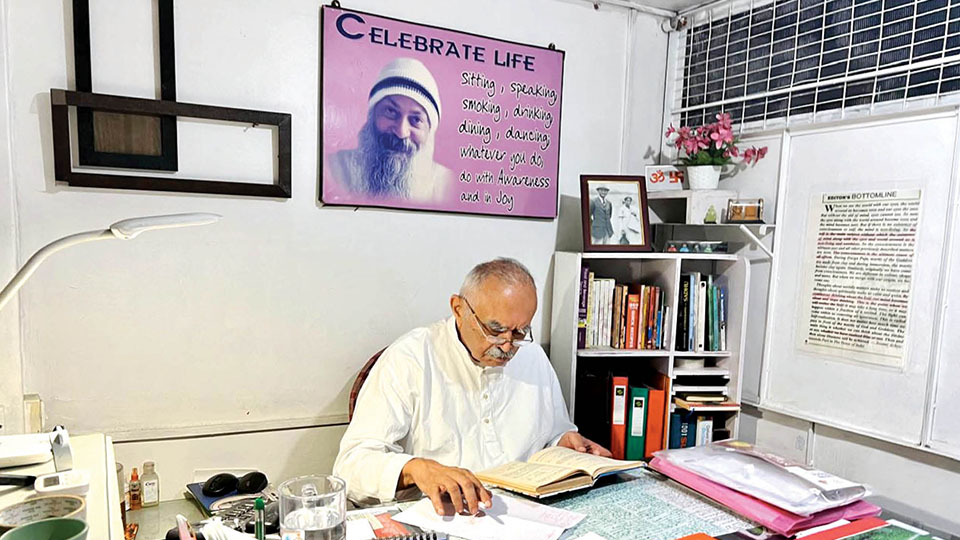
Ponoo Uncle at the Pelican Pub.

I visited Ponoo’s office twice in my life. Once as a young college student and again recently. The backdrop has remained the same — a poster of Osho Rajneesh with the quote: “Celebrate life. Sitting, speaking, smoking, drinking, dining, dancing, whatever you do, do it with awareness and in joy.”

Interestingly, Ponoo served one of the best draught beers in town but never touched alcohol himself! But he taught us, unknowingly, how to pace our drinking.

We’d stand to greet him out of respect when he visited our table but knowing he might come back again later to check if everything was still okay, we paced ourselves. We didn’t want to end up too drunk to greet him properly or to slur our words — no one wanted to embarrass themselves in front of him.

Despite his many virtues, Ponoo  had one tiny flaw — he was soft-spoken, literally. We often strained our necks to hear him, and some older men stood up more to catch his words than out of sheer respect.

Over the years, Pelican Pub became Mysuru’s reunion centre. During the holiday season, Mysureans from around the globe would flock to the pub, rekindling old friendships and making new memories.

Last year, during a conversation about the perils of old age and death, Ponoo said, “It is not death that a man should fear, but rather fear the regret of having not lived.”

Ponoo  lived. He lived on his terms and to the fullest. His graceful presence and handsome smile will be dearly missed by all his patrons at Pelican Pub.

On behalf of thousands of Mysureans from across the world, who have laughed, loved, cried and cheered at Pelican, thank you Ponoo Uncle.

May you continue to make the Gods smile with your grace and the Angels laugh with your naughty wit… Just make sure you speak a little louder up there, please. Cheers and Goodbye.

e-mail: vikram@starofmysore.com

source: http://www.starofmysore.com / Star of Mysore / Home> Columns> In Black & White > Top Stories / by Vikram Muthanna / June 22nd, 20234