Category Archives: Uncategorized
01 Jul
30 d Influenza
KAAPI LEKKA (kaapilekka.com) – For the First time a user-friendly FREE App (kaapilekka.com) has been created in both Kannada and English. Exclusively for the benefit of Coffee Planters of Kodagu by a native generational Kodagu Planter
by Abdul-Aleem
This Free and easily accessible new product is being introduced for the First time in Kodagu (Coorg) District, Karnataka . Karnataka produces over 70% of India’s coffee and Kodagu accounts for roughly 50% of the state’s production.
For ease of the reader/user the following information is divided in 3(three) parts. First a simple profie and easy to understand communication on the new App www.kaapilekka.com. Second a brief interview with the App creator, to better understand the App www.kaapilekka.com. Thirdly thumbnail notes on the Ammathi (Virajpet District) Kodagu native ,whose idea it was to benefit the planters of Kodagu with Free access.
Part 01 (One)
About Kaapi Lekkkaa (www.kaapilekka.com)
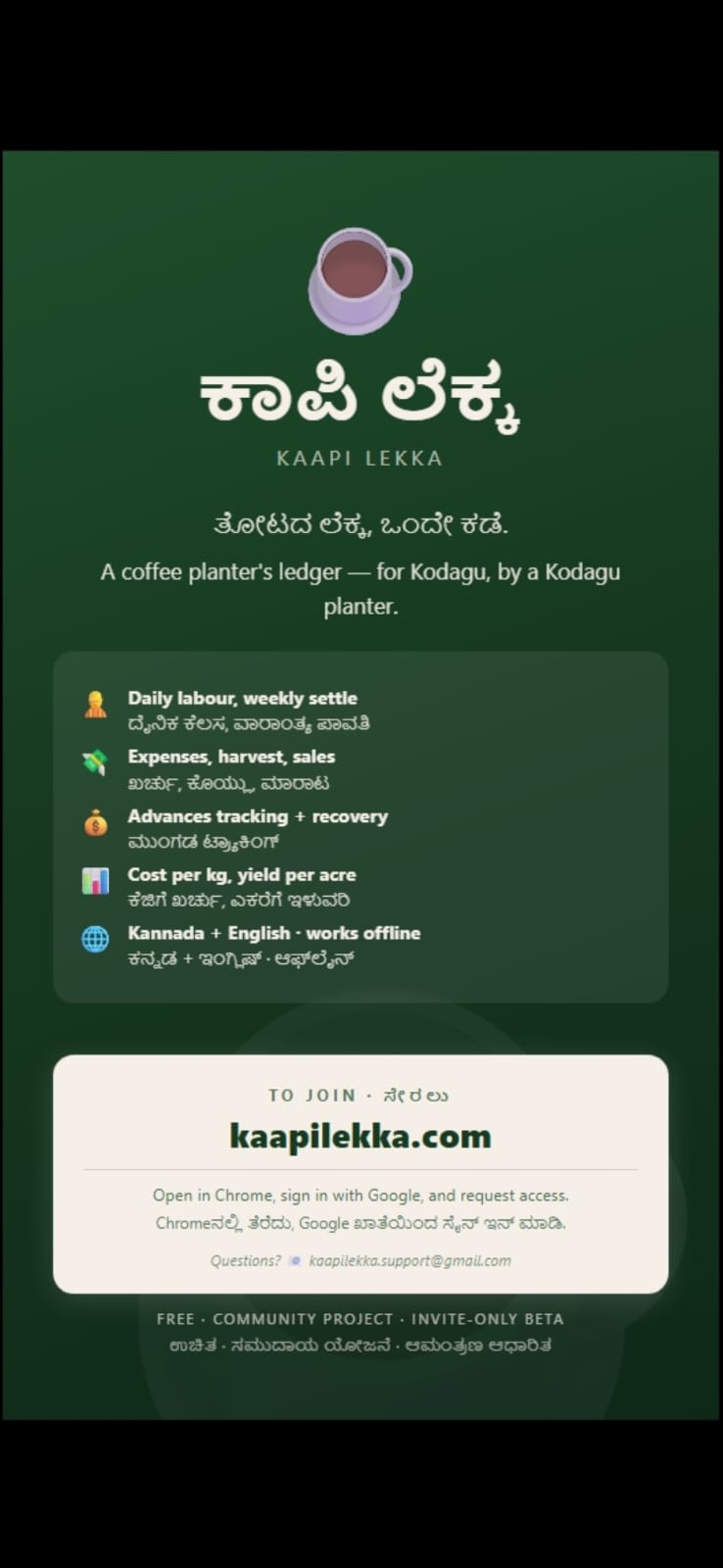
A free digital ledger built for Kodagu coffee planters
In one sentence Kaapi Lekka helps a coffee planter keep labour, advances, expenses, harvest and sales in one private ledger, so the year’s real cost and cost per kilogram become easier to understand.
From one estate ledger to a community tool
Seventeen workers turn up today. Four have advances. One worked a half-day. The brush cutter needs maintenance. Fertilizer must be paid for. Pepper is harvested and coffee goes for curing.
A coffee year advances through hundreds of such entries – each ordinary on its own, but difficult to reconstruct later.
Most planters keep records, but those records are often split between a labour book, diary, spreadsheet, messages and memory.
By the end of the year, one practical question can be surprisingly hard to answer:
what did the year really cost, and what did each kilogram of clean coffee return?
Kaapi Lekka began as a personal estate ledger built to answer that question. It was not conceived as a startup or a commercial accounting package.
The aim was simpler: keep the everyday plantation record in one place and make the running picture of the estate easier to see.
Once the tool proved useful in day-to-day estate work, it was opened to fellow planters as a free community project.
Built around the way an estate actually works
Kaapi Lekka is designed around routine estate decisions rather than formal accounting terminology. It keeps people and payments, estate activity and the running financial picture connected without asking a planter to learn a conventional accounting system.
a. People and payments — daily labour by worker, block and work type; reusable wage rates; receiver grouping; and visible advances and settlements.
b. Estate activity and costs — expenses such as fertilizer, spray and transport, together with harvest and sales recorded as the season progresses.
c. The running picture — a dashboard that brings cost, output, settlements and cost per kilogram together for review.
Especially useful for small and medium planters
Large estates often have established systems, dedicated staff or people assigned to accounts. On a smaller or family-run holding, the planter may be the owner, supervisor, record keeper, buyer and seller at once.
Important information can remain scattered simply because there is no separate person available to organise it.
Kaapi Lekka is intended especially for that situation: discipline without complicated paperwork, and a clearer view of labour, advances, expenses, harvest, sales and profitability while the season is still in progress. It supports the planter’s judgement rather than trying to replace it.
A simpler first-time experience
The current sign-in experience is direct. A new user visits kaapilekka.com, chooses English or Kannada, signs in with a Google account and can start immediately. There is no access request form and no waiting period for manual approval.
A short guided setup then helps the user name the estate, add the first block, optionally add a worker, and optionally record a first activity such as a workday, expense, harvest or sale. The Home screen keeps a simple getting-started checklist so the user can return to unfinished steps later.
Designed for phones, field conditions and local use
Kaapi Lekka works in a web browser on Android phones, iPhones and laptops, and it can be added to a phone’s home screen like an app. The interface is available in English and Kannada. It uses large, direct actions and a guided setup intended to reduce the learning burden for users who do not work with conventional accounting software.
Connectivity on estates is not always reliable. After a successful online sign-in and load, the app can cache work on the device while offline and resume synchronization when connectivity returns. The screen shows whether entries are saved, queued or synchronized so that a planter is not left guessing.
FREE-to-Use & privacy-conscious
Kaapi Lekka is currently offered free of charge as a community project. The Kaapi Lekka Team bears the hosting and maintenance costs and intends to continue doing so in support of the community.
The service has no advertisements, paid tier or sale of planter data. The application uses Google sign-in, Firebase Authentication and Firestore. Security rules separate each signed-in member’s ledger from other members, while the member can use the same Google account across devices.
The current public experience is August 28th, 2026
For more information : contact the Kaapi Lekka Team : email:kaapilekka.support@gmail.com
_____________________________________________
Part 02
An INTERVIEW with the idea and product creator of www.kaapilekka.com – Makeen Khan
” Kaapi Lekka applies the discipline and clarity I learned in large organisations to a very practical problem at home. The aim is not to replace a planter’s judgement, but to make the year’s real costs easier to understand. “ says Makeen

Interview in Q & A format to address specific issues, one-by-one :
1. What specific problem prompted you to build Kaapi Lekka?
The immediate problem was fragmented estate record-keeping. Labour might be in one notebook, advances in another, expenses in messages or bills, and harvest and sales in separate sheets. That makes it difficult to know the estate’s true running cost or cost per kilogram of clean coffee. Kaapi Lekka began as a practical ledger for one estate and was later opened to other Kodagu planters.
2. How did you validate that a digital app was the right solution?
The first validation came from actual use on the creator’s own estate. The test was not whether it looked modern, but whether it reduced reconstruction at the end of the season and made everyday figures easier to retrieve. A phone-based ledger was useful because the phone is already present when labour, payments and field activity are being recorded. The project is still learning from real use; it does not claim a formal market study.
3. Were local growers or cooperatives involved in design and testing?
The product grew from a planter’s own workflow and early informal feedback from a small number of Kodagu planters, rather than from a formal cooperative-led design programme. That feedback reinforced the need for simplicity, local terminology, clear payment handling and a low-friction first-time experience. Wider planter feedback is now important, but we prefer to describe that process honestly rather than overstate the scale of testing.
4. How does the app handle weak connectivity and synchronization?
After a successful online sign-in and load, the app uses local browser storage and Firestore offline persistence to keep entries available when signal drops. Pending changes synchronize when connectivity returns, and the interface shows whether data is saving, queued offline or synchronized. An internet connection is still needed for the initial Google sign-in and first load.
5. How did you address language and accessibility for non-technical users?
The interface currently supports English and Kannada. A new user chooses a language before sign-in and can change it later. The app uses a guided first-time setup, direct action labels, large tap targets, helpful empty screens and an always-available quick-add action. Kodava Takk is not currently supported, so we would not claim that it is.
6. What technology stack keeps the app affordable enough to remain free?
Kaapi Lekka is a lightweight progressive web app built with web technologies and hosted through Firebase. Google sign-in handles authentication, Firestore stores and synchronizes data, and the app can be installed from the browser without an app-store distribution layer. This serverless approach keeps infrastructure and operational complexity low for a small community project.
7. What metrics are you tracking to measure real-world impact on yield or income?
We do not currently claim a measured improvement in yield or income. The first useful indicators are simpler: whether a member completes setup, returns to the ledger, records activity consistently and can use the resulting cost and settlement information. Administrative monitoring is deliberately limited to activation signals rather than private ledger values. Any future impact study should rely on voluntary, consented feedback rather than inspection of members’ financial records.
8. Since the app is free, how will it remain sustainable?
Kaapi Lekka is maintained as a small community project, and its serverless architecture keeps operating costs modest. The Kaapi Lekka Team currently bears the hosting and maintenance costs and intends to continue doing so in support of the community. No paid tier is planned; the intention is for Kaapi Lekka to remain free and ad-free, without selling planter data.
9. How do you protect privacy and prevent commercial exploitation of planter data?
Members sign in with Google, and Firestore security rules separate each member’s ledger from other members. Data synchronizes only for the signed-in account, and users can export a JSON backup of their own records. Kaapi Lekka does not sell planter data or use it for advertising. Support and activation monitoring are designed around account and onboarding information, not the member’s detailed labour, expense, harvest or sales values.
10. Does Kaapi Lekka address white stem borer, monsoon variation or other local crop challenges?
Kaapi Lekka is not an agronomy or pest-diagnosis app. It does not predict weather or prescribe treatment. What it can do is help a planter record the labour, inputs, dates, blocks and costs associated with estate work. For example, spray-related labour can be recorded against a block and the related expense recorded by date and category, creating a clearer history to discuss with a qualified agronomist. Specialist crop advice should continue to come from qualified agronomists and local institutions.
11. Will the app expand to Chikmagalur, Wayanad or crops such as pepper?
The present focus is Kodagu coffee estates. The ledger can already accommodate mixed-estate activity and planter-defined work or expense categories, but the product has not announced a broader regional rollout. Expansion should happen only if the current Kodagu experience remains simple and dependable and if growers elsewhere confirm that the workflow fits their needs.
Important and Beneficial Facts of kaapilekka.com for the Users:
- Kaapi Lekka is a free, ad-free community ledger for Kodagu coffee planters.
- It covers labour, workers, advances, expenses, harvest, sales and cost-per-kilogram reporting.
- The current interface supports English and Kannada.
- New users can sign in with Google and start immediately; there is no request form or approval wait.
- The app can be added to a phone’s home screen and can queue entries during poor connectivity after an initial online sign-in/load.
Important technical ‘Qualifications ‘ to the Users :
- Proven yield or income gains — no formal impact study has yet established this.
- The app can be added to a phone’s home screen and can queue entries during poor connectivity after an initial online sign-in/load.
- Proven yield or income gains — no formal impact study has yet established this.
- Agronomy advice — the app records estate activity but does not diagnose pests or recommend treatment.
- Always works offline — the initial Google sign-in and first load need connectivity; offline work follows a successful online load.
- Gmail-level security — say that the app uses Firebase Authentication, Firestore and per-user security rules instead.
- Formal cooperative validation — describe the present evidence as own-estate use and early informal feedback from a small number of Kodagu planters.
- Website: kaapilekka.com
- Support contact: kaapilekka.support@gmail.com
_____________________________________
Part 03 (Three)
THUMBNAIL BRIEF on Makeen Khan – the Creator, Founder and Project Stewart of App – Kaapi Lekka
(Notes: Here we can show the picture of the App in English or a different app angle)
Makeen’s roots are in Ammathi, Kodagu, where his family has been landholders for generations. After a long international career in technology and digital transformation, he returned to Coorg following his retirement from Coca-Cola and brought that experience back to a practical challenge at home: helping planters understand the true running picture of their estates.
Professional journey
Across more than four decades in technology, Makeen worked on enterprise systems, data and analytics, cloud technology, cybersecurity, automation and large-scale digital transformation. He spent nearly three decades with Coca-Cola and served as Chief Information Officer. His leadership responsibilities extended across the Middle East and South West Asia, bringing together technology, people and business priorities across different countries and cultures.
He is currently Senior Vice President at eBest Mobile, where he contributes to the company’s growth. His professional background is relevant to Kaapi Lekka not because the project is intended to become a large commercial platform, but because it brings disciplined systems thinking to a familiar local problem.
From Ammathi roots to Kaapi Lekka
After returning to Coorg, Makeen saw how estate information could remain divided between labour books, diaries, messages, bills, spreadsheets and memory. Kaapi Lekka began as a personal estate ledger to connect labour, advances, expenses, harvest and sales in one place and make the cost per kilogram easier to understand. Once the approach proved useful in everyday estate work, it was opened to fellow Kodagu planters as a free community project.
Makeen currently bears the hosting and maintenance costs and intends to continue supporting the service for the community. Kaapi Lekka has no advertisements, paid tier or sale of planter data. The public support channel remains Kaapi Lekka Support, allowing the project to be accountable without exposing personal contact information.
At a glance
- Roots: Ammathi, Kodagu; from a family of landholders across generations.
- Career: More than four decades in technology and digital transformation; former Coca-Cola Chief Information Officer.
- Current role: Senior Vice President at eBest Mobile, supporting the company’s growth.
- Community work: Founder and project steward of Kaapi Lekka, built by a Kodagu planter for fellow planters.
Disclaimer :
Editorial use: Name and the biographical facts in this approved profile may be used with agreed coverage. Personal phone, personal email, home or exact estate location, relatives’ identities, and any photograph require separate approval. Coca-Cola and eBest Mobile are biographical references only and do not imply organisational endorsement of Kaapi Lekka.
(Abdul-Aleem is the founder/creator of the News Aggregators www.karnatakafirst.com (also available on Whats Ap) and www.kodagufirst.in amongst others)

