Category Archives: Uncategorized
29 f
29 e
29 c
29 b
28
27
INS Shivalik Model, Submarine, Anti-Aircraft Gun At Madikeri
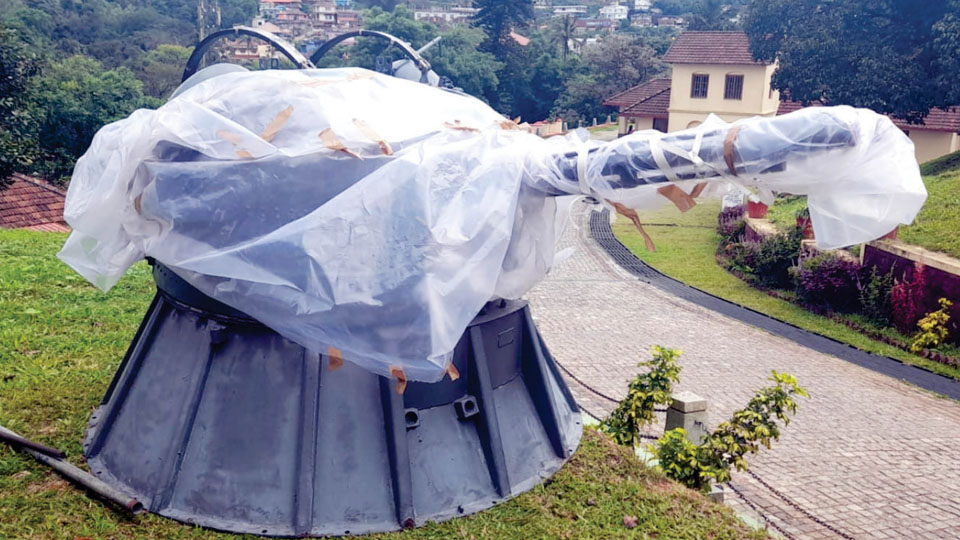
New war machines brought to Sunny Side, General K.S. Thimayya Museum
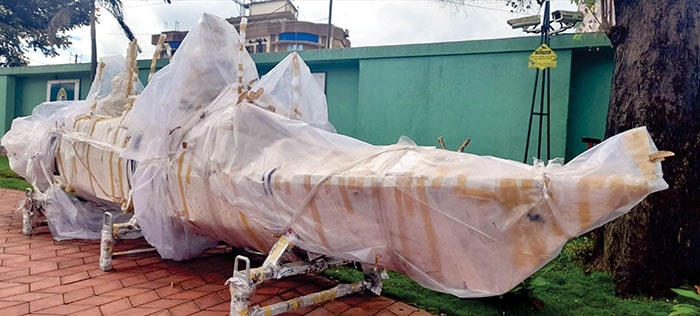
The submarine, INS Shivalik model and the anti-aircraft gun were brought to Madikeri from Visakhapatnam Naval Base in giant many-wheeled trucks and have been placed on the museum campus for a formal handing over and opening.
The formal handing over will take place in Madikeri either in December this year or January 2022. The Flag Officer Commanding-in-Chief, Western Naval Command of the Indian Navy, will arrive in Madikeri and officially hand over the new items to the Deputy Commissioner and they would be open for public display.
Till now, only one ship anchor was on display in the museum and not many of the Indian Navy relics were there. But now with the addition of the INS Shivalik and a submarine being added to the existing attractions, it is a befitting tribute to the celebrated General who is Kodagu’s pride.
About INS Shivalik
INS Shivalik is designed to escape detection by normal radars and surveillance equipment. Special aerodynamics, equipment and material used in designing and building these ships makes it very difficult to monitor their movements. That’s why they are called ‘stealth frigates.’
With INS Shivalik, India made it to the elite club of eight nations that build stealth warships, adding new fire power and muscle to its Navy. Apart from India, only the US, Russia, UK, France, Sweden, Japan, Italy and China have the capability to build stealth warships of this size and class.
The vessel was ordered in 1999 and saw its keel laid down on July 11, 2001 by shipbuilder Mazagon Dock Limited. As a multi-role warship, the INS Shivalik is fielded with a varying group of armament options to contend with aerial, surface and underwater threats.
Rear Admiral’s contribution
Rear Admiral Ichettira Uthappa, who is a relative of Col. (Retd.) Kandrathanda Subbaiah, the President of Field Marshal Cariappa and General Thimayya Forum, had visited Sunny Side four months back and Subbaiah had drawn the attention of the Rear Admiral to the fact that the museum did not have a warship.
Uthappa promised Subbaiah that he will pursue efforts to bring a warship model to the museum and accordingly, the war machines were brought to Madikeri. Rear Admiral Uthappa interacted with Navy authorities and sanctioned INS Shivalik warship model that is 24-ft in length and a submarine which is 8-ft in length.
Even the anti-aircraft gun that was brought to Madikeri from Visakhapatnam had served the Navy for years and the cost of all the latest additions to the museum is estimated to be Rs. 20 lakh.
According to Field Marshal Cariappa and General Thimayya Forum Convener Major (Retd.) Biddanda Nanjappa, Rear Admiral Uthappa bore the transportation costs of shifting the naval items to Madikeri and in the coming days, a suitable place will be made to accommodate these war machines, he added.
source: http://www.starofmysore.com / Star of Mysore / Home> News / December 01st, 2021
Approval Sought To Develop Kodagu Roads In PPP Model
Mysore/Mysuru:
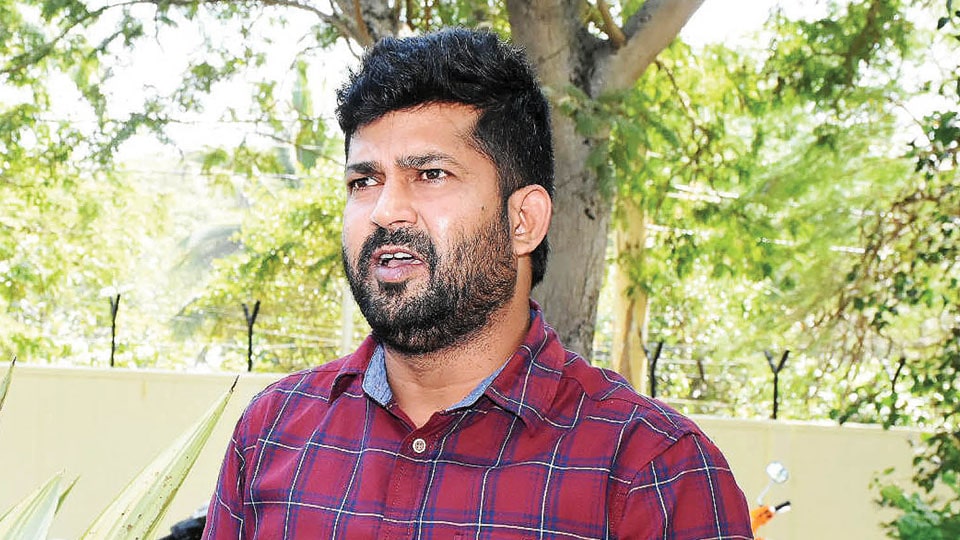
During his meeting with CM Bommai in New Delhi yesterday, MP Pratap Simha has urged for approval to develop certain roads in his constituency (Mysuru-Kodagu) under Public-Private-Partnership (PPP) model with Karnataka Road Development Corporation Limited (KRDCL).
The roads identified to be developed in the PPP model are: Mysuru-Madikeri Road from Yasodharapura near Hunsur on National Highway 275 Junction (Kallbeta), State Highway 90 from Hunsur, Virajpet to Talacauvery, State Highway 91 from Thithimathi, Gonikoppal, Bittangala to Perumbadi, Kandimakki-Makutta road till the Kerala border up to 76 kms and State Highway 89 from Madikeri to Kutta via Siddapura, Pollibetta, Gonikoppal, Ponnampet, Hudikeri, Shettigeri and Srimangala with a total distance of 85 kms.
Reports have been submitted to the State Government by KRDCL Managing Director Rekha after studying the modalities, present situation of the roads and also how the PPP model can be implemented.
The KRDCL has estimated the cost of repairs at Rs. 6.43 crore. The MP drew the CM’s attention to a memorandum submitted by him to PWD Minister C.C. Patil following which the estimate was made. He urged Bommai to allocate funds in the forthcoming Budget.
source: http://www.starofmysore.com / Star of Mysore / Home> News / February 08th, 2022
A Place Apart: English Translation Of Some Kodava Poems
There are two basic forms of writing. One is prose and another verse. Prose is used in speaking and writing, distinct from verse. Prose follows a basic grammatical structure. In verse, poetry, there is compromise on grammar and even use of words and phrases. It is called poetic liberty. It follows a metrical structure.
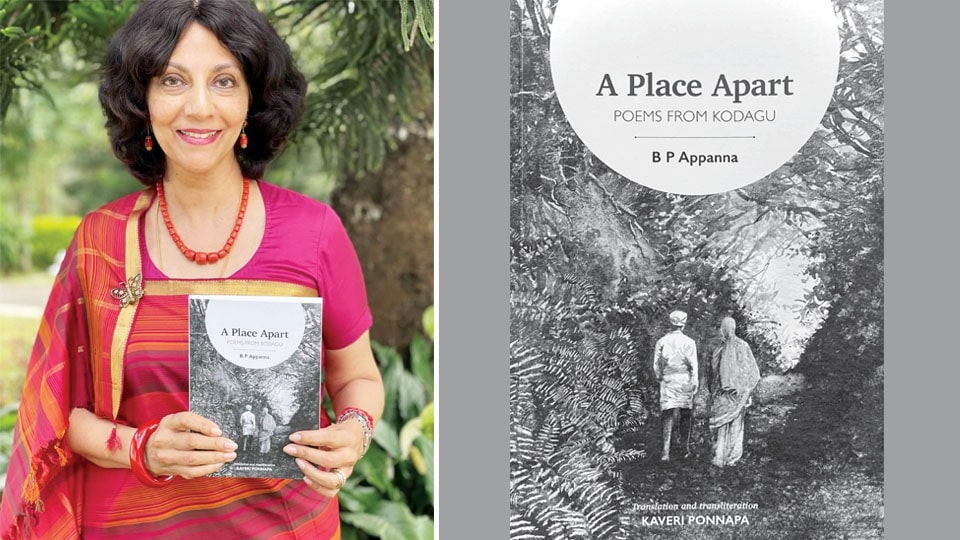
With this, brief, succinct introduction to prose and verse, let me take on a book that landed on my desk for review and critique. The title of the book ‘A Place Apart – Poems From Kodagu,’ is alluring. It is originally written in Kodava language, a dialect, using Kannada script. The author, a junior college lecturer in Kodagu and a Kodava by race.
Much thought and labour seem to have gone into the writing and production of this book which carries both translation from Kodava language (written in Kannada script) into English and a transliteration where Roman script (english alphabets) is used to write the original poem, just as Kannada is used in the first part of the book that contains 21 poems.
The translation and transliteration are by Kaveri Ponnapa, the famous author of the book ‘The Vanishing Kodavas,’ a magnum opus of a pictorial, research-based book on Kodava people, their heritage, culture and a dismal future. She has a Master’s Degree in Social Anthropology from London. Naturally, the book acquires its importance because of the quality of the translation and transliteration that enables the reader to understand the sound and pronunciation of the spoken Kodava language.
She has indeed played the role of James Boswell to Dr. Samuel Johnson, the english lexicographer, so to say. Of course, Boswell made Johnson more famous by writing a masterpiece of a biography of the latter. Let it be. But here, the book of 21 selected Kodava poems written by B.P. Appanna and rendered into english by Kaveri Ponnapa, seems like serendipity for B.P. Appanna in getting a scholar of Kaveri Ponnapa’s stature to select his works for this book in english. For me those poems, described elsewhere as ‘deceptively simple poems’ did not seem to portray, as claimed, ‘the sense of dislocation and erosion of identity’ of Kodava people at all. This was the subject of Kaveri Ponnapa’s book ‘The Vanishing Kodavas.’ Here it is a poetic narration of Kodagu’s natural beauty — the deep verdant valley, the cloud kissing peaks of mountain ranges, dark forests, wildlife — almost like a prose sans soul, emotion, without igniting imagination in the reader.
Even so, this book will surely expose the author and the translator to the world outside Kodagu ignorant of Kodagu and Kodavas, a land and its people with distinctive geography and culture.
Kodava language, the dialect, has its vocabulary limited to that of the hunter-gatherer of the early ages related to agriculture, hunting and skirmishes. Naturally, a Kodava writer or a poet has to express himself using these limited vocabulary only. To overcome this handicap, perforce he has to borrow words from another language, here Kannada. Which is why, for example, in one poem where he should have used the pure Kodava word ‘Batte’ for road, he has used the word ‘Marga’, road in Kannada. May be for the purpose of alliteration in the stanza.
The transliteration section of the book is a testimony to Kaveri Ponnapa’s patience, tenacity and dedication to her work. It is a transliteration of the Kodava poems (written in Kannada script) using Roman, with a Kodava-english key to reading them. It offers an opportunity to those who do not know Kannada but know english to approach the sound and sense of Kodava language.
According to Kaveri Ponnapa, Romanisation like this will offer a practical opportunity to keep the language alive by reaching out to maximum number of speakers. Indeed, very true. As she further avers, “If we are looking at a way to taking endangered languages into the future, we need more speakers (and also readers).”
Here is her final word to those who tried to develop a new script for Kodava language, including the well-known Kodava author I.M. Muthanna. She says: “Languages like Kodava Takk do not need new scripts, they need more accessible scripts that open them up to a greater number of speakers or readers.”
We read in ‘Alice in Wonderland’, ‘What is a book without pictures’ and ‘A picture is worth a thousand words.’ Fortunately, for the reader of this book, there is much consolation and compensation when he sees those water-colour illustrations of people, places and artefacts of Kodagu the land, by artist Rupesh Nanaiah. Wish they were in colour. They speak about the subject of the book more eloquently than all those words.
I also wish Kaveri Ponnapa had chosen for this book some poems from other Kodava poets also.
There are some brilliant poems written by non-Kodavas about Kodagu and Kodavas like Panje Mangesh Rao, for example. A Kodava Sanyasi of Ramakrishna Ashram Swami Shambhavananda, I.M. Muthanna and others too have written about the people, flora and fauna of Kodagu that evoke nostalgia among the old and the diaspora.
Anyway, A Place Apart is a significant contribution to the Kodava community and its literature. The book must adorn every Kodava household and also the libraries of every Kodava Samaja. To purchase the book, contact: Dushyant on WhatsApp 99009-99994 or place your order at: https://www.coorg.com/kaveri.
e-mail: voice@starofmysore.com
source: http://www.starofmysore.com / Star of Mysore / Home> Columns> abracadabra / by K.B. Ganapathy / January 08th, 2022

