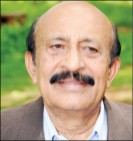
Veteran politician and former Minister M.C. Nanaiah has urged the State Government to honour Kodagu sports person Joshna Chinappa who won gold medal in the Squash Doubles in the CWG-2014.
Speaking to press persons here yesterday, Nanaiah said the Karnataka Olympics Association (KOA) must honour Joshna as she hails from Polibetta in Kodagu, with her grand parents and parents all belonging to this place.
Pointing out that her parents moved to Chennai seeking a career, Nanaiah said that Joshna was born and brought up in Kodagu and she belonged to the State. The squash player was living with her parents in Chennai and it was not correct on the part of the KOA for not honouring her citing that she was a resident of Chennai.
Noting that the KOA honoured Vikas Gowda who is settled in the US and others such as cricketer Azaruddin and tennis player Sania Mirza earlier, Nanaiah wondered why the Association ignored Joshna, who through her feat in the Commonwealth Games (CWG) had brought good name to Karnataka.
Pointing out that the Tamil Nadu and Andhra governments had announced cash rewards ranging from Rs. 20 lakh to Rs. 50 lakh for CWG achievers, the former Minister urged Chief Minister Siddharamaiah and Minister for Youth Services and Sports Abhayachandra Jain to look into the discrimination against the squash players, which has hurt sports lovers across the State and take measures to felicitate and reward Joshna as early as possible.
Referring to the spurt in atrocities and sexual violence against women in the State, Nanaiah observed that the effective implementation of the POCSO Act will go a long way in preventing crimes against women.
Reiterating the need for implementing the POCSO Act to curb sexual abuse of women and children, Nanaiah said that the Government has constituted a 26 member committee, headed by him, to look into effective measures needed for preventing sexual violence and other crimes against women and chilren, including implementation of POCSO Act.
The Committee, which is due to begin work shortly, will deliberate on the laws related to sexual violence and atrocities against women and children and come up with practical measures for tackling such crimes, he added.
source: http://www.starofmysore.com / Star of Mysore / Home> General News / August 09th, 2014
GROUND ZERO
Lessons only a mother can teach
The understanding of our existence is a lifelong quest on a path strewn with flowers and thorns. Urbanisation and materialism have seen many of us lose our moral compass. My mother taught us to stay connected to those around us and Nature even as we travelled far and wide.
Raj Chengappa
My mother went gently into the long night last week. She had lived a full life of 85 years. We had known that the end was near for the past couple of months. She herself had wanted to go ever since she had lost her life’s companion, my father, a decade ago but her spirit and body would not give up. She had prided herself that she had never visited a hospital for treatment and she was determined not to do so in her twilight years. We respected that, and though her last couple of months were tough as her body wilted, she coped with it in the familiar surroundings of her children’s houses.
When I got the call just before midnight from my sister, whom my mother had been staying with in Bangalore, the finality of her passing away hit me. As I prepared to take the flight to Bangalore from Chandigarh, the memories sped by in staccato frames with no particular narrative or continuity. There was a feeling of immense gratitude and love for someone who along with my father had ensured that each of her four children was sufficiently equipped to face life’s struggles and had the freedom to pursue their dreams.
Uppermost among them was the fact that she opted to say alone in Bangalore for five years when my father, who was in the Army, was posted in Kashmir, so that we would get the best of education. All of us were below eight years of age and she would bundle us every day to school, our uniforms starched and ironed and tiffin boxes packed. On our return, a hot snack would be waiting for us. She made sure we had our baths in the evening and prayed before going to bed. It was only when I became a parent I truly appreciated the effort. Her village nestled among the verdant Coorg hills gave her the love for her roots and Nature.
As I got on in life, my mother’s primary question till the very last was, “How is your health — hope you are taking care of yourself?” She rarely asked me questions as to how successful I was in terms of my career, how much money I had saved or what kind of house I was living in. She only wanted to know if I was maintaining my health. The old saying ‘health was wealth’ still held good for her.
Perhaps an equally important lesson she taught us was never to forget our roots or humble beginnings. Though educated in Bangalore and Delhi and having lived in Jammu, Ferozepur (where I was born) Kolkata, Deolali, Hyderabad and Nellore, my mother never ever forgot the village in Kodagu (Coorg) where she lived in the formative years of her life.
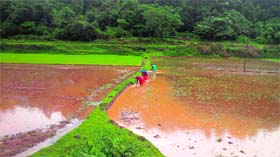
When my maternal grandfather was alive, she ensured that we spent many holidays in her village. To reach her ancestral house we had to walk over 5 km from the bus stop, past hills clad in thick forest, valleys with verdant paddy fields and the swift flowing Cauvery river that originated not far from her village.
It taught us to love nature and understand how most of India lived then and many do even today — no roads, tap water, toilets or electricity. We learnt to wake up to the call of the rooster in the morning, to milk the cows, help plough the fields, call cattle back from the meadows in the evening and read under oil lamps or listen to grandpa’s experiences.
My mother’s last wish was that part of her ashes be strewn in the Cauvery river flowing near her house, a part buried near the house where her parents’ ashes were interred and the remaining buried next to those of my father in the fields in his village some 30 km away.
Heavy monsoon rain lashed Kodagu when we took the urns carrying her mortal remains. We were warned that the river was in spate and the roads leading to her village were inundated. But Mother Nature obliged and the rain abated just enough for us to fulfil her last wish of being forever back among the people and place she loved the most.
Her final journey was a lesson too. The search for our roots and the understanding of our existence is a lifelong quest on a path strewn with flowers and thorns. Rapid urbanisation has seen many of us lose our moorings and moral compass. The pursuit of materialism as an end itself has only made emptiness and disquiet grow.
My mother taught us the importance of staying connected to nature, family, friends and those who worked or lived around you. Never to forget your roots even as your body and mind took you far and wide. So that when the bell tolled, Nature would welcome you with open arms and to limitless warmth, as it did her.
raj@tribuneindia.com
source: http://www.tribuneindia.com / The Tribune Online edition / Sunday, July 27th, 2014
Mysore-Kushalnagar rail line may extend till Madikeri
Mysore :
Mysore-Kodagu Lok Sabha MP Pratap Simha has expressed happiness over the announcement of Mysore-Kushalnagar-Madikeri railway link in yesterday’s railway budget.
Speaking to SOM yesterday, Pratap Simha said the Mysore-Madikeri railway link was a long standing demand of the people of Kodagu. He had promised the railway link during his campaign for the Lok Sabha, which has now been fulfilled with the announcement, he remarked. Pointing out that he had met railway Minister D.V. Sadananda Gowda thrice and PM Narendra Modi for fulfilment of the railway needs of the region, Pratap Simha thanked the Railway Minister for making the announcement.
Asserting that the Railway Minister had promised execution of the Mysore-Madikeri rail link soon after the completion of Kushalnagar-Madikeri stretch survey, the MP said Sadananda Gowda’s wife Dattay Sadananda Gowda too had exerted pressure on her husband for the rail link.
City BJP President Maruti Rao Pawar has expressed delight over the maiden Railway Budget presented by Railway Minister D.V. Sadananda Gowda yesterday.
Addressing a press-meet here yesterday, Pawar said that the BJP as promised is promoting tourism in Mysore region by providing a new Mysore-Kushalnagar train which is bound to boost tourism in Mysore and Kodagu districts.
Stating that the State has got 10 new trains in the budget, the City BJP President said the Railway Minister taking into consideration MP Pratap Simha’s appeal has promised to complete the Mysore-Bangalore track doubling within a year.
source: http://www.starofmysore.com / Star of Mysore / Home> General News / July 09th, 2014
Coffee Board has achieved a breakthrough in its research to combat white stem borer attack, which has become the single largest threat to the survival of arabica coffee cultivation in India.
Management of this devastating pest has been increasingly difficult due to the vagaries of Nature and shortage of skilled work force. It has threatened to bring down arabica crop to 65,000 tonne this year.
Among the various control measures currently available, pheromone technology is the latest one which can be adopted easily. The Central Coffee Research Institute (CCRI) has been working on the refinement of the pheromone technology and had identified the existence of female sex pheromones and some attractants known as kairomones, within the plant itself. Kairomones are the chemicals released by host plants that attract the pests towards them.
Earlier, Coffee Board through a tie up with Bio Control Research Laboratories (BCRL) succeeded on the production of the male pheromone compound. The Board is now providing traps baited with this pheromone at 50% subsidised rates to the coffee growers. The traps help the growers to monitor the borer emergence and assess the spread of the flight season which are crucial to initiate the control measures.
Coffee Board had launched a collaborative research programme with BCRL in 2012 to identify the role of female sex pheromones and kairomones in mating and infestation process.
The studies conducted by BCRL scientists revealed the existence a female sex pheromone compound. A plant volatile from attacked plants, which attracted the stem borer, was also identified.
Preliminary field studies using combinations of these two in traps attracted maximum beetles when compared to the male pheromone alone.
These findings offer scope for improving the pheromone technology, which could form the basis for a breakthrough in eco-friendly stem borer management. Further field trials to arrive at the optimal and cost effective combinations are under way, according to an official statement from Coffee Board.
Source: http://www.articles.economictimes.indiatimes.com / The Economic Times / Home> News> Economy> Agriculture / by ET Bureau / July 08th, 2014
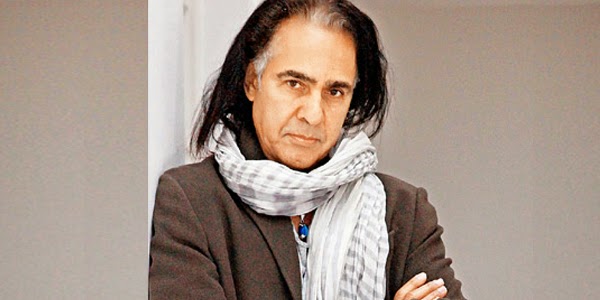
Who can forget the sex siren Zeenat Aman dancing and singing to the sensational disco beats of ‘Aap Jaisa Koi…’ in Feroz Khan’s super hit movie QURBANI in the 80’s. Wanna know who composed this all time hit song? Well the music was composed by Biddu Appaiah, popularly recognized as Biddu, the Indian-born, England based music composer who is regarded as a pioneers of Disco, Euro disco and Indi-pop around the globe.
Winner of the prestigious Gramm Award and ranked 34 in the 50 Greatest Producers Ever list of New Musical Express (NMI), Biddu after five decades of career in music has moved to writing and has penned a fictional novel ‘The Abundance of Nothing’ published by Times Group Books.
Speaking about his switch from music to writing he confessed, “I have been regarded as the king of Pop music but truly speaking producing pop music is purely for the young, just being young at heart does not qualify to compose pop music. Hence I decided to silently shift gears from music to my other passion writing.”
Few know that QURBANI had music by famous Bollywood music director duo Kalyanji Anandji but Feroz Khan happened to hear the disco beats of Biddu in London and was so impressed that he hired him to compose just one song for his movie.
Initially Biddu declined the offer as he was busy in the West but when he found Feroz Khan to be serious and willing to pay an enormous amount he gave in.
In an interview Biddu had said, “I am the first person to introduce disco in India thanks to Feroz Khan. It was his obsession that made me compose the song. Before ‘Aap Jaisa Koi…’ the disco fever was nonexistent in India, however the song became such a craze that after ‘Aap Jaisa Koi…’there was a literal flood of disco songs and no Bollywood movie was released without (at least one) disco song
Like today’s item numbers, disco songs had become a permanent fixture till the late 90’s.”
source: http://www.indiaglitz.com / IndiaGlitz / Home> IndiaGlitz> Bollywood / Tuesday – June 10th, 2014
If Saina and Sindhu performed well, no praise is less for the way Jwala and Ashwini combined to give their best against tougher rivals. By Rakesh Rao.
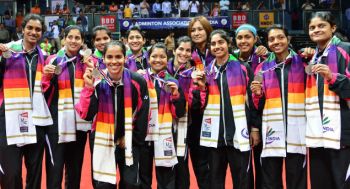
The jubilant Indian women with bronze medals./ Photo: by Sandeep Saxena
In the past four years, women badminton players have brought laurels to the country. Saina Nehwal, P. V. Sindhu and the crack doubles combination of G. Jwala and Ashwini Ponnappa have given India the much-needed identity and a place among the elite nations.
For long, the success story of Indian badminton was associated with the unprecedented achievements of Prakash Padukone and the lone All-England triumph of P. Gopi Chand. Now, there is not much to talk about our men when compared to the feats of our women players. No wonder, when the prestigious Thomas Cup and Uber Cup Finals were hosted by India, only our women’s team was expected to win a medal.
In a format where each tie has five matches — three singles and two doubles — India went in with optimism in two singles and a doubles.
For a nation, that had failed to produce true world-beaters in women’s badminton until 2006, the event was a huge opportunity to showcase India’s worth at the global stage.
With Saina and Sindhu among the world’s elite, having won bronze medals in Olympics and World Championship respectively, India had hoped to make initial headway. With the experienced doubles combination of Jwala-Ashwini looking hungry to make up for the lost time, India was hopeful of claiming the decisive third ‘rubber’ in these best of five match format.
The anticipated, dismal performance of Indian men — losing to Malaysia and Korea in the league — was soon pushed into the background as the women’s team produced a series of consistent performances.
Clubbed with Thailand (headed by World champion Ratchanok Intanon), Hong Kong and Canada, the host gained in confidence by winning every tie.
Saina ended her lean trot to beat Intanon, the Thai girl, who has struggled with fitness and form since winning the World title in August last year.
Saina had not beaten a higher-ranked player since the conquest of World No. 2 German Juliane Schenk in the BWF Superseries Finals in December 2012. Therefore, the 22-20, 21-14 triumph over Intanon was more than just another victory.
Like Saina, Sindhu too won all her five singles. Creditably, the 18-year-old has beaten all three leading Chinese girls — World No. 1 and Olympic champion Li Xuerui, former World champion and World No, 1 Wang Yihan and the reigning Asian Games and All England champion Wang Shixian.
Among Sindhu’s victories, the ones against Indonesia and Japan stood out. The youngster fought match-points in both these matches.
Sindhu bounced back to stop Indonesia’s Bellaetrix Manuputty 21-16, 10-21, 25-23 and returned the following day to overpower Japan’s Sayaka Takahashi 19-21, 21-18, 26-24. In recent times, Sindhu had lost a few three-game encounters. Therefore, these victories should boost Sindhu’s self-belief.
If Saina and Sindhu performed well, no praise is less for the way Jwala and Ashwini combined to give their best against tougher rivals.
Unlike Saina and Sindhu, whose professional needs are taken care of by the Gopi Chand Academy, life is much tougher for Jwala and Ashwini.
Jwala trains under Mohammad Arif in Hyderabad and Ashwini with Tom John in Bangalore. They had to fend for themselves when they had travel to each others’ city for joint training.
Perhaps, these challenges and the adverse times they had faced together in the days leading to the Indian Badminton League (IBL) auction last year, have toughened them. Jwala even fought a legal battle and won a favourable verdict from Delhi High Court against the Badminton Association of India (BAI). So over all, the coming together of these two doubles specialists, who won the National title in December, has helped the country more.
“I think, Ashwini and I are playing better and enjoying our game more than we did before the 2012 Olympics. We will surely improve ahead of the Commonwealth Games, followed by the Asian Games this year,” assures Jwala.
It was against Japan, in the semifinals, that the World No. 36 doubles pair lost its only match to World No. 4 Misaki Matsutomo and Ayaka Takahashi 12-21, 22-20, 21-16. Indeed, it was a gallant performance.
But this loss, after Saina and Sindhu had put India 2-0 up, proved costly. Japan easily won the third singles and the second doubles, where coach Gopi Chand experimented with Saina-Sindhu combination instead of the off-form pair of Pradnya Gadre and Sikki Reddy.
Overall, barring these four players, there is no bench-strength even in women’s badminton as well. India went in with just one plan and lasted as long it worked. All credit to Saina, Sindhu, Jwala and Ashwini for taking India to a historic medal. Will this prove as a catalyst for future medals in team events? Only time will tell.
source: http://www.sportstaronnet.com / Sports Star / Home> Vol.37, No.24 / June 14th, 2014
Shipments for the product stood at Rs 2,347.92 crore in the corresponding period last year
India’s coffee exports increased by 9.32% in value terms at Rs 2,567 crore during the January-May period this year on better realisation in view of firm global prices, according to the Coffee Board.
Coffee shipments from India, the world’s fifth biggest exporter, stood at Rs 2,347.92 crore in the corresponding period last year.
In volume terms, however, the shipments fell marginally to 1,59,275 tonnes in January-May of 2014 from 1,59,295 tonnes in the year-ago period.
“Because of firm global price trend, we got average export realisation of Rs 1,61,160 per tonne. This is 9% higher than Rs 1,47,394 per tonne earned in the year-ago period,” a senior Board official said.
Global coffee prices have risen by more than 80% during the period – after having dipped sharply last year – on expectation of production fall in the world’s largest coffee producer Brazil, the official added.
According the Board’s latest data, the country exported 43,465 tonnes of Arabica coffee and 73,645 tonnes of Robusta coffee during the January-May of this year.
The Arabica shipments rose by 31% from 33,220 tonnes, while Robusta exports dropped by 15% from 86,736 tonnes in the said period.
The shipment of instant coffee rose significantly by 91% to 18,875 tonnes in January-May of this year as against 9,850 tonnes in the year-ago.
Total domestic output is expected to be in line with the Board’s estimate of 3,11,500 tonnes for 2013-14 crop year (October-September), down by 2.1% from 3,18,200 tonnes produced in 2012-13.
India exports coffee largely to Italy, Germany, Belgium, Jordan, Turkey and Russia, among others.
source: http://www.business-standard.com / Business Standard / Home> Markets> Commodities> Food & Edible Oils / Press Trust of India / New Delhi – June 02nd, 2014
Shveta Reddy, a model-turned-actress is all set to enter tinsel town. This newbie has chosen Tamil over Kannada to kick start her career. Shveta is from Coorg and has moved to Bangalore to enter showbiz with Tharkapul directed by Ravi.
“I looked for a good launchpad for myself and I felt Tharkapul was the right choice. I have got an opportunity to play the lead with a known actor in Kollywood, whose name I am not supposed to reveal right now. He is the son of a famous director who does movies in all South Indian languages. I would have got a Kannada film, but it wouldn’t have been a good start for me. So I decided to take up this project.
I hope to get better opportunities here after my first film in Tamil,” she says. A BBM graduate, Shveta made sure she got short-term experience before entering the glam world. She took up theatre, walked the ramp and did advertisements. Her portfolio reached a Tamil director, who chose her for the debut role. “It is a cop film. My portions will start from June, for which I need to be in Chennai,” she says.
source: http://www.newindianexpress.com / The New Indian Express / Home> Entertainment> Kannada / by A Sharadhaa / May 22nd, 2014
Senior scientist and expert on apple cultivation from Himachal Pradesh Dr Chiranjit Parmar expressed confidence that in Karnataka, especially Kodagu, apple cultivation will be successful as the weather here is suitable.
Parmar, who was on a State tour, told reporters here on Monday that efforts are on to grow apples in Tumkur, Bangalore, Uppinanagady in Dakshina Kannada and Somwarpet in Kodagu.
He said Karnataka is better than Himachal Pradesh for apples as the growers here will get the yield twice a year compared to the northern state where it is once a year due to snow.
“Since three years, efforts are on to grow apples in Karnataka and it has been successful as the weather is conducive,” he said.
Parmar tasted the apples grown in Sulimlathe of Abbukatte in Somwarpet in the district.
Apple growers of Kodagu C R Shivakumar and Krishna Shetty of Uppinangady accompanied Parmar during his tour.
source: http://www.newindianexpress.com / The New Indian Express / Home> States> Karnataka / by Express News Service – Madikeri / April 22nd, 2014
Vero Beach artist Robert Ottesen has created the world’s first serigraph using a repeatable printing process and coffee-based ink. What began as a simple artistic statement led to several innovations that allowed an image of the Seattle Space Needle to be printed in a photo-realistic manner.
According to Ottesen, “I just wanted to make a simple artistic statement – by printing with coffee, I wanted to show its importance to our daily lives. I had no idea, when I started the project, how difficult it would be to create a photo-realistic image from coffee pigment alone.”
The print is already attracting attention from experts in the field.
“This is amazing. Rob has pushed the envelope and developed a new and creative print-making technique,” said Frank Romano, RIT Professor Emeritus and President of the Museum of Printing.
In order to print with coffee, Ottesen needed a coffee-based ink. So he turned to Bob Peterson, a consultant with over 30 years of experience in the ink business. Peterson, after numerous attempts, was finally able to get coffee to mix with a special blend of printing oils.
According to Peterson, “When Mr. Ottesen approached me and explained that he wanted to make an ink from coffee, I told him that it couldn’t be done. However, after listening to what he had planned to use the ink for, I decided to take on the challenge. Creating an ink from coffee grounds has never been attempted, to the best of my knowledge. It was extremely difficult to identify an ink varnish that would allow the coffee grounds to blend with the varnish. Additionally, the time and mechanical force required to blend the coffee with the varnish was ten times more than that of a regular ink. The process definitely required “thinking outside the box”!
Interested parties will soon be able to view a copy of this historic print at the Museum of Printing in North Andover, Massachusetts.
source: http://www.digitaljournal.com / Digital Journal / Home> Press Release / PRWEB.com Newswire / Vero Beach, Florida – April 02nd, 2014
WELCOME. If you like what you see "SUBSCRIBE via EMAIL" to receive FREE regular UPDATES.
Read More »