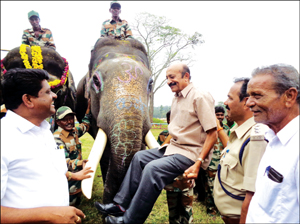
F. M. Khan is taking a walk in his home garden. Picture right shows Dahlia in full bloom.
Madikeri :
Former Rajya Sabha member F. M. Khan is holding the annual flower show at his home garden for the public in Boikeri, near Madikeri, on Jan. 30 and 31.
The garden at Khan’s Balyatrie Estate, with more than 100 varieties of flowers — most of them rare — is spread over more than half-an-acre in front of his house.
Multi-hued roses, dahlia, chrysanthemum, jasmine are in full bloom to welcome the visitors.
Addressing media persons here yesterday, he said floriculture helps in the economic progress of the country and urged the government to support floriculture.
Stating that there is a huge demand for flowers at the international market, he said floriculturists should grow flowers in a natural atmosphere.
With the vagaries of nature, one needs to give special emphasis on protection of plants, he added.
Flowers like Jasmine, anthurium, marigold, salvia, Gerbera, Zenia, Dahlia, Cosmos, croton, colin, Plectranthus, Impatiens, Daisy, Gardenia, sun flower, Hollyhocks, Clarkia, Cockscomb, Lupine, Verbena, Fuchsia, pinks, spider flower, oster flower, calendula flowers, cupia, Gazania, Sweet pea, Cineraria, stock flower, love in a mist flower, devil in the bush and others are on display.
The flower show will be open to visitors from 10 am to 5 pm today and tomorrow.
source: http://www.starofmysore.com / Star of Mysore / Home> General News / January 28th, 2016
After flip-flopping for many months, there is a concrete sign of Karnataka getting its first river museum. On Wednesday, the state government took first baby steps to expedite on its dream project, Cauvery river gallery.
The gallery, expected to be thrown open to the public in six months from now will showcase cultural and socio economic aspects of the river. It will feature exhibits, detailed satellite images, multimedia displays, digital video-shows and real-time experience of cruising along the river which is around 765 km in length.
Originating in the Brahmagiri Hill in Kodagu, the river flows from the western ghats and descends into the eastern ghats in a south-easterly direction covering 320 km in Karnataka and drains itself into the Bay of Bengal. “The proposed gallery would be set up with the support of the National Academy of Sciences of India (NASI).
The government has already earmarked Rs 3.5 crore for the project. NASI would run it for first three years, train local personnel and then hand it over to the state government,” tourism minister R V Deshpande after signing an MOU with NASI on Wednesday said. By capturing the etymological, ecological, cultural, heritage, and social characteristics of the river, the gallery which would be set up in about 2500 sq ft area will also serve as a learning centre on the major south Indian river. The modalities are being worked out by the NASI, he added
Though the proposal was mooted by the Karnataka Knowledge Commission headed by K Kasturirangan, the government failed to find an appropriate place.
Initially, the commission had suggested establishing the gallery on the banks of the river Cauvery at Mysuru on the lines of Ganga Gallery at Allahabad and Brahmaputra Gallery at Guwahati. Later it was planned to establish the gallery in the premises of University of Mysore and also at a century old mansion on Kantharaj Urs Road in Mysuru.
source: http://www.timesofindia.indiatimes.com / The Times of India / News Home> Good Governanace> Karnataka / Manu Aiyappa / TNN / January 07th, 2016
Dr S V Narasimhan, a medical practitioner in Virajpet in Kodagu district, is perhaps better known as a bird enthusiast. An avid bird watcher, he has been carrying out an awareness campaign with focus on conservation for the past three decades.
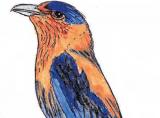
As part of the initiative, every year he sends hand-painted cards to over 1,000 people across the world. The card consists of meticulous painting of a bird or an animal with information about it, and conservation messages.
Here are some sample messages — “ We co-exist, can’t you?” by a tiger and a spotted deer; “It was we who filled the world with melodious music,” by common iora bird.
Narasimhan feels that all creatures are equally important for the survival of life on earth. He chose this signature campaign to motivate people to think about environment and our roles in conserving it. These wildlife message cards are individually handpainted and sent to people across the world, free of cost, during the wildlife week every year. In the last 32 years, he has painted 62,420 cards.
This year alone, he painted 1,930 cards. In the process, he has painted more than 480 species of animals, birds and butterflies. One of his messages said, “Let us join hands to make our earth a greener place to live. This is the only place where all the elements of life can live in health, happiness and harmony.” He has also authored a bilingual book (Kannada and English) on birds called Feathered Jewels of Coorg.
To know more about the campaign, visit www.drsvnarasimhan.blogspot.in.
source: http://www.deccanherald.com / Deccan Herald / Home> Supplements> Spectrum / AP – December 08th, 2015
Most of us think of ways to reconnect with the world — go on adventure trips, explore the offbeat locations of the City and more — but ever considered going barefoot for all your expeditions? As part of the ‘Coorg Reconnect Festival’, the Coorg Wellness Foundation, the Coorg Wildlife Society and the United Sisters Foundation are jointly organising the first barefoot marathon.
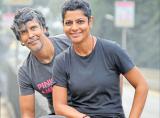
Milind Soman and Nikki Ponappa are the face of the event and are hoping to meet barefoot runners from across the country to share their stories.
“This is going to be the first barefoot marathon in the world, so you can image how excited we are about it. Barefoot running in general is becoming popular around the world and to be able to do it in a beautiful place like Coorg is a plus point,” says Milind.
Much has been spoken and lots has been heard and read. But this time, one can take the time to reconnect with the earth and be their innermost being. With the initiative called ‘Reconnect’, the organisers are inviting people from around the country to participate in the marathon.
“We have been getting a lot of entries from around the country. People from North East, Mumbai, Tamil Nadu and even Delhi have registered. We didn’t think it would generate such a huge response, but we’re thrilled to start the first of many in a grand way,” shares Nikki.
But it’s not just the barefoot running marathon that’s the primary focus. The focus is also on supporting rehabilitation of elephants in Coorg and on afforestation. Milind says, “The whole idea of running barefoot was to feel connected with the world. When we go to holy places, we take off our shoes and that makes sense because we’re trying to be one with the world. There are also many rural communities who walk around without shoes and live in harmony with the environment. So this marathon is symbolic to the that kind of emotion.”
And what’s the one piece of advice the ironman wants to share with the runners? “Have fun. Don’t do anything that you don’t want to do. The most important thing about running a marathon is to train yourself. If you’re running too fast and you can’t talk, you’re doing it wrong. So just have fun and everything else will fall in place,” he says.
But when asked what he thinks will be some of the challenges he might face during this marathon, he laughs and says, “I won’t be running this marathon. But the challenges I have right now is being the organiser. It’s a lot of work getting everything in place and also to make sure that the runners are comfortable during the run.”
However, he runs on a regular basis and does not let anything stop him. “I make sure that I run whenever I can. I don’t set any goals for myself; I run till I have a meeting to attend. Running for me is a way to de-stress and get energised for the day, not exhausted. So I’m always up for a run!”
The marathon will take place on December 5 in Coorg and December 6 in Bengaluru. For more details, log on to www.thebarefootmarathon.com
Springheads, the point where springs emerge, are to be treated carefully so that people using the waters do not cause pollution or damage.
by S. Vishwanath
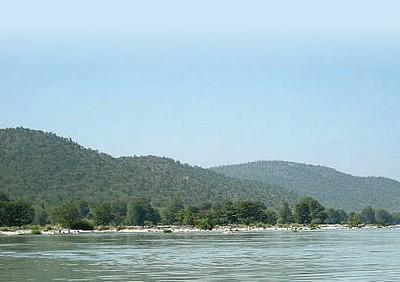
This part of the beautiful Sahyadri or the Western Ghats is lush green, thanks to a long spell of rain. Talacauvery is an hour’s drive from Madikeri in Kodagu district. Here the beautiful river Cauvery rises. On the day celebrated as Sankranti, the waters appear here in a small pool. It then disappears to reappear at Bhagamandala as a stream, meeting the Kannika and the unseen Sujyoti.
What appears in Talacauvery is a spring. On the upper reaches of the hills of the Brahmagiri, rainwater infiltrates and percolates into the ground. Filling up the aquifers, it forms the groundwater in the space.
Groundwater which emerges naturally onto the surface is called a spring. As Himanshu Kulkarni, a leading hydro-geologist, would say, springs are best treated and understood as groundwater.
In India springs have long suffered neglect in terms of research. Though they have been the lifeline for many communities, especially in the hilly regions of the Himalayas, the Western Ghats and the Eastern Ghats, not much effort has been put in to understand and model them better. Dr. Kulkarni points out many typologies for springs. In one particular case he shows how the recharge zone, where the water enters the aquifer, is on the other side of the hill from where the spring emerges.
The traditional watershed approach would fail to recharge the aquifer of this typology of springs because it would be addressing water flows and recharge in the same side of the hill without understanding the nature of the geology at the place. Instead of a ridge to valley approach to manage water, a valley to valley approach would have to be envisaged for such spring management.’ In simple language there is a recharge zone for a spring and the spring itself is in the discharge zone. Understanding, mapping and managing recharge zones is crucial to the health of the springs. For long Indians have trekked to the source of rivers and paid homage to the life-giver. They have in actuality been worshipping springs. It is time that we understood this source of water better and managed them better. That would be water wisdom.
zenrainman@gmail.com
source: http://www.thehindu.com / The Hindu / Home> National> Kerala / by S. Vishwanath / November 28th, 2015
Former Law Minister M.C. Nanaiah enjoying a ‘JUMBO’ ride sitting on the tusk of an elephant at the Aane Utsava held at Dubare Elephant Camp in Kodagu yesterday.
Kushalnagar :
Former Minister M.C. Nanaiah has urged the Government to release Rs. 100 crore for overall development of Kodagu district.
Speaking after inaugurating the 61st wildlife month and elephant day celebrations at Dubare Elephant Camp, near Kushalnagar yesterday, Nanaiah asked the State Government to take Cauvery River cleaning on the lines of Ganga River cleaning taken up by the Prime Minister.
Urging the Government to announce a special package for Kodagu, Nanaiah stressed on the need for initiating appropriate measures for ending man-animal conflict across Malnad region, which has seen an alarming rise over the past few years.
Calling for installation of solar fencing and construction of trenches in order to prevent elephant intrusions into farm lands and human habitats, he urged the Government to move the Supreme Court for taming wild elephants, which are causing havoc across Malnad region.
The former Minister then urged the government work towards conservation of Western Ghats, preservation of forest wealth and water bodies. He also urged the Govt. to regularise the services of Dubare Elephant Camp Mahouts who have been serving for years.
Karnataka Forest Industries Development Corporation Chairman T. Eshwar, in his address, said that the Corporation has sent a proposal to the Government on setting up a mega Bamboo Industry at Kushalnagar at a cost of Rs. 100 crore. Madikeri Division DFO Yedukondalu called upon the involvement of everyone in putting an end to man- elephant conflict.
source: http://www.starofmysore.com / Star of Mysore / Home> General News / Monday – November 16th, 2015
The majestic march of the elephants, spraying of water on anxious tourists, movements in tandem, trumpeting to the command of mahouts to the delight of spectators, playing football, etc. were the major attractions at ‘Aane Utsava’ (Elephant Festival) at the Dubare Elephant Camp on the banks of the River Cauvery near Kushalnagar in Kodagu yesterday.
The festival was organised by Madikeri Wildlife Division in association with Dubare Ammale Grama Aranya Samithi.
A total of 25 elephants participated in various games such as running race, football, basketball, sugarcane eating competition, obeying the commands of mahouts, spraying water on tourists, etc.
Elephants Vikram, Gopi, Cauvery, Harsha and Prashanth, which had participated in Dasara festivities at Mysuru, were decorated with ornaments. Gopi held the Kannada flag high to greet everyone and led the elephants in a march past, which received huge applause from the cheering crowd.
Older elephants were joined by calves in the performance. Elephant calves namely Agasthya, Mythili and Pruthvi also enthralled the crowd with their mischievous performance.
Elephants Gopi, Ranjan, Kapila, Gange and Aiyappa sprayed water to the delight of kids while Aiyappa, Karthik, Parashuram and other elephants walked like newly-weds by holding each other’s trunks.
Tourists and visitors, who had thronged the venue to witness the festival, were seen standing next to the elephants and getting themselves photographed besides taking selfies with them.
Former Minister M.C. Nanaiah, Karnataka State Forest Industries Corporation Chairman T. Eshwar, Madikeri Division DFO Yedukondalu, ACF Poornima, Kushalnagar Zone Forest Officer M.S. Chinnappa and Dubare Elephant Camp Asst. Forest Officer Ranjan were present.
source: http://www.starofmysore.com / Star of Mysore / Home> General News / Monday – November 16th, 2015
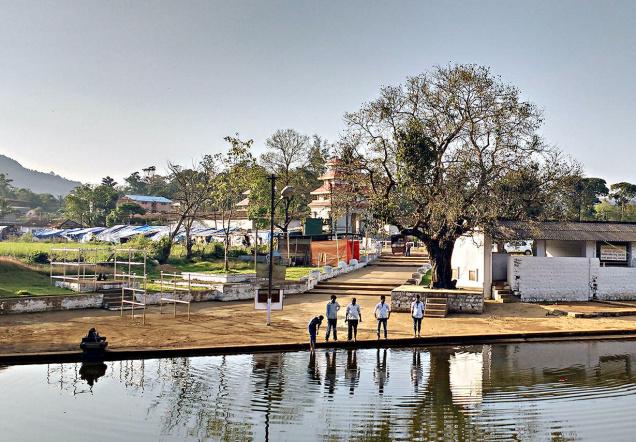
Pure divine bliss is what you feel when you sit on the banks of Honnammana Kere, a holy lake, located in Doddamalthe, six km away from Somwarpet town in Kodagu district. The 16-acre lake, surrounded by beautiful mountains, cliffs and coffee plantations, is perhaps the largest lake in Kodagu district. Two hills, Gavi Betta and Mori Betta, lie near the lake.
There is a temple — dedicated to Goddess Honnamma — adjacent to the lake. The Honnamma Devi Temple has a multicoloured shikhara-style gopura with a flag fluttering high on it. The idol in the sanctum is made of black stone and is well adorned with ornaments. The shilashilpa (temple history) stone is set on the ground in front of Honnamma Devi sanctum. The ancient Temple was renovated some years ago, with the financial help of villagers.
On the occasion of Gowri festival, every year, thousands of devotees, especially newly-weds, visit the Temple and offer prayers to Goddess Honnamma. They also offer bagina (puja items along with flowers and bangles placed in a bamboo sieve) to the lake and pray for good rains. There is another temple on the banks of this lake, dedicated to Lord Shiva as Amrutheshwara. There are two more shrines, dedicated to Basaveshwara and Ganapathi, in this complex.
Adjoining the lake is the 300-feet-high Gavi Betta. A short walk and a climb of about 260 cemented steps brings one to this cave. From the top of the hill, one can enjoy the panoramic view of the lake and its scenic surroundings. Some devotees also undertake a short trek up the close by rocky hill, visit another cave and offer prayers to the holy spring that trickles inside the cave.
Another hill, Mori Betta, is a stiff rocky facade on the other side of the lake. It is said that the Pandavas lived in a cave here during their vanavasa (exile). Cool breeze, fresh air, emerald-coloured lake, green canopy and the rocky edifices attract tourists to Honnammana Kere. The local Gram Panchayat has installed benches along the lakeside.
Picnic by the lake
A trip to the lake can be a fun and enjoyable activity for the entire family, but safety comes first. Locals say that the water level in the lake is very deep and one should be very careful. Tourists are advised to stay within the safety limits around the bathing ghat steps. Though there is good road connectivity as the lake is located close to the Somwarpet-Shanivarsanthe Road, there are no food stalls around the lake. One can carry a picnic basket, spread a sheet on the lakeside and enjoy a good sumptuous picnic lunch here. Ensure that you carry back the litter and drop it in the waste-bin placed at a corner.
Ceremonies like wedding, christening, annadana and pujas are regularly held in the Temple premises. Sitting beside the lake, one can enjoy the sight of water being rippled by the light breeze, and listen to nature’s melody and the occasional reverberation of temple bells. Nothing but pure divine bliss.
source: http://www.deccanherald.com / Deccan Herald / Home> Supplements / by Viswas Menon / DHNS – November 10th, 2015
Dubare Reserve Forest is a great place to ride on elephants | Manjusha Naik
Kodagu, also known as Coorg or Kodava Nadu, is undoubtedly one of the best places I’ve visited. It is Karnataka’s well-known tourist attraction and known for it’s coffee plantations, oranges and various spices. Kodavas are the most dominant community at Kodagu.
Kodava cuisine is famous for its bamboo shoot curry, rice rotti and Kadumbuttu-rice dumplings, usually consumed with Pandi (pork) curry. It is also known for its homemade wines made of grapes, sugarcane, beetel nuts, orange, chikoo and gooseberry. These wines are made out of carefully handpicked fruits and are available at the local stores. Homemade chocolates are quite famous too. Honey and Kachampuli (vinegar) are the favourites of the locals.
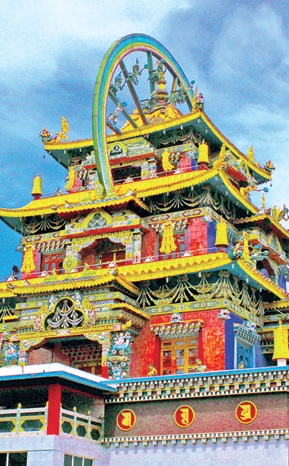
Buddhist shrine at Bylakuppe
I loved visiting the Dubare Reserve Forest and Elephant Camp and running into over 150 elephants. The Buddhist temple and monasteries at Bylakuppe was another delight. I loved photographing the cheerful monks, the multi-coloured Tibetan flags strung across the sky and the detailed murals.
The serenity here evokes within a sense of stirring spirituality and the feeling of being above it all continues when you visit Abbi or Abbey falls, located amid the lush coffee plantations. This place is best visited during monsoon. As I walked across the bridge near the falls for a better view of the scenic beauty, I was mesmerised.
Raja’s seat, located in Madikeri, is known for it’s beautiful view of the valleys that are covered by mists early in the morning. Sunsets here are worth watching too.
I clicked a lot of pictures too at the Nagarhole National Park with the beautiful Kabini lake. There was much to photograph here, including tigers, leopards, wild boar and deer. For a better visual access to the national park, visit it in the summer as during monsoon this place is overgrown by lush forests.
Talacauvery, located in the Brahmagiri hills, is a sacred place where River Kaveri originates. It attracts tourists from all over the world. During the Kaveri Sankramana festival, there are hundreds of people here, trying to collect holy water.
I also visited the Kandi Makki Devastana at the Arji village, Virajpet, in the month of March. A special pooja was held here for about three-and-a-half days for the deities Murthillu, Muthappan, Puakka, Korathi, Potathere and so on. It has been about eight months now since my visit and I am still overwhelmed by the way I felt when I stepped into this sacred place.
Kodagu has a pleasant weather throughout the year. Between June and August, there is heavy rainfall. There are plenty of homestays and resorts. The most recommended ones are The Orange County in Virajpet, Tamara in Yavakapdi village and Amanvana and Honey Pot in Madikeri.
source: http://www.newindianexpress.com / The New Indian Express / Home> Cities> Bengaluru / by Manjusha Naik / October 22nd, 2015
To reduce man-elephant conflict, especially in Kodagu, the Forest Department is keen to acquire land from people and has joined hands with Wildlife Trust of India (WTI) in this regard.
The department wants to acquire about two kilometre of land belonging to the Huvinkadu and Faith coffee estates, which is part of the Kutta-Tiranahalli corridor, which in turn is part of the Nagarahole-Brahmagiri elephant corridor link. “Elephants use this stretch and we want to acquire it to reduce man-animal conflict,” Manoj Kumar, Chief Conservator of Forests, Kodagu, told reporters here on Friday on the sidelines of a workshop on ‘Dealing with leopards and elephants in human-use landscape’ here organised by Wildlife Conservation Society-India Programme (WCSIP).
“Landowners are demanding Rs 20 lakh for an acre. Hence, we have approached the WTI to map the area, ascertain land width and find out if that is necessary because there is another route through Wayanad which is also frequented by elephants,” he said.
To further reduce man-elephant conflict, the Forest Department will soon hold meetings with officials in forest departments of Kerala and Tamil Nadu on how to strengthen the Nilgiri Biosphere Reserve. The 6,000-sq km biosphere reserve presently houses 6,000-odd elephants. The last meeting in this regard was held in December 2014.
“We will hold meetings with the deputy and assistant conservators of forests of the two states to assess ground reality and undertake research. There is a need to know how many elephants can the biosphere hold and for how long. It’s crucial since this is the only habitat left for elephants. That will also help strengthen corridors,” Kumar added.
Prithviraj Fernando, Trustee and Scientist at the Centre for Conservation and Research, Sri Lanka, stressed the importance of ensuring safe habitats for elephants. “Case studies in India, Malaysia and Sri Lanka have shown that elephant relocation has not been very successful. Relocation is temporary and shifts the problem from one area to another,” he said while speaking on human-elephant interaction.
Fernando, who has been working on elephant conservation in Sri Lanka for many years now, said there was a huge population of jumbos in the island nation, and 70 people and 250 elephants died in conflict every year.
Vidya Athreya, Senior Research Fellow at WCSIP, spoke on human-leopard interaction and Ranjeet Jadhav, a journalist at Mid-Day, Mumbai, spoke on ‘Reporting human-leopard interactions in Maharashtra: A case study’.
source: http://www.deccanherald.com / Deccan Herald / Home> City / DHNS, Bengaluru – October 10th, 2015
WELCOME. If you like what you see "SUBSCRIBE via EMAIL" to receive FREE regular UPDATES.
Read More »