
Category Archives: Nature

From berry to brew…

CoffeeKODAGU21sept2014
Coffee was once a closely guarded Arabian secret until Baba Budan, a Sufi mystic, smuggled seven beans from Yemen and scattered them on the hills of Chikmagalur, from where it spread to the rest of India…Anurag Mallick and Priya Ganapathy spill the beans on the story of coffee, the world’s most popular brew.

It was Napoleon Bonaparte who once grandly announced, “I would rather suffer with coffee than be senseless.” Sir James MacKintosh, 18th century philosopher, famously said, “The powers of a man’s mind are directly proportional to the quantity of coffee he drank.” In The Love Song of J Alfred Prufrock, when T S Eliot revealed, “I have measured out my life with coffee spoons,” he hinted at the monotony of socialising and the coffee mania of the 1900s. German musical genius J S Bach composed the ‘Coffee Cantata’ celebrating the delights of coffee at a time when the brew was prohibited for women.

“If I couldn’t, three times a day, be allowed to drink my little cup of coffee, in my anguish I will turn into a shriveled-up roast goat,” cried the female protagonist! French author Honoré de Balzac wrote the essay ‘The Pleasures and Pains of Coffee’ to explain his obsession, before dying of caffeine poisoning at 51. Like Voltaire, he supposedly drank 50 cups a day! So, what was it about coffee that inspired poets, musicians and statesmen alike?

Out of Africa

Long before coffee houses around the world resounded with intellectual debate, business deals and schmoozing, the ancestors of the nomadic Galla warrior tribes of Ethiopia had been gathering ripe coffee berries, grinding them into a pulp, mixing it with animal fat and rolling them into small balls that were stored in leather bags and consumed during war parties as a convenient solution to hunger and exhaustion! Wine merchant and scientific explorer James Bruce wrote in his book Travels to Discover the Source of the Nile that “One of these balls they (the Gallas) claim will support them for a whole day… better than a loaf of bread or a meal of meat, because it cheers their spirits as well as feeds them”. Other African tribes cooked the berries as porridge or drank a wine prepared from the fermented fruit and skin blended in cold water.

Historically, the origins of the coffee bean, though undated, lie in the indigenous trees that once grew wild in the Ethiopian highlands of East Africa. Stories of its invigorating qualities began to waft in the winds of trade towards Egypt, North Africa, the Middle East, Persia and Turkey by the 16th Century. The chronicles of Venetian traveller Gianfrancesco Morosini at the coffee houses of Constantinople in 1585 provided Europeans with one of the foremost written records of coffee drinking. He noted how the people ‘are in the habit of drinking in public in shops and in the streets — a black liquid, boiling as they can stand it, which is extracted from a seed they call Caveè… and is said to have the property of keeping a man awake.’

It was only a matter of time before the exotic flavours of this intoxicating beverage captured the imagination of Europe, prompting colonial powers like the Dutch, French and the British to spread its cultivation in the East Indies and the Americas. Enterprising Dutch traders explored coffee cultivation and trading way back in 1614 and two years later, a coffee plant was smuggled from Mocha to Holland. By 1658, the Dutch commenced coffee cultivation in Ceylon (Sri Lanka). The word ‘coffee’ is apparently derived from qahwah (or kahveh in Turkish), the Arabic term for wine. Both the terms bear uncanny similarity to present day expressions — French café, Italian caffè, English coffee, Dutch koffie or even our very own South Indian kaapi. A few scholars attribute ‘coffee’ to its African origins and the town of Kaffa in Ethiopia, formerly known as Abyssinia. However, the plant owes its name “Coffea Arabica” to Arabia, for it was the Arabs who introduced it to the rest of the world via trade.

As all stories of good brews go, coffee too was discovered by accident. Legends recount how sometime around the 6th or 7th century, Kaldi, an Ethiopian goatherd, observed that his goats became rather spirited and pranced after they chewed on some red berries growing in wild bushes. He tried a few berries and felt a similar euphoria. Excited by its effects, Kaldi clutched a handful of berries and ran to a nearby monastery to share his discovery with a monk. When the monk pooh-poohed its benefits and flung the berries into the fire, an irresistible intense aroma rose from the flames. The roasted beans were quickly salvaged from the embers, powdered and stirred in hot water to yield the first cup of pure coffee! This story finds mention in what is considered to be one of the earliest treatises on coffee, De Saluberrima Cahue seu Café nuncupata Discurscus, written by Antoine Faustus Nairon, a Roman professor of Oriental languages, published in 1671.

Flavours from Arabia

Coffee drinking has also been documented in the Sufi monasteries of Yemen in South Arabia. Arabic manuscripts dating back to the 10th Century mention the use of coffee. Mocha, the main port city of Yemen, was a major marketplace for coffee in the 15th century. Even today, the term ‘mocha’ is synonymous with good coffee. Like tea and cocoa, coffee was a precious commodity that brought in plenty of revenue. Hence, it remained a closely guarded secret in the Arab world. The berries were forbidden to leave the country unless they had been steeped in boiling water or scorched to prevent its germination on other lands.

In 1453, the Ottoman Turks brought coffee to Constantinople, and the world’s first coffee shop Kiva Han opened for business. As its popularity grew, coffee also faced other threats. The psychoactive and intoxicating effects of caffeine lured menfolk to spend hours at public coffee houses drinking the brew and smoking hookahs, which incited the wrath of orthodox imams of Mecca and Cairo. As per sharia law, a ban was imposed on coffee consumption in 1511. The Grand Mufti Mehmet Ebussuud el Imadi was hailed when he issued a fatwa allowing the consumption of coffee, by order of the Ottoman Turkish Sultan Selim I in 1524.

Though subsequent bans were re-imposed and lifted at various points of time according to the whims of religious politics and power, coffee pots managed to stay constantly on the boil in secret, or in the open, for those desirous of its potent influence. Given the fact that Sufi saints advocated its uses in night-time devotions and dervishes and Pope Clement VIII even baptised the bean to ward off the ill-effects of what was regarded by the Vatican as ‘Satan’s drink’ and the ‘Devil’s Mixture of the Islamic Infidels’ till the 1500s, it is easy to see why coffee is nothing short of a religion to some people.

Coffee enters India & beyond

Surprisingly, India’s saga with coffee began in 1670 when a Muslim mystic, Hazrat Dada Hyat Mir Qalandar, popularly known as Baba Budan, smuggled seven beans from Arabia and planted them on a hillock in the Chikmagalur district of Karnataka. The hills were later named Baba Budan Giri in his memory. From here, coffee spread like bushfire across the hilly tracts of South India.

In 1696, Adrian van Ommen, the Commander at Malabar, followed orders from Amsterdam and sent off a shipment of coffee plants from Kannur to the island of Java. The plants did not survive due to an earthquake and flood but the Dutch pursued their dream of growing coffee in the East Indies with another import from Malabar. In 1706, the Dutch succeeded and sent the first samples of Java coffee to Amsterdam’s botanical gardens from where it made further inroads into private conservatories across Europe. Not wishing to be left behind, the French began negotiating with Amsterdam to lay their hands on a coffee tree that could change their fortunes. In 1714, a plant was sent to Louis XIV who gave it promptly to the Jardin des Plantes at Paris for experimentation. The same tree became the propagator of most of the coffees in the French colonies, including those of South America, Central America and Mexico.

The importance of coffee in everyday life can be gauged by the fact that its yield forms the economic mainstay of several countries across the world; its monetary worth among natural commodities beaten only by oil! It was only in 1840 that the British got into coffee cultivation in India and spread it beyond the domain of the Baba Budan hills.

Arabica vs Robusta

Kodagu and Chikmagalur are undoubtedly the best places to know your Arabica from your Robusta and any planter worth his beans will trace coffee’s glorious history with pride. The strain that Baba Budan got was Coffea arabica and because of its arid origins, it thrived on late rainfall. Despite its rich taste and pleasing aroma, the effort required to cultivate it dented its popularity. The high-altitude shrub required a lot of tending, was susceptible to pests, and ripe Arabica cherries tended to fall off and rot. Careful monitoring at regular intervals affected production cost and profitability.

Till 1850, Arabica was the most sought-after coffee bean in the world and the discovery of Robusta in Belgian Congo did little to change that. Robusta (Coffea canephora), recognised as a species of coffee only as recently as 1897, lived up to its name. Its broad leaves handled heavy rainfall much better and the robust plant was more disease-resistant. The cherries required less care as they remained on the tree even after ripening. Its beans had twice the caffeine of Arabica, though less flavour, which was no match for the intense Arabica. It was perceived as so bland that the New York Coffee Exchange banned Robusta trade in 1912, calling it ‘a practically worthless bean’!

But in today’s new market economy, the inexpensive Robusta makes more commercial sense and is favoured for its good blending quality. Chicory, a root extract, was an additive that was introduced during the Great Depression to combat economic crisis that affected coffee. It added more body to the coffee grounds and enhanced the taste of coffee with a dash of bitterness. Though over 30 species of coffee are found in the world, Arabica and Robusta constitute the major chunk of commercial beans in the world. ‘Filter kaapi’ or coffee blended with chicory holds a huge chunk of the Indian market. Plantations started with Arabica, toyed with Liberica, experimented with monkey parchment and even Civet Cat coffee (like the Indonesian Luwak Kopi — the finest berries eaten by the civet cat that acquire a unique flavour after passing through its intestinal tract), but the bulk of India’s coffee is Robusta.

As the coffee beans found their way from the hilly slopes of the Western Ghats to the ports on India’s Western Coast to be shipped to Europe, a strange thing happened. While being transported by sea during the monsoon months, the humidity and winds caused the green coffee beans to ripen to a pale yellow. The beans would swell up and lose the original acidity, resulting in a smooth brew that was milder. This characteristic mellowing was called ‘monsooning’. And thus was born Monsooned Malabar Coffee.

Kodagu, India’s Coffee County

Currently, Coorg is the largest coffee-growing district in India, and contributes 80% of Karnataka’s coffee export. It was Captain Lehardy, first Superintendent of Kodagu, who was responsible for promoting coffee cultivation in Coorg. Jungles were cleared and coffee plantations were started. In 1854, Mr Fowler, the first European planter to set foot in Coorg, started the first estate in Madikeri, followed by Mr Fennel’s Wooligoly Estate near Sunticoppa. The next year, one more estate in Madikeri was set up by Mr Mann. In 1856, Mr Maxwell and Mcpherson followed, with the Balecadoo estate. Soon, 70,000 acres of land had been planted with coffee. A Planters Association came into existence as early as 1863, which even proposed starting a Tonga Dak Company for communication. By 1870, there were 134 British-owned estates in Kodagu.

Braving ghat roads, torrid monsoons, wild elephants, bloodthirsty leeches, hard plantation life and diseases like malaria, many English planters made Coorg their temporary home. Perhaps no account of Coorg can be complete without mentioning Ivor Bull. Along with District Magistrate Dewan Bahadur Ketolira Chengappa, the enterprising English planter helped set up the Indian Coffee Cess Committee in 1920s and enabled all British-run estates to form a private consortium called Consolidated Coffee. In 1936, the Indian Cess Committee aided the creation of the Indian Coffee Board and sparked the birth of the celebrated India Coffee House chain, later run by worker co-operatives. With its liveried staff and old world charm, it spawned a coffee revolution across the subcontinent that has lasted for decades.

Connoisseurs say Coorg’s shade grown coffee has the perfect aroma; others ascribe its unique taste to the climatic conditions and a phenomenon called Blossom Showers, the light rain in April that triggers the flowering of plants. The burst of snowy white coffee blossoms rends the air thick with a sensual jasmine-like fragrance. Soon, they sprout into green berries that turn ruby red and finally dark maroon when fully ripe. This is followed by the coffee-picking season where farm hands pluck the berries, sort them and measure the sacks at the end of the day under the watchful eye of the estate manager.

The berries are dried in the sun till their outer layers wither away; coffee in this form is called ‘native’ or parchment. The red berries are taken to a Pulp House, usually near a water source, where they are pulped. After the curing process, the coffee bean is roasted and ground and eventually makes its journey to its final destination — a steaming cup of bittersweet brew that you hold in your hands.

The ‘kaapi’ trail

In India, coffee cultivation is concentrated around the Western Ghats, which forms the lifeline for this shrub. The districts of Coorg, Chikmagalur and Hassan in Karnataka, the Malabar region of Kerala, and the hill slopes of Nilgiris, Yercaud, Valparai and Kodaikanal in Tamil Nadu account for the bulk of India’s coffee produce. With 3,20,000 MT each year, India is the 6th largest coffee producer in the world.

Recent initiatives to increase coffee consumption in the international and domestic market prompted the Coffee Board, the Bangalore International Airport and tour operator Thomas Cook to come together and organize coffee festivals and unique holiday packages like The Kaapi Trail to showcase premium coffees of South India. Coffee growing regions like Coorg, Chikmagalur, B R Hills, Araku Valley, Nilgiris, Shevaroy Hills, Travancore, Nelliyampathy and Palani Hills are involved in a tourism project that blends leisure, adventure, heritage and plantation life.

At the Coffee Museum in Chikmagalur, visitors can trace the entire lifecycle of coffee from berry to cup. In Coorg and Malnad, besides homestays, go on Coffee Estate holidays with Tata’s Plantation Trails at lovely bungalows like Arabidacool, Woshully and Thaneerhulla…
The perfect cuppa

Making a good cup of filter coffee traditionally involves loading freshly ground coffee in the upper perforated section of a coffee filter. About 2 tbs heaps can serve 6 cups. Hot water is poured over the stemmed disc and the lid is covered and left to stand. The decoction collected through a natural dripping process takes about 45 minutes and gradually releases the coffee oils and soluble coffee compounds. South Indian brews are stronger than the Western drip-style coffee because of the chicory content. Mix 2-3 tbs of decoction with sugar, add hot milk to the whole mixture and blend it by pouring it back and forth between two containers to aerate the brew.

Some places and brands of coffee have etched a name for themselves in the world of coffee for the manner in which coffee is made. The strength of South Indian Filter coffee or kaapi (traditionally served in a tumbler and bowl to cool it down), the purity of Kumbakonam Degree Coffee, the skill of local baristas in preparing Ribbon or Metre coffee by stretching the stream of coffee between two containers without spilling a drop… have all contributed to the evolution of coffee preparation into an art form.

With coffee bars and cafes flooding the market and big names like Starbucks, Costa, Barista, Gloria Jean’s, The Coffee Bean, Tim Horton’s and Café Coffee Day filling the lanes and malls in India along with local coffee joints like Hatti Kaapi jostling for space, it’s hard to escape the tantalising aroma of freshly brewed coffee. And to add more drama to the complexities of coffee, you can choose from a host of speciality coffees from your backyard — Indian Kathlekhan Superior and Mysore Nuggets Extra Bold, or faraway lands — Irish coffee and cappuccino (from the colour of the cloaks of the Capuchin monks in Italy) or Costa Rican Tarrazu, Colombian Supremo, Ethiopian Sidamo and Guatemala Antigua. And you can customise it as espresso, latte, mocha, mochachino, macchiato, decaf… Coffee is just not the same simple thing that the dancing goats of Ethiopia once enjoyed.

source: http://www.deccanherald.com / Deccan Herald / Home> Supplements> Sunday Herald / September 21st, 2014
KSTDC to stard one-day package tours in Kodagu from Sept. 12

Mysore :

With the influx of tourists to Kodagu district and Dasara fast approaching, the Karnataka State Tourism Development Corporation (KSTDC) will commence one-day package tour in Kodagu from Sept. 12. The decision has come after the recent visit of KSTDC Managing Director Dr. P.S. Harsha to Madikeri during which he had promised to introduce one-day package tour to various tourist spots in the district.

During his visit, Dr. Harsha held a meeting with the stake holders and later decided to introduce one-day package tours from Madikeri on Sept. 12. The introduction of package tours is expected to bring down the burden on tourists who often complain about being charged exorbitantly at the tourist locations.

The package tour will be flagged off on Sept. 12 at 8.30 am from Hotel Mayura Valley View in Madikeri by Kodagu Deputy Commissioner Anuraj Tewari. The package tour, which begins from Madikeri, will travel to Bhagamandala, Talacauvery, Rajara Gadduge, Abbi Falls, Raja Seat, Omkareshwara Temple and will return back to Madikeri. Tourists may visit in person Hotel Mayura Valley View (KSTDC), Kodava Samaja Building, near Police Station, for reservations or contact Ph: 08272-228372 or 08272-223333 or Mob: 89706-50028 or 89706-50116 or 93417-93984.

Pick-up Points: Hotel Mayura Valley View, Madikeri, Convent Junction, SBI Junction, KSRTC Junction, Kodava Samaja and Thimmaiah Circle have been identified as pick-up points said V. Paneesh, Asst. Director, Department of Tourism.

source: http://www.starofmysore.com / Star of Mysore / Home> General News / Wednesday -September 10th, 2014

Kodagu Trees Are Source of Data for Researchers

Bangalore :

Three thousand trees in parts of Kodagu are helping forest ecology studies by providing experimental evidence for various research projects.

The trees are being studied to understand how they adapt to changes in rainfall, temperature and duration of the rainy season.

This data is part of a bigger project in which tree responses to changing climates are being measured to gauge how trees react to changing weather parameters.

The trees are on two 30-hectare sample plots set up by the Forest Department in collaboration with the French Institute of Pondicherry (FIP), in low-lying wet evergreen forests in Kadamakkal reserve forest.

“My colleagues and I have found that the amount of rainfall has decreased in the last 100 years and that is why there has been less growth of tree species,” said Dr B R Ramesh, faculty at French Institute of Pondicherry.

The researchers are measuring the girth of the trees using a stainless steel tape and a Vernier scale to record their growth patterns in different climatic conditions.

Their work also focuses on long-term ecological monitoring of forests, the use of new remote-sensing data and techniques to predict biomass and structure, modelling distribution of species and biodiversity and making databases with the available information.

“New research lines are also being developed that explore the effects of landscape change on ecosystem services and potential climate change impacts on forest vegetation,” Dr Ramesh added.

These experts have also explored the environmental and social impact of restitution of tree rights to coffee planters, the Western Ghats acting as a water sink and the loss of forest cover and the extent of biodiversity in the Ghats.

Dr Ramesh and his colleagues, Dr S Prasad and Dr Anupama K, have also developed an app called Biotik which can be used to identify 600 tree species in the Western Ghats.

source: http://www.newindianexpress.com / The New Indian Express / Home> States> Karnataka / by Papiya Bhattacharya / August 19th, 2014

Natural pampering

Coorg

The air smelled green. For someone from the city who is used to the smell of petrol fumes, garbage and fried food, inhaling this crisp, clean air was a real treat.

My drive on the winding roads of Coorg transported me to another world. I put my head out of the car to click away at the Kodava houses lining the roads, quaint churches and local shops. My photo sessions attracted some curious glances from local women. I had officially arrived for my weekend in the coffee district of Karnataka, and my stay at one of the most luxurious resorts in the region was about to begin. As the rains pelted the roof of my cottage at Tamara Coorg, a luxury resort situated in the picturesque confines of lush verdant coffee plantations, I opened my eyes to the breathtaking view, wishing I could wake up to this every day.

The mist kissed the foreheads of the silver oaks and the rosewoods, as I walked to the balcony with a hot mug of bella kapi. I sipped the aromatic yet comforting black coffee laced with cardamom and flavoured with jaggery, while listening to the symphony of cicadas and birdcalls. The fresh taste of coffee resurrected my soul and prepared me for the invigorating plantation walk that my hosts at the resort were kind enough to organise.

After being playfully warned about the leeches by the resort’s guide, I remained skeptical about the trek around the 170-acre Kabbinakad Estate, tucked inside the resort. “Don’t worry, madam, leeches will only suck out the bad blood, and you won’t even feel the pain. You know they are now being used for medical treatments in several parts of the world,” he said. Nevertheless, his scientific explanation failed to comfort me as I tied my shoe laces tight, determined not to have my blood sucked out. ‘Just enjoy the walk, and take in the natural beauty,’ I told myself.

Natural fortress

Built strategically around landscaped waterfalls and glistening streams, the resort is home to some rare species of flora and fauna. As we walked around the plantation, we had the electro-pop background score of gushing falls and cicadas follow us wherever we went. “Hey, but why can’t I smell the coffee?” I asked out of ignorance. “Well, you won’t smell coffee here. But you will see the beans in different stages of growth,” my well-informed guide explained. Arabica and Robusta, the two kinds of coffee plants, are grown at the estate, which is dotted with cardamom plants and pepper vines.

Handing me a bright green pod, the guide said, “Just bite into it and tell me what it is.” As I nibbled on the pod, suspiciously, waiting for some allergic reaction to pop out, a fragrant taste exploded my palate. “It’s cardamom, isn’t it?” I shouted excitedly. Finding my daily food ingredient in its freshest form left me hungry for more. By the end of the walk, I had savoured passion fruit right off a tree, watched in awe at the bitter lime tree pregnant with fresh fruits and beautiful wild mushrooms.

Bird-watchers too have something to look forward to at the resort, as one can find some rare avian species, including Malabar trogons, Nilgiri laughing-thrushes, great black woodpeckers, and Malabar whistling-thrushes (that are a part of the night-time orchestra). Apart from these, yellow-browed bulbuls, Pacific swallows, grasshopper warblers, orphean warblers and yellow-billed babblers can also be spotted.

Coffee kicks

After teasing the touch-me-nots, collecting some rudraksha berries and clicking away at the luscious red ginger flowers and pristine white coffee blossoms, it was time to call it a day. But the coffee lover in me was still to be satiated. And the best was yet to come. The resort definitely knows how to woo coffee addicts, and my experience at The Verandah at Tamara Coorg made me fall in love with the drink that half of the world kick-starts the day with. Right from handpicking the fresh beans, drying them, roasting them, sifting through them and grinding them, coffee-making is nothing short of an art form. And the experience of making my very own brew made me feel like an alchemist. And the secret to pure healthy brew is roasting and grinding your own beans.

A visit to Coorg will be incomplete without sampling the authentic Kodava cuisine that includes the famous pandi curry (pork curry) and koli barthad (chicken fried in spices). But for a vegetarian like me, it was best to tip-toe around the meaty dishes and stick to the green zone — lip-smacking mangye pajji (ripe mango curry), kadambuttus (rice dumplings), kumm curry (mushroom curry), akki rotis, banana fritters and sumptuous payasam.

Coorg is blessed with nature’s bounty. Apart from plantation tours, one can trek to the nearby Manje Motte view point, Pathi Pole Falls and Ballyaatre Ridge. For wildlife and history enthusiasts, this quaint hamlet has a lot to offer in the form of Pushpagiri Wildlife Sanctuary, Nagarhole National Park and Madikeri Fort. As the afternoon sun gave way to the golden light of dusk, dark clouds gradually invaded the sky. The rains pounded the earth with all their might, bringing to life every inch of the green surroundings. The perfect weather to cuddle up and read. Another day had come to an end in the land of the brave Kodava warriors, and I slept fitfully to the lullaby of noisy cicadas.

source: http://www.deccanherald.com / Deccan Herald / Home> Supplements> Sunday Herald travel / by Arundhati Pattabhiraman / August 17th, 2014

Kodagu DC prohibits tourist vehicles on Talacauvery road

Several waterfalls have come alive, attracting scores of tourists

Kodagu
Kodagu

The monsoon may not have reached its peak in the State. But, they have intensified in some places, while disappointing farmers in other places. Showers have been heavy, especially in the coastal and Western Ghats belts of the State.

Kodagu

Deputy Commissioner Anurag Tewari has banned the entry of tourist vehicles on the Bhagamandala-Talacauvery road for 15 to 20 days.

This is a precautionary measures as cracks have developed on the boulders of a hillock on the roadside. On Monday, the deputy commissioner visited the spot where boulders had caved in on the road.

He said as the Talacauvery area is receiving heavy rainfall, there are possibilities of flood. The boulders beside the road have developed cracks. Thus, officials of the PWD and Mines and Geology department had been directed to submit a report on the safety of the road, Tewari said. Only light vehicles will be allowed on the road.

A boat has been arranged to ferry people in Bhagamandala to safer areas. It will be better if tourists do not come to Bhagamandala-Talacauvery during rainy season, Tewari said. In the meantime, rain receded in Madikeri, Bhagamandala, Napoklu, Kushalnagar and Somwarpet. Balele, Nittur and Srimangala received good rainfall.

Two persons suffered injuries when a branch of a tree fell on them at Arameri in Virajpet. Bhagamandala received 13.7 cm rainfall. The water level in Harangi
reservoir stood at 2,841.66 feet. The inflow of water was 8,359 cusecs.

Shimoga

Though several parts of the district continued to receive moderate to heavy rain on Monday, the intensity was less.

The Malnad taluks of Teerthahalli, Sagar, Hosanagar received moderate to heavy rain. In the last 48 hours, Agumbe received the highest rainfall of 283 mm, followed by Yadur (Hosanagar taluk) 240 mm, Hulikal 205 mm, Chakra 227 mm, Savehaklu 190 mm, Teerthahalli 145.2 mm and Sagar 85.4 mm.

Following the heavy rain in Teerthahalli, the Mandagadde bird sanctuary was submerged. The nests of birds were washed away in rain. The mantap near the Korpalaiah convention hall on the banks of River Tunga in Shimoga city was submerged, following the release of water from Tunga dam.

Water levels in various reservoirs across the district witnessed a drastic rise following heavy rainfall in the catchment areas. The level in Linganamakki reservoir rose to 1,754.50 against the maximum level of 1,819 feet. The inflow of water was 38,183 cusecs and the outflow 175 cusecs.

The water level in Bhadra dam rose to 144 feet against the maximum level of 186 feet. The inflow was 24,854 cusecs and the outflow 120 cusecs. The level in Tunga dam rose to 588.21 metres against the maximum level of 588.24 metres. The inflow of water was 68,000 cusecs. As many as 48,000 cusecs of water was released from 19 out of the 22 crest gates.

Dakshina Kannada

Heavy rain that lashed Dakshina Kannada district on Sunday receded on Monday. However, intermittent rain continued to lash the district. The sky remained overcast the whole day.

In the last 24 hours, Bantwal received 135 mm, followed by Belthangady—114.6 mm, Moodbidri—104.2 mm, Sullia—98.2 mm and Puttur—72 mm. The water level has receded in Kumaradhara river.

Three houses were partially damaged when a hillock caved in on them at Shantigudde near Jokatte in Mangalore taluk.

The road leading to Athoor Mahaganapathy temple at Pakshikere in Mulki was inundated, following heavy rain on Sunday night.

Udupi

The district recorded an average of 104.1 mm rainfall in the last 24 hours. Karkala taluk received 134.4 mm, Kundapur taluk 106.6 mm and Udupi 71.3 mm.

Following gusty winds, a house at Nejar in Mooduthonse village of Udupi was damaged. Another house was partially damaged in Karkala taluk. A tree was uprooted on the Hebri-Karkala road, disrupting the movement of vehicles for a few hours. River Sita is in spate.

Chikmagalur

Rain has receded in NR Pura, Chikmagalur, Tarikere and Birur. However, rains continued to lash Kottigehara, Javali, Gonibeedu, Kalasa, Kigga and Sringeri. Kerekatte received the highest of 195.4 mm of rainfall in the last 24 hours.

Belgaum

The Malaprabha, Mahadayi and Pandari rivers are in spate following heavy rains in the Western Ghats region of Khanapur taluk in the district. The Gawwali, Kongala and Pastoli villages of Nerasa Gram Panchayat have been cut off and have formed an island as the Mahadayi river and the Bandora canal are overflowing.

Power supply was disrupted in the Shiroli Gram Panchayat as several trees and electricity poles were uprooted, snapping power lines. Overflowing ponds have hit movement of vehicles on the roads.

source: http://www.deccanherald.com / Deccan Herald / Home> State / Bangalore, DHNS – July 14th, 2014

‘Madikeri to get water from Kundamestri shortly’

The work on a temporary project to supply water from Kundamestri is nearing completion. The water from Kundamestri is likely to be supplied to the citizens of Madikeri by the week end.

Sand bunds have been laid to store water. The collected water will be supplied to Kootuhole through pipes. After filtering the water at a Filter house at Stuart Hill, water will be supplied to the citizens.

Madikeri reels under water crisis every year during summer. The work on Kundamestri project was initiated to mitigate water crisis.

However, owing to delay in release of funds, the work could not be completed. Now the estimated cost of the project has been escalated.

The Kundamestri project is being implemented by Karnataka Water Supply and Sewage Board. It will take another one year to complete the work.

Board Executive Engineer Balachandra has expressed confidence of completing the work. The project has been taken up keeping in mind the development of Madikeri in the next 50 years.

When the water level declines in Kootuhole, water will be supplied from Kundamestri to Kootuhole.

source: http://www.deccanherald.com / Deccan Herald / Home> District / Srikanth Kallammanavar / Madikeri – DHNS, July 26th, 2014

Visitors flock to picturesque spots along the Cauvery

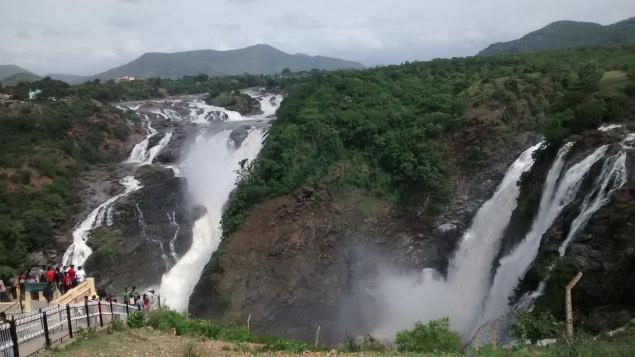
The Gaganachukki waterfalls in Mandya district is one among the tourist spots along the Cauvery that has been attracting visitors every day for the past two weeks / . Photo : Special Arrangement / The Hindu

The outflow from the reservoir was at the rate of just 350 cusecs on July 8. However, it rose to 8,052 cusecs on July 15 as the Irrigation Department began discharging water to Tamil Nadu.

With the Irrigation Department releasing water from the Krishnaraja Sagar (KRS), tourism spots along the Cauvery have been witnessing a steady rise in the number of tourists for the past couple of weeks.

Catchment areas of the Cauvery in Kodagu district and areas upstream of the reservoir received good spells of rainfall in recent days and therefore, the inflow rate into the reservoir has increased significantly. The authorities have increased the outflow from the reservoir, owing to which, these tourism spots now look vibrant and picturesque.

Tourism spots
Visitors are flocking to KRS, Balamuri waterfalls, Ranganathittu Bird Sanctuary, Srirangapatna, Paschima Vahini, Gende Hosahalli Bird Sanctuary, Mahadevapura, Muthathi, Bheemeshwari fishing camp, Shivanasamudra and Gaganachukki waterfalls in the district.

The outflow from the reservoir was at the rate of just 350 cusecs on July 8. However, it rose to 8,052 cusecs on July 15 as the Irrigation Department began discharging water to Tamil Nadu. It continuously increased till Sunday, when it was 11,475 cusecs at 6.30 a.m. The CNNL then reduced the outflow rate to 446 cusecs on Sunday night. It was, however, increased to 3,100 cusecs on Tuesday morning.

At least 20,000 tourists — domestic and foreign nationals — have been visiting these places every day for the past two weeks. Many of them come from Bangalore and other parts of south India to take in the beauty of nature, a senior officer of the Department of Tourism told The Hindu here on Tuesday.

He said that the number of people thronging these tourism spots was expected to increase in the coming days.

Meanwhile, the Mandya police have deployed additional policemen at Muthathi, Gaganachukki and Balamuri, KRS and other places to prevent loss of life and property.

source: http://www.thehindu.com / The Hindu / Home> News> National> Karnataka / by M. T. Shiva Kumar / Mandya – July 23rd, 2014

Shirin in a horror film

Actress Shirin will be seen next in a lead role in a horror film titled Dhigil, directed by Santosh Kodenkeri, an ad filmmaker who is making his feature film debut. Ashok of Pidichirukku fame plays the male lead.

ShirinKF18jul2014

Says Santhosh, “The entire film happens in one night. Shirin plays a TV script writer who is travelling from Chennai to Coorg. She stays in a home stay in Coorg for the night as she wants to surprise her boyfriend, played by Ashok, on his birthday the next morning.
The mysterious happenings that occur during her stay and her ordeal through the night form the plot.” He adds that though there will be a few supernatural ele ments, the film is basically a psychological thriller.

Interestingly, Santhosh is making the film in Kannada as well. “Since the subject is universal, I decided to make this as a bilingual. While Ashok reprises his role, Sayali Bhagat plays the female lead in the Kannada version,” he reveals.

source: http://www.timesofindia.indiatimes.com / The Times of India / Home> Entertainment> Tamil> Movies / M. Suganth, TNN / July 15th, 2014

Madikeri Farmer Eyes Record With 41-ft Cane

Madikeri :

B Hoovaiah is a happy man. A stalk of sugarcane grown by Hoovaiah in Madikeri is all set to enter the Guinness Records as the tallest in the world. The earlier record, set in 2001, was held by Venkatesh Gowda of Kolar.

Hoovaiah, a BSNL tower operator in Convent Junction in Madikeri, has been protecting the cane for three years now. All the required inspections have been completed by expert committees and a team from Guinness is expected to arrive shortly, before an official announcement can be made.

Hoovaiah told Express that an expert team inspected the stalk and measured it at 41.1 feet.

He then formally approached the Guinness authorities, asking them to consider it for a world record.

Later, he received an acknowledgement from Guinness records in-charge, Era Norroy.

Hoovaiah, who served in the Indian Army for 26 years, lives at Bettathoor in Madikeri taluk and has served as a tower operator for 11 years.

He expressed happiness that the cane had been grown organically.

source: http://www.newindianexpress.com / The New Indian Express / home> States> Karnataka / by B C Dinesh / July 10th, 2014

Saving Kodagu

Kodira A Kushalapa writes why there is an urgent and dire need to protect the natural landscape of Kodagu, the “Scotland of India”.

The erstwhile state of Kodagu is now a district in Karnataka with nature and culture, that require immediate efforts to conserve, not only for the present, but also for the future generations to survive.

The district is partly located on the Western Ghats with a portion on the east.

The Western Ghats is considered an ecologically sensitive area and requires careful scientific approach in its development and management, failing which, it will have adverse impacts on the entire southern part of India.

Under Article 48A of the constitution, the government is under an obligation to protect and improve the environment and to safeguard the forests and wildlife of the country.

Under Article 51A(g), likewise, each one of us as citizens, has the obligation to “protect and improve the natural environment including forests, lakes, rivers and wildlife and to have compassion for living creatures.” There are several issues that require careful and urgent handling.

Paddy cultivation
The district, on an average, receives over 2500 mm of rainfall annually and is ideally suited for rain-fed paddy cultivation.
People were cultivating only paddy till the British invasion in 1834 and took up coffee cultivation subsequently.

Now, only 10 to 12 per cent of its total area is under paddy. It is been discovered recently that paddy cultivation is not economical and farmers are diverting their paddy fields for cultivating cash crops or for construction, without any concern and forethought.
This has increased the run-off during the rainy season, resulting in flash floods, damaging the lands by accelerated soil erosion. Paddy cultivation was impounding rainwater for about 100 in paddy fields, allowing slow infiltration enriching the subsoil groundwater.

This would be beneficial to us later, due to slow release of the groundwater, to maintain continuous flow in rivers.

Now the rivers are almost dry during summer, indicating that there is a need for encouraging paddy cultivation all over Kodagu district by introducing incentives, subsidy and support price.

The government should immediately prohibit conversion and use of paddy fields for any other purpose, like it has been done in Kerala and Dakshina Kannada.

Another issue which needs immediate attention is reduction of crop damage by wild animals, which has forced many farmers to abandon paddy cultivation.

Forest conservation

Nearly 31 per cent of the geographical area of Kodagu is under forests managed by the government. Tropical evergreen forests dot this landscape.

Any disturbance to them will make the area barren, like we see around Talacauvery, where the once dense forests have now been reduced to grasslands due to continuous use of wood by pilgrims.

These lands are so degraded with poor nutrient top soils, that reforestation has become a hard task.

The forests have to be protected to facilitate infiltration of rainwater and to prevent accelerated soil erosion.

Natural forests once destroyed cannot be recreated and reforestation can only create plantations.

The various forest and wildlife acts should be strictly implemented and the persons who violate them should be suitably punished.

Relocation

There are a number of cases of encroachment in the forests. Even high forests like Devarakadu and national parks have been encroached upon, where wildlife need relocation and rehabilitation, outside the forests and possibly even out of Kodagu district to drier areas suitable for agriculture.

The Forest Rights Act envisages the issue of khatha to all tribals and others, residing inside forests for 2 to 3 generations, not to continue there only inside the forests, but as an important document to get equal areas outside forests during relocation.

The union government is committed to grant Rs 10 lakh per family during the relocation to bigger and compact blocks.

Fodder development is another important activity to contain wild animals inside government forests. The flowering of bamboos has left only dried clumps and have become hazardous to forest fires.

Grass and other fodder species have been destroyed and invaded by lantana and other weeds as ground flora, preventing natural regeneration of native species.

It is impossible to raise any fodder plants now in government forests unless large blocks or compartments are properly fenced and protected and then planted with tall seedlings of fodder species annually to cover the entire forests.

In addition, profuse aerial seeding of treated bamboo and other miscellaneous seeds should be taken up with the onset of monsoon all over the forests.

The old plantations of teak covering over 7000 ha in Nagarhole National Park and other areas should be harvested and liquidated in a phased manner (with special permission of the Central government) and followed by planting of bamboo seedlings to develop fodder resources to wild animals.

The forest department should give priority for creating barriers along the boundaries of government forests and develop fodder resources for herbivores inside such forests.

Development of tourism

Kodagu has attracted tourists from all over the world, creating irreparable damage to the landscape.

The presence of numerous resorts and homestays all over the district has attracted more tourists resulting in landslides, water scarcity, waste management problems, bad roads, felling of trees for constructing houses, influx of outsiders for business and settlement and high cost of living.

There is no proper guidance and control for activities like registration of homestays and resorts, study of environmental impact assessment and carrying capacity of every activity.

The building and house constructions have been taken up on steep terrains as seen in Madikeri and Virajpet landscapes, making the hills barren.

The riverside areas are all occupied unauthorisedly, polluting river water.

There is a need to control and restrict the tourists coming to Kodagu, by studying the carrying capacity of land involved in every activity and their impact on environment and framing suitable guidelines.

Management of private forests

Nearly 75 per cent of the area in the district is covered by trees.
Coffee estates maintain sufficient shade trees per ha in which silver oak gets precedence due to its faster rate of growth, straightness of bole, multiple use of wood for planks, furniture, peeling, plywood etc and exempted from felling and transit permits and fetches revenue returns in about 30 years.

However, its cultivation should be restricted to allow other indigenous species to maintain biodiversity, to facilitate birds and bees to control pests and increase pollination.

Jamma malai and Jamma bane land holders who have also maintained trees in their land should be given tree rights as an incentive to grow more trees to supplement their income when necessary.

There is, however, a section in the Karnataka Forest Act with a provision to take over the management of private forests by forest department, if the owners violate the provisions of the Act and management principles. This would be binding on the owners to protect the standing trees.

Under the provisions of Karnataka Protection of Trees Act, if a tree is felled, double the number of seedlings should be planted by the owners and this would ensure the sustainability of tree cover.
Therefore the ownership rights of the trees should be with the owners.


Land ownership

Jamma land holder
s have been enjoying the land tenure even before the rule of Lingayat Rajas, who surveyed, documented and levied necessary land tax.

The Bane lands attached to paddy fields called Jamma Bane, in many families, have been converted into coffee and other plantations and by paying necessary tax, are now the property of those families.
The Jamma malai owners have been negotiating with the government to surrender their privileges for a reasonable compensation, which should be accepted as these malais are situated on the ecologically sensitive hill ranges and the composition is similar to natural evergreen forest types.

Compensatory Afforestation Fund Management and Planning Authority (CAMPA) funds could be utilised to pay compensation. Necessary amendments to the KF Act should be introduced to make the families of Jamma holders as the rightful owners of Jamma lands.

However, to safeguard the unique culture of natives of Kodagu, the sale of their Jamma property should be prohibited, except for other Jamma holders only.

High Tension 400 kV line

The proposal to draw a 400 kV line, partly along the reserve forest, private wetlands and coffee estates was met with stiff opposition from local people.

There are several alternate routes available, such as, along the Mysore-Kodagu forest boundary line, or by upgrading the older available 220 kV line or taking through an underground tunnel (not feasible here) without clearing much forest growth.

Amendment 4.4 to the FC Act issued by Ministry of Environment & Forests (MoEF) on January 7, 2013, indicates that for linear projects, alternate routes, if available should be indicated and availed of, so that forest lands are saved.

This linear project should be aligned outside the protected area without any consideration of increased cost and accordingly the MoEF may be appraised to allow the HT line through alternate non-forest areas.

source: http://www.deccanherald.com / Deccan Herald / Home> Supplements> Environment / by Kodira A. Kushalapa / DHNS – July 08th, 2014