Category Archives: Nature

Paddy transplantation begins in Kodagu

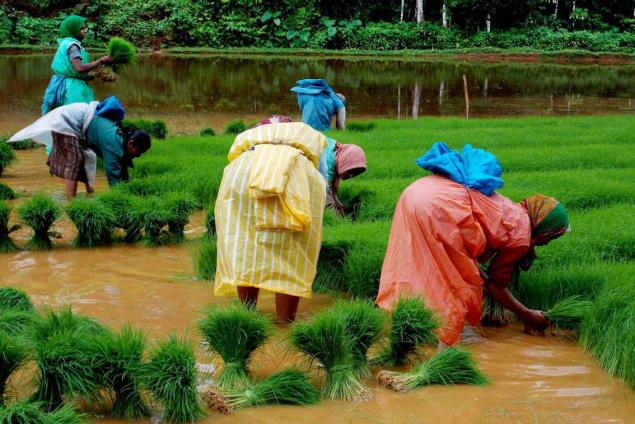
Women readying paddy seedlings at a nursery in Napoklu in Kodagu for transplantation./ The Hindu

Paddy transplantation has begun in the right earnest in Kodagu district, thanks to the copious rainfall which has far exceeded last year’s figures in the corresponding period.

Many farmers are steadfastly continuing the avocation against odds such as expensive labour, high input costs and irrational prices.

Transplantation has started in Napoklu and surrounding areas. Paddy seedlings are ready for plucking in the district and the works are expected to gather momentum in a couple of days, says Deputy Director of Agriculture, Kodagu, Ramakrishna. The target for paddy cultivation was 35,000 hectares of which 1,360 hectares had been covered till date, he told The Hindu.

Farmers in remote villages still depend on agriculture in Kodagu though it is not financially viable for most of them. However, the sheen associated with paddy transplantation where a large group of men and women sang to chorus to mask the tiredness of work cannot be seen any longer.

One would compete with the leader to match his speed of transplantation even if it rained hard. A big column in the middle of the paddy field would be left vacant to facilitate the ‘Nati Vota’, wetland sprint, in which youth would take part with great glee. It used to be the custom in the past. Not many indulge in ‘Nati Vota’ these days. The vacant column used to be covered up with seedlings after the sprint.

According to Monnanda Somaiah, a farmer from Napoklu, expensive labour costs, apart from the shortage of workers, had made many farmers give up agriculture in villages. Many of them had sold off cattle and some had converted fields into housing sites.

Farm mechanisation was a process yet to catch up in the district, though a few progressive farmers had discovered its utilities. Elephant attacks would result in destruction of paddy crops in the district in the recent years.

Fertilizer had replaced cow dung and other leafy manures that were organic, says Subbaiah, another farmer from the same region.

Paddy transplantation would pick up in Virajpet taluk, which had the largest areas in terms of coverage, in a few days as seedlings were ready for plucking, Mr. Ramakrishna said.

Not so long ago, the extent of paddy fields was considered a sign of high social status. Coorg mandarin (orange) cultivation had become popular enhancing one’s social status later onwards.

Coffee holding now symbolises the social status in Kodagu. Paddy crop is seen as goddess Lakshmi as the ‘Puttari’ of ‘Hutri’, the harvest festival for the people of Kodagu, is directly connected with it.

Cutting the paddy sheaves and taking home by chanting ‘Poli poli deva…’ meant appeasing goddess Lakshmi to give them a bountiful crop and abundance. Decrease in the paddy cultivation has robbed the harvest festival of its glory, says, Mr. Somaiah.

Kodagu received 1,602.1 mm of rainfall from January this year till 8 a.m. on July 18. It is more than last year’s figure of 732.89 mm.

Madikeri taluk received 2,372.24 mm, the highest among three taluks, in the same period this year. It was 1,049.2 mm last year. Virajpet taluk received 1,146.61 mm (622.19 mm) while Somwarpet taluk received 1,287.4 mm (527.27 mm).

source: http://www.thehindu.com / The Hindu / Home> News> National> Karnataka / by K. Jeevan Chinnappa / Mysore – July 21st, 2013
Where myth, history and beauty meet

A blend of mythology, history and scenic locales, Madikeri is every traveller’s dream. Nothing like a weekend trip here to rejuvenate your tired soul, writes Swapna Dutta

It is a sluggish, cloudy morning. We are on our way to Madikeri, a place known for its calm, cool, peaceful and pollution free atmosphere. The very word Coorg spells wooded slopes and colourful scenery. Also, coffee and cardamom; black pepper and honey. The landscape is somewhat rugged but the misty mountain ranges that comprise ridge after ridge of lush, green forest reaching out to the bright blue sky is a sight to behold. The road is remarkably smooth and well-maintained and we are hardly aware that we have been climbing up steadily. It is easy to understand why Coorg was one of the places the British chose to settle down and continued to occupy it for over a hundred years; it was their ‘ Scotland of India’.

Madikeri, the charming capital of Coorg district, is located at an elevation of 1,525m above sea level. As we look around, breathing in the refreshing mountain air, we see the red-tiled bungalows that dot the hillside and a bustling market place at the heart of the city. There are acres and acres of tea and coffee plantations, orange groves, and undulating paths — all in all, a breathtaking view. The place also has a distinct old world charm about it.

Madikeri or Mercara, as it was called earlier, was founded in 1681 by Muddu Raja, a prince from the Haleri dynasty. It was originally called Muddurajakeri and was later shortened to Madikeri. Apart from being one of the most picturesque hill stations in South India, it is also the place from where the river Cauvery originates. It is generally believed that Coorg was ruled mainly by chieftains and local princes until the 17th Century. A number of inscriptions and copper plates found in different parts of the state denote that it was under different dynasties at different times; the Gangas, the Haleris, the Kadambas, the Cholas, the Kongalvas, the Changalvas, the Hoysalas and the Nayakatas being the most prominent ones among them.

The main sights of Madikeri town include the charming well-tended park in the heart of the city known as the Raja’s seat. It is said to be the place from where kings watched the setting sun along with their queens. The pavilion offers a gorgeous view of towering hills, green valleys full of paddy fields and forests and the road that looks like a curved ribbon lying way down below.

We next visit the Omkareshwara temple built by Lingarajendra Wodeyar II in 1820. The temple that has a beautiful tank in front is a mixture of Gothic and Islamic architecture. The Madikeri fort, an imposing structure that can be seen from almost the entire town, was originally built as a mud fort by Mudduraja along with a palace in the 17th Century. It was later rebuilt with granite by Tipu Sultan. When the British took over, they added a portico and a clock tower to the building. The fort building now houses a prison, a temple, a chapel, a museum and assorted government offices.

There are a number of tombs and memorials of historical importance in Madikeri. There is the Raja’s tomb which is a beautiful structure. The others comprise the tombs of Lingarajendra built in 1820 by his son, the tomb of a royal priest Rudrappa built in 1834 and the tombs of two brave soldiers who died fighting with Tipu Sultan.

The next day we make our way to the Talacauvery, located 44 km away from Madikeri on the slope of the Brahmagiri hills where the Cauvery originates. It is one of the important sacred places in Karnataka and is always full of pilgrims.

The place is marked by a tirtha kundike or a tank where the river emerges as a perennial spring and flows underground again, emerging a short distance away. From Talacauvery there are steps leading to the peak of the Brahmagiri from where one can get a panoramic view of the whole place.

How to get there

Madikeri does not have an airport; the nearest one is in Mangalore from where one can hire a taxi to get there. KSRTC runs a number of buses to and from Madikeri which are quite comfortable. Depending on where you live, hiring a taxi or going by car is also a good option as it is difficult to find local transport for sightseeing. From Bangal­ore it takes just under six hours to get there.

Stay is not a problem as there are a number of budget hotels, homestays, medium range and luxury hotels as well as resorts. But it is always advisable to book in advance as the place could well be full of tourists and pilgrims just when you plan to visit it.

source: http://www.deccanherald.com / Deccan Herald / Home> Supplements> Spectrum / by Swapna Dutta / July 16th, 2013

Migratory Birds from Nigeria flock to Kodagu

The guests from Nigeria have arrived in Kodagu. Its now their season to enjoy the mother nature, who are found aplenty in plantations, paddy fields and wherever you can see. It does not mean they are newcomers to Kodagu. They arrive here as guests on every monsoon since the past several decades.They will arrive in the future too. Now, you will wonder who these Nigerian guests are. If you want to see them, they are aplenty at Moornadu, Napoklu and Virajpet who fly in flocks between huge trees; they are none other than migratory birds from Nigeria or the locals call them as Bellakki, because they are white like snow.

If you go to see, its customary for the migratory birds to arrive in hilly range of Kodagu at the onset of monsoon, who take refuge from heavy gales and torrential rains. However, there have been a little changes in the recent past. It doesn’t rain like before here owing to which a few bird remain here. Moreover, no sooner monsoon sets in, these Nigerian migratory birds flock here and make nests in huge trees and busy themselves in procreation.

These birds that arrive in Kodagu take shelter in Napoklu, Moornadu and Virajpet. They are merrily made their nest in huge trees in towns and are least concerned of human activities on earth. These birds fly across blue sky, make nest and busy in laying eggs, a scenic sight indeed. If you view these migratory birds high on huge trees, it reminds of falcons of Mandya.

A few migratory birds were cited in the huge trees located at Napoklu.They returned to their bases after hatching and returned with newborn chicks.The number of migratory birds increased since then as the food was found aplenty and none troubled them. The flocks increased over the years and began settling in huge trees not only in Napoklu, but also in Hakattoor, that lies on Moornadu – Madikeri road. These birds shifted to localities of Moornadu, Napoklu and Virajpet as huge trees were felled in Hakattoor.

These migratory birds arrive in flocks during May – June at the onset of monsoon and settle in the huge trees of Napoklu, Moornadu, Virajpet (nearby KSRTC bus stand) in town.

These birds busy themselves in building nest from dry leaves and small bits of wild vegetation that they source from nearby coffee and cardamom estates. The female bird remains in the nest, lays eggs and hatches them, while the male bird brings food for them from fields nearby. The female bird feeds the newborn that shot is a cherished shot for any cameraman.

The birds get aplenty food such as worms, insects etc when the farmer tills the paddy field. The newborn learn to fly and collectively fly all over without bothering to the people and chaos in the city. These birds make their return journey along with the confident chicks to their homelands. They will only return during next monsoon. The city-folks do not bother these migratory birds in procreation that makes them to come back in next season.

source: http://www.newskarnataka.com / Home> Cities / by B M Lavakumar / July 18th, 2013

Discovering the Scotland of India

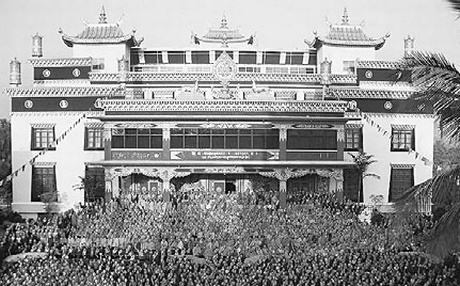
Namdroling Monastery.

Monsoon brings its share of troubles to the binge-traveller. But some of the travel destinations are best visited during the monsoon, one of these is Madikeri, ‘The Scotland Of India’. Among the most beautiful hill-stations in Southern India, Madikeri is a haven for nature lovers and trekkers. It is the capital of Coorg district, Karnataka. Formerly known as Muddurajakeri, Madikeri was named after the prominent Haleri king, Mudduraja who ruled Kodagu from 1633-1687. Poets have often referred to Madikeri as full of mystique on account of its unsurpassable beauty and romantic weather.

Madikeri lies on the Karnataka State Highway 88 that runs from Mysore to Mangalore. From Bangalore, this hill station is at a distance of 252 km. A hub of rich tradition and culture, Madikeri is one place that should be on your ‘must-visit’ list. The main tourist attractions are the Raja’s seat, Madikeri Fort, Omkareshwara temple, Abbey falls, Bhagamandala temple, Nisarga Dhama and Namdroling Buddhist Monastery.

Raja’s seat basically is a garden with a beautiful panoramic view of the Kodagu valley and offers you one of the best views of sunset and sunrise.

Madikeri Fort- A must visit: The famous Madikeri Fort was built by Mudduraja in the last quarter of the 17th century. He also built a palace inside the fort. It was eventually rebuilt in granite by Tipu Sultan who named the site as Jaffarabad. Two life size masonry elephants are located in the north-east corner of the entrance and a church is located in the south-east corner. The uniqueness of the Omkareshwara temple is that it is built according to the Mohammedan architecture and attracts a large number of devotees.

A landmark of sorts: Abbey falls, one of the most beautiful falls in India, is 7-9 kilometres from Madikeri. The falls are inside a coffee plantation. A hanging bridge has now been built across the gorge here offering a good view of the falls. The source of river Cauvery known as Talakaveri is found in Madikeri.

The Tibetan Golden Temple: Namdroling monastery also known as the Tibetan golden temple is a Tibetan Buddhist monastery. This monastery located around 6 kms from Kushalnagar is basically a Tibetan settlement at Bylukuppe and is the second largest Tibetan settlement outside Tibet. There are over 7,000 monks and students living at the monastery. The 40 ft tall golden Buddha statues are the major attractions here.

The walls of the temples are decorated with colourful paintings, depicting gods and demons from Tibetan Buddhist mythology.

The monastery not only attracts large number of young Tibetans seeking enlightenment and education, but also draws tourists from all over the world.

A trekker’s paradise: Madikeri is also a trekker’s paradise. Mountains such as Thadiyandamale, Pushpagiri and Kotebetta offer some of the best trekking experiences.Thadiyandamole is the highest peak here and should not be missed.Igguthappa Kundu, Brahmagiri and Nishanimotte are micro hotspots of bio-diversity in South India and are also amazing places for trekking.

Pork is a delicacy: Madikeri is famous for coffee and pork. It is one of the few places in India where pork is a delicacy.No matter what you do in Madikeri make sure that you pick up a bottle of authentic Coorg honey.

source: http://www.newindianexpress.com / The New Indian Express / Home> Cities> Bangalore / by Sandeep S – Bangalore / July 1th, 2013

Rainfall inches to a record high in Kodagu

Madikeri :

Heavy rain lashed Madikeri town on Saturday evening bringing traffic to a screeching halt in many areas. On the Sri Omkareshwara temple road, several vehicles were submerged. Girish, from Mallikarjunanar, who was in a Maruti Omni with his wife and son were forced to get out of their vehicle and brave the rain when water entered their vehicle. “We had no choice but to get out, as water had entered the car. Even inside the car we were shivering with cold.” he said.

Earlier, the town experienced light showers. But later in the day it was bright and pleasant, until evening.

The Pushpagiri hilly belt in north Kodagu comprising Mutlu, Hammiyala and Kumbaragadige villages received more than 100 inches of rain during rain star Aridra this year. Today, the rain star Punarvasu starts

Aridra rain this year has broken all previous records in these villages. In the last 20 years, Aridra rain record had not crossed 70 inches in these villages. In 1993, it was 51 inches. The heaviest rainfall was recorded in 1994 at 70 inches in these villages between tail-end of June and July first week.

C N Somesh, parpathehegar, in Sri Omkareshara temple, who hails from Mutlu village said that this is the first time that the villages have received such rain.

The averge rainfall in Kodagu so for reached has been 50 inches, 50% more compared to last year’s figure of 25 inches. In Somwarpet taluk it was 39 inches this year while last year it was 19 inches.

Water level in Harangi reservoir has touched 2855.95 out of 2849 feet. The inflow is 11,497 cusec and the outflow is 11,600 cusec.

source: http://www.articles.timesofindia.indiatimes.com / The Times of India / Home> City> Mysore> Kodagu / TNN / July 07th, 2013

‘Extend zoo club activities to more schools’

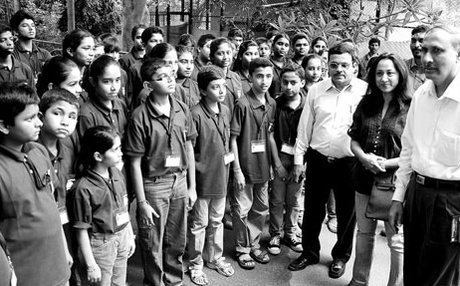
International athlete Ashwini Nachappa, Additional Principal Chief Conservator of Forest IFS Ajai Misra and Zoo directer B P Ravi look on.

International athlete Ashwini Nachappa stressed the need for Sri Chamarajendra Zoological Gardens extending its youth club activities to the schools outside Mysore city.

Addressing students after inaugurating a youth club at the Mysore Zoo Auditorium on Sunday, Ashwini asked the kids to grab the opportunities that come their way.

“People only talk about the death of people due to floods in Uttarakhand. No one is bothered about the loss of endangered species of animals, plants etc,” she regretted.

Additional Principal Chief Conservator of Forests (Wildlife) Ajai Misra asked parents to make their children aware of the need of conserving the environment, especially wildlife.

Pointing out the reasons for man-animal conflict, Misra said: “The population of elephants was one lakh when that of humans was 35 crore in undivided India before 1947. But now when the population of humans has touched 120 crore, the elephant population has reduced to about 25,000.”

But the decrease in the number of elephants has nothing to do with man-animal conflict. Wild animals are blamed for man-animal conflict despite human beings responsible for the same, he said.

He said that environment conservation was a complex issue.

Man is becoming selfish and indifferent by taking up development, he regretted.

source: http://www.newindianexpress.com / The New Indian Express / Home> States> Karnataka / by Express News Service – Mysore / July 08th, 2013

Rainfall abates in Kodagu district, except Madikeri

Rainfall abated further in all other places in Kodagu district except Madikeri on Sunday and the rivers that were in spate receded. The average rainfall in Kodagu district from 8 a.m. on Saturday and 8 a.m. on Sunday was 39.41 mm.

Madikeri city received 123 mm rainfall in the period between 8 a.m. on Saturday and 8 a.m. on Sunday.

Sampaje hobli in Madikeri taluk continued to receive heavy rainfall in the district with 140.8 mm. Bhagamandala hobli recorded 76 mm rainfall followed by Shantalli hobli receiving 51.2 mm rainfall.

HARANGI FULL

The inflow into the Harangi reservoir was at the rate of 11,600 cusecs on Sunday and the outflow was at the rate of 8,050 cusecs.

The water-level in the Harangi reservoir stood at 2,855.40 ft as against the maximum reservoir level of 2,859 ft. The water-level during the corresponding period last year was 2,820.06 ft.

AVERAGE RAINFALL

The average rainfall in Kodagu district from January 2013 till July 7 at 8 a.m. is 1,312.76 mm as against 643.47 mm rainfall during the same period last year.

Madikeri taluk received an average rainfall of 1,951.10 mm from January till July 7 at 8 a.m. It was 894.22 mm in the corresponding period last year.

Madikeri taluk recorded an average rainfall of 91.10 mm in the period between 8 a.m. on Saturday and 8 a.m. on Sunday.

Virajpet taluk recorded an average rainfall of 968.90 mm from January till July 7 as against 551.03 mm in the same period last year. Somwarpet taluk recorded an average rainfall of 1,017.07 mm from January till July 7 as against 485.16 mm rainfall in the corresponding period last year, according to meteorological department sources.

source: http://www.thehindu.com / The Hindu / Home> News> National> Karnataka / by Special Correspondent / Mysore – July 08th, 2013

Harangi reservoir reaches brim, almost

HarangiKF03jul2013
The Harangi reservoir in the taluk is just two feet away from reaching its maximum level. On Monday, the level stood at 2,857.14 feet, against a maximum level of 2,859 feet.

A total of 400 cusecs of water is being released from the dam since morning. The inflow into the reservoir stood at 3,600 cusecs at 8.30 am. The present storage in the reservoir is 7.65 tmc feet against the total capacity of eight tmc feet.

The reservoir had reached its brim in August last year. But this time, the rainy season has begun a month early, facilitating good inflow into the dam. Engineers manning the dam said that the irrigation consultative committee would meet on July 15, after which water would be released to the canals for irrigation. Releasing water to the canals would irrigate 1.37 lakh acres of land.

source: http://www.deccanherald.com / Deccan Herald / Home> State / DHNS – Kushalnagar (Kodagu Dist.) / July 01st, 2013

South west monsoon active once again

Mysore :

Sudden depression in bay of Bengal coupled with intensified south west monsoon has brought cheers on the farmers and water resource officials as the region failed to receive much rain last week. On Monday suddenly the skies opened up and rain started pouring .

Meanwhile, Kodagu district administration has declared holiday for the schools and colleges on Tuesday in the wake of heavy rain being witnessed by the region. Even Mysore district received rain on Monday.

Along with the farmers , the engineers of the water resource department who were worried about the dwindled inflow into the dams are a relived lot with the inflow into all the four dams in the Cauvery delta increasing considerably.

Especially the inflow into KRS dam which slumped down to less than 3500 cusecs after a week of inflow ranging between 10000 and 15000 . This is expected to increase by tomorrow morning following heavy rain in Kodagu district , the core area of the Cauvery catchment . An engineer of the water resource department said the inflow into KRS dam was 3223 cusecs on Monday evening against an outflow of 1195 with the dam’s level standing at 79.96 ft against the maximum height 124.80 ft.

However inflow is anticipated to rise considerably by tomorrow afternoon with the rain lashing the Cauvery catchment area , the engineer added.. According to director state meteorology department Puttanna though the Kodagu is yet to record heavy rainfall, district is expected to receive more rain in the coming days. “Today, the rain is more due to low pressure in bay of Bengal and from tomorrow onwards the monsoon rain will continue to occur” he added .

Last year average rainfall in Kodagu in June was 375.6 mm, but this year it has recorded 498.4 mm rainfall and this has raised hopes of region receiving good rain this year . Even inflow into Kabini dam increased suddenly on Monday evening with inflow reaching 11968 cusecs with the water crossing 2275.50 ft mark against the dam’s maximum height of 2284. A dam engineer told TOI that the inflow may increase and cross 16000 cusecs by Tuesday morning due to reports of Kerala’s Waynad district receiving heavy rain in the last 12 hours. Even the water level in the Harangi dam is slowly inching towards it’s maximum height of 2859 ft with the level on Monday evening standing at 2831 .45 ft . with an inflow of 1095 cusecs . ” Water level in Kabini dam may reach it’s maximum level in next four five days if the inflow continues to remain at 16000 cusecs” the engineer added.

source: http://www.articles.timesofindia.indiatimes.com / The Times of India / Home> City> Mysore / by MB Maramkal, TNN / June 24th, 2013

Rivers in spate in Kodagu, Chikmagalur districts

DC declares holiday for schools, colleges today

The inflow of water into Harangi reservoir has increased following copious rainfall in various parts of the district on Tuesday.

KodaguKF27jun2013Madikeri, Napoklu, Sampaje, Bhagamandala, Virajpet, Srimangala, Shanthalli recorded more than 100 mm rainfall.

The house belonging to M C Changappa was partially damaged in Kunjila village. Another house in Bellur village was also damaged in the rainfall. Cauvery, Lakshmanatheertha, Hemavathi, Harangi, Barapole, Chiklihole rivers are in spate following incessant rainfall in the region.

With rain water flowing on road, the movement of vehicles on Napoklu-Moornadu road has been disrupted. Flood water has inundated road at Bhagamandala. If the region continues to receive rainfall, then road will be cut off from the rest of the world. A minor bridge in Balamuri is inundated in flood water. Water has entered paddy fields in Balamuri.

In the last 24 hours, the district received an average of 91.91 mm rainfall. This includes Madikeri—121 mm, Virajpet—90.15 mm and Somwarpet taluk—64.75 mm.
Rains received in hobli centres are as follows: Madikeri kasaba—100 mm, Napoklu—110.8 mm, Sampaje—132.2 mm, Bhagamandala—150 mm, Virajpet kasaba—127.4 mm, Hudikeri—38.1 mm, Kodlipete—40 mm, Kushalnagar—24.4 mm, and Suntikoppa—62.3 mm rainfall.

Chikmagalur

With heavy rains lashing Mudigere, rain water has entered into fields in Kesavalalu and Uggehalli. If the region continues to get rainfall, then houses will also be inundated.
Paddy saplings kept ready for transplantation in the fields have been inundated at Banakal, Baggasagodu, Horatti, Mugrahalli, Kithlegandi, Bettadamane and Gonibeedu.

Work in the coffee estates have been suspended following heavy rainfall. With rains lashing catchment areas, Bhadra and Somavathi rivers are in spate in Kalasa.

source: http://www.deccanherald.com / Deccan Herald / Home> District / Madikeri – DHNS / June 25th, 2013