The Kodava Koota of North America has instituted a scholarship for the year 2020 to recognise and reward meritorious Kodava students studying in India.
Kodava Koota is a non-profit organisation founded in 2017 by like-minded Kodavas living in North America under the leadership of Gina Konganda, an entrepreneur based out of Dallas, Texas. She constituted a Board of 8 members (Appachu Ballachanda, Phoenix, AZ – Vice-President, Appanna Chottera, New Jersey – Secretary, Avinash Chottangada, Atlanta, GA – Treasurer, Nithan Monnanda, Philadelphia, PA – Kodagu Initiatives, Nalini Kuliyakanda, Goldsboro, NC – Culture and Traditions, Priya Pattada, San Francisco, CA – Membership and Subbaiah Cherumandanda, Los Angeles, CA – Career and Entrepreneurship), who are undertaking several initiatives both in North America and Kodagu.
In the year 2020, Kodava Koota is institutionalising multiple scholarships amounting to $10,000 (about Rs.7.5 lakh) for Kodava students in India. Kodava Koota has allocated $3,000 (about Rs. 2.2 lakh) from its membership fund and one of its members Jyothi and Pavan Pattada have donated $7,000 (about Rs. 5.3 lakh) for this initiative.
The objective of this initiative is to encourage Kodava students and reward them with scholarships as a token of appreciation towards their accomplishments and encourage other students to follow suit.
CATEGORIES: Medicine Studies (2 students pursuing under-graduate or post-graduate); Ph.D (1 pursuing Ph.D in the area of Science, Engineering or Technology); Engineering (2 under-graduate or post-graduates); Dental Sciences (1 under-graduate or post-graduate); Agricultural Science (1 under-graduate or post-graduate) and 2 students pursuing Master’s in Science and Mathematics.
ELIGIBILITY: Kodava students studying anywhere in India are eligible to apply for these scholarships. Awards will be adjudicated by Kodava Koota Board or a Committee constituted by it. The scholarships will be administered through its partners Coorg Education Fund (coorgeducationfund.com).
LAST DATE TO APPLY: Applications should reach Kodava Koota before July 31, 2020. Signature and seal of the educational institution is mandatory on the supporting documents like marks cards and letter of recommendation.
Students who are going to start 1st year of the course in 2020 are eligible to apply but will have to attach documents that confirm admission in addition to Grade 12 (or 2nd PUC marks sheet); First year students of courses like MBBS, BDS, BE where CET/NEET are applicable, applicants should upload a copy of the CET/NEET allotment order.
Fill the application forms and upload the supporting documents via: https://forms.gle/jcxPQDJMBZiNhJrQA
For more details, reach out to: kodavakoota.na@gmail.com or coorgedufund@gmail.com, according to a press release from the Kodava Koota.
source: http://www.starofmysore.com / Star of Mysore / Home> News / June 12th, 2020
I have a confession to make: secretly, I was kinda happy when India went into a total lockdown on March 25. Come on, I was feeling only what your average overworked, stressed out middle-class working woman felt. The disease was bad, but I was happy to take my staycation.
But I was not going to laze through 21 days. I had plans – house cleaning, writing, being the light of my family, getting lighter … all that good stuff.
Day 1: Woke up with a sense of awe. We were witnessing history! Realized that there was no newspaper. Worse, no housemaid. For 21 days. An icy hand clutches my internal organs. A week, I can get by, but three weeks?
Upside: Had a nice long nap in the afternoon. Felt really rested.
Day 2: My mother was absolutely right – housework never ends. No point in slaving, you have to do it all over again … in an hour’s time. New rule: no one allowed to walk on the floor or change clothes. And if anyone wants to eat the rice, sambhar, rasam, veg fry, and curds, they could use their fingers and palms only – no plates allowed.
Upside: Have started watching re-runs of re-runs old shows.
Day 3: A day of realizations.
My neighbor’s baby has colic. My neighbor has a baby. Really? Just exactly, who is this neighbor?
A family that stays at home eats too much. I have to cook often and in large quantities. Ergo, more dishes. Aaarrrrgggh!
Love my family. I just don’t want them around all the time.
Eating healthy when confined to the home – an oxymoron. Also, how long will my stash of snacks hold out
Upside: Discovering the joys of binge-watching.
Day 4: I hate housework. I-HATE-HOUSEWORK. Once this lockdown is over, I’ll burn the house down. Finding it hard to binge-watch Friends and Big Bang Theory while wondering – ‘Who the h**l is doing their dishes and cleaning their apartments when they are at that d***n coffee shop or the Cheesecake Factory?’ This thought sucks the fun out of watching the shows.
Upside: Begun reading a book … more than a page at a time!
Day 5: Going to commit murder. A man in the next building keeps singing off-key and loudly along with his stereo. Hoping his family will do him in themselves. If they can’t, I volunteer.
Hearing about immigrants in cities trying to go home. Terribly sad for them. Okay, I’ll admit – my suffering is small potatoes. By the way, do I have enough potatoes?
Upside: Gave myself the day off. Read a wonderful thriller.
Day 6: Dying of housework. Wiping all the torches, electric lamps and burned out bulbs, even gas stove – but no genie. I now know who I love the most – the maid. If anyone offers to bring my maid back in return for my family … well, I guess that’ll never happen (sob).
Sick of Friends. For just how long did this show run?
Upside: Today, a resident set things up so that we get veggies and milk packets every morning. Yay!
Day 7: Today, my husband went out, as a volunteer for shopping for our apartment complex. I suspect he was just itching to get out of the house. When my hunter-gatherer returned from the mythical land called Outside, I made him give a step-by-step account of the entire half-hour trip. It took 45 minutes. A highlight of today.
Huge Upside: Husband took over the dishwashing duties.
Day mmm-hmm: Missed a few days of journaling. Hell, missed a few days of life – got my dates wrong. I cheered when I found we had a couple fewer days to go of the lockdown. I have gone from being merely grouchy to being depressed as well.
Upside: ?????
Day something or the other: Today, my husband got another chance to escape … needed salt! Bit down hard on a pillow and stay that way to prevent myself from asking him to buy a ton of snacks.
Day sometime-during-week-two: Am all weirded out. Vocabulary stunted as we use only the words Corona Virus, Covid-19, lockdown, self-quarantine, shut up, and how the hell should I know. Still hate housework, but we now have a truce going. I’ll sweep, but the corners have to fend for themselves. If my boss can’t deal with it, she can do the work herself. Oh, wait, I’m the boss. Dang it.
Upside: All of us are healthy. We are all home, we are together. Watching TV footage of all the migrant laborers trying to get home – heartbreaking. Hunger and uncertainty in the camps – scary. And sick people in overflowing hospitals and the deaths … at least we aren’t going through that.
Day end-of-week two: Identified new syndrome – Lockdown-Induced Writer’s Block. Wonder if people will still be interested in the same things post-COVID. Still can’t get over the unreality of the situation. Is this lockdown a waste of time, or the best idea ever?
The mood around town is strange too. Most people are taking it as a time to relax. Some are going out anyway, once or twice a day. There is some seriousness but it’s not all gloom and doom.
Summer is in full swing. The heat is killing. It’s enforcing the lockdown better than the fear of Coronavirus.
Upside: Birds are singing like gangbusters. We’re seeing bulbuls and parrots far more than before.
Week 3 beginning day-(Name starts with M or something like that): Conflicting feelings:
Happy because I’ve Corona eyes – dark circles are completely gone.
Upset, because I’ve Corona hair – shaggy and roots are showing.
Day Wed/Thurs. Week 3: Yay, only one more week to freedom. I am feeling far more upbeat than before.
April 15: India’s lockdown extended until May 3.
Hell, I’m putting all activities on hold as I concentrate on saving my sanity.
Good luck to you too!
Lakshmi Palecanda moved from Montana, USA, to Mysore, India, and inhabits a strange land somewhere in between the two. Having discovered sixteen years ago that writing was a good excuse to get out of doing chores, she still uses it.
source: http://www.indiacurrents.com / India Currents / Home / by Lakshmi Palecanda / May 20th, 2020
Bangalore boy and Indipop pioneer Biddu Appaiah, at 75, continues to groove to the beat of his own drum.
Biddu
A guitar as a present on his 13th birthday set the wheels in motion for the youngster to chase his dream of “making it as a musician in the West”.
Now, all of 75, Bangalore boy Biddu Appaiah, one of the pioneers of disco and Indipop, with millions of records sold worldwide, continues to be counted among the top Indian music producers on the international scene. In fact, he was ranked 34 on British magazine NME’s ‘The 50 Greatest Ever Producers list’.
Today, Biddu can afford to take life easy, dividing his time between homes in London, Spain and India, but his journey to the top was no cakewalk. The pop icon formed a band, The Trojans, at 16 and played at the 3 Aces and small private parties in Bangalore. From then on, there was no looking back. After the group split, Biddu trained his sights on London, the home of rock-n-roll, Beatles and The Rolling Stones. His arduous journey in 1967 on a Haj ship to Mecca and then hitchhiking through the Middle East deserts is now legendary. In London, with just his clothes, his trusty guitar and a dream to make good music, the struggle continued, juggling odd jobs to earn his bread and butter until 1974, when his most recognisable production ‘Kung Fu Fighting’ with Carl Douglas, became a chartbuster.
Towards the late 70s, he collaborated with Tina Charles and soul legend Jimmy James, producing hits such as ‘Dance Little Lady’, ‘I Love to Love’, ‘Now is the time’ and others. All this and the Biddu Orchestra that produced instrumental sensations won him awards, including the Ivor Novello award, the British equivalent of the Grammys.
‘Made in India’
Biddu is also credited with writing the music for two notable movies — The Stud and The Bitch. In 1979, Indian actor-director Feroz Khan got Biddu to compose a track for his movie ‘Qurbani’ and ‘Aap Jaisa Koi’ sung by Pakistani teenager Nazia Hassan happened, again a mega hit of the era. Next, Biddu produced a disco album ‘Disco Deewane’ for HMV featuring Nazia with her brother Zoheb that became the largest selling pop album in Asian history, topping the charts in 14 countries.
In 1987, he scored a top hit in Japan for ‘The Look that Kills’ produced for Japanese singer Akina Nakamori. In the 80s, Biddu pioneered a new genre of Hindi music called Indipop, producing ‘Made in India’ with the velvety-voiced singer Alisha Chinai as well as with Shweta Shetty, Shaan, Sagarika and Sonu Nigam.
As the disco boom began fading in the late 80s and 90s, Biddu donned his writer’s hat, churning out three books. The first, ‘Made in India’, his autobiography published in 2010, an eminently readable book with his characteristic humour and honesty, was a bestseller. Next came ‘Curse of the Godman’ and ‘The Abundance of Nothing’, both set in India.
Interestingly, fans can still look forward to more music from the septuagenarian who is currently composing some new songs.
Excerpts from an interview:
You’ve been there done that. Any dreams yet to be fulfilled?
Career-wise, I am happy. I am going through my catalogue of 583 songs and picking half-a-dozen with a view to sending them to new, young singers of today. I am also working on a few new songs. I won’t produce them, but will get someone younger to do so.
Anything special for your 75th? What does this milestone mean to you?
As I said, I am working on a few new compositions. As for the milestone, at 75 years of age, it is more like a millstone!
What’s life for Biddu these days?
Life today is all about breathing, which is one way of staying alive and spending time with the family.
You left India in your early 20s. Why were you so keen to leave India for the West?
I wanted to make it in the West. India in the 60s was a poor country; we were dancing with Russia instead of rocking with the West. I needed to get out of India as my interest was Western pop music; I was never into Bollywood. I left India and walked all the way to Beirut, singing there for six months until I saved enough moolah to get to England. However, I do come to India to see my sister and relatives. I spend a couple of months in Goa in the winter. But, to be brutally honest, I would never come back to live in India. The politics and corruption would kill me, if not the pollution and the chaotic traffic!
How do you see the music scene in India today?
Frankly, I do not know anything about the Indian music scene. I do know that making music in English has a narrow bandwidth (it always had) and from what people tell me regarding Indian film music, melody has given way to beats and rap. There’s not much noise about Indian music in the West. A R Rahman had a moment and Anoushka (Shankar) is fairly well-known, but only among world music aficionados.
Youtube, TikTok, Spotify, basically Internet has changed the game…
This is the way forward. It is the avenue from where young people get their music. We, of the older generation, may not like it or find downloading Apps too complicated, but this is modern life. You can’t stop the waves from hitting the shore.
Your message to young, budding artists who want to pursue a career in music?
Be prepared for a tough slog. The chances of you not making in the music business is considerably more than you making it. There’s so much talent around, but only a few lucky ones make it. It is a tough game.
Your stint as music director for a few Hollywood films was short. Why?
I prefer making records. Firstly, it’s on the go. It doesn’t take a year or years as the case may be. Also, in films, you are being told what to do by the script, the producer/director etc. When you make pop music, you are directed by your own desires; you are the master of your destiny.
Music has been a big part of your life. What has it taught you?
Music has been great for me. I was inspired by the Beatles and Elvis and I had this fire in the belly to make a name for myself in the West. It is this desire that drove me. Doing something you love is irreplaceable. It has shown me how lucky I am to have followed my dream and succeeded in it. Success is not just about talent, but luck and opportunity, although I believe sometimes you make your own luck.
What kind of music do you listen to?
I was never a voracious listener of music. In fact, it is well-known amongst my friends that I don’t have a music collection. I listen to the radio when driving; that keeps me up on the current trends in music. I am a big fan of Ed Sheeran — great voice and great songs.
source: http://www.deccanherald.com / Deccan Herald / Home> Sunday Herald> Sunday Herald Art & Culture / by Stanley Carvalho / May 31st, 2020
Quantum Physics deals with the behaviour of subatomic particles and is arguably the most complex branch of Theoretical Physics. I do not profess to understand this highly abstract subject but know that classical laws of Physics fail at quantum levels.
It boggles the mind when told that a subatomic particle exists simultaneously at two different spots. One location could be on your table and the other on the surface of Jupiter!
English Physicist Paul Dirac theoretically proved way back in 1930s that fundamental particles known as fermions should have a counterpart somewhere in the universe with an opposite charge – known as anti-particle.
Complicated. Difficult to fathom. I fail to comprehend. Based on this theory it is theoretically possible to have ‘teleportation’ that are portrayed in science fiction movies and books.
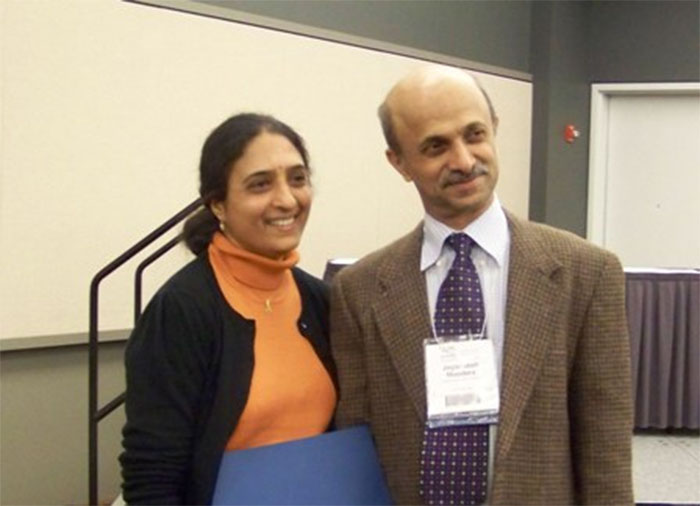
Coorg-born Physicist Dr. Jagadeesh S. Moodera has been a scientist at Massachusetts Institute of Technology (MIT) since 1981. He has several path-breaking research papers to his credit. My wife and I had the good fortune of a guided tour of his laboratory at MIT during our visit to Boston to attend the Kodava Convention-2019, in September last year.
Dr. Jagadeesh explained the intricacies of the experiments that he and his team were involved in. It was fascinating to see a huge setup with myriad tubes, probes, cables and instruments in order to create a 100% vacuum in a space of about 2 cubic centimetres.
Part of the experiment was conducted in this small space which was absolutely contamination free. There was another setup equally complicated where a space was created for the experiment which was free of any kind of vibration – not even that created by the traffic in the streets distance away, or footsteps of students in the nearby corridors. In addition, this space is cooled to -273 degree centigrade (that’s as close as one could get to -273.15 degree centigrade which is absolute zero). The experiments were conducted under these ideal conditions and usually between 10 pm and 6 am when chances of vibration were the least.
The experiment Dr. Jagadeesh and his colleagues have been working on since 2012 was to discover what Italian Theoretical Physicist Eltore Majorana, extending on Paul Dirac’s theory, had postulated in 1937 that there should be some subatomic particles that are indistinguishable from their anti-particle.
Scientists have been looking for these particles named Majorana fermions. Many theories have emerged over the years. Theoretical Physicists at MIT and elsewhere predicted that Majorana fermions may exist on solids such as gold under certain conditions. Dr. Jagadeesh and his team were on a mission to discover the existence of the elusive Majorana fermion.
The experiment, extremely complicated, needed many long hours in the laboratory. Dr. Jagadeesh explained how the delicate research was carried out at nano-particle level and observed through Scanning Tunneling Microscope (STM). STM is capable of ‘feeling’ the presence of atoms and molecules. 3mm x 3mm was the size of the surface on which the experiment was carried out, consisting of nano-wires of gold, grown on superconducting material: Vanadium.
MIT News dated 10th April 2020 has announced the successful sighting of the mysterious Majorana fermion by Dr. Jagadeesh Moodera and team. This is a major breakthrough. In Dr. Jagadeesh’s words ‘We have shown they are there, and stable, and easily scalable.’ Please visit webpage: http://news.mit.edu/2020/first-majorana-fermion-metal-quantum-computing-0410
The finding that Majorana fermions are scalable and could be made into qubits (individual computational units) is spectacular. These qubits could be used to build the most powerful and error free quantum computers. This will be a step closer to the phenomenon known as Singularity, which predicts that by the year 2042 AD there will be computers that will have computing power of all the human brains put together!
Once Singularity is achieved, humans need not invent anything further. Solutions to the most complex problems will be arrived at within seconds. If we had these computers today, a remedy for the current Covid-19 would have been found in a jiffy!
Dr. Jagadeesh’s wife Dr. Geetha Berera is a senior lecturer in MIT and we had an opportunity to visit her laboratory as well. The couple are totally dedicated to academics and research. Every year they visit Coorg and conduct a Quiz programme for school students. They are in the process of starting a school in Coorg under their organisation – CREATE Gurukula Trust – focusing on encouraging young minds in research activities. Meritorious students at Coorg Institute of Technology (CIT) are recipients of annual scholarships and awards instituted by Dr. Jagadeesh and Dr. Geetha. Dr. Jagadeesh and Dr. Geetha are eminent role models for young Kodavas to emulate.
source: http://www.starofmysore.com / Star of Mysore / Home> Feature Articles / by C.P. Belliappa / May 04th, 2020
Hugely acclaimed US saxophonist signs to Whirlwind Recordings for his new album, Hero Trio, released on 19 June.
Across his 25-year career Rudresh Mahanthappa has become known for his garrulous mix of fiery post bop and complex Carnatic music, which has seen him explore everything from re-cast classic bop to post M-BASE fusion.
On Hero Trio, his 16th release as a leader/co-leader, he pays tribute to his greatest influences with an album of interpretations. All of the material is presented in Mahanthappa’s wry, spontaneous and imaginative way, alongside long-time heavyweight associates François Moutin on bass and Rudy Royston on drums.
The first single: June Carter Cash wrote ‘Ring of Fire’ for her husband Johnny, and the tune connects Mahanthappa with his Colorado childhood – which you can hear on the video below.
Commenting on the song, the saxophonist says; ‘Like Dolly Parton, when you take a closer look at what they did compositionally you realise that it has a conversational flow, with odd length phrases and extra bars here and there, and I wanted to capture that freedom.”
For more info visit rudreshmahanthappa1.bandcamp.com/album/hero-trio
Dr Keekanamada Preethi at her house with husband Subramani. DH Photo
The citizens of USA have offered a hearty felicitation to Dr Keekanamada Preethi, a Kannadiga doctor of Kodagu origin, who is treating Covid-19 patients, as a gesture of thanksgiving for her dedicated service.
Recently, Dr Uma Madhusudan, a native of Mysuru who is also serving in the US, was felicitated grandly by the American citizens. Incidentally, Dr Preethi lives in the same residential layout where Dr Uma resides in South Windsor, Connecticut. Dr Preethi lives with her husband Keekanamada Subramani.
Dr Preethi graduated in medicine from M S Ramaiah College in Bengaluru and migrated to the US in 1999. She is currently working at St Francis Hospital in South Windsor. As a heartfelt gesture, the patients who have recovered from the deadly disease, police and fire and emergency service personnel recognised the service of Dr Preethi by announcing her contributions on publicity vehicles.
Dr Preethi, replying to this unique felicitation, said that she accepts the honour with all humility. The video clip of Dr Preethi’s felicitation is being widely circulated on social media.
Dr Preethi is the daughter of Mundanda Rajappa, a native of Nelaji village. Rajappa was the first player to represent Kodagu district in the state Ranaji cricket team. He is currently based in Bangaluru. He said he is proud of her daughter’s work.
Her spouse Subramani hails from Birunani village of Kodagu.
source: http://www.deccanherald.com / Deccan Herald / Home> State> Top Karnataka Stories / DHNS, Madikeri / April 24th, 2020
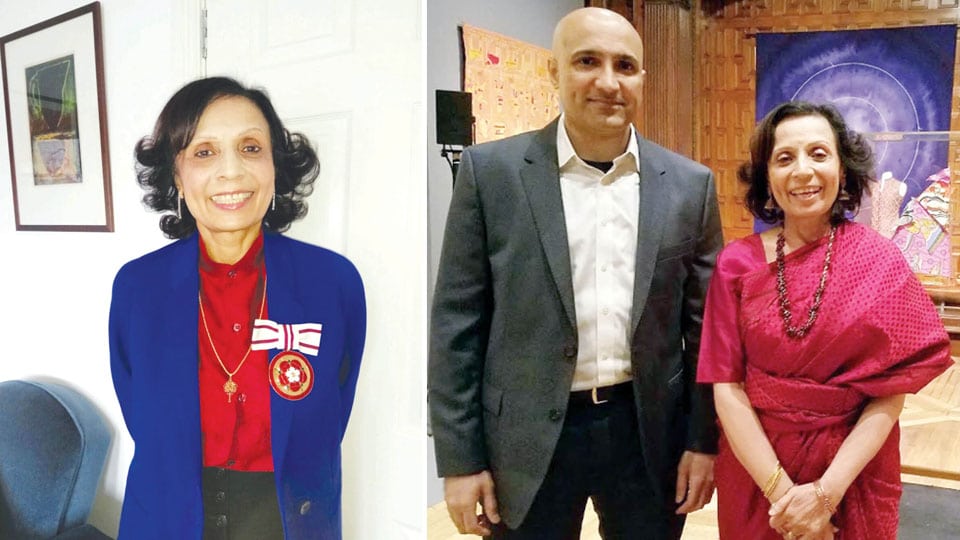
Dr. Nima Poovaya-Smith, who hails from Mysuru, was conferred the prestigious Order of the British Empire (OBE) in 2016 for her contribution in the field of Arts and Museums.
Recently, Nima was bestowed with another unique honour. She has been appointed as one of the Deputy Lieutenants (DL) of West Yorkshire County in the United Kingdom (UK).
Deputy Lieutenants assist the Lord-Lieutenant in carrying out his role as the Queen’s representative. Historically, the duty of the Lord-Lieutenant used to be in organising the county’s militia! In 1871, the Lieutenant’s responsibility over the local militia was removed.
Dr. Nima Poovaya-Smith with the insignia of Office of Deputy Lieutenant of West Yorkshire.
The current Lord-Lieutenant of West Yorkshire is Sir Ed Anderson. The responsibilities of the Lieutenancy includes making arrangements for Royal visits to the county and for hosting those visits; representing the Monarch at a wide range of events across West Yorkshire; presenting British Empire Medals and other awards; advising on submissions for honours nominations; submitting nominations for Royal Garden Parties; and maintaining close links with regional armed forces. He is assisted by the Vice-Lord-Lieutenant, the Clerk to the Lieutenancy and a team of Deputy Lieutenants.
Nima’s father Ammanichanda Poovaya and mother Biddanda Muthie Poovaya (my mother’s sister) were in Belgaum for many years and that’s where she and her siblings had their early education. The family settled in Mysuru and Nima earned her Ph.D in English literature from the University of Mysore under the mentorship of well-known academician Prof. C.D. Narasimhaiah (late). She was also a student of Prof U.R. Ananthamurthy (late).
In 1981 Nima went to the University of Leeds, UK, on a scholarship for post-doctoral studies. Nima is married to Paul Smith, who besides being a Sociologist specialising in the Sociology of Knowledge, is an authority on the Theosophical Society founded by Colonel Olcott and Madame Blavatsky.
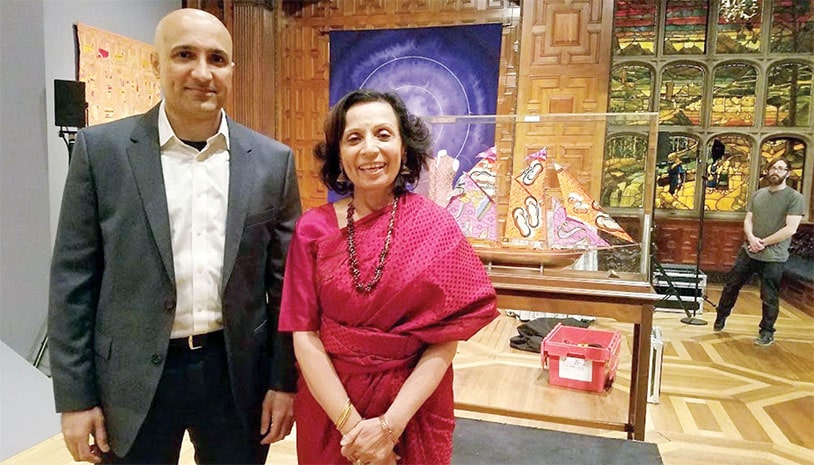
Dr. Nima Poovaya-Smith with her nephew Dr. Kodimanianda Ajit Belliappa in front of Yinka Shonibare’s acclaimed piece The Wanderer that she was instrumental in purchasing for Bradford Museums and Galleries in 2007.
Nima has been actively involved in collecting art and in curating museums. One of her assignments was collecting rare textiles for Cartwright Hall Museum, Bradford. Various noteworthy collections are currently being celebrated at the ‘2 Temple Place’ Gallery in London (till 19th April 2020). Seven top women collectors of textiles for public collections are being showcased and Nima’s contemporary South Asian collection is one of them.
For more details visit website: https://twotempleplace.org/exhibitions/unbound/
Nima is the Founder-Director of Alchemy Anew, an organisation involved in confluence of cultures. Currently, she is the Senior Visiting Research Fellow, School of Fine Arts, History of Arts and Cultural Studies, University of Leeds.
source: http://www.starofmysore.com / Star of Mysore / Home> Feature Articles / by C.P. Belliappa / April 04th, 2020
Lake Bridge Capital, Inc. (“Lake Bridge”) and Fengate Asset Management (“Fengate”) announced the sale today of NRStor C&I L.P. (“NRStor C&I”) to funds managed by Blackstone Energy Partners.
NRStor C&I is a leading Toronto-based developer of battery storage solutions, targeting scale storage deployment opportunities within the commercial and industrial sector in North America. A pioneer in the rapidly growing energy storage market, NRStor C&I provides solutions to customers across North America. A former subsidiary of NRStor Inc., it has over 200MWh of operational, in construction and contracted projects. Lake Bridge Capital was the seed investor in NRStor Inc. and the majority investor in NRStor C&I.
“It is gratifying to see the momentum that NRStor C&I has achieved,” said Sarita Mandanna, Managing Partner, Lake Bridge Capital. “The company’s growth underlines the need for innovative energy solutions. The scale and resources of its new partner will only escalate its progress, and I wish the team every success.” Joe Cashion, Managing Partner at Lake Bridge Capital, added “We’re thrilled that the NRStor C&I team has partnered with Blackstone for the next stage of delivering sustainable energy solutions across North America.”
Marathon Capital, LLC served as advisor to NRStor C&I, Fengate and Lake Bridge. McCarthy Tetrault LLP and Torys LLP served as legal counsel to NRStor C&I, Fengate and Lake Bridge.
About Lake Bridge Capital
Lake Bridge Capital is an investment management company focused on growth capital investments. Headquartered in Toronto, the company has a global portfolio, investing in entrepreneurs and technologies across a range of industries, and in both primary and secondary transactions
About NRstor C&I
Established in late 2016, NRStor C&I L.P.is a turn-key energy-as-a-service provider to commercial, industrial and institutional customers as well as utilities across North America. With energy storage being a focal point of its offering, NRStor C&I provides its services under a turn-key build, own, and operate business model where no-capital outlay or operational expertise is required from the customer. NRStor C&I offers stand-alone, renewable coupled energy storage systems, as well as microgrids which are centrally managed through its state-of-the-art operational platform.
source: http://www.finance.yahoo.com / Yahoo Finance / Home / Toronto / by PR Newswire / March 06th, 2020
UCLA’s Center for the Art of Performance (CAP UCLA) presents Fly Higher: Charlie Parker At 100 on Thursday, March 26 at 8 p.m. at Royce Hall. Tickets starting at $28 are available now at cap.ucla.edu, 310-825-2101 and the Royce Hall box office.
Charlie “Bird” Parker was a legendary Grammy Award-winning jazz saxophonist who, with Dizzy Gillespie, invented bebop. This year marks the 100th year since the legend’s birth and therefore is cause for celebration. Acclaimed co-musical directors Rudresh Mahanthappa and Terri Lyne Carrington honor Charlie Parker’s centennial year by showcasing his uncompromising musical joy, humor and beauty, mining his deep repertoire and showcasing new, modern compositions.
Hailed by Pitchfork as “jaw-dropping” and saxophonist of the year for seven years running in Downbeat, Rudresh Mahanthappa is a 21st-century voice of jazz. Since his emergence in the late ’90s, Mahanthappa harnesses the power of the horn to create a rhythmic urgency and showcases an astonishing facility. In addition to creating Fly Higher with Carrington, Mahanthappa is the Director of Jazz at Princeton University.
Carrington returns to the Royce Hall stage for the second CAP UCLA season in a row. A three-time Grammy Award-winning drummer, Carrington has performed on over 100 recordings and just released Waiting Game this past November with her band Social Science. Last year, Carrington was acknowledged for her contributions to jazz with the Doris Duke Artist Award. Fly Higher is no exception as a significant contribution.
This performance concludes CAP UCLA’s Jazz series for the 2019-20 season. For more shows, please visit cap.ucla.edu/calendar.
CAP UCLA presents
Fly Higher: Charlie Parker at 100
Thursday, March 26 at 8 p.m.
Royce Hall, UCLA
10745 Dickson Court, Los Angeles, CA 90095
Program:
Fly Higher: Charlie Parker at 100 celebrates one of the most innovative and influential artists in modern musical history and examines his impact on pop, hip hop, rap, rock and jazz. Rather than imitating the original, Fly Higher strives to forward the art form by developing new perspectives on tradition.
Credits:
Fly Higher: Charlie Parker At 100 features:
Seven women who collected textiles during the 20th century are the focus of this exhibition, which considers how the collections they formed – ranging from Balkan costumes to South Asian saris – helped to assert the status of these materials as works of art. Find out more from Two Temple Place’s website.
Preview the exhibition below | View Apollo’s Art Diary here
The artist and writer Edith Durham (1863–1944) travelled widely across the Balkans in early 20th century, becoming renowned for her anthropological reports on life in Serbia, Albania and Kosovo. In 1935, her collection of Balkan costume and jewellery – including this giubba, a traditional robe worn by Albanian women – was donated in 1935 to the Bankfield Museum in Halifax, where it remains to this day.
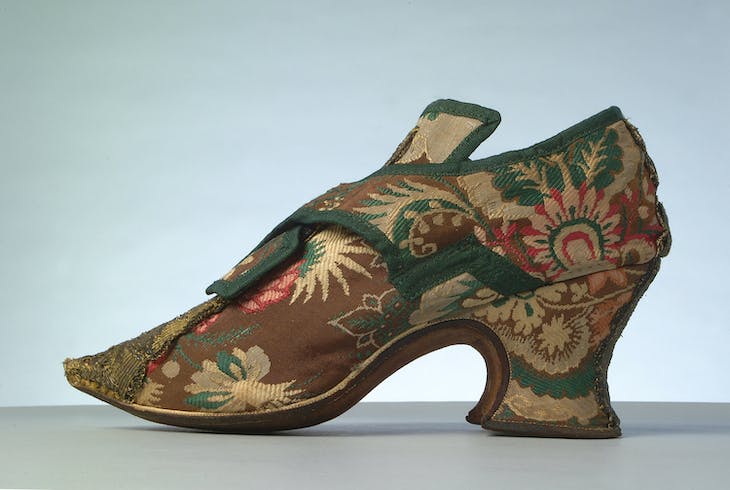
Brocade shoe without clog (1735–45), unknown maker. Photo: John Chase Photography/The Olive Matthews Collection, Chertsey Museum
Drawn to historic fashion from a young age, Olive Matthews built up a significant collection of more than 4,000 objects over the course of her lifetime – being careful always to stick to a budget of no more than £5 per item. She focused particularly on delicate needlework and embroidery – as seen on this shoe of brocaded silk from the 18th century.
Along with her friend Margaret Lambert, Enid Marx amassed a major collection of English folk art after 1932, although by this time she was already a renowned textile artist in her own right, having studied alongside Eric Ravilious and Edward Bawden at the Royal College of Art in the 1920s. In the exhibition, examples of her own work – such as this repeating pattern, reminiscent of animal hide – are on show alongside objects from her collection.
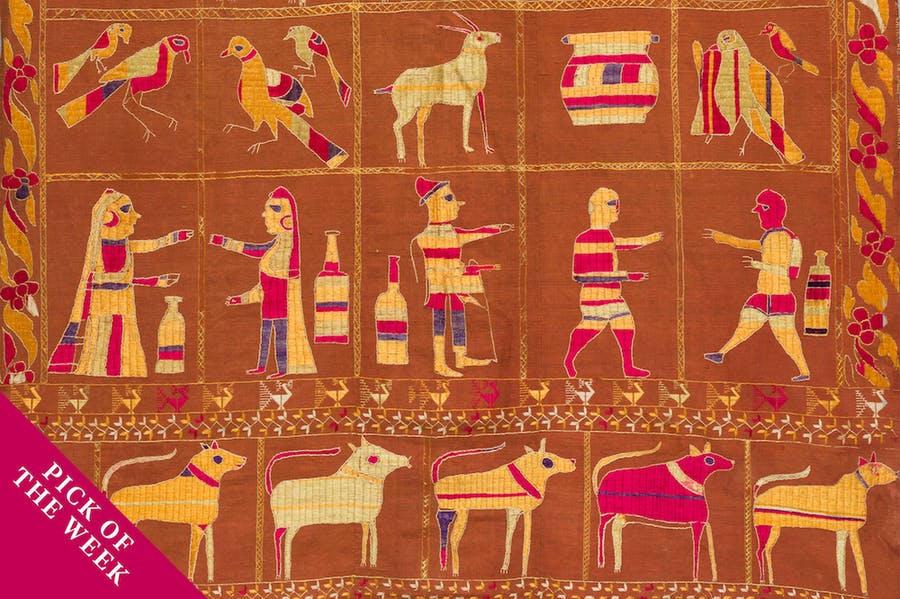
From 1985–98, Nima Poovaya-Smith was senior keeper of international arts at Bradford Art Galleries and Museums, during which time she established the transcultural gallery at Cartwright Hall. She built up a collection at the gallery that reflected Bradford’s history of textile manufacture and explored the influence on it of fabrics from across the world – in particular southern Asia. This colourful cloth is an example of phulkari (‘floral work’ in Punjabi), so-called because of the embroidered patterns that extend over every inch of the fabric.
Event website
source: http://www.apollo-magazine.com / Apollo / Home> Whats On / January 25th – April 19th, 2020
WELCOME. If you like what you see "SUBSCRIBE via EMAIL" to receive FREE regular UPDATES.
Read More »