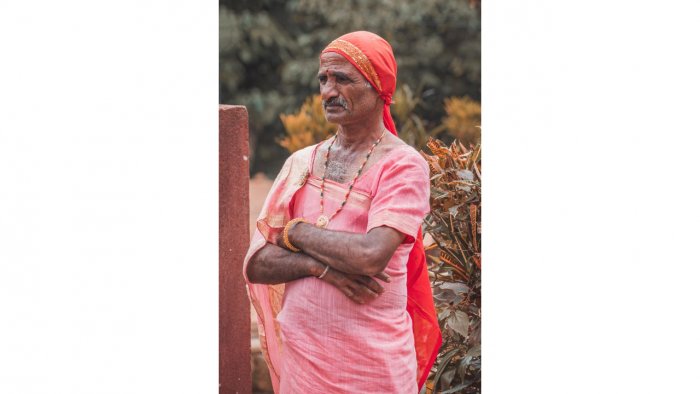
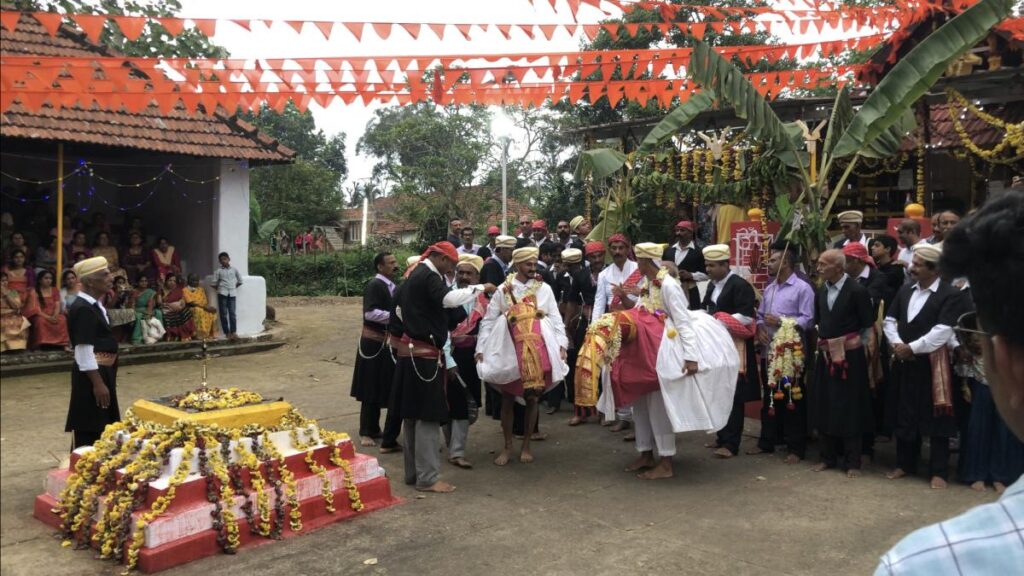
Rhythmic and upbeat songs fill the air across the villages of South Kodagu during summer. Dressed in bright and colourful attire, villagers dance to the rhythm of nature and mythology while visiting each house – marking the celebration of the unique festival ‘Bodu Namme’ aka ‘Bedu Habba’. People dress as brightly coloured tigers in body paint and slush smeared hay, as bamboo horses and elephants… to an outsider, it seems like a mass fancy dress event.
However, this unique festival of the indigenous tribes of Kodagu is much more than fun and frolic. It narrates the ancestral connection with the elements of nature and recounts mythological tales.
Following the ‘Cauvery Theerthodbhava’ (gushing of river Cauvery at Talacauvery) festival in October, the ‘Bodu Namme’ is kindled at the Kunda Hills near Ponnampet in South Kodagu. Rituals are offered at the Ishwara Temple in the village, marking the beginning of the ‘Bodu’ festive season. Post the first ‘Bodu Namme’, several other villages in South Kodagu celebrate the festival after the Kodava New Year (in April) and each village narrates its rich folkloric culture. The festival is linked to the folklore of Ishwara and Bhadrakali.
Following the ‘Cauvery Theerthodbhava’ (gushing of river Cauvery at Talacauvery) festival in October, the ‘Bodu Namme’ is kindled at the Kunda Hills near Ponnampet in South Kodagu. Rituals are offered at the Ishwara Temple in the village, marking the beginning of the ‘Bodu’ festive season. Post the first ‘Bodu Namme’, several other villages in South Kodagu celebrate the festival after the Kodava New Year (in April) and each village narrates its rich folkloric culture. The festival is linked to the folklore of Ishwara and Bhadrakali.
There is a Kodava saying – ‘Kundathl Bottl Nhenda Kudure, Paranamanil Alunja Kudre’ – that states that the horse (made of bamboo) that was raised in the Kunda Hills marking the beginning of ‘Bodu Namme’ will be sacrificed at Paranamani, ending the annual festivity. “At Paranamani, the festival is about the story of deity Ishwara and demon Basmasura. Three horses and two elephants made of bamboo collected from the sacred grove in the village are worshipped and later sacrificed,” explained Raghu Machaiah, a resident of Paranamani.
Mythological stories connected to each village are unique, he says. “The different costumes in which the villagers dress up during the festival depict the different forms of Lord Ishwara.” Another story links ‘Bodu Namme’ to the story of the deity Bhadrakali. “In the deity’s ferocious avatar, no one could calm her down. To appease her, devotees worship her in different attire. Tiger, hay costumes, cross-dressing by men of the village are ways to placate the goddess,” narrate Parvathi Chengappa and Kundranda Sannu Pemmaiah of Aimangala village.
Villages in South Kodagu – Chembebelluru, Aimangala, Parana, Kavadi, Bilugunda, Nalvathoklu, Kutandhi, and Aarji – observe the festival. “Natives here are indigenous and Ishwara worshippers,” explained Parvathi.As was inevitable, modernity touched the tradition of outlandish dressing. Politicians, famous and infamous personalities, film actors, comedians, and mafia kingpins have found their way into the festival of appeasing Goddess Bhadrakali and Lord Ishwara. During the festival, people visit every home across the village to offer prayers and seek blessings.
Apart from the fascinating fusion of colours, the festival also stresses the protection of nature with many restrictions, including a ban on cutting trees during the celebrations. “The history of ‘Bodu Namme’ dates back to ancestral times, and the rituals and culture of this festival have stood the test of time. While it looks exciting, there is a religious aspect to the festival. In an era of rapid urbanisation, the festival unites villagers and speaks of love, trust and harmony,” opined Shashi Somaiah, a resident of Madikeri.
source: http://www.newindianexpress.com / The New Indian Express / Home> States> Karnataka / by Prajna GR, Express News Service / May 22nd, 2022
After Zoya Akhtar’s The Archies reignited the nepotism debate, Gulshan Devaiah stepped in to defend the filmmaker.
As the nepotism debate surrounding Zoya Akhtar’s The Archies intensifies , actor Gulshan Devaiah weighed in on the subject, saying that the whole discussion was just an excuse for a select few to settle personal scores. His tweet comes a few days after director Zoya Akhtar shared the teaser of her upcoming film , which stars Shah Rukh Khan’s daughter Suhana Khan, Amitabh Bachchan’s grandson Agastya Nanda and Sridevi’s daughter Khushi Kapoor.
Gulshan wrote, “Opinion: The nepotism debate harnesses the angst & disdain that many have from within & outside the Hindi entertainment industry to serve the interests of a few who use it to settle personal scores. This business is tough & very unfair but nepotism is not it’s greatest problem.” He added, “As an actor (for example) the anxiety & insecurity comes from the need for opportunities & there are privileged ones who have it a bit easier but this is a bit of an illusion that’s amplified/coloured by personal & peer opinions based on individual and collective disappointments.”
“
Opinion: The nepotism debate harnesses the angst & disdain that many have from within & outside the Hindi entertainment industry to serve the interests of a few who use it to settle personal scores. This business is tough & very unfair but nepotism is not it’s greatest problem.
— Gulshan Devaiah (@gulshandevaiah) May 17, 2022
“
He further wrote, “If a producer wants to capitalise on the public interest in a star kid then it’s their prerogative to do so. It’s no crime. This method has its more than fair share of failures. Film production is a private business. It’s not based on merit the way for eg: education, sports are.” In another tweet, he wrote, “This is the nature of this business. It’s tough.. very very tough & hence forget being rich & famous but to be a regularly working actor is most desirable. People have to find their way through this very very subjective & judgemental business (audiences also judge).”
The nepotism debate has always hounded the film industry, but was kicked into a higher gear after Kangana Ranaut accused Karan Johar of being the ‘flagbearer of nepotism’ on Koffee with Karan. It was reignited after The Archies teaser was released on Saturday. In the film, Suhana will supposedly play Veronica Lodge, while Khushi will play a version of Betty Cooper. The film is set in 1960’s India and is said to be a musical.
source: http://www.indianexpress.com / The Indian Express / Home> Entertainment> Bollywood / by Entertainment Desk, New Delhi / May 19th, 2022
Seen are (sitting from left): Baleyada Hemalatha – Treasurer; Nallamada Carriappa – Secretary; Kullachanda Kesari – President; Noorera Yashu Bipin – Joint Secretary;(standing from left): Coluvanda Chengappa, Chendanda Nirmala Subramani, Bachamada Vasanth – Committee Members
The Annual Get-together of Railway Kodava Association was held at Simply Kodavas in Vijayanagar, Mysuru, on May 15.
On the occasion, Bachamada Vasanth and Coluvanda Chengappa, who retired from service, were felicitated in the presence of their family members and the new Committee was formed.
The new team comprises of Baleyada Hemalatha – Treasurer; Nallamada Carriappa – Secretary; Kullachanda Kesari – President; Noorera Yashu Bipin – Joint Secretary;( Coluvanda Chengappa, Chendanda Nirmala Subramani, Bachamada Vasanth – Committee Members
source: http://www.starofmysore.com / Star of Mysore / Home> Photo News / May 20th, 2022
Every year, some parts of south-east Kodagu see the celebration of the festival Boad namme. Namme means festival in Kodava language. Boad namme is usually celebrated in the areas that have a temple of Bhadra Kaali.
During the festival, people disguise themselves and visit houses in the village. This is called boad kali in general and can be of different forms. The most common form is that of cross-dressing, where men and boys dress as women and girls.
During Boad namme, people cross-dress or paint themselves like tigers. Credit: Aiyuda Prasad Ponnappa
There is the bandu kali form where men apply wet, sticky mud on themselves. There is vadda kali where a man dresses as a vadda, a digger of wells and tanks. Some wear gaarudi gombes, a type of gigantic dolls with large heads made from wood and papier-mâché, with holes for eyes, while others don body paint and assume puli vesha (tiger form).
Dhol paat singers enter a house’s nellakki nadubade (the hall with the household prayer lamp), followed by the boad performers. People throw money at the tiger dancers who pick it up in their mouths while dancing.
A ritual as part of the Boad namme festival in Kodagu. Credit: Mookonda Kushalappa
The horse and the woman
The following day, a teenage boy wears a horse frame and is called a kudure. Another small boy is dressed in red sari and is called a choole. The kudure is a form of Shiva (Hara) while the choole is a form of Mohini (Hari).
Just like Vishnu takes the female form of Mohini, the enchantress of demons, the choole is a male who dresses up as a female. Thus, cross-dressing is part of the festival.
Men from the Panika community perform the theray at this temple every year. They carry a large, white parasol with a mask on top.
Bonda was known as Bonda Moonoor okka, or Bonda 300 clans. It was an ancient village inhabited by 300 clans which were split into the modern villages of Bilugunda, Nalvathoklu and Hoskote.
The festival is held in mid-May. Clans of Bilugunda and Nalvathoklu villages take turns to send a kudure and a choole to the temple on a rotation basis every year. These are dressed up in the houses of the clan.
Songs and a race
This year, it was the turn of the Mandepanda clan of Bilugunda and the Nellachanda clan of Nalvathoklu to send a kudure and a choole. The kudure and the choole from both villages come in a procession and meet at a field, and then at the temple. Both the kudures will have a brief race.
If someone dies in a clan, that clan or family cannot participate in the ritual for a certain period. When this happens, other families of the same village share the responsibility. The traditional dudi paat is sung before the kudure and the choole procession starts.
There is a saying in the Kodava language: “The kudure raises at Kunda, the kudure falls at Parana”. Hence, the first Boad festival of the year is at Kunda village and the last is at Parana.
source: http://www.deccanherald.com / Deccan Herald / Home> Spectrum / by Mookonda Kushalappa / May 18th, 2022
People can send stories along with photographs and audio or video clips for curation.
Bengaluru-based India Foundation for the Arts (IFA) is inviting members of the Kodava community to share stories of their people and cultural history for an online museum it plans to launch next year.
It is International Museum Day on May 18.
Speaking ahead of the occasion, IFA said people can send stories along with photographs and audio or video clips, which will be curated.
The project is called Sandooka, the Living Museum of Kodava Culture. Sandooka means treasure chest in Coorgi language, and the museum strives to be a repository of stories ranging from the traditional costumes to present-day experiences of the Kodavas, native inhabitants of Kodagu in Karnataka.
IFA is working with Nitin Kushalappa, an author and researcher who is a member of the Kodava community, to put together this project along with design experts Upasana and Saurav Roy from Switch Studio.
The project started in 2021. Rathi Vinay Jha, chair of the Sandooka museum’s advisory group, shares, “The younger generation of the community is dispersed all over the world and is losing connection with their heritage. This museum will provide an opportunity to reconnect with their culture.”
And because the project wants to foster community participation and be accessible globally, the concept of online museums fits well, says Lina Vincent, project director and curator.
Arundhati Ghosh, executive director, IFA, believes the museum will help document and preserve the stories and heritage of the Kodavas, much of which remains undocumented.
“My vision is for it to be a virtual space devoted to the Kodava community. I hope this can serve as a model for other communities that are disappearing to keep their stories alive,” says Lina.
You can submit the stories at sandookamuseum.org/form/intro
source: http://www.deccanherald.com / Deccan Herald / Home> Metrolife – Your Bond With Bengaluru / by Sowmya Raju, DHNS / May 17th, 2022
Ravi Kushalappa, chairman of Karnataka State Western Ghats Task Force, has suggested the State Government follow the court’s direction with regard to encroachment of forest areas in Shivamogga district.
In a meeting with officers at the Deputy Commissioner’s office in Shivamogga on Monday, Mr. Kushalappa said that the task force was committed to clearing encroachments of the forest areas and illegal activities within the forest limits. The court orders with regard to clearing encroachments should be acted upon.
Regarding the plantation activities, the chairman said the village-forest committees had to be active in protecting and conserving forests. The Forest Department had to spread awareness among the public in this regard. The Forest Department had to take up plantation activities with the active participation of rural people. The tribal communities, who had been residing in the forest areas, should be provided with basic amenities, he said.
Additional DC Dr. Nagendra Honnallli, Shivamogga DCF Shankar and others were present in the meeting.
source: http://www.thehindu.com / The Hindu / Home> News> National> Karnataka / by Special Correspondent / Hassan – May 16th, 2022
In recent months, a new initiative has come up, which shines the spotlight on the fast-vanishing heritage of the brave Kodavas of Coorg
One of the most significant projects in this context is by researcher-writer Kaveri Ponnapa. She has relentlessly been documenting the culture of the Kodavas through her books such as The Vanishing Kodavas. Her latest work is A Place Apart, translations and transliteration of 21 poems by eminent writer Bacharanianda P. Appanna. This is her bid to save the Kodava takke, classified as a definitely endangered language by Unesco and spoken by just 166,187 people according to the 2001 census. Having spent decades in the field, researching Kodava culture and history, she felt the urgent need for a selection of his poems to reach a wider audience, both from Kodagu and anyone else interested in small cultures.
Appanna was one of the elders that Ponnapa worked very closely with while researching her first book. His knowledge of the culture and very importantly, the Kodava language, is extraordinary; he continues to extend invaluable help in expanding her understanding of their shared heritage.
Edited excerpts from an interview, in which Ponnapa talks about the various facets of her project:
Could you talk about the factors that prompted the project, A Place Apart: Poems from Kodagu?
Bacharanianda P Appanna is one of Kodagu’s best known writers and an acknowledged authority on the Kodava language. He is also a poet, and whenever I visited, he would sing some of his poems out loud, and I would make recordings of them. I was struck by the beauty, depth and rich cultural content of the poems, and equally, how many unfamiliar words they held.
There was a very real sense of loss, a realisation of how much the language had diminished, in a sense, with words disappearing from everyday usage. Appanna contributed about four hundred old Kodava takke words to a dictionary published a few years ago, and his experience as a Kodava takke teacher in collaboration with the Kodava scholar, the late IM Muthanna, brought important perspectives to our conversations on the language.
So much of our heritage and identity are held within these poems—for instance, Forest Trees of My Village and Wild Creatures of Kodagu hold details of the natural world and landscape that are now lost, and The Kodava speaks of our ethos and worldview. As Ross Perlin of the Endangered Language Alliance has observed: “It’s hard to maintain the full richness, depth and complexity of a culture without its languages”. This project was an attempt to expand the reach of the Kodava language so that more people might have an understanding of our culture.
You have written in the book about the need for transliteration, especially for people who can’t follow the Kannada script. If you could talk about that?
Ours was an oral tradition, wherein all cultural and linguistic knowledge was passed down through the generations in song. Kodava takke does not have a script. From about the 17th century onwards, a set of historic and political circumstances led to the Kannada script being introduced as a language of Court. Kodava takke took a further back seat from the mid-19th century onwards, when Kannada was introduced as the medium of instruction by the British colonial administration.
The oral tradition led to a continuous transmission of language, and cultural knowledge, which is now permanently changed. In addition, the use of the Kannada script presents definite challenges—there is a loss of linguistic nuance, changes in vocabulary and distinct shifts in pronunciation and speech, as Kannada does not, for instance, contain the additional vowel sounds of Kodava takke. Since Appanna and I worked through long conversations, these compromises between the spoken and the written became very apparent.
What led you to the Romanisation of the Kodava takke?
About three decades ago, as a postgraduate student at the SOAS University of London, I read a paper by the eminent linguist, MB Emeneau. I cannot describe the excitement I felt when I realised that what I was reading effortlessly was the Kodava marriage contract in Romanised Kodava takke. I held onto the idea of Romanisation, and was finally able to use it in this book. The transliteration in my book uses a Kodava-Kodava and a Kodava-English key to reading the poems, and has been kept very simple, the idea being to offer people an opportunity to approach the language through an already familiar medium and script. Recordings of Appanna singing his poems support the book and the transliteration.
What has the response been like?
The response has been overwhelming, particularly from the younger generation and those living overseas, as they have a window to their heritage through this work. Romanisation makes it widely accessible to many. If you look at social media posts, you will see that young Kodavas are sharing cultural knowledge, including old songs using an informal, Romanised script. Young people are eager to learn all that they can about their heritage, using non-traditional means.
What are the factors that have led to the Kodava takke becoming an endangered language?
It is not easy to address this question. There are multiple factors, some which I have already mentioned—historical and political situations, migrations in search of better educational and economic opportunities and so on. We have always been very small in number. With such a small population, it’s more likely that we choose dominant languages as we migrate, even though there is a deep emotional attachment to the mother tongue, and all that it signifies. We are further limited by the use of the Kannada script, which excludes a section of the people, particularly the diaspora, and generations brought up outside Kodagu, from expanding their knowledge of Kodava takke. If we are looking for a way of taking an endangered language into the future, we need many more speakers, and a widely accessible script. Without speakers, efforts to save a language, as the linguist Salikoko Mufwene has said, is like preserving languages as museum artefacts.
source:http://www.lifestyle.livemint.com / LiveMint.com / Home> Mint Lounge> How To Lounge / by Avantika Bhuyan / May 17th, 2022
A file photo of workers in a coffee estate near Rayarakoppalu in Hassan district, Karnataka.
CSIR-CFTRI, Mysuru has developed the drink from coffee leaf and claims the brew can be an alternative to green tea or herbal tea
How about a coffee leaf brew? Sounds interesting. Coffee leaves can be used to prepare a health drink which can be an alternative to green tea.
CSIR-CFTRI, Mysuru has developed the drink from coffee leaf which it claims can be used as an alternative to green tea or herbal tea. “It is an ideal health drink to consume at any time of the day. The brew can be prepared with water which can be filtered and consumed,” the institute said.
Phytochemicals like phenolics, alkaloids, flavonoids, and anthocyanins in coffee leaves contribute to its health benefits. The coffee leaf brew mix that the institute has developed can be produced from the leaves that are pruned at the time of maintenance of the plants. They can be a good source of raw material for the drink, the scientists at the CFTRI said here on Wednesday.
Selection of coffee leaf is key as the quality of the brew mix depends on the raw material, according to the Technology Transfer Department.
CFTRI said the plant for producing coffee leaf brew mix can be set up at a cost of ₹70 lakh and the total project cost would be around ₹1.40 crore. A Kushalnagar-based coffee powder manufacturing unit has taken the licence of the product for mass production.
source: http://www.thehindu.com / The Hindu / Home> News> National> Karnataka / by Special Correspondent / Mysuru – May 11th, 2022
The actor talks about having his grocery store on speed dial, going to bed with his iPad and being biased towards movies.
Gulshan Devaiah poses exclusively for this HT Brunch column (Shreya Dev Dubey)
The handsome lawyer of the recent film Badhaai Do was once addicted to sugar and would eat eight to nine tablespoons of refined sugar and half a kilo of jalebis in one go, until he practised control and became aware of its ill-effects. Today, ‘Eat less, live longer, look younger’ is Gulshan Devaiah’s mantra. As a kid, Gulshan was shy and inhibited. But when he was seven years old, he played a part in a sketch he’d created, discovered that he enjoyed it and was less inhibited. He also fell in love with cinema, so much so that his performance in Shaitan earned him a Filmfare nomination for Best Male Debut. Gulshan is also quite the fashionista, being a NIFT graduate and designer.
ell us one dream that you constantly saw as a child or while growing up.
That I’m a Hindi movie star.
What is the best thing about acting?
That you can pretend to be someone else for some time.
What would you have been if not an actor?
What I was before, a designer.
Tell us something no one knows about you.
There’s a reason why nobody knows it…
One relationship rule you always follow?
Be the best version of your true self.
A self-discovery during lockdown?
That I actually like Twitter.
Who is on your speed dial?
Roman Stores, for my groceries.
What is the first thing you do in the morning?
Feed the cats.
What’s your dream debut?
I have no idea who’s dream I’ve debuted in.
So, who’s your dream girl?
Ayushmaan Khurrana.
A podcast you like listening to?
Joe Rogan.
And one health shot for our readers?
Eat less, live longer.
Describe yourself in a hashtag.
#TheBossOfTheCosmos.
Bedside stories
Are you an alarm person?
Totally.
A book you usually take while curling up in your bed?
My iPad.
What do you wear to bed?
A pair of old shorts and a T-shirt.
What’s always on your bedside table?
Handcuffs.
Your preferred side of the bed?
I’m a centrist, but left if I’m sharing.
This or that
Movies or web series?
I’m a bit biased towards movies.
Big party or small gathering?
Very small gathering.
Money or fame?
If you are famous, you can figure out how to make money.
Instagram or Twitter?
These days neither, but if I must then, Twitter.
source: http//www.hindustantimes.com / Hindustan Times / Home> Lifestyle> Brunch / by Rupali Dean / April 15th, 2022
WELCOME. If you like what you see "SUBSCRIBE via EMAIL" to receive FREE regular UPDATES.
Read More »