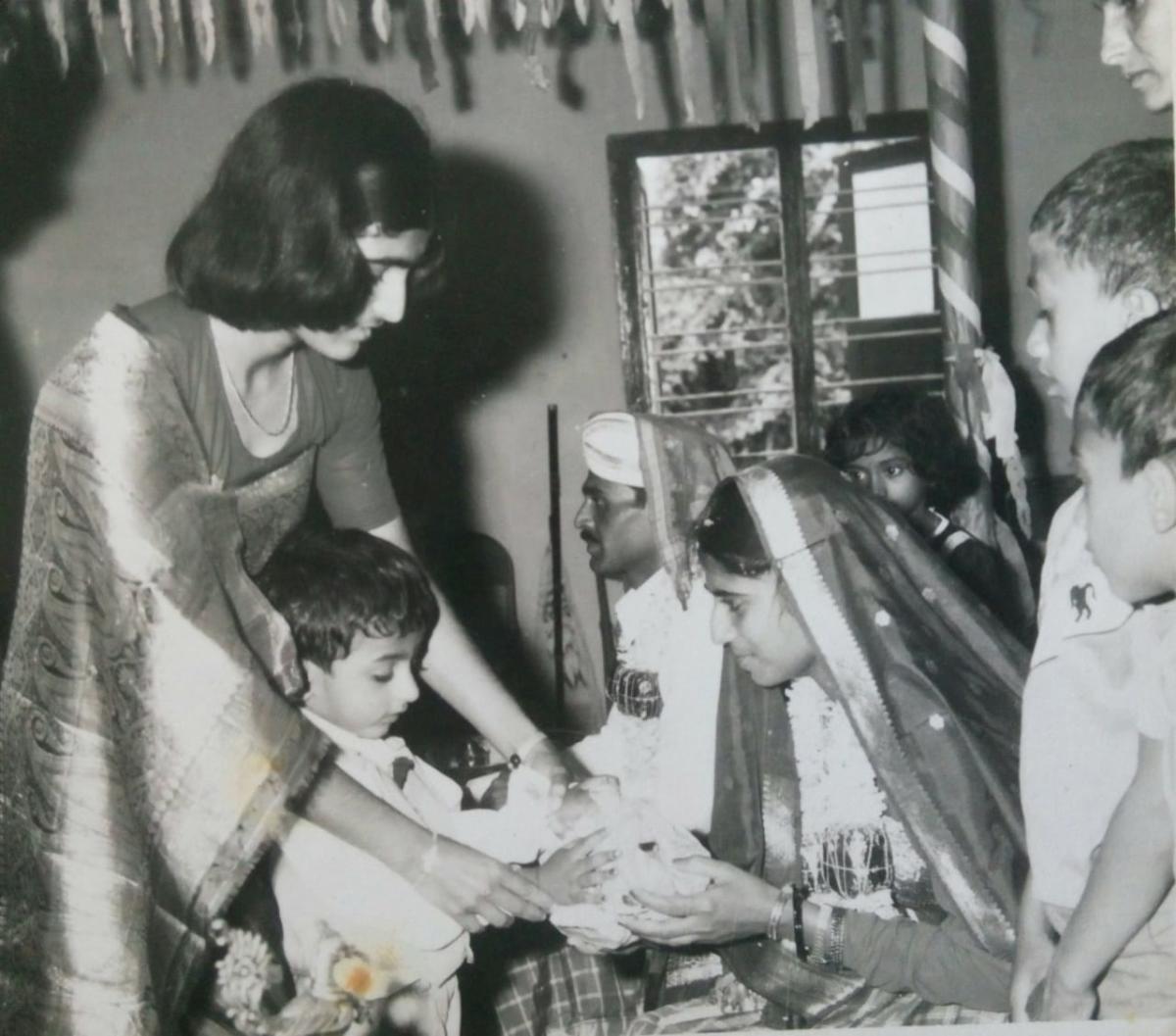
A kodava bride and groom being wished by relatives during muhurtha.
Weddings are perhaps the grandest celebrations in any community. This is especially true of the Kodava wedding which is strikingly unique in the fact that the weddings are not solemnised by priests but by family elders.
While the modern-day weddings are typically held in convention halls, the current restrictions due to Covid-19 have led to people reverting to simpler ceremonies, offering a glimpse of how Kodava weddings, called mangala, took place a few generations ago.
In the earlier days, the wedding would be conducted at ainmanes – the ancestral homes of the groom and the bride – and was purely a family affair. Unlike common perception, there is more to Kodava weddings than just merriment, and each ritual is invested with a deeper meaning.
The wedding ceremonies are held for two-days. On the day before the wedding, Karik Muripa, Punda Pani and Oor Kooduvo ceremonies are held separately at the groom’s and the bride’s homes. It is interesting to note that, Karik Muripa means cutting vegetables for curry; Punda Pani means erecting bamboo stumps as pandal and Oor Kooduvo means gathering of villagers.
On this day, all the villagers and family members of the groom and the bride gather at their respective homes and make all the arrangements for the wedding to be followed the next day.
The bride and the groom offer prayers to the gods and the ancestors before the nellakki bolcha (sacred lamp) at their ainmanes and seek blessings from their parents and all the elders assembled there. The groom’s mother then puts a pavala (coral) mala around his neck, and similarly the bride’s mother ties a pathaak (necklace) around her neck, to solemnise the wedding.
While people pitch in to help during the day, the evenings are reserved for festivities. There’s good food, liquor, music and dance.
On the day of the wedding, the groom dressed in traditional white Kupya Chele goes to the bride’s home, along with other family members, where the Baale Kethuva ceremony is held. In this ceremony, maternal uncles of the groom and the bride cut a row of nine or more banana stumps (in multiples of three) symbolising the obstacles that had to be conquered and the ultimate victory of the groom over other suitors.
The groom is then led inside the bride’s home by the bojakara (the best man), and the bride draped in Kodava sari is accompanied by the bojakarthi (bridesmaid). They offer prayers, are blessed by the elders and exchange garlands during the muhurtha.
The bride is granted all the rights at the groom’s home by the elders. The groom also gives her a bag containing gold, silver and copper coins to symbolise the sharing of his wealth with her.
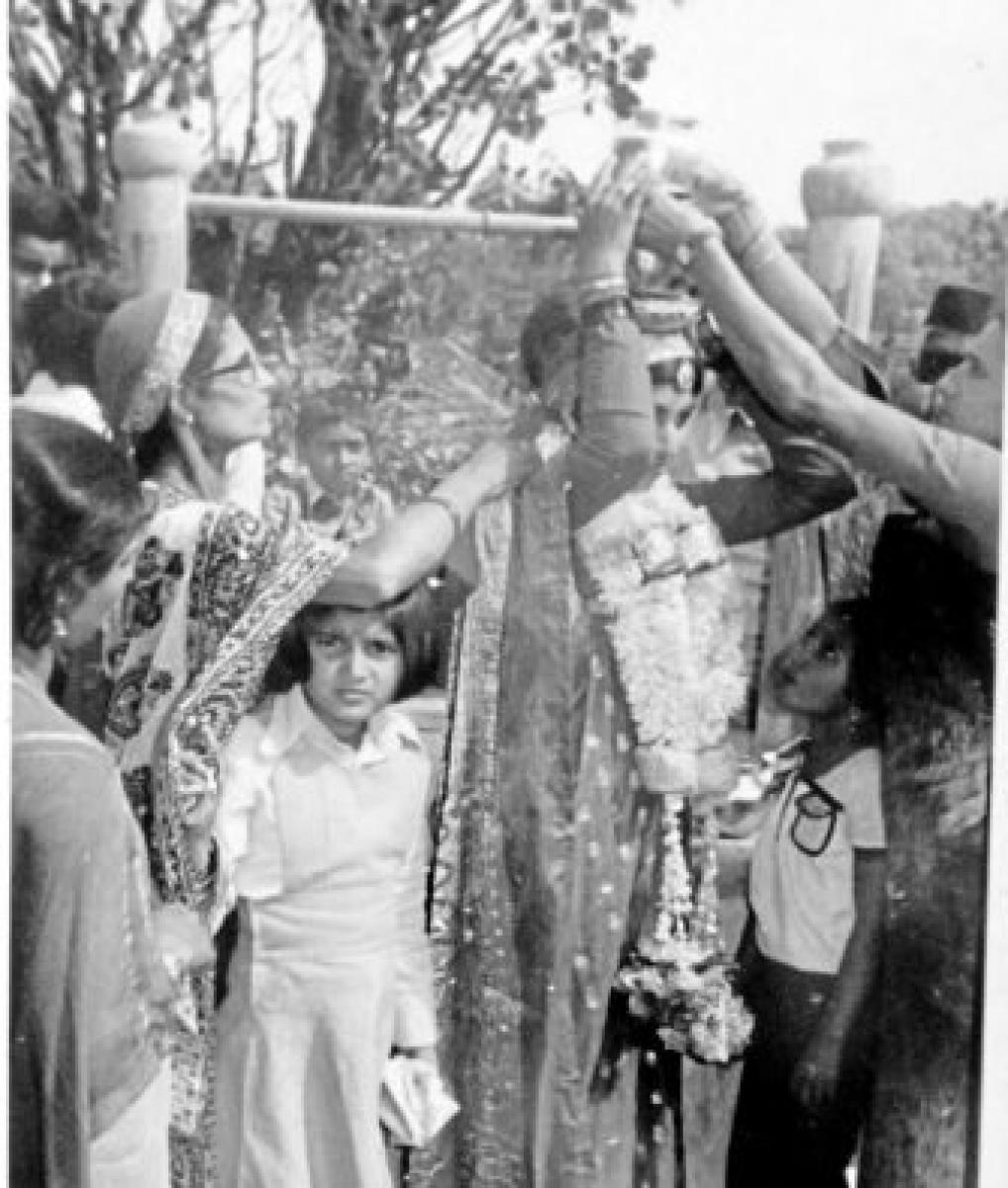
A bride fetches a pot of water from a well during the ‘neer edpo’ ceremony.
The bride then embarks on a journey to her new home with the groom and his relatives. There, as part of the Ganga Pooja or Neer Edpo ceremony, which literally means fetching water, she has to draw water from the well. As a symbol of becoming a part of her husband’s family and taking up the household work, she carries two pots of water from the well to the kitchen. However, the path is blocked by members of the groom’s family, to imply that as a married woman she may have to face hardships. Meanwhile, the youths dance to volaga (traditional music) in merriment.
After her way is cleared, she enters the house and places the pots near the sacred lamp. She is now formally the lady of the house.
source: http://www.deccanherald.com / Deccan Herald / Home> Spectrum> Spectrum Statescan / by Dhanyata M Poovaiah / July 25th, 2020
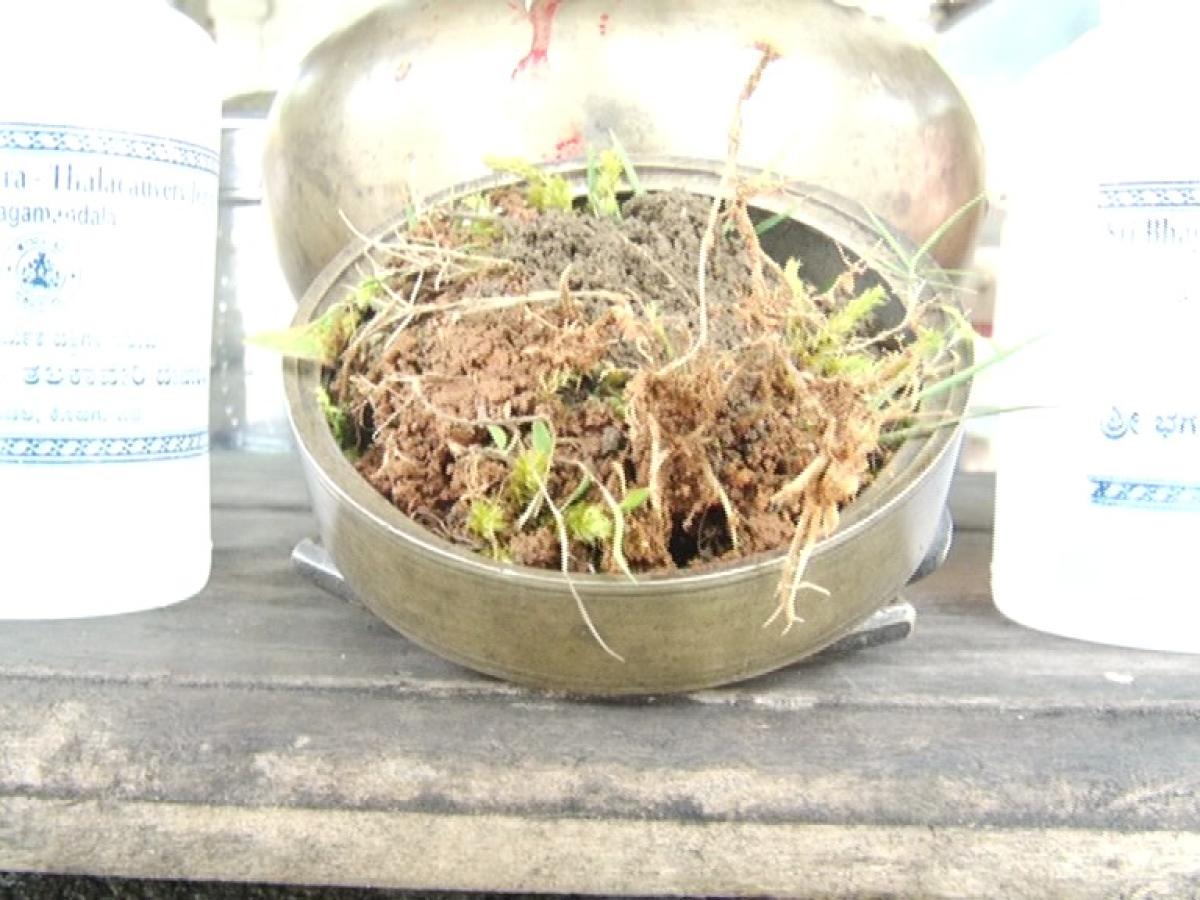
Water and soil collected from Talacauvery. DH Photos
Soil from Kodagu and water from River Cauvery were sent to Ayodhya, on Thursday.
The soil and water from the district will be used while performing ground breaking for Sri Ram Mandir on August 5.
Workers of Bajrang Dal, Vishwa Hindu Parishat and Hindu Jagarana Vedike collected the soil and water from River Cauvery at Talacauvery Kshetra.
Meanwhile, special pooja was offered at Talacauvery, praying for the timely completion of the Ram Mandir in Ayodhya.
Talacauvery Kshetra Chief Priest Narayana Acharya said that justice had been made in Ayodhya issue, which had efforts of many people behind the same.
Speaking on the occasion, MLC Sunil Subramani said that the dream of constructing the Ram Mandir was getting realised. He recalled that he had visited Ayodhya in 1992.
Leader Chakkera Manu said that the long cherished dream of Ram Mandir in Ayodhya was being fulfilled.
Vishwa Hindu Parishat leader Chi Na Somesh, Bajrang Dal District Convener Chethan, VHP Madikeri taluk President Suresh Muttappa and VHP district Secretary Pudiyokkada Ramesh were present.
source: http://www.deccanherald.com / Deccan Herald / Home> State> Karnataka Districts / by DHNS, Madikeri / July 24th, 2020
Even though coffee and pepper are the prominent commercial crops in Kodagu, several farmers have been growing both agricultural and horticultural crops in integrated farming method, thereby, contributing to food security.
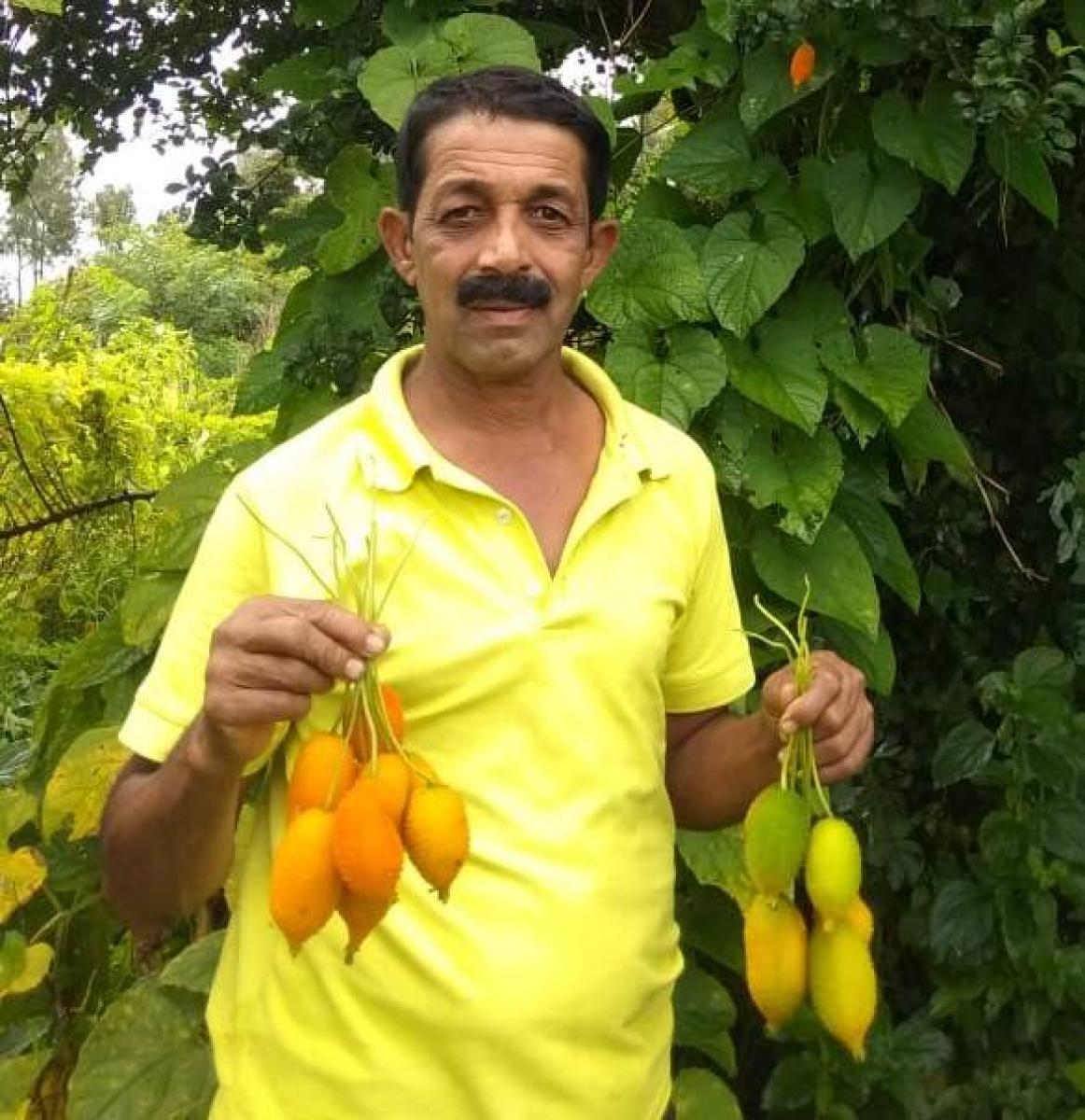
Somengada Ganesh Thimmaiah from Nallur village of Ponnampet in Virajpet is one such agriculturist who has scripted success through his innovative methods in farming.
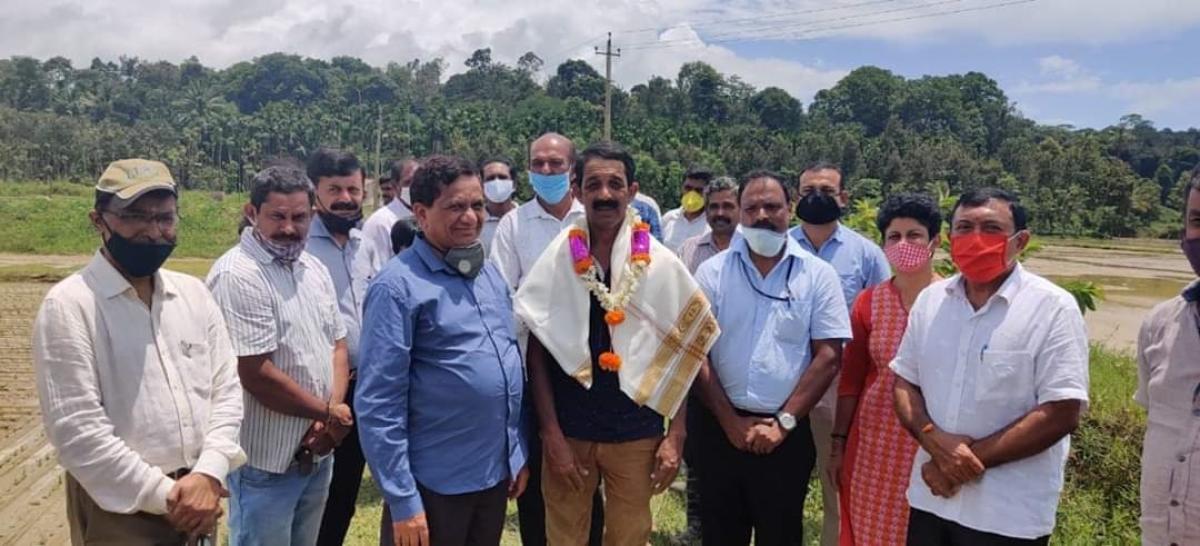
Somengada Ganesh Thimmaiah was felicitated by Virajpet MLA K G Bopaiah. DH Photos
He is the winner of the National-level Babu Jagjivan Ram Krishi Samman award this year. Indian Council of Agricultural Research (ICAR), New Delhi, conferred the prestigious award on Thimmaiah during a function held recently on the occasion of its 92nd Foundation Day.
Thimmaiah has been following the integrated method in agriculture where he grows areca, coffee and paddy as main crops and a variety of vegetables and fruits and sub-crops.
Along with agriculture, he is also into apiculture, poultry and pisciculture, which gives him additional income. Thimmaiah has also been growing the ‘Beth’ plants required for honey bees.
He has successfully experimented with more than 60 paddy varieties and has implemented a mechanised system in agriculture and his paddy field is tech-savvy.
The annual produce of paddy on his farm is 350 to 400 quintal while that of coffee is about 200 bags. He said that pepper also is one of his main sources of income. He has also been cultivating butter fruit, sapota, mango, jackfruit, orange, egg fruit and rambutan as well.
A lot of youth have been visiting Thimmaiah’s farm and seeking his guidance in farming to which he says youth showing interest in agriculture and horticulture is a good sign.
Virajpet MLA K G Bopaiah visited Thimmaiah’s farm and felicitated him for winning the much-coveted award.
Forestry College, Ponnampet, too, honoured Thimmaiah. College Dean Dr Cheppudira G Kushalappa, Extension Unit Head Dr R N Kenchareddy, Agricultural Officer Teetamada Meera were present on the occasion.
source: http://www.deccanherald.com / Deccan Herald / Home> State> Karnataka Districts / by Aditya K A, DHNS, Madikeri / July 22nd, 2020
In Nov 1948, Thimayya moved Stuart tanks in utmost secrecy by dismantling their turrets and used them in direct firing role that led to the capture of Zoji-la which had evaded capture on previous instances. It was because Zoji-la was in our hands that liberation of Kargil was possible in 1999.
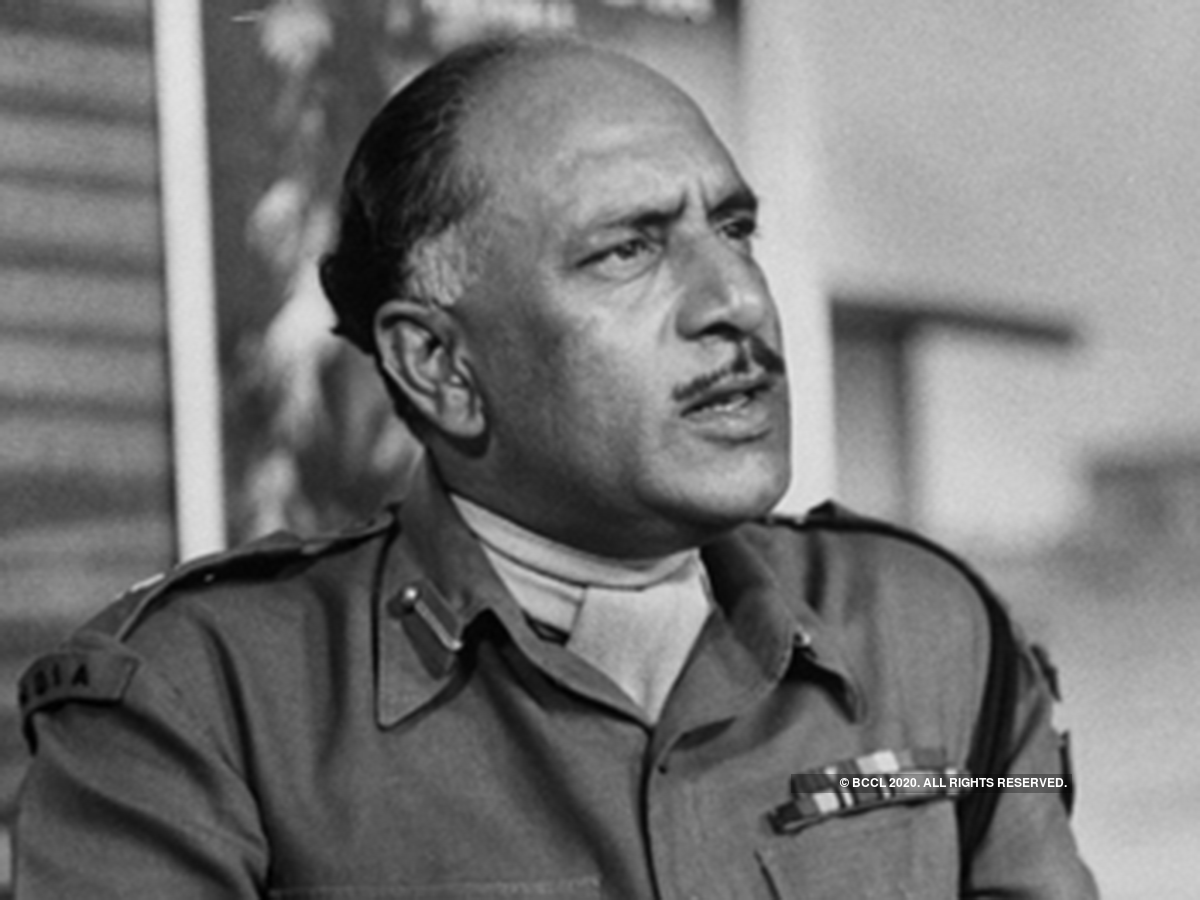
General KS Thimayya
There were three elements to India’s largely unknown role in the Korean War 1950-1953. This is the second in a continuing series on that conflict. For the earlier story on the 60th Para, click here (https://bit.ly/2DW0PHS)
India became a member of the United Nations when the organization was founded on October 24th, 1945. Established to ensure world peace—among other goals— after a ruinous World War, the UN has had a mixed track record. One of its successes, however, was the bringing of the Korean War to a close. India played a unique role in bringing the conflict to a speedy conclusion by advocating against a policy being debated at the UN which could have led to the war’s prolongation or escalation. That war was also the first commitment to a UN assignment by an independent India and the Indian Army. This contribution and the men who made it a success are still celebrated as heroes for their commitment and courage.
The Korean War began on 25th June 1950 and would rage for three long years between the Western alliance—led by the USA under a UN resolution called the UN Command—and a Socialist alliance of North Korea and China (known as the Korean People’s Army (KPA) and the Chinese People’s Volunteers (CPV)) supported by the Soviet Union. The two sides reached a military stalemate by the middle of 1953 and had agreed on the terms of a ceasefire. In truth, the war would have come to an end in 1952 if the peace talks held at Panmunjom on October 25, 1951 could have reached a decision on the question of prisoner swaps. This was a contentious topic, and one where India finally found the solution—a solution accepted nearly unanimously by the UN, allowing for the signing of the Korean Armistice Agreement on July 27, 1953. India’s efforts to find a compromise failed more often than not, increasing tensions between India and the United States, and even South Korea. The US had reasons to suspect Indian neutrality as we were among the first countries to recognize China diplomatically, even advocating for their seat at the UN in 1950.
A major issue that defied agreement was how to deal with a large number of Korean and Chinese prisoners—about two hundred thousand of them—held by the UN Command. Many prisoners refused to return to their original countries. There were also a few similar UN prisoners, mostly Americans, held by the Korean People’s Army (KPA) and the Chinese People’s Volunteers (CPV))
The Armistice agreement stipulated that a Neutral Nations Repatriation Commission (the NNRC) would be established with two countries from each bloc, and headed by India—underscoring our nation’s reputation as a neutral country. Thus the NNRC had Czechoslovakia and Poland from the Eastern Bloc, and Sweden and Switzerland from the West. India was also tasked with providing a brigade of soldiers to provide security for the prisoner exchange.
The NNRC decided the fate of the remaining 20,000 POWs —and their repatriation—also called the Big Switch. It followed Operation Little Switch in April-May of 1952, which saw the exchange of wounded and sick soldiers held by both sides. The solution included handing over these prisoners to the NNRC headed by India. A full Indian contingent of nearly 6000 called Custodian Force of India (CFI) were to take over physical custody of these prisoners; this was our nation’s initiation into peacemaking and conflict resolution.
Led by General Thimayya as Chairman, and Ambassador B.N. Chakravarty, IFS, as the Alternate Chairman, the Neutral Nations Repatriation Commission (NNRC) was a task that many did not think Indians would be able to handle or deliver, because of its layered complexities and intrigue.
The Indian government had made sure to send their best medical unit 6oth Para Field Ambulance earlier ( https://bit.ly/2CrHWfn) and now, in sending General KS Thimayya—later to be the COAS— they displayed the same intent.
The force behind the NNRC
Kodandera Subayya Thimayya was one of three brothers born to a rich coffee planter of Cheppudira clan in Madikeri in the district of Kodagu. He joined Bishop Cotton School in Bangalore before enrolling at the Prince of Wales Royal Indian Military College (RIMC) in Dehradun; he was one of six Indian cadets later chosen to attend the Royal Military Academy at Sandhurst along with Gen PN Thapar who would later succeed him as the Chief in 1961 and be made a scapegoat for failures in 1962. Gen Thimayya’s brothers too joined the Army and his elder brother Ponnappa later joined the INA inspired by Subhas Chandra Bose and his younger brother died in the first war in Kashmir.
Thimayya graduated from Sandhurst in 1926 and received a commission into the British Indian Army, going on to become the first Indian to command an Infantry brigade: the 268th Indian Infantry Brigade—part of the post-World War II British Commonwealth Occupation Force in Japan. He received the British Distinguished Service Order for his service for the British military during World War II.
General Thimayya was also chosen to lead the counter offensive in Kashmir and headed the Jammu Kashmir force from April 1948 . The J&K force was split as Srinagar and Jammu Division, Gen Thimayya headed the Srinagar Div in May 1948 . Immediately he set about recapturing territories lost to the marauders with his daring and dynamic brigade commanders – Brig LP Sen of 161 brigade in Uri Sector, Brig Atal of Para Brigade tasked to recapture Zojila and Harbaksh Singh in command of 163 in Handwara – Kupwara . They were on a recapturing spree when Nehru decided to unilaterally declare suspension of operations as the case was referred to the UN much to the protestations of the army brass. Fortunately Pakistan didn’t comply with the UN resolution allowing the re – commencement of operations. This window of opportunity saw the consolidation of Ladakh with the capture of Zojila Dras and Kargil. Leh a weakly held garrison was saved by the sheer audacity and courage of Thimayya and Air Cmde Mehar Singh who landed in a Dakota together for the first time in Leh paving the way for beefing up troops that saved Leh from enemy hands . In another audacious move for capture of Zojila tanks of 7 Cavalry was used in a direct firing role which completely destroyed the enemy morale leading to its capture . Thus Ladakh was saved in the nick of time by November 1948 before winter set in . Seeing the change in pace and tempo of operations Pakistan quickly agreed to the terms of the UN resolution calling for a ceasefire before it lost all other territories held by them. The rest is history but what stood out is the sheer character and audacity which made him a national hero for saving Kashmir .
Another anecdote that revolves around him is the detention of a senior politician’s son after he and some goons passed lewd remarks and even tried to molest the wife of an Army officer of 5 JAT in Amritsar in 1959 . With the personal involvement of none less than that of the CM Of Punjab the ripples of this action went up to Parliament. General Thimayya was summoned for an explanation and his response that silenced the opposition was “If we cannot defend the honour of our women, how can you expect us to defend the honour of our country?”
His ability to project India’s honor was on full display during his handling of the NNRC in Korea.
The NNRC through CFI was responsible for gathering non-repatriated prisoners into camps; that included nearly 170,000 prisoners held by UN forces who didn’t want to return to either China or North Korea.
In the face of Chinese demands for the forceful repatriation of their soldiers, the UN and the CFI worked hard to explain to each prisoner their rights and privileges; they could then choose to go home or remain with the side that captured them.
This called for compassion, fairness, and neutrality on the part of the Indian Custodian Force, who rendered yeoman service during the entire span of their mission from September 1953 to March 1954. On several occasions, intricate situations were resolved only because of the patience and tact of General KS Thimayya and Major General SPP Thorat. They proved their mettle, earning well-deserved praise for their command and for India.
It was an unenviable task; in the end only less than 100 who wished not be repatriated to either country came back to India once the NNRC and CFO concluded their operations. A few Koreans chose to resettle in India, while others were repatriated to Brazil.
General Thimayya is not only an Indian military hero he is also a hero of the Korean War . It has been 66 years since the end of the Korean war but even till day he is remembered by Koreans with gratitude and affection. He was awarded a Padma Bhushan in 1954 for his service in Korea.
General Thimayya went on to become the COAS from 1957-1961. After his retirement the UN again requested for his service in 1964 to command UN troops operating on Cyprus in keeping with his reputation of impartiality displayed in Korea . He would however die of a massive heart attack on December 18, 1965 at the age of 59.
————–
Col ( Dr) Divakaran Padma Kumar Pillay, Shaurya Chakra, PhD is a Research Fellow, with the Manohar Parrikar Institute for Defence Studies and Analyses. His twitter id is @dpkpillay12.
—————
source: http://www.economictimes.indiatimes.com / The Economic Times / Home> National> Business News> News> Defence / by ET Contributor – Col.(Dr)Divakaran Padma Kumar Pillay / July 21st, 2020
Unlike other bigger districts in the State, Kodagu has limited private healthcare resources and this has been one of the reasons for its dependence on cities like Mysuru and Mangaluru for healthcare needs.
However, under the regulated situation triggered by COVID-19, patients of one district are not being treated/permitted in another easily, and this has put a further strain on the medical staff and infrastructure in the district. This has necessitated roping in more doctors. The fact that three doctors had to be rushed to Madikeri COVID-19 Hospital from the Mysore Medical College and Research Institute to handle the situation resulting from the spurt in infections highlights the situation in the hilly district.
Exhausting the possible options amidst the crisis, the Kodagu district administration sought to play the “Work for Kodagu” card, with a fervent appeal to doctors belonging to Kodagu and working elsewhere to return to their homeland and join hands with the government in the unending fight. “I think it’s the best opportunity for them [doctors of Kodagu origin] to work for the land. Kodagu needs doctors and you can fill the emptiness,” said Deputy Commissioner Annnies Kanmani Joy.
The recruitment process has been eased to such an extent that any medical graduate and postgraduate can walk into the medical college or the DHO office in Madikeri with relevant educational documents.
“If selected, the appointment order is issued the very next day and he or she can start working,” Ms. Joy said, while sharing Kodagu’s COVID-19 combat when she came live on Facebook.
However, there are not many takers for the doctors’ posts as only two have responded.
“The appointees can either work in the medical college hospital or in PHCs,” she said, recalling the help received from the people hailing from the district when Kodagu was battered by two back-to-back floods and landslides. Ms. Joy said Kodagu might be a small district but the COVID-19 preparedness was on a par with any other bigger district.
source: http://www.thehindu.com / The Hindu / Home> News> States> Karnataka / by Shankar Bennur / Mysuru – July 18th, 2020
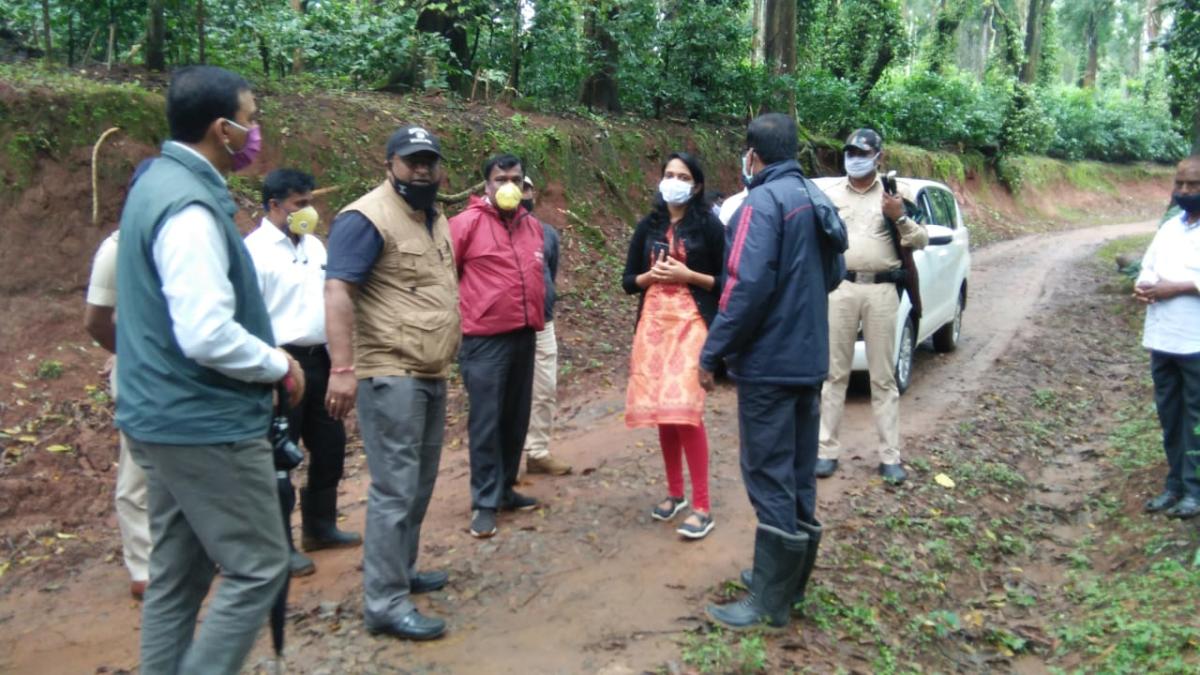
Deputy Commissioner Annies Kanmani Joy visits the rehabilitation site in Arekadu village, on Thursday.
Deputy Commissioner Annies Kanmani Joy has issued orders to allocate sites in Arekadu village, to the people dwelling on the river banks who lost their houses owing to floods.
The district administration had cleared the encroachment of land in Arekadu village which was earmarked for the houses meant for flood victims in Nelyahudikeri limits. But, there were confusions regarding the road which passes through private land.
Speaking on the occasion, she said there was a minor issue regarding the road that connects to the rehabilitation site.
“The marking of the site will be done in the next 15 days. The ACF has given permission to fell the trees on the site. After felling of trees is complete, the rest of the works will be carried out by Taluk Panchayat executive officer,” she added.
ZP member Sunitha Manjunath, Taluk Panchayat member Shuhad, local Gram Panchayat former vice president Safiya, district assistant commissioner Javaregowda, Somwarpet tahsildar Govindaraju, Horata Samiti leader P R Bharat, Tata company general manager M B Ganapathy, legal manager Vijay Karnad and deputy general manager K P Appaiah were present.
source: http://www.deccanherald.com / Deccan Herald / Home> State> Karnataka Districts / by DHNS, Siddapura / July 17th, 2020
Personal loss failed to shake this student. When all her classmates were busy preparing for the PU Board exams, Nidyamane Prakruthi lost her family in a road mishap. However overcoming grief, this gritty student has secured 92% in the exams.
Her father Nidyamane Ashoka, mother Hemavathi, brother and sister died on the spot in a car accident near Sullia in Dakshina Kannada during September 2019. They were all heading to Moodbidri to see Prakruthi, who was studying at Alva’s College.
Prakruthi fought the trauma and put all her efforts in studies, to excel in the examinations.
Kodagu toppers
Apoorva H G from St Micheal PU College, Madikeri, has scored 590 out of 600 (98.33%) in Second PU Board examination in the Commerce stream, thus bagging the topmost position in the district in the stream.
A U Ranjana, a student of Vidyanikethana PU College, Gonikoppa, is the topper in the Science stream for the district. She has secured 589 marks (98.17%).
K S Lakshmi from St Jospeh Composite PU College, Madikeri, is the district topper from the Arts stream. She has scored 564 marks (94%).
PU Education Department Deputy Director Shivalinga Shetty said the other toppers from the Commerce stream are B N Chaitra (97.50 %), A M Devika (97.33%) and B M Lipika (97.33 %) from St Annamma PU College, Virajpet.
Mrinalini Tamankar (97.83%) from Vidyaniketana PU College, Gonikoppa, has secured second place in the district in the Science stream with 587 marks, K Yukta Kaverappa and Fatima Taslima P R from the same college have scored 582 marks (97.17%).
H G Dhayashree with 562 marks (93.67%) is the second topper in Arts. She is a student of Made Mahadeshwara PU College, Madenadu.
H P Ankita from St Joseph Composite PU College and H C Geetha from Government PU College, Sampaje, have shared the third position in Arts with 558 marks (93%).
source: http://www.deccanherald.com / Deccan Herald / Home> State> Mangaluru / by DHNS, Madikeri / July 15th, 2020
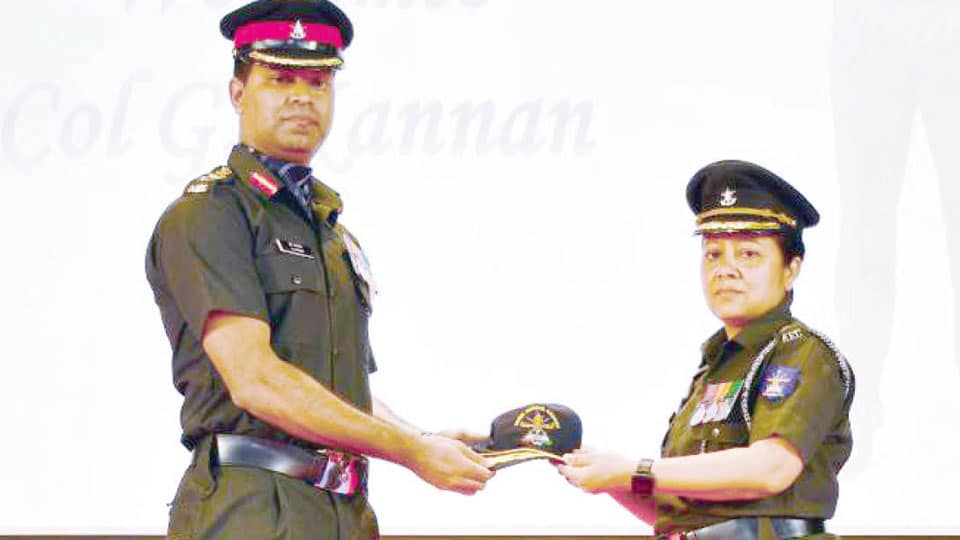
Col. G. Kannan recently took charge as the new Principal of Kudige Sainik School located in Kudige Agricultural Farm premises near Kushalnagar in Kodagu district. He was received by Vice-Principal Lt. Col. Seema Tripathi.
Soon after taking over, Col. Kannan paid floral tributes to martyred soldiers memorial in the campus.
Speaking on the occasion, Col. Kannan expressed happiness about the facilities provided to the students and also lauded the School’s achievement over the years.
Noting that Kudige Sainik School was one of the prestigious educational Institutions, he stressed on the need for maintaining discipline, unity and hard work. Expressing concern over the spread of COVID-19, Col. Kannan said that it was important to fight unitedly to tackle the virus, which has been causing great havoc across the world. Emphasising on the need for maintaining COVID regulations, he said it is important for every individual to take precautionary and safety measures such as wearing of face mask, use of hand sanitisers and maintenance of physical distancing for containing the spread of the virus.
He further said that the School must make special efforts for more admission of girl students.
School’s Administrative Officer Squadron Leader R.K. Dey, senior teacher S. Suryanarayan and other staff were present.
Col. G. Kannan has the experience of serving as the Principal of various Training Schools of Defence Department. He has been conferred Vice-Chief of Staff Award in recognition of his service. He is a Post-Graduate in Computer Applications and holds a B.Ed degree too.
source: http://www.starofmysore.com / Star of Mysore / Home> News / July 13th, 2020
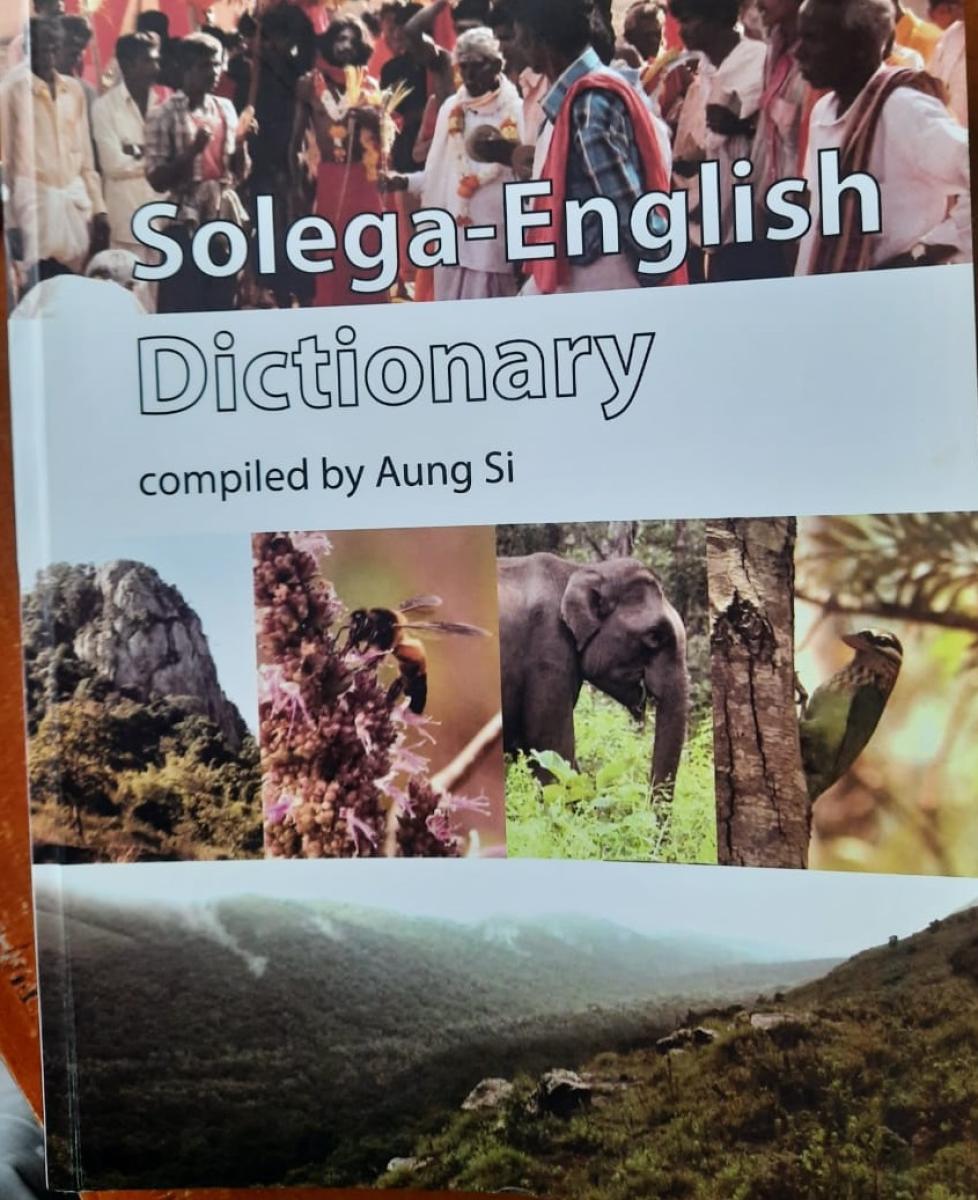
A researcher from Myanmar has compiled an English dictionary on the words used by the people of Soliga tribe, living in and around Biligiri Ranga Hill in Chamarajangar district.
Aung Si has compiled the words used only by the six Soligas tribes, living in the tribal hamlets. The 445-page dictionary has more than 1,500 words, used by Soligas. The words have been written in Kannada script and the explanation and meaning is in English. The book has pictures of rare trees, plants and animals found in BR Hills.
Aung Si has printed around 150 copies, priced Rs 1,500 each. He has handed over the responsibility of the book sales to the Soliga leaders, asking them to utilise the money earned for the development of the tribals.
Aung Si has earned a PhD from the Australian National University, conducting a research on the lifestyle of Soligas in 2012. He has been working hard for around 12 years, from 2008. He has interacted with the tribe of Soligas, learning about their languages.
He has sought the help of Ashoka Trust for Ecology and Environment in BR Hills, to compile the dictionary. He has also taken the help of Soliga leaders and other research persons for his work.
Scientist C Madegowda of Ashoka Trust told DH that there are 148 Soliga tribal hamlets in the district. Only six particular tribes of Soligas in 55 hamlets of BR Hills, still use the words and language, which are on the verge of extinction. Others speak Kannada and have adapted to the new lifestyles. Youngsters are not well versed in Soliga language and culture. This dictionary may be useful for them in future. It will also help those involved in further research on the language, he said.
source: http://www.deccanherald.com / Deccan Herald / Home> State> Karnataka Districts / by Gayathri G R, Chamrajnagar / July 06th. 2020
Meets religious leaders; lists Standard Operating Procedures for dignified last rites of COVID-19 victims
Madikeri:
Following viral visuals of COVID-19 victims being denied dignity in death in some parts of the State, Kodagu Deputy Commissioner Annies Kanmani Joy has sought co-operation from various religious heads to conduct the last rites in a dignified manner and after following Standard Operating Procedures (SOP).
At a meeting with religious heads at the Kodagu Institute of Medical Sciences (KIMS) in Madikeri on Saturday, the DC said that last rites of COVID-19 victims have to be done as per SOP. She said that the District Administration has identified one acre land each at three taluks — Madikeri, Somwarpet and Virajpet — and necessary staff would be deployed and training would be given to them. She said that no post-mortem is done on the bodies of COVID-19 victims and family members and relatives can pay their last respects from a distance of four metres and the funeral rites can be done from the same distance.
Dr. Umesh Babu, Head, Department of Forensic Sciences, KIMS, said that the bodies are carried in ambulances to the funeral site by a four-member team. Only five members in the family are allowed to pay their tributes and they cannot touch the bodies. The bodies are packed in three layers for the funeral. There is a provision for the funeral rites as per the religious traditions.
President of Madikeri Kodava Samaja K.S. Devaiah said that the District Administration had been working day and night to control the spread of COVID-19 and extended the community’s co-operation. He was in favour of conducting the last rites as per their religious beliefs. The Deputy Commissioner said the video of the funeral rites would be done on behalf of the Government and there is no provision for others to videograph it.
Madikeri Muslim Jamath Federation President Mohammed Ali said that there was 22-acre land belonging to Jamath and of that one acre can be spared to bury Muslim COVID patients. He requested the DC to permit the Jamath to carry out the last rites of Muslim patients at the land. The DC said she would look into the request.
Amruth Raj of CSI Church sought to know whether there was a provision to bury the dead belonging to the community in coffins. Dr. Babu said the bodies can be buried in coffins.
Seva Bharathi’s Mahesh Kumar, Popular Front of India (PFI) District President Amin Mohisin, Gowda Samaja President Soorthale Somanna, Wakf Board President K.A. Yakub, Kodagu Zilla Kraisthara Seva Sangha President K.T. Baby Mathew and Bajarang Dal’s Vinay Kumar also spoke at the meeting.
Superintendent of Police Kshama Mishra, Deputy Conservator of Forests (DCF) Prabhakaran, Additional DC Dr. Sneha, District Health and Family Welfare Officer Dr. Mohan, KIMS Director Dr. Cariappa, Superintendent Dr. A.J. Lokesh and others attended the meeting.
source: http://www.starofmysore.com / Star of Mysore / Home> News> Covid-19 News / July 06th, 2020
WELCOME. If you like what you see "SUBSCRIBE via EMAIL" to receive FREE regular UPDATES.
Read More »