Codava National Council (CNC), the apex body of the Kodava tribe (original residents of Kodagu) has intensified their demand for a separate Kodava land having jurisdiction of two taluks Madikeri and Virajpet and parts of Somwarpet.
“We are being socially, economically and politically exterminated systematically by well connected political parties. The names of our villages and our festivals are being wiped off, distorted and forgotten. Our contribution to the country’s armed forces is being deliberately wiped under the mat by the people in power,” Codava National Council (CNC) President N U Nachappa Codava told reporters in Mangaluru on Thursday.
“We want our own administration on the lines of the hill council in the North East. An autonomous administrative unit. After the abrogation of Article 370 and subsequent rearrangement of Jammu and Kashmir state by the central government, our hopes of getting administrative autonomy has brightened, Nachappa said, adding the CNC will release a charter of 12 demands on the Kodava National Day planned on November 24 in Madikeri.
“The main objective behind the celebrations of the annual Codava National Day programme by CNC is to rejuvenate our geo-political aspirations in the quest for autonomy,” he added.
source: http://www.deccanherald.com / Deccan Herald / Home> State> Mangaluru / by DHNS, Mangaluru / November 21st, 2019
Former athlete and Ashwini Sports Foundation Director Ashwini Nachappa (right) releases the banner of the district-level track and field championship and Karumbaiah Memorial Masters’ Cup in Madikeri on Tuesday.
Ashwini Sports Foundation, Karumbaiah Academy for Learning and Sports (KALS) and Kodagu Athletic Association will jointly organise a district-level track and field championship event for boys and girls at KALS ground in Kaikeri on December 2 and 3, said Ashwini Sports Foundation Director Ashwini Nachappa.
Launching the banner of the Championship and Masters’ Cup, she said that boys and girls between 12 and 18 can take part. Race, shotput, long jump, discus throw, high jump and relay events will be held under various age categories.
Stressing on the need for the budding sportspersons to have an experience on tracks in the primary level, she said that Ashwini Sports Foundation will encourage budding talents by providing training.
DDPI P S Machado has been supporting the foundation, added Ashwini Nachappa.
She further said that Karumbaiah Memorial Masters’ Cup will be held for hockey, in the grounds of Karnataka Public School in Ponnampet, on December 5 and 7.
Eight invited teams will take part in the school level tournament, she added.
Trainer Chethan was present. For more details, contact: 08274 279456-57.
source: http://www.deccanherald.com / Deccan Herald / Home> State> Mangaluru / by DHNS, Ponnampet / November 21st, 2019
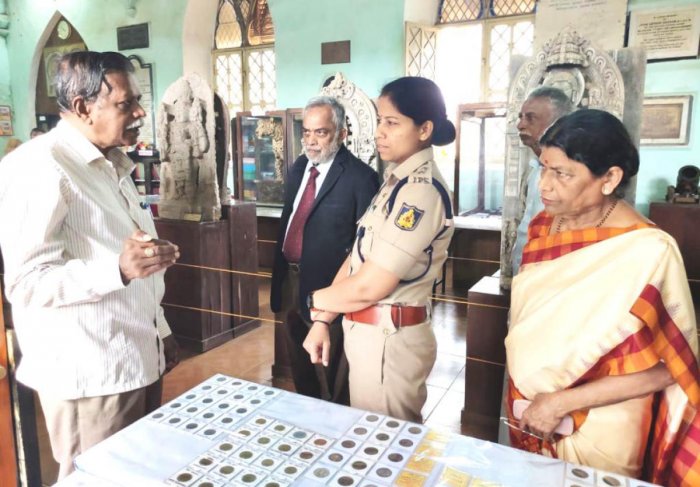
Superintendent of Police Dr Suman D Pennekar at the exhibition of coins and currency notes at Old Fort in Madikeri on Friday.
Rare and ancient coins of half paisa, one anna and two annas, were featured in a numismatic exhibition in the premises of the Government Museum at Old Fort Hall in Madikeri on Friday, as a part of World Heritage Week 2019.
An exhibition of old currency notes and photographs of heritage structures of Kodagu was also organised on the occasion.
The coins and currency notes exhibited on the venue were from the collections of numismatist P K Keshavamurthy from Hunsur. It was the 147th exhibition by him. The collection included the punch mark coins circulated in 5th century AD and coins dating back to the period of Greek and Roman rulers and also those circulated during the period of Gupta, Shathavahana, Kadamba, Chola, Pandya and Mughal empires, British and Portuguese rulers.
People examined the coins belonging to the rulers of Mysuru and Travancore. An array of exhibits included copper, golden, silver, lead and brass coins.
Numismatist P K Keshavamurthy said that he developed the hobby of collecting coins and currency notes when he was an employee in BSNL in Madikeri. Later, he exhibited his collection for the first time in 1992.
He got the chance to conduct his 50th, 125th and 147th exhibitions in Kodagu, he said.
The collections of Dr Patkar, Narayana Bhat, Y Mahalingeshwara Bhat, Nanjappa, Seetharam and Chettalli estate owner C A Appanna were also exhibited in the exhibition.
The photography exhibition of heritage structures of Kodagu featured the Kakkabbe Palace, Rajara Gadduge and Old Fort.
Superintendent of Police Dr Suman D Pennekar inaugurated the exhibition of coins and currency notes.
Dr M G Patkar inaugurated the exhibition of the photographs of heritage structures. Government Museum curator Rekha was present.
The exhibition will be held till November 24.
source: http://www.deccanherald.com / Deccan Herald / Home> State> Mangaluru / by Adithya K A , DHNS – Madikeri / November 22nd, 2019
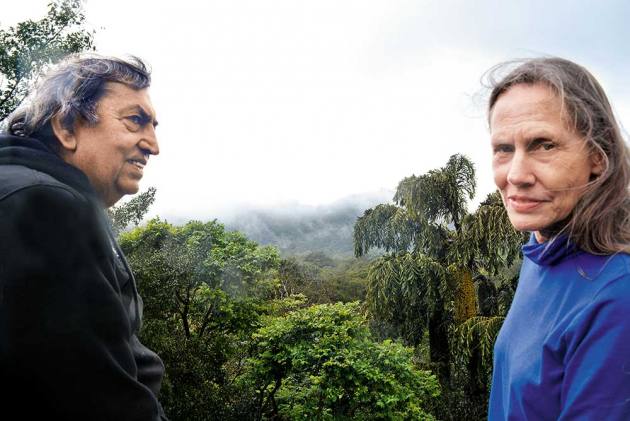
Foresters Anil and Pamela Malhotra have found peace among the coffee plantations of Coorg. Embracing nature has been their passion.
PHOTOGRAPH BY AJAY SUKUMARAN
Around four in the evening, after a late lunch, Pamela Gale Malhotra is standing at a bay window of her living room looking out at a picture-perfect landscape—a gushing stream in a rain-soaked forest with the abutting Brahmagiri hills framing the backdrop. It was about 25 years ago that she first stumbled onto this view. At the time, she was out scouting for a site for their home and had been hurrying up a hill trying to escape the rain and leeches when it struck her speechless.
The place is now more wooded than it was in 1995 when Pamela, 67, and husband Anil Malhotra, 78, built their home in south Coorg—in a coffee estate that had been listed. How they got here is quite a story, told amidst a primordial symphony—the burble of the stream and the call of the crickets.
Their first port of call in India was in the Himalayas in Uttarkashi along the Assi Ganga, where they stayed for nearly a decade before deciding to move south. After scouting through a few states, they finally found what they were looking for at the Brahmagiri foothills in Theralu—a remote plantation where they could raise a forest, as bizarre as it sounded to the folks around back then.
It might still sound like a nutty proposition, until you drive past the gates of the Save Animals Initiative (SAI) Sanctuary. Suddenly, you are in a thicket with a narrow driveway that meanders some distance to a garage and beyond that the dark peach walls of the Malhotra home. Around you is a 300-acre native rainforest through which the elephant and tiger freely saunter.
___________________________________________
“When you are away from Nature you aren’t thinking clearly…This is our passion.”
___________________________________________
Every morning, in more hospitable weather, Pamela and Anil set forth into this grove—their walks take an hour-and-a-half usually unless she’s checking on the dozen or so camera traps dotting the landscape, replacing batteries, swapping memory cards or switching locations. Over the years, Pamela has collected a mountain of data—otter, porcupine, leopard, sambhar, all kinds of species on video. Since it’s a wilderness—whatever remained of the coffee plants became humus for the trees—the couple merely follow the paths the elephants have cleared.
“We’ve set up this private model,” Anil tells Outlook. “We want other Indians who can afford it, we need even those who can’t, to join together to build this.”
The hills get covered up and the rain comes down. It’s been bucketing down all through the south-west monsoon this year, casting a gloomy outlook for coffee growers in Coorg. “When we came here, it was normal to have 350 inches of rain a year. Even if it was buckets of it, we had this,” says Pamela, pointing to the woods. “This is what the forest canopy is for. It’s like using an umbrella with pores in it, it’s going to break it up and slow it down.” But over the decades, Coorg’s forest cover has been dwindling. “The coffee plant is useless when it comes to retaining moisture…they have extremely small, shallow roots. We’ve warned people again and again, “don’t cut down your big native trees.””
The Malhotras put together their 300-acre sanctuary piece by piece, starting 1991, first by purchasing a 55-acre coffee estate. “Patches were cleared for coffee. So what we did was to fill up the patches with native trees,” says Anil. They planted jackfruit, Nandi, Rosewood, Matti and hundreds of fruit trees. “And, of course, the native trees come out way on top in absorbing carbon,” adds Pamela, pointing to sequestration studies which show that SAI Sanctuary acts as a carbon sink, helping the neighbourhood as well as providing a haven for the wildlife moving between the Brahmagiri reserve forests and Nagarahole national park, an hour away by road.
Down by the stream, a snake slithers away as we approach the water. Most days, the couple crosses over onto two rocks on a small island to meditate. “We were sitting on these rocks once and a matriarch elephant came up,” says Anil. It didn’t sound pleased, he recalls. “We kept sitting and mentally saying we have come in peace. They may not speak English but they know vibrations. She started eating the bamboo and then 8-10 members of the family came. They surrounded us for 45 minutes. It was such a beautiful experience.” Frequently, local people and the forest department bring them injured animals—dogs, cats, parakeets—which find a ready home.
Anil says it is possible for others to do what they did—buy land and restore forests—even if it’s difficult. “It can be done. People tell us “we haven’t made the money you made in America”. We bought at the right time. I can’t afford it today.”
Pamela and Anil met in the US in the early 1970s at her hometown, Red Bank, New Jersey, where he ran an Indian restaurant. She worked at an all-night cafe at Asbury Park, where a young Bruce Springsteen (then playing in a band called Steel Mill) would drop in to play sometimes during breaks from the music club upstairs.
“But Anil and I were on complete opposite sides of the political spectrum then,” she laughs. “I’ve always described it as fire and petrol…explosive encounters.” Mostly over the Nixon presidency and the anti-war movement. Soon after, she went back to college to study political science—the breaking-out of her conservative mindset of ‘materialistic Americana’ happened then. He sold up and followed her to Colorado, where they stayed for a few years, she working as a sales rep in a pharma company and he with a mortgage firm. The commissions he got were reinvested in real estate in Colorado and then in a forested patch in Hawaii, which they fell in love with on their honeymoon. The couple moved to India in 1986 to visit Anil’s ailing father and eventually settled in Uttarkashi where they wanted to recreate their wooded Hawaii home. The land ceiling regulations prompted the decision to look at plantation land in the south.
“I could have continued the real estate and all that in America, but what is the point of life then. I can’t take it after me,” says Anil. “I’d rather drink pure water and breathe fresh air than breathe carbon dioxide and be ill half the time and give all my money to doctors and hospitals.” Adds Pamela: “Being in Nature helps us physically. Kids today are being hot-wired by not having time out in Nature to play.”
Pamela, who received the Nari Shakti awards for her efforts in afforestation in 2016, has given numerous presentations across the country—including a recent one at the Apple facility in Cupertino while on her first visit to the US in 20 years—to raise awareness. She’s currently working on an autobiography titled From the Heart of Nature, slated for publication next year. “When you are away from Nature you aren’t thinking clearly,” says Anil. “Grow fruit trees, grow organic food…the demand far outstrips supply. We have planted thousands of native fruit trees now. Last year, we distributed thousands of saplings at schools and colleges telling them this is the future.”
The Malhotras, like successful permaculturalists, are mostly self-sufficient for most of the year. They rely on roof-top solar panels, installed in 1997—a year after the house was built. The patch next to the house is an organic food garden where most of their vegetables and salads come from. Pamela prefers cooking on biogas.
“Everything comes out of our pockets, except approximately two per cent in the form of donations if we are lucky,” says Pamela. Eco-tourism—they have four rooms for guests—helps meet expenses. “This is our passion, our life. So we have to keep things going. But there are things we’d love to do, like Payment for Ecosystem Services. We’d like to sponsor more organic farming,” says Pamela. “I cannot tell you how frustrating it has been trying to raise money for any of these programmes.”
The rain lets up for a bit, but the clouds hang low. Pamela and Anil climb up a wet, metal ladder to the rooftop for a sweeping view of their sanctuary. Pamela recalls a dream she once woke up with, years earlier. “I had seen a house on a small hill, overlooking a pond with the river flowing past in the middle of a wooded valley with white-capped mountains all the way around and a lot of wildlife. This was that view…those mountains are white-capped from the mist.” This was before they bought this place in Coorg. “I thought we’d find that in the Himalayas. But it wasn’t in the Himalayas, it was here. So, you never know.”
By Ajay Sukumaran in Coorg
source: http://www.outlookindia.com / Outlook / Home> Magazine> National> Cover Stories / by Ajay Sukumaran / November 21st, 2019
Deputy Commissioner Annies Kanmani Joy submitted a proposal to the Principal Secretary of the Revenue department on reorganising the villages in Virajpet and adding them to the soon-to-be declared new taluk– Ponnampet.
A detailed list, comprising of the demarcated hoblis, villages and forest lands from Virajpet taluk, had been drafted for final approval.
The new Ponnampet taluk will comprise of 18 villages, 11 sub-villages, four forest areas in Ponnampet hobli limit, nine villages, one sub-village, one forest area in Balele hobli, 12 villages, 4 sub-villages, one forest area in Srimangala hobli, 10 villages and 6 sub-villages in Hudikeri hobli.
As many as 21 out of the 34 gram panchayats in Virajpet taluk are proposed to be appended to the new taluk.
A total of 2,23,507 acres of forest land from Devamacchi, Nagarahole and Brahmagiri forest areas, will be added to Ponnampet taluk. The new Ponnampet taluk with 49 villages will have a population of 1.30 lakh people. Around 100 primary schools, over 50 high schools, 15 PU colleges, two polytechnics, one ITI and one-degree college will be added to the new taluk.
Ponnampet’s history
Earlier, Ponnampet was a taluk centre, named as Kiggattunadu. The nameplates of the government model primary school is still Kiggattunadu. In 1800, Diwan Ponnappa founded Ponnampet town, combining the villages in Halligattu and Matturu. Ponnampet was named after the Diwan.
Ponnampet also has the distinction of hosting Mahatama Gandhiji’s programme. Ponnampet is recognised as the cultural center of Southern Kodagu. Except for the office of Tahsildar, all taluk level government offices are situated in Ponnampet, making it the obvious choice for the taluk centre.
Ponnampet houses a court, treasurer, Taluk Panchayat office, Sub-divisional office of PWD, offices of the departments of social welfare, backward classes welfare, horticulture, Nadakacheri, office of the DCF and other government offices.
The new Ponnampet taluk, on becoming a reality will be easily accessible to the bordering villages of Balele, Nitturu Karmadu, Kutta, Birunani, Parakatageri and Teralu, villagers added.
source: http://www.deccanherald.com / Deccan Herald / Home> State> Mangaluru / by DHNS, Gonikoppa / November 14th, 2019
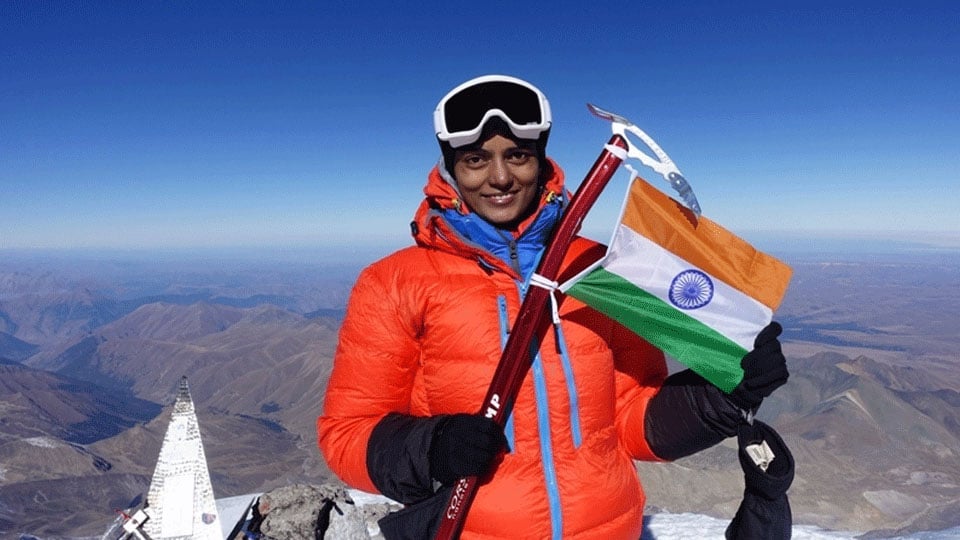
After pegging the National Flag atop Mount Elbrus, the highest mountain in Russia, T.N. Bhavani of Kodagu has one more feather in her cap in being the first Indian woman to have undergone training at the Mount Ruapehu, an acclaimed Stratovolcano in New Zealand.
Bhavani is the daughter of Thekkada Nanjunda (Shambu) and Parvathi (Divya) of Perur village near Napoklu in Kodagu. While studying at Navodaya Vidyalaya, Bhavani joined NCC which paved way to groom her interest in adventure activities.
Having got trained in swimming, horse-riding and mountaineering, Bhavani recently completed a three-month training in skiing at Mount Ruapehu in New Zealand and has been qualified as an International Skiing Instructor and is eligible to undergo advanced training in South Korea.
Mount Ruapehu is a Stratovolcano or a composite Volcano formed by alternate layers of hardened lava and ash.
They are characterised by a very steep profile and periodic explosive emissions. Getting trained in skiing at such mountains is not easy and Bhavani has come out successful in the training in September.
Road to success
Bhavani, having completed her primary education at J.C. School in Srimangala in South Kodagu, finished her secondary education at Jawahar Navodaya School in Galibeedu, Madikeri taluk. She graduated from St. Agnes College, Mangaluru and had worked as an Instructor at Himalaya Mountaineering Institute, Darjeeling.
Having attended many NCC camps at school and college, Bhavani had participated in the Republic Day Parade in Delhi in 2016.
She participated in the All India Vayu Sainik Camp held recently in Jodhpur, Rajasthan and won accolades from NCC Director General Lt. Gen. Anirudh Chakravarthy, Karnataka-Goa NCC Deputy Director General Air Commander C. Rajiv and former Chief Minister Siddharamaiah.
She got trained in mountaineering at Atal Bihari Vajpayee Institute of Mountaineering and Allied Sports, Manali and Himalaya Mountaineering Institute, Darjeeling. She underwent skiing training in Gulmarg, Kashmir and further in New Zealand.
Bhavani is acclaimed as the first woman to successfully complete the tough First Grade Training at Himalaya Mountaineering Institute climbing tough peaks like Friendship in Manali and others in Uttarakhand, Sikkim and Leh.
She reached the top of Mount Elbrus in 2018 after climbing for 8 hours continuously and was adjudged the first to reach the peak among four mountaineers from various countries.
source: http://www.starofmysore.com / Star of Mysore / Home> News / November 11th, 2019
Sanjay Saini, assistant public relations officer, has won this year’s National Award for Excellence in Journalism.
Saini, former correspondent of Dainik Bhaksar in Mandi, will get 2019 National Award under the rural journalism category jointly with Raj Chengappa, former Editor-in-Chief of The Tribune and currently Group Editorial Director of India Today.
Saini said the award would be given at a function being held on National Press Day on November 16 at Vigyan Bhawan, New Delhi.
The other recipients includes Gulab Kothari, Chairman of Rajasthan Patrika, a leading newspaper of Rajasthan. — TNS
source: http://www.tribuneindia.com / The Tribune / Home> Himachal / November 09th, 2019
Army Training Command General Officer Commanding-in-Chief Lt Gen P C Thimayya visited the under-construction General K S Thimayya Museum in Madikeri on Saturday.
Army Training Command General Officer Commanding-in-Chief Lt Gen P C Thimaya visited General K S Thimayya Museum, which is under construction, in Madikeri on Saturday.
Sunny Side, the residence of late General K S Thimayya is being converted into a museum.
Speaking on the occasion, Lt Gen Thimaya said, “Converting a house to a museum is a challenging job.”
Field Marshal Cariappa and General Thimayya Forum convener Major B A Nanjappa explained about the work.
He appealed to Lt Gen Thimmayya to make efforts to hand over the uniform, war equipment of General Thimmayya to the museum.
source: http://www.deccanherald.com / Deccan Herald / Home> State> Mangaluru / by DHNS Madikeri / November 09th, 2019
City-based NR Group organised NR Golf Open Championship 2019 at Mercara Downs Golf Club, here recently. A total of 75 golf enthusiasts participated in the tournament conducted in eight different categories. The tournament was teed-off by I.K. Anil, Captain, Mercara Downs Golf Club. Dwarakanath, National Sales Manager, Cycle Pure Agarbathies presented the trophies to the winners. Harish Appanna, Hon. Secretary, Mercara Downs Golf Club, Tournament Convenor K.P. Ranjith were present.
The Golf Championship witnessed golfers from Mysuru, Bengaluru, Kodagu, Chikkamagaluru, Ooty and Kodaikanal vying for the titles. Below is the list of winners.
K.P. Ranjith receiving the Runner-up Rolling Trophy
Open Strokeplay: Rolling Trophy donated by NR Group: Winner – Amogh Devaiah 75, Runner Up – K.P. Ranjith 76.
Net Strokeplay (0-18): Rolling Trophy donated by NR Group: Winner – Faiz Moosa Kutty 63 Nett, Runner Up – Rahul Kuttappa 66 Nett.
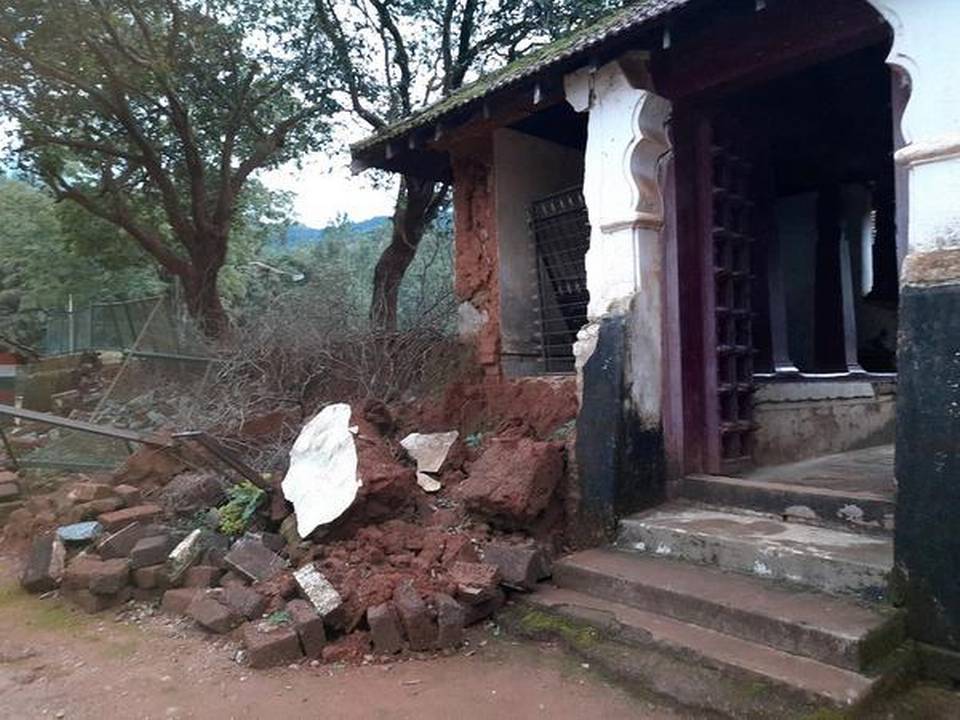
A portion of Nalknad Palace in Kodagu district collapsed a few weeks ago following torrential rains. | Photo Credit: M.T. Shiva Kumar
There is no sign of restoration work being taken up by the ASI.
Nalknad Palace, at the foot of the dense Tadiandamol, the highest peak in Kodagu district, once stood as a symbol of elegance, architecture and style. Today, it is crying for protection.
The two-storeyed building with historical significance, which is also known as Naalnaad Aramane, was built between 1792 and 1794 AD to commemorate the victory of Haleri king Dodda Veera Rajendra over Tipu Sultan. It has precious murals, pillars, various wooden carvings, dark rooms [or hiding rooms], secret passages, bathrooms and galleries of the 18th and 19th centuries.
A portion of the palace collapsed a few weeks ago following torrential rains. There is no sign of restoration works being undertaken, according to sources in the Archaeological Survey of India (ASI). An ASI source said repair work can be taken up only after the rains subside fully. As such, the chance of miscreants damaging the precious artefacts and structures at the palace is high, as the lone caretaker leaves after closing time (6 p.m.).
Hiding place
According to the ASI, Dodda Veera Rajendra decided to construct the palace at Yavakapadi at the foot of Tadiandamol as the place was thickly wooded. Although he won a battle against Tipu, he was still under the threat of enemy troupes. The legendary ruler saw the need for constructing an elegant structure with safety features in the dense forest area to use as a hiding place. Thus, Nalknad Palace was built, according to a history lecturer in Hunsur.
A sign put up outside the palace gives brief details of the building, including that Dodda Veera Rajendra built it to protect his family from enemies.
He married again in 1796 to Mahadevamma at the same palace and lived there until she died in 1807. An elegant wedding mantap, constructed for his marriage, still exists there and is the cynosure of all eyes arriving at the palace.
It was also the hiding place and last residence of Chikka Veera Rajendra before he surrendered to the British in 1834 AD.
The palace was a rendezvous point for miscreants till a few years ago, before the ASI took it under its wing. Later, the palace was restored. Unfortunately, irreparable damage has been caused to the murals and paintings on the walls, according to ASI sources.
The Haleri kings might have left precious artefacts at the palace when they deposed to the British. Sources say the artefacts might have been shifted elsewhere or stolen.
According to the visitor register, footfall at the palace is sometimes nil and at other times reasonable.
source: http://www.thehindu.com / The Hindu / Home> News> States> Karnataka / by M. T. Shiva Kumar / Mandya – November 04th, 2019
WELCOME. If you like what you see "SUBSCRIBE via EMAIL" to receive FREE regular UPDATES.
Read More »