Category Archives: Records, All

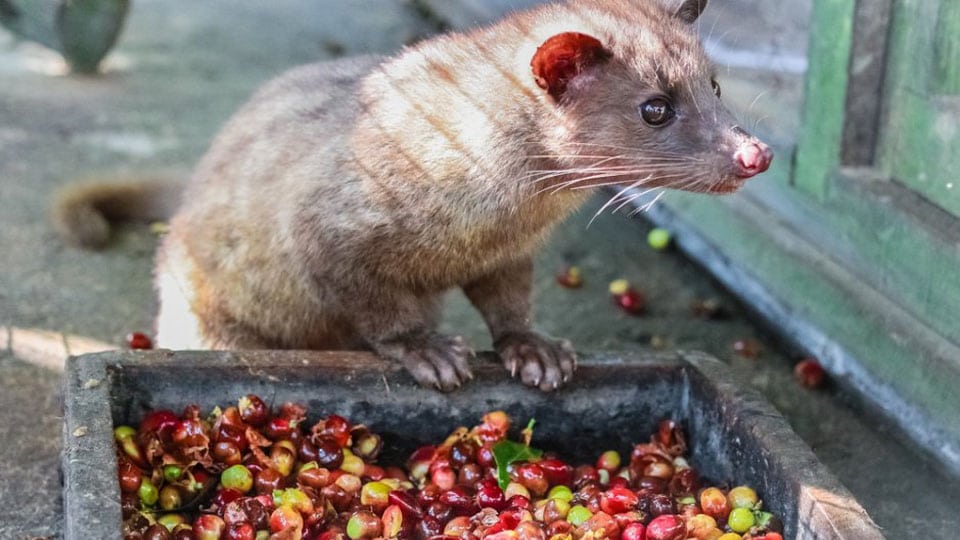
Coffee Board Courts Cat Poop Controversy

– Issues notice to producer of Civet Cat Coffee in Kodagu; files
Police complaint

– Plaint closed as there is no evidence of cats being reared and
tortured for poop
CivetCatKF26may2019

Mysuru:

The Coffee Board has issued notice to Coorg Consolidated Commodities regarding what it calls ‘unauthorised sale of Civet Coffee’. The notice has been issued by Deputy Director, Extension, Coffee Board, to Thamoo Poovaiah who markets Civet Coffee in Kodagu.

India, Asia’s third-largest producer and exporter of coffee, has been producing the world’s most expensive coffee, made from the poop of Civet Cat, on a small scale in Kodagu district. The Civet Coffee, also called as Luwark coffee, is expensive because of uncommon method of producing such a coffee. It is produced from the coffee beans digested by Civet Cat.

The faeces of this cat are collected, processed and sold. It is highly priced because it is claimed to be more nutritious and high cost involved in sourcing the animal dropping, wastage during processing and quality certification.

The Coffee Board notice, the copy of which is with Star of Mysore, states that the sale of Civet Coffee is banned under Wildlife Act. “It is surprising how can you brand and sell Civet Coffee when you don’t own wild cats in your estate. You are procuring raw coffee in the form of faeces of wild cats which is sold by persons who are known to you,” the notice states.

The Coffee Board has asked Thamoo Poovaiah, who is the managing partner of Coorg Consolidated Commodities that markets the Civet Coffee in brand Ainmane, to provide the names and addresses of those persons who supply Civet Coffee to him.

Police complaint

In addition to sending a notice, the Coffee Board also filed a complaint against Thamoo Poovaiah with the Kodagu SP for allegedly rearing Civet Cats to produce Civet Coffee. The complaint mentions that a well-known animal rights activist has alleged that worldwide, Civet Cats are confined and force-fed coffee cherries for them to produce poop. The complaint alleges that even Thamoo Poovaiah rears Civet Cats in confinement to produce the expensive coffee. Rearing such cats in cages is illegal and punishable under Wildlife Act as it is one of the most endangered species in the world.

Complaint closed

Following the complaint, the case was transferred to Madikeri Rural Police Station and the Police, armed with a search warrant issued by Madikeri Additional Civil Judge and JMFC Court, conducted an inspection of Poovaiah’s estate near Kadagadalu along with Coffee Board and Forest Dept. officials. The team discovered that Civet Cats are not reared at the estate and the case has been closed now and the same has been communicated to the Court.

Reacting on the Coffee Board notice and the subsequent lodging of the case, Poovaiah told SOM that his firm procures Civet Cat poop through legal means and in no way the endangered species are confined and tortured as alleged by Coffee Board.

‘False and malicious complaint’

“This is a false and malicious case. If at all there is a violation in the Wildlife Act, the Forest Department must take action. Why is Coffee Board involved in this? Actually, Coffee Board should be promoting rare coffee produce such as Civet Coffee which are famous worldwide rather than harassing growers who are popularising such exotic coffee,” he said.

“In reply to the Coffee Board notice, I have set them a legal notice asking clarification on their move and how could they act autocratically in collusion with some animal rights activist that they have not named. Their move to lodge complaint and search my premises will amount to defamation and I am ready to take them on in the Court of law,” Thamoo Poovaiah added.

source: http://www.starofmysore.com / Star of Mysore / Home> News / May 25th, 2019
25-Member NDRF Team Arrives In Kodagu From Vijayawada

Forces begin field work; to train people how to save themselves in case of sudden disaster

NdrfKF26may2019

Madikeri:

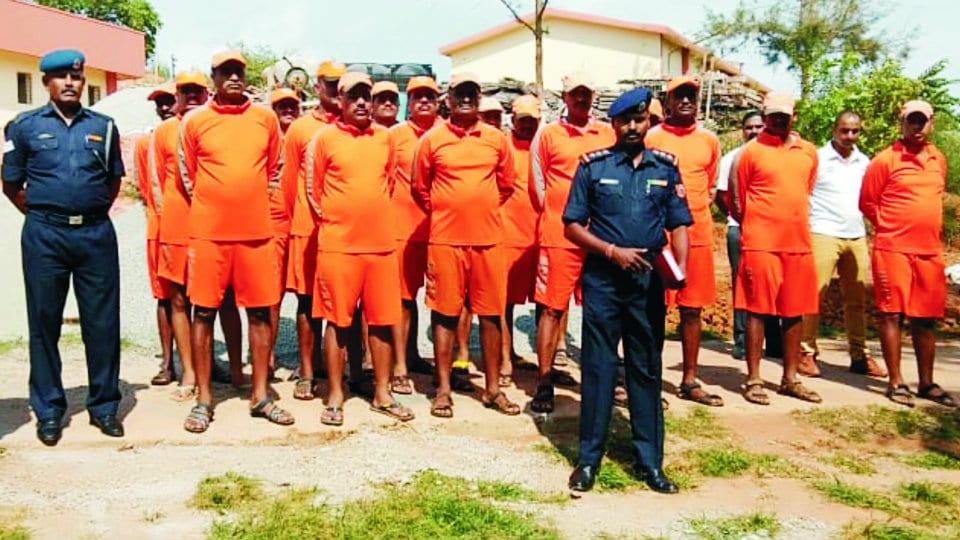
To instil confidence among people of Kodagu that the Central and State Governments will be with them in case of a repeat natural disaster this year and as a precautionary step even before the arrival of monsoon, a team of National Disaster Relief Force (NDRF) has already arrived in Kodagu.

The 25-member NDRF team from B/10NDRF Vijayawada in Andhra Pradesh is camping at Jawahar Navodaya Vidyalaya at Galibeedu in Madikeri. Along with NDRF, teams from State Disaster Response Force (SDRF), Army’s Dogra Regiment and Civil Defence are expected to reach Kodagu soon.

As of now, two NDRF teams have been deployed in Karnataka. While one team is already in Kodagu, the other team is stationed at New Mangalore Port in Mangaluru. In case of emergency like last year, the NDRF Mangaluru team can reach Kodagu in short notice.

The NDRF team is led by Commander Veluru Ramesh and also includes members from Bengaluru and Dharwad. Ramesh said that the Kodagu District Administration had requested the team to camp in Kodagu for at least three months as a precautionary measure. Their stay will be extended depending on the scale of the disaster.

Last year in August, the NDRF and SDRF teams did enormous relief and rescue operation though it took time for their deployment as the catastrophe was sudden and was in an unprecedented scale. Before the arrival of Central Forces, the District Police and the Fire Service Department had carried out rescue operations and they could do only small-scale rescue works as they are not well-equipped. Not taking any chances, this year, the NDRF team has been stationed even before the onset of Southwest monsoon.

On May 29, the NDRF team will visit flood and landslide-prone areas including Makkandur, Hebbatageri, Madapura, Hattihole, Kaloor, Jodupala, Monnangeri, Mangaladevinagar, Thantipaala and other areas and will train people to save themselves and their livestock in case of a disaster.

The team will start field work during monsoon on priority basis and according to Commander Veluru Ramesh, more teams will be deployed in Kodagu based on the intensity of floods and landslides.

“Before a natural disaster strikes, Nature will give signals of it that can be captured through scientific methods. People must be moved to safe areas and the loss of life can be minimised or eliminated,” Ramesh said.

Another member of the team, Doddabasappa, who hails from Dharwad, said, during the heavy landslides on Makutta Road connecting Kerala State, the team had cleared the fallen trees and rubble. He said his team had participated in the rescue operation during the Fani cyclone in Odisha. Joint mock rescue operations will be conducted alongside the local Departments as per the direction given by Kodagu Administration, he said.

Such disaster management teams are formed by picking people from the nation’s Paramilitary Forces and are trained to rescue people and livestock during natural calamities. Apart from ensuring the nation’s security, such teams also protect people from unforeseen circumstances, he added.

source: http://www.starofmysore.com / Star of Mysore / Home> News / May 26th, 2019

Football tourney from May 24

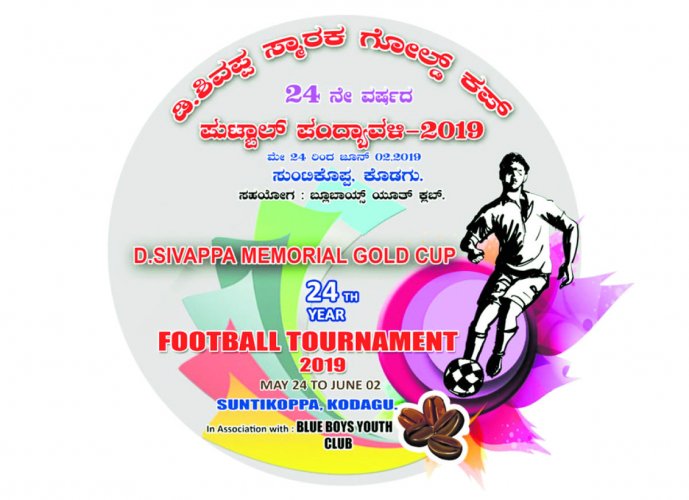
Logo of D Sivappa Memorial Gold Cup Football Tournament 2019.

D Sivappa Memorial Gold Cup Football Tournament 2019 organised by Blue Boys Youth Club will be held at the grounds of Government Primary School grounds in Suntikoppa in Kodagu from May 24 to June 2.

Bettageri estate owner late Doddamane Sivappa’s grandson and D Vinod Shivappa’s son Vishal Sivappa will flag off the tournament. He is the chief patron of the tournament.

Consumer Forum Hassan President A Lokesh Kumar, Kushalnagar DySP Dinakar Shetty and patron D Vinod Sivappa will be part of the inaugural session.

D Sivappa was one of the main patrons of football tournaments in Suntikoppa. After him, his son D Vinod Sivappa initiated a football tournament through Blue Boys Youth Club in loving memory of his father every year and has been sponsoring the trophies and cash prizes. Several philanthropists are behind the success of the football tourney in Suntikoppa, a press release said.

D Vinod Sivappa is sponsoring a cash prize of Rs 30,000 to the winning team, Rs 20,000 to the runners-up team, trophies and also other individual prizes.

At Kunde Habba, people have fun hurling abuses

Bawdy abuses filled the air across villages of South Kodagu as ‘Kunde Habba’, a unique tribal festival kickstarted on Wednesday.

Smeared in mud and cross-dressed, members of the Kuruba community hurl abuses at all passersby while celebrating Kunde Habba (Photo | EPS)

Madikeri :

Bawdy abuses filled the air across villages of South Kodagu as ‘Kunde Habba’, a unique tribal festival kickstarted on Wednesday. An annual festival of Kuruba community of Kodagu, the fiesta is celebrated across villages of Thithimathi, Balele, Balegundi, Maldare and many others. The highlight of this festival is participants hurling vulgar abuses and collecting alms.

“The annual festival is celebrated from May 22 to 24. The final ceremony will be held at Bhadrakali Temple in Devara Kadu (sacred grove) at Thithimathi. It is an ancestral ritual celebrated by the Kurubas,” Bacharaniyanda Appanna, a historian, said.

“The festival is called Kunde Habba as people hurl abuses in abundance. They are abusing and describing their Goddess Bhadrakali. People used to pray for protection of sacred groves and in return held an annual pompous celebration, thanking the deities – Bhadrakali and Aiyappa. The Kurubas believe that abusing the goddess will please her,” Appanna added.

Smeared in mud and cross-dressed, people visit houses in the village, collecting alms. While rice, hens and money were earlier collected as alms, collecting money is the basic ritual now. “Half the money collected goes into buying alcohol and the rest goes to the temple collection box. The bigger hens that are received are sacrificed and later feasted upon at the temple and smaller chickens are taken home and reared,” Appanna said.

source: http://www.newindianexpress.com / The New Indian Express / Home> States> Karnataka / by Prajna GR / Express News Service / May 23rd, 2019

First General Elections In Coorg-1951 …Remembering The First Parliament Elections

PoonachaKF22may2019

Coorg, or Kodagu, was a province of the dominion of India and was declared as a State in 1950. Daya Singh Bedi, ICS, was appointed as the Chief Commissioner of Coorg.

Just before the General elections of 1951, Coorg was offered the choice of either remaining a State or joining the Presidency of Mysore. While many Congressmen were in favour of merging Coorg with Mysore, there were some others who favoured the alternate choice.

The latter group of leaders broke away from the Congress and formed a new party with “Weighing Scales” as their symbol. They aptly named themselves the Thakkadi Party.

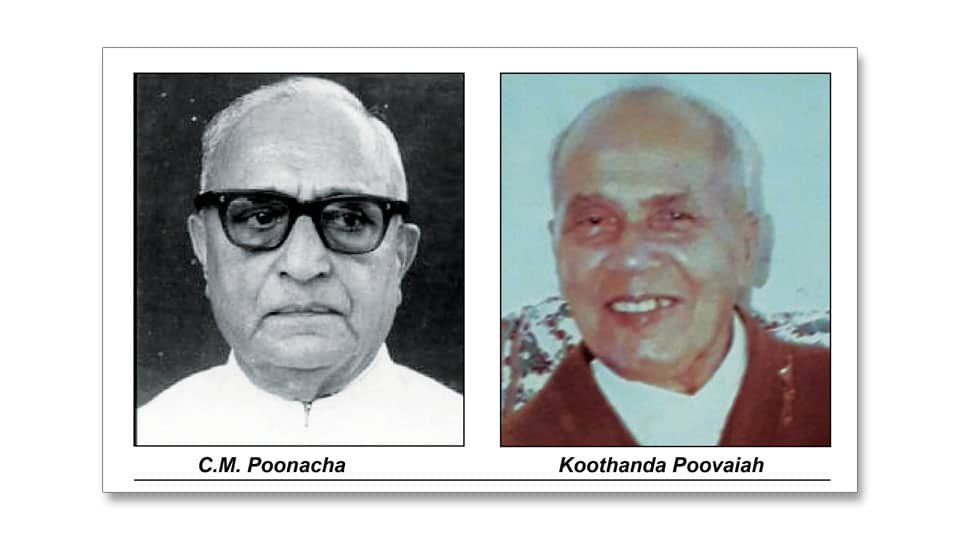
Pandiyanda Belliappa was the leader of the Thakkadi party and my father, Koothanda Poovaiah, also joined him. So, the election fever gripped our family as well.

My father would canvass in a jeep along with his followers in Pollibetta and Siddapur. The contest in Coorg was for 24 seats from 18 constituencies. Six constituencies were to elect two members each and the remaining 12 were single-member constituencies. There were no reserved seats, though there were 4 members from the SC category who contested under the General category. I recall that 27,947 people across Coorg voted in the elections.

While campaigning for my father, teams would visit the homes of the voters each day and collect their names and other details. My siblings and I were tasked with transferring these details to postcards which were then sent to the voters’ home addresses. These postcards were meant to identify voters on Election Day, a precursor to laminated voter identity cards of today. We enjoyed writing these postcards. I fondly remember being gifted a “Swan” pen by my father for my efforts.

Among the candidates from Siddapur were Muruvanda Machaiah and Betta Kurubara Kala. To our disappointment, our father lost the election and Muruvanda Machaiah won.

For me, it was an interesting involvement with the electoral process. Thereafter, I married into the Army and had to be content with sending postal ballots. It would be more than 30 years before I stepped into a polling booth again.

In the Coorg Assembly elections, the Congress party won 17 seats while the Thakkadi party won the remaining 7 seats. The Coorg Legislative Assembly was convened at Madikeri by the Chief Commissioner on 27 Mar 1952. Cheppudira M. Poonacha was elected as the Chief Minister of Coorg.

He also held the Finance portfolio. K. Mallappa was made the Home Minister.

The Congress party was in favour of merging Coorg with Mysore. In accordance with the States Reorganization Act 1956, Coorg ceased to be a State and was merged with Mysore on Nov 1, 1956.

While in existence, the State of Coorg sent an elected representative to the Parliament as well. Niddemane Somanna was the MP from Coorg. After the reorganization of States and subsequent delimitation of Parliamentary constituencies, Coorg and Mangalore were merged into a single constituency. More recently, Coorg was merged with Mysore LS constituency.

It is a matter of conjecture whether Kodagu and its people benefited from the historical changes brought upon it. However, its contribution towards nation-building has been significant and shall remain a matter of pride and fulfilment.

First Parliament elections

I am struck by a bout of nostalgia each time our country goes to the polls. There have been discussions about the lengthy election process this time around, consisting of seven phases and extending over four weeks.

Here, it is appropriate to recall that the first general election was conducted from Oct. 1951 to Feb. 1952, a period of six months. However, it is to be remembered that India was newly independent and conditions were very different.

The government of the day set up the Election Commission of India with Sukumar Sen, ICS, as the Chief Election Commissioner. He was given the mandate to conduct the Parliamentary election and all Assembly elections simultaneously “at the earliest”. The earliest dates proposed by Sen were between Oct. 1951 and Feb. 1952.

A massive enrollment drive was undertaken to prepare a list of the electorate. It is to be understood that in an era with rudimentary means of travel and communication, the exercise was an onerous one. The wide reach of All India Radio was utilised to create awareness about the impending elections and the importance of participating in them. As a part of the enrollment drive, volunteers and officials visited individual houses. The eligible voting age was fixed at 21 years and there was no discrimination between the sexes.

Quirky situations arose which made the task difficult. It must be remembered that 88 percent of our country was illiterate. Womenfolk were reluctant to reveal their given names and had to be coaxed to do so. Due to the overwhelmingly illiterate population, each booth had a set of ballot boxes with the party symbol pasted on them. The voter was advised to drop his ballot paper into the box of his choice; so much for a secret ballot!

Despite several handicaps, it was ensured that 45% of the registered electorate exercised their franchise by Feb. 1952.

Our country has been through 17 Parliamentary elections so far and the electoral process has been extremely streamlined. Modern ideas and technology have been employed to quell new challenges.

The modern Indian electoral process has been lauded by several countries and serves as a role-model to many of them. We should be proud of this achievement.

source: http://www.starofmysore.com / Star of Mysore / Home> News / by Shanthi Ganapathy / May 22nd, 2019

Bike riders take a voyage to Himalayas

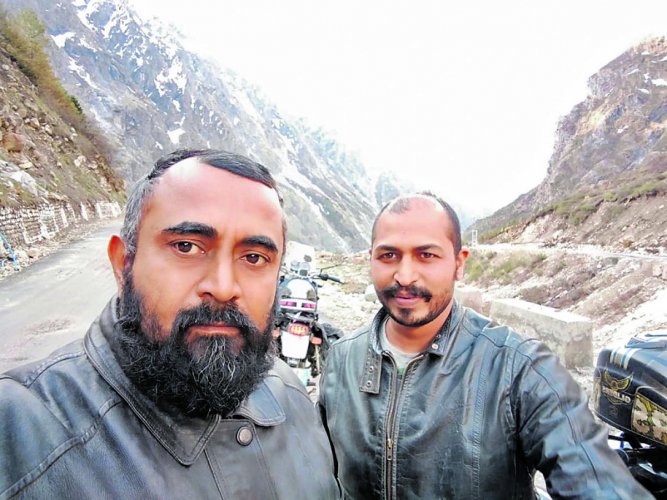
Bikers Ranjith Kiggal and Kashyap Mekeri.

Ranjith Kiggal and Kashyap Mekeri from Kodagu have successfully undertaken a bike voyage to the Himalayan region.

The bike ride named ‘The ride of life Part-2’ kick-started in front of General Thimayya statue in Madikeri on April 14. After the completion of the ride, the duo has returned to Madikeri.

Ranjith and Kashyap have visited Nainital, Badrinath in Uttarakhand and the Himayalan regions, on their Royal Enfield bike.

The distance covered by them was approximately 6,200-km and the preparation began three months ago.

Both of them got in touch with bike riders who had already visited these places by bike. They took the Madhurgiri-Anantapuram-Hyderabad-Nagpur-Jhansi-Bareli route to reach Nainital in Uttarakhand on the sixth day of their ride.

In the course of their journey, they visited Jhulaghat on India-Nepal border and also Rishikesh and Haridwar. From Haridwar, they took the route of Mathura-Agra-Shirdi-Satara-Belagavi-Davanagere-Hassan to return to Madikeri.

Rider Ranjith Kiggal said that they had a fresh experience in visiting these places. They encountered a different atmosphere, people and culture on the route.

Appanderanda Yashwant Kalappa guided their tour, he added.

source: http://www.deccanherald.com / Deccan Herald / Home> State> Districts / by Adithya K A / DH News Service,Madikeri / May 20th, 2019

Project Radio Collar Launched To Track Elephants In Kodagu

ProjectCollarKF19may2019

Siddapura:

Concerned at the increasing instances of elephant-human conflict, the Forest Department, for the first time in Kodagu, has put radio collars on elephants to study their migration patterns.

The Department has decided to put radio collars on selected elephants so that their migration patterns can be studied. An analysis of their movements will help in avoiding human-elephant conflict that results in deaths of humans and damage to crops, said Department officials.

Accordingly, over six elephants that usually enter coffee estates and fields have been radio-collared in places including Virajpet, Madikeri, Kushalnagar, Maldare, Ammathi & Pollibetta. These areas have witnessed increased elephant attacks in the recent past.

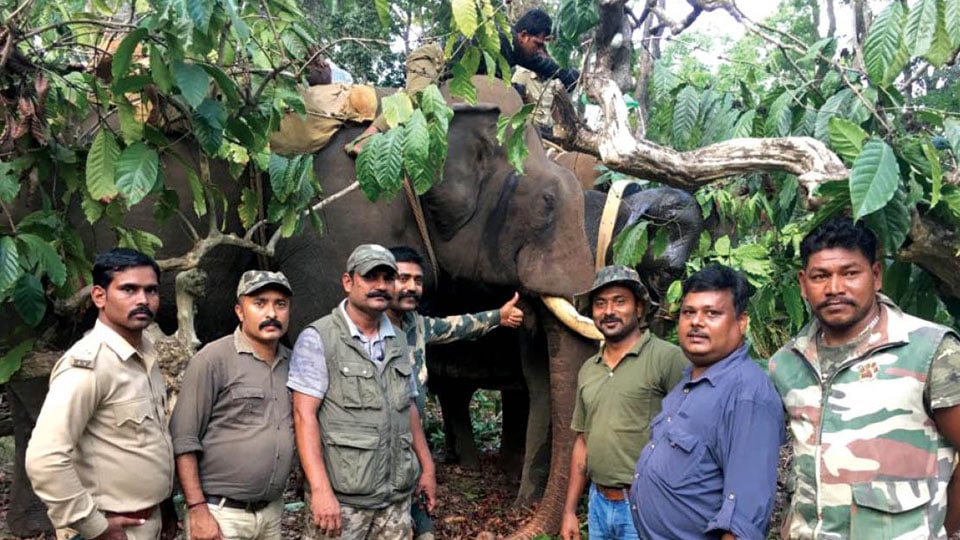
The collars were fitted on the wild pachyderms with the help of tamed elephants including Bhima, Abhimanyu and Krishna. Last time, over four collars were fitted on the elephants and the Department staff was able to successfully track the elephant movements and prevented them from entering the human habitats.

Department officials said that radio collars could further strengthen the elephant corridor management strategy. It could also become an early warning system for villagers in order to avoid conflict with elephants as the collars could provide real-time information. Radio-collaring of animals is a tried and tested method of studying free-ranging wild animals that has been in practice for several decades. It is primarily used for tracking the movement and activity patterns of the tagged animal, with the signals being sent to a handheld device or to a computer via a satellite.

It is often the only method that is available for studying the movement and activity patterns of a secretive species like the tiger or a wide-ranging species like the elephant. Information obtained from the use of radio telemetry is of high scientific and conservation value. The GPS-enabled radio collars will provide updates in real-time about the location of a herd and help track them within the State as well as during migration. A tool embedded in the collar will send signals 24X7.

“Once we receive signals on the presence of the elephant herd near human habitation, the ground-level Rapid Response Team of the Dept. will be alerted on their mobile phones so that they can rush to the place and launch an operation to drive elephants back into the woods,” said District Forest Officer Maria Kristhu Raj.

The kumkis (tamed elephants) will infiltrate the herd and scatter the elephants. When the female leader is isolated, the experts perched on the nearest kumki will shoot her with a dart loaded with a tranquillising drug called xylazine. The dosage will be decided according to the size and strength of the matriarch. “After being hit, the elephant will walk like it is intoxicated for 10 minutes and then it will fall asleep. So, our men have a window of about 40 minutes to put the radio collar on the elephant,” he explained.

“In the 40 minutes the animal was under sedation, the team fixed the radio collar and activated it. Soon, veterinarians injected a drug to revive it. The entire operation was over in 50 minutes and the animal started heading back into the forests,” the DFO added.

source: http://www.starofmysore.com / Star of Mysore / Home> News / May 14th, 2019

Two-day DC interview on Madikeri AIR

Deputy Commissioner Annies Kanmani Joy will be interviewed on All India Radio, Madikeri, on May 17.

The deputy commissioner will speak on the relief measures, compensation and future projects being planned by the district administration.

The programme will be broadcast on May 17 (8.35 am and 5.30 pm) and May 18 (1.30 pm and 6.50 pm), a press release stated.

source: http://www.deccanherald.com / Deccan Herald / Home> State> Mangaluru / by Adithya K A / DH News Service, Madikeri / May 17th, 2019

Field Marshal KM Cariappa 26th Death Anniversary: Remembering First Commander-in-Chief of Indian Army

Field Marshal KM Cariappa (Photo Credits: indianarmy.nic.in)

Field Marshal Kodandera Madappa Cariappa breathe his last 26 years ago on May 15, 1993. He was the first Indian Commander in Chief of the Indian Army. Cariappa took command of the Army from its British Commander in Chief, General Sir Roy Bucher. He was also nicknamed “Kipper”. Cariappa was born on January 28, 1899, in Madikeri, Kodagu which is today part of Karnataka.

Field Marshal Criappa had his formal education in Madikeri and pursued his college education from the prestigious Presidency College in Chennai. Cariappa joined the British Indian Army in 1919 and was commissioned in the 88th Carnatic Infantry at Bombay (now Mumbai) as Temporary Second Lieutenant. He was granted permanent commission on September 9, 1922. In 1927, he was promoted to the rank of Captain.

During the World War–II, Field Marshal Cariappa actively served in Iraq, Iran and Syria in 1941–1942 and then in Burma in 1943–1944. Back in India in March 1942, he was posted as second-in-command of the newly raised 7th Rajput Machine Gun Battalion at Fatehgarh. Cariappa was posted as AQMG of the 26th Indian Division stationed at Buthidaung in Burma. The division played an important role in pushing the Japanese back from Arakan. For his services in the operation, Cariappa was awarded the Order of the British Empire (OBE) in June 1945.

In the same year, Cariappa was made the commander of the Bannu Frontier Brigade in Waziristan. During this period, Colonel Ayub Khan – later Field Marshal and President of Pakistan from 1962–1969 – served under him. In 1947, Cariappa was the first of two Indians selected to undergo training at the Imperial Defence College, at Camberly, in the UK, to attend the higher command courses.

After Independence, He was promoted to the rank of Major General and was appointed as deputy chief of the general staff. In November 1947, Cariappa was appointed as the Eastern Army commander after being promoted to a rank of Lieutenant General. As the situation worsened in Kashmir in 1947, Cariappa was moved as General Officer Commanding-in-Chief, Western Command. He directed operations for the recapture of territories seized by Afghan tribals backed by the Pakistani Army.

On January 15, 1949, Cariappa, took over the reins of the Indian Army. The day is now celebrated in India as the Army Day. He served in the Indian Army for over 30 years. After his retirement in 1953, he served as the Indian high commissioner to Australia and New Zealand until 1956. On April 28, 1986, the Government of India conferred the rank of field marshal on Cariappa. He was the second Field Marshal of the Indian Army after Sam Manekshaw. Cariappa’s health began to deteriorate in 1991. He suffered from arthritis and heart problems. He died in his sleep on May 15, 1993, at the Bangalore Command Hospital.

Cariappa was married in March 1937, in Secunderabad, to Muthu Machia. The couple had a son and a daughter. Their son, K.C. Cariappa also known as “Nanda”, joined the Indian Air Force and rose to the rank of air marshal. During the 1965 war, Nanda was shot down over Pakistan. He was captured and held as a prisoner of war (POW). After realising the identity of the captured IAF officer, General Ayub Khan, the then president of Pakistan himself contacted Cariappa to inform about his son. When Ayyub offered to release Nanda, Carriapa asked him to give his son no better treatment than any other POW. Field Marshal Carriappa was a recipient of Indian Independence medal, Burma Star and General Service Medal.

source: http://www.latestly.com / LatestLY / Home> Lifestyle> Festivals Events / by Team LatestLY / May 15th, 2019

Bollinamme fest on June 8

‘Bollinamme’ programme to mark the silver jubilee celebrations of Karnataka Kodava Sahitya Academy, will be held at Cauvery College in Gonikoppa on June 8, said Academy president Pemmanda K Ponnappa.

Speaking during the launch of the Bollinamme logo at the Academy’s office in Madikeri, he said that for the last 25 years, the Academy had been doing a commendable job in preserving the language, literature, history and culture of the Kodava community with the help of the government grants.

He said that the Academy was holding programmes within and outside the district focused on the Kodava tradition, folklore, culture, theatre.

“The Academy has been successful in publishing books and CDs. An effort is being made to document the life of a Kodava from birth to death,” he added.

Fest attractions

Stating that Bollinamme would feature cultural, literary programmes and a procession, Ponnappa added that a photo exhibition and documentary screening (on Kodava culture) would be some of the attractions of the fest.

“Kodava antiquities will be displayed. Kodava cuisine and Kodava books will be on sale,” he added.

The programme would be inaugurated with a procession at 9 am. It will be followed by a meeting at 10.30 am.

Cultural programs such as Umathaat, Bolakaat, Kathiaat, Duddikott, Kolaat, Urtikott, Talipaat, Kappekalli will be performed by artistes.

It will be followed by a special performance by Kodava theatre artists in the evening at 5 pm, he said.

A poetry meet is scheduled at 11 am. The valedictory ceremony will be held at 2 pm, he added.

The publicity committee members are Naliyamanda K Umesh, Itichandanda Ramesh Uthappa, Beekachanda Beliappa, the stage committee members are Hanchetira Manu Mudappa, Shorerea Mudaiah and Mannakamane Balakrishna.

Hospitality and transport committee members constitute of Mannakkemane Balkrishna.

Procession committee member is Bollajira B Ayiappa, reception committee members are Angira Kusum, Aminchanda Praveen Chengappa and Hanchetira Fancy Muthanna.

Ajjamada P Kushalappa, Sullimada Bhavani Kaveriappa, Changulanda P Suraj and Kudiyara Sharada are part of the cultural committee.

source: http://www.deccanherald.com / Deccan Herald / Home> State> Mangaluru / by Adithya K A / DH News Service / Madikeri / May 14th, 2019