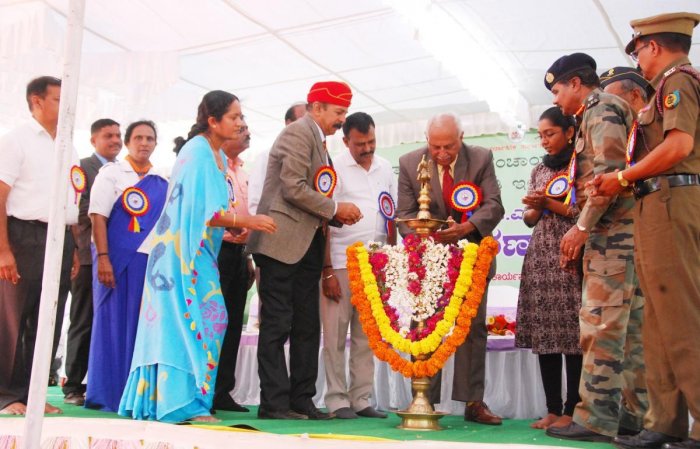
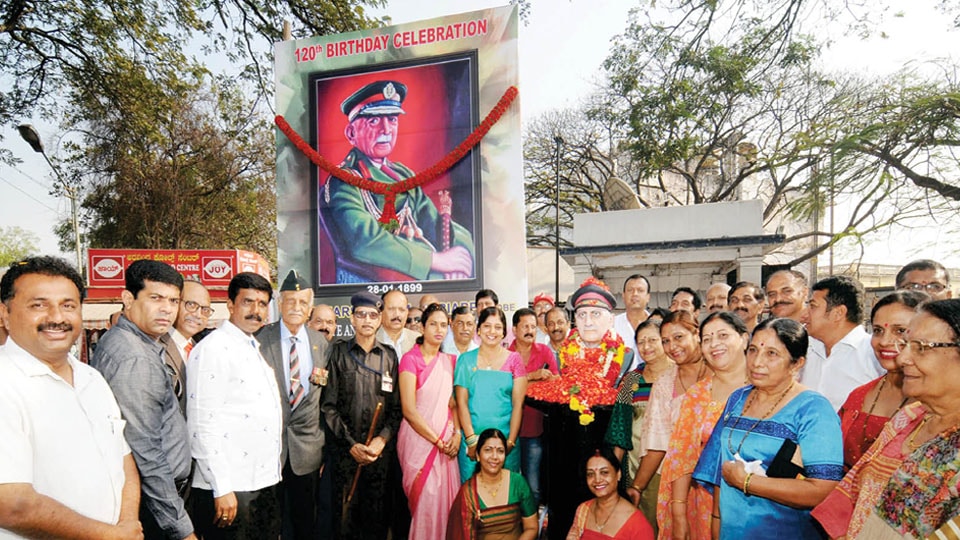
Retired Air Marshal K C Cariappa inaugurates the 120th birth anniversary celebrations of Field Marshal K M Cariappa, organised by the district administration, Zilla Panchayat and Kannada and Culture Department, on Old Fort premises in Madikeri on Mon…
The money used for the celebrations of birth anniversary can be used for the welfare of the poor, suggested retired Air Marshal K C Cariappa.
Speaking at the 120th birth anniversary celebrations of Field Marshal K M Cariappa, organised by the district administration, Zilla Panchayat, Kannada and Culture Department at the Old Fort in Madikeri on Monday, he said, “Funds are wasted in the name of garlanding the statue and procession. The only thing that people will remember is the food that was served. My father (K M Cariappa) would not have liked it. Instead, the money can be used for the welfare of the people from next year.”
“For my father, the country came first,” he said.
“Lots of discussions are held in connection with the grant sanctioned by the government for observing birth anniversaries. The deputy commissioner, district in charge minister and MLA can think of utilising the amount for the welfare of the poor,” he added.
K C Cariappa said hundreds of people have lost their houses in the natural calamity. There is a need to take up rehabilitation work at the earliest.
MLC Sunil Subramani said, “The birth anniversary should be organised to create awareness among the youth on the achievements of Field Marshal K M Cariappa.”
“Cariappa could have spent his last days in Paris or London. However, he did not forget his native and came back to Madikeri and spent his last days here,” he said.
Field Marshal K M Cariappa and General Thimayya Forum President K C Subbaiah said, “The government has been observing the birth anniversary for the last several years. In spite of announcing the grant in the budget, the officials had failed to get the amount for the same.”
Retired Major B A Nanjappa said, “We should instil the patriotic fervour and time sense of K M Cariappa. He had contributed to the growth of the Indian Army.”
Kannada Sahitya Parishat President Lokesh Sagar said, “We should not forget farmers and soldiers of the country.”
In-charge Deputy Commissioner K Lakshmi Priya, Kannada and Culture Department Assistant Director K T Darshan and others were present.
MLAs K G Bopaiah, M P Appacchu Ranjan, MLC Veena Acchaiah, ZP President B A Harish did not take part in the stage programme. They had only garlanded the statue of Field Marshal Cariappa. Even District In-charge Minister Sa Ra Mahesh and MP Prathap Simha remained absent.
A procession was held from Cariappa Circle to Old Fort premises. Military band, folk art troupes, NCC, Seva Dal, Scouts and Guides were part of the procession.
source: http://www.deccanherald.com / Deccan Herald / Home> States> Mangaluru / by Adithya K A / DH News Service, Madikeri / January 28th, 2019
Indian Ambassador Munu Mahawar presented a number of awards, including a special hockey stick to Naqvi for his contributions to promoting hockey in the Sultanate.
Muscat:
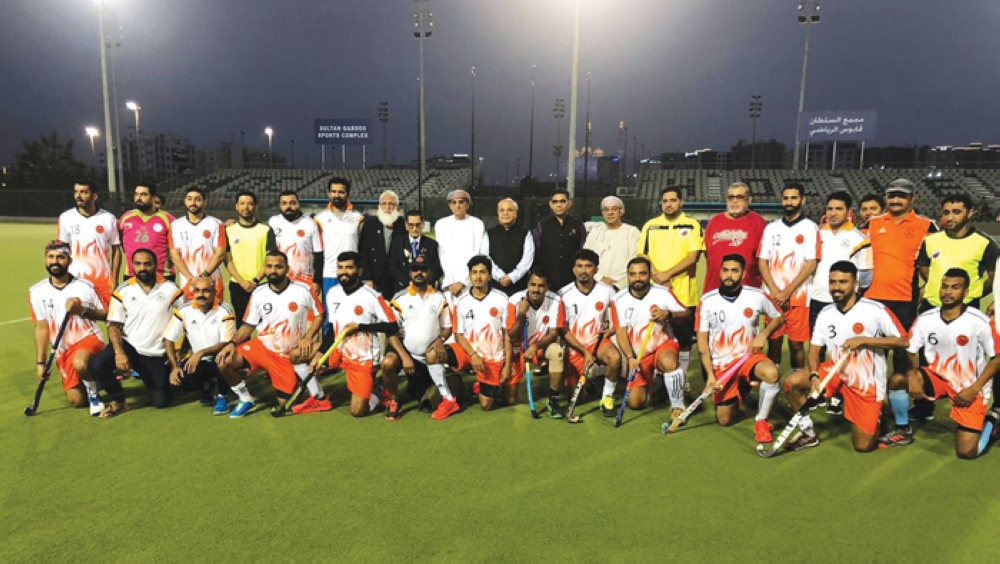
India’s 70th Republic celebrations kicked off in Muscat with a hockey festival held at the Sultan Qaboos Sports Complex in Bausher.
S.A.S Naqvi, former technical adviser of the Oman Olympic Committee and organiser of the event, said, “As it will be the 70th Republic Day of India, to commemorate this national event, we held two hockey cups: the Ambassador Cup, in which school teams competed, and the Republic Day of India Cup, where the Oman Veterans Team and expat Team Coorg competed.”
The Chief Guest of the tournament was Indian Ambassador Munu Mahawar, who was joined by Guests of Honour Kiran Asher, Group Managing Director of Al Ansari Group, and Captain Talib Al Wahaibi, Chairman of the Oman Hockey Association.
Team Coorg Muscat claimed victory in the Republic Day Cup, beating the Oman Veterans in a hotly contested match.
Naqvi said, “Team Coorg Muscat won the Republic Day Cup by edging out the Oman Veterans 3-1.” The Ambassador Cup was played in two categories: one for the boys’ teams and one for the girls. The winners of the cup this year were Indian School Al Seeb and Indian School Maabela, who both won their final matches on penalties.
Al Wahaibi said, “It was great and entertaining hockey and I am very grateful to Team Coorg and to the embassy for hosting these events for the youngsters every year. It was great and I really enjoyed it.” According to Naqvi, “The school teams of Al Seeb and Maabela won the Ambassador Cup. Another highlight was the Indian School Wadi Kabir Musical Band, which included 100 boys and girls.”
After the tournament, Mahawar presented a number of awards, including a special hockey stick to Naqvi for his contributions in promoting the game of hockey.
A number of events are being held across Oman in the run-up to Republic Day, culminating in a flag-hoisting event at the Indian Embassy in Muscat.
In an announcement published on Twitter, the embassy said, “Members of the Indian community in Oman are invited to join a flag hoisting ceremony at the embassy premises in celebration of the 70th Republic Day of India. Date & time: 26 January 2019 at 08.30 hrs. Please arrive by 08.15 hrs.”
“Please carry [a] resident card and a copy of the uploaded invitation,” the statement added.
source: http://www.timesofoman.com / Times of Oman / Home / by Times News Service / January 20th, 2019
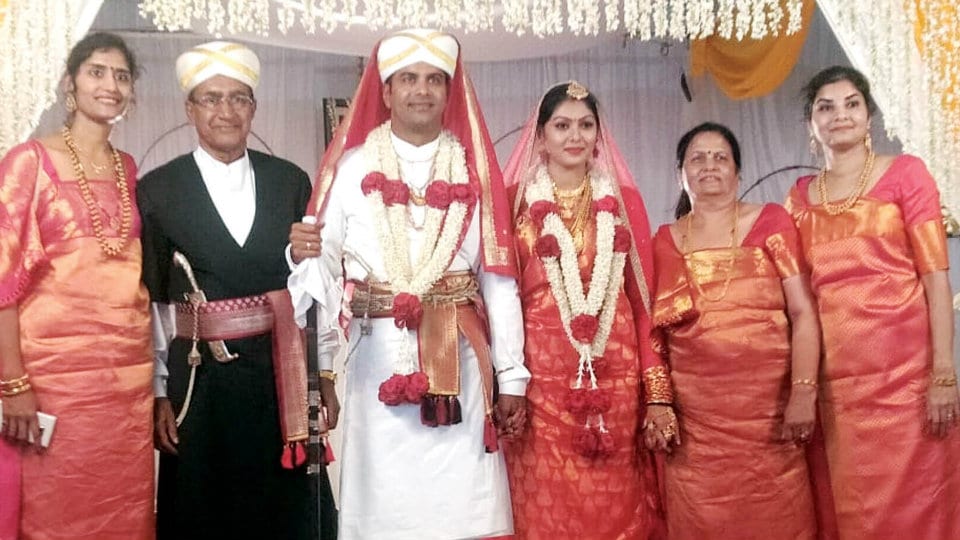
Karnataka cricketer and Bigg Boss Kannada Season-3 contestant Neravanda Chetticha Aiyappa, aka N.C. Aiyappa, got hitched to actress Anusha (Anu) Poovamma yesterday. The couple had a typical ‘Kodava’ wedding at Kodava Samaja in the town.
Anusha Poovamma is a well- known actress, who has acted in some Kannada movies. She is currently seen playing the role of ‘Aishwarya’ in the popular Kannada serial ‘Muddulakshmi’. Aiyappa, on the other hand, is the younger brother of popular South Indian actress Prema.
Aiyappa is the son of Neravanda Chetticha and Cauvery of Kumbaladalu village while Anusha is the daughter of Maletira late Chinnappa and Pushpa of Kedamullur village.
source: http://www.starofmysore.com / Star of Mysore / Home> News / January 21st, 2019
In an interview to GQ India the doubles player Rohan Bopanna revealed who has been his biggest idol in life. Bopanna picked the six-time Major winner Stefan Edberg not only for his on-court successes but behaviour as well.
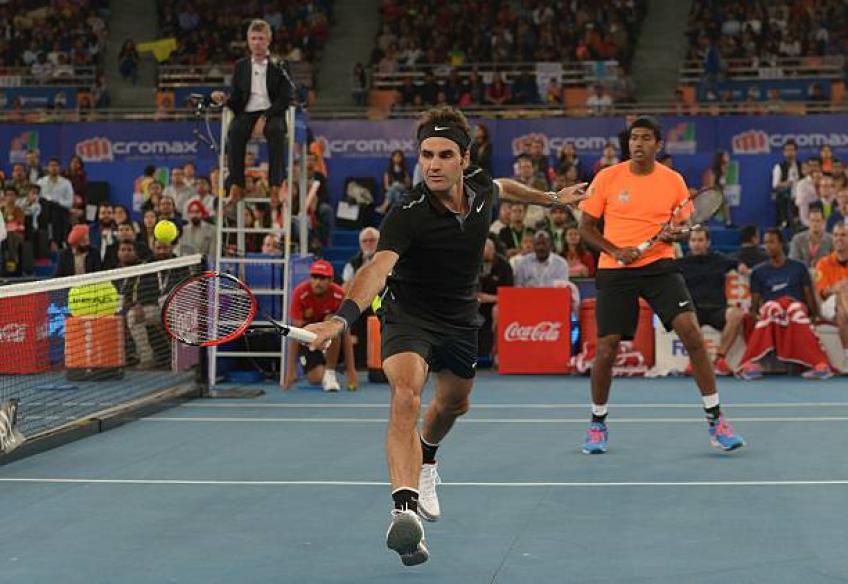
“I had the opportunity to meet him, and he was just as I’d imagined him to be”, confessed Bopanna. “Aisam-ul-Haq Qureshi and I we were playing against Roger Federer and Stanley Wawrinka [in 2014], and Stefan Edberg happened to be coaching Roger Federer.
He happened to be sitting in the box obviously, watching Federer. It was crazy – I couldn’t have imagined playing against some of the best tennis players in the world, and then having your idol watch the match.”
Bopanna also revealed he changed his eating regime in recent times: “I did a food intolerance test in India, which showed that my yeast intolerance was very high. So I’ve completely stopped having bread; it’s been about two years now.
Perhaps before a match, I’ll have fish and white rice, which gives me the energy I need. While playing, I’ll have a banana and you need electrolytes and water of course – especially when it’s hot. Otherwise, I keep things as simple as possible.
Fitness wise, I travel with my trainer, and that’s made a huge difference in terms of stretching at the right time, cooling down – especially as you get older and recovery becomes more important.”
source: http://www.tennisworldusa.org / Tennis World / Home> Tennis News> Roger Federer / by Luigi Gatto / January 28th, 2019
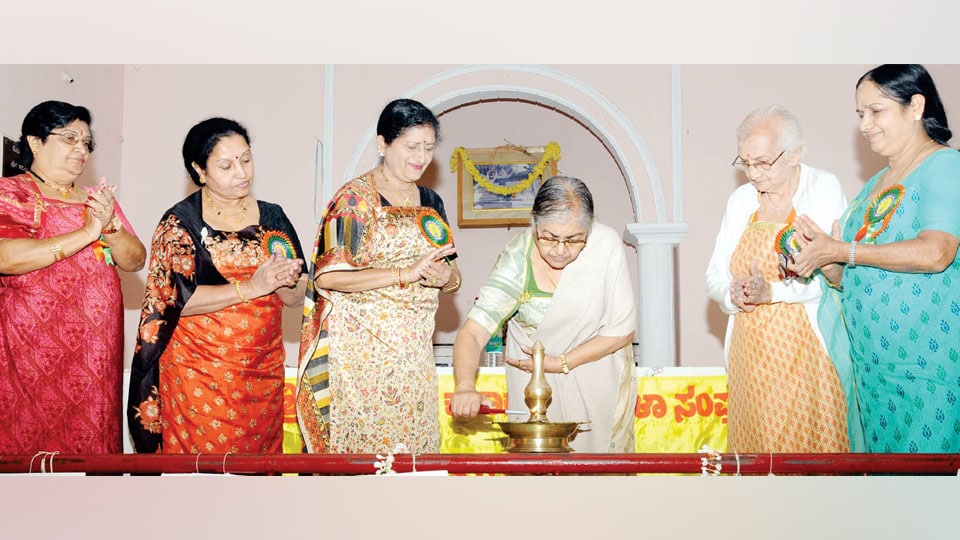
Chendrimada Sushila Subramani seen lighting the lamp to inaugurate the cultural competitions organised by Shree Kaveri Kodagu Mahila Sangha at Kodagu Sahakara Sangha in Jayalakshmipuram here yesterday as Chendanda Nirmala Subramani, Mahila Sangha Secretary; Ponjanda Lovely Appaiah, Vice-President; Moovera Bollamma Kuttappa, President; Ittira Dotti Cariappa, Advisor-cum-Founder-President and Machanda Jaya Muthappa, Treasurer, look on.
Sangha members and their children took part in various cultural competitions like Dance, Drawing, Singing, Kodava Paat and Pick-and-Speak.
source: http://www.starofmysore.com / Star of Mysore / Home> Photo News / January 21st, 2019
Kodandera Madappa Cariappa is a man known for many firsts, but he is best remembered as the legend who made the Indian Army truly Indian. Perhaps this is why people feel the time has come to honour the late Field Marshal with the ‘Bharat Ratna.’
This morning too, the demand for ‘Bharat Ratna’ was raised by Mysureans on the occasion of 120th birth anniversary celebrations of Field Marshal K.M. Cariappa. The event was marked by showering of flower petals on the bust and garlanding of a huge portrait of the late Commander-in-Chief of the Armed Forces at Field Marshal K.M. Cariappa Circle (Hotel Metropole Circle) on JLB Road.
Speaking on the occasion, former Mayor M.J. Ravikumar said that when he was the Mayor a few years ago, he took measures for installation of Cariappa’s bust at the Circle following a demand from Kodava Samaja.
Stating that both Field Marshal K.M. Cariappa and Siddaganga Seer late Dr. Sri Shivakumara Swamiji very much deserved ‘Bharat Ratna,’ he said that the Union Government must consider this demand of the people.
Former Vice-President of Mysuru Kodava Samaja Cultural and Sports Club N.M. Thimmaiah said that he had written to the MCC and the Government demanding the installation of a life-size statue of the great warrior at the Circle in city. Recalling the achievements of Cariappa as Army Chief, he said Cariappa deserved ‘Bharat Ratna’ for his courage, bravery and valour.
Maj. Gen. C.K. Karumbaya (retd.), Corporators Prameela and M.U. Subbaiah, former Mayor H.N. Srikantaiah, Kodava Samaja Vice-President Prof. K.C. Belliappa, Secretary M.M Ponnappa, Cultural and Sports Club President M.P. Nanaiah and others were present.
source: http://www.starofmysore.com / Star of Mysore / Home> News / January 28th, 2019
In Coorg, regional cuisines bear the imprint of a long-gone era.
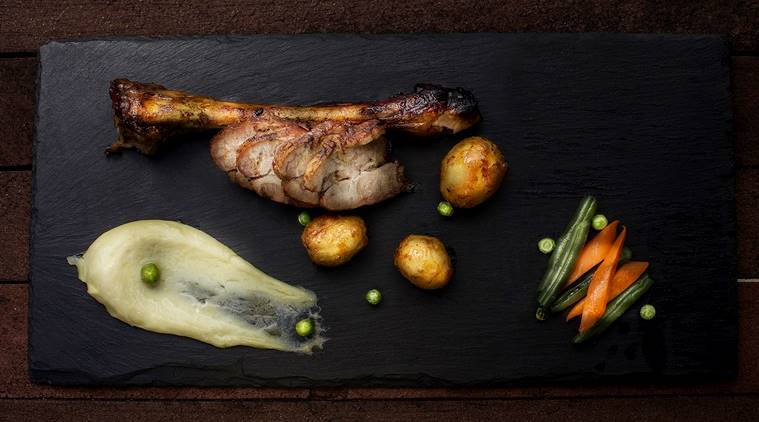
A whiff of the raj: Roast lamb.
I’m not a fan of Anglo-Indian cooking (nor of the omnipresent curry powder that got dunked into its gloopy, bland sauces). Yet, the diverse ways in which English tastes combined with regional ingredients and cooking styles across India during the Raj continue to fascinate me.
On a recent visit to Coorg, I found myself wondering what it must have been like for the British sahibs and memsahibs as they found themselves amidst the seclusion of its forested hills. Watching the mists drift across the plantations of Siddapur in south Coorg, Karnataka, I tried to imagine how these foreigners recreated a taste of British cities and shires in this isolated station, where estates were often 20 to 30 miles apart.
Gazatteer of Coorg, first published in 1870, notes that following the opening of Mercara Estate in 1854 by one Mr Fowler, the first European planter, dozens of extensive estates sprang up in Coorg within a short time. “Here seemed to have been discovered the Eldorado of honest industry in a delightful climate and home-like country,” it notes.
Yet “home-like country” it wasn’t. As the British initiated the planting of coffee in a big way in Coorg, Hassan and Chikmagalur, they were confronted by brutal heat, unfamiliar customs, frightening wild animals, blood-sucking leeches and a lengthy monsoon that could stretch up to six months.
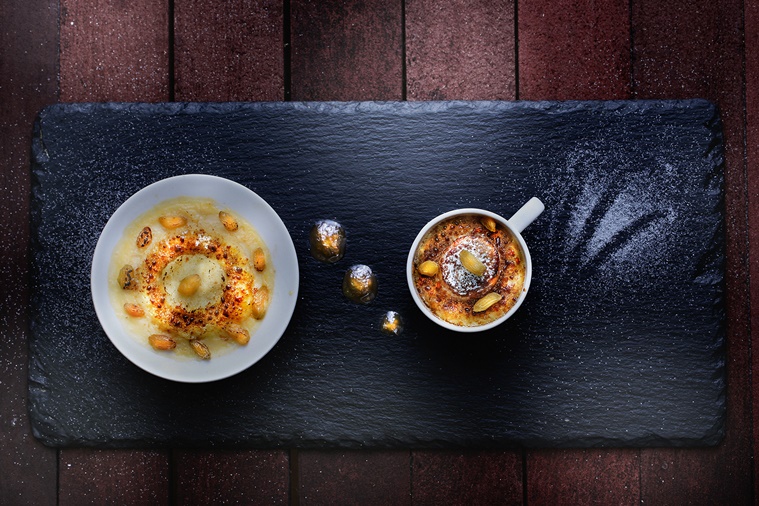
Bread pudding at the Evolve Back Chikkana Halli Estate in Siddapur.
But the interplay between diverse people, larders and culinary traditions led to the development of a distinct culture on the plantations. A lively snapshot of the time appears in Cathleen Ballantyne’s account of plantation life, Plenty Salaams, first published in 1954. Ballantyne arrived in Coorg during the 1880s for a visit and stayed with her husband George, a planter, for 50 years.
Describing the thrum of daily life, Ballantyne writes, “On a coffee estate, the day began early. At 6.30, one was wakened by the clanging of the estate bell, which summoned coolies to muster-roll before starting their day’s work…Then at 7, out on the verandah, chhota hazri — a substantial meal of porridge, eggs and bacon, coffee and fruit. For the dorai (the master), there came the morning round of the estate. For the wife, the walk, or ride, before engaging in the usual household routine, such as the ordering of meals, the weighing out of all the commodities required for the day, and, by using a lactometer, finding out that the milk had not been watered…”
Celebrations served to break the monotony and hardship of plantation life, and Ballantyne’s droll account is replete with instances of tomfoolery and merry-making during parties and picnics. My favourite is a description of a slapstick food fight at a picnic on the banks of Cauvery, where “rolls, potatoes, curry puffs and other eatables were flung about with great dexterity.” The beloved foods of the foreigners came out during these outings. Ballantyne mentions “lobster salad, chicken in aspic, cold saddle of mutton, curry puffs (pastry enclosing curried mince), an assortment of cold sweets”. Milk punch and whiskey flowed, heightening the attractions of these riotous, unending rounds of feasting.
Evolve Back Chikkana Halli Estate in Siddapur, my perch during this visit, has devoted some time to researching this slice of life. Over a meal of pepper water, mutton-ball curry, delicate coconut rice, and pan-roasted roast chicken, chef Naveen Alvares talked about the months of research that led to the planter’s menu currently served at their restaurant Peppercorn. Disappointed with their initial recces of Anglo-Indian restaurants in Bengaluru, Alvares and his team took the help of late Ranee Vijaya Kuttaiah, the author of the highly regarded Cuisine from Coorg, to master colonial-era planters’ dishes. The roast chicken, for instance, is a simple recipe that requires chicken to be marinated with salt, pepper and vinegar, caramelised with a little sugar and then cooked in its own juices in the pan.
No Anglo-Indians remain in Coorg today. In the absence of first-hand testimonies and experiences, reminiscence and nostalgia play a vital role in forming a clearer picture of life in those times. Vivian Rodrigues, whose family has owned coffee and pepper plantations in Pollibetta in Coorg and Saklespur in Hassan district for over a century, painted a vivid picture of the clubs that sprung up during the 19th century as places for the planters and their wives to relax and socialise. “The bar was the most important fixture in the club and the choicest single malts and gin were stocked. The cuisine was obviously British. Local cooks became butlers and were rechristened with British names that were easy to pronounce. We had an Anthony from Ooty who used to be Arokiaswamy!” he recounts.
Bridget White-Kumar, author of several books on Anglo-Indian cooking, says, “The British and Europeans in Coorg ate largely what they ate back home. Yet, over time, some regional influences came into their cuisine and they began eating rice with a curry made with minimal spices.” Various blends of curry powder were concocted, including Bolst’s hot curry powder, which became an instant rage.
Though locals never quite took to curry powder, they inherited an abiding love for baking from the British, and recipes of cakes dating back to the colonial times continue to be religiously followed in homes, clubs and bakeries. “It’s typical in Coorg to come home to a freshly baked cake in the evening,” says Muthu Bopanna, the owner of coffee plantations and a heritage homestay in Madikeri.
Roasts and barbecues are just as beloved. Vancouver-based blogger Shalini Nagappa cherishes her childhood memory of a Christmas spent feasting on roast turkey at her uncle’s farm near Kushalnagar. “What a moment of high excitement it was! And while it was not the exaggeratedly plump, meltingly tender, cartoon bird of my dreams, my uncle’s penchant for adding ‘more butter’, a la Julia Child made it divine,” she writes in her blog, A Cookery Year in Coorg.
After India gained independence in 1947, British planters sold their estates to Kodavas and other south Indians. The food served on these estates today tends to be a mix of traditional Kodava, Mangalorean, Bunt, Lingayat and Chettiar cuisine — depending on the ownership — and their personal eclectic influences.
Former journalist David Housego, writing about the cooking of the Raj, observed that in contrast to the Portuguese, who left a strong culinary footprint on the cuisine of former colonies like Goa, the British largely ignored the rich regional cuisines of India. As a result, no truly great hybrid dishes came out of this East-West encounter. This is evident in Coorg, where the local cuisine remains largely unaffected by British influence. Yet, one still gets a whiff of the time when the intermingling of British, Irish, European and Indian culinary accents created a unique Anglo-Indian aroma across the coffee estates, planters’ clubs and dak bungalows of Coorg.
This article appeared in print withe headline ‘Curry Puff Days’
source: http://www.indianexpress.com / The Indian Express / Home> Eye / by Sona Bahadur / January 20th, 2019
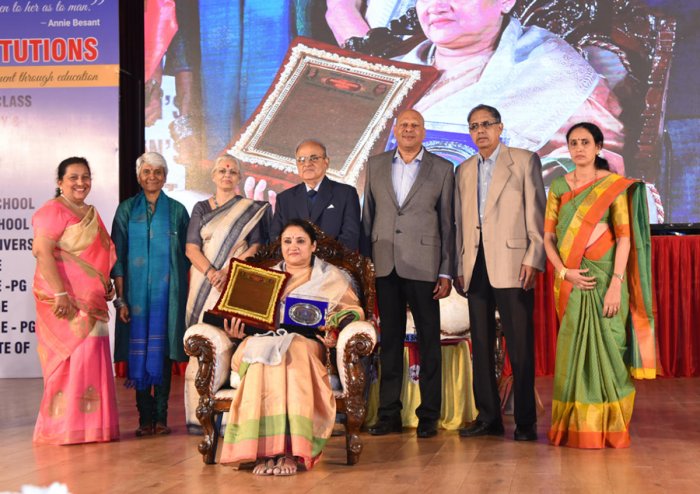
Athlete Vandana Rao was felicitated at the valedictory function of Besant centenary celebrations organised at Dr T M A Pai International Convention Centre in Mangaluru on Saturday.
Bengaluru-based Coffeelab Limited President Sunalini N Menon stressed on Saturday that excellence is taking pride in work and being the best at the work.
She was speaking at the valedictory function of the Besant centenary celebrations organised by Women’s National Education Society (WNES) at Dr T M A Pai International Convention Centre here.
She said, “Nobody remembers how fast the job was done, but how well the job was done. Whether be it washing utensils in the kitchen or sweeping the floor, being the best in your work is a self-portrait of what you are and the best insurance in the future for a job,” Sunalini said.
She said creativity and eye for detail are a must for the perfect execution of goals.
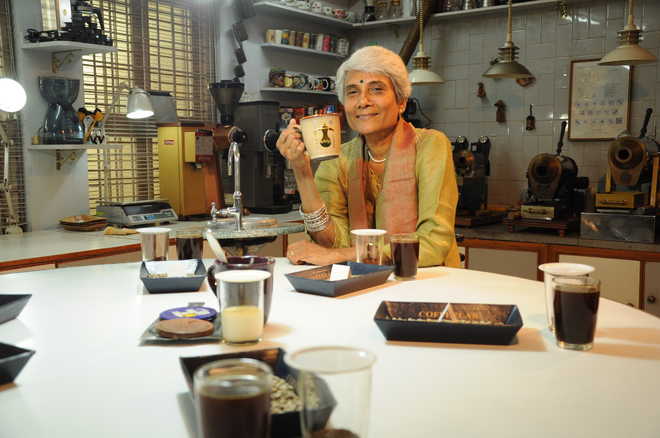
Sunalini, reflecting on her four decades of experience as a coffee taster, described the coffee tasting as a fascinating journey. “It is not a mere cup of coffee. There is so much of science and knowledge that you will learn humility,” the internationally recognised coffee-taster said.
She also invited the students present in the hall to learn more about the profession.
She said Indian Coffee Board offers ‘Kaapi Shastra’ on how to brew a perfect cup of coffee and there is a PG diploma course on coffee quality and another course on coffee entrepreneurship from Indian Institution of Plantation Management (IIPM).
She said her Coffeelab analyses samples from across the world.
“We are more as a facilitator, depending on what the market wants and what the grower can provide,” she said.
Presiding over the programme, former vice-chancellor of SNDT Women’s University Prof Rupa Shah urged women not to be fearful about the outcome. “I will compete and emerge successful should be the motto,” she stressed.
The Besant group of institutions felicitated alumni achievers including writer Kasturi, gynaecologist and well-known athlete Vandana Rao.
Kasturi and Devayani, who had emerged as toppers and declared as Vasantha Ranis while in school in 1959, were felicitated on the occasion.
Devayani thanked the management for remembering them after 50 years.
source: http://www.deccanherald.com / Deccan Herald / Home> State> Mangaluru / by Harsha, Mangaluru / January 19th, 2019
Asia’s first woman coffee taster, Sunalini N. Menon, is now opening a museum for coffee
Susheela Nair
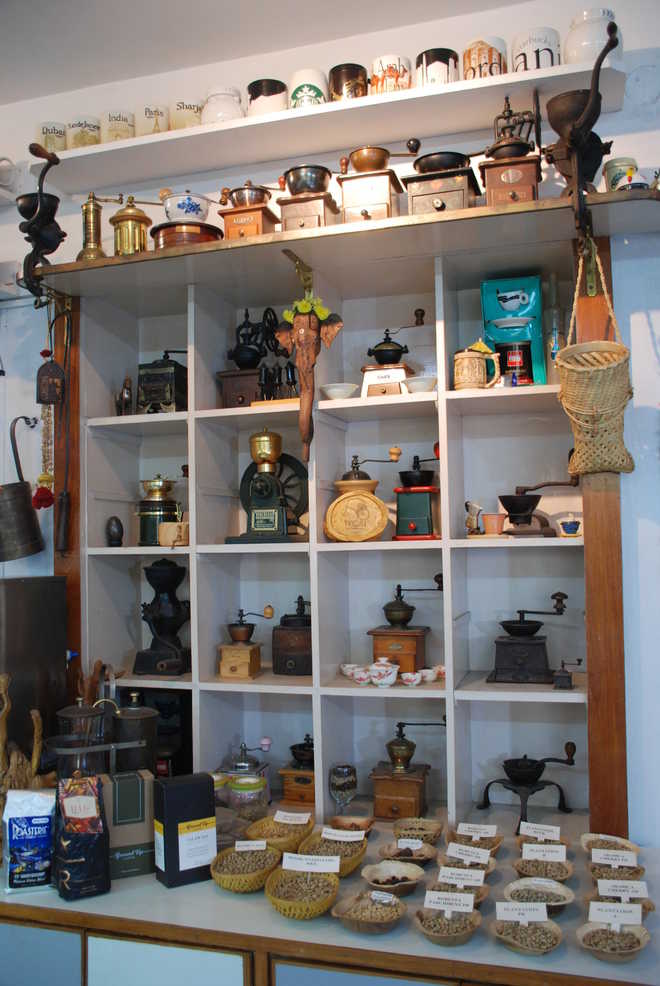
The aroma of coffee wafts through the air as one steps into the Coffee Lab in Sadhashiva Nagar, a posh locality in the heart of Bangalore. Every nook and corner of the lab is adorned with mugs, coasters, antique jugs, filters and other coffee paraphernalia collected from all over the world. The Coffee Lab bears the semblance of a mini museum with its walls lined with a variety of packaged coffee and curios from around the world — exquisite grinders, scented candles, filters, mugs, and a whole shelf of good old-fashioned tumblers, a stark contrast to a regular sparkling white laboratory filled with shiny apparatus used for coffee accreditation and testing.
It also houses memorabilia, including tribal products from coffee growing areas, areca nut pickers, ancient milk measurement units and coffee pots. Each equipment throws light on the culture of the country it comes from. For instance, Italian pots have ornate carvings; the ones in Iran are known for their silver and filigree work; Pakistan has a recurring crescent moon pattern while Egypt sports designed Cleopatra. The star attraction of the Coffee Lab is the painting of Mona Lisa in coffee powder.
In the middle of the lab, inhaling deeply from one of the deftly prepared samples of green and roasted beans, in front of her, is the first woman coffee taster in Asia and ‘quality-control expert’ Sunalini N. Menon. After acquiring a Master of Science in food technology, Sunalini’s first choice was to become a dietician, but destiny had something more fascinating in store for her. She had to choose between further studies at the New York Institute of Dietetics or a job with the Coffee Board. But she chose the latter which was a turning point in her life.
From an assistant taster at the Coffee Board of India to the head of the quality control department (at the age of 28), and director (quality control) until 1995, Sunalini has traversed a long way fighting a lone battle against all odds at every stage of her career. Steering her way through the male-dominated world of coffee tasters and growers, recognition and acceptance as an accredited international cupper came her way belatedly, almost two decades later. She is a walking encyclopaedia on coffee and knows the coffee bean inside out. This coffee veteran takes 100 sips of coffee — all in a day’s work. Known as Asia’s first woman of coffee, she moved on to set up her own lab, the Coffee Lab in Bangalore, in 1997 for evaluating the technical nuances of Indian coffee.
The advent of liberalisation in the Indian coffee market inspired Sunalini to set up her own lab in 1996. She established Coffee Lab Private Limited, the first private sector lab of its kind equipped with modern equipment and accredited by the Coffee Board of India, in Bangalore.
Explaining the main objective of her Coffee Lab, Sunalini says, “From the seed to the cup, we offer the entire gamut of services. We delve into the technical aspects of coffee-making, quality testing, advising growers on how and when to sell the beans, and preparing special coffee brands. Coffee Lab uses the time-tested techniques of visual and organoleptic evaluation for the quality analysis of Indian coffee. We conduct appreciation courses for homemakers and also classes for farmers.”
True to her social commitment of empowering women economically, Sunalini has employed women to handle the sensitive and critical steps of green coffee evaluation. Though there are innumerable problems plaguing the coffee industry, the coffee veteran believes that the burgeoning coffee culture in the country has the potential to impact the market.
Revealing her plans to start a Coffee Museum, Menon says, “A trust will be formed as it is a non-profit initiative. We will start the story of Baba Budan (who brought coffee to South India) and traverse through the cultural aspects of coffee, diversified cultivation pattern and types of seed material. We are planning a layout that is representative of a typical Indian coffee plantation. The exhibits will include antique coffee roasters, grinders, brewing equipment, mugs, cups and coffee powders from different parts of the world.”
source: http://www.tribuneindia.com / The Tribune / Home> Trends / January 26th, 2019
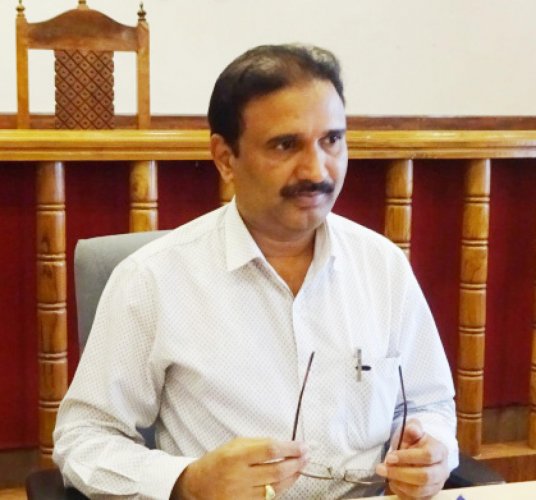
As per the newly released draft of the revised voters’ list, there are 4,34,256 voters in Kodagu district, said Additional Deputy Commissioner Shrinivas.
Addressing reporters at the DC’s office in Madikeri on Wednesday, he said that new 5,444 voters are enrolled this time. The names of 6,449 voters have been omitted from the list, for the reasons of death, change of place and repeated entries.
The draft of the voters’ list, containing the picture of the voters, has been published as per the directions issued by the Election Commission of India.
The voters must ensure that their names are mentioned in the revised voters’ list, said the additional DC. If not, the citizen may submit their application in Form-6, to booth level officers or to the taluk office. The deletion of the names of demised voters, change of location and removal of repeated entries can be requested under Form 7.
Shrinivas further said that an awareness programme on voting will be held for the sake of voters in the booth, taluk and district levels on January 25, on account of Voters’ Day.
The new voters will be distributed with voter’s identity cards on the occasion, he added.
This apart, the Election Commission has set up the helpline number 1950 in all districts, to clarify the doubts of people on the voting process. The helpline will be operational between 9 am and 9 pm on all the days.
In connection with the release of the draft of the revised voters’ list, a meeting was convened by the additional DC, with the representatives of political parties.
Leaders Sajil Krishna from BJP, Tennira Maina from Congress, Ajith Kumar from JD(S), Appanna and Shamaraj were present.
source: http://www.deccanherald.com / Deccan Herald / Home> State> Mangaluru / by Adithya K A / DH News Service, Mangaluru / January 16th, 2019
WELCOME. If you like what you see "SUBSCRIBE via EMAIL" to receive FREE regular UPDATES.
Read More »