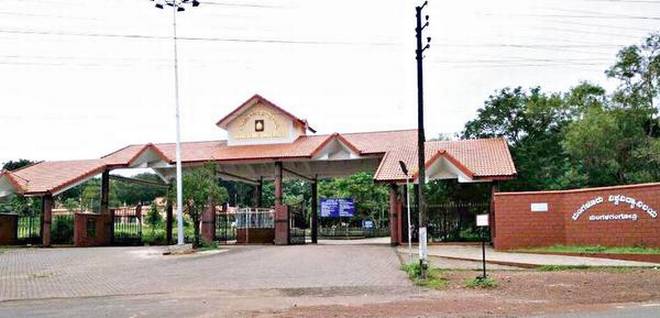
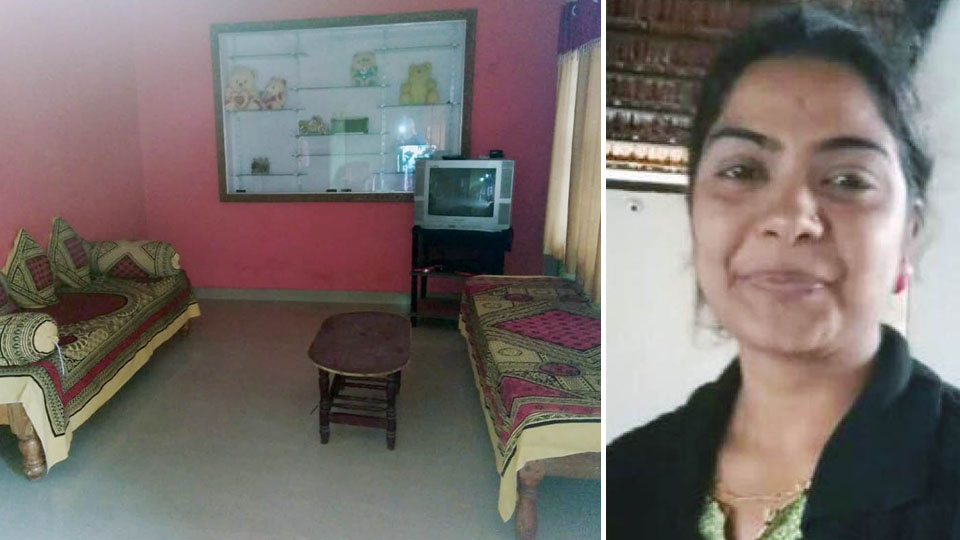
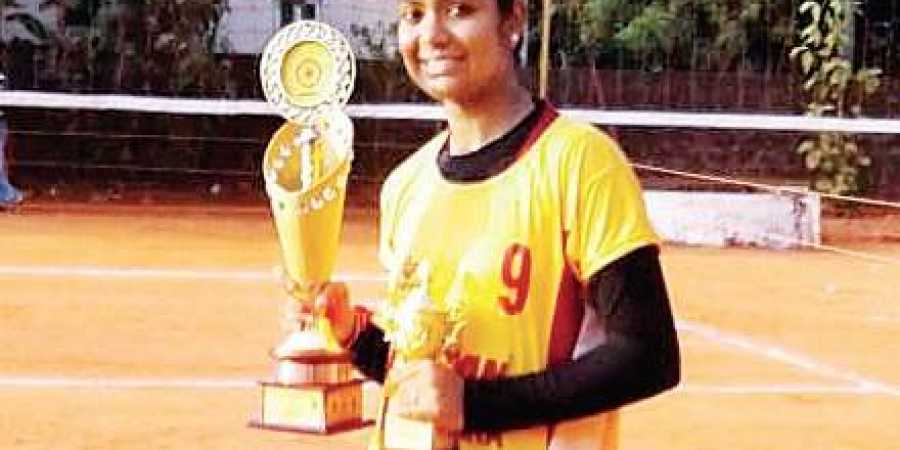
With a view to empower and encourage young women achievers, St Agnes College (autonomous) organized a felicitation programme for Poovamma, an Indian spinster who hails from the district.
The programme was held on September 14 at St Agnes College.
Sr Dr M Jeswina AC principal St Agnes College, Sr Dr Venisssa AC, vice principal St Agnes College, Malavika, dean administration and Vasudha, physical education directress were present for the programme.
Vasudha, the physical education directress of the college welcomed the gathering.
Ladleen Monteiro introduced Poovamma to the gathering who was then felicitated by the dignitaries on the dais. Poovamma addressed the gathering and said that with hard work and determination, one can surely achieve great heights.
This was followed by a short message by the principal Sr Dr M Jeswina AC wherein she encouraged the students to take inspiration from Poovamma’s life.
Vijayashree, the sports secretary proposed the vote of thanks.
The programme concluded by singing the college anthem.
source: http://www.daijiworld.com / DaijiWorld.com / Home> CampusBeat / by Media Release / Mangaluru – September 18th, 2018
Before the rains started, coffee planters in Coorg were talking of a good crop —the plants were well rested after a lean year and went through the process of blossoming and forming fruits. That settled, seasonal certainty is gone with the wind and merciless lashings of torrential rain.
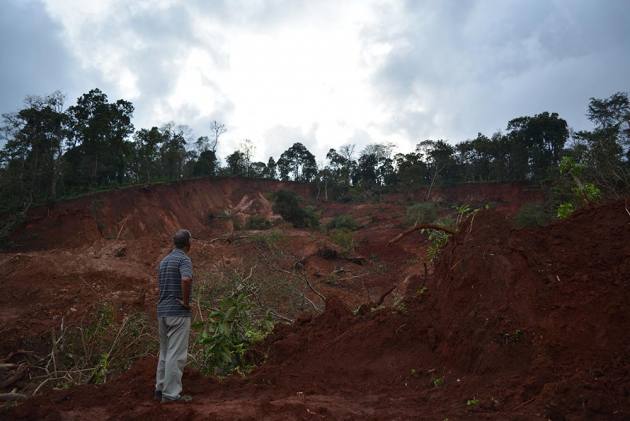
HELPLESS / A planter contemplates nature’s carnage where once existed a fecund patch / PHOTOGRAPH BY AJAY SUKUMARAN
A fully-done crossword puzzle is on the table next to Chitra Subbaiah who confesses that she could forego reading the newspaper, but not the crossword. We are in the cottage of a home-stay in Madapura, north Coorg, resplendent in the evening sun—the first day in two months that the rain has let up. It brings some relief from fear. Chitra, nearing eighty, recounts a painful experience with great fortitude. “You have to do some mental jugglery, you know. You can’t curse your fate.” She’s staying in a friend’s cottage because her home, in the neighbouring village of Hattihole, now lies beneath a pile of earth which slid down the hillside, burying everything she owned.
“Wiped out, totally. I don’t have one pin. There is nothing to say there was a house,” she tells Outlook. All she could reach out for in time were her spectacles, medicines and some gold the workers from her coffee estate had entrusted her with safekeeping. The workers’ quarters on her coffee estate too went down. Fortunately, they had time to move out. She points to others in the same situation. “At least I can rent a house and stay. What about so many others, who have nothing,” she asks.
Before the rains started this year, coffee planters in Coorg were talking of a good crop—the plants were well rested after a lean year and went through the process of blossoming and forming fruits.
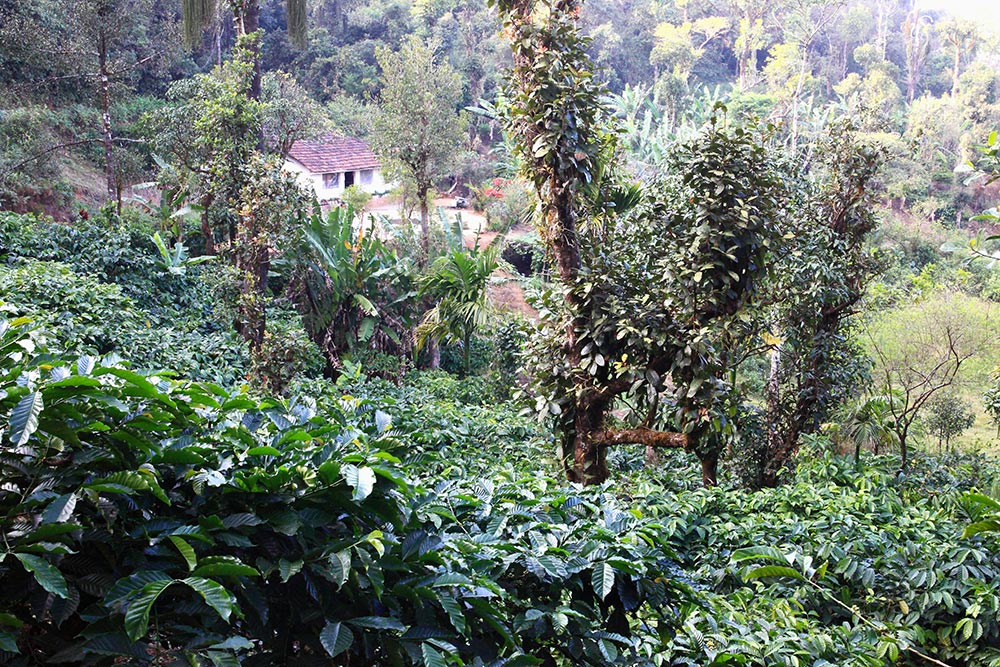
The scene at a typical Coorg coffee estate / PHOTOGRAPH BY GETTY IMAGES
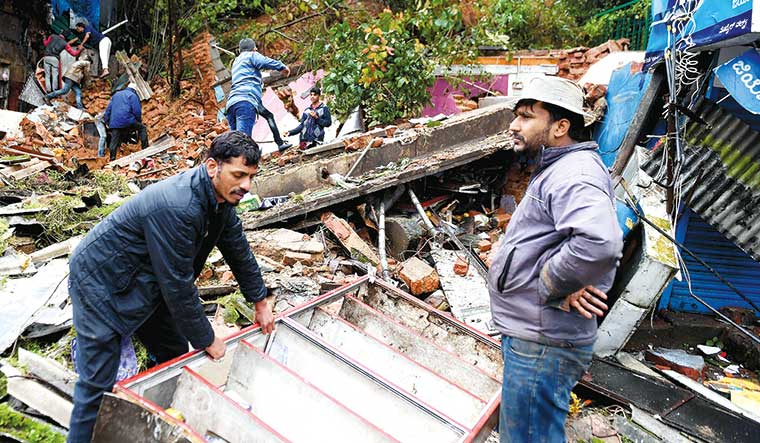
That settled, seasonal certainty is gone with the wind and merciless lashings of torrential rain. It rained heavily through July and August in this region of south Karnataka bordering Kerala. Then, in late August, came a series of punishing cascades of sodden earth. Now, there’s a trail of ruin in these charming hills, where landslides have swept off whole villages, re-arranged estates and shattered its economy. With immediate rescue measures tapering off, one question hangs limply in the air: where do you start picking up the pieces?
“I can’t plant anything now on my land, that’s for sure,” says K.U. Erappa, standing in his camouflage gumboots in a relief camp inside Madikeri’s old fort where, grouped with several families, he has been staying for days now. “All that’s left of my coffee plants are just stalks,” Erappa says. His ageing mother walks up to say, “We had a small house, but it was pretty.” Their grief is palpable. Erappa owned a few acres of coffee and paddy in Mukkodlu, one of the hardest-hit places in north Coorg, in the vicinity of district capital Madikeri. Much of Coorg is remote, away from the main-travelled roads. Like others, Erappa has been going back to salvage what he could. His three children, like most kids from his village, have been sent away to a temporary residential facility in a school in Ponnampet town at the southern end of the district. “We never dreamt Coorg would come to this,” says N. Bose Mandanna, a planter from Suntikoppa.
Right now, a full picture of the damage isn’t available, though it is being estimated. Planters like Mandanna reckon that at least 5,000-7,000 acres have been wiped off in the landslides. For the plants still standing, there’s the danger of wet feet and black rot—water-logging at the base of the plant that strangulates it, causing leaves to fall off. “When leaves are lost, next year’s crop is also lost,” says Mandanna. Coorg, with about one lakh hectares in cultivation, accounts for close to 40 per cent of India’s coffee production. The 2017-18 post-blossom estimate was 1,33,500 metric tonnes, most of which is exported, Italy being a top destination. To make matters worse, prices, say market watchers, have been at historic lows. Brazil is harvesting a good crop this year and so will Columbia and Vietnam.
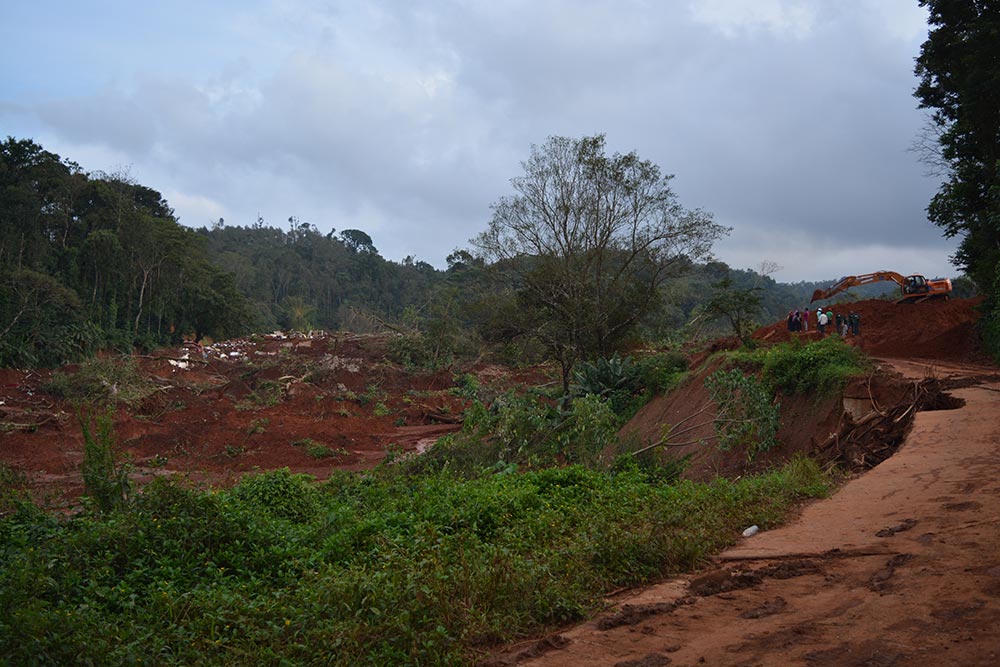
The desolation on the spot after the landslide / PHOTOGRAPH BY AJAY SUKUMARAN
“International prices have gone (down) to levels last seen in 2006. We are getting a lot less now, if you factor in the inflation,” says Ramesh Rajah, president of the Coffee Exporters Association. Prices depend on the big three producers—Brazil, Columbia and Vietnam—which account for over 70 per cent of the global production. “Only if there are supply shocks in the big three will there be impact in international prices. India can lose one third or even half its production and the international market is not going to blink,” says Rajah.
In the mid-nineties, Coorg coffee saw a boom when prices rose because of a supply shortage in Brazil whose production, apart from being vulnerable to frost, was considered inefficient then. The boom years lasted a decade until trends began to reverse. Owing to hilly terrain, Coorg can’t mechanise the way Brazil did. So, it has been grappling with high labour costs. Nor can other crops be sown, as coffee plants need trees for shade. Many Kodavas, as Coorg’s natives are called, concede the difficulty in maintaining plantations. The symptoms, many say, have been showing—an ageing population, a younger generation that has been migrating to cities and bits of land being sold to meet expenses, the latter contributing to a social churn in the highlands. This devastating blow came on top of all this.
The future, many say, is bleak. First, the question of land lost, by no means an easy task, given the complexities that involve verifying claims, boundaries and so on. “Let the government acquire the property. See the record, settle them,” says planter Mittu Chengappa, who’s also a Karnataka Congress general secretary. His suggestion, that the government acquire private land ravaged by landslides for afforestation so that owners can begin afresh elsewhere, has been voiced by many. Unlike neighbouring Chikmagalur—where coffee was first grown in India—there are more small growers in Coorg, many owning only a few acres.
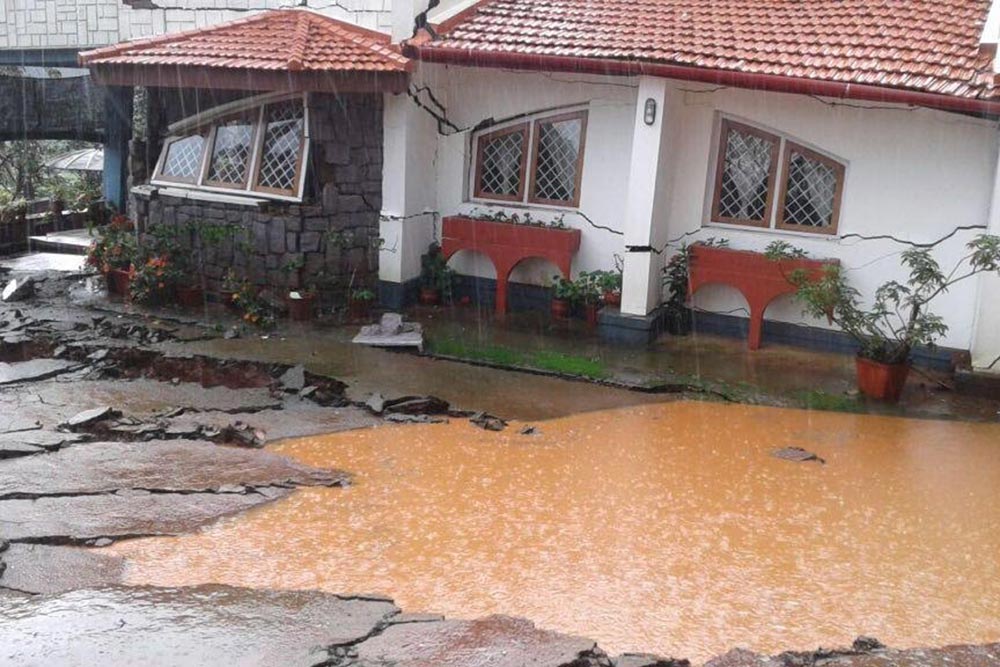
Chitra Subbaiah’s house in her estate in Hattihole village
Even for those who didn’t lose land, replanting will be a big financial burden, says Rajah. Besides the upfront cost, it would mean a five-year wait for yields. “So, how will they sustain themselves for five years? What does he do about infrastructure within the farm, workers’ houses, his house?” asks Rajah. Coffee planters have always weathered difficult years, but the destruction this year is unprecedented. “Some years, the crop yield is sharply lower because of lack of rain or excess rain. But this is the first time we have actually seen this sort of damage where infrastructure is damaged. It’s going to be very difficult in the short term,” reckons Rajah. In the long term, he says, every producing country is bleeding, so things can be pulled back to a degree by increasing efficiency. Of course, primary rehabilitation remains a priority; the process of replanting will take place slowly.
“The other thing is the labourers are not coming back. We are still in a state of flux, a dilemma as to what’s going to happen. There are a lot of issues, it’s very fluid,” says Nanda Belliappa, a coffee grower from Hattihole who has to now walk half a kilometre inside his property to reach his house, as the road leading to it is blocked. The Hatti, a stream outside his gate—where once a Malayalam film was shot—has beached fallen tree trunks ashore. “The neighbours’ coffee plants and trees are on our road…it’s unbelievable,” says his wife Anitha. In villages in these parts, the conversations go from rain to earthquake—many planters say they heard loud booms and felt tremors, but officials say no seismic event was captured.
Bose Mandanna too says he won’t be so pessimistic as to say that the coffee industry won’t claw back. But he’s doubtful about the prospects of a full recovery in North Coorg. “This area cannot come back in a hurry,” he says. Last weekend, as the evening drew on, Madikeri wore a deserted look—tourism has stalled and hotels are ordered not to take in travellers for some time. “Every night, there’s fear that the hill will come down on your head,” says Mandanna. The Kodava harvest festival Kailpodh, when they worship their guns, went by this week. Says Mandanna, “Nobody was interested in the festival. Coorg has become like a funeral parlour.”
source: http://www.outlook.com / Outlook / Home> The Magazine> Business / by Ajay Sukumaran / September 17th, 2018
Mangalore varsity to provide document copies for free, conduct special exams
Mangalore University will take a host of measures, including waiving of examination, tuition and other fees, to help college students, whose families have lost properties in the recent landslips and floods in Kodagu.
According to Kishore Kumar C.K., acting Vice-Chancellor of the university, attendance will be given to students who could not attend classes owing to the floods.
The university will give copies of education-related documents, such as marks cards, for free to those who have lost them in the floods. Special examinations will be held for students in colleges where lessons could not be completed on time.
Mr. Kumar told The Hindu that the university has provided free accommodation to students who have lost their houses, in the Field Marshal K.M. Cariappa College in Madikeri. There are 20 such students in the college now.
He said some colleges in Dakshina Kannada and Udupi have come forward to admit such students who cannot continue their present education in Kodagu thanks to road-connectivity issues. The university will approve the admission of such students.
Those education institutes have come forward to provide free hostel facility to such students.
Mr. Kumar said the university will call a meeting of principals of all 20 colleges in Kodagu on September 6 to sort out issues relating to classes, conduct of examinations and approval of admissions.
Many colleges under the university are now collecting funds to help students of Kodagu.
He said the social work students of the university will conduct field survey in Kodagu and come out with a report on measures to be taken to bring back the life to normality.
The report will be submitted to the government. The university was now collecting data of the students who have been affected. The university will conduct National Service Scheme camps in Kodagu to help in restoration activities.
source: http://www.thehindu.com / The Hindu / Home> News> Cities> Mangaluru / by Special Correspondent / Mangaluru – September 05th, 2018
Tashma Muthappa, an International-level Throwball player who was living in a flood relief camp along with her family has now been rehabilitated. She, along with her parents, will move to a rented accommodation in Madikeri on Monday. Also, Kodagu District Minister S.R. Mahesh has promised her a government job.
It may be recalled that Star of Mysore had published a report on Aug. 30 under the title “Floods shatter sports star’s life in Kodagu.” The report had highlighted the plight of Tashma, who brought laurels to Karnataka and India by winning national and international tournaments. First she was forced to give up her sporting career and take up a data entry job to support her family and second, her house was destroyed in floods and landslides.
Tashma’s house, built just one-and-a-half-years back in Second Monnangeri at Madikeri was washed away and all her medals, certificates and hard-earned money were lost. 23-year-old Tashma was to get married in December but now her wedding has been postponed to April next year as the jewellery worth Rs. 3.5 lakh too were swept away.
Following the publication of the report that was widely shared in social media, help started pouring in to Tashma and her family. They will move to a fully-furnished house at Kannika Layout near Madikeri Race Course Road on Sept. 3. Singapore Kodava Samaja has sponsored Rs. 50,000 to be paid as advance to the house and has also sponsored the monthly rent of Rs. 10,000 for one year.
The Singapore Art of Living team has sponsored utensils, food, fuel and other requirements to the family and Chandrashekar and friends have volunteered to look after the day-to-day needs of the family till it can sustain on its own.
Meeting Tashma, Kodagu District Minister S.R. Mahesh has assured her that he will secure her a government job.
source: http://www.starofmysore.com / Star of Mysore / Home> News / September 01st, 2018
Both will receive the Rs 20 lakh high cash incentive earlier announced by the late Chief Minister J Jayalalithaa for sportspersons winning medals in international games.
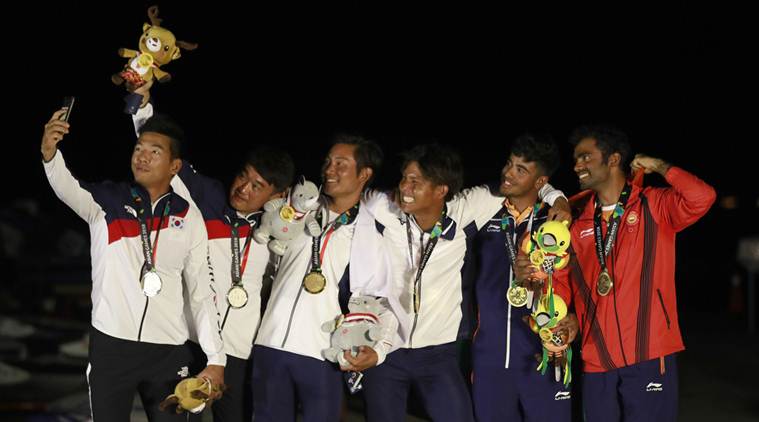
Jakarta : From left to right silver medalist Chae Bonjin and Kim Dongwook of Korea, gold medalist Shingen Furuya and Shinji Hachiyama of Japan and bronze medalist Varun Ashokthakkar and Kelapanda Chengappa of India pose for a selfie with their medals during the victory ceremony for in the 49er Men of sailing event at the18th Asian Games in Jakarta, Indonesia, Friday, Aug. 31, 2018.AP/PTI(AP8_31_2018_000227B)
Tamil Nadu government Saturday lauded state sportspersons Vikas Thakkar and Chengappa Ganapathy Kelapanda for winning the bronze medal in 49er men’s sailing event at the ongoing Asian Games in Indonesia.
Chief Minister K Palaniswami announced a high cash incentive of Rs 20 lakh each for their feat, in line with the government’s policy of promoting sporting talent from Tamil Nadu. In seperate letters to Thakkar and Kelapanda, the Chief Minister lauded them for their medal winning performance and said they had made the state and the country proud.
Both will receive the Rs 20 lakh high cash incentive earlier announced by the late Chief Minister J Jayalalithaa for sportspersons winning medals in international games, he said. “On behalf of the people and Government of Tamil Nadu, I once again extend my warm greetings to you and all those who supported you in this achievement and wish you bring more laurels to the country and the state in future,” he told them.
Further, the Chief Minister announced an additional Rs 20 lakh for paddler A Sharath Kamal, for winning a second bronze medal in the ongoing Asiad. “I am happy to hear that you have won your second medal in the ongoing 18th Asian Games, 2018 a Bronze Medal in Table Tennis mixed doubles event,” Palaniswami said.
The Chief Minister said Kamal was now eligible to receive a high cash incentive of Rs 20 lakhs, apart from a similar amount announced by him on August 29.
source: http://www.indianexpress.com / The Indian Express / Home> Sports> Asian Games / by PTI, Chennai / September 01st, 2018
MR Poovamma, spearhead and senior most member of the Asian Games gold medal winning Indian 4×400 Women’s relay team (which included Hima Das, Saritaben Gayakwad and VK Vismaya), explains the future implications of the victory in Jakarta, and reveals details behind the bold strategy that helped them upstage Salwa Naser-led Bahrain.
A gold medal is special under any circumstance, no doubt. But, when the top prize at the Asian Games — at any competition for that matter — comes after an athlete manages to upstage the best in the world, the medal attains a deeper meaning. Its significance transcends the podium, going much beyond the fervour or emotions the celebrating athletes, the fluttering flag, and the national anthem conjure up. The gold medal gets an additional gleam from a promise for the future, while dreams and aspirations of the athlete involved find new horizons.
When Hima Das, MR Poovamma, Saritaben Gayakwad and VK Vismaya climbed onto the top rung of the podium to celebrate the country’s final gold (in the women’s 4x400m relay) from athletics in Jakarta, on the last day of track and field competitions at Gelora Bung Karno (GBK) Stadium on August 30, they stood tall with a realisation that could, in the coming years, take them to higher pedestals.
source:http://www.newsclick.in / News Click / Home> Sports> India / by Leslie Xavier / August 31st, 2018
Hailing from a poor family in 2nd Monnangeri — which was destroyed in a landslide — Tashma had a flair for throwball since childhood.
Tashma Muthappa
Madikeri :
The recent floods in Kodagu have altered numerous lives. Like that of Tashma Muthappa’s. Tashma (23), an international-level throwball player from Kodagu, is now staying at a relief centre after her house was washed away in the floods. And she lost her medals and trophies too. But thanks to the power of social media, help has been pouring in for her. After her story was circulated on the social media platforms, there has been a ray of hope. “I received help from 2nd Monnangeri activist Dhanjay and People for Kodagu Organisation,” Tashma said.
On Wednesday, MLC Veena Achaiah and her son Vishwas Achaiah visited Tashma and offered her help. “Vishwas Achaiah and his friends have offered to pay one year’s rent for our house and have promised to look after other expenses,” she added.
Hailing from a poor family in 2nd Monnangeri — which was destroyed in a landslide — Tashma had a flair for throwball since childhood. She has taken part in many throwball events, including those in Sri Lanka and Malaysia. She was part of the Indian throwball team that won an international championship in Bengaluru recently. However, she gave up her sporting career owing to financial constraints. Tashma, who completed her PU from Alva’s College, Mangaluru, now works as a data operator at Kodagu Medical College. Her parents Muthappa and Girija work at a homestay.
Life suddenly turned upside down for her on August 17. “At around 10 am that day, we started fleeing our homes after we noticed numerous cracks in the earth. We climbed uphill as roads were blocked owing to landslides. Walking through forests, we reached a relief centre at Cherambane at 9 pm,” she said recalling the horror. The family was later moved to a relief camp in Madikeri, where her story was learnt by many well-wishers and was circulated on social media.
Tashma hopes that the government offers her a permanent job. Though her immediate goal is to get a job and support her family, Tashma is ready to enter the throwball field and prove her mettle again … if she gets more support.
source: http://www.newindianexpress.com / The New Indian Express / Home> States> Karnataka / by Express News Service / August 31st, 2018
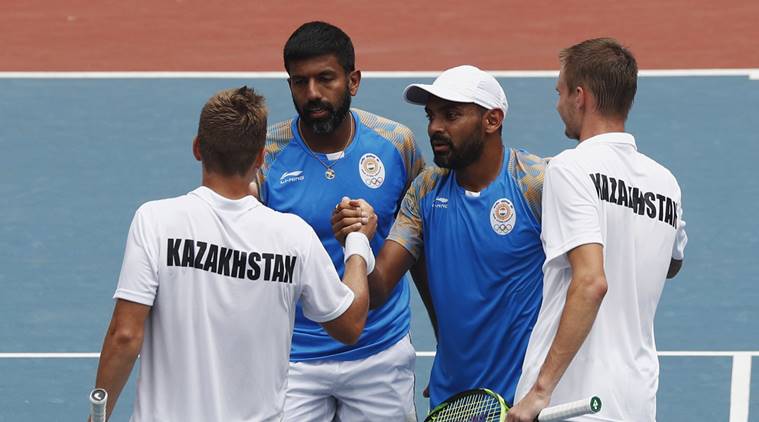
Rohan Bopanna and Divij Sharan won 6-3, 6-4 to become the fifth men’s doubles pairing to win gold at the Asian Games.
Tennis – 2018 Asian Games – Men’s Doubles – Final – JSC Tennis Court – Palembang, Indonesia – August 24, 2018. Rohan Manchanda Bopanna and Divij Sharan of India shake hands with Aleksandr Bublik and Denis Yevseyev of Kazakhstan after winning their match. REUTERS/Edgar Su
Top seeded men’s doubles pairing of Rohan Bopanna and Divij Sharan won India’s second medal in tennis – after bronze for Ankita Raina in women’s singles – at Palembang in the Asian Games. The duo produced clinical display of attacking tennis to beat the Kazakhstan pairing of Aleksander Bublik and Denis Yevseyev 6-3, 6-4 in 52 minutes.
In under 20 minutes, Bopanna-Sharan had taken a 4-1 lead in the opening set with two breaks of serves under their command. Soon enough, Bopanna got the job done to wrap up the opening set thanks to his booming serves and Divij’s confident play at the net. Kazakhs did have their moments but were undone by erratic and inconsistent play – a brilliant cross-court backhand winner one moment was followed up by a powerless return buried in the net the very next minute.
Bopanna who played mostly from the back of the court was formidable in his returns. He pulled off some tough winners helped by his sheer force.
Second set was a more evenly contested affair with Bublik and Yevseyev connecting better but they couldn’t keep their unforced error count low to put pressure on the Indian pairing. At 3-3, Bopanna and Sharan clinched the all-important break to go up and despite being pushed a bit in the very next game, the top seeds held serve to grab a 5-3 lead. Kazakhs held their serve to put the onus on Bopanna to hold for the gold medal – which he did so by serving it out to love.
India have claimed the men’s doubles gold on four occasions at the Asian Games, the last pair being Somdev Devvarman and Sanam Singh in the 2010 Guangzhou edition. Mahesh Bhupathi and Leander Paes remain the most successful Indian men’s doubles pair in the Asian Games history, having claimed back-to-back gold medals in the 2002 and 2006 Games.
Paes, however, had stunned the Indian team this time by pulling out on the eve of the Games after complaining of not getting a specialist partner of his choice.
In 2014, Saketh Myneni and Sanam had ended with a silver medal.
(With PTI inputs)
source: http://www.indianexpress.com / The Indian Express / Home> Sports> Asian Games 2018 / by Sports Desk / August 24th, 2018
Old-timers and environmentalists blame tourism for the devastating floods in Kodagu
Shattered hopes: As many as 1,206 houses and 278 government buildings were damaged in the Kodagu floods | Bhanu Prakash Chandra
IF THE RAINS had not wreaked havoc in Kodagu, Karnataka’s coffee country would be preparing for ‘Kail Murta’, a festival in which the Kodavas worship their weapons. But, the district, which got battered by flash floods and landslides that took 12 lives and rendered more than 1,500 families homeless, is now left with just one weapon: resilience.
On the midnight of August 15, torrential rains started pounding Kodagu. The hills cracked up and tumbled down, and the rivers swallowed everything on their way—century-old houses, brand-new homestays, tiny tea shops, lush green paddy fields, vast stretches of coffee plantations, forests, livestock, bridges and vehicles. Incessant rains submerged low-lying areas in Kushalnagar, Somwarpet and Madikeri, pilgrimage centres like Talacauvery and Bhagamandala, and major bridges like Bethri, while landslides along the national highways turned those into death traps.
By the time the district administration launched rescue operations, the communication lines were cut off and most villages had become inaccessible. Heavy rains, tough terrain and scattered habitations made rescue operations a daunting task even for the armed forces and the National Disaster Response Force. Many people were hungry and exhausted when the rescue teams finally reached them.
Manu Madappa from Mukkodlu village said around 40 people took refuge in his homestay for three days. But with no help arriving, they decided to trek to Madikeri. “We covered a distance of 20km, walking in the rain on a muddied path, and made it to a relief camp in Madikeri,” he said.
As many as 51 relief centres have been opened across the district, sheltering 7,594 people as on August 22. NGOs have ensured an uninterrupted flow of relief material to these camps. The Kodava Samaj in Bengaluru and Mysuru are the nerve centres for organising relief material.
Local MP Pratap Simha, who was part of the rescue operations, said the devastation was unimaginable. “Incessant rains prevented airlifting of stranded people although three Army choppers were on standby. After I sent an SOS to Defence Minister Nirmala Sitharaman, the Army unit from Karwar was rushed in,” he said. “The relief centres are working well, and our next big challenge is rehabilitation. We will need huge cash donations to rebuild homes.” According to the Karnataka State Natural Disaster Monitoring Centre, 1,206 houses and 123 kilometres of roads have been damaged, 58 bridges and culverts have collapsed, 278 government buildings and 3,800 electric poles and transformers have been severely damaged.
Chief Minister H.D. Kumaraswamy, who conducted an aerial survey, said the infrastructure damage alone amounted to Rs 3,000 crore. “A team of engineers from the Border Roads Organisation and the Army engineering task force have been called in to clear roads and restore them,” said Kumaraswamy. “A team from the National Geophysical Research Institute, Hyderabad, is conducting geotechnical studies to ascertain the causes of landslides. We have deputed two IAS probationers to fasten the process of identifying the lands for rebuilding 2,000 temporary homes.” he said.
The government has promised Rs 3,800 per family, along with essential groceries as immediate relief. The chief minister has promised the affected people work under the National Rural Employment Guarantee Act and offered to issue provisional documents for those who have lost their Aadhaar and ration cards and title deeds. “Rs 5 lakh will be given to the family of the deceased. Special classes and books for children are also being planned,” said Kumaraswamy.
The rainfall was unprecedented, but old-timers and environmentalists said the alarming plight of Kodagu was the fallout of the booming tourism industry. G.S. Srinivas Reddy, director of the Karnataka State Natural Disaster Monitoring Centre, said Kodagu received 103 per cent more rainfall than normal this year.
U.M. Poovaiah, editor of Brahmagiri, a Kodava weekly, said he had never seen or heard of such devastation in the history of Kodagu. “This is the fallout of unregulated tourism that has razed down the hills to make roads to homestays. The riverbed has been encroached upon. Unplanned construction has pushed the district to the edge. The authorities are to blame for the influx of tourists and atrocities against nature in this once-pristine district. We want unlicensed homestays and construction activity to be stopped,” said Poovaiah.
The Coorg Wildlife Society, too, blamed the severe stress on Kodagu because of the change in land use and unbridled tourism. In a letter sent last May to Prime Minister Narendra Modi, the CWS wrote, “Kodagu provides almost 50 per cent of the total inflow into Cauvery, which is the lifeline of South India, and provides water to over 80 million people and 600 major industries across the region. The food, water and economic security of southern India hinges largely on Cauvery River. It is therefore in national interest to preserve the Kodagu landscape and protect its ecosystems.”
Colonel (retd) C.P. Muthanna, president of CWS and co-ordinator of the Save Kodagu and Cauvery campaign, said more than 2,800 acres of paddy fields, coffee plantations and highlands were converted to residential layouts, sites, commercial complexes and resorts between 2005 and 2015. “Kodagu’s fast-paced urbanisation will turn it into a slum,” said Muthanna. Earlier this year, he had urged the Karnataka government to regulate tourism in the region and demanded an audit of water and waste and sewage management in the resorts. “While Kodagu has a population of 5.5 lakh, the number of tourists goes up to 13 lakh,” he said.
A report by the Centre for Ecological Sciences, Indian Institute of Science, Bengaluru, said massive deforestation and monoculture plantations caused the landslides. “Trees hold the top soil and also absorb and regulate the flow of rainwater. But deforestation for construction of roads and power lines have resulted in soil erosion,” said T.V. Ramachandra of the centre. “If the government wants to avert disasters, it should not take up any mega projects.”
source: http://www.theweek.in / The Week / Home> The Week> Cover Story / by Prathima Nandakumar / September 02nd, 2018
WELCOME. If you like what you see "SUBSCRIBE via EMAIL" to receive FREE regular UPDATES.
Read More »