Category Archives: Records, All

Patience helps Nagarathar kin to enter TN coffee market

With coffee running in the blood lines of the family the Mother Mirra Group has owned coffee plantations for four generations.

Sundar Subramaniam, executive director of Mother Mirra Group of companies releasing their company product in Coimbatore. (Photo: DC)

Coimbatore:

His family is introduced as the ‘first Asians’ to own a plantation in Asia. Ironically, it took several years and four generations of entrepreneurs of the ‘Mother Mirra Group of Companies’ to foray into retail coffee market.

Speaking to DC, Mr. Sundar Subramaniam executive director of group said, “way back in the 1930s, my great grandfather Mr. PPR. Subramanian Chettiar owned and managed estates in Malaysia at a time when only British and Scots owned coffee plantations. Since then on, my family is in the business of supplying coffee powder and roasted beans from our estates in Coorg to different parts of India. Entering into the domestic filter coffee market is a dream come true for my father Mr. S. Subramanian, who is a third generation entrepreneur of our family.”

With Mirras Coffee the company has entered the domestic filter coffee market. Two options of coffee powder were launched in Coimbatore recently. Mirras Premium blend is a combination of 85 per cent coffee and 15 per cent chicory while the Mirras Gold variant is a combination of 53 per cent coffee and 47 per cent chicory.

Available in 200 grams sachets, for a cost that is affordable, the traditional filter coffee tastes just like home-made coffee, sticking to the tag line of the product ‘idhu namma veetu kaapi’.

The product is available across big and small stores and supermarkets across the city. The firm has a strong dealership network in Tamil Nadu and Puducherry. “We have partnered with 350 dealers across both the regions. In a year’s time we are hopeful of capturing 3.50 per cent to 4 per cent of the filter coffee market,” Mr. Sundar Subramaniam said.

The company already has a strong market hold in the wholesale filter coffee market segment with regular consignments of their coffee powder delivered across India. Karnataka and Tamil Nadu is where the company does thriving business. The coffee is customized for their wholesale clients.

With coffee running in the blood lines of the family the Mother Mirra Group has owned coffee plantations for four generations.

It is home where three generations of employees have worked and it has to its credit more than seven decades of experience of growing and producing coffee powder. At the product launch in the textile city, one-year-old master Shiv Ram Alagappan, the founders’ grandson, gracefully received the first packet of coffee.

source: http://www.deccanchronicle.com / Deccan Chronicle / Home> Nation> In Other News / by Lakshmi L Lund, Deccan Chronicle / April 08th, 2018

Vice Admiral unveils war memorial in Madikeri

Vice Admiral A R Karve offers tribute after unveiling the war memorial at Sunnyside in Madikeri on Saturday.

A war memorial, built in memory of all martyrs from Kodagu who laid down their lives, on Sunnyside premises the abode of late General K S Thimayya was unveiled on Saturday by Vice Admiral A R Karve.

The government has planned to develop Sunnyside as a museum, and the work is in progress. The war memorial has been built next to the museum. A war tank has been placed in the memorial.

Later, the district administration and the Kannada and Culture Department observed the 112th birth anniversary of General K S Thimayya.

‘Pride of the nation’

Speaking on the occasion, Vice Admiral A R Karve said the people of Kodagu are known for their valour. He called upon the youth from the district to join armed forces. “Field Marshal K M Cariappa and General K S Thimayya are pride for the entire nation. Youth should come forward to serve the nation,” he said.

“Gen Thimayya was known for war tactics. He served as General from 1957 to 1961,” he said.

Forum member Major (retd) B A Nanjappa said, “Gen Thimayya was a sports lover. In spite of difficulties, he led the country to victory in the war.”

K C Subbaiah, who is the president of the Cariappa, Thimayya Forum, hoped that Field Marshal Cariappa will be bestowed with the Bharat Ratna at the earliest.

Deputy Commissioner P I Sreevidya, Superintendent of Police P Rajendra Prasad, Zilla Panchayat CEO Prashanth Kumat Mishra, Air Marshal (retd) K C Cariappa and others were present on the occasion.

source: http://www.deccanherald.com / Deccan Herald / Home> District / DH News Service, Madikeri / March 31st, 2018

Indira Canteen opened on Madikeri Race Course Road

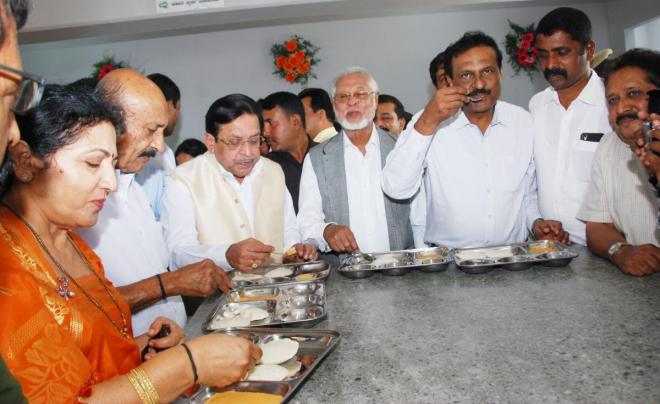
District In-charge Minister M R Seetharam and others have food at the new Indira Canteen on Race Course Road in Madikeri on Thursday.

District In-charge Minister M R Seetharam inaugurated the Indira canteen at Race Course Road in Madikeri on Thursday.

Minister Seetharam, MLC Veena Acchaiah, CMC president Kaveramma Somanna and others tasted the food at the canteen on the first day. The menu consisted of idly, pulao and kesari baath. The canteen evoked a good response on the first day.

Breakfast and meals will be available in the canteen on all seven days of the week. Breakfast is priced at Rs 5.

The breakfast menu will vary from day to day and is as follows: Monday: Idly – puliyogre, Tuesday: Idly – khara baath, Wednesday: Idly – pongal, Thursday: Idly – rava khichdi, Friday: Idly – chitranna, Saturday: Idly – Vaangi baath, Sunday: Idly – kesari baath. (One of the two dishes will be served)

The afternoon and evening meals cost Rs 10 per plate and will comprise of rice, sambhar and curds. Any one item out of tomato baath, chitranna, vaangi baath, bisi bele baath, menthe pulao, puliyogre and pulao will be served.

The minister, meanwhile, inaugurated the market in Mahdevpet and the mobile canteen.

source: http://www.deccanherald.com / Deccan Herald / Home> District / by DH News Service, Madikeri / March 22nd, 2018

Brijesh Kalappa appointed Congress media convenor in Karnataka

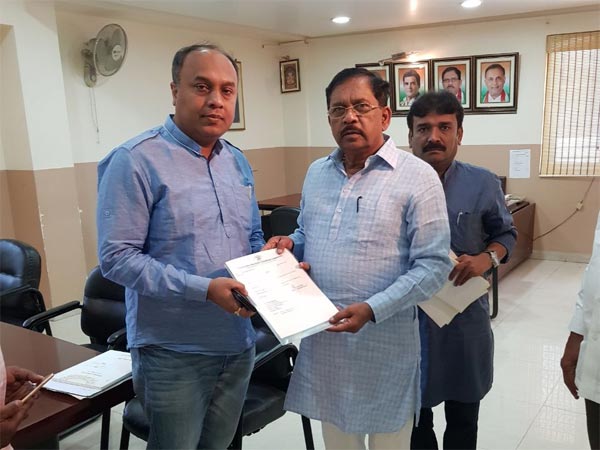
BrijeshKF20mar2018
Brijesh Kalappa has been appointed as the media coordinator of the Congress in Karnataka. The appointment was made by Karnataka Pradesh Congress Committee President, Dr. G Parameshwar.

Brijesh Kalappa, an advocate in the Supreme Court was also the former legal advisor to the government of Karnataka. He was also the former additional advocate general, Haryana.

He is a former journalist and has a wide range of interests including reading and travelling.

On the professional front, he has worked with several legal luminaries on subjects of importance in civil, criminal, water and electoral laws and has individually represented governments, eminent individuals and major industrial houses.

source: http://www.oneindia.com / OneIndia.com / Home> News> India / by Oneindia Staff Writer / Sunday – March 04th, 2018

Joshna Chinappa and Velavan Senthilkumar figure in ASF Awards

JoshnaKF20mar2018

Chennai:

Leading lady of Indian squash Joshana Chinappa and a former junior star Velavan Senthilkumar figure in the Asian Squash Federation’s list of performance awards for the year 2017.

Another Indian to get noticed is Deepak Mishra, a former player who has become a coach at the Indian Squash Academy. Deepak is to be presented with the Certificate of Recognition by the ASF.

Joshna’s best moments last year came in the Asian Individual championship which was held in April here at the Express Avenue mall where she made history by becoming the first Indian to win the coveted championship honours. For her stupendous show the Asian body chose her for the Dato Alex Lee award (outstanding performance of the year – Senior). The award for the best male player in this category went to Max Lee of Hong Kong.

Velavan had the distinction of winning the British Junior Open U-19 title for the Drysdale Cup in January in what was an historic occasion for the country with three Indians taking the first three positions. Velavan won the gold, Abhay Singh the silver and Aditya Raghavan the bronze. Velavan also featured in the title-win over Malaysia in the Asian junior team championship held in Colombo in February. For his overall show of excellence, the ASF chose him for the Hassan Musa Award ( outstanding performance of the Year- junior). The award for the female player went to Satomi Watanabe of Japan.

In all there were seven categories of awards, including for Coaches. There were 12 nominations from four countries for the Performance awards and nine nominations from six countries for the Coaches awards. The awards are to be presented at the Asian Team Championships to be held this year in Cheongju in Korea.

source: http://www.timesofindia.indiatimes.com / The Times of India / News> Sports News> Others / by Damayanti Dasgupta / TNN / March 20th, 2018

Cauvery: A time to pause

The role played by Kodagu, which has nourished and nurtured the Cauvery over time, needs to be recognised.

The Supreme Court of India has determined the manner in which the waters of the Cauvery river are to be shared among the beneficiary States. In its recent judgment on the long-pending issue, the court virtually pulled the proverbial rabbit out of the hat. The decision has received with muted acceptance, understandably, by all concerned, and some token opposition.

The Cauvery dispute has been a long-standing issue among the States, each one trying to tweak the 1924 Agreement forged during the British administration. Much water has flowed down the river since, and each State was trying to secure the best deal for itself.

A noteworthy aspect is that the matter has engaged some of the brightest minds, be it engineering, law, administration or politics, and the fortunes of many rose and fell at each turn of events. The din has for the present subsided. The bigger and immediate challenge now is to save the river to ensure lasting harmony and sustained development of the beneficiary States of Karnataka, Kerala, Puducherry and Tamil Nadu.

Amid all the arguments, the role played by Kodagu district in Karnataka, which has nourished, nurtured and nursed the river over time, has hardly been recognised or acknowledged.

Kodagu is part of the lower Western Ghats and at its highest point, is around 5,000 feet above sea level. Originally administered directly by the British from Madras, it became a Part ‘C’ State at the time of Independence, with its own legislature and Ministers. Subsequently, after the Reorganisation of States it became the smallest district, with a wealth of natural resources. It is in the Brahmagiri hills of Kodagu that the Cauvery rises and disappears, till it is seen again outside the boundaries of the district. The scenic beauty of the Brahmagiri range is a feast for any nature-lover. A mind-boggling phenomenon can be seen between October 14 to 17 every year unfailingly, when the Cauvery, which is nowhere to be seen, suddenly gushes forth from a spring and then swells into the river that bestows its bounty on millions of people along the way, till it reaches the Bay of Bengal in Thanjavur district of Tamil Nadu.

Kodagu has the largest acreage under coffee in the country, with one of the Tata companies owning approximately 40,000 acres. Trees of vintage growth, bamboo, pepper vines, spices, fruits and other agricultural produce make Kodagu a nature’s paradise. Kodagu hosts many species of wildlife, including the tiger, making it an attractive tourist destination.

Kodavas, the numerically small Hindu ethnic community, are different from neighbouring communities in their costume, language, and social practices. Suffice it to say that they have distinguished themselves in many fields and contributed to India significantly. This, however, is not about the Kodavas.

Journey to Tamil Nadu

Abundant green cover in Kodagu is of vital importance as this will ensure that the district receives sufficient rainfall to bring the river to life and flow in all its glory up to Tamil Nadu. Unlike Himalayan rivers, which are snow-fed, the Cauvery depends primarily on the Southwest monsoon. The river is impounded at the Krishnaraja Sagar dam, outside Mysore, conceived and constructed during the British period by the legendary engineer Sir M. Visvesvaraya. From here water is released, reaching Tamil Nadu, where it is stored in the Mettur Dam (Stanley Reservoir). Further release of water is dependent on the agricultural requirements of farmers downstream.

It would be facile to assume that the court decision has solved all problems and that the States concerned will live happily ever after. In a year when there is copious rainfall in Kodagu and the Cauvery is in spate, Karnataka releases water freely, making a virtue out of necessity. There is then no need for any water- sharing formula. It is only in years when rainfall in Kodagu and the catchment of the Cauvery is below par that the problem arises. This results in constant wrangling, and heated arguments between the States over the quantity of water released, the timing of the release and the manner of release, often resulting in violence. Matters get worse if the ‘deficit’ year happens to be an election year. This is the real issue and to date no satisfactory acceptable formula for sharing the distress has evolved, nor is a sound mechanism in place, for delivery in such situations.

It would be relevant to examine data for the decade 2007-2008 to 2017-2018 relating to release of water. Flows received from Karnataka were measured at the Mettur Reservoir up to 2012-13, and from 2013-14, at the Biligundlu gauging site maintained by the Central Water Commission. Against an annual 205 tmc ft (thousand million cubic feet) at Mettur, only 69.727 tmc ft was realised in 2012-13. At Biligundlu, against an annual figure of 192 tmc ft, the receipt in 2015-16 was 15.385 tmc ft. In 2016-17 the figure was 69.316 tmc ft and in 2017-18 it was 113.084 tmc ft. The statement shows that in the preceding decade there was deficit in four years. This is a matter of concern.

Reason for ‘deficit’

The main reason for deficit is reduced rainfall in the catchment area of the Cauvery in Kodagu district, mainly on account of loss of ‘green cover’. One needs to understand the reason for this loss. It is stated that construction of high tension power lines across Kodagu required felling of large number of mature trees, which reduced the ‘green cover’ substantially along the alignment. Perhaps that was the price to be paid for providing sustained power supply to areas beyond Kodagu. But who paid the price? The farmers in Karnataka and Tamil Nadu were the ones directly affected, along with all those areas that depend on assured water supply, such as Bengaluru which supports major industrial activity and large populations. In recognition of this need, the Supreme Court has specifically earmarked a certain quantity of water for Bengaluru.

Disturbing news

A matter of serious concern is news that certain infrastructure projects have been lined up for implementation in Kodagu. Two railway lines are planned: the Mysore-Kushalnagar-Madikeri (Makkandur) line and the Thalasssery-Kodagu-Mysore line. Four National Highways are planned. These are the Mysore-Kodlipet-Sunticoppa-Madikeri- Gonikoppal- Kutta-Mananthawadi; the Bangalore-Bantwal highway via Kushalnagar and Madikeri; Pannathur-Bhagamandala-Madikeri, and Mattanur-Gonikoppal- Thithimathi-Hunsur. This will connect the new Mattanur airport to Mysore and Bangalore at a cost of Rs. 1,000 crore. Additionally, existing roads are to be upgraded into four-lane highways.

These projects will undoubtedly result in the felling of a large number of trees, constant influx of persons transiting Kodagu without any concern or commitment for the local environment, increasing issues of waste disposal and management. Many other unacceptable activities will disturb the ethos of Kodagu and its natural environment.

The question to be asked is whether Kodagu, which is the major watershed and catchment for the Cauvery, requires these projects that are likely to cause more harm to the beneficiary States, while bringing only marginal and doubtful benefits. The ryots in the Thanjavur delta of Tamil Nadu that covers vast acreage, the farmers of Mandya in Karnataka, the drinking water supply needs of burgeoning cities such as Bengaluru and Chennai and many areas in the other States will be affected by any reduction in the flows of the Cauvery. There is no indication that the long-term impacts of these actions have been considered. No consultation with local communities appears to have been done. The impression at the ground level is that a very short-sighted view has been taken, and these projects have been mooted at the instance of local politicians as part of vote bank politics, in some cases backed by lobbies eager to monetise the natural wealth that will need to be extracted before implementation.

The way forward

It is clear that India needs to walk the ‘development path’. The right way is ‘sustainable development’, which does not appear to be the case in respect of the above-mentioned projects. The waters of the Cauvery have nourished downstream civilisations for centuries. It is the life blood of the States that now comprise the region. The time has come to save the river, bring back its glory as a provider and nourisher of humans, enabling them to live in peace, harmony, and rise to their full potential in every sphere of endeavour. There is no case for inter-State political one-upmanship or victory or loss for any group. The goal and cause are one…. save the Cauvery for the good of all, for all time to come, by taking a long-term view. Everyone needs to be on the same page.

The following steps need to be taken immediately.

1. Suspend all infrastructure projects, proposed or under implementation, for six months or a year. This short postponement will give time to study the issues necessary for saving the Cauvery.

2. Set up a competent neutral body to assess the real need for connectivity through Kodagu with contiguous areas and examine alternative options.

3. Identify the best option that will cause least damage to the environment and catchment of the Cauvery.

4. Having completed the above three tasks, arrange for a ‘carrying capacity study’ to be done by a credible professional body.

5. On the basis of the findings of this study, the implementation of projects should be supervised by an empowered body to be named the ‘Kodagu Sustainable Infrastructure Projects Board’, with the Deputy Commissioner of the district as Chairman, and the representatives of different agencies and local non-officials as members, to ensure timely implementation in accordance with project specifications.

6. Quarterly meetings of Chief Secretaries of the four States to be convened by the board to update them on the progress and the status of safeguards for the Cauvery.

The need of the hour is statesmanship, avoiding political short-sightedness. It should not become a case of winning the battle of sharing the Cauvery waters and losing the war of saving the river for posterity.

The author, who retired from the Indian Administrative Service, has written this as a concerned citizen. Email: sonnabel@gmail.com

source: http://www.thehindu.com / The Hindu / Home> Opinion> Open Page / by P.M. Belliappa / March 18th, 2018

SWR employees to represent India at Commonwealth Games

Two employees of the Mysuru Division of the South Western Railways will represent the country in the Women’s Basketball at the Commonwealth Games to be held in Australia in April.

P.U. Navaneetha and H.M. Bhandavya are among the 12 members selected by the Basketball Federation of India.

The team will leave for Australia on Monday ahead of the games where it is pitched against eight other countries.

source: http://www.thehindu.com / The Hindu / Home> National> Karnataka / by Special Correspondent / March 12th, 2018

Mangaluru: Indian hockey star S V Sunil ties knot at Kudroli temple

Mangaluru :

Indian national team hockey player and Arjuna awardee Somwarpet Vittalacharya Sunil, known as S V Sunil tied the nuptial knot with Mangalurean Nisha at Kudroli temple on Sunday, March 4.

Nisha, daughter of Tharnath Acharya hails from Derebail Konchady. SV Sunil and Nisha got engaged last year at Konchady.

The reception ceremony will be on March 5 at Madikeri where several hockey players are expected to take part.

SV Sunil, son of Vittal Acharya, made his international debut at the young age of 18. With 11 years of experience, presently S V Sunil is one of the key members in the Indian hockey team. He was part of the team in the year 2008 for the Sultan Azlan Shah Cup, in which India won the silver medal. In 2011, he played in the Champion’s Challenge and scored four stunning goals, the most by any Indian forwarder. He was also part of the team that secured gold in 2014 at the Asian Games at Incheon. Sunil was part of the team in the Hero Champions Trophy 2016 and won the silver medal.

S V Sunil received the prestigious ‘Arjuna Award’ from president Ram Nath Kovind on the birth anniversary of hockey wizard Dhyan Chand on August 29 last year.

source: http://www.daijiworld.com / DaijiWorld.com / Home> Karnataka / by Daijiworld Media Network – Mangaluru (ANK) / Mangaluru – March 05th, 2018

A welcome retreat

RetreatKF14mar2018

The recent withdrawal of the amendment bill to the Karnataka Preservation of Trees Act, 1976 (KPT Act) by the government, which would have allowed indiscriminate cutting down of some 50 tree species, came about under pressure from green NGOs but is perfectly welcome. Farmers prefer growing hebbevu, eucalyptus, Casuarina, silver oak, Acacia auriculiformis, shivane, teak, sandal, etc.

The first four of the above species are already on the exemption list. The current proposal of the Forest department for inclusion in the exemption list includes Acacia auriculiformis, Kakke, Gulmohar, Peltoform, Raintree, Christmas tree, orange tree, Purple Bauhinia, mulberry, curry leaf, drumstick, Simaruba glauca, African tulip, tabebuia, Tecoma, Indian cork tree (Mellingtonia), etc.

Granting exemption on Gulmohar, Peltoform, Raintree, Purple Bauhinia, Tabebuia, Tecoma would lead to destruction of trees from urban areas. Thankfully, withdrawal of the exemption proposal does not hurt farmers as these are not their preferred species.

Acacia auriculiformis was the main species of forest plantations for more than three decades. Now, the planting is banned in some areas, yet its exemption may induce smuggling from older plantations. It is understood that the plantations are to be protected by the department, then why not include other species like teak, etc., on the exemption list?

When KPT Act was legislated in 1976, Casuarina and Hopea wightina were in the exemption list. Other species required permission. But, for nine districts, namely Chikkamagaluru, Chamrajnagar, Dakshin Kannada, Hassan, Kodagu, Mysuru, Shivamogga, Udupi, Uttar Kannada, felling permission is not needed for any species except sandalwood and rosewood.

Even in these districts, tree-owners had provision for domestic consumption. People were harassed in the districts by Revenue and Forest officers. In 1987, the Act was amended to include Coconut, Erythrina, Eucalyptus, Glyrecidia, Prosopis, Rubber, Sesbania and Silver oak in the exemption list.

There were difficulties in protecting exempted species in the forests, yet the amendment was not retracted. The red tape in the lower bureaucracy continued to harass tree-owners for several other species. By another amendment in 2015, the exemption list was extended to subabul, areca nut, coffee, guava, hebbevu, Ailenthus excelsa, lemon, Maeopsis eminni, mango, sapota, Dendracalamus stocksii, Burma bamboo, Yellow bamboo, Acacia mangium, Acacia hybrid, Balangi and Cashew.

Exemption for mango and Balangi posed a serious threat to forest conservation in the Western Ghat areas. Huge mango trees growing on water courses in the forests were illicitly cut away, sometimes with the connivance of the officers. Many varieties of mango disappeared.

The loss of these trees from water courses can deplete water flow in the tributaries of major rivers. The Karnataka High Court removed the exemption on mango trees. The exemption of other species did not bring any negative impact on the conservation of forests.

To popularise farm forestry, Karnataka took some interesting initiatives. Krishi Aranya Protsah Yojane (KAPY) was launched in 2011, where tree-growers were paid an incentive for successfully growing plants for three continuous years. The initiative has picked up well.

The recently published Forest Survey of India (FSI) report confirms that the state’s forest cover has gone up from 36,449 sqkm to 37,550 sqkm in two years. The cover in recorded forests, Revenue and Paisary lands has gone up by 359 sqkm. However, in private wooded areas, coffee estates, and coconut and areca nut gardens, it has increased by 742 sqkm, but the assessment has not separated the contributions of forests and horticultural plants. Tree groves below one hectare and strip plantations are also assessed by FSI, where tree-cover is found to have increased from 5,552 sqkm to 5,713 sqkm in the same period.

The assessment is based on satellite imagery of October 2016. Assuming that five years’ growth is necessary for a signature to be picked up in satellite imagery, the increase, if any, can be attributed to plantations raised prior to 2012, and not due to the impact of KAPY and exempting additional species from KTP Act.

Mixed findings

FSI has also brought out the district-wise status of forests. It is heartening to note that the tree-cover in all dry districts has gone up, and horticultural plantations have also contributed. The success of the forestry programme in dry districts can be attributed to the fact that these districts are not covered under KPT Act and the movement of growing trees has picked up well.

Further, there is a disturbing trend of forest cover in Malnad districts like Dakshina Kannada, Kodagu, Mysuru and Shivamogga having decreased. This is the negative impact of KPT Act, as some of the exempted species have been illicitly removed from forests. The forests in these districts must be preserved as these are the catchments of many important rivers. Kodagu is a hilly district extending over 4,102 sqkm, of which only 1,700 sqkm is recorded forests. The vegetation on private land is equally important in the catchment of Cauvery river. The KPT Act has played havoc there in the past. It is time to suspend felling of naturally-growing trees on private lands in Kodagu.

Forests are the ‘mothers’ of several rivers, and the KPT Act is important for conservation. At the same time, growing trees on private lands must be encouraged and authorities must be held accountable for any laxity in dealing with cases under KPT Act. Bureaucratic hurdles are man-made, which must be dealt with severely.

Prime Minister Modi’s vision is to double farmers’ incomes by 2022. Among other things, he has been talking about soil testing, easy availability of neem-coated urea to reduce costs and growing tree species on the periphery of farmlands as well as bee-keeping to boost incomes. We have been importing wood for quite some time for our domestic consumption. The only way to save the foreign exchange is to grow our wood requirement indigenously.

(The writer is a former Principal Chief Conservator of Forests, Karnataka)

source: http://www.deccanherald.com / Deccan Herald / Home> Main Article / by B.K. Singh / March 10th, 2018

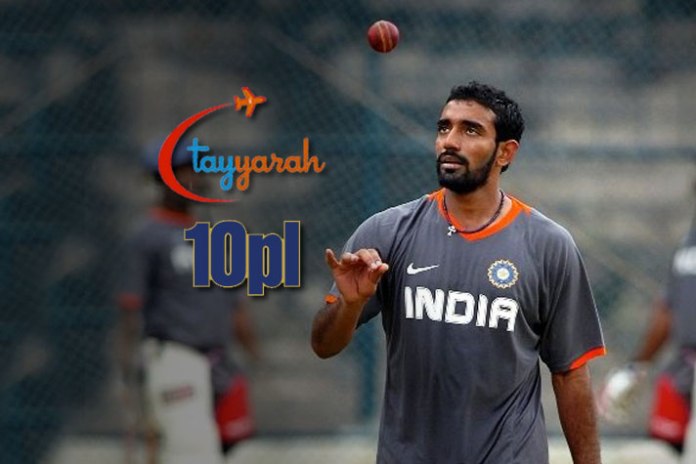
Robin Uthappa mentor and brand ambassador of Tayyarah.com 10PL team

RobinUthappaKF14mar2018

Robin Uthappa will be seen in a new avatar at the upcoming Tayyarah.com 10 PL. The veteran Indian cricketer has been signed as the brand ambassador and mentor for Tayyarah.com’s side in the Ten Premier League (10PL). The league is slated between March 19 and 23 at the Sharjah Cricket Stadium. In all 16 teams will be participating in what is the world’s biggest tennis ball cricket tournament.

Uthappa will be present in Sharjah on 21 March to cheer and support his team during the team’s two matches on the day, news agency PTI has reported.

“It will be interesting to see cricket in a new form. I am fortunate that I can bring in some of experience to cheer my squad, albeit from the sidelines. All of us have played tennis ball cricket at sometime in our lives in India. So it would be great to relive that experience,’’ said Uthappa.

Pakistan paceman Mohammed Asif, Sri Lanka’s Thilan Thushara and Chamara Silva are also likely to play in the tournament. From India a number of players who have played Ranji Trophy are listed in squads, alongside former Rajasthan Royals paceman Kamran Khan.

Former Pakistan captain Wasim Akram, also the brand ambassador for the tournament, has earlier unveiled the jersey, anthem and the trophy of the tournament. The launch event, held at the Intercontinental Hotel in Dubai Festival City, was attended by the teams along with several other stakeholders including sponsors and other commercial partners.

This new and exciting format of cricket is the brainchild of UAE-based leading Sports Management Company Petromann Events, headed by Mr. Abdul Latif Khan. The tournament boasts the highest prize money for tennis ball cricket anywhere in the world and is valued at a total of 250,000 Dirhams (USD $68K).

The schedule of the tournament, under the aegis of the Sharjah Cricket Council, was announced in January 2018.

source: http://www.insidesport.co / IndiaSport / Home> Sport> Cricket / by InsideSport Desk / March 12th, 2018