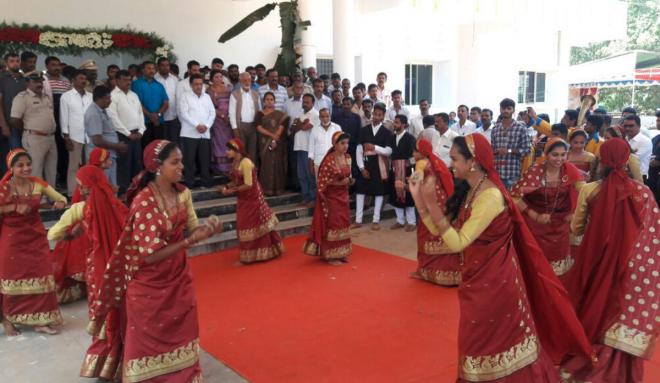
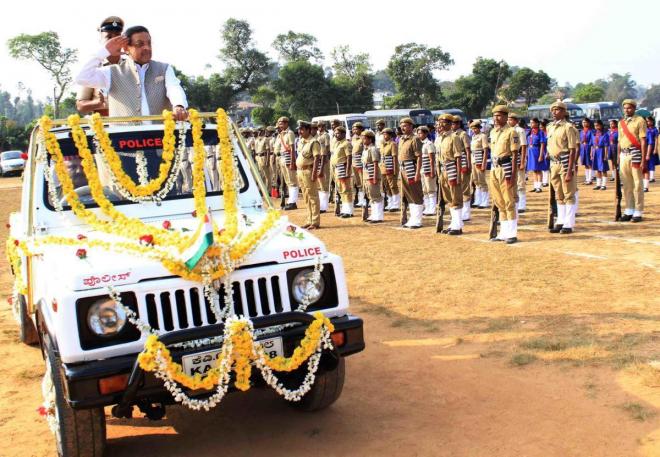
Kaveri College students present cultural programme, during the inauguration of mini Vidhana Soudha, at Virajpet on Sunday.
District in-charge minister M R Seetharam called upon the students to develop a scientific temper.
Speaking after inaugurating the mini Vidhana Soudha at Virajpet on Sunday, he said, “Public should exert pressure to accelerate public works, which are moving at a snail’s pace. A lot of development works have been initiated after the Siddaramaiah-led government came to power in the state.
Title deeds
The taluk authorities had received 3,900 applications seeking title deeds. Already, 2,459 title deeds have been distributed. The remaining will be distributed within 15 days.
The minister distributed title deeds to 121 beneficiaries on the occasion.
The students of Kaveri college presented cultural programmes as well.
BJP boycotts
The inauguration of mini Vidhana Soudha was scheduled at 11 am. As the minister arrived late, the programme started at 12.45 pm. BJP elected representatives, who had arrived on time, boycotted the programme citing they had other engagements.
Reacting to this, Seetharam said, “Politically-motivated behaviour does not speak well for anyone. Two programmes were fixed at 11 am. After taking part in a programme at Madikeri, I arrived at Virajpet.”
source: http://www.deccanherald.com / Deccan Herald / Home> District / DH News Service, Virajpet / February 18th, 2018
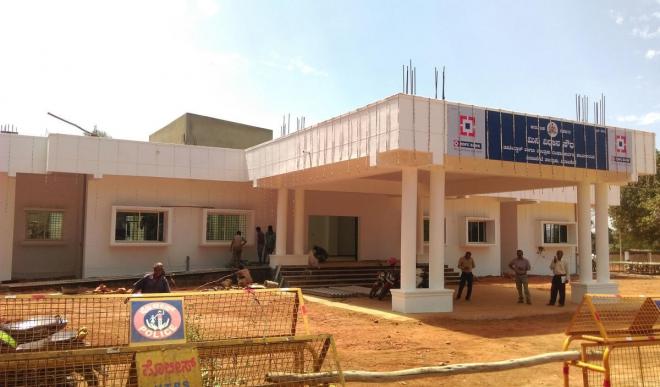
The first phase of the Mini Vidhana Soudha in Virajpet has been completed and will be inaugurated on Sunday.
With this, the long-pending demand of the people in the taluk will be realised. The first phase of the work was taken up at a cost of Rs 2 crore. It has seven rooms including the tahsildar’s court and toilets.
In the second phase, two-storeys will be built. A proposal for Rs 6 crore has been submitted to the state government. With the completion of the first phase of the work, the taluk office, sub-treasury, Department of Survey will be shifted. Once the second phase of the work is complete, entire Revenue Department of the taluk will function under one roof, according to officials.
The mini Vidhana Soudha for Virajpet was sanctioned way back in 1997. A committee was constituted to decide on the place for the Vidhana Soudha. Though there was a demand to build the Soudha at Ponnampete or Gonikoppa, it was decided to construct it at Virajpet keeping in mind the convenience of the citizens.
It was said that three years were spent on identifying the land. As suitable land was not available it was decided to construct it in a place where the old taluk office existed. The old building was demolished to facilitate the work on the Vidhana Soudha.
Accordingly, PWD invited e-tender for the work. Two contractors who had taken up the work left the work halfway. Later, once again tender was invited in 2013. Owing to a shortage of sand, and change in contractor, the work was further delayed.
District-in-charge minister M R Sitharam will inaugurate the Mini Vidhana Soudha, while MLA K G Bopaiah will preside.
With the completion of the first phase work, the offices will start functioning from mini Vidhana Soudha from March itself, said tahsildar R Govindaraj.
source: http://www.deccanherald.com / Deccan Herald / Home> District / DH News Service, Virajpet / February 17th, 2018
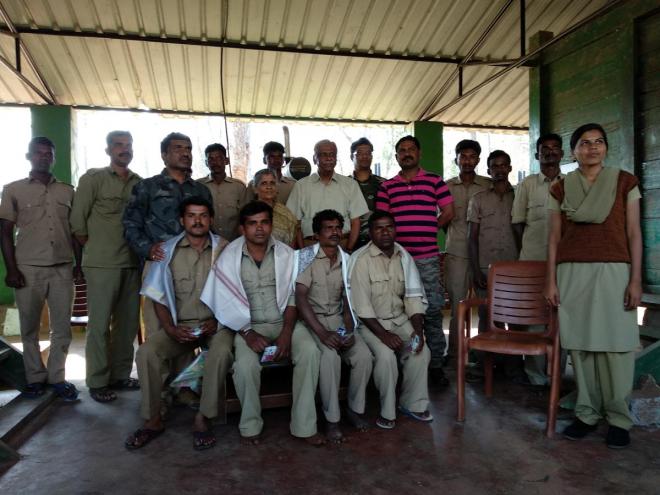
Mahout Vasantha and Gundu and kavadis Jaibal and Ravi being felicitated by retired secretary for forests A C Lakshmana and his wife Savithri at Mathigodu Elephant Camp, in Virajpet taluk, Kodagu district, on Wednesday. ACF S R Prasanna Kumar, RFO Y K Kiran Kumar and veterinarian Dr Mujeeb ur Rehman are seen.
In recognition of their services, mahouts Vasantha and Gundu and kavadis Jaibal and Ravi were felicitated by retired secretary for forests A C Lakshmana at Mathigodu Elephant Camp in Virajpet taluk, under Nagarhole National Park, on Wednesday.
It has to be recalled that Jaibal and Ravi, caretakers of elephant Drona, successfully took part in the operation to rescue a rogue elephant at Nagavara in Alur taluk, Hassan district, recently. Another elephant, Gopalaswamy, from Veeranahosahalli camp had taken part in the operation.
Jaibal and Ravi could complete the operation even though Drona was attacked by the rogue elephant, which was in ‘mast’. “Drona was injured but he recovered in a few minutes and joined Gopalaswamy to complete the operation,” Jaibal said.
Vasantha is the mahout of Abhimanyu, the star trouble shooter. Vasantha said, “Abhimanyu has taken part in 30 operations to rescue rogue elephants in Hassan district alone. He has taken part in various elephant rescue operations across India whenever there was a man-animal conflict. Besides, he was instrumental in rescuing seven tigers. When my father Sanappa was his mahout, Drona had rescued 12 elephants in Madhya Pradesh,” he said.
Assistant Conservator of Forests S R Prasanna Kumar said Vasantha was also on a 10-day tour to Indonesia, along with Nayaz from Dubare camp, to train the elephant caretakers in that country.
A C Lakshmana said that elephants are the most intelligent animals on earth and their caretakers understand them well and train them accordingly. “The services of the elephant caretakers to the Forest department in tackling man-animal conflict and in conserving the nature is commendable. They work under adverse conditions. So, it is our responsibility to recognise their services,” he said.
He said that even though there is a general feeling among the people that ‘kheda’ (operation of rescuing elephants) has been stopped, only ‘kheda’ as a sport has been stopped. “The last kheda as sport was held at Kakanakote forest in 1972, and in 1962, even then President Rajendra Prasad was witness to ‘kheda’. However, all rescue operations of elephants, during man-animal conflict, are similar to ‘kheda’. Now, the officials have the option to use tranquilisers in case the operation becomes difficult,” he said.
Range Forest Officer Y K Kiran Kumar said, till recently, there were 38 elephants in Mathigodu camp, but four of them have been given to Chhattisgarh while another four have been shifted to nearby camps, where availability of fodder is adequate.
source: http://www.deccanherald.com / Deccan Herald / Home> District / DH News Service, Mysuru / February 14th, 2018
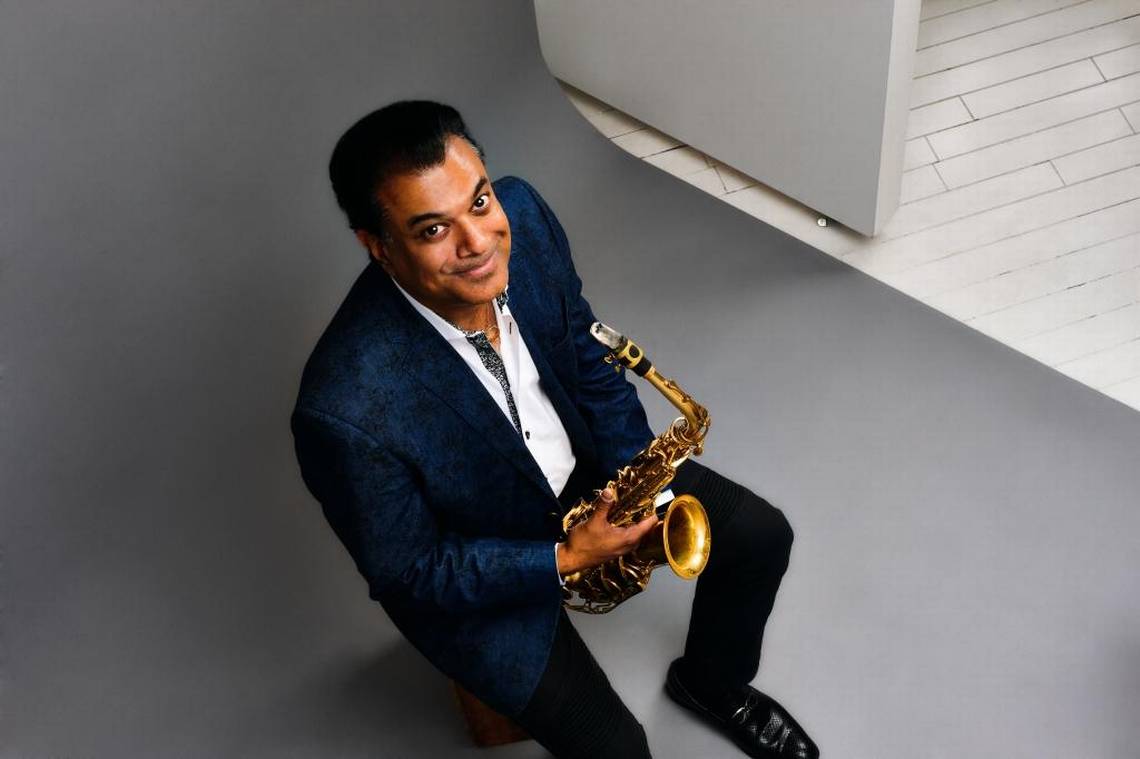
Rudresh Mahanthappa has been named alto saxophonist of the year six out of the last seven years by Downbeat magazine. Ethan Levitas
Rudresh Mahanthappa
Opening: Osland/Dailey Jazztet. 7:30 p.m. Feb. 10. Singletary Center for the Arts Recital Hall, 405 Rose St. $13 public, free in advance to University of Kentucky students. 859-257-4929. Singletarycenter.com, Rudreshm.com.
With each recording he cuts and each band he takes the stage with, Rudresh Mahanthappa reveals different views of a musical persona that can best be described as globally expansive.
In 2015, the composer, educator and bandleader — as well as Alto Saxophonist of the Year, as voted on by Downbeat Magazine’s International Critic’s Poll six out of the last seven years — channeled, dissected and re-assimilated the music of Charlie Parker into an audacious album called “Bird Calls.” Last fall, Mahanthappa followed with “Agrima,” a stylistic turnaround that meshed jazz, Indian classical music and electronics. As he prepares for his Kentucky debut on Saturday, Mahanthappa discussed plans for a future project that involves a straight ahead jazz trio of sax, bass and drums fashioned after Sonny Rollins’s classic 1958 album, “A Night at the Village Vanguard.”
“Look at my discography, and you will see every album is different,” Mahanthappa said. “Almost every album has a completely different band, so I’m always trying to shake things up for myself and change the vehicle as much as I can. My musical personality stays the same, I guess, but different scenarios bring different things out of me.”
I KNEW EVERY TRACK WITH A SAXOPHONE SOLO THAT WAS BEING PLAYED ON TOP 40 RADIO, WHETHER IT WAS MEN AT WORK OR SUPERTRAMP OR THE SAX SOLOS ON SPRINGSTEEN RECORDS.
Mahanthappa’s personal history is as culturally rich and varied as his music. Born in Italy to Indian parents, he grew up in Boulder, Colorado, initially absorbing the pop sounds of Grover Washington Jr. and David Sanborn on the radio before cutting his teeth in area jazz and even Dixieland bands.
“I knew every track with a saxophone solo that was being played on Top 40 radio, whether it was Men at Work or Supertramp or the sax solos on (Bruce) Springsteen records. I learned them all. That was my first kind of ear training, trying to learn by holding my mono tape recorder up to the radio so I could learn the saxophone solos.
“The players in the Boulder bands were all twice my age, but they took me in. I was butchering Charlie Parker solos, but people gave me a chance. Those experiences were really important. It was the welcoming aspect that really mattered. I felt like I belonged someplace. Not that I didn’t belong in my family. It was just a way to really be a musician with other musicians.”
Curiously, Mahanthappa’s exploration of his Indian heritage came much later in his decidedly American upbringing.
“The elements of Indian music came from a place of trying to engage my ancestry in a way that was really meaningful. I don’t speak my parents’ language. I didn’t grow up around any other Indian families. Beyond the limits of my immediate household, I was figuring out how to create an Indian-American culture on my own and with my brothers. For me, in particular, music was the most effective way of describing that, defining that and communicating that. I feel a lot of the music I play is a by-product of me getting to know myself.”
IT’S NICE TO GO TO THESE PLACES I’VE NEVER BEEN BEFORE AND PLAY WITH THE LOCALS WHO HAVE DEVELOPED A REAL SCENE IN THEIR PART OF THE COUNTRY.
Today, Mahanthappa’s heralded career is balanced with duties as the head of jazz studies at Princeton University. That ties in to his performance on Saturday at the Singletary Center, where he will team with University of Kentucky jazz pros Miles Osland and Raleigh Dailey in their Jazztet.
“It’s nice to go to these places I’ve never been before and play with the locals who have developed a real scene in their part of the country. I think it’s very important to the relevance of this music to engage as many of the communities as possible and not just show up to do the gig and take off. There’s a lot more to it than that.”
source: http://www.kentucky.com / Lexgo – Kentucky.com – Lexington Herald Leader / Home> Music News & Reviews / by Walter Tunis, Contributing Music Critic / February 07th, 2018
Romance blooms along with coffee in Manu Warrier’s debut feature film.
A love story set in the lush coffee plantations of Coorg, where love blooms along with the coffee flowers. And you have a Kodava protagonist in a Hindi movie! Co-written by Mumbaikar from Kerala Manu Warrier and Bengaluru man Sharath Parvathavani, Coffee Bloom is an indie inspired by the scenic plantations of Coorg.
Manu, whose directorial debut is Coffee Bloom , wanted the location to be an important part of the narrative. “My co-writer Sharath, with whom I have worked on a short film earlier in the U.S., is from Bengaluru and it dawned on us when we were working on the script that Coorg is just one night away from Bengaluru. Our story required a contained setting. We visited Elephant Corridor (a homestay in Siddapura) owned by Viju and Nimmi Chengappa and they gave us a detailed account of life there and the phenomenon of coffee blooms. We realised this could be a key factor in our story and we reworked the script around it, and adapted the story to Coorg, so that it didn’t feel gimmicky.”
Manu admits that till he visited the Chengappas, his knowledge of Coorg was limited to photographs. “The first thing that occurred to me was that it was a visual delight.”
Manu, a scriptwriter, says he’s averse to showing violence and frustration on screen. “I’m driven to working on plot-oriented subjects.” So, the story traces the life of Dev Anand, a self-proclaimed wise man who finds comfort in being a loser, having given up on life as a result of a romance gone wrong. A life-changing event takes him on a journey to a coffee plantation in Coorg, where he meets Anika, his long-lost love, currently his boss. Love blooms in an idyllic setting; and much is at stake as the yearly bloom is round the corner.
Manu admits that he was lucky when he started out wanting to make this indie. He was introduced to Bollywood producer Harish Amin by filmmaker Leena Yadav, who loved the story. He also brought on board Bollywood actor Arjun Mathur, who has earlier starred in Luck by Chance, My Name is Khan, and Fireflies, and Sugandha Ram who was part of Jaane Tu Ya Jaane Na and My Name is Khan . The film also stars Mohan Kapoor and Ishwari Bose-Bhattacharya. Manu started writing the film in 2011 and shot it in February 2013. “The climax was dependent on nature. We had to chase the seasons to ensure continuity did not suffer.” Thus the film cost Rs. 1.5 crore to make, he admits. In 2014, it premiered at the MAMI Mumbai Film Festival. At the NFDC Film Bazaar, it was marked for ‘Market Recommendation’.
It was while he was studying for his MBA in U.S.A. that Manu seriously started getting engrossed in cinema. “I wanted to make films, but my middle-class upbringing frowned on filmmaking as a career. But, in the U.S., I had access to film libraries. I started reading, and started DIY filmmaking.” He worked in HR recruitment for a while, and then decided to come home. When he moved to Mumbai, he says he was naïve enough to believe that he would write scripts and films would be made out of them. “But reality doesn’t work like that. So I started pitching myself as a scriptwriter, and as someone who would develop people’s content for them.” Things started opening up, but projects were also frustratingly shelved midway.
Manu says he had been going back and forth with filmmaker Anurag Kashyap to collaborate on a script when another great opening came his way — “Anurag Kashyap suddenly called me late one night and said there is a writing project. He didn’t tell me any more details or who it involved. I think it was about being in the right place at the right time.” Manu landed a writing job, having been given the task to write the screenplay for four episodes of Yudh , the TV series starring Amitabh Bachchan, that Kashyap had created.
Talking of opportunities available now, and the possibilities of the indie film in Hindi cinema, Manu says there are people who make films on controversial subjects to get attention, and there are others putting up their films online.
“But whatever you do, struggle is a part of the picture. I was a rank outsider. And it’s never easy. But after a point, you just want to be part of the picture, whether it’s rosy or not. But the indie scene is surely changing for the better,” says the 36-year-old filmmaker.
Coffee Bloom releases in India, U.S. and Toronto simultaneously on March 6.
source: http://www.thehindu.com / The Hindu / Home> Features> MetroPlus / by Bhumika K / March 03rd, 2015
The Kodavas were always a martial race with a pronounced colonial hangover (Agency Photo)
It’s an impressive roll call. Field Marshal K M Cariappa, Gen Thimmaiah, B C Nanda, M P Ganesh, Prasad Bidapa, Len Aiyappa….The Kodava community, from southwestern Karnataka, has always punched above its weight in Indian public life. Kodavas rose high in the Indian Army; they excelled at sport, particularly hockey and flourished in the coffee trade. But that was then. Today, the Kodavas are buffeted by the winds of change. Modernity and migration are taking their bewildering toll on a people that set great store by tradition.
This is the context of renewed demands for a separate Kodava autonomous region, which would give them a separate place of their own, in keeping with their claims of being vastly different from everyone else. For this would also accrue all the benefits that go with a distinct identity. The men are strikingly handsome and their women appealing winsome. Their customs and traditions too are quite different from those in the rest of the region,one being that an uncle usually marries his niece. For nearly two decades, the Codava National Council (CNC) has been fighting for autonomy and the issue is back on the agenda with regular dharnas and sporadic protests at the state legislature.
The Kodavas were always a martial race with a pronounced colonial hangover. Their loyalty to the British meant they found secure footing in the armed forces. Even though they had few officers and mainly made up the rank and file, the Army had a significant Kodava presence. No longer. Kodava recruitment at the Bangalore Army headquarters, which caters to Karnataka, Kerala, Mahe and Lakshadweep, fell steadily from 85 in 2001-02 to 28 in 2007-08. Today, the highest-ranking Kodava officer is a lieutenant-general and they have just a few major-generals.
The once-famous Coorg Regiment has suffered too. Twenty-five years ago, every Kodava family could proudly list several of its men in uniform. That’s history. Sons prefer to head for engineering colleges now or professions more lucrative than the Army, say recruitment officers.
It is the same with sport and the Kodava’s once-legendary skill on the hockey field. M P Ganesh, the first Kodava to captain the national team, heads a list that also features ace players such as M M Somaiah, B P Govinda, Len Aiyappa and Mandepanda Monappa. The community always enjoyed and excelled at traditional war games such as pareya-kali and shakti-kolu. This is why Ganesh, who started playing hockey late, was deemed a natural.
Army hockey teams, particularly those that played for the Madras Engineering Group, had several Kodavas. They were robust, used to walking to school several miles a day. And they had the right temperament for the game. But now, hardly any Kodavas play hockey, says Ganesh. “High coffee prices, other employment opportunities and a more sedentary lifestyle have led to a lack of interest in the game,” he says.
Today, the Kodava’s passion for hockey surfaces only during the annual tournament in Madikeri, the town in the Kodagu district that Kodavas regard as home. The tournament is hosted by one Kodava family or clan. Other families and clans play for pride and honour. Women are allowed to compete. National and state players are welcome but Ganesh says they are nothing like yesterday’s Kodava hockey stars. “Players should be picked up from here and coached,” he suggests. Eight Kodavas play in the Karnataka team today, but none in the national team. Len Aiyappa was the last to distinguish himself at the national level.
It is hardly different in the former Kodava mainstay, the coffee plantation. Once upon a time, almost every Kodava family owned a coffee estate, or part of it, ranging from a few acres to vast swathes of land. Coffee is cultivated on roughly 2.5 lakh acres in Kodagu, says M C Nanaiah, a member of the state legislative council, but the Kodavas no longer rule the roost.
Many Kodava families are selling off their ancestral homesteads and estates and migrating to Bangalore or Mysore. The trickle grew to a flood after coffee prices slumped a few years ago. Kodavas are also converting their palatial bungalows into home-hotels, burgeoning business ventures for sure but emblematic of their decision to swap a timeworn culture for modern commerce.
The winds of change are sweeping the little district, bearing the scent of the white coffee flowers. The Kodavas are hanging up their hockey sticks and Army boots. Many argue that it is all to the good for a community to change with the times, embracing newer professions such as IT and science. For the Kodavas, the change may be eagerly sought but bewildering.
deepa.bhasthi@timesgroup.com
source: http://www.timesofindia.indiatimes.com / The Times of India / News> India News / by Deepa Bhasthi / TNN / November 02nd, 2008
In 1837, this anger turned to action for freedom and the British suffered a temporary defeat, says N.S. Deviprasad Sampaje, Writer.
The Jangama Kalyanaswamy’s flag used during the Sullia rebellion was hoisted by Guddera (Guddemane) Appaiah against the British in 1837 was later adopted as the Kodagu Gowda coat of arms. They are also called Arebhashe Gowdas
Mangaluru:
It was the first armed uprising against the British, which took place 20 years before the First War of Indian Independence in 1857. The men who laid down their lives in this uprising of 1837 in Mangaluru are not forgotten.
The Tulunadu Rakshana Vedike and several others organisations marked the 179th anniversary of the uprising on Tuesday at Bavutagudda, where the rebels hoisted the Indian flag to mark their victory over the British on April 5, 1837.
“The people of Kodagu and Canara (coastal Karnataka) were unhappy with the British for various reasons. In 1837 this anger turned to action for freedom and the British suffered a temporary defeat,” recalls writer, N.S. Deviprasad Sampaje.
Mr Sampage , who wrote the book ‘Amara Sulliyada Swatantrya Sangrama,’ detailing this early struggle for freedom, says it was a mass movement and not restricted to some villages or caste.
“It received unprecedented support from the people of Dakshina Kannada. However there were efforts to tone it down by labelling it ‘Kalyanappa na Katakayi, or ‘loot of Kalyanappa’.
But in reality it was a major movement for freedom in the region, which scared the British. The reports of the then Collector of Dakshina Kannada, Leven, reveals this,” he says.
The rebellion was led in Kodagu by leaders such as Aparampara, Kalyanappa and Putta Basappa and continued in Sullia, Puttur before culminating in Mangaluru, the seat of the British Collector.
It is said the rebels held control of the city for 13 days before British reinforcements arrived in Mangaluru and recaptured it.
But it took two months more for the British to arrest the rebels and hang them in public to silence the movement.
“The government must do a proper study of the entire movement so people get to know its importance,” emphasises Mr Sampaje.
source: http://www.deccanchronicle.com / Deccan Chronicle / Home> Nation>Current Affairs / by Gururaj A. Paniyadi, Deccan Chronicle / April 06th, 2016
Passionate about relics and all things old, this retired History lecturer’s face brims with excitement as he shows his collection to the tourists and attempts to provide a theatrical demonstration of the artefacts. Bacharaniyanda P Appanna, a native of Kushalnagar, is a hoarder of historical artefacts that are exclusive to Kodagu. History comes alive in his house not just through the artefacts, but also through his energetic tale-telling enactment.
The history and culture of Kodagu have been an enticing topic for professional and amateur researchers alike. For most of these researchers, the abode of Bacharaniyanda P Appanna is a treasure trove of knowledge, resembling a theatre of history.
The dwelling
Appanna invariably accompanies while the curious visitor explores his collection. Taking you through a small room, he points out at an ordinary bulb. Switching it on, he says, “This bulb has been functioning from January 1, 1973.” Such is his precision and enthusiasm for age-old things. One is welcomed by a huge bookshelf at the entrance of his house. There is a kurikutt – a single piece vermilion and turmeric holder made of wood, hanging beside a brass lamp inside the house. Below this lies a chanduka, a compartmented wooden case.
Sitting beside these dateless artefacts, he says, “I have been hoarding historical objects for over 30 years now. Students and professionals from around the globe come here to learn about the significance of these artefacts.”
Appanna travels to the interior parts of Kodagu and scrutinises each village to source his artefacts. He is interested in exploring old ancestral houses, and says, “I mostly visit age-old houses owned by the elderly. Requesting their permission, I first scrutinise the attic and then the backyard to find the valuables.” Thereby, he acquires innumerable authentic and priceless artefacts for his collection.
Appanna has thoroughly researched and named the artefacts correctly, some in Kannada and the rest in Kodava language. Since his house cannot accommodate all the artefacts, some are placed in a makeshift shed outside the house.
Several Kodava weapons hang inside the house. They include the amb kathi, meembal, vodi kathi and a variety of rifles strung along with a line of bullets. Spirited, he precisely enacts how the Kodavas used these weapons, and explains, “Amb kathi was designed for the ladies, who were skilfully trained to use them. The meembal was used for fishing.”
Showcasing hobbies
His makeshift shed is home to antique vessels, vintage knitted baskets and stone measures to name a few. Explaining the functionality of sekala, a huge mud pot with pores in its inner lining, he says, “It was the steam cooker of the bygone era.” He then lines up a few measuring bowls, pare, pani and sair, and explains, “One pare is 10 sair, one pani is two sair…” These are local measuring units of the bygone days. Similarly, he lines up a few stone weights and goes on to explain their units, which include pare and batti.
Furthermore, he introduces the kota kudike, a mud pot that used bamboo leaves and wet sand placed at its bottom to preserve meat and fish for five to six days. He also possesses a wooden device used to make nuputtu, a famous Kodava dish. Next is the batte bari, a knitted basket, that acts as a wardrobe. Showing one of the ancient ones, he says, “This belonged to the wife of Kaliyat Ajappa, a cult deity.” Likewise, he shows more items such as the pombana (coin holder), maal pott (jewellery holder), ele thatte (ancient tray), etc.
He also possesses the ceremonial dowry items given to women during their weddings.
In the backyard, equipment related to agriculture and fishing is arranged. The design of the ancient fish trap is sure to enthral the viewers. Bacharaniyanda house is open to all enthusiasts who want to experience the culture of Kodagu and the visitors’ names are jotted neatly in his diary with dates. Appanna can be contacted on 9480730763.
source: http://www.deccanherald.com / Deccan Herald / Home> Supplements> Spectrum / by Prajna G R / January 22nd, 2018
Kodagu District In-charge minister M R Seetharam receives the guard of honour during the Republic Day event in Madikeri on Friday.
The state government is committed to the development of the state and is working relentlessly, surpassing the barriers of caste, religion and language, said District-In-charge Minister M R Seetharam.
He was speaking after hoisting the Indian flag during the Republic day celebrations at General Thimmaiah ground in Madikeri on Friday.
The Indian Constitution upholds the value of ‘unity in diversity’. The contribution of Dr B R Ambedkar and others in providing us with a written constitution will be remembered by all the generations to come, he said.
The lives of the general public hold utmost importance for the government. Harmony and brotherhood is the mantra of development. Thoughts of people in a secular country should be based on secularism and equality, he said. All must take a pledge to respect the constitutional values, he said.
M R Seetharam said that during his recent visit to the district, Chief Minister Siddaramaiah had initiated projects worth Rs 122 crore. 94,011 families have been benefited by Anna Bhagya scheme in the district. 5514 and 799 people have been provided with title deeds under 94 C and 94 CC respectively. The construction work of 528 houses for Diddalli evacuees is on. Around 8,200 families of Jenu Kuruba and Erava Soliga communities are being provided with nutritious food. Forest Rights have been provided to 1,392 forest dwellers.
The minister further said that Indira Canteen will be set up in Somvarpet, Madikeri and Virajpet.
Troupes from DAR Police, Civil Police, Home Guards, MFC College, Koodige Sainik School, Bharatiya Vidya Bhavan, Government PU College, Government High School, General Thimmaiah School and St Micheal High Schools carried out a march past on the occasion.
MLC Veena Acchaiah, Zilla Panchayat President B A Harish, CMC President Kaveramma Somanna and Deputy Commissioner P I Srividya were present among others.
Schoolchildren presented cultural programmes on the occasion.
source: http://www.deccanherald.com / Deccan Herald / Home> District / DH News Service, Madikeri / January 26th, 2018
Anita Cariappa of Kodagu, has bagged the Karnataka Nataka Academy award for the year 2006-07 for her contribution to the field.
She is the wife of stage artiste and founder of “Sristi” theatre in Kodagu, Addanda Cariappa. Ms. Cariappa is a product of the “Neenasam” and a postgraduate in Kannada.
She is the recipient of many awards relating to Kannada and Kodava theatre.
Ms. Cariappa had been a member of the Karnataka Nataka Academy.
She has acted in Kodava films, such as “Bal Polandat” and the national award-winning movie “Hasina”, apart from acting in television serials.
N.S. Deviprasad, who also hails from Kodagu, who has organised various theatre activities in the district, has been selected for the Suvarna Karnataka award from the academy, according to information reaching here.
source: http://www.thehindu.com / The Hindu / Home> National> Karnataka / by Staff Correspondent / July 11th, 2007
WELCOME. If you like what you see "SUBSCRIBE via EMAIL" to receive FREE regular UPDATES.
Read More »