Category Archives: Records, All

Book on freedom fighter to be released on Jan 15

A work on freedom fighter and veteran politician Pandyanda Belliappa, titled ‘Kodagina Gandhi, Pandyanda Belliappa’, will be released at the Kodava Samaja in Ammathi on January 15.

The book has been written by Aithichanda Ramesh Uthappa.

Karnataka Sahitya Academy president Aravinda Malagathi will release the book while Ammathi Kodava Samaja president Mookonda Bose Devaiah will preside over the programme.

source: http://www.deccanherald.com / Deccan Herald / Home> District / DH News Service / Madikeri – January 13th, 2018

Karnataka coffee growers in a fix over wage hike

The new structure suggests 10% hike in the basic daily wage

Bengaluru :

Amidst the prevailing volatile price trend, an imminent wage hike of over 10 per cent is seen inflating the cultivation costs for the coffee growers of Karnataka, which accounts for more than two-thirds of India’s output.

Negotiations of wage hike have been completed recently between the growers and labour unions and the Karnataka government is expected to notify the new wages soon.

As part of the new wage structure, the basic daily wage is fixed at ₹305 — up 10.10 per cent over the current ₹277.41, said N Bose Mandanna, a member of the committee that negotiated the new wage structure. Including the other social costs, the total outgo for a worker would be in the range of ₹450-470 per day, he said.

Total outgo up
Labour wages account for around 60 per cent of the cultivation costs in the coffee sector, followed by fertiliser and fuel which constitute 35 per cent, Mandanna said.

“The wage hike is going to affect the growers badly,” said HT Pramod, Chairman, Karnataka Planters Association, the apex body of the growers in the State.

To offset the wage hike impact, the government should help the growers by reducing the interest costs. “We have urged the government to reduce the interest on loans up to 25 lakh at 3 per cent and above 25 lakh at 6 per cent,” he said. Pramod further said the impact of the wage hike could be more on growers of arabica, where the cost of production and pest incidence is higher and the productivity is low compared to robustas.

Global production
The revision in wages, after a gap of around four years, is happening at a time when the prices globally have been volatile and at multi-year lows.

The prevailing bearish trend in prices is largely attributed to a surge in global output, which is seen heading for a record in 2017-18 (October-September) at 158.8 million bags (of 60 kg each), about 0.7 per cent higher than last year’s 157.7 million bags, according to the latest estimates of the International Coffee Organisation released on Tuesday.

Production of arabicas is projected to reach 97.3 million bags — down 1.1 per cent from the 2016-17 season.

Robusta production in 2017-18 is seen at 61.5 million bags, up 3.7 per cent over last year, mainly on account of rebound in output of Vietnam, the largest producer of the variety. The prospect of a hike in global output is seen resulting in a bleak outlook for rebound in prices.

“We don’t have any hopes of getting a better price this year,” said DM Purnesh, a large grower in Chikmagalur.

Back home, the harvest of arabicas is almost over, while that of robustas has commenced in the key growing regions of Kodagu and Chikmagalur.

For 2017-18, the State-run Coffee Board sees a 12 per cent increase in total output at 3.5 lakh tonnes with output of arabicas estimated at 1.03 lakh tonnes and robustas accounting for the rest. Growers and the trade, based on the harvest and marekt arrivals, estimate arabica production to be around 90,000 tonnes, while that of the robusta could be much lower than the Board’s estimates.

source: http://www.thehindubusinessline.com / Business Line / Home> Economy> Agri-Business / by Vishwanath Kulkarni / January 11th, 2018

Salem, Madikeri get Fly bus from KIA

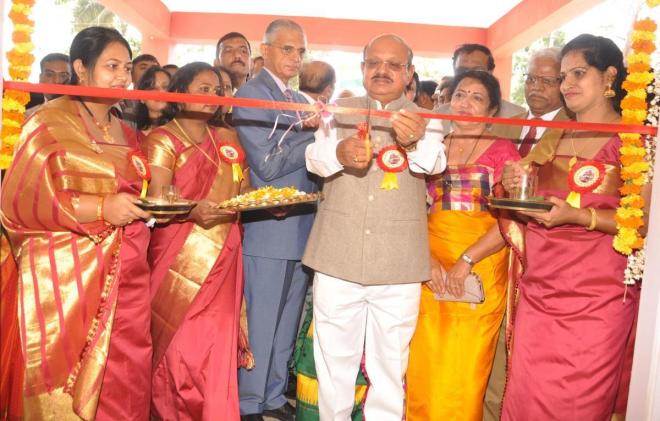
Transport Minister Revanna inaugurated three more services, two to Salem and one to Madikeri from the Airport.

Transport Minister Revanna launches the new KSRTC Fly bus services

Bengaluru:

After the success of KSRTC fly bus service from BIAL to Mysuru, Transport Minister Revanna inaugurated three more services, two to Salem and one to Madikeri from the Airport. The first of its kind in country, the service provides interstate connectivity to the Airport. The luxury Volvo buses have in-built toilets, saving passengers the inconvenience during long-distance travel.

“Now, we have six fly buses to Mysuru and two to Kundapura. Apart from the three inaugurated today (Monday), we plan to extend services to Tirupati and Kozhikode. Fly buses have live flight details, 12 gears to support the back wheel as opposed to other Volvos that have 6+1 gears, backdoor emergency exit and minimal consumption of diesel,” said Mr Revanna.

Assistant vice-president of BIAL, Mr Venkatram, said, “Our survey showed that passengers prefer coming to Bengaluru Airport instead of Chennai Airport to go to nearby places like Mangaluru, Udupi, Manipal, Madikeri, Mysuru, Kundapura and Salem. With the 2nd Terminal coming up, we will ensure the buses stop near it.” The tickets are priced at Rs 800 to Salem and Rs 1,000 to Madikeri, plus 5 % GST. Mr Revanna said that commuters prefer taking the bus from the airport, rather than travel all the way to the Satellite terminal.

KSRTC General Manager (Traffic) K.S. Vishwanath said that earnings from Fly Bus Mysuru are good. “We spend Rs 40 per km and earn Rs 70 in return. There is definitely a profit. Pantry services within the bus were not much of a hit with passengers, and we withdrew it this time,” he said.

Mr Revanna said, “We are collaborating with other state transport corporations in Telangana, Maharashtra and Tamil Nadu. We are yet to get Kerala Transport Department to coordinate with us. This will help us extend more services.”

source: http://www.deccanchronicle.com / Deccan Chronicle / Home> Nation> Current Affairs / Deccan Chronicle / January 09th, 2018

India’s ‘first coffee’ brews GI tag

Representational Image / TOI

Kochi :

Baba Budangiri, 250 km from Bengaluru, where coffee was first grown in India, is going for Geographical Indication (GI) of its variety of the Arabica brew.

On January 1, the Coffee Board filed an application for the GI tagging of Baba Budangiri Arabica and four other varieties — Coorg Arabica, Wayanad Robusta, Chikmagalur Arabic and Araku Valley Arabica — with the Geographical Indication Registry at Chennai.

Coffee Board head (coffee quality) K Basavaraj said: “We have applied for the GI marker and we are also profiling the majority variety grown in Baba Budangiri, a variety called Selection-795,” Basavaraj said. Selection-795 (S-795) is considered to be the natural descendant of two of the oldest African cultivars of coffee — Coffea Arabica and Coffea Liberica — and a third variety is called Kent. Currently, S-795 is the most prominent coffee grown at Baba Budangiri.

Edmund Hull in his book ‘Coffee Planting in Southern India and Ceylon’ says that Coffea Arabica originated in Caffa in southern Abyssina and then found its way to Yemen. According to John Shortt’s ‘A Handbook on Coffee Planting in Southern India’, Baba Budan (Baba Booden), a Muslim pilgrim, brought the brew from Mocha, a port city in Yemen, in the 17th century and introduced the variety in the uninhabited hills that came to be known as Baba Budangiri.

Today, Baba Budangiri Arabica is grown acorss 15,000 hectares around the original hills, where it was first planted. Over the last few centuries, coffee plantations grew beyond Baba Budangiri and the adjoining Chickmagalur and spread to Kodagu and Hassan in Karnataka, and Wayanad, Travancore and Nelliampathy regions of Kerala. It is also grown in the hilly regions of Palani, Shevroy, Nilgiris and Anamalais in Tamil Nadu. The non-traditional areas of coffee-growing in India includes certain pockets in Andhra Pradesh, Orissa, Assam, Arunachal Pradesh, Manipur, Meghalaya, Mizoram and Nagaland.

source: http://www.timesofindia.indiatimes.com / The Times of India / News> Business News> India Business News / by Shenoy Karun / TNN / January 06th, 2018

Ashwini Ponnappa is Coorg Person of the Year

Star Indian badminton player and Olympian Ashwini Ponnappa has been chosen as the ‘Coorg Person of the year, 2017,’ in a poll conducted by www.coorgtourisminfo.com, Kodagu’s first news portal, promoted by senior journalist P T Bopanna.

A release said that what clinched her the title besides her sporting achievements was Ashwini’s decision to marry a fellow Kodava instead of marrying outside her community.

Ashwini had won a gold medal in the women’s doubles event of the 2010 Delhi Commonwealth Games.

There was much rejoicing recently in the small Kodava community following Ashwini’s decision to marry a Kodava. Ashwini, who belongs to the Machimanda clan married model Ponnachettira Karan Medappa.

The close-knit Kodavas (Coorgs) who number less than two lakhs have been worried by the recent trend of community members marrying non-Kodavas.

Iychettira Ravi Somaiah who has built a sports facility for the public near Kushalanagar in Kodagu was also nominated for the title.

source: http://www.deccanherald.com / Deccan Herald / Home> District / by DH News Service / Madikeri – January 01st, 2018

Karnataka second in nation for providing court infrastructure: T B Jayachandra

Law and Parliamentary Affairs Minister T B Jayachandra inaugurates the Court Complex and quartters of Judicairy officials at Ponnampet in Virajpet on Saturday.

Karnataka is in the second position in the country for providing infrastructure facilities to courts, said Law and Parliamentary Affairs Minister T B Jayachandra.

Inaugurating the court complex and quarters for officials of the judiciary in Ponnampet, Virajpet taluk on Saturday, he said that the meeting of the Prime Minister and Supreme Court Judges in Delhi has appreciated Karnataka’s efforts in this regard.

There are 1,300 courts operating in the state and the government has decided to open 254 more courts.

Also, 2.90 lakh cases are pending in the High Court and 13 lakh cases are pending in lower courts.

Lawyers have a responsible role in disposing of cases. The lawyers should also work like officials of judiciary, the minister said.

Jayachandra further said that lawyers should respect the feelings of people who come to court seeking justice. He hoped that the new court which covers four hoblis will play a vital role in clearing the cases soon.

During a period of four years and eight months, the Congress-led state government has implemented 161 laws including the Prevention of Superstitions bill. The laws should be well implemented for the public good.

There are more land-related cases in DC, AC and tahsildar courts, than in civil courts. Thrust should be laid on clearing these cases soon, he said.

Jayachandra felt the need to revise old laws to address the current issues. He added that a special rule has bee formed to provide 50% reservation for the students from the state in the National School of Law.

High Court Justice A S Bopanna said that lawyers should take initiative to solve the cases amicably through reconciliation in Lok Adalat.

MLA K G Bopaiah said that the state government should address the grievances of the people of Kodagu. The traffic issue has become a nightmare in Kodagu.

Currently, there is a shortage of judges in the High Court. There are only 24 judges in the place of 62 judges. There is less number of judges in local courts too, he said.

Kodagu District Administrative Judge R B Boodihal, MLA M P Appacchu Ranjan, High Court Registrar General Ashok G Nijagannanavar also spoke. Principal District and Sessions Judge Master R K G M M Mahaswamiji, MLC Veena Acchaiah, Forest Development Corporation Chairperson Padmini Ponnappa and Bar Association President S D Kaveriappa were present on the occasion.

source: http://www.deccanherald.com / Deccan Herald / Home> District / Madikeri – DH News Service / December 24th, 2017

The roots of Kannada in Kodagu…

The coffee land is all set to witness the 80th Kannada literary meet scheduled to begin on January 7, after a long gap of 32 years. Earlier, Madikeri has witnessed two literary meets – the 18th literary meet in 1932 under the leadership of D V Gundappa and the 54th literary meet in 1982 under the leadership of Dr Shambha Joshi.

Interestingly, despite being one of the smallest districts in Karnataka, it has a wide variety of culture as well as languages that include Kodava, Arebashe Gowda and Malayalam, yet the region has managed to retain the flavour of State language.

If one goes down the pages of history, the little district with unique weather and culture has contributed immensely for the development of Kannada language. The Ganga – Kongwala – Hoysala and Haleri dynasties, perhaps laid the strong foundation for Kannada through inscriptions way back in the 9th century. In the 10th century, Nagaverma had created ‘Chandombudi’ and ‘Punyashrava,’ according to the reference available at ‘Kodagu Sahithya – Sanskrithi Darshana,’ published by Kodagu District Kannada Sahithya Parishat.

During the Chengalva dynasty, the third Mangarasa had published ‘Jayanrupa Kavya’ and ‘Samyukta Kaumudi’ (1508), while his cousin Nanjunda had written ‘Kumara Ramana Kathe.’

There are documents to prove that the first epic ‘Rama Vijaya Kavya’ was written by Devappa, a Jain poet in 1540. Similarly, Dodda Veera Rajendra, who ruled Kodagu between 1789 and 1809, has the credit of documenting history titled ‘Rajendra Name’ in Kannada. The II Linga Rajendra, who ruled Kodagu between 1810 and 1820 had written a book pertaining to land in Kodagu entitled ‘Lingarajana Shisthu.’

The 19th century

The leading name of 19th century pertaining to literature is that of Panje Mangesh Rao, who served as a teacher in Kodagu in 1920s. He had penned poems pertaining to Hutthari festivities among other literary works. In fact, he was the president of All India Kannada literary meet held in Raichur in 1934.

Haradasa Appacchha Kavi, popularly known as the Adi Kavi of Kodagu had penned many plays including ‘Savithri,’ ‘Yayathi,’ ‘Kaveri’ and ‘Subramanya’ in Kodava language. The same were translated to Kannada language by Dr I M Muttanna, who also hailed from Kodagu.

Kodagina Gowramma

The first woman story writer in Kannada literary field, Gowramma, hailed from Kodagu and she is known as ‘Kodagina Gowramma.’ Born in Madikeri in 1912, she did her early schooling in Madikeri and married to B T Gopalakrishna in 1928.

From 1931, she wrote a number of articles and stories in the name of ‘Mrs G T G Krishna’. Most of her stories were based on the theme of women’s problems. However, she passed away in 1940 when she was just 28 years old. When Mahathma Gandiji arrived at Kodagu, she had invited Gandhiji to her home and she had donated her jewellery for the cause of freedom.

Bharathisutha

A teacher by profession, ‘Bharathisutha’ was the pen name of S R Narayana Rao. Based on the life story of Kodagu ruler Siribai Dodda Veerappa, he had written ‘Huliya Haalina Mevu,’ which was later made into a film by the same name.

His other stories too have been made into films and they include ‘Girikanye,’ ‘Edakallu Guddada Mele’ and ‘Bayalu Daari’ among others. His work on ‘Solle Haraduva Rogagalu’ (Diseases transmitted by mosquitoes) and ‘Giliyu Panjaradolilla’ (The parrot is not in the cage) earned him Central government award and Karnataka Sahithya Academy award respectively.

Kittel’s footsteps

Rev Fr Ferdinand Kittel, who contributed immensely to the field of Kannada literature has left indelible marks in Kodagu, prominent among them include the Kannada – English dictionary.
A German missionary, who served in Kodagu church (presently knownn as Shanthi church) between 1871 and 1876, was the first parish priest of the church. Rev Kittel started learning Kannada after going around the coffee land, says the present parish priest of the church.

DH News Service

source: http://www.deccanherald.com / Deccan Herald / Home> District / by Srikanth Kallammanavar / Madikeri – DHNS, January 05th, 2014
Chikkaveerarajendra’s descendants visit Kodagu

Lakshmidevi is the great granddaughter of the king

Chikkaveerarajendra of the Haleri dynasty was last ruler of Kodagu

Akhila Bharata Veerashiava Mahasabha received the members of the ruler’s family

Madikeri:

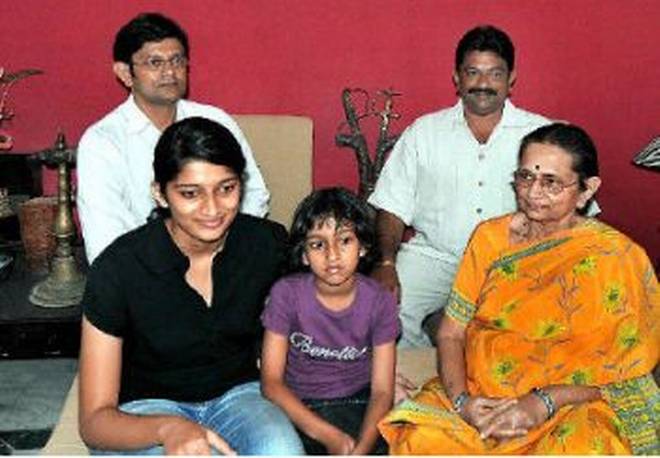
Descendants of the last ruler of Kodagu, Chikkaveerarajendra of the Haleri dynasty, carrying memories of the glory their ancestors, arrived in the district on Sunday to a rousing reception accorded to them by the members of the Kodagu unit of the Akhila Bharata Veerashiava Mahasabha.

Family

Lakshmidevi, great granddaughter of the last ruler of Kodagu Chikkaveerarajendra, her sons, Praveen Sardesai and his brother Girish, wife of Dr. Sardesai, Anuradha and their two daughters, Deepti and Disha, arrived at the Anechowkur gate on the Kodagu-Mysore border on Sunday afternoon.

The president of the Akhila Bharata Veerashaiva Mahasabha, Kodagu unit, S.P. Mahadevappa and members of the mahasabha from various parts of the district welcomed the royal descendants.

Mr. Mahadevappa said that the British, after wresting power from Chikkaveerarajendra in 1834 and banning him from Kodagu, had prohibited the royal family members from entering Kodagu.

The members had not thought of venturing into the district till 1947. However, Lakshmidevi, paid a secret visit to Kodagu in 1974, thanks to a Minister, who was in the State Government at that time, he said.

Dr. Sardesai is a ENT specialist serving in Hyderabad and his brother is pursuing a business, he said. Dr. Sardesai had also visited Kodagu in 1986 as part of the bird watching team in 1986.

He is said to be a member of the Andhra Pradesh Bird Watchers’ Society. The royal family members were just here to reminisce the past and not to claim any property in the district, Mr. Mahadevappa clarified.

Felicitations

The members were taken to the Bamboo Club in Polibetta and later they went to a private resort in Kakkabe, near Napoklu.

On Monday, the family members were felicitated by Shantamallikarjuna Swamy of Arameri Kalancheri Math near Virajpet.

The members will be felicitated at the Gaddige located in Madapur on Tuesday, Mr. Mahadevappa said.

Lakshmidevi is the great granddaughter of Chikkaveerarajendra and granddaughter of Gangamma, one of the three daughters of Chikkaveerarajendra. Gangamma was married to a zamindar in Hyderabad. Veeramma, the other daughter was married to a prince in Madhya Pradesh and the other Muddamma was married to a former Prime Minister of Nepal, Mr. Mahadevappa said.

source: http://www.thehindu.com / The Hindu / Home> National> Karnataka / by Staff Correspondent / September 29th, 2009

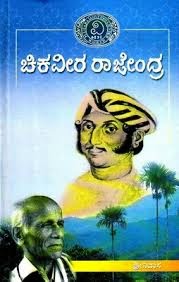
Book Review: Chikaveera Rajendra (A Kannda Novel)

BookChikkaKF28dec2017

Chikka Veerarajendra was the last king of Kodagu (Coorg) before it fell into British hands.

This book provides a picturesque account of life and time of the ruler, cultural preferences of Kodava community (the locals), gods worshipped by them, and their attitude towards the rulers.

Chikka Veera Rajendra, a spoilt prince has only one confidant in kunta (lame) Basava and when he becomes king, he makes Basava his minister not to support him in administration but to make arrangements for his whims.

The kingdom is mostly run by his other two ministers, Bopanna and Lakshminarayanaiah, while the king is busy fulfilling his bodily needs, leaving no money in treasury and acting cruelly when forced to take decisions. While the public in general dislike their ruler, a balancing act is done by the queen, making correcting efforts wherever possible to protect the interests of her family and the kingdom.

The king has a sister, Devammaji and her husband Chennabasavaiah who is interested in dethroning the king and taking power into his hands by making his wife the ruler. Becoming aware of this plan, the king puts his sister in captivity but releases her later as per requests from the queen, his daughter and a priest, Dikshit who advises the same.

Devammaji delivers a baby boy after her release and her husband devises a plan to run away from the clutches of the king and seek help from the British in dethroning the king. While he puts this plan to work, the couple in a hurry loses their baby on the way and it reaches the hands of the king and the palace. The king receives letters from the British to return the baby to his parents but he refuses to do so and in an act of madness, he kills the baby.

This incident causes a revolt in his administration who could not tolerate evil deeds of the king anymore and the opportunist British too come down with a force to attack. The turnout of events leads to capture of the king by the British and Kodagu being annexed into the British administration.

After losing the kingdom and being deported from Kodagu, life of Veerarajendra continues, he lives on the compensation fund he receives from the British. His wife meets death on the pilgrimage and his daughter marries a British, goes on to live in London.

This historical novel won the author the prestigious literary honor Jnanapith award in 1983. This hardbound book also provides the images of paintings and historical photographs, and descriptions of references to the history and also about the life of the celebrated author Masti Venkatesha Iyengar.

source: http://www.booksmarketsandplaces.blogspot.in / by Anand Maralad / Monday – August 18th, 2014

Coorg connection

EXOTIC LINEAGE The Coorg royal descendents   | Photo Credit: PHOTO: SATISH H
EXOTIC LINEAGE The Coorg royal descendents | Photo Credit: PHOTO: SATISH H

It’s interesting to note how the descendents of Coorg royal family came to settle down in Bodhan

In a sub-continent that has been in existence for ages, it is no surprise that there is every possibility of us crossing paths with the descendents of some king or sultan who had reigned over some part of the Indian soil. Within the confines of this city, or more so a fairly small place called Bodhan in this State (Nizamabad district to be precise), we’d come across the direct descendents of the Coorg royalty — the Haleri clan that had held sway over the exotic tract of land for nearly 234 years. That they found their way to Bodhan is mind-blowing, for Coorg is nowhere in the horizon of Andhra Pradesh! But as Lakshmi Devi Sardesai and her son Ajay Rajendra Wadiyar point out, there is a third dimension to the riddle —the Benaras factor.

The jigsaw nature of Coorg history started unfolding no sooner than Lakshmi Devi began her crisp narration introducing herself as the great granddaughter of the last king of Coorg Chikka Veera Rajendra. The beautiful lady is grace personified, albeit a little frail. Says she, “to cut a long story short, the last rajah was arrested by the British (East India Company) and put in house arrest at a place of his choice and this happened to be Benaras.” The East India Company provided him with a privy purse which allowed him, his four sons and daughter Gowramma to live in comfort if not luxury. One of the sons was Lakshmi devi’s grandfather on the paternal side. Chikka Veera Rajendra along with his daughter went to Britain to plead for his case to no avail. His daughter was baptized there after the Queen of England who took a liking to the beautiful Gowramma but the Rajah refused to convert, it was reported. Heart-broken, he left his daughter along with the royal jewels in the care of a British royal couple and died quite suddenly in London. The mortal remains of his body buried in that country was later sent to Benaras to be immersed in the Ganga as per Hindu custom.

Now, where is the Bodhan link? Smiling, Lakshmi Devi shares the information for the Veera Shaiva sect, there was a mutt (Jangamvadi) in Kasi (Benaras) headed by a Panchacharya (seer). Congregation of all lingayat priests (Jangam) from across the length and breadth of the country at this mutt at least annually was not uncommon then and even now. It so happened that one Jangam from Bodhan Samsthan met Chikka Rajendra’s son at Benaras during one of his visits to the place. An alliance for the two daughters of the king was proposed to the Deshmukh of Bodhan. Both were without heirs and it was then that one of the sisters decided to call her brother’s son (nephew) to Bodhan to take care of the family and property. That’s how Linga Rajendra (third son of Veera Rajendra) came to settle down at Bodhan. The other three sons of the rajah were Veera Rajendra, Mudhu Rajendra and Chandrashekara Rajendra. Since Linga Rajendra at a young age his and my widowed grandmother called for her youngest brother-in-law to take care of the Samsthan at Bodhan.

It’s interesting to know that Lakshmi Devi’s second son was adopted by her father to take on the family name as there was no male progeny. The silverware, brassware embossed with the royal seal and gazette notifications are the only precious preserves now with the family while the original Madikeri (Markara) palace at Coorg has been housing the Collectorate now.

The erudite Lakhmi Devi, is personification of the three ‘Bs’ (beauty, brains and breed) not to talk of the Coorg secularism.

source: http://www.thehindu.com / The Hindu / Home> Features> MetroPlus / by Ranee Kumar / November 01st, 2008