Category Archives: Records, All

Native spices get a new gene bank

SpicesKF16jan2018

Kozhikode :

The immense effort that goes into setting up a gene bank is such that it can be termed as a mission. And when a group of farmers here came together to start one, it turned out to be a worthy venture. And ‘spicy’ too.

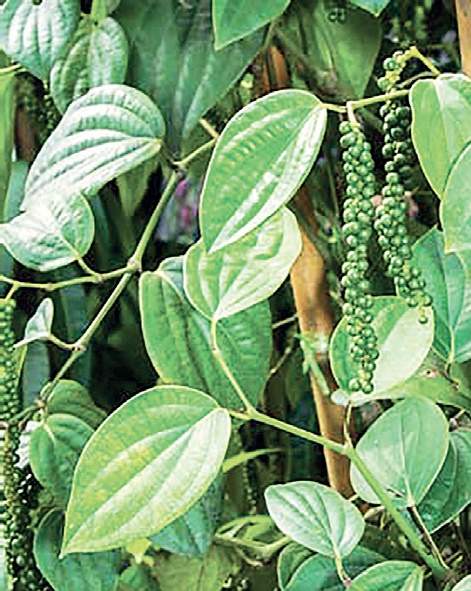
The Koorachundu Sugandhavila Karshaka Samithi realised it was high time they set up a gene bank to conserve the native varieties of spices, after they found that imported and hybrid varieties have become popular among farmers. They decided to begin with pepper and the Indian Institute of Spices Research (IISR), Moozhikkal, which got enthusiastic about the idea, decided to help the farmers collect a wide variety of local pepper plants.

Unlike the research institutes where spices are conserved in labs and experimental farms, the Samithi members will grow local varieties in their farms. As of now, the farmers are conserving 11 pepper varieties, including Arakulam Munda, Chomala, Pottanadan, Thulamundy, Kaniyakkadan and Nedumchola.

“The idea came up when we thought about the Western Ghats’ conservation and peaceful co-existence of farmers and wild animals,” said Samithi secretary P T Thomas.The Samithi, which began its gene-bank mission a month ago, plans to expand its basket to include clove, nutmeg, mace, cardamom and cinnamon in the coming days. It has 30 farmers, who own around 90 acres. Each farmer will collect a specific spice and grow it in his farm.

“Landraces of many crop plants are getting eroded due to a variety of reasons. Conservation of the landraces, which harbour many useful genes, is mostly a government effort. However, if people-participatory or farm conservation can be effected, it’ll help conserve landraces in their natural habitat,” said IISR’s crop improvement and biotechnology division head B Sasikumar.

The native varieties of pepper have the capacity to survive in the Western Ghats and can be cultivated at a low cost. Farmers can plant it under a jackfruit tree without the need for a support system, said Thomas. In contrast, imported and hybrid varieties need a proper support system.

The Samithi members are hopeful the gene bank will become fully functional in 18 months’ time. “The yield from native varieties can be an influential thing among farmers as the yield influences the farmer to decide whether to continue with the cultivation or not. However, at the Samithi, we’re planning to go forward without considering the yield from native varieties,” said Thomas.

source: http://www.newindianexpress.com / The New Indian Express / Home> States> Kerala / by K C Arun / Express News Service / January 01st, 2017
English welcomes Sowmya Dechamma

SowmyaDechammaKF16jan2018

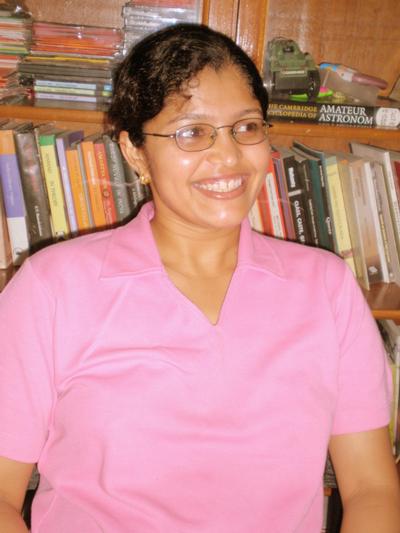
This autumn English will be welcoming Sowmya Dechamma CC, PhD who has received a prestigious Commonwealth Fellowship to work in association with Dr Stephen Morton in the area of postcolonial studies.

Dr Dechamma is an Assistant Professor in Comparative Literature at the University of Hyderabad, India. Her area of study is Minority Discourse in Colonial India, and her project title is ‘Between the Colony, Anti-Colony and the Modern: The Politics of Identity of Kodagu’. Her tenure at Southampton is from September 2010 to February 2011.

Professor Anne Curry (Head of Humanities) commented: “This is important recognition of Stephen Morton’s and English’s excellence in the area of postcolonial studies.”

source: http://www.southampton.ac.uk / University of Southampton / Home> English> Part of Humanities> News & Events> News / June 25th 2010

Kodavas: One of the few tribes in India allowed to possess a gun without a licence

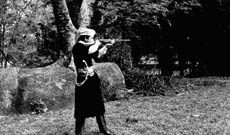
A Kodavn takes aim: a shortage of bullets threatens his way of life

An acute shortage of cartridges is threatening the way of life of the Kodavas, a martial race living in Kodagu (Coorg) district in south-west Karnataka. The Kodavas are one of the few tribes in India allowed to possess a gun without a licence. Cartridges are sold like any other commodity in Janata bazaars, cooperative stores and by private traders throughout the district.

But every time a fresh consignment of cartridges is received by the 36 licenced ammunition dealers, long queues are formed in front of these shops. The cartridges are rationed and usually-one box is allotted per person. At least four private dealers have closed shop because of the shortage.

C.U. Kalappa, president of one of the Janata bazaars, told India today in Mercara: “We had indented for 20,000 cartridges but the Government supplied us only 5,000. Now there is such a big rush for them that quarrels are frequent.” Of course, there are no shoot-outs as bullets have become a scarce commodity. Of the district’s demand of two-and-a-half lakh cartridges, the Government was able to supply only 1.3 lakh last year.

Shortage of bullets had been reported in the past few years after the Government banned manufacture of ammunition by private dealers and made the Government ammunition factory at Kirki the sole supplier. But it is only now that the shortage is being felt acutely and has restricted certain rituals of the Kodavas for whom guns are as common as ploughs.

Exception: The Kodavas have been exempted from the Indian Arms Act right from the time it was introduced by the British in 1834. The British made an exception for this tribe in appreciation of their valiant support to them in their fight against Tipu Sultan. Of the 3.8 lakh people living in Kodagu, almost every family possesses a gun, some even ten. The only regulation is that the Kodavas should obtain an exemption certificate from the Government, which gives them the right to possess any gun without a licence. Borkar, the district superintendent of police said: “In the past five years 12,189 exemption certificates have been issued. We can roughly estimate that about 40,000 weapons are in the district.”

Kodagu is perched on the summit of the Western Ghats and its numerous hills are covered with thick forests. Panthers, tigers, wild boars, bisons and elephants abound in large numbers and the Kodavas are adept hunters. The 1973 Wild Life Preservation Act put an end to one of the important traditions of this tribe. But even now, clandestine hunting goes on.

Legend has it that in the good old days no Kodava was allowed to cultivate a handlebar moustache unless he had shot a tiger. Even as late as 1970 there were nine forests reserved specially for hunting and licences were issued to people who wanted to shoot tigers. Today most of the ancestral houses are decorated with stuffed bisons or boar heads and tiger skins.

The Kodavas are one of the few races in India who worship a god for sports and hunting called Sarthau. Every year a special festival called Kiel Poldu (worship of arms) is held in which Kodavas perform poojas for their guns and swords. Every festival is usually accompanied by a shooting competition in which three coconuts are placed and the men are expected to knock them down. The Kodava festive dress, a black robe with a white turban, is embellished with jewelled guns and swords.

The men usually carry an ornamental dagger and a sharp sword. According to tradition, whenever a male child is born two rounds of ammunition are fired in the air. When a male member dies, two rounds are fired simultaneously and if it is a female, only one round. During the death ceremony, every time a group of mourners pay homage to their dear departed, a round is fired.

Complaint: Because of the acute shortage of cartridges, these customs have to be curtailed drastically. The more affluent families still observe these customs with the full paraphernalia and usually buy the bullets in ‘black’ at double the controlled price. Said B.D. Ganapathy, a noted Kodava writer: “We don’t use the guns as indiscriminately as before because of the cartridge shortage. But it has not drastically affected our culture because we are still willing to buy cartridges from other sources. But I don’t know how long we can continue.”

Said K.N. Ponappa, vice-president of the Mercara Kodava Samaj: “Our major complaint is that our crops are systematically being destroyed by wild animals and we are helpless because of the Government Act banning shooting. The Government must modify these laws.”

The present law stipulates that if a wild animal is troubling a village then the forest officer should be called to shoot it. But one planter said: “Who can afford to wait till a government officer comes to shoot the animal?” Many planters kill the animal themselves and have a feast at dusk.

source: http://www.indiatoday.in / India Today / Home> News> Magazine> Coorg / by Raj Chengappa / November 20th, 2013

Tracing the roots of Kodava tribe

There is opposition to releasing the findings of research

Blood samples of 100 couples to be drawn for DNA tests Kodava tribe is said to be 2,000 years old Research team asked to be cautious while dealing with sensitive issues There is apprehension that research findings may divide the community

Virajpet (Kodagu Dt.) :

Kodagu Natural Sciences Society has launched a unique initiative to trace the origin of Kodavas by ascertaining the ancestry, customs, culture, language and a study of genealogy by the Kodagu Natural Sciences Research Society.

A research professor from Delhi University has drawn 150 blood samples of selected Kodava families for conducting the DNA test. This was revealed at a seminar organised by the Akhila Kodava Samaja here on Friday, attended by representatives of various Kodava Samaj units, prominent Kodavas and office-bearers of society. The significance of the research will be to carry out DNA tests on Kodavas to trace their origin and roots.

Society president Lt. Gen. B.C. Nanda said Kodavas inhabited Kodagu 2,000 years ago. The first recorded instance of Kodavas was found in 1174 AD during Hoysala dynasty in the State. Kodava was the only community that accepted the “gotra” system other than non-Muslim and non-Christian communities, he said.

Speaking in favour of tracing the origins of Kodavas, Gen. Nanda said modern scientific inputs gave ample opportunities to take up research work. Along with the DNA test, socio-cultural aspects, somatometry (physical measurements on various attributes) and demography should go hand-in-hand to corroborate the theory. The final report will be submitted to Akhila Kodava Samaja president Matanda.C. Monnappa.

Gen. Nanda said the pilot project started involving nine couples aged between 20 and 40. As many as 100 DNA samples will be drawn from Kodavas living in all parts of Kodagu. The outcome of the study will be kept confidential.

The former president of the Karnataka Kodava Sahitya Academy B.P. Appanna, who did not approve of the idea, said a report on the scientific study on Kodavas can turn out to be sensitive. The principal investigator of the study team is M.A. Abdul Kalam, Department of Anthropology, University of Madras, Chennai, and the project coordinator is Xavier Raj from the Social and Environmental Research Centre, Chennai. The cost estimated for carrying out the study is Rs. 11.80 lakhs.

source: http://www.thehindu.com / The Hindu / Home> National> Karnataka / by Jeevan Chinnappa / February 18th, 2006

Angakali: Traditional tribal folk dance inching towards burial

Funeral01KF16jan2018

Madikeri:

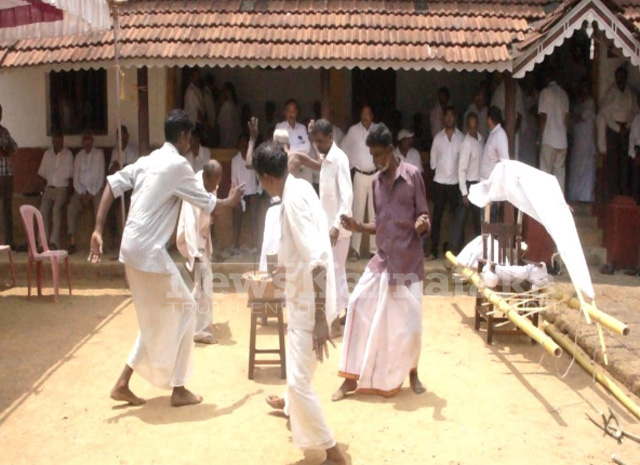
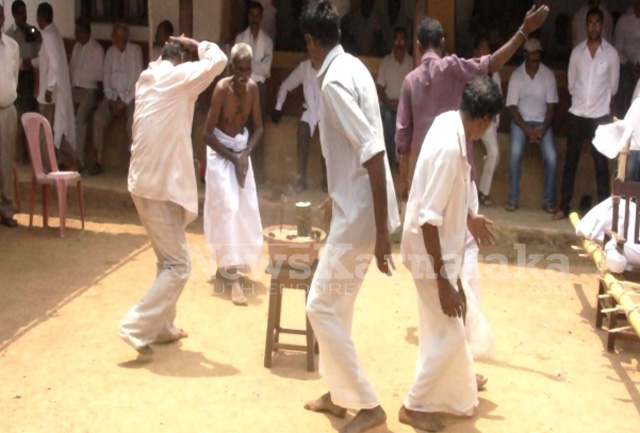
Angakali is the traditional tribal folk dance performed at the Kodava funerals before performing the last rites after the demise of the head of the family or elderly member by a special tribe called “Kembatti.” With changing times and attitudes most Kodavas of the present times are not even aware of this dance form called Angakali.

When Okkada (family head) dies in the Kodava family, Kembatti tribals in the village are summoned to perform Angakali.

A lamp lit using castor oil is placed at the centre of a cane basket filled with rice. Another tubular container and coconut is placed in the middle and a wooden rod is inserted in the rice. A white “Mundu” (Long piece of cloth tied around the waist extending till the ground) is given to the main performer by the family of the deceased.

The performer enacts a scene where he touches the dead body thrice by chanting, “Kattiri adanne bolla, kattiru abbayo” and circles around the lit lamp placed in the centre to the beats of “Malepoyithodeyutha” band.

The main Angakali performer has to strictly adhere to certain norms till the end of the funeral (Mengathe). If the deceased member is elder to him, he will be sent back home with a basket full of rice, coconuts, salt, meat, oil and cloth sufficient enough to stitch a shirt.

If the performer is woman, the cloth given will be of sari length.

The folk dance ritual is rarely seen off late at Kodava funerals with only a handful of artistes remaining, including Biddanda Kutada Sannu and Bollu to perform Angakali.

There is story woven around this folk funeral ritual by the Kembatti tribes. According to them, Lord Shiva had granted a boon to Basmasura using which the latter could turn anyone to ashes by placing his hand on the target. In an attempt to test his powers, Basmasura attempted to place his hand on Lord Shiva himself. Lord Krishna sensing the danger to Shiva, came to his aid in woman’s attire ultimately averting the danger.

Most Kembatti tribes believe this story led to the folk dance ritual at the funerals and continued it for generations.

Angakali is performed when deaths occur in Kodavas, Medaru and Kembatti communities.

The Kembatti tribals have performed the folk rituals at the cultural events/folk shows held in the cities of Bengaluru and Mysuru to keep the tradition alive and to draw the attention of the government for support.

Funeral02KF16jan2018

Bavali residents near Parane, inhabited by Kembatti tribes rue over total neglect by all the concerned.

Angakali (word found in Malayalam language too) means “part dance” with “part” referring to the parts of the body and “kali” means play/dance. It is considered the last attempt by the Kembatti tribes to please the deity to rescue the dead (In this case Okkada-head of the family/eldest member).

source: http://www.newskarnataka.com / News Karnataka / Home> Special / by Coovercolly Indresh / January 03rd, 2017

Getting a memorial: War tank reaches ‘Sunny Side’

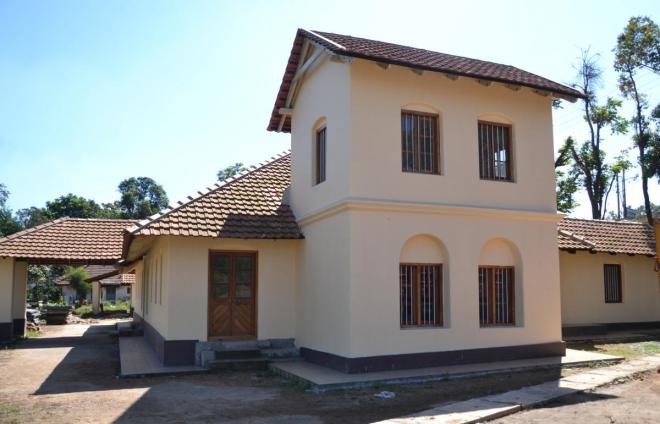
A view of the General Thimayya Memorial Bhavana in Madikeri.

The work on converting Sunny Side, the abode of late General K S Thimayya in Madikeri into a memorial has been re-started.

The state government, through the Department of Kannada and Culture, released Rs 2.30 crore for the purpose last week. The memorial is expected to be ready within a few months.

At the same time, a war tank, a long-pending demand, has finally arrived at the ‘Sunny Side’.

Demand for tank

Owing to shortage of fund, the work on converting ‘Sunny Side’ into a memorial could not be taken up. Ex-servicemen have been demanding that a war tank be kept in the museum of ‘Sunny Side’. When the Indian Army Chief General Bipin Rawat visited Kodagu to unveil the statues of Field Marshal K M Cariappa and General K S Thimayya on Kaveri College premises in Gonikoppa recently, the ex-servicemen’s association had appealed for the same. The war tank has arrived at Madikeri from Army Training Centre in Pune.

The battle tank “Himath” was used during the India-Pakistan war in 1971. After the completion of the memorial, the war tank will be open for public viewing.

The Nirmiti Kendra has taken up the work on the memorial but will retain the old structure of the house. It is proposed to keep a model of a fighter plane too, and items used by Gen Thimayya while serving the Army, along with war tank, in the memorial.

Funds for memorial

The state government had announced the conversion of the house into a memorial in its budget. Accordingly, the district administration had prepared an estimate for Rs 5.5 crore.

In 2013-14, the government had released Rs 45 lakh. When the state government claimed that it cannot release such a huge amount, the district administration had revised the estimate to Rs 3.70 crore. The state government has so far released Rs 1.45 crore. With the recent release of Rs 2.30 crore, the work is likely to be completed at the earliest, said the Nirmiti Kendra officials.

source: http://www.deccanherald.com / Deccan Herald / Home> District / by DH News Service, Madikeri / January 14th, 2018

Army Day 2018: Important Things Students Should Know About Field Marshal KM Cariappa

January 15 is observed every year as Army Day in India.

CariappaKF16jan2018

New Delhi:

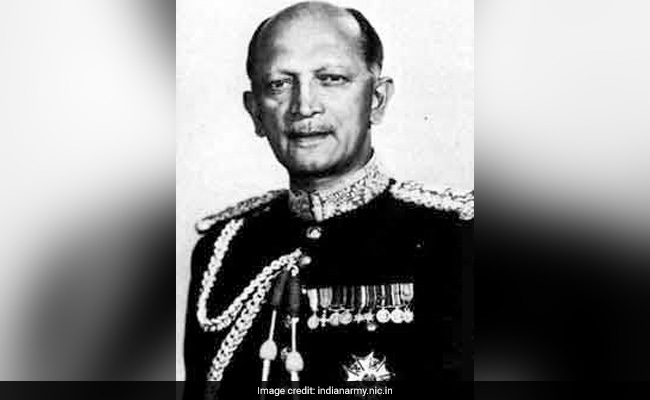
January 15 is observed every year as Army Day in India. Field Marshal Kodandera M Cariappa took over as the first Commander-in-Chief of the Indian Army from General Sir Francis Butcher, the last British Commander-in-Chief on this day in 1949. Army day is dedicated to the soldiers who fought to safeguard the country’s honour. Prime Minister Narendra Modi has extended his greetings on Army Day. PM said, “On Army Day, I convey greetings to the soldiers, veterans and their families”.

“Our Army always puts the nation first. I salute all those great individuals who sacrificed their lives while serving the nation. India will never forget our valiant heroes,” he added.

Army Day 2018: Important Things Students Should Know About Field Marshal KM Cariappa
ArmyKF16jan2018

January 15 is observed every year as Army Day in India

Born on 28th January 1900 in Mercara state, now part of Karnataka, Field Marshal KM Cariappa was amongst the first officers to receive the King’s Commission in 1919.

After an outstanding career, he became the first Commander-in-Chief of the Indian Army on January 15, 1949.

A hardcore Infantryman, Field Marshal KM Cariappa was a thorough gentleman who exhibited the highest standards of self discipline and compassion.

He had been a legend in his life time and left an indelible impression that would inspire the people for a long time.

Field Marshal KM Cariappa was the first Indian Commander-in-Chief of the Indian Army and was conferred the rank of Field Marshal on 28 April 1986.

He breathed his last in May 1993.

In memory of Field Marshal KM Cariappa, the Infantry Directorate at the Army HQ has been organizing the ‘Field Marshal KM Cariappa Memorial Lecture’ every year, since 1995, as part of Infantry Day celebrations.

Gen Dalbir Singh, then Chief of the Army Staff, dedicated a statue of Field Marshal K M Cariappa at the Army Parade Ground, Delhi Cantonment and rechristened the parade ground as “Cariappa Parade Ground” on December 29, 2016.

Three Service Chiefs paying homage at Amar Jawan Jyoti on the occasion of 70th #ArmyDay 2018 #ArmyDay2018@DefenceMinIndia@SpokespersonMoDpic.twitter.com/FbAUAAwFY

– ADG PI – INDIAN ARMY (@adgpi) January 15, 2018

source: http://www.ndtv.com / NDTV / Home> Section> Education / by NDTV Education Team / January 15th, 2018

Book on freedom fighter to be released on Jan 15

A work on freedom fighter and veteran politician Pandyanda Belliappa, titled ‘Kodagina Gandhi, Pandyanda Belliappa’, will be released at the Kodava Samaja in Ammathi on January 15.

The book has been written by Aithichanda Ramesh Uthappa.

Karnataka Sahitya Academy president Aravinda Malagathi will release the book while Ammathi Kodava Samaja president Mookonda Bose Devaiah will preside over the programme.

source: http://www.deccanherald.com / Deccan Herald / Home> District / DH News Service / Madikeri – January 13th, 2018

Karnataka coffee growers in a fix over wage hike

The new structure suggests 10% hike in the basic daily wage

Bengaluru :

Amidst the prevailing volatile price trend, an imminent wage hike of over 10 per cent is seen inflating the cultivation costs for the coffee growers of Karnataka, which accounts for more than two-thirds of India’s output.

Negotiations of wage hike have been completed recently between the growers and labour unions and the Karnataka government is expected to notify the new wages soon.

As part of the new wage structure, the basic daily wage is fixed at ₹305 — up 10.10 per cent over the current ₹277.41, said N Bose Mandanna, a member of the committee that negotiated the new wage structure. Including the other social costs, the total outgo for a worker would be in the range of ₹450-470 per day, he said.

Total outgo up
Labour wages account for around 60 per cent of the cultivation costs in the coffee sector, followed by fertiliser and fuel which constitute 35 per cent, Mandanna said.

“The wage hike is going to affect the growers badly,” said HT Pramod, Chairman, Karnataka Planters Association, the apex body of the growers in the State.

To offset the wage hike impact, the government should help the growers by reducing the interest costs. “We have urged the government to reduce the interest on loans up to 25 lakh at 3 per cent and above 25 lakh at 6 per cent,” he said. Pramod further said the impact of the wage hike could be more on growers of arabica, where the cost of production and pest incidence is higher and the productivity is low compared to robustas.

Global production
The revision in wages, after a gap of around four years, is happening at a time when the prices globally have been volatile and at multi-year lows.

The prevailing bearish trend in prices is largely attributed to a surge in global output, which is seen heading for a record in 2017-18 (October-September) at 158.8 million bags (of 60 kg each), about 0.7 per cent higher than last year’s 157.7 million bags, according to the latest estimates of the International Coffee Organisation released on Tuesday.

Production of arabicas is projected to reach 97.3 million bags — down 1.1 per cent from the 2016-17 season.

Robusta production in 2017-18 is seen at 61.5 million bags, up 3.7 per cent over last year, mainly on account of rebound in output of Vietnam, the largest producer of the variety. The prospect of a hike in global output is seen resulting in a bleak outlook for rebound in prices.

“We don’t have any hopes of getting a better price this year,” said DM Purnesh, a large grower in Chikmagalur.

Back home, the harvest of arabicas is almost over, while that of robustas has commenced in the key growing regions of Kodagu and Chikmagalur.

For 2017-18, the State-run Coffee Board sees a 12 per cent increase in total output at 3.5 lakh tonnes with output of arabicas estimated at 1.03 lakh tonnes and robustas accounting for the rest. Growers and the trade, based on the harvest and marekt arrivals, estimate arabica production to be around 90,000 tonnes, while that of the robusta could be much lower than the Board’s estimates.

source: http://www.thehindubusinessline.com / Business Line / Home> Economy> Agri-Business / by Vishwanath Kulkarni / January 11th, 2018

Salem, Madikeri get Fly bus from KIA

Transport Minister Revanna inaugurated three more services, two to Salem and one to Madikeri from the Airport.

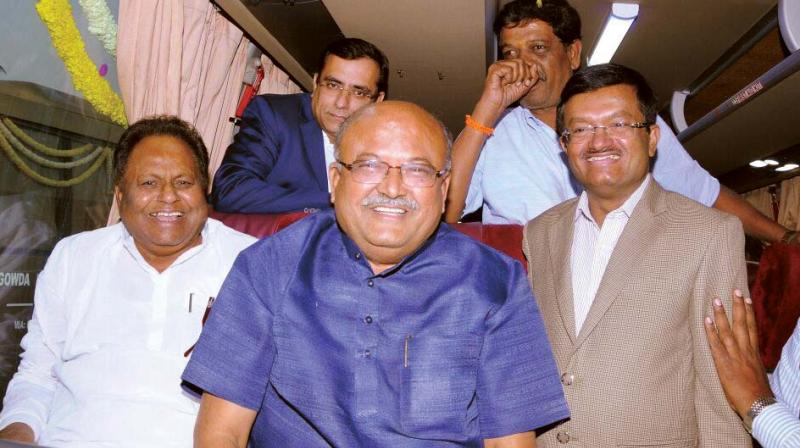
Transport Minister Revanna launches the new KSRTC Fly bus services

Bengaluru:

After the success of KSRTC fly bus service from BIAL to Mysuru, Transport Minister Revanna inaugurated three more services, two to Salem and one to Madikeri from the Airport. The first of its kind in country, the service provides interstate connectivity to the Airport. The luxury Volvo buses have in-built toilets, saving passengers the inconvenience during long-distance travel.

“Now, we have six fly buses to Mysuru and two to Kundapura. Apart from the three inaugurated today (Monday), we plan to extend services to Tirupati and Kozhikode. Fly buses have live flight details, 12 gears to support the back wheel as opposed to other Volvos that have 6+1 gears, backdoor emergency exit and minimal consumption of diesel,” said Mr Revanna.

Assistant vice-president of BIAL, Mr Venkatram, said, “Our survey showed that passengers prefer coming to Bengaluru Airport instead of Chennai Airport to go to nearby places like Mangaluru, Udupi, Manipal, Madikeri, Mysuru, Kundapura and Salem. With the 2nd Terminal coming up, we will ensure the buses stop near it.” The tickets are priced at Rs 800 to Salem and Rs 1,000 to Madikeri, plus 5 % GST. Mr Revanna said that commuters prefer taking the bus from the airport, rather than travel all the way to the Satellite terminal.

KSRTC General Manager (Traffic) K.S. Vishwanath said that earnings from Fly Bus Mysuru are good. “We spend Rs 40 per km and earn Rs 70 in return. There is definitely a profit. Pantry services within the bus were not much of a hit with passengers, and we withdrew it this time,” he said.

Mr Revanna said, “We are collaborating with other state transport corporations in Telangana, Maharashtra and Tamil Nadu. We are yet to get Kerala Transport Department to coordinate with us. This will help us extend more services.”

source: http://www.deccanchronicle.com / Deccan Chronicle / Home> Nation> Current Affairs / Deccan Chronicle / January 09th, 2018