Category Archives: Records, All

Karnataka is now biggest pepper producer in the country

For the second year running, Karnataka has been named the country's largest pepper producer, accounting for 45% of the spice produced in India
For the second year running, Karnataka has been named the country’s largest pepper producer, accounting for 45% of the spice produced in India

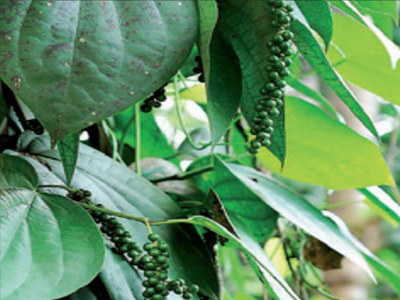
Karnataka has overtaken Kerala and become the country’s leading pepper producer, accounting for 45% of the total production.The Centre’s Spices Board data puts Karnataka ahead of Kerala for the second year running. While Karnataka produced 33,000 metric tonnes of pepper in 2014-15, against Kerala’s 28,000MT, the margin widened in 2015-16 as Karnataka’s yield remained 33,000MT and Kerala’s fell to 26,000MT.

Kerala’s decline, to a great extent, has been because of its black pepper vines falling to quick wilt, a disease that causes sudden wilting, drying and death of the vines. In Wayanad district in Kerala, farmers lost almost 90% of their vines to the disease. The Spices Board has taken up extensive research to contain the pest. The sudden scourge, however, has turned the focus on pepper production in south Karnataka districts.

Pepper is grown in several parts of Karnataka, mainly in Chikkamagaluru, Shivamogga, Madikeri and Kodagu.

Alternative to areca, rubber

The state’s plantation growers have adopted the spice as an economically profitable alternative to areca (palm), coffee, rubber and coconut. The spice crop is grown in the middle of coffee plants, said Bose Mandanna, former vice-president of Coffee Board and a leading planter in Suntikoppa in Kodagu. At least 40 pepper vines are planted in an acre of robusta coffee plantation. This goes up to 80 vines if it is an arabica plantation, because these are grown at lower heights and produce less coffee per hectare.The harvest is done during February-March.

“Kodagu accounts for 25% of the pepper production in the country,” Mandanna said. An acre fetches 100kg to 150kg of pepper but with intensive cultivation, some growers get up to 500kg.

There is some difference in the production data of the government’s Spices Board and the National Commodity & Derivatives Exchange (NCDEX), but both sources indicate that Karnataka is beginning to unseat Kerala from the No.1 spot. NCDEX data shows Karnataka having a big lead over Kerala in 2014-15, marginally losing out to Kerala the following year, but regaining the lead in 2016-17.

NCDEX says India accounts for 17% of the world’s production of pepper, and is the second largest producer after Vietnam. The exchange relaunched its pepper contract on the platform in July, after about five years. In just three days, it saw a total volume of 807 tonnes of pepper, valued at Rs 38 crore, being traded.

Sarat Mulukutla, chief (commercial segment) of NCDEX, said considering the rise in pepper production in Karnataka, the exchange is launching a third delivery centre in Hassan. The other two are in Kochi and Kozhikode in Kerala.

Attractive price

Anish Madappa of T Shettigeri in south Kodagu said pepper production had grown in Karnataka for a decade due to the good price it fetches. Ten years ago, a kilo of pepper fetched Rs 260, now it is about Rs 680. Coffee planters have started growing pepper on poles with the help of biomass, leading to a jump in production. Drip and sprinkler irrigation have helped minimise water loss and increased the yield per acre. “Once a high rising (pepper) creeper is planted, it will provide yields for 35 to 50 years with little or no investment,” said Kannagi Sheshadri, a farmer cultivating plantation crops in Theerthhahalli taluk. “The plants need to be carefully treated to achieve maximum yield. I reaped 12 tonnes last year and hope to double it this year,” said Joney Mathew, a farmer with crops in Shivamogga and Chikkamagaluru districts.

“Pepper produced in Kodagu is of the best quality,” said Madappa. “This is because we normally use only Bordeaux spray, which contains lime and copper sulphate.” The spray helps protect the pepper vines from fungal problems and resists quick wilt disease.

source: http://www.timesofindia.indiatimes.com / The Times of India / News> City News> Bangalore News / by Shalina Pillai & G. Rajendra & CV Raghavendra Rao / TNN / September 26th, 2017

With output rising, India is now a hub for instant coffee

Coffee Board to finalise estimates after consulting stakeholders
GenericCoffeeKF21sept2017

Coonoor :

India is becoming a manufacturing hub for instant coffee after Brazil and Peru, said Y Raghuramulu, Director of Research, Coffee Board.

In his presentation on coffee at the 124th UPASI annual conference here, he said the country is doing extremely well on the export front

The total volume of export between April and August this year stood at 1.78-lakh tonnes, up from 1.63-lakh tonnes in the corresponding period the previous year.

The country has moved from bulk exports to value-added coffee exports, he said. “We are consistently importing more for re-export. Imports are mainly for value-addition and re-exports by EOUs with duty free under FTP.”

Import volumes during 2015-16 stood at 65,618 tonnes and the re-export volume at 67,283 tonnes. This surged to 78,042 tonnes and 79,254 tonnes the following year. Value-wise, the imports were estimated at ₹927 crore (₹802 crore) in 2016-17 and re-export at ₹ 1,346 crore against ₹1,147 crore in the previous year.

Green coffee exports account for 70 per cent of the total export volume, with specialty green coffee exports inching its way from 3.20 per cent between April and August last year to 3.80 per cent during the corresponding months of this year. Value-added coffee exports have stagnated at around 25 per cent.

Reverting to production, Raghuramulu said: “USDA has forecast India’s production at 3.3-lakh tonnes, but the Coffee Board is yet to release the estimate for 2017-18. The board is in consultation with various associations for finalising the estimates. We do not want to release as in earlier years and come out with a revision.”

The board has undertaken a couple of fresh initiatives, such as the revamping of India Coffee House, brand ambassadors to promote Indian coffee and organising outreach programmes.

“We are looking to franchise at least 10,000 vending machines in the medium-term. Our initiatives will indirectly benefit small coffee growers. We have also initiated discussions with small growers to form producer organisations to help them achieve better returns.”

source: http://www.thehindubusinessline.com / Business Line / Home> AgriBusiness / by L N Revathy / September 13th, 2017

Joshna Chinappa moves up to 12th in squash world rankings

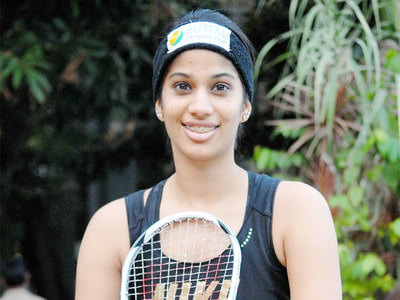
Chinappa made the main draw of the China Open earlier this week. (TOI Photo)

New Delhi :

India’s highest ranked squash player, Joshna Chinappa, has gained two places to be 12th in the latest PSA rankings.

Chinappa made the main draw of the China Open earlier this week before losing in the opening round.

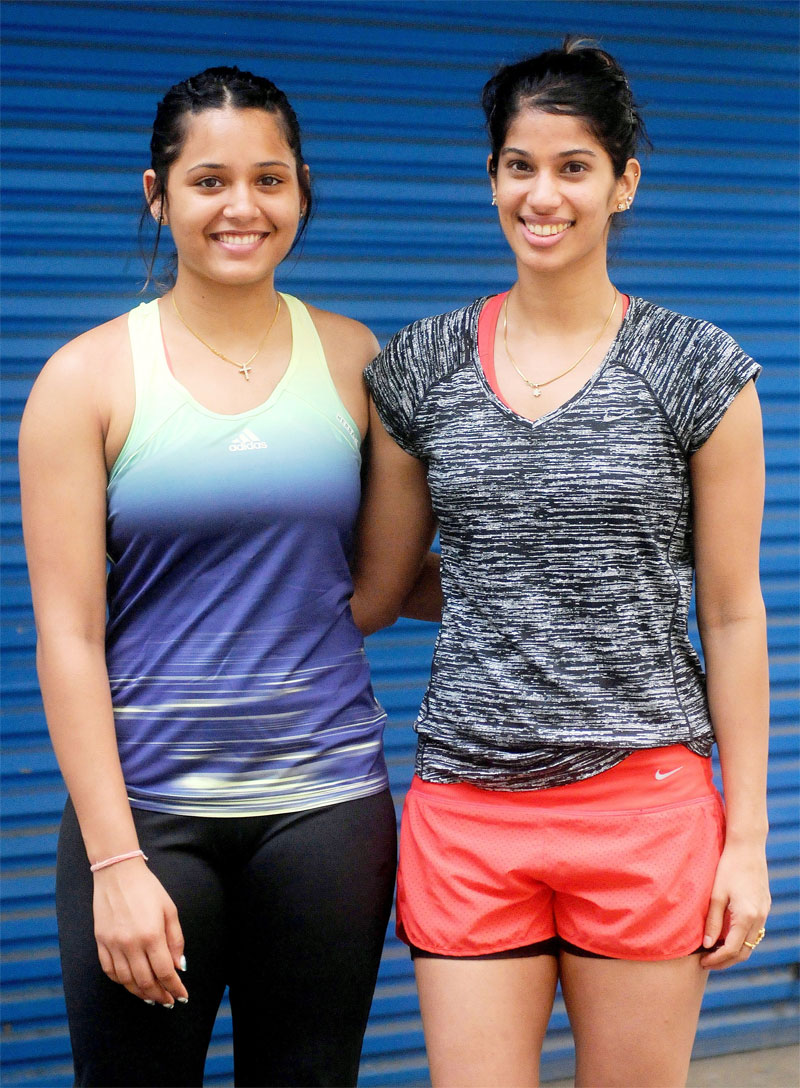
Her teammate Dipika Pallikal moved up a place to be 21st. Pallikal had lost to Chinappa in the China Open qualifiers.

Both Pallikal and Chinappa will be seen in action at the HKFC International in Hong Kong next week.

Among the male players, Saurav Ghosal dropped a place to be 28th while Vikram Malhotra was on 62, Harinder Pal Sandhu on 66 and Mahesh Mangaonkar on 67.

source: http://www.timesofindia.indiatimes.com / The Times of India / Home> Sports> News / PTI / September 01st, 2017

Bengaluru Cup hockey kick-starts today

Nithin Thimmaiah and Komala BM will lead the State sides in the 3rd All-India invitational hockey tournament for the Bengaluru Cup which gets underway at the hockey stadium on Tuesday.

A tournament that started in 2014 but was not held last year due to unavailability of turf, returns to the fold this time with six of the top men’s and women’s teams from the country vying for top honours.

In the men’s section, the State side will be joined by Indian Oil Corporation Limited (IOCL), Punjab National Bank (PNB), Oil and Natural Gas Corporation (ONGC), South Central Railway and Army XI while in the women’s battle, the State side will have to fight it out against defending champions Hockey Haryana, Madhya Pradesh Hockey Academy (MPHA), Hockey Odisha, Eastern Railways and Hockey Maharashtra.

The tournament will be played on a round-robin cum knock-out format with top four teams from the group qualifying for the semifinals on September 7. The final is scheduled for September 8.

In the men’s section, Karnataka begin their campaign against a red-hot PNB side while the women’s side will face Eastern Railway in the opener on Tuesday.

Karanataka squad: Men: Jagdeep Dayal (GK), Mahan Gowda(GK), Appachu SK, Cariappa KT, Veeranna Gowda SP, MB Aiyappa, Rathan Muthanna VT, Abhishek HS, Rajendra, Naeemuddin, Somaiah KP, Raheel, Pradhan Somanna, MB Cariappa, Nithin Thimmaiah (C), Darshan DS, Bharath KR, Pruthvi Raj; Verghese (coach); Sampath (manager).

Women: Shravya GB (GK), Sandhya MG (GK), Chaithra N, Bhagyashree, Cheluvamba P, Pooja MD, Komala BM (C), Kruthika SP, Kaveramma AH, Sowmyashree, Anjali HR, Swapna NR, Leelavathy MJ, Nisha PC, Ramya, Reshma BB, Avinashree SR, Shalini U; Ganapathy KS (coach); Ankita (manager).

source: http://www.deccanherald.com / Deccan Herald / Home> Sports> DH News Service, Bengaluru / August 29th, 2017

I have plenty more left to achieve for India: Joshna Chinappa

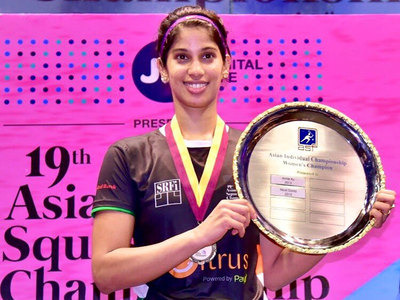
Joshna Chinappa with her Asian Squash Championship title which she won in April (Twitter image)

HIGHLIGHTS

Joshna won the National Squash Championship a few days back and the Asian Champinship in April

She recovered from a career-threatening knee injury sutained in 2011 and hasn’t looked back since

Joshna was recently appointed a senior sports officer with the Tamil Nadu Generation and Distribution Corporation

New Delhi :

“I’m not thinking of stopping anytime soon. I have a lot more to achieve.” Being appointed a senior sports officer with the Tamil Nadu Generation and Distribution Corporation does not mean that Joshna Chinappa, India’s highest-ranked squash player, is contemplating life beyond the sport already. Her decision to make a direct appointment under the sports quota was made after she put in a request. And as Joshna puts it, the post is a back-up so that she can work towards the promotion of sport when she is done as a professional squash player.

That thought however, should be put away for a long while because Joshna is going strong. Over the weekend, she won the 74th National Squash Championship as many expected, and even though she did not have it easy in the title round, it all went according to the presumed script. Joshna notched up her 15th national title by beating Lakshya Ravendran 11-6, 8-11, 11-2, 11-4 in the final, which leaves her just one shy of equalling Bhuvneshwari Kumari’s record of 16 titles.

That wasn’t even her best though. In April, Joshna became only the second Indian in 21 years to make the final of the Asian Squash Championship. This time she would go one up on Misha Grewal – who had claimed silver in 1996 – and clinch gold. The Asian crown is a big shot in the arm for the 30-year-old ahead of the Commonwealth and Asian Games next year.

Speaking to TOI Sports , she elaborates: “The Asian Championship is one of our prestigious events in squash and I’ve been playing the Women’s Championship since I was 12. When I played it the first time, I won the consolation prize; I don’t think many people know this. I’m just really glad that I could win it this season. It was a long season last year and it was a nice way to cap it off. I’m happy to have won it in Chennai in front of my home crowd.”

One could almost sense it coming. There were a few quarter-final and semi-final finishes in between since she broke into the top 10 in November 2016, and one of them included the World Championship in Egypt. Joshna, seeded 12th, lost 6-11, 12-10, 7-11, 11-8, 3-11 to second seed and World No. 3 Camille Serme of France. Then there was also a second-round elimination at the British Open Squash Championship in London – just a month before the Asian Championship – where she lost to Egyptian World No. 3 Raneem El Welily. It was a frustrating period.

“Absolutely; especially last year in Mumbai when I lost the final of the $ 35,000 event. I’d come that close to ending my drought of lifting a title. Of course it was heartbreaking but as an athlete you keep going back, keep working harder, keep fighting. Eventually it will come together. It’s frustrating as an athlete to figure when it’ll come together but that’s what being professional is about, and I love it,” says Joshna.

“I enjoy training much more than I enjoy playing the actual matches. I love the work that goes into being a professional squash player. It is so physical and I really like that part. The playing part is not so exciting because there is nerves, pressure of winning matches. I’m the most relieved when the game is over; irrespective of a win or a loss.”

Beyond that immense training lies Joshna’s gritty determination and steely resolve. To clinch the Asian title, she beat none other than Dipika Pallikal, her compatriot and at the same time one of her biggest opponents. She had lost to Dipika the last few times – including the final of the National Championship last year – but come the All-India final, where both were assured of a medal, Joshna had come prepared and eventually prevailed in a tight five-game encounter 13-15, 12-10, 11-13, 11-4, 11-4. The two go way back; to a time when Dipika was a 10-year-old who had just started playing and had front bands falling on her forehead. Growing up training together, they know each other’s games inside out, and as time passed, evidently, the two became each other’s competition.

Joshna: We're at a stage where Dipika and I have each other's back "
Joshna: We’re at a stage where Dipika and I have each other’s back “

“We have this unique case where even though we have to compete against each other, at the same time the next moment if we have to play for India, we are on the same page,” Joshna says. “Of course we have our ups and downs in the game but today we are at a place where we both have each other’s back. We really want to do well for India and win medals for the country together. We had a great time at the World’s doubles Championship where we won a bronze medal and we have great team work going on right now. We train with the same coach, who has been a real positive influence on both of us.”

Despite training with different coaches, for a major part of her career, Joshna travelled to tournaments without a coach before the Squash Rackets Federation of India roped in Achraf El Karagui as the consultant coach midway through last year. A native of Egypt, a country that is a force to reckon with in squash, Achraf has been a positive influence not just on Joshna, but also the likes of Dipika, Saurav Ghosal and many budding players.

“I work with Achraf pretty much all the time, and he has helped be bring order and structure to my game. I know what I have to work on everyday and I’m constantly reinforcing the physical aspect, skill aspect, mental aspect day in and day out. That I believe is going to help me become a more complete player when I’m competing with the top girls,” Joshna says.

“Achraf has been part of that Egyptian culture so he brings a lot of that with his coaching when he’s working with me or Dipika or anyone else for that matter. So I know how these girls are working. Also I went and spent some time in Egypt during the summer; I was training over there so I worked with one of their top fitness trainers. I really got to know the type of work a world champion is doing and tried to put those elements in my game. I felt a lot stronger and understood the game better. I owe a major chunk of my success to him.”

And to think that all this almost didn’t happen. In 2011, during the semi-final of the Hamptons Open, Joshna tore a ligament on her knee and was stretchered off midway. The scans suggested that Joshna’s injury was almost a career-threatening one and the doctors’ flat-out verdict of her being out for at least year was almost “coup de grace”. It was so bad that all Joshna wanted to do was to be able to walk again.

“It was very heart-breaking but then again, it allowed me to begin a process. I moved to Mumbai to basically get away from everything, do my rehab there and come back stronger,” Joshna says. “It gave me the opportunity to start from scratch and do things right. So I really worked on my physical strength, getting my legs stronger; I worked with Ritwik Bhattacharya (ex-national champion and Joshna’s coach for four years). I just think I became a very different athlete and person altogether from that injury.

source: http://www.timesofindia.indiatimes.com / The Times of India / News / by Aditya Bhattacharya / timesofindia.com / August 29th, 2017

Joshna wins her 15th National crown; Ghosal completes a dozen

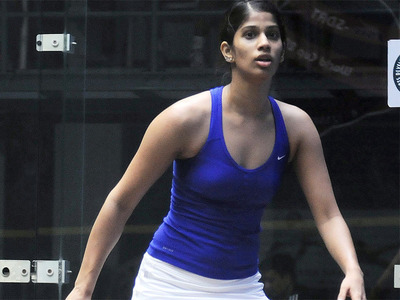
Joshna Chinappa (TOI Photo)

Greater Noida :

Joshna Chinappa cruised to her 15th women’s singles title while Saurav Ghosal secured his 12 men’s singles crown at the HCL National Squash Championship that concluded on Saturday.

Chinappa and Ghosal, the flagbearers of Indian squash for the past decade, were stretched in the finals by Lakshya Ravendran and Mahesh Mangaonkar respectively before getting home in four games.

Top seed Chinappa, who had lost to Dipika Pallikal in the final last year, regained the trophy with a 11-6, 8-11, 11-2, 11-4 victory over Ravendran.

The World No 14 is now one shy of equalling Bhuvneshwari Kumari’s record of 16 national titles.

Chinappa’s main rival and longtime teammate, Pallikal, had pulled out of the tournament at last minute due to an ankle strain.

Later in the day, Ghosal got the better of Mangaonkar in a closely-contested final with the final scoreline reading 11 -8, 11-13, 11-9, 11-6 in favour of the Kolkata man.

It was the second year in a row that squash nationals offered equal prize money with eventual winners receiving Rs 1.5 lakh each.

The total prize money of the tournament was a little over Rs 11 lakh.

source: http://www.timesofindia.indiatimes.com / The Times of India / News / by PTI / August 26th, 2017

Immortalised in stone

StoneKF26aug2017

Since ancient times, kings have dedicated hero stones, called Bira Kall in Kodava language, to the memory of martyrs. Many hero stones have been found in North Kodagu, especially around Somwarpet. These coarsely sculpted granite tablets, often issued by the rulers or commissioned by affluent families, are also known as Kolle Kallu, stones of the killed.

A number of hero stones have been lined around the Government Museum in the Madikeri Fort. Often, the hero stone comprises of 2 or 3 panels. Usually, on the top of the hero stone, a sun and a crescent moon are inscribed. At the bottom, figures of men and women holding weapons such as swords, shields and bows are carved.

Some sculptures in the classic style have been found elsewhere in Karnataka, such as Mysuru, Shivamogga and Belagavi. In such hero stones, the topmost compartment, underneath the sun and moon, would be a linga and a bull with worshippers around them. The second would show the hero ascending the heavens with apsaras on either side fanning him. The third would have the hero battling other warriors during his life on earth. Sometimes there is a fourth, the bottommost compartment, which might have a horse and an elephant etched.

A peep into history
Of these, the most well-known Bira Kall in Kodagu, made in 1768, has an image representing Kannanda Doddayya, a dalavayi or army general, wearing a traditional costume, called the kuppya chele, with a gun in one hand and a native war knife, an oide katti, in the other. It is said that when Hyder Ali unsuccessfully attacked Kodagu, Doddayya stood before King Muddu Raja II on the eve of the battle and declared: “Twice before have I returned after defeating Hyder and bowed to you. But this time, I shall not be back.” Indeed in 1767, Doddayya was fatally wounded near Kajur Bagilu even as the army returned victorious. Later, his house was destroyed and 24 members of his family were killed by Hyder’s son Tipu Sultan.

According to G Richter’s Manual of Coorg, which was published in 1870, Doddayya’s Bira Kall was first placed in a paddy field, upon a hill slope and opposite the Mercara Central School.

A kaimada, a small sanctuary built in remembrance of ancestors, was built a few decades ago and the Bira Kall was shifted into it. In front of this place, which is also called Birappa Sanctuary, and to the right is a shrine dedicated to Vishnu Murthy (Vishnu’s spirit). To the left of the sanctuary is a shelter, called the pavali, where a number of devotees can sit within. Behind the sanctuary and to the left is a trishul, planted upon a raised platform. There are two raised stone seats, one behind the other and facing the sanctuary.

The Kannanda family has 3 more memorial stones, featuring some more family members, placed inside another shrine. While one stone has a male ancestor with younger members, the second has a woman with children around her and the third shows two male ancestors holding weapons. Beside this second shrine is another pavali with stone benches inside. When I paid a visit to the Bira Kall site, I met some members of the Kannanda family — Suresh, Ashwini, and a clan elder, Pookunhi to know more about the hero stone. They narrated the legend of Doddayya. Accordingly, Doddayya’s Kodagu army had successfully defeated Hyder Ali’s army and was returning back victoriously. But unfortunately Doddayya was struck and wounded on the way.

The king, pleased upon seeing the return of the victorious army, was dismayed when he heard of the dying general. Doddayya was led up the walls of Madikeri Fort and all the lands that he looked upon were then granted to his family by the grateful King. Part of this was what is today called the Kannanda bane (land), the area beyond Mann’s compound and Ajjamada Devaiah circle in Madikeri. Doddayya passed away and a Bira Kall was made for him. Some more land grants were made to the Kannanda family by the king. Thus the family came to own lands in seven places: Bavali, Madikeri, Haleri, Poramale, Kajur, Noorokkal and Katakeri. It is said that at one point, the Kannanda family owned half of Madikeri. Family members sold away most of their lands over the years. Now only 3 of the original 7 places remain with them.

Folk culture
A week after the festival of Shivaratri, the Pade Bira (war hero) Kannanda Doddayya is remembered and a two-day festival is organised. Dance and enactment performances, called there, are arranged. On the first day, prasada is prepared and the Guru Karana, an ancestor who was the preceptor as well, is remembered. The bhandara, money offered at the temple, is moved that evening. Throughout the night, the Anji Koot Murthy (five spirit deities) is held. At dawn the next day, the Vishnu Murthy There is held.

The final function, Pade Bira There, has a performer imitate Kannanda Doddayya and the Nari Pooda (tiger spirit) There has another performer emulate a tiger. The Pade Bira There and the Nari Pooda There performers together dance frantically around the place. While the Pade Bira sits upon the seat near the temple, the Nari Pooda sits upon the seat away from the temple.

The Nari Pooda performer leaves early while the Pade Bira performer is the last one to remain.

Not only do the hero stones allow us to remember those who have sacrificed themselves, they also allow us to understand a time in history.

source: http://www.deccanherald.com / Deccan Herald / Home> Supplements> Spectrum / by Mookanda Kushalappa / April 26th, 2016

The tragic story of a warrior

Pattedar's graves
Pattedar’s graves

A few of the families in Kodagu maintain the tombs of their distinguished ancestors. A few families are also in the possession of paintings of their ancestors being felicitated by the kings. A few others maintain artefacts such as oide katti, also known as a billhook-shaped war knive, with king’s insignia upon them.

The Thathanda family is one such family that received three of these honours.

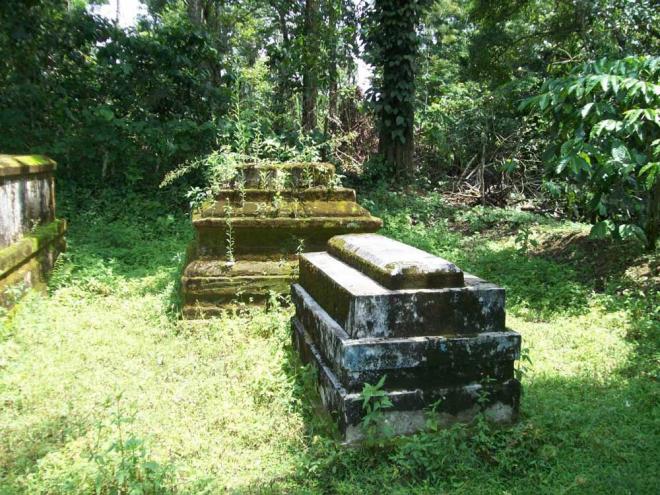
They have their ainmane, or ancestral house, in Kuklur village of Virajpet taluk. Their ancestral house was formerly a mundu mane, a house with an open, central courtyard, which is called a mund. The sepulchre of their renowned ancestor Karyagara (officer) Thathanda Subbayya lies some distance away from the ainmane. It has a Nandi figure upon it. Beside this tomb is an unmarked grave. Both these tombs are within an enclosure.

Nearby in the same graveyard are two large graves. The names of two of the four buried there were not known to us. Clansman Thathanda Nanaiah explains, “Subbayya ajja’s (forefather) elder brother had a son who addressed ajja as kunjappa (one of the names for a paternal uncle). After ajja’s death, this nephew inherited his possessions. It is this nephew’s grave which lies beside the tomb of ajja and within the boundary. The two buried outside the boundary were clan elders, each called a pattedar. ”

According to his book, Kodagina Itihasa (1974), historian D N Krishnaiah came to learn of Karyagara Subbayya from the Thathanda elders. In 1811, two British officers General Welsh and Captain Williamson visited the court of the then king of Kodagu, Linga Rajendra. They were pleased with the hospitality offered. When the king heard the news of a rogue tusker, he proposed a hunt and his guests agreed. Thathanda Subbayya was given the responsibility of organising the hunt.

Accompanied by elephants and attendants, the hunting party set out to the jungle. In the trees and around a forest clearing, boxed seats made of cane were prepared. Ladders were used to reach it. The king, the two Englishmen and others settled themselves in the cane boxes. Kodava pikemen, with their long spears, would comb the jungle and drive the prey into the clearing during a hunt. Several drum beaters would aid the hunters by scaring the animals with their noise. This way, the wild tusker was driven into the clearing and shot dead.

Pleased with Subbayya’s arrangements, the king honoured him with a gold medal and gifted him a gun. Subbayya was also awarded a oide katti with the king’s insignia on it. A painting of Subbayya and the king was also gifted to him. However, some people grew jealous of Subbayya and schemed against him. The opportunity came when the king received complaints about cattle-stealing tigers.

A hunt was organised by Subbayya in order to eliminate the tigers. On the night before the hunt, Subbayya ensured that the cane seats were securely placed in the area where the hunt was to take place. When he left, his enemies loosened the seats. The next day, when the king shot a tiger, the seat he was on fell apart and he fell. Furious, he demanded to have the head of the man who had set up these seats. Subbayya was blamed for what was thought to be a shoddy work. As he was deep in the forest with the other hunters, the executioners were sent out to behead Subbayya.

One servant ran before them and told Subbayya everything that had transpired. Subbayya was unhappy as there was no way for him to prove his innocence. Subbayya told the servant to convey to the king that he had been framed and sent him back. As Subbayya did not want to be punished for a crime he did not commit, he shot himself. When the king came to know what had taken place, he was displeased. Subbayya was buried on his family farm. Enquiries were held and the king discovered that Subbayya was indeed innocent. The king had a mausoleum built over Subbayya’s grave.

source: http://www.deccanherald.com / Deccan Herald / Home> Supplements / by Mookonda Kushalappa / August 15th, 2017

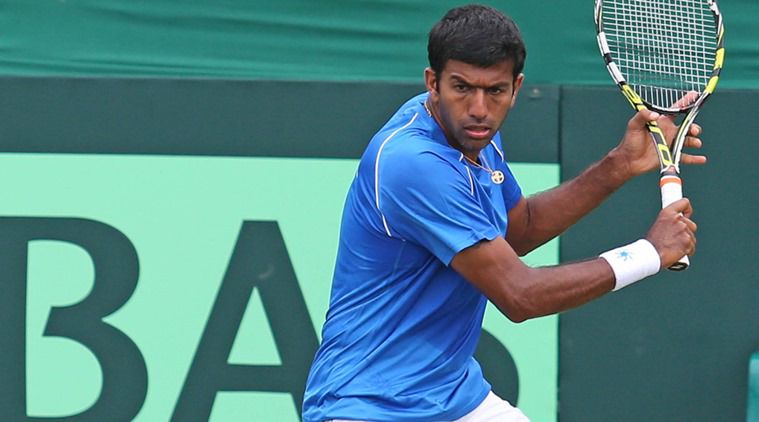
At 37, ace Rohan Bopanna is just getting started

Fresh from his Grand Slam in France, he’s got big plans

RohanBopannaKF26aug2017

Washington :

By the time most tennis players are 37, they have retired or gone on to become commentators or analysts – or even entered another profession.

When Rohan Bopanna reached that age, he got his maiden Grand Slam win in the French Open mixed doubles with Canadian partner Gabriela Dabrowski.

“Even though it sounds very cliché,” Bopanna said, “age is only a number, but whoever says whatever to me, I look at it as a positive—that means they are thinking of you, whether it’s a negative, or whether it’s a positive. They are talking about you. That means you are doing something out there.”

The trophy he won in June was “purely a personal goal — nobody else’s goal. Whether I win a Grand Slam or don’t win a Grand Slam, I am the one who’s putting in the work. So, I don’t think age should bother you. It never bothers me what everybody says.”

He achieved the title 14 years after first turning pro.

Immediately after his Grand Slam victory, the All India Tennis Association nominated him for the Arjuna Award, saying: “This is a well-deserved victory. We wish him more success in years to come. His victory will certainly be a morale booster to young and budding tennis players in the country.”

Bopanna, who has been a member of the Indian Davis Cup team since 2002, he finished in 2010, with Pakistani Aisam-ul-Haq as a runner-up in the doubles at the U.S. Open. Earlier that year, the duo, nicknamed the IndoPak Express, had also reached the quarter-finals at Wimbledon. After the U.S. Open, they went on to win the Johannesburg Open.

Regarding his Paris win, he said: “If you had asked me a few years ago about getting my first Grand Slam on a clay court, I would have probably said that what you are saying is just impossible. But, over the years, I enjoyed playing on clay, and I learned how to move better on it and that made the difference. Even in my games, and in my style, I’m not always serving and volleying now. The guys return extremely well now and so, I mix and match my strengths accordingly. So, that experience over the years has helped and made a big difference to get my first Grand Slam.”

He credit his wife, Supriya Annaiah, 29, a psychologist, as his inspiration and a catalyst for his success.

“My wife is a psychologist, and so indirectly, I may be getting powered,” he said. “And, it’s nice to have her at these major tournaments. Sometimes, you are so much into practice and training and all that, you need some time away from it to keep your mind relaxed, and she brings that good side to me.

“Being a psychologist, she knows about down-time, de-compressing, a hundred percent. She understands the mechanics to this sport and how much sometimes I just need time for myself to just focus, which she gives me and that’s something.”

There have been other benefits to his top performance. Bopanna was named spokesman and partner with FDC Ltd./India’s balanced energy drink brand Enerzal after his win and Enerzel committed to being a partner with his tennis academy.

“Tennis is a sport that we as a brand are invested in and believe that India has tremendous potential to excel at globally,” said Ameya Chandavarkar, director of FDC India. “Teaming up with Rohan and his academy allows us to truly be part of the tennis ecosystem, from the grassroots all the way to the top.”

Bopanna said the commercial endorsement and being spokesman for Enerzal “would help in getting the message out about sports awareness, and the exposure, the promotion, the nutrition aspects, and everything else comes into play.”

He also said that he has been involved with the IndianOil, which has supported athletes over the years with its IndianOil Sports Scholarships – one of which he received in 2002.

If India is to compete to European and American standards, business backing is essential, he said. “We have to match up in every way and that’s where we have to change the mindset,” he said.

source: http://www.indiaabroad.com / India Abroad / Home> India / by Aziz Haniffa / August 21st, 2017

Regional languages facing threat of extinction: Bilimale

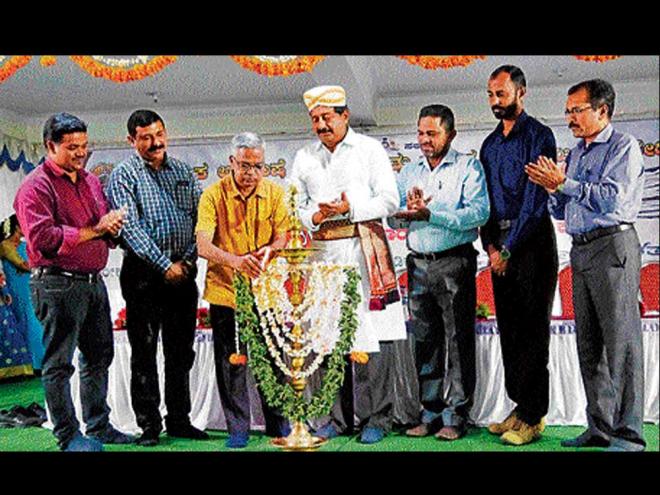
Purushottama Bilimale, researcher and head of Kannada department, Jawaharlal Nehru University (JNU) inaugurates a multilingual poets' symposium organised by Karnataka Arebhashe Culture and Literature Academy in Gowda Samaja, Madikeri, on Sunday. dh photo
Purushottama Bilimale, researcher and head of Kannada department, Jawaharlal Nehru University (JNU) inaugurates a multilingual poets’ symposium organised by Karnataka Arebhashe Culture and Literature Academy in Gowda Samaja, Madikeri, on Sunday. dh photo

Owing to an obsession with English, several regional languages are facing the threat of going extinct, said Purushottama Bilimale, researcher and head of Kannada department, Jawaharlal Nehru University (JNU).

He was speaking during a multilingual poets’ symposium organised by Karnataka Arebhashe Culture and Literature Academy in Gowda Samaja, Madikeri on Sunday.

Starting from the communication between the nations to the communication between households, English has been dominating the scene, to the extent that English schools are being opened in rural areas, Bilimale said.

More than 400 languages in the country have been feared of becoming extent in the next 30 years, he said. The youth have not been taking enough care to preserve the multilingual fabric of the Indian culture.

The absence of projects which aim towards developing the language in the local levels has been the main reason for the extinction of regional dialects of languages, Bilimale observed.

The Central Government has only been focusing on Hindi and it has cleverly passed on the responsibility of protecting the regional languages to the states, he said.

Pattada Shivakumar, lecturer at Government PU College, Doddaravalanje, said that languages like Arebhashe, Kodava and Tulu are included in the list of languages which face the threat of extinction.

The poets who took part in the poets’ symposium were: Bareyanda Joyappa and Kudekal Santhosh(Arebhashe), M A Ajij, K S Kanchana (Kannada), Chammattira Pravin Uttappa and Shobha Subbaiah (Kodava), Kishor Rai, Navin Suvarna (Tulu), M A Muhammed, M A Abdulla (Beary) and Charles D’Souza (Konkani).

Arebhashe Culture and Literature Academy president Kolyada Girish was present on the occasion.

source: http://www.deccanherald.com / Deccan Herald / Home> District / DH News Service – Madikeri / August 14th, 2017