Reverend K A William will be ordained as seventh bishop of Mysuru diocese, which comprises four districts of Karnataka — Mysuru, Mandya, Kodagu and Chamarajanagar — at the Episcopal Ordination and Installation ceremony at St Philomena’s Church on Monday.
Bishop Emeritus Reverend Thomas Anthony Vazhapilly will officiate the ordination, while Bengaluru Archbishop Reverend Bernard Moras and Chikkamagaluru Bishop Reverend T Anthony Swamy, will be the co-consecrators. This will be followed by a felicitation ceremony for the new Bishop William, and the former Bishop, Thomas Anthony Vazhapilly.
The bishop is the spiritual head of all Catholic Churches in the four districts. As many as 180 Parishes, 131 Diocesan priests, 23 male Religious and 55 female religious congregations in six deaneries, apart from 136 educational institutes fall under the Mysuru Diocese.
William was appointed bishop for the diocese by Pope Francis, and the announcement was made on January 25, 2017.
His ordination is likely to witness the participation of 25 bishops from Karnataka, and neighbouring dioceses, in addition to 500 priests, sisters and other key members from the parishes. The Pro-nuncio, the Papal Ambassador to India, and district in-charge minister H C Mahadevappa, local MLAs and MPs have also been extended invitations.
“The ordination ceremony will commence at 4.30pm on Monday,” said Reverend Leslie Moras here on Saturday. Thomas Vazhapilly, who resigned on turning 75, the maximum age to hold any posts, served as bishop for 14 years from 2003. Thomas will be Bishop Emeritus of Mysuru and will continue stay here at Prashantha Nilaya, a home for retired clergy of the diocese.
About new bishop Reverend William, a native of Polibetta, Kodagu, was educated in Mysuru. He did his schooling at Good Shepherd Convent (elementary), St Mary’s (primary) and St Philomena’s (High School) and completed his pre-univerity education from St Philomena’s college. William joined the seminary and completed theological studies from St Mary’s Minor seminary, Mysuru, and St Peter’s Pontifical seminary, Bengaluru. William has done his master’s degree in Canon Law and Christianity.
William was ordained a priest on May 18, 1993 and has served as parish priest of St Thomas Church, Thomayarapalaya and Our Lady of Lourdes Church, Martalli, Kollegala and at Our of Lady of Lourdes church, Gundlupet, Chamarajanagar and the Holy Family Church, Hinkal, Mysuru, St Philomena’s church and St Joseph’s church Jayalakshmipuram. He was the financial administrator and chancellor of the diocese for six years. William was secretary of Mysuru diocese educational society.
William worked hard to get funds to the tune of Rs 5.5 crore from government for the renovation of St Philomena’s Church, a popular tourist spot. The work on the church is under way. The Reverend has also composed a number of hymns that have been brought out in CDs.
source: http://www.timesofindia.indiatimes.com / The Times of India / News> City News> Mysore News / TNN / February 26th, 2017
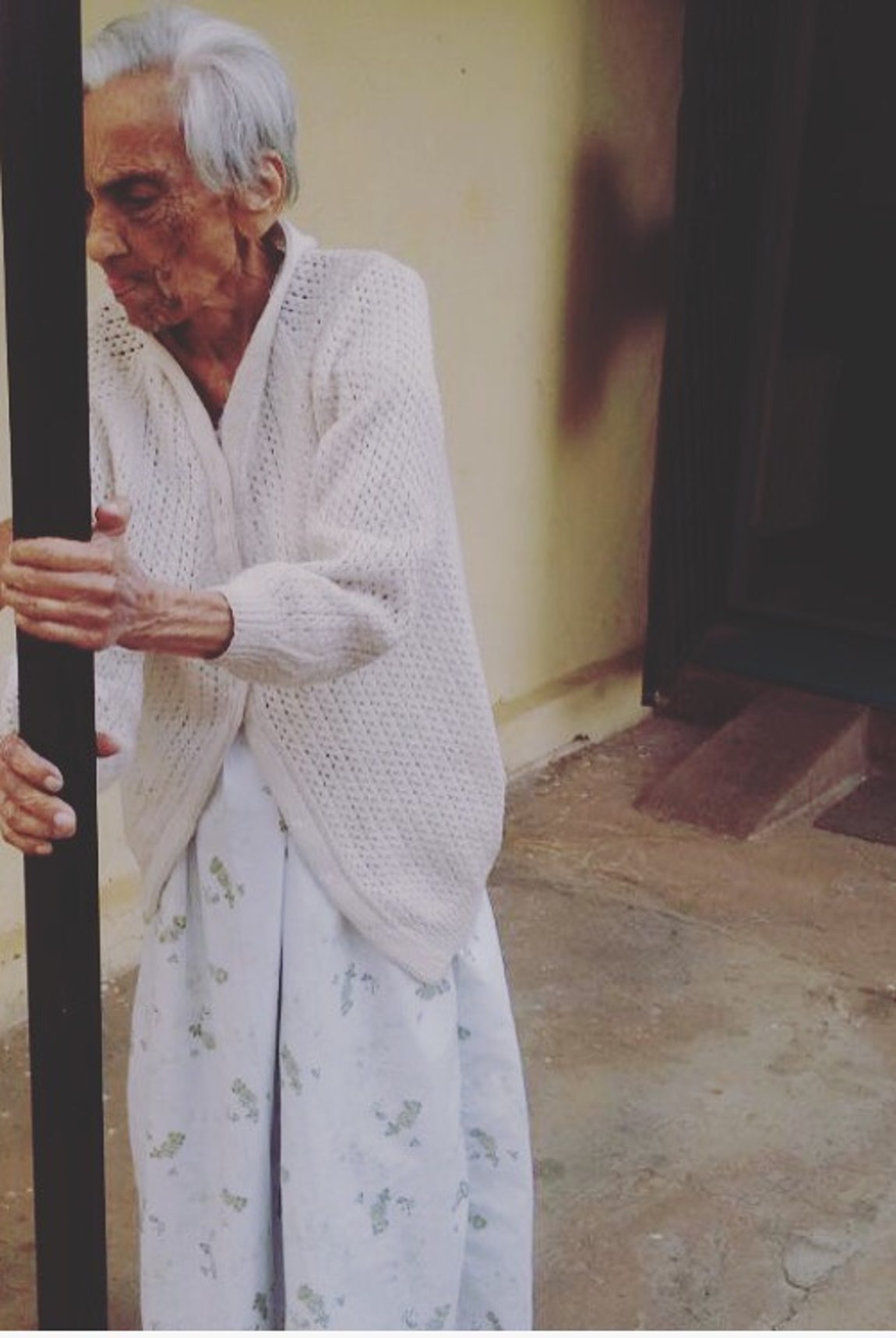
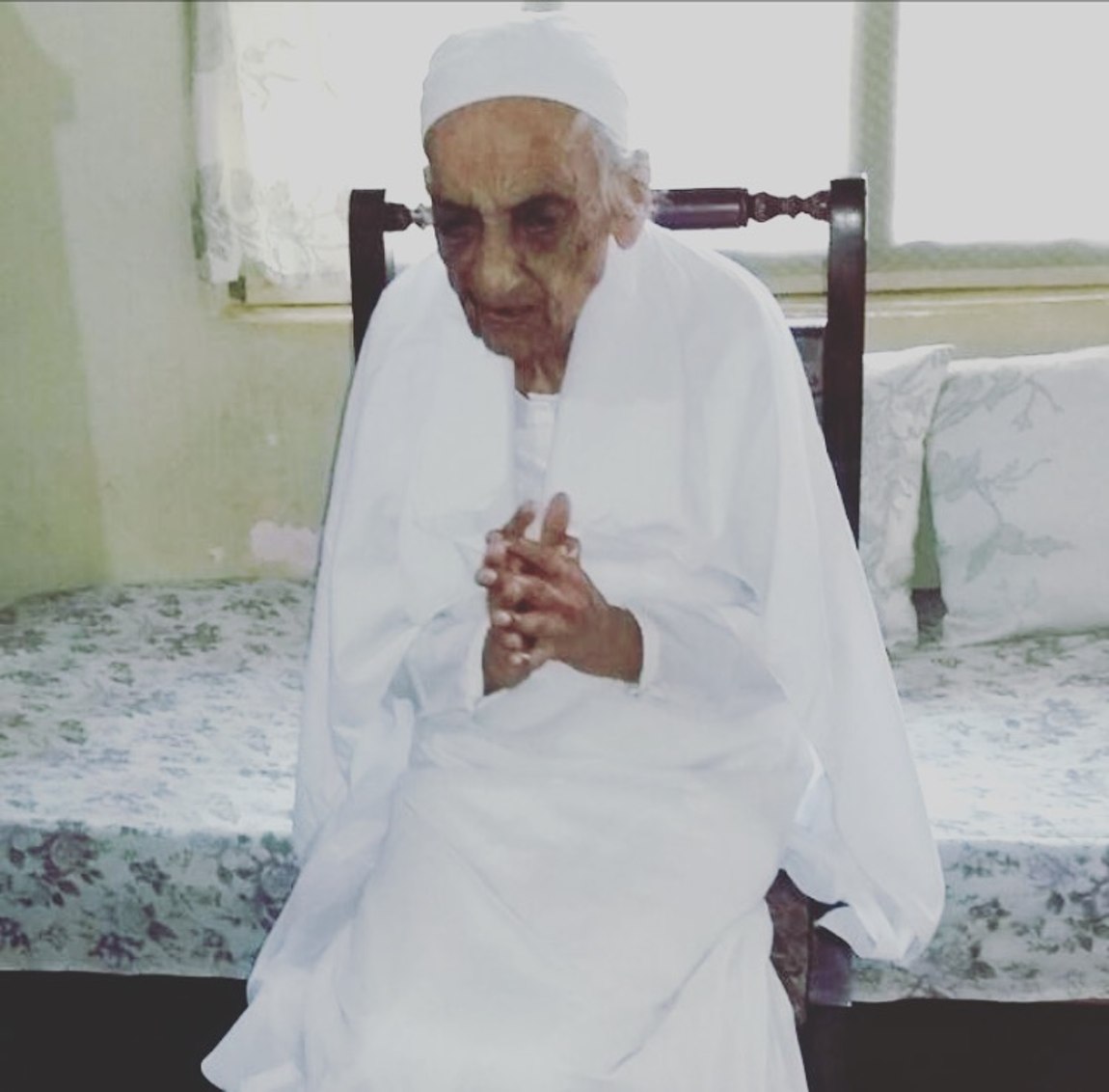
For as long as I can remember, my grandmum has always been old, almost timeless. Time is perhaps the most active change agent. It makes even actors and actresses, with millions to spare for matters, cosmetic, look like second hand imitations of their older selves – but what can it take of those like my Avayya?
In many ways, I always assumed she had conquered time. Even looking at her lying motionless, now, in the midst of a crowd, it only seemed as if she was going to awake from her nap and sip her cup of black coffee, and then some time later, brandy with hot water.
She lived a simple life that belay the many tribulations, women – especially those widowed at an early age – overcame for the prosperity of their family. At 101, she had passed. Quietly.
My Memories of Avayya (and her Imaginary Friends)
As the mournful masses milled around her body to pay their final respects, I couldn’t keep a steady mind. I was sad but also confused.
Here was a woman who in her lifetime had lived through the invention of the modern television set, World Wars I and II, the Indian freedom struggle and independence from the British, the Cold War, the Emergency, the invention of the internet, the Pokhran nuclear tests, the year 2000, her second (or third, I don’t know for sure) favourite grandkid’s playing Bryan Adams’ Summer of 69 on repeat, and much else. You tend to associate a certain degree of immortality to someone of that stature.
At 101, she had passed. Quietly. (Photo Courtesy: Roshan Cariappa)
She was a reservoir of knowledge, the lone connecting thread between five generations of a family that stretched across many geographies far from her native town.
My own personal memories of her were fond.
When we were children, we visited Coorg in the summers a couple of times. Avayya – probably in her 70s then – still managed a home and an estate by herself. I found old houses eerie – a fact manifoldly exacerbated by Avayya’s telling us of our long deceased Granddad’s proclivities for pinching people’s bottoms in the night. I huddled under the blankets in the night, my tiny bottom firmly planted on the ground, waiting to fall asleep. It worried me greatly that the others seemed unperturbed by Granddad’s post life nocturnal harassment. Some even attested, amusingly, that they had been subject to said antics.
Sometimes, while making supper in the kitchen, she’d venture out in the abject darkness to fetch firewood or water. While we sat beside her and ate rotis and bamboo shoot curry, she’d narrate anecdotes of people and events that, for us city rats, seemed from North of Jupiter. Somehow, she seemed to know it all. Mostly, her stories were about our Uncle Jimmy and his drunken misadventures. She had a wry smile; her eyes closed momentarily in a wink. And if you saw her then, with the many wrinkles even, her face betrayed a childlike impish charm.
She also had a wicked sense of humour. Many years later, while living at my uncle’s house in Mysore, she started animated conversations with imaginary friends from across the hall. Now, if you were studying late for your board exams (like my cousin Bopu was at that time), this was no laughing matter. Try doing any of those innocuous activities you do around the house with someone actively conversing with people you can’t see, let alone host. It warranted a visit from my uncle from abroad to set things straight. Having inherited some of her traits, my uncle armed her with a stick and some ash, and is said to have told her to put it to use if ‘them imaginary friends’ showed up. Just in case. And surely enough, her friends and conversations were gone. Maybe it was a ploy to see her son, but I think she did it just for kicks.
She was a reservoir of knowledge, the lone connecting thread between five generations of a family that stretched across many geographies far from her native town. (Photo Courtesy: Roshan Cariappa)
The week after she passed, we had a traditional ceremony. The family gathered to partake in the rituals – that included sharing her virtues, praying to the gods to look upon her kindly, offering her favourite things: food and drink.
While we took turns keeping aside a morsel of rice and meat, each, for her on a plantain leaf, somebody remarked to refill the brandy. Apparently, the level of brandy in the glass from the night before had depressed. While some of us looked at Bopu, who maintained it had evaporated, I couldn’t help but smile.
It just could have been Avayya and her imaginary friends.
(Roshan Cariappa is a Bangalore-based tech entrepreneur, occasional writer, and musician. He finds inspiration in Bharat, dharma, economics, music, and startups. He tweets at @carygottheblues.)
source: http://www.thequint.com / Home> Blogs / by Roshan Cariappa / February 19th, 2017
The Sarang helicopter team talks about the risks in the air,how they were inspired to master the skill of formation flying and the courage it takes to deliver a flawless performance
Bengaluru :
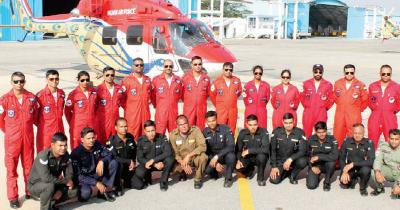
In their saffron uniforms, the men and women who swing their Sarangs into perfect flight formations display skill and dare and splendid teamwork. Not many on the ground know the challenges and risks that go into it.
After enthralling the crowd at the inaugural day of Aero India 2017, the pilots shared their life stories, and how they came to be flying their HAL Dhruv choppers.
Sneha Kulkarni wanted to become an event manager, but ended up as an Indian Air Force pilot in 2006. “When my elder brother joined the Army, I went for a training camp. There, the uniform inspired me to join the air force. I had not believed that I would become a pilot, but here I am,” a relaxed Sneha said on Tuesday afternoon.
Wing commander Sachin Gadre, team leader, says the choice of a new teammate is almost always a collective one, with the final call left to him. “First, we ensure that the person joining our team actually volunteers to be here. Considering how strenuous and challenging it is, we don’t want them to be under any risk. He or she has to fly with us once before we finalize the person to ensure that the entire team bonds. The ability to remain calm, no matter what, is the most important quality,” he said.
“We fly so close to each other that the slightest mistake could be disastrous. And we have to ensure that we maintain our formation. We need to have our emergency protocol in place and follow it,” he added.
Considering the challenges, the Sarang Air Force Helicopter team performs on non-fixed wing aircraft, flying the choppers in perfect sync. The highly skilful pilots are called into action 12-15 times a year for various academy parades, exercise programmes and other formal events. To achieve the perfection that they are famous for, they have to put in nearly 500 hours of practice time, specially on a helicopter. “It is for the safety and beauty of our performance that we train so hard. It requires courage,” says Gadre.
It was precisely this precision that attracted squadron leader Bhushan Rao to the elite team of performers. “I saw them perform at Marine Drive in Mumbai and was so impressed that I immediately wanted to join. It is much more difficult than the apparent ease with which the performance happens,” said Rao, who is serving his second tenure and has been with the team since 2012.
Wing commander P Prithvi Ponappa, 38, says he was watching a Sarang display in 2003 when he first wanted to fly one. And at Aero India 2015, he finally did. For him, performing at the Aero Show is like being on home turf. “It was always my dream to perform at the show. I was on standby last time, so this is a dream come true. The first time I flew, I was so nervous that I was looking to my senior beside me for guidance,” he said. The airman from Kodagu narrated how every display performance is preceded by multiple dry runs on the ground, followed by a mandatory video debriefing.
Wing commander Ashish Moghe says, “Apart from maintaining the basic level of fitness that an average military aviator should have, the team claims that they do nothing out of the ordinary, apart from following a balanced diet.”
The voice of the team cannot be missed. Tinju Thomas, 28, from Ahmedabad, is an economics graduate and now commentator of the Sarang team for four years. Managing a team of 15-16 officers and pilots and 30 technicians isn’t easy, but for her it is as much fun as it is duty. “I always wanted to visit Bengaluru and my work brought me here,” she laughs.
source: http://www.timesofindia.indiatimes.com / The Times of India / News> City News> Bangalore News / Arpita R / TNN / February 17th, 2017
Four elephants from Mathigodu elephant camp in Kodagu district left for Uttarakhand on Monday. The elephants have been sent to Jim Corbett Tiger Reserve as per the MoU signed between the Karnataka and Uttarakhand governments.
The elephants that left for the north Indian state are Thunga (15), her two-year-three-month-old calf Karna (7) and Bheeshma (7). Mahouts Gopal, Rama and Lingappa, are accompanying the pachyderms.
The elephants halted at Kallabettu forest in Hunsur on Monday evening and will resume their journey on Tuesday morning, said Mathigodu RFO Kiran Kumar. He said the elephants will travel by lorry. The mahouts will be with the elephants till they get accustomed to the new environment, said the RFO.
Elephant Thunga is the daughter of Varalakshmi, who is at the elephant camp. Karna is the son of Chamundi who was captured at Dandeli. Bheeshma is an orphaned elephant who was found on the periphery of Veeranahosahalli. He was separated from his mother and was reared by mahouts at the camp.
source: http://www.deccanherald.com / Deccan Herald / Home> State / DHNS- Gonikoppa (Kodagu District) / February 21st, 2017
Ibnii Coorg is nestled on 120 acres of which 50 acres is being used for coffee plantation
Ibnii Coorg, an eco luxe resort located in Coorg (Kodagu) district of Karnataka, has become the first hospitality project in India to receive the IGBC Platinum certification for energy and resource-efficient, sustainable, cost-effective buildings.
source: http://www.financialexpress.com / The Financial Express / Home> Lifestyle> Travel Tourism / by Steena Joy, Madikeri / February 21st, 2017
Ibnii Coorg, an eco luxe resort located in Coorg (Kodagu) district of Karnataka, has become the first hospitality project in India to receive the IGBC Platinum certification for energy and resource-efficient, sustainable, cost-effective buildings that impose minimal stress on the environment. The resort is also gearing to get its LEED (Leadership in Energy & Environmental Design) certification by April.
The Indian Green Building Council (IGBC), part of the Confederation of Indian Industry (CII) was formed in the year 2001.The rating systems are based on the five elements of nature (Panchabhutas) and are applicable to all five climatic zones of the country.
Ibnii Coorg is nestled on 120 acres of which 50 acres is being used for coffee plantation. The resort has just finished with its first coffee harvest. Speaking exclusively to FE Online, Dr Sherry Sebastian, director, Ibnii Coorg, informed, “In the last 60 years, no pesticides have been used on this land. So it is an ecological and biodiversity hotspot. Very few trees were cut during construction of Ibnii Coorg. We are also very actively involved in rainwater harvesting as we have three large water catchment areas. We harvest nearly five million litres of water every year. Apart from a waste management plant, we have a state-of-the-art Sewage Treatment Plant (STP) too to further minimise our dependency on fresh water. The treated water is used for landscaping and other utilities. Ibnii is also a vehicle free zone with only electric buggies used for internal movements. Guests are encouraged to walk around the resort.”
The resort also has introduced other ecological initiatives such as an inhouse tailoring facility where many articles are created out of recycled materials like shopping bags out of used cement sacks and bubble wraps; use of steel fruit and vegetable crates in the kitchens instead of the conventional plastic crates; use of drop pops in the restaurants in place of finger bowls for washing hands. The resort is also part of a new project with Madikeri town for making a road using recycled plastic from the resort.
Ibnii Coorg also has TieCop, its Environment Conservation Programme.
Dr Sebastian added, “We also want our supply chain to be eco sensitive – so we source only from vendors who have the same sensitivity towards the environment. Presently, we source the coffee for the resort from Halli Berri, a fourth generation all woman owned concern coffee estate in Chikmagalur with a similar vision towards sustainability, but soon we hope to be able to use our own coffee. We have a vegetable garden where we source most of the vegetables for our salads. Another bigger vegetable garden is being created which is expected to give us around 14 tonnes of vegetables.”
The resort has a robust waste segregation system where the organic waste is used in a vermicompost to generate high-yield, organic manure which is in turn used in the green house to grow fresh organic vegetables and fruits.
source: http://www.financialexpress.com / The Financial Express / Home> LifeStyle> Travel Tourism / by Steena Joy ,Financial Express, B2B / Madikeri – February 21st, 2017
Senior journalist Raj Chengappa has been re-elected as the President of the Editors Guild of India.
At the Annual General meeting of the Guild on Saturday Raj Chengappa was unanimously re-elected as its President and Prakash Dubey as General Secretary, a statement released here said.
The Guild also elected Kalyani Shankar as Treasurer.
At the meeting, the Guild decided to take a fresh look at the criminal defamation law in India and explore legal options for seeking its abrogation, the statement added. PTI ADS DV
This is unedited, unformatted feed from the Press Trust of India wire.
Are Kodavas (Coorgs) Hindus? The answer is both ‘yes’ and ‘no’. If one defines Hinduism as a way of life, then Kodavas are Hindus. If one looks at Hinduism from a rigid caste-centric angle, then Kodavas are not Hindus.
Sarvepalli Radhakrishnan (1888-1975), former president of India, who was one of the most erudite scholars of all times, had said: “Hinduism is not a religion, but a commonwealth of religions. It is more a way of life than a form of thought. The theist and the atheist, the sceptic and the agnostic may all be Hindus if they accept the Hindu system of culture and life. Hinduism insists not on religious conformity but on a spiritual and ethical outlook of life. Hinduism is not a sect but a fellowship of all who accept the law of right and earnestly seek for the truth.”
The concept of Hinduism as propounded by Radhakrishnan was lofty and incorporated the essence of the ancient Indian civilisation. But in the present era of ‘Mandal’ and ‘Kamandal’ politics, it is caste which determines the Hindu identity.
Kodavas are a unique race of people who live in Kodagu (Coorg, as the British called it), the smallest district in Karnataka. Very little is known about the origin of this community of warriors who have lived on the slopes of the Western Ghats of South India from time immemorial. This land-owning community known for its martial traditions, has a distinct culture that is strikingly different from that of the neighbouring cultures.
If caste is used as the yardstick to ascertain whether Kodavas are Hindus, then this small community, numbering less than two lakh, are certainly not Hindus because they do not belong to any Hindu caste and there is no caste system among the Kodavas.
Another important factor which characterises the Hindu caste system is the belief in the supremacy of Brahmanism. Judged from this yardstick too, Kodavas are not Hindus because there is hardly any role for Brahmins in the various Kodava ceremonies related to birth, marriage and death. It is the elders in the community who conduct all rituals.
Kodavas are basically ancestor and nature worshippers. Every Kodava is a member of a patrilineal okka (clan) that has descended from a common ancestor. The Karanava, the first ancestor of the clan, is revered as a god, and Kodavas worship the ancestral spirit, their Guru Karona.
While their ancestors are their guiding spirits, Kodavas consider their elders as their living guides. The youngsters greet their elders by touching their feet three times and the latter invoke their ancestors when they bless them.
Every ancestral home (ainmane) invariably has a kaimada, a small shrine nearby, where prayers to ancestors are offered. The ancestral homes face the east, and Kodavas start their daily chores by opening the main door of the house and saluting the sun in prayer. And idol worship is non-existent. A lamp (bolcha) or hanging lamp (thook bolcha) is lit, both at dawn and dusk, to invoke the blessings of the ancestors. The lamp is kept in the nellakki nadu bade (central hall in the ancestral home).
The sacred area around the lamp is empty and no idol or photograph adorns the space. The same goes for the space where meedi (offerings to the ancestors) is kept. Most of the important decisions are solemnised in front of the lamp. However, in recent years, in some ainmanes, framed photos of Hindu gods are kept in these sacred spaces.
There are no idols in the kaimada, the central place of ancestor worship, where the annual ritual of Karonang Kodpo is held in memory of the ancestors. A few kaimadas have figurines resembling humans, to represent their ancestors. To sum up, Kodavas believe that there is a direct link between the living and their ancestors.
Major deviation
Kodavas worship river Kaveri as water and not as an image. During Kaveri Sankramana to celebrate the birth of the river, goddess Kaveri is symbolically represented by a decorated coconut or cucumber.
Another major deviation from mainstream Hinduism is the practice of meedi offerings for ancestors which consist of food items, including non-vegetarian dishes like pork, the signature dish of the Kodavas. Along with the food, liquor is also offered to invoke the blessings of ancestors. This practice is inconsistent with the rigid notions of ‘pollution’ practiced by orthodox Hindus.
Though Kodavas had maintained their own religious identity of ancestor and nature worship, things began to change after 1600 AD with the advent of the Lingayat or Haleri kings in Kodagu. The Haleri Rajas built Hindu temples and appointed deva thakkas (temple headmen) to propagate their faith among the Kodavas. Tulu and Kannada-speaking Brahmin priests were brought from outside Kodagu to perform pooja at these temples.
Over the years, temples dedicated to deities such as Bhagavati or Muthappan have come up in Kodagu. These deities mainly belong to the neighbouring Kerala. Igguthappa, the god dedicated to rain and harvest, was also one such belonging to Kerala. Kodavas also worship a few spirit deities like kulika, pashana murthi etc who belong to Tulunad or Kerala.
In today’s circumstances, it is essential that we maintain our Kodava identity instead of trying to embrace mainstream Hinduism where we do not belong. The belief in ancestor and nature worship is much more rational and scientific, compared to belief in myths and rituals which are alien to Kodava religious practices. It is best they tribe remains Kodavas and not Hindus.
(The writer is a senior journalist and author based in Bengaluru)
source: http://www.deccanherald.com / Deccan Herald / Home> Panorama / by P T Bopanna / February 17th, 2017
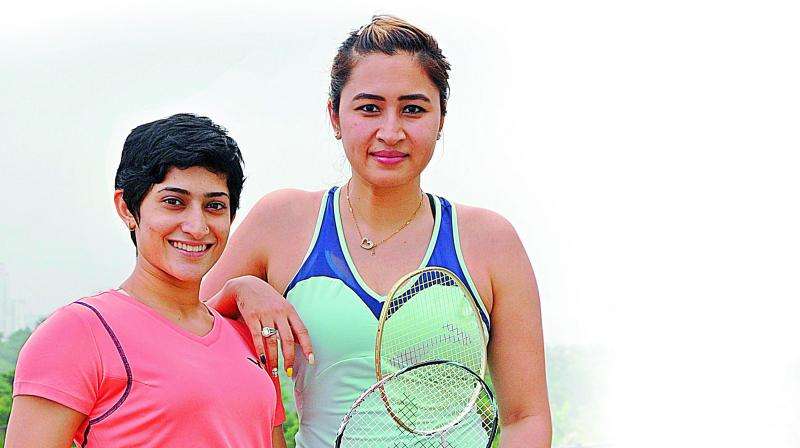
Ashwini Ponnappa opens up to Sportskeeda about her career, struggles, achievements, doubles getting ignored and much more.
Ashwini Ponnappa. [Image Courtesy: Red Bull]
“India, as a country, is reactive rather than pro-active.
”Having won tournaments ever since joining the international circuit and still not getting enough support, Ashwini Ponnappa hits the nail on the head with this statement.
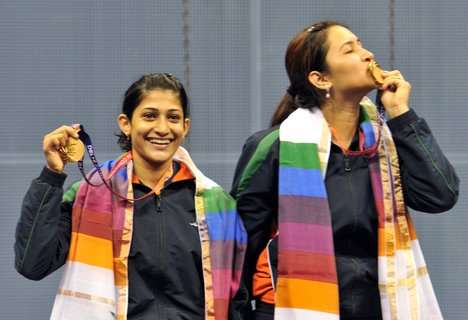
The Gold at the 2010 Commonwealth Games in women’s doubles was supported with a mixed team silver while she and Jwala Gutta became the only Indian pair, and second Indians after Prakash Padukone in 1983, to win a medal at the World Championships when they won the bronze at London in 2011. The 2015 Canada Open triumph came on the back of yet another successful CWG campaign in Glasgow and a bronze at the 2014 Asian Games.
Despite all these achievements, it wasn’t until September 2015 – less than a year before the Rio Olympics – that Jwala and Ashwini were included in the Target Olympic Podium (TOP) scheme. And that, too, came after a war of words and multiple requests and demands to the Sports Ministry.
“Not just the TOP scheme, a lot could have been handled way better, to be honest. I think when Jwala and I did well at the World Championships in 2011, things should have changed then,” the 27-year-old claimed. “When we did well in 2010 at the CWG, we should have had support, which would have eventually led to us, probably, doing well at the 2016 Olympics, not in 2012, where we lost out by just 1 point.”
“So when you see a pair having potential, who have done well, are doing well and have the potential to do even better, support them! Did anyone come forward to do that?,” questioned Ashwini. “They didn’t. And that’s why I think the delay in us being involved in the TOP scheme cost us a little bit (at the 2016 Olympics).The support we got was not enough to guarantee a medal.”
Looking at the likes of HS Prannoy, Guru Saidutt part of the list already, it is natural that the country’s most successful doubles pairing would be hurting from being overlooked time and again.
Doubles ignored by the badminton fraternity
This inadvertently prompted the question if doubles badminton gets step brotherly treatment as compared to singles. And like she plays on the court, Ashwini didn’t hold back from this either, bluntly admitting that it is foolhardy to harbour expectations of a medal from the Olympics without significant backing.
“You see the companies that are supporting the junior players – all of them are supporting singles players while nobody supports doubles players. Nobody wants to gamble on a doubles pairing and pick a pair and back them to win a medal, the way they would do for a singles player.”
“If you look at Saina and Sindhu, they have been given consistent support since the age of 13-14 and that’s what has helped them achieve everything at the international level. There’s not one doubles player who is given that backing. But, you expect so much out of us when we are struggling, as it is. You can’t expect miracles at the Olympics as it is simply not going to happen with this backing,” she continued.
Rewinding the clock and remembering the unrealistic expectation the nation had on the pair during the London and Rio Olympics, I had to agree with her. Just when my mind began to wander about how they kept their motivation up, she explained:
“Everything that Jwala and I achieved. Everything that Jwala-Diju achieved, what the other doubles players have achieved – is amazing. I think that’s remarkable. It’s an outstanding effort put by all of us because without having support, to just go there and play because you want to play and work hard for yourself, for your country. Of course, it stings when you don’t get any support, but it hasn’t stopped us from working and fighting and trying to do really well,” she answered as if she could read my mind and anticipate the next question.
“But, to push us to the next level, we need more – a lot more – to make us do that and that isn’t happening. We still believe that despite all that we are going to do well, but how far can belief just take you alone. We need a lot of support. But, hopefully things change. It hasn’t happened in the past, though despite Jwala and I performing well,” the anguish was quite palpable on her face as she talked about the obvious lack of support.
Jwala Gutta’s and Ashwini Ponnappa’s success has come despite the obvious lack of support
By this time it was clear that having already competed with the top nations and coming out on top on quite a few occasions was despite the negligible funds and backing given to doubles badminton in India rather than because of it.
No Indian pair goes into any Superseries, Olympics or Asian Games as one of the favourites. Any achievement by any Indian pair, not just Jwala and Ashwini, is considered as a bonus. From parents not encouraging kids to take up doubles to lack of media coverage, it is not just the lack of funds or support that has resulted in Indian players merely making up the numbers at every tournament and playing second fiddle to the Far East and European countries when it comes to doubles. The problems are deep-rooted and many, which have resulted in India’s current standing in doubles badminton.
“When we look at other countries, I feel, we are definitely capable of beating them. But, at the same time, there’s a massive difference in the kind of facilities they are provided in terms of training and encouragement – which is most important at the grassroots level.“The fans, as awesome as they are, can only feed what’s given to them and that’s where the media plays a huge role. Unfortunately, there’s not a lot mentioned about doubles as opposed to singles. The same performance between a singles player and a doubles player, the singles player would get definitely more. In terms of that, I feel doubles is not given any importance, whatsoever. And that makes parents question whether they want to put their kid into doubles or let them continue there if he/she is put in doubles,” a realistic Ashwini confessed.“As a parent, you are looking out for the well-being of the child. So, you see how much a singles player gets and at the same time you see that a doubles player doesn’t get anything, it makes you question if you should let them continue doubles. I feel in that sense, India’s got a HUGE way to go to ensure the doubles players get the respect, acknowledgement, and encouragement – which is there in the other Asian as well as European countries,” said Ashwini, for whom being pragmatic about the whole ordeal seemed to come naturally. To be honest, if I was a doubles player like her, I would be seething at the system we’ve created.
“There are plenty of problems, but it all starts from the backing you have. You go to a tournament, we send 5-6 singles player, but just 1 doubles pair – that’s it. So, how can we expect India to catch up because there’s a vast difference between that one pair and everyone else?”
Playing singles with Carolina Marin
After listening to the Cinderella-esque challenges that doubles badminton faces in India, I begin to ponder when they would get the Fairy Godmother it so badly requires. After an awkward silence, I look down at my list of questions as I seek to change the mood in the reception of the Karnataka State Badminton Association facility – the venue of the interview.
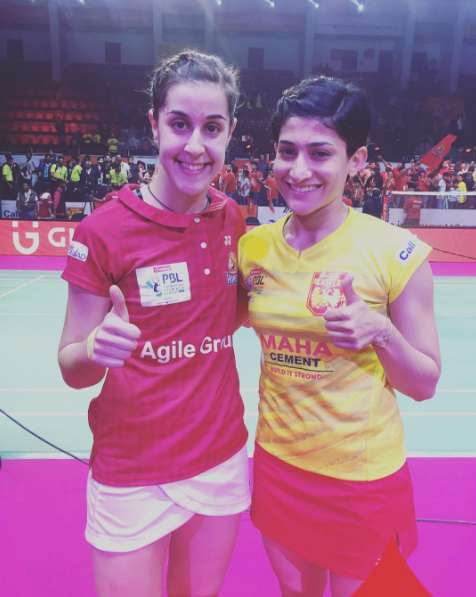
Suddenly my thoughts began to move towards the Premier Badminton League (PBL) where the ‘interviewee’ played an unexpected, yet delightful singles match against the reigning Olympic champion Carolina Marin. Ashwini displayed an array of shots to surprise the Spaniard, and everyone else, and take the first game 11-9. Although she went down 5-11 and 8-11 in the other two games, it was refreshing to see her step away from her comfort zone and give an excellent account of herself.
“Thank you so much,” she uttered mustering a smile when I mentioned that it was my favourite match of the 2017 PBL. “It (playing with Marin) was amazing, to be honest. That’s the best part about PBL – it gives you opportunities. In life you have things thrown at you and you have to grab them. And as I love playing singles despite being better at doubles and not having played that format for a long time, I put my hand up to play against the Olympic gold medallist.”
Ashwini Ponnappa gave the Olympic champion a scare at the PBL
Talking about the match, she explained how well she prepared herself that led to winning the opening game against the then World No. 1. “I wanted to make sure that I play really well. Getting on the court, I just wanted to put up a fight and make sure I didn’t lose 11-0, 11-0. (grins as she recalls her mentality at the time). I just wanted to prepare well and I think it is part of being a professional badminton player that you don’t get into a match, irrespective of whether you’re training for it or not, without being prepared. So, I decided I was going to prepare myself, watch how she plays, and it actually paid off,” she recalled.
The PBL has thrown up such challenges at players time and again while giving them the opportunity to share the dressing room with the who’s who of the badminton world. Although she never had an idol growing up, she had always been a keen observer, trying to pick things from each and every player and that is precisely what she has been doing at the PBL as well. Asked about how the league has helped her and other youngsters, the Bangalore-born shuttler was unequivocal in her praise of the tournament.
“The PBL has helped me a lot, personally and I am sure it has helped the others too. When I played the first edition of the IBL (the IBL was rechristened as the PBL after the first edition), I partnered Victor Fischer who had won bronze in the Olympics and the World Championships. So I learnt A LOT! Being somebody who isn’t primarily a net player, and playing with someone like Fischer helped me immensely and I partnered him in the second season too,” she fondly recalled.
“Like I have learned a lot, I am sure the other Indians would have also learned by just watching them play, get ready, their preparations. These top players are very forthcoming with their opinions. They are happy to share and give you advice as well.”
Partnering with Sikki Reddy
In the 2017 edition of the PBL, Ashwini Ponnappa partnered Sikki Reddy for the Bengaluru Blasters and had the former World No. 2 Korean pairing of Ko Sung-Hyun and Yoo Yeon-Seong to learn from – something she believes helped her massively as it was one of the biggest learning curves in her illustrious career.
“In the last PBL, when Sikki and I partnered, the Koreans in our team were like coaches to us and it was amazing how well we got to interact with them. They would guide us how to move and also give us drills. I learned a lot, and I am sure Sikki did as well as they would point out the nitty-gritties tell us what we were doing right and wrong, that nobody generally tells you. But, the fact that they did, was really helpful as we’re constantly learning,” uttered Bengaluru Blasters’ star doubles player.
Post the PBL, the unseeded pair of Ashwini and Sikki got another feather in their cap by reaching the final of the Syed Modi International. Despite leading in both games at one point, they ended up on the losing side against the Danes, something which Ashwini believes would not happen if they were to get more consistent.“I feel, we still have to get more consistent. At the Syed Modi International, I feel we improved on the consistency bit. But, as a pair, we haven’t had that many matches, so I think it would still take time,” confessed the 27-year-old. “I am quite disappointed that we lost, irrespective of it being just our fourth tournament, because as a player you go to every tournament to win. And, I truly believed we could have won and pull it off. But, we do tend to lose a couple of points in cases when we’re leading. So, we’ll have to work on that and maintain a consistent lead.
”Unlike with Jwala where Ashwini did most of the running, we have seen Sikki and her share the running and be a more fluid unit, exchanging positions effortlessly. Their debut tournament was a second round exit before a final in Wales, a semi-final appearance at Ireland and reaching the final at the Syed Modi Int’l. Asked if the team dynamic was the reason behind the upward curve ever since they teamed up, Ashwini said that could be one of the reasons along with the fact that the two of them are “go-getters” while playing down all their achievements so far.
She explained, “We’ve started with tournaments that we thought we could handle well as a pair. But, as you go on to the bigger tournaments like the Superseries, it’s not going to be so easy. It’s good to start on a positive note and that’s why we started off in the smaller tournaments and the results in the first 3 tournaments gave us confidence. And now reaching the final at the Syed Modi, which is a big tournament, is a big deal for us. So, that motivates us a lot.”
With the All England Championships up in March the next major challenge for the pair, Ashwini said that the duo would be ready for their first Superseries despite the stiff challenge posed by the presence of the Chinese and the Koreans.
The difference between Sikki and Jwala
A hyperactive child growing up and one who loved running out and playing till the sun went down, Ashwini didn’t envisage herself as a professional badminton player when she was ‘forced to pick up the sport’ as her parents thought it was a good way to keep her busy. However, once she got into the junior category, it was then that the bustling little girl began taking badminton seriously.
After spending a few years in the junior category, she was thrown into the deep end when she, just 20 years old was asked to partner a then 26-year-old Jwala Gutta. Their partnership lasted for 6 glorious years – a period she looks back on fondly, calling her former teammate a great mentor and partner.
“When I partnered with Jwala, I had zero experience. I started playing in the junior category and then moved to the seniors for a year and the next thing I know, I was partnering Jwala. So, I believe Jwala had a lot of responsibility because we played in big tournaments. However, the good thing is that when I started playing with Jwala, we clicked instantly! She guided me a lot, was very supportive and was there for me every step of the way. She was always the one with experience and I was picking things up,” Ash gave a glowing tribute to her former partner.
Drawing parallels to Jwala in 2010 and Ashwini now, I asked her if she felt any added pressure to guide 23-year-old Sikki Reddy similar to how Jwala mentored her? “Not at all,” came the instant reply from her. “Sikki and I are, more or less, on the same page considering she already has a few years of experience under her belt, unlike me when I started out with Jwala.”When quizzed about the future of the partnership, Ashwini is taking a pragmatic approach while looking forward to a great partnership in the meantime.
“We are two ambitious individuals who have gotten together. We are going to see how it goes. If it works, that’s great. If it doesn’t, well, that’s how life is,” admitted Ashwini.
Saina or Sindhu
Moving on to the biggest debate in Indian badminton was a no-brainer, but Ashwini, diplomatically, refused to pick one out of Saina Nehwal or PV Sindhu, saying they both have a long way to go.
Answering the debate in the same clever manner she deals with a tricky drop shot on the court, she said, “I feel the one that is more mentally tough and lasts there the longest will be considered the greater player. Sindhu is still young while Saina also has a few years ahead of her. Saina is very strong mentally and is extremely hard working while Sindhu has age on her side. When they both hang their boots, we may have Saina and Sindhu as 1-2, or it could be the other way around, you never know. Either way, it doesn’t matter as both of them are Indians at the end of the day.
”Going nowhere with the Saina-Sindhu debate despite repeated probing, I moved on to ask her about her fitness mantra, which has helped her stay at the top of her game for so long.
“Currently, my fitness mantra is being smart. I’ve always been on the stronger side physically. When I started working on my fitness in December after a spell out, I took on a routine that was ‘my body specific’. Being a sportsperson, it is very important you only do stuff which helps your body and not everything which ends up breaking your body.
”She talked about having to keep herself motivated to work out and keep her fitness levels up, specifically highlighting the effort of fitness trainer Deckline Leitao and Red Bull, who have let her enjoy her fitness sessions once more with their unique ‘best fitness friend’ campaign.
“It’s nice I’ve found this new found love to enter the gym and go and work out. It’s been good,” said the Red Bull athlete.
Using social media as a motivating tool
Ashwini is one of the most accessible Indian sportspersons, regularly using social media as a tool to communicate with her fans and loved ones – something she thinks the European players do extremely well. However, she has made her share of mistakes by being over-indulgent and says that she has been learning over the years.
“In the past, I had put out my email address on social media, and I got a lot of mails. I was overwhelmed with all the love and replied to each of them. But, I would get more replies and it became an endless cycle,” laughed Ashwini recalling her young, naïve self.
“Twitter helps that way. When I have time, I go there and answer questions of fans who I feel are genuine and want to know about me. So, I feel like social media like Twitter and Facebook is a good way to let your fans know what you’re up to. It’s amazing the kind of support you get, especially when you’re down and things aren’t going your way. They give you messages like ‘It’s okay. We’re with you, etc. So, it’s very motivating.’” she claimed.
“Being a public figure, it’s important you stand up for a cause”
Anyone who knows Ashwini Ponnappa is well aware of her love for animals. She has been an active PETA campaigner while constantly lending her voice and face for causes supporting animal rights. Being a public figure, she feels it is imperative that one supports a cause.
“For me, personally, I do it because I love animals. Being in the limelight, a celebrity, sportsperson or a public figure, it’s important you stand up for some cause – need not be animal rights, it could be the environment, supporting the girl child, old age homes, etc. I think that when you are in a place where you can make a difference and you can help out, I think you should do that,” professed the animal-lover, who herself has 4 adorable dogs at her parents’ house in Coorg.
Biggest achievement
The coveted gold at the 2010 CWG made a massive impact as it was won in front of the home crowd.
A quick glance at my watch made me realize that I had overshot my time by over 20 minutes – a period which had flown by as she patiently answered each of my questions, keeping me entranced all the time. Trying to quench my never-ending thirst, I put forth a final question in front of her: ‘Which achievement would you classify as your best so far in your career?’
“The best would definitely be the 2010 Gold at the CWG. The next would be followed by the bronze at the World Championships because it is, after all, the World Championships! Also because we were the first Indian pair to win it and the second after Prakash sir to win a medal there was a huge deal,” she revealed. “However, the CWG is close to my heart as it was the first win for us (Ashwini and Jwala) and it was massive because it was in front of our own fans with everyone watching.”
“It made a huge difference that we won it in India. If we had won it in 2014 in Glasgow and not in 2010, the impact wouldn’t have been the same and people probably wouldn’t have known who Jwala and I were. If it was somewhere else other than India, the newspapers would have carried it as (uses her hands to indicate a small heading at the bottom of the page) ‘Jwala and Ashwini won CWG gold’. While the same paper would have printed ‘Saina won CWG gold’ (gestures it to be a front page headline).
With the kind of treatment meted out to doubles players despite all the achievements, I shuddered as I thought of the impact, or lack of, it would have made had the 2010 CWG been held outside India. The repercussions would have been unimaginable and despite going through it all, Ashwini continued with her charming smile as I thanked her for her time before she humbly bowed out of the room to continue working ‘smart’ on her fitness in her quest to bring further laurels to the country.
source: http://www.sportskeeda.com / Home> Badminton / by Saransh Gehlot @saransh2703 / Editors Pick / February 13th, 2017
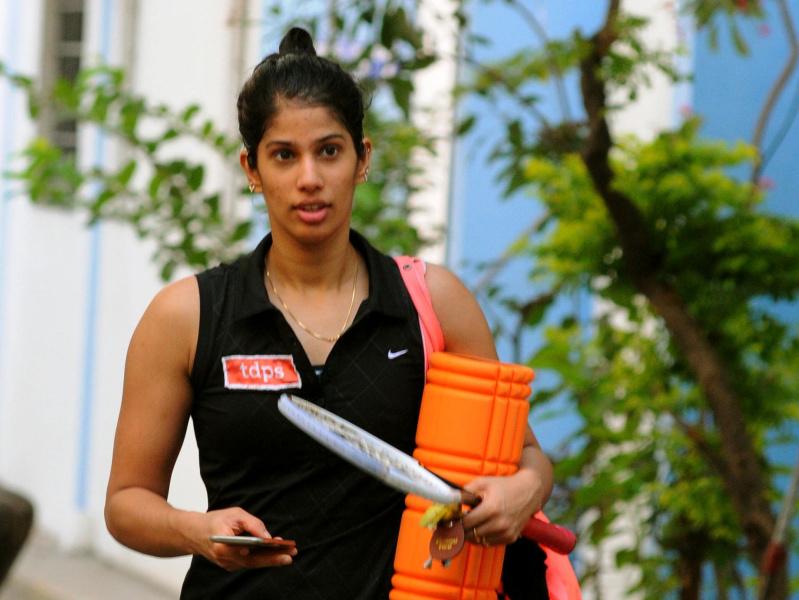
Joshna Chinappa, at rank 14, was the highest-ranked current Indian squash player in the latest Professional Squash Association rankings released.
Joshna Chinappa dropped a spot to be placed at 14th. – R. RAGU
Joshna Chinappa remains the highest-ranked Indian squash player in the latest Professional Squash Association (PSA) rankings released. Chinappa is positioned 14th, eight spots ahead of second-placed Indian Dipika Pallikal Karthik.
Sachika Ingale was at 79, and Janet Vidhi at 96, in the women’s section.
Among men, Saurav Ghosal remains the highest-ranked Indian, at 24. Vikram Malhotra is at 67, and Mahesh Mangaonkar at 70. Harinder Pal Singh Sandhu is positioned at 99.
source: http://www.sportstarlive.com / Sport Star / Home> More Sports> Squash / by Team Sportstar / February 03rd, 2017
This year’s two Republic Day parade contingents at the Rajpath in New Delhi were led by two Commanders from Kodagu. While Col. Bommanda Dhiraj Chengappa led the President’s Bodyguard, a regiment of the Indian Army that consists of 46 horsemen, Ajjinanda G. Aishwarya led the all-girls National Cadet Corps (NCC) contingent.
Col. Dhiraj Chengappa is the son of Bommanda Muthanna Chengappa, a retired IGP in the Border Security Force. Dhiraj was selected for the Army through UPSC and he lives in New Delhi with his wife and son. He graduated from Delhi University and then joined the Army.
Aishwarya is the daughter of Ajjinanda Ganesh and Monthi Ganesh. She is a student of St. Joseph’s Girls’ Composite Pre University College in Madikeri and has been the ‘Best Cadet’.
Aishwarya belongs to the 19 KAR Battalion and was also part of the R-Day camp in 2015 as a junior wing cadet. This was the first time after 18 years that a girl from the Directorate had been given the honour.
Aishwarya, a Science student with good academic track record, is also an accomplished skater and hockey player apart from playing the guitar.
This cadet wants to join the Indian Air Force (IAF) and become a fighter pilot.
source: http://www.starofmysore.com / Star of Mysore / Home> General News / January 27th, 2017
WELCOME. If you like what you see "SUBSCRIBE via EMAIL" to receive FREE regular UPDATES.
Read More »

![Ashwini Ponnappa. [Image Courtesy: Red Bull]](http://www.kodagufirst.in/wp-content/uploads/2017/02/AshwiniPonnappa01feb152017.jpg)
![Ashwini Ponnappa with Sikki Reddy (L) [Image courtesy: Ashwini Ponnappa’s Facebook]](http://www.kodagufirst.in/wp-content/uploads/2017/02/AshwiniPonnappa04feb152017.jpg)