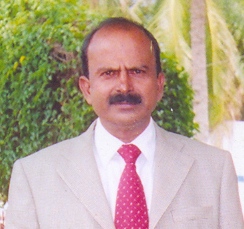
During the 1965 war, his son K C Nanda Cariappa, an Indian Air Force pilot who went on to become Air Marshall, was shot down over Pakistan by Army officer Major Zaidi. He was captured and imprisoned as a PoW by him. On realizing the identity of the wounded soldier at Dargil, Radio Pakistan immediately announced the safe capture of Flt. Lt K C Nanda Cariappa. Gen Ayub Khan, himself contacted Field Marshal Cariappa, who was living a retired life at Mercara, his hometown, with information about his son’s safety. When Gen. Khan offered to release his son immediately, Field Marshal is reported to have scoffed at the idea and told him to give his son no better treatment than any other PoW. “He is my son no longer,” the old soldier is reported to have thundered. “He is the child of this country, a soldier fighting for his motherland like a true patriot. My many thanks for your kind gesture, but I request you to release all or release none. Give him no special treatment,” the Field Marshal is reported to have said.
As a token of gratitude for the exemplary service rendered by him to the nation, the Government of India conferred the rank of Field Marshal on Cariappa in his 87th year, on 14 January 1986. He is among only two Indian Army officers to hold the highest rank of Field Marshal (the other being Field Marshal Sam Manekshaw).
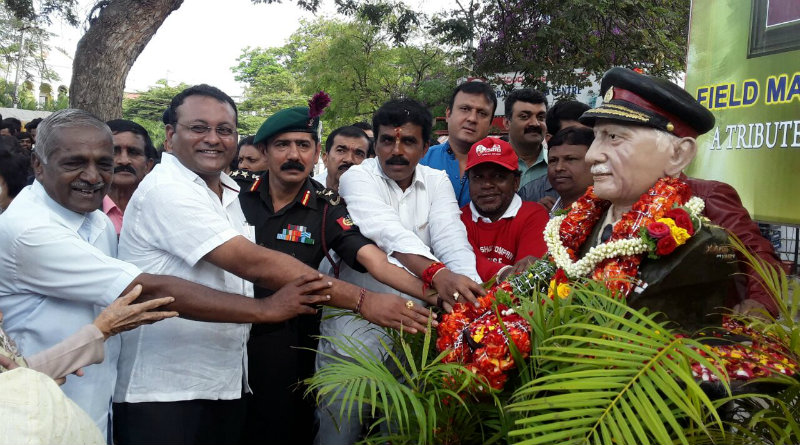
Today is the birth anniversary of Field Marshal Kodandera Madappa Cariappa – the first Indian Commander-in-Chief of the Indian Army.
On this occasion, MCC had organised a celebration of the birth anniversary of the Field Marshal. MCC Mayor M J Ravikumar garlanded the statue of K M Cariappa, near Metropole circle, Mysuru. Sweets were distributed to public.
Bopanna, Chengappa, Aiyappa, members of Kodava samaj, members of MCC participated in the function.
source: http://www.citytoday.news / City Today / Home> Mysore / CT Bureau / January 28th, 2017
The Indian Navy will extend support to Field Marshal K M Cariappa Museum coming up at his residence Sunny Side here, Commandant of Indian Naval Academy (INA) (Ezhimala) Vice Admiral S V Bhokare said.
He was speaking at the 118th birth anniversary celebrations of Field Marshal Cariappa organised by district administration, Karnataka Kodava Sahitya Academy here on Saturday. “Kodagu has given birth to first Indian commander-in-chief K M Cariappa. His service to the country is remembered even to this day,” he recalled. “With dedication and hardwork, one can achieve success. Cariappa is a inspiration for present generation,” he said.
Recalling an incident, Bhokare said Cariappa’s son K C Nanda Cariappa had crossed the Line of Control once. The then Pakistan General Ayub Khan called Cariappa and informed that all efforts will be made to release Nanda Cariappa. Cariappa said there is no need to give special treatment for his son and asked him to release his son on the day when all others are released. He was a true patriot, he recalled.
MLA M P Appacchu Ranjan said Cariappa was known for discipline and honesty. The youth should imbibe Cariappa’s qualities to achieve success in life, he observed. Field Marshal Cariappa and General Thimmaiah Forum Convener Major (retd) B A Nanjappa said, “While visiting Cariappa’s house, one had to compulsorily have pen, notebook and a kerchief. He would daily offer honour to the portrait of his parents with a sepoy.”
Forum President Col (retd) K C Subbaiah said, “The district administration has sanctioned land for museum at Sunny Side. The forum will make an effort to enrol students from Kodagu to Sainik School at Koodige.”
Winners
As part of Cariappa’s birth anniversary, various competitions were organised for students. The winners are – Essay—Shafana (I), Deepthi (II), Rishika (III); patriotic song — General Thimmaiah School (I), Ammathi High SChool (II), A V School, Nelyahudikeri (III); marchpast — Government PU College, Madikeri (I), Kodagu Vidyalaya (II) and General Thimmaiah Public School (III); PU category — patriotic song — PU College, Moornadu; marchpast — PU College, Moornadu; Degree college category — patriotic song — FMC College (I), Government First Grade College (II); marchpast—Field Marshal College (I).
source: http://www.deccanherald.com / Deccan Herald / Home> District / DHNS – Madikeri, January 29th, 2017
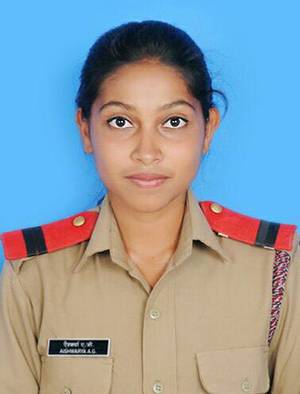
A.G. Aishwarya is a student of St. Joseph’s PU College in Madikeri.
It was a moment to savour for senior under officer A.G. Aishwarya of Kodagu as she led the all-girls National Cadet Corps (NCC) contingent at the Republic Day parade held at Rajpath, New Delhi, on Thursday.
For the student of St. Joseph’s PU College in Madikeri, participating in the parade was a childhood dream inspired by her elder sister Ambika, who was decorated as the ‘Best Cadet’ and honoured at her institution a few years ago.
Her father Ajjinanda Ganesh, mother Monthi Ganesh and sister were in New Delhi on Thursday to witness the parade and cheer her on. Aishwarya belongs to the 19KAR Battalion and was also part of the Republic Day camp in 2015 as a junior wing cadet. She hopes this is just the beginning of an incredible journey as she is determined to join the Indian Air Force and become a fighter pilot.
Ms. Ganesh spoke to The Hindu from New Delhi soon after witnessing the parade and said the entire family was proud of Aishwarya. “There are no words to explain how proud we felt at that moment,” she said.
She recalled that Aishwarya was in class 2 when she witnessed seniors, including her sister, participate in NCC activities. She was also inspired by her uncle Major Nanjappa and other relatives in the armed forces. “She joined Bulbul while in primary school and later joined the Guides and finally the NCC when she was in class 8 and 9,” she said.
Aishwarya, who is a science student with good academic track record, has a little more than a month to prepare for her II PUC examinations, which commence in March, but she is not at all tense. “She has consistently secured distinction in all subjects despite her extracurricular activities and [she] is not tense at all,” her mother said.
Aishwarya is an accomplished skater and hockey player apart from also playing the guitar.
source: http://www.thehindu.com / The Hindu / Home> News> States> Karnataka / by Special Correspondent / Mysuru – January 26th, 2017
The invigorating aroma of the coffee blossoms carried by chilled breeze, the midnight green ambience along the loopy roads… it is not just the abundant natural beauty that makes Kodagu a distinct place. Its people — the Kodavas — with discrete culture and heritage, boost the glory of this coffee land.
Be it the language (Coorgie), cuisine, attire or rituals, Kodava culture moves away from the humdrum reckoning a distinct ethnic identity. And safeguarding this ethnicity while preserving their way of life is the architectural legacy known as the ain mane or ballya mane.
Ain Manes (ain in Coorgie translates to original) are the ancestral heritage homes of the Kodavas that reflect the eminence of a sanctum sanctorum. With quintessential framework, an archetypal heritage home comprises traditionally-carved wooden pillars, bricked white and red walls, intricately-carved wooden doorways and windows. With a typical style, each of them has an unmatched old-world charm.
Every corner of the house is given a name and holds mythical importance. With two types — the othe pore (single roofed house) and mundh mane (courtyard house) — the traditional features of ain manes include kannikamba (a sacrosanct pillar), kayyale (verandah), aimaras (wooden slabs in the verandah), machi (wooden ceiling), mundh (open courtyard) and kannikombre (worship room). Most of the ain manes have kaimadas – a sacred shrine built to worship the ancestors. Since the existence of nuclear families, there were outhouses built around the premises called ale pore.
While the interiors reflect somber and subdued beauty, its exteriors manifest valour and strength. As Chakku Chengappa, a member of Nadikerianda clan, explains, “Hidden and safeguarded amidst the estate were the fort-like structures of ballya mane (ballya means huge); built in this manner to prevent an ambush from enemies. The entrance to the ain mane has many sections. There is a long curvy oni (alley), bakka pare and ala pare (extensions of the alley), which lead to the verandah.”
Nonagenarian Nadikerianda Muthamma adds, “The Kodava women were known to be beautiful, and this is why ain manes needed to be protected at the time of British rule. However, today the ain manes play an important role in reuniting families.”
“Much more than just a roof over the head, ain manes are an important part of the tangible heritage of the native community of Kodagu,” write Boverianda Chinnappa and Nanjamma in their book Ainmanes of Kodagu. Built in the ancestral or the jamma land, the ain mane is a binding force that is a pillar of strength — both literally and figuratively. Many findings state that the inception of the concept of ain mane dates back to eighth century.
The origins
“The early settlers of Kodagu stayed in forests as a family. Due to feudal fights, it was common for people with the same bloodline to stay together in a small thatched hut. These settlements grew in size and became stronger, which made the ruling king seek their support. In return, the king gifted them land, which is the jamma land. As their living conditions improved, they built a strong fort-like structure on the jamma land, which came to be known as ain mane or ballya mane,” explains Boverianda Nanjamma.
However, the architectural style takes its root from Kerala. She adds, “Kodagu grew paddy abundantly but depended largely on Kerala for other commodities. During the travel for exchange of commodities, the Kodavas were pleased by the Kerala architectural style and there flowed workmanship from Kerala to build the ain mane.”
While there are over 900 clans in existence in Kodagu, not all of them have an ain mane. Nanjamma explains, “During the research work for our book, we found out that many deteriorating ain manes were never rebuilt.” According to their findings, only 40% of the ain manes were renovated keeping the tradition intact and the rest did not see the light of the new era.
Today, there are over 400 ain manes in existence and each of them belongs to a patriarchal clan, which is recognised by unique family names known as mane pedas. They bustle with ritualistic celebrations during festivities including Putthari, Kailpodh and annual kola (spirit dance). “The annual hockey matches conducted between families shed light on the revival of ain manes,” opines Kayapanda Shashi Somaiah, a journalist in Kodagu. Nonetheless, the revival of the ain manes are not just a process of renovation of age-old structures but also a resurgence of Kodava culture.
Unity in diversity
The Kundyolanda clan, which has 35 families, has its ain mane in Kolakeri village that was recently renovated to its pre-eminence. The rituals followed in this ain mane are uncompromising and many. “It is a family temple for us. We strictly adhere to the rituals and it is mandatory for women to wear traditional Coorgie saree and vastra (veil) over the head while entering the house. Apart from this, there are various other restrictions followed religiously in the ain mane,” explains Kundyolanda Dinesh, owner of a hotel.
They have a 400-year-old othe pore ain mane with 14 rooms, but there is no one residing here. However, it is made sure that lamps are lit twice a day and the house is maintained meticulously. “Each nuclear family of the clan takes turn to maintain the house and no one can back out from their duties,” he explains.
The Nadikerianda clan, with over 40 families, has a mundh ain mane in Karada village, which bustles with ritualistic activities during the festivals. A diligently maintained heritage home, it reflects the glory of the past and is keeping alive the culture and traditions. A 350-year-old house, it has a kaimada and a snake shrine in its premises. With 10 rooms, it has a beautifully-carved wooden window frame and a small wooden post box at the entrance. The huge mundh open to the skies is supported by four wooden pillars — all carved differently.
The Arapattu Mukkatira clan has their ain mane in Kadanga village. With 13 rooms, the uniqueness of this ain mane is that it has two mundhs and two kayyales. A 300-year-old structure, it is said that the temple treasure from the village Bhagavathi Temple was locked safely in a wooden treasure box kept in the attic of this ain mane. This wooden treasure box still lies in the attic. “We are a clan of 45 families. The age-old rituals are still in practice here. The renovation of the house is soon to take place with help from all the family members,” explains Katty Uthappa, deputy manager of a bank.
The Biddanda family has the ain mane built in the property gifted by King Veeraraja in 1795. With eight partitions in this mundh mane, there is a kaimada close by and the pictures of ancestors of eight generations can be seen hanging on the wall at the entrance. “One of our ancestors, Sarvakayaka Bopanna, was very close to the king. His (Bopanna’s) tombstone is right next to King Veeraraja’s tombstone,” explains Biddanda S Ganapathi, a retired navy officer.
The ain manes are a matter of pride to the Kodavas and are unique to their ethnicity. This uniqueness in architecture has been adopted by many resorts in Kodagu that woo the tourists. However, ain manes do not just demonstrate pride but bespeak culture. They are the souls of Kodava rituals, and their revival provides a surety to Kodavas’ customs and legacy.
source: http://www.deccanherald.com / Deccan Herald / Home> Supplements> Spectrum / Prajna G R / January 24th, 2017
Madanda Cup-2013, this year’s version of the annual Kodava hockey festival, is being organised by the Madanda family, and is currently underway at Balugodu near Virajpet in Kodagu. The festival has earned the distinction of being the most eagerly looked forward to event by the Kodava families in the district since the last 16 years.
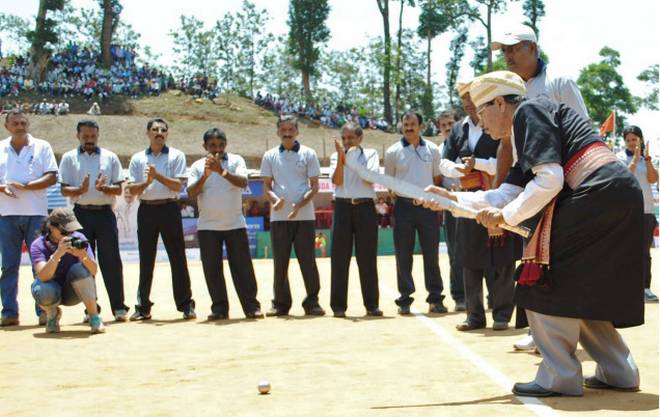
The founder of the festival, Pandanda Kuttappa (Kuttani), hit a silver hockey ball with a silver hockey stick to formally inaugurate the festival at the grounds of the Kodava Sports and Cultural Centre, amidst applause from a large crowd, on April 14. As many as 225 Kodava family teams are participating in the 24-day fest and many teams have already been eliminated.
This is the first time the festival is being organised at the Kodava Sports and Cultural Centre at Balugodu, where the entire complex is coming up at an estimated cost of over Rs. 12 crore. A sum of nearly Rs. 4 crore had already been invested. The matches are being held simultaneously on two grounds located adjacent to each other. All previous 16 editions of the festivals were held in different venues of the district with Ponnampet and Ammathi having the credit of hosting most of the festivals.
Every member in a family irrespective of age or gender could play for their teams. There have been several instances where father-son-daughter combination had played for a particular family team. The festival is already is the Limca Book of Records for it sheer magnitude and volume in terms of number of participants and visitors to the matches.
According to Mr. Kuttappa, the very purpose of organising the festival is to bring the Kodava clans under one roof and help enhance camaraderie. Indeed, it has helped forge many matrimonial alliances and cement the bonds of friendship between the Kodava clans, besides restoring relationships among members of the same families. The festival, which did not have a competitive edge initially, had also thrown up some wonderful talents that have donned the State and national colours successfully.
As usual, on the day of inauguration of the festival, guests and senior members of the organising family would arrive in a procession from the main entrance of the centre to the ground. Madanda family members had the honour of unfurling the family flag this year by virtue of being the organisers while Mr. Kuttappa unfurled the flag of the Kodava Hockey Academy, under whose aegis the festival is being held. Olympian Anjaparavanda B. Subbaiah, who was conferred a doctorate by the Mangalore University recently, was felicitated on the occasion by the Madanda family members.
The president of the Federation of Kodava Samaja, Mallengada N. Belliappa, who was the guest, addressing the gathering, utilised the opportunity to appeal to the members of the Kodava community to come up with contributions to help complete the Kodava Sports and Cultural Centre and make it a model in the entire State.
Government sponsorship
What is significant about the festival is that it has been able to garner support from the State government in the form of sponsorships since 2008. Starting from Rs. 5 lakh, it went up to Rs. 30 lakh in 2012 and could garner more in the coming years. Speaker of the just dissolved Legislative Assembly, K.G. Bopaiah, was instrumental in securing this largesse from the government. Reputable private companies too have been making a beeline to sponsor the festivals these days. The government also promises to come up with more synthetic hockey playing surfaces in the district to encourage local talent, keeping in view the rich hockey tradition in Kodagu.
Many hockey stars such as Maleyanda D. Muthappa, Mollera P. Ganesh, Maneyapanda Somaiah, Anjaparavanda B. Subbaiah, Baleyada Subramani, Paikera Kalaiah, Baleyada Poonacha and Sannuvanda Uthappa among the new crop, and a host of others playing for leading hockey institutions hail from Kodagu. Even non-Kodava players have made the district proud such as V.R. Raghunath, who is currently the vice-caption of the Indian team, S.V. Sunil, V.S. Vinay, and Arjun Halappa carrying forward the rich hockey tradition of the district.
Mr. Bopaiah has said that efforts would be made to get more number of synthetic hockey playing surfaces laid in different parts of the district.
The event has now drawn the attention of Hockey India. Its president, Mariamma Koshy, had attended the Iychettira Cup Kodava Hockey Festival last year held at Ammathi. She had promised help to lay three more synthetic hockey playing surfaces in Kodagu district, if the district administration sent proposals in that regard. Chief Coach of the Indian hockey team, Michael Nobbs, was present on that occasion.
The Vice-Chairman of the Murugappa Group, M.M. Murugappan, who was a guest at the Iychettira Cup last year, had lauded the hockey tradition in Kodagu, saying the game has enhanced the prestige of Kodagu in all forums. His company was closely associated with the game of hockey in the last 50 years by conducting prestigious hockey tournaments, he had stated.
Kootanda, Kullettira, Palanganda and Nellamakkada families have accounted for a large number of wins in the festivals so far.
The ‘Pandanda Cup’ held for the first time in 1997 was won by Kaliyanda family team. Kullettira team won the ‘Kodira Cup’ in 1998, Kootanda and Kulletira were joint winners of the ‘Ballachanda Cup’ in 1999, Kootanda won the ‘Cheppudira Cup’ in 2000, Kootanda won again the ‘Nellamakkada Cup’ in 2001, Kullettira won the ‘Chekkera Cup’ in 2002, and Nellamakkada won the ‘Kaliyanda Cup’ in 2003.
Kootanda won the ‘Maleyanda Cup’ in 2004, Nellamakkada won the ‘Biddanda Cup’ in 2005, Palanganda won the ‘Kallichanda Cup’ in 2006, Mandepanda won the ‘Mandettira Cup’ in 2007, Anjaparavanda won the ‘Alamengada Cup’ in 2008, Nellamakkada won the ‘Mandepanda Cup’ in 2009, Palanganda won the ‘Maneyapanda Cup’ in 2010 and defended it successfully in 2011 by winning the ‘Machamada Cup’. It completed a hat-trick of wins by winning the Iychettira Cup held at Ammathi in 2012.
K. Jeevan Chinnappa
Ongoing ‘Madanda Cup-2013’ is the 17th edition
source: http://www.thehindu.com / The Hind / Home> Features> Features Plus / by K . Jeevan Chinnappa / May 11th, 2013
by Mandetira N. Subramani, President, VeKare Ex-Servicemen Trust, MysoreM N Subramani
Most of the Ex-Servicemen of yore, who joined the British Indian Armed Forces during early 1940s, and participated in World War-II, are no more. However, there are still numerous widows of World War-II veterans, around 70 odd years of age, living in Mysore and Kodagu region, who narrate their helplessness and pathetic stories.
It was customary for men of yesteryears to marry a life partner who is younger to them by 10 to 15 years. It is quite but natural that most of such wives become widows and may live for 10 to 15 years, or even longer, after the demise of their husbands. Trends have changed. The present day men don’t mind marrying a life partner elder to him by 3-5 years and the educated ladies consider it as out of fashion and a mismatch to marry men who are 3 or 4 years elder to them.
Reverting to the subject of helplessness of widows of World War-II veterans, a gentleman barged into my office a few days ago with a complaint that his 76-year-old mother, living in a remote village called Kiggal, near Murnad, Kodagu (erstwhile Coorg), is not being granted defence family pension even after a lapse of 12 years after the demise of his father, due to some vague reasons projected by the Army’s EME Record Office, Secunderabad. The hapless widow happened to be one Mrs. Kaveriamma, widow of a World War-II veteran, Naib Subedar Ballachanda Nanjappa Ayyappa.
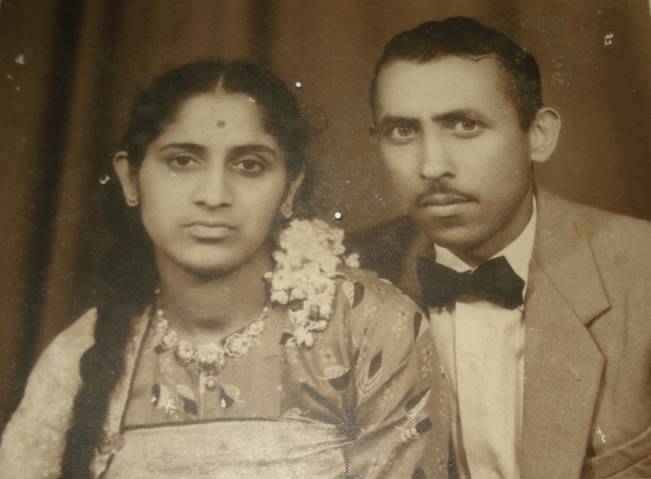
Mrs. Kaveriamma & late Nb Sub B.N. Ayyappa.
I being not only an Ex-Serviceman myself but also a son of a World War-II veteran who served in the Corps of EME and died unsung and unheard 22 years ago, decided to help the Late Nb Sub Ballachanda N.Ayyappa’s widow Kaveriamma with whatever little bit of knowledge and expertise I had gained during the course of taking up the cause of Ex-Servicemen and widows of Ex-Servicemen since the past 22 years after I quit the Armed Forces.
I believe in “seeing is believing.” Hence, I told late Naib Sub B.N. Ayyappa’s son, Ganapathy, that I wished to see his mother Kaveriamma personally, without doubting his (Ganapathy’s) version of the pathetic story of his mother. Without a second thought, Ganapathy informed me that his 76-year-old mother has been suffering from all sorts of old age ailments and that if I wished to see her, I would have to visit his ancestral Ballachanda House in Kiggal village in Coorg, which is well over 150 kms from Mysore. He also suggested that I could accompany him the following day itself to his village to see his mother. Though there was a clash of opinions between my mind and heart regarding his suggestion, I decided to listen to my heart, which is always weaker than the mind. The widow’s old age and ill health became a priority over my next day’s assignments and engagements all of which I had to abort.
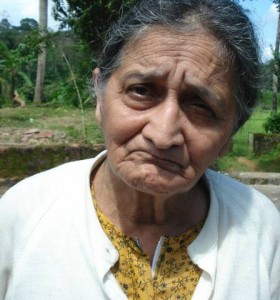
It was indeed a huge expedition on the next day. It took almost nearly three-and-a-half- hours to reach the 100-year-old ancestral house of late Nb Sub Ayyappa in his village, which resembled a bit of British architecture. However, it took me waiting for nearly two hours to get the audience of the grand-old-lady, as she took time to wake up from her sleep, get ready and come out of her bedroom with the support of her son. B.A. Kaveriamma, widow of late Nb Sub B.N. Ayyappa.
During the waiting period, in Kaveriamma’s house, I had to perforce spend my time speaking to an 87-year-grand-old gentleman, who was resting in his easy chair. I was amused when he kept showing extra attention and courtesies to me than what I really deserved. This grand-old-gentleman, however, kept firing some uncomfortable questions to me such as, when did I join the Armed Force? When did I quit? Why did I quit? What was the last rank held by me? What I have been doing after quitting the forces etc… etc… as if I were put in a witness box for some crime committed by joining the Armed Forces! If someone around my age had asked me those questions, I would have blown my trumpet about my life in the Armed Forces, my last rank held as equivalent to one of those one star or two stars rank etc. But, I held back, because, in my subconscious mind I saw something very special in him that made me to tell him only the truth, including the last rank held by me, that is, Sergeant in the Indian Air Force.
While answering all the questions fired at me by this grand-old-gentleman, I was also looking at the walls of the huge verandah to deter him from firing anymore questions. However, I found some old photographs of late Naib Sub Ayyappa’s father, who was a Sub-Inspector of Police during the British regime, hung on the wall. Among the numerable old photographs on the walls, I also noticed a certificate framed and hung in a remote corner, which I could not read because of the size of the certificate, and my failing eye sight. I was compelled to remove the framed certificate and read it just out of curiosity. To my surprise, it was a citation of a gallantry award, that is, “Mention in Dispatches” awarded to Flight Gunner Sgt. Ballachanda N. Medappa.
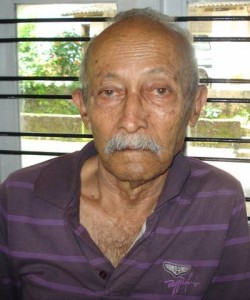
Ex-Warrant Officer B.N. Medappa, M-In-D
I became very curious and asked Ganapathy as to who this Flight Gunner was ? Ganapathy pointed out at the grand-old- gentleman who was sitting on the same easy chair busy reading a Kannada daily Mysooru Mitra and said, “he is my father Nb Sub Ayyappa’s younger brother Ex-Warrant Officer of the Indian Air Force.” I realised that he is really an ‘Ex-Air Warrior,’ a term commonly referred to all Ex-Air Force personnel of late. I too sometimes proudly call myself as an Ex-Air Warrior to my advantage but it proved to be otherwise all the time with my retired rank ‘Ex-Sergeant.’
In the meantime, the widow of Nb Sub Ayyappa managed to come up to the verandah with the support of her son. As per the customs of the Coorgs’, I touched her feet to seek her blessings, and took a few photographs of her from my worn camera. After speaking to her for a few minutes I casually told her that I would try to resolve her defence family pension issue, at which she nodded her head casually, without any anxiety or hope of receiving it in the near future. I understood that she was fed up of trying for her defence family pension for the past 12 years.
On our way back to Mysore from Coorg after having met the widow, my thoughts were more on the unassuming Ex-Air Warrior I met that day than the problem of the widow of World War- II veteran Ayyappa. I tried to make a guess as to how many such great war heroes were still living or dead, unheard and unsung, among the tiny Kodava Community besides the number of General Officers this tiny Coorg District has produced till date. I even started calling up all my fauji friends, as if there was an impending war.
All armed forces veterans who served three decades ago know that there was a separate Coorg regiment, which largely included people from non-Kodava backgrounds while the Kodavas themselves served in different other regiments; this is in keeping with the Army’s non-bias policy. Field Marshal Kodandera Cariappa of the Rajput regiment and General Kodandera Thimayya of the Kumaon regiment are the most distinguished Army men among the Kodavas. Other illustrious Kodavas from all ranks lead from the front in their own way, not only during wars but also in war-like situations and counter insurgencies.
Lt. Gen. Apparanda Aiyappa is best remembered for his contributions towards the Corps of Signals and towards Bharat Electronics Limited. There were several war heroes as well such as Nadikerianda Bheemaiah, a JCO who was the first among Coorgs to be awarded the Vir Chakra for conspicuous bravery in J&K Operations during 1947, and Air Marshal Cheppudira D. Subia, a daring fighter pilot, was awarded the Vir Chakra during 1950 for his courageous and relentless attacks on the enemy targets which has largely contributed to the successful capture of Garais in Jammu & Kashmir.
Squadron Leader Ajjamada B. Devayya (known as the ‘wings of fire’), a fighter pilot of rare acumen, was awarded the Maha Vir Chakra after the 1965 Indo-Pak War, posthumously. Lt. Col. Ganapathi Puttichanda Somaiah (then known as the ‘Major who kept his cool’) was awarded the Maha Vir Chakra for his conspicuous bravery of fighting against the militants under odd condition while deployed in Sri Lanka as part of Indian Peace Keeping Force.
Lt. Col. Anjaparavanda Ganapathy was decorated with Vir Chakra for his valour during the 1965 war. Maj. Gen. Kuppanda Nanjappa and Colonel Mandettira Ravi were decorated with Vir Chakra for their valiant display of courage and gallantry in the face of the enemy on land during the 1971 Indo-Pak war. Sqn. Ldr. Mandepanda Ganapathy was awarded Vir Chakra for shooting down one of the first Pakistani Sabre Jets, which intruded into Indian air space during the 1971 war.
Wg. Cdr. Ballachanda Karumbaya is another war hero to be decorated with the Vir Chakra for displaying his gallantry in the air during the 1971 war. The youngest among the above said war heroes is the then Capt. Baleyanda M. Cariappa to be decorated with Vir Chakra on 21st June 1999 for displaying repeated acts of valour, bold leadership, unparalleled courage, leading from the front and devotion beyond the call of duty in the face of the enemy.
Kodagu being one of the smallest districts across India, today boasts of the highest density of devoted, daring, dedicated, disciplined and duty-bound gentlemen soldier officers, with many adorning the highest echelons of the defence services in India.
At any given point of time, till 1980, the number of persons serving the forces far exceeded the proportion of any other set of people from any other region in India. The contribution of Coorg to the cause of the nation has been phenomenal and Armed Forces Martyrs from Kodagu District are innumerable.
The appended list of Army General Officers the tiny District of Kodagu [population 5 lakh and population of Kodavas is about 1.3 lakh] has produced over the last 65 years is testimony to the fact that the District is a cradle of mighty Generals:
1. Field Marshal Kodandera M. Cariappa, OBE; 2. General Kodandera S. Thimayya, DSO; 3. Lt. Gen. (Retd.) Apparanda C. Aiyappa PVSM, MBE; 4. Lt. Gen. (Retd.) Biddanda C. Nanda PVSM, AVSM, ADG; 5. Lt. Gen. (Retd.) Codanda N. Somanna PVSM; 6. Lt. Gen. (Retd.) Bittianda K. Bopanna PVSM, AVSM, VSM; 7. Lt. Gen. (Retd.) Ballachanda K. Chengappa; 8. Maj. Gen. (Retd.) Guddanda C. Somanna; 9. Maj. Gen. (Retd.) Kongetira M. Chengappa; 10. Maj. Gen. (Retd) Kotera C. Bheemaiah; 11. Maj. Gen. (Retd.) Codanda K. Karumbaya SM; 12. Maj. Gen. (Retd.) Cheppudira I. Jay Appachu AVSM; 13. Maj. Gen. (Retd.) Somaiyanda K. Kariappa AVSM, YSM; 14. Maj. Gen. (Retd.) Madaiyanda M. Belliappa AVSM, VSM; 15. Maj. Gen. (Retd.) Bovverianda M. Aiyanna; 16. Maj. Gen. (Retd.) Bachamanda A. Cariappa; 17. Maj. Gen. (Retd.) Moovera C. Nanjappa AVSM, VSM; 18. Maj. Gen. (Retd.) Kuppanda P. Nanjappa AVSM, VrC; 19. Maj. Gen. (Retd.) Kelapanda B. Swaraj; 20. Maj. Gen. Kodandera Arjun Muthanna; 21. Maj. Gen. Paruvangada M. Cariappa VSM.
Courtesy: Star of Mysore
source: http://www.exservicemen.in / Ex-servicemen India / Home> India> News> Views, Articles / by M N Subramani / October 19th, 2012
Kodagu is known to produce world class sportspersons in the field of hockey, tennis, badminton and athletics over the years and teenager Leelavathi is the latest addition.
Leelavthi, daughter of Mallamada Jaya and Vani couple, is the resident of Bekkesodlur village in South Kodagu.
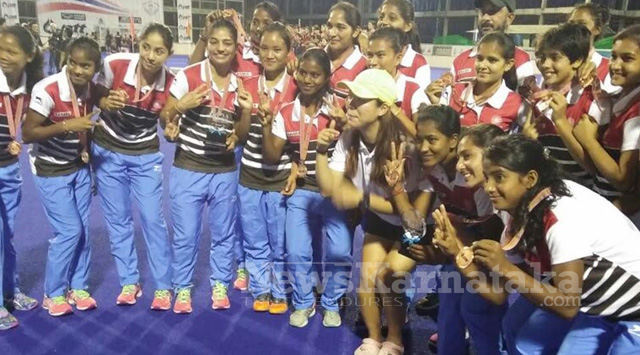
In the Under -18 age group Leelavathi was the lone player representing the state in Indian team that won the Bronze medal in the just concluded Asia cup. Eight nations took part in the U-18 tournament including China, Japan, Thailand, Korea, Singapore, Malaysia and Chinese Taipei.
Leelavthi , First degree student at Field Marshal Carippa (FMC) college is undergoing training at Sports Authority of India (SAI), centre in Madikeri. Leelavthi scored the first goal in the tournament opener which the team won by 4-0. She also played a major role in India’s bronze medal victory against South Korea.
Leelavathi aspires to represent the senior Indian team in future and owes her success to the contribution from family members, trainers at School and SAI centre.
Renowned cartoonist Nala Ponnappa, known for his offbeat tongue-in-cheek humour, is the ‘Coorg Person of the Year-2016’.
Nadikerianda Subbayya Ponnappa, whose cartoons appear in The Times of India, Bengaluru edition, was selected ‘Coorg Person of the Year’ in a poll conducted by www.coorgtourisminfo.com, Kodagu’s first news portal, promoted by senior journalist P.T. Bopanna.
Ponnappa’s first cartoons appeared in Chicago in 1972 where he was studying for a Master’s degree in Architecture. He began cartooning as a hobby by contributing his cartoons to college magazines.
The cartoons of the Coorg-born Pune-based cartoonist also appears in The Sunday Mid-Day, The Economic and Political Weekly and The Economic Times. His works have also appeared in the International Business Times.
Born in 1948, his early education was in Mangalore and Pune. He graduated in Architecture from the Madras University with a first class. He had an eleven-year stint from 1970 to 1981 as an architect in Chennai, Delhi and Lagos, before he turned into a cartoonist. He settled down in Bengaluru in 1982 and began his career as a freelance cartoonist.
His works have also been published in the Penguin Book of Indian Cartoonists and The Third World Book of Cartoonists from Germany.
He was awarded the First prize by the epd-Entwicklungspolitik publication, in a competition held at Frankfurt to commemorate the 50th year of India’s Independence.
Ponnappa was a member on the world jury of an international cartoon competition on Humankind and Energy held in Hanover, Germany in September 2000. At a competition held in Germany, one of Ponnappa’s cartoons, which depicted the German language being deeply influenced by the English language, was selected to be put up as a poster by the German Cartoonist Association.
He has also won prizes of excellence at cartooning competitions held in Korea and Romania. He was the only Indian to be invited to attend the Kyoto International Cartoonist Conference in 2002 where he was also presented the jury award for his cartoon on ‘Remembering 9/11’.
Among the many awards he has received is also the State Rajyotsava Award in 2007.
He has also written plays and acted on stage. His hobbies include drawing, music, photography and travelling. Ponnappa splits his time between Pune, where he works and resides, and his hometown Coorg.
Ponnappa is the grandson of Nadikerianda Chinnappa, the compiler of the Pattole Palome, a book on Kodava culture, folksongs and traditions.
Among the others who were nominated for this year’s ‘Coorg Person of the Year’ include 77-year-old Boverianda C. Uthaiah compiler of the Kodava-Kodava-Kannada-English dictionary which is due for release shortly.
Last year, the ‘Coorg Person of the Year’ title was given to athlete M.R. Poovamma.
source: http://www.starofmysore.com / Star of Mysore / Home> General News / December 31st, 2016
Kodava elders hope the festival of Kailpodh will encourage the community’s youth to enter international sporting events
Image credit: Shawn Sebastian and Tejaswi Dantuluri
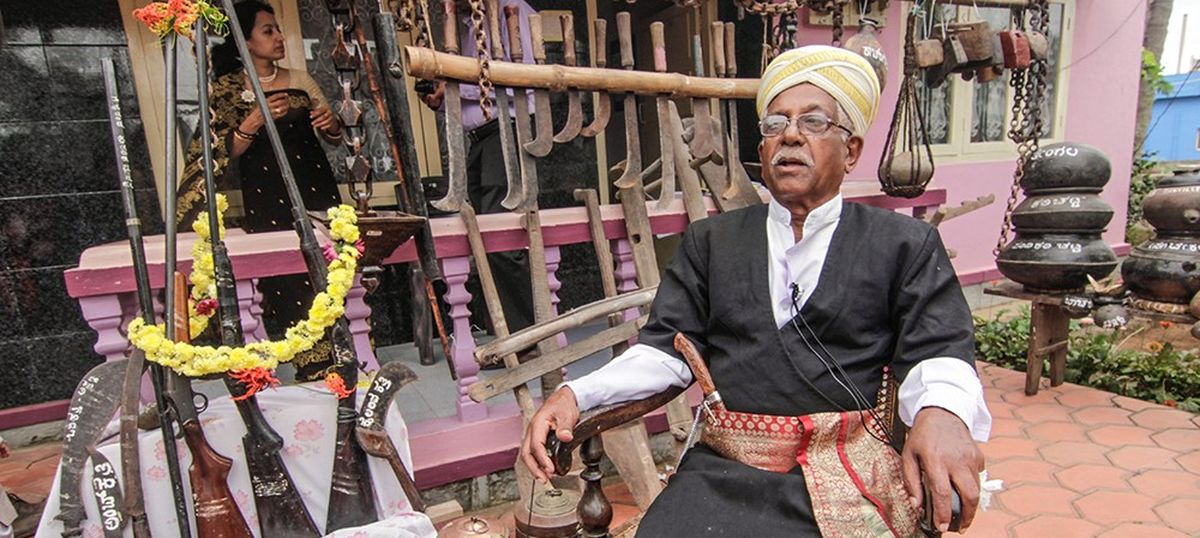
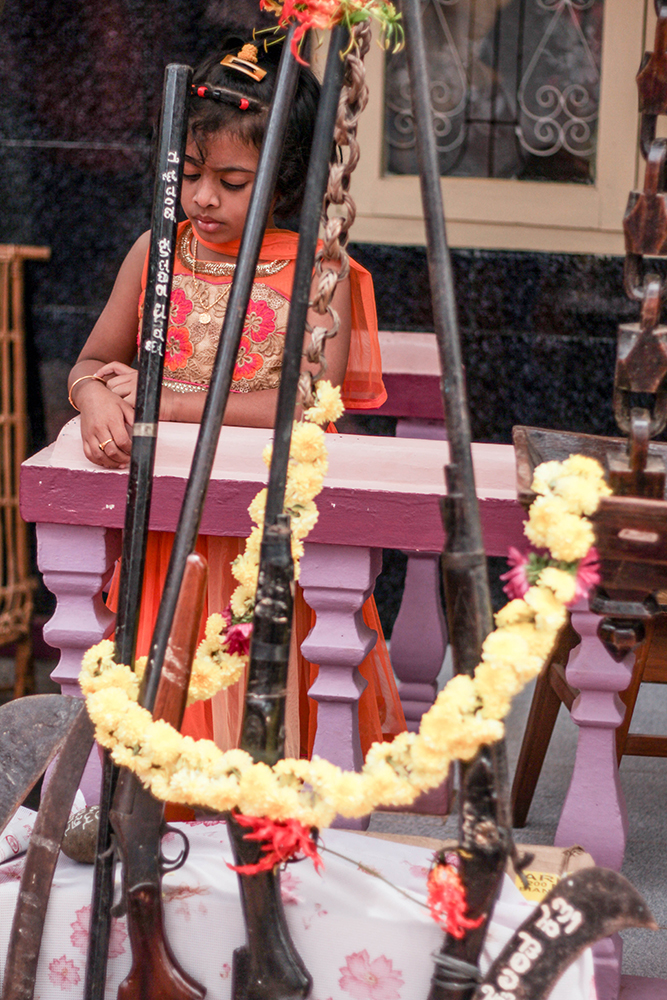
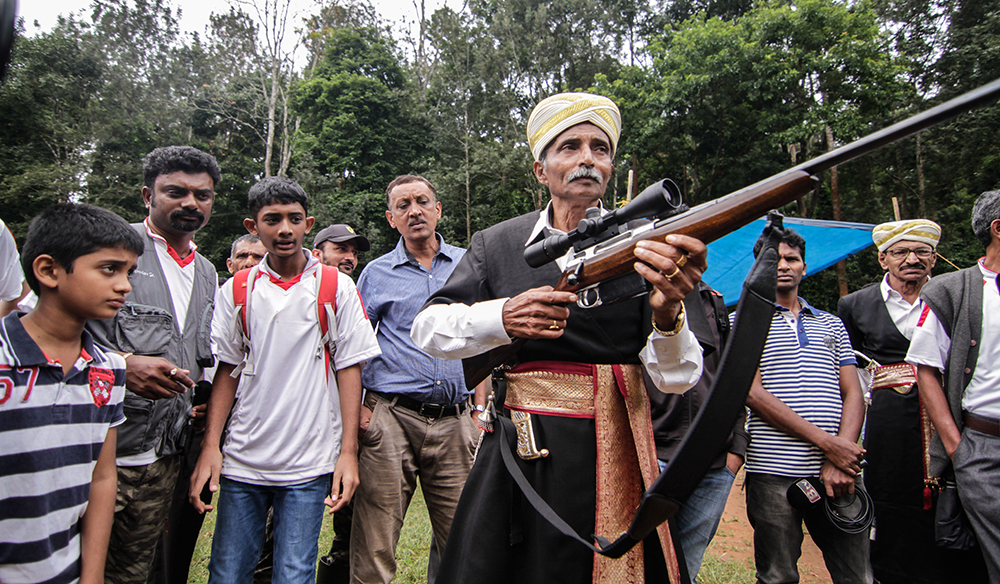
Deep in the sanctum of his 150-year-old ancestral home, Lokesh Achappa is surrounded by weapons. Dressed in a Kupya, the traditional Coorgi outfit of knee-length black overcoat, a gold and maroon sash with an ornate, carved silver dagger tucked in its folds, Achappa prays to an array of weapons: an antique double-barrel, a .22 mm rifle, traditional daggers and swords, all garlanded with flowers and smeared with sandalwood paste.
Once the ritual is complete, he steps out of the house, and a series of thundering gun shots reverberate across the valley.
Coorg, a district in Karnataka famous for its coffee, is home to the Kodavas, a martial hill tribe with a population of less than six lakh. Historically, the community has shared a deep connection with its weapons. Valiant guerrilla fighters and agriculturists, the Kodavas once defended territories with locally made bow-and-arrows. With the advent of firearms, guns became central to Kondava life. Weapons appear frequently in important social customs: births and deaths in the Kodava tribe are announced with gunfire, every newborn touches a bow and arrow, as initiation into the tribe. At the annual harvest festival of Puttari, one of the most important events on the Kodavas festival calendar, everyone in the valley opens fire.
Weapons are also celebrated at Kailpodh, the annual Kodavas (or Coorgi) festival in the first week of September which marks the end of hardships for the agrarian community – once the paddy has been transplanted. During the festival, Kodavas clean and worship weapons to express their gratitude for the protection they have offered.
“The period is a time for jubilation when distant families get together,” local resident Ashik Appanna explained.
Image credit: Shawn Sebastian and Tejaswi Dantuluri
With the tightening of gun regulation laws, the ban on hunting, and due to large-scale migration of younger generation Coorgis, many have predicted that the Kodava weapon culture will disappear altogether. Elders of the Kodava community are hoping that festivals like Kailpodh will encourage young Kodavas to return to their traditional shooting skills.
Gun Rights and Regulations
In 1861, the British administrators granted Kodavas an exemption from the Arms Act, for their support to the East India Company in administrative and military affairs.
“Gun ownership is a birthright for us,” said Appanna Bacharinanyanda, an 80-year-old retired lecturer who exhibits antique Kodava weapons and utensils in his front yard every Kailpodh.
Bacharinanyanda says the Kodavas never “misuse” guns. He expresses a deep apprehension over the government’s attempts at over-regulating weapons: “These days authorities have started demanding bribes to grant us the exemption certificate, which is completely unacceptable.”
With the Wildlife Protection Act of 1971, hunting has been prohibited in India. The legislation came as a big blow to the Kodavas, for whom hunting was an integral part of life and survival.
Naveen Bidappa, a young Kodava lawyer, pointed to a photograph in his house of a man named Tiger Thimmaiah. In the picture, Thimmaiah stood next to a tiger he had killed and then tied to a tree.
“He shot 12 tigers, hence the name,” smiled Bidappa.
Since tigers posed the biggest menace for livestock, tiger hunters were once highly venerated figures in the Kodavas society.
“Narimangala (tiger-marriage) was a big tradition in the olden days,” he said. “The tiger hunter was married to the tiger he killed, and villagers would offer them gifts and cash as a mark of respect.”
Changing relevance of gun culture
In early September, scores of Kodava youth assembled at a school ground at the Coorgi village of Chettali. Each carried a gun.
Bidappa, a 70-year-old elder from the community, walked into the ground filled with curious onlookers, and shot a coconut hung several yards away to inaugurate the annual shooting competition that coincides with Kailpodh. He hit the bulls-eye with a single shot.
“Shooting skills are in our blood,” he said, shrugging at the crowd’s deafening cheers.
Over the last few years, shooting competitions that were once limited to households have turned into larger events, with an increasing number of shooting enthusiasts showing up from all over Coorg.
“Our aim is to prepare and pass down shooting skills to the younger generation,” Bidappa said.
Over the next five years, local shooting competition organisers plan to develop a shooting range in the village to groom young shooters, and train them for national shooting competitions.
“Festivals such as Kailpodh have found a new meaning in changing circumstances,” he said.
A Kodava shooting competition. Credit: Shawn Sebastian and Tejasvi Dantuluri
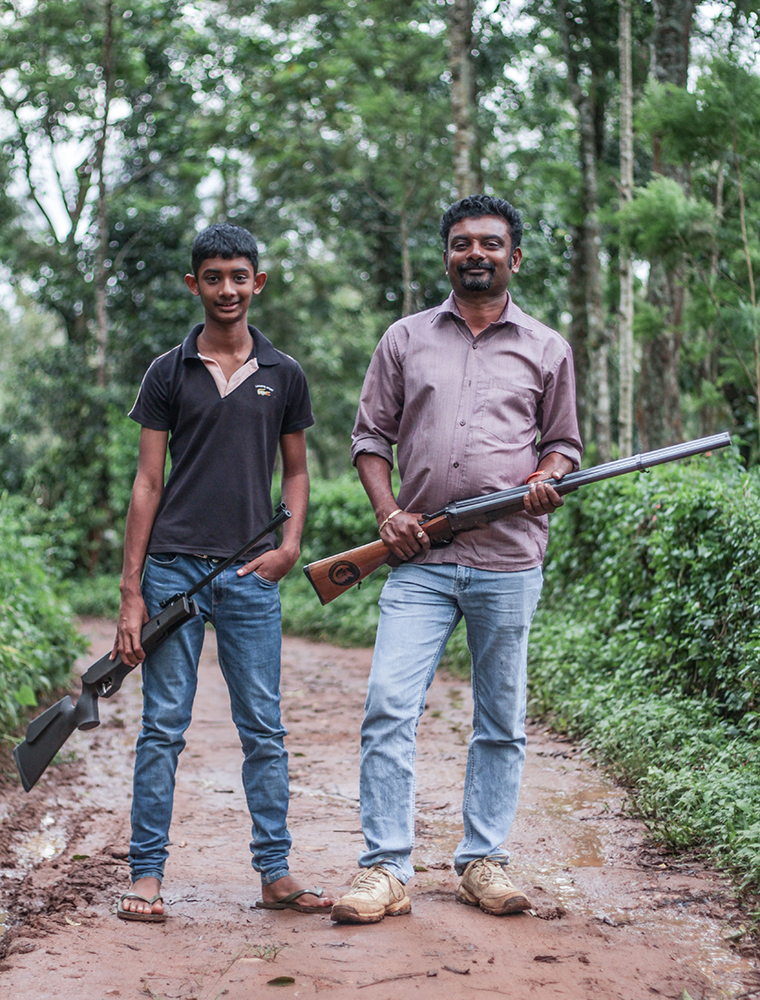
Fifteen-year-old Lakshan Ayyappa is a widely recognised face at Kodavas shooting competitions. He is the great-grandson of Tiger Thimmaiah, but has also established himself as an ace shooter in his own right – he has won more local competition prizes than he can remember.
“My target is to make it for 2020 Tokyo Olympics,” he said. Ayyappa first learnt to shoot at the age of five. He was taught by his mother.
“Whenever I see a new gun, I discuss it with my dad,” he said. “I know everything about its make, calibre, range, the cartridges used. I feel by the time we are born, we are already half trained.”
Like in Punjab, it is usual for Kodava households to send a member of their family to join the military. Many attribute this to early affinity Kodava youngsters develop with weapons.
Credit: Shawn Sebastian and Tejasvi Dantuluri
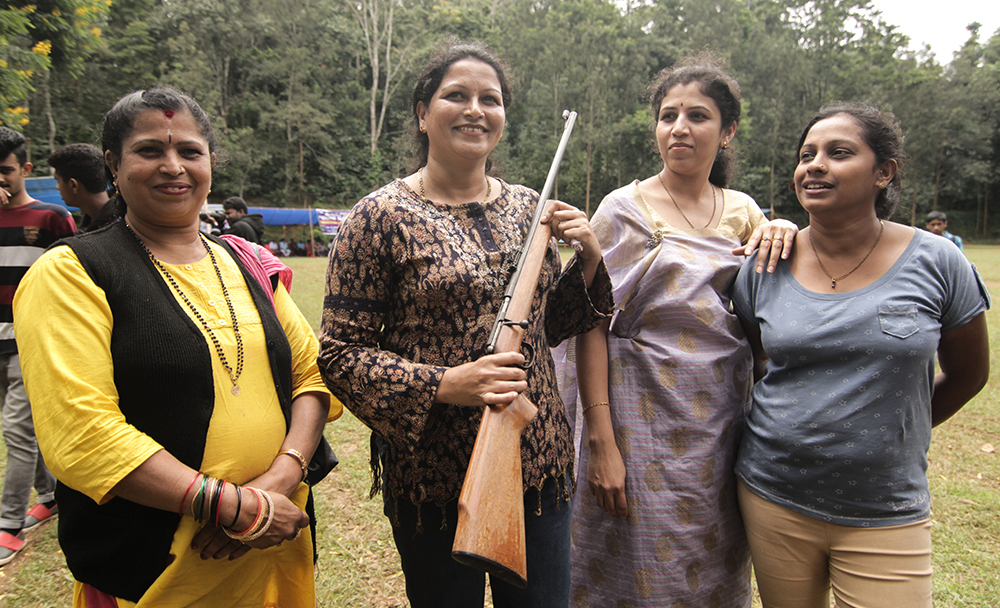
Shooting is not a male sport in the Kodavas tribe. Kodava women traditionally kept guns to protect their families when the men left for hunting and battle. Everyone from septuagenarian grandmothers to 16-year-old girls participate in local shooting competitions.
Credit: Shawn Sebastian and Tejasvi Dantuluri
Shooting is not a male sport in the Kodavas tribe. Kodava women traditionally kept guns to protect their families when the men left for hunting and battle. Everyone from septuagenarian grandmothers to 16-year-old girls participate in local shooting competitions.
Credit: Shawn Sebastian and Tejasvi Dantuluri
Several modern-day sports like shooting and archery have been born of indigenous communities across the world. In India, the attempts at unearthing such indigenous talents have been poor.
A few notable exceptions are people like Laxmirani Manji, from the Santhal tribe in Jharkhand who represented India in archery at the 2016 Rio Olymipcs, and Limba Ram of Ahari tribe in Rajasthan, an Arjuna awardee archer who represented India at three Olympics. If they are given enough support and attention, many modern-day Tiger Thimmaiahs might emerge from Coorg.
We welcome your comments at letters@scroll.in.
source: http://www.scroll.in / Scroll.in / Home> Magazine> After the News / Point & Shoot
Gen Dalbir Singh, Chief of the Army Staff, dedicated a statue of Field Marshal K M Cariappa at the Army Parade Ground, Delhi Cantonment and rechristened the parade ground as “Cariappa Parade Ground” .
It is customary in the Indian Army that parade grounds are named after eminent military personalities and war heroes.
Army Parade Ground at Delhi Cantonment has been rechristened as Cariappa Parade Ground in the memory of Field Marshal KM Cariappa, the first Commander-in-Chief of the Indian Army.
The Parade Ground in Delhi Cantonment is one of the largest and most prominent parade grounds of the country.
source: http://www.defenceaviationpost.com / Defence Aviation Post / Home> News Updates / December 31st, 2016
WELCOME. If you like what you see "SUBSCRIBE via EMAIL" to receive FREE regular UPDATES.
Read More »