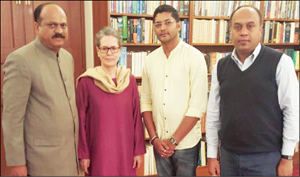
Kodava Sahitya Academy Chairman (extreme left) Biddatanda S. Thammaiah, Legal Advisor to Karnataka CM Palachanda Brijesh Kalappa (extreme right) and artiste Chekkera Pancham Thyagaraj seen with AICC President Sonia Gandhi at her 10 Janpath residence in Delhi.
New Delhi :
The Kodava Sahitya Academy has demanded an exclusive Rajya Sabha (RS) seat for Kodavas on the lines of Anglo-Indian community and conferment of Bharat Ratna posthumously on the country’s first Field Marshal, Gen.K.M. Cariappa.
A delegation of Kodava Sahitya Academy, comprising its Chairman Biddatanda S. Thammaiah, Legal Advisor to Karnataka Chief Minister Palachanda Brijesh Kalappa and artiste Chekkera Pancham Thyagaraj, which met AICC President Sonia Gandhi at her 10 Janpath residence here recently, apprised her of the current status of Kodavas.
Responding to the delegation’s plea, Sonia Gandhi said that she was aware of Kodagu district’s unique geographical features, Kodava culture and traditions.
Recalling that Gen. K.S. Thimmaya’s sister Ammi was a Personal Secretary of late Prime Minister Indira Gandhi, Sonia Gandhi reminded that it was Rajiv Gandhi’s Government which bestowed the ‘Field Marshal’ title on Gen. K.M. Cariappa on Jan. 14, 1986.
Sonia also assured that she would look into the demands of Kodavas and respond appropriately, said Brijesh Kalappa.
source: http://www.starofmysore.com / Star of Mysore / Home> General News / March 10th, 2016
For the past two decades, Kodavas from all over the world have come back to the tiny district to take part in the annual tournament.
Kaveri Ponnapa, author of the book The Vanishing Kodavas: A Cultural Exploration of the Kodava Community, vividly remembers the frail, old lady she encountered while watching a hockey match in Coorg many years ago. “I heard her yell once during the match, ‘Avan mara khethiyandula, hockey kalchandille’ (He is chopping wood, not playing hockey),” she says.
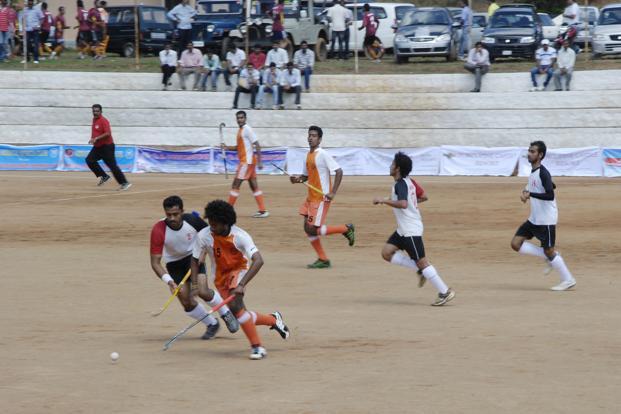
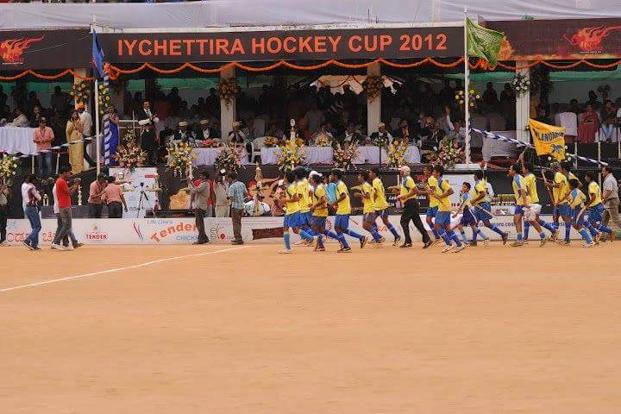
But these are common enough scenes at the Kodava Hockey Namme, or the annual family hockey festival. Held every summer, soon after the coffee season, the Namme is a spectacle that should not be missed.
Women dressed in their stylish best, shaded from the heat by Jackie O sunglasses and broad-brimmed hats, cheer and gossip while their menfolk, some perched precariously close to the dusty field, focus intently on the brightly clad players scuttling frenziedly across it.
Children, clutching on to neon wigs too big for their small heads, weave in and out of the crowds, scrambling over the makeshift bleachers. There is no lack of food, drink or entertainment: think pork, rum, music, dance and even a few brawls on the sidelines.
“By the semifinal, these matches see almost 8,000-10,000 people congregating at the grounds,” says Sandhya Kumar, a Bengaluru-based, national award-winning filmmaker, whose 2015 documentary film, Hockey In My Blood, chronicles this very festival. “The energy from the crowds as they cheer and shout for their favourite players is incredible.”
It is that time of the year when all of Kodagu comes together; when the usual discourse revolving around coffee and politics is taken over completely by hockey. And it isn’t just the actual inhabitants of Coorg who live here all year-round, who attend this annual Namme. Kodavas from all across the country and beyond make a trip here at around that time, crossing sea and shore, to be part of this event. The month-long tournament is estimated to have almost 50,000-60,000 people attending it.
Photo courtesy the Shantheyanda family.
Coorg’s sporting culture
Nestled in the Western Ghats, in the south-west corner of Karnataka and bordered by Kerala on one side, the little district of Coorg, or Kodagu, is the heartland of Indian hockey. For the inhabitants of this district, which has churned out more than 50 international hockey players, the game is inextricably woven into the fabric of their everyday existence.
Despite a hectic routine, which includes visits to the estates, trips to the district’s centre and a fairly active social life, the average young planter inevitably manages to squeeze in a game of hockey at the local ground, nearly every day. And for the young men holding regular day jobs outside of Coorg—say, in Bengaluru or Mysuru—there are the matches organized by the local Kodava samaja.
Sport is simply an extension of this naturally athletic community’s culture, agrees Ponnapa. “The constant need to prove yourself physically is everywhere and hockey is an offshoot of this,” she says. “It is the nature of the place we inhabited, I think. You needed to be very fit and alert to survive here.”
The annual Namme stands testimony to this. The festival, which was started in 1997, has been going strong for exactly two decades. Open only to members of the Kodava community (anyone can attend though), matches are played between the members of different mane-pedhas, which can be loosely translated as the family name or clan name. The mane-pedha precedes the individual’s name and brings with it a unique identity.
Meet a fellow Kodava and this is the first thing that you will be asked, “Daada-re?” (which mane-pedha do you belong to?).
There are around a thousand such family units of varying sizes—some are huge, with members spread all over Coorg (and beyond), while others are restricted to tiny pockets of the district.
Kodendara, for instance, is a big family name here. Not because it is a particularly big family, but because Madappa Kariappa, India’s first field marshal, hails from it. General Subayya Thimmiah, chief of army staff from 1957 to 1961, also belonged to the same clan on his father’s side.
And while a lot of people from this community have distinguished themselves in the armed forces, their achievements in sport are not far behind either.
Other clans that have produced distinguished offspring include the Mulleras and the Anjaparavandas—former professional hockey players and Olympians Poovayya Ganesh and Bopaiah Subbaiah belonged to the two families, respectively.
“I have played in every edition of the family tournament that I could attend,” says Subbaiah, today an Indian hockey team selector. “I have only missed it when I was playing for India. Our family has won the tournament three times so far,” he adds proudly.
The Karada connection
In February, coffee processing is at its peak and the flavourful bean has taken over the lives (and land) of everyone here. Globules of ruby-red berries are drying on large, polythene sheets, spread across backyards in the district, including a large field in Karada (Virajpet) where the very first family tournament took place.
There are berries (and clothes) drying outside Pandanda Kuttappa’s little homestead in Karada. The family hockey tournament, started in 1997, was the brainchild of this sprightly 89-year-old. A former State Bank of India employee and an ex-first division referee, Kuttappa remembers attending the Asian Games in 1982, where he saw India lose to Pakistan.
“The score was 7-1,” he recalls, “Only one player, M.M. Pooviah was from Coorg. It made me realize that though we have such good players, they do not get enough opportunities.”
When he retired in 1995, he “decided to start a family hockey tournament and spent Rs15 lakh from my own pocket”, he says. Today, the budget stands at around Rs1 crore, with the money sourced from the government, sponsors and private individuals.
The first tournament, which was held in 1997 at Karada, saw 60 clans from across the region participating. “We wanted to make Karada the Sansarpur of Kodagu. Sansarpur in Punjab has so far produced 23 Olympians from its village, including the great Pargat Singh,” he smiles, adjusting his gold-framed spectacles.
The Kodava Hockey Academy, an organization set up to oversee this festival, was started soon after. Every year, a different clan or family conducts the match and it is this organization that regulates the process.
“The Kodava Hockey Academy allots the hosting rights to a family,” explains Ravi Uthappa, secretary of the Kodava Hockey Academy, adding that the family gets only one chance to host a tournament. “We have enough families battling to host the tournament. It is booked till 2020 and we have applications till 2024.”
By 1998, the number of participating teams had nearly doubled: 116 teams played the game in 1998 at the tournament hosted by the Kodira family. The popularity of the game continued to grow, reaching an all-time high in 2003 with 280 teams fighting for the Kaliyanda Cup.
“We have found a place in the Limca Book of Records as the largest field hockey tournament in India,” says Kuttappa.
“It is an extraordinary event,” says Kumar, the filmmaker, adding, “A lot is talked about leaving a legacy of sports and it is very inspiring to see a system that is making that possible within the community.”
She also believes that the tournament helps make young people economically independent. “Young boys are often spotted by Sports Authority of India (SAI) officials and end up getting a spot in the state team, which helps them ultimately get government jobs.”
Kuttappa agrees, “This tournament became a platform for youngsters to get jobs as they play with all their heart for their families. Over the years, 900-1,000 people have gotten jobs in excise, customs, banks, etc.”
Subbiah, on the other hand, is not convinced. He says that though it is certainly true that there is chance that a good player may get spotted by a SAI official at a match and may be called for a selection, “no one has got a job playing in this tournament. Only players who have gone up all the way to state and national hockey have actually gotten jobs,” he says.
He adds, however, that “there could be times when the army has come in looking to recruit players based on their hockey talent”.
In addition to this, “family hockey has created a lot of enthusiasm and inspired many people to take up the game”, he says, adding that in a few cases, matches have led to match-making. “I have heard that sometimes a good player is spotted and an alliance is fixed,” he laughs.
The Shantheyanda Cup 2016
The narrow, curved road that leads to the hill station town of Madikeri, the capital of Coorg, is flanked by tall trees with pepper vines snaking around them. Mist-swathed hills loom in the distance; lovesick cicadas compose ballads to eligible females, seduction on their minds; the omnipresent aroma of coffee merges with that of vanilla and fresh earth.
It is in these pristine, beautiful surroundings that the hockey matches will be held this year. Hosted by the Shantheyanda family, a clan dating back to the 11th century, with around 150 members, the 20th edition of the game will be held at the FMKMC College grounds in April-May.
“We started bidding three years ago and finally won it. We took over the flag in mid-May last year,” says Namrata Vikas, convener of the tournament, who married into the Shantheyanda family. Incidentally, women also participate in the tournament—they can choose to represent either their father’s family or their husband’s.
“We gave ourselves a break of about three months and then launched our logo on 9 September,” she says, adding that ground preparation is underway.
Photo courtesy the Shantheyanda family.
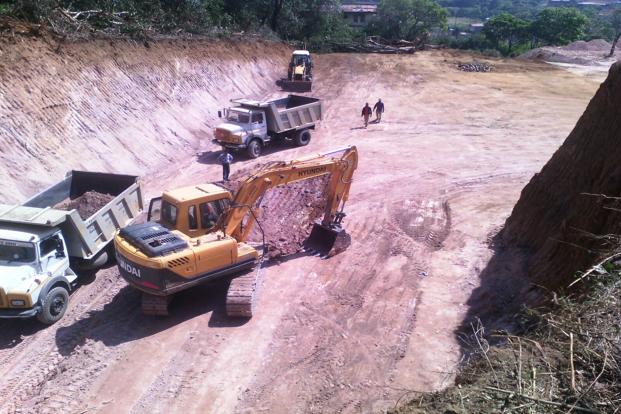
A crowd of people and one humongous earthmover toil under a searing late-morning sun at the FMKMC College grounds. The labour is necessary—the Shantheyanda family is trying to expand the size of the ground and accommodate a 400m track. “We want to leave something behind for the college, and hopefully a future tournament,” Vikas says.
The bidding process, though hugely competitive, is only the tip of the iceberg. The actual organizing of the tournament is a daunting task.
The host family needs to raise funds, prepare the fields and the galleries and stalls surrounding it, reach out to various other clans to ensure plenty of participation, manage schedules and ceremonies and garner media support. In addition to that, it has to come up with new and interesting ways to etch its name into the hearts and minds of every participant and visitor. And yes, it needs to brush up on its game.
The tournament, a surprisingly well-organized affair considering the scale, has rules that may put to shame many sports bodies in the country. Every team has a unique jersey, a family logo and flag; they must all be in proper uniform and carry the right equipment (some of which, including the goalkeeper’s kit, is provided by the hosts).
Professionalism is a vital part of every match: the referees are certified ones, strict timelines are adhered to; there are medical teams on standby and refreshments for all the players.
And the Shantheyanda family is pulling out all stops to make this year’s edition the biggest ever in the history of the tournament. “We hope to have at least 300 teams participate this year,” says Vikas Achaiah, the tournament’s director.
To ensure this, the family has sent out a flurry of invites, reached out to youth clubs and the heads of the families, and attempted to mobilize radio and local Kodava newspapers to drive home the message. “Many families who participated in earlier editions have stopped now. We are trying to find out if it is money, distance or any other reason. We will try and bring them back,” says Achaiah.
After all, “everyone makes time for hockey”, chips in Ravi Kushalappa, the tournament’s president.
With families spread so far and wide, practice sessions haven’t yet begun. “They will start (to practise as a family team) by mid-March,” says Vikas, adding that people from all over the world usually take a month’s leave from work and come down to Coorg to play.
“Earlier, if Kodavas did not get leave from their jobs to come play for a tournament, people would send a telegram saying, ‘Grandfather dead, come home immediately’,” says Kuttapa. “It was the best way to get the family members to come and play for the team back then.”
Subbiah believes the tournament does have a chance of becoming really big this year because it is now part of the Hockey India national schedule. “I am trying to bring the Hockey India League president to the game this time,” he says, adding, “Coorg hockey was dying at some point because all good hockey players were employed in places outside the district. This tournament ensures that they all return.”
More importantly, as Ponappa says, “The festival brings all the clans together. And since teamwork and community are the foundations of our society, hockey fits in here perfectly. Sport always proves to be a great binder of people.”
Comments are welcome at feedback@livemint.com
source: http://www.mintonsunday.livemint.com / LiveMint / Home> Mint on Sunday> The Small Story / by Preeti Zachariah and Sharan Poovanna / Sunday, March 06th, 2016
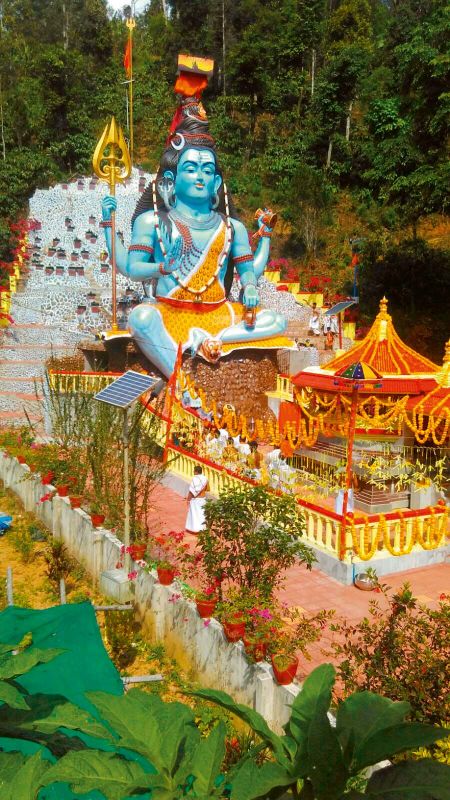
A 52 ft. statue of Lord Shiva was installed on the grounds of Sri Rajarajeswari temple in Karnangeri near Madikeri in Kodagu.
Mysuru:
A 52 ft. statue of Lord Shiva was installed on the grounds of Sri Rajarajeswari temple in Karnangeri near Madikeri in Kodagu, here on Friday. As many as 108 Shivalingas brought from Kaashi were also installed around the statue which Madikeri artist, Ravi, took a decade to sculpt.
The 52 ft Shiva statue at Sri Rajarajeswari temple at Karnangeri village near Madikeri (Photo: DC)
The temple, 3 km from Madikeri, attracts thousands of devotees from around the state and country every day ,who arrive here to worship goddess Mangaladevi of Mangaluru. The crowds swell on Tuesdays, Fridays, Mondays and Saturdays, when the goddess is said to fill the temple priest with her aura and resolve the problems of devotees during a holy darshan. A Jaathra Mahothsava of the goddess is held at the temple every first Tuesday of May.
It was in the early 1960s that late Sannaiah Swamy of Thombaththu Mane near Haakathur established the temple at Karnangeri after the goddess reportedly appeared in a dream of his mother-in-law Manjamma. It is said the goddess helped Sannaiah’s ailing father-in-law, Kariappa as well. The statue was installed by Dharmasthala Dharmadhikaari, Sri Veerendra Hegde.
source: http://www.deccanchronicle.com / Deccan Chronicle / Home> Nation> Current Affairs / by Shilpa P, Deccan Chronicle / March 05th, 2016
It was in December 1946 that a Constituent Assembly was constituted and it took 3 years for the august body to draft the historic document which enshrines the guiding principles of this country. Members who were active in the freedom movement were inducted through indirect elections from the Central and Provincial Assemblies to represent a broad cross-section of the country.
C.M. Poonacha
The Assembly was further strengthened by inducting legal luminaries such as Dr. B.R. Ambedkar, Dr. K.M. Munshi, N. Gopalaswami Ayyangar, K.T. Shah et al, even though they did not participate in the freedom movement. My father C.M. Poonacha, a leading freedom fighter from Coorg, who was the District Board President at the time, represented Coorg. At 36 years of age, he was one of the youngest members in the Constituent Assembly.
One of the earliest decisions taken was to avoid the Constitution being written only by technical experts or the elite-bureaucracy (Pakistan took this route, and their Constitution has been re-written three times!). The Indian Constitution was drafted through a combination of ‘democratic-consensual’ and ‘elite-bureaucratic’ approach. This has resulted in a resilient and all-inclusive document which has stood the test of time for 66 years.
Another unique feature in drafting the Constitution was to pass every resolution unanimously after extensive consultations and debate. Thus, every clause in the Constitution was discussed until all the members of Committees and Sub-Committees agreed without dissent. None of the resolutions were put to vote to avoid ‘tyranny of the majority.’
Final draft
The final draft of the Constitution of India was signed and adopted on 26th November 1949. C.M. Poonacha was one of the 299 signatories to this revered document (see the last signature in the image). The Constitution of India was brought into force on 26th January 1950 when India was declared a sovereign Republic.
One more distinctive narrative in the Constitution of India is that the nation expects excellence from every citizen. Unfortunately, that is least practiced in recent years, especially by the elected representatives!
Now, the tricycle!
During the course of his duties in the Constituent Assembly, my father took us to Delhi a couple of times. My age was in single digit and my sister was an infant. However, I have vivid memories of Delhi at the time.
Most of the Constituent Assembly members, who came from other parts of the country, were housed in the ‘Constitution House’ on Janpath Road (It does not exist any longer). The accommodation was modest — a studio apartment in a double-storied building complex.
One evening we were window shopping in Connaught Place when a toy-shop attracted my attention. I peeled off and stood watching in awe the colourful toys. I then spotted a tricycle which had a wooden horse head and a horn with a rubber bulb, mounted on its handle. I gingerly asked my father if he could buy it for me. “No, No, it’s expensive and I don’t have the money for it,” he said. My eyes welled-up and I beseeched him again.
Just then, the shop-keeper sidled up to us. ‘Your little boy likes the tricycle sir,’ he said to my father and subtly encouraged me. My parents wanted to distract me and exit the shop as soon as possible. Emboldened by the shop-keeper, I started howling and held on to the tricycle. No amount of cajoling would make me relent. Finally, my father tried to pacify me by saying that we would return the following day with the cash.
But I stuck to my guns and yelled, ‘Nakkikkabondu’ (I want it now!) My sister too joined me in crying. Soon we attracted the attention of others in the shop and my parents were thoroughly embarrassed. I kept hollering ‘Nakkikkabondu…’
The clever shop-keeper suggested that the tricycle could be taken and the payment made the following day. My father had no other option! I proudly pedalled my new possession right from the shop to the tonga we took back to the Constitution House!
Back in the Constitution House, I happily rode all along the corridors. Many luminaries framing the Indian Constitution would tousle my hair, chat me up and admire my tricycle!
About the author: C.P. Belliappa writes humour, history and human interest stories, and is a regular contributor to newspapers, websites and magazines. He holds a Master’s degree in Chemical Engineering from Stevens Institute of Technology, USA. Belliappa currently lives in Coorg.
source: http://www.starofmysore.com / Star of Mysore / Home> Feature Articles / February 19th, 2016
Educational Multimedia Research Centre (EMRC), attached to University of Mysore, won two national awards for the documentary film titled ‘DGWT – A cause for Concern,’ in the recently held 6th National Science Film Festival organised in Mumbai. The institute won the Silver beaver award which carries a trophy, a citation and Rs. 50,000 cash prize and also the best graphics award carrying a trophy, a citation and Rs. 30,000 cash prize.
The documentary was directed by Syed Kaleem, Senior Producer of EMRC, Mysuru and Former Director of EMRC, Odisha. This is the second National Award won by Syed Kaleem. The first one was in 2001 for the film on the life of Kodava’s titled ‘Kodavas, The highlanders.’
The best graphics award was received by Chandra Kumar, graphic artiste of EMRC, Mysuru. The film was photographed by Keerthi Kumar, sound effects by Badrinarayana and Somashekar was the Technical Director. The narration of the film was done by Beliappa.
The film highlights the grave danger caused due to depletion of ground water and its long time impact on ecology and environment.
source: http://www.starofmysore.com / Star of Mysore / Home> General News / February 15th, 2016
K. Byrappa, Vice-Chancellor of Mangalore University, said that the dictionary, which was being printed, would probably be released in Kodagu itself.
A minority language unfamiliar to many in the State will finally have a comprehensive dictionary of its own with meanings in Kannada and English.
Kodava vocabulary will be captured in Kodava Arivole, which will be published by Mangalore University in March.
Boverianda C. Uthaiah (77) and wife B.U. Thangamma (66) joined forces and compiled the Kodava-Kodava-Kannada-English, which has about 11,000 words.
Mr. Uthaiah is a former professor of agricultural sciences.
According to the UNESCO, Kodava is a ‘vulnerable’ language, said Lokesh K.M., coordinator, Kodava Samskritika Adhyayana Peetha at Mangalore University.
Those knowing Tulu and Malayalam can grasp Kodava takk (language) better as it has common words with these two languages, as well as Persian.
Though the latest statistics on how many speak Kodava takk is not available, according to the 2001 census, only 92,193 people speak the language, Mr. Uthaiah said.
A handicap he faced was trying to include 2,000 words in the lexicon as no one knew their meanings.
Mr. Lokesh, also a professor of History at Mangalore University, said the lexicon has some rare words such as ‘kaju’ (gold) and ‘aarayu’ (water). It has social and cultural terms, and words relating to folk traditions such as ‘jamma’ (a land tenure system in Kodagu with long-standing hereditary rights held by clans), and ‘okka’ (Kodava clan, all of whom have descended from a common ancestor). The dictionary also has botanical and zoological terms.
Mr. Lokesh said though two Kodava dictionaries have been published earlier, they are not comprehensive. I.M. Muthanna’s Kodava Nudi Artha Kosha, the first dictionary published in 1988, gave the meanings of Kodava words in Kannada. In addition, Karnataka Kodava Sahitya Academy brought out a handbook Kodava-Kannada-English Kaipudi in 1988.
K. Byrappa, Vice-Chancellor of Mangalore University, said that the dictionary, which was being printed, would probably be released in Kodagu itself.
source: http://www.thehindu.com / The Hindu / Home> National> Karnataka / by RaviPrasad Kamila / February 12th, 2016
“An Indian and to the last breath would remain an Indian. To me, there are only two Stans – Hindustan (India) and Foujistan (the Army).” – Field Marshal K. M. Cariappa
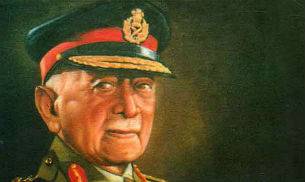
Famously known as Kipper, Field Marshal K. M. Cariappa was born today, 117 years ago on January 28, 1899. He was the first Commander-in-Chief of the Indian Army and was the first Indian Officer who was given command of a unit before independence.
Some interesting facts that you must know:
– K. M. Cariappa’s full name was Kodandera Madappa Cariappa
– He was born at Shanivarsante in Kodagu, which was a princely state in Karnataka
– Cariappa was selected to the first batch in King’s Commission after the World War I in 1918
– His permanent regimental home was 2nd Queen Victoria’s Own Rajput Light Infantry
In 1933, he was the first Indian officer to undergo the course at Staff College
– Cariappa served in many countries like Iraq, Syria and Burma
In 1949, he was appointed as the first Indian Commander-in-Chief of the Indian Army
– After his retirement, he served as the High Commissioner to Australia and New Zealand till 1956
– He was awarded with the General Service Medal, Indian Independence Medal, Order of the British Empire, 1939-1945 Star, Burma Star, War Medal 1939-1945, Indian Service Medal and Legion of Merit
– He died on May 15, 1993 at the age of 94.
source: http://www.indiatoday.intoday.in / IndiaToday.in / Home> GK & Current Affairs> Listicles : Microfacts / Story / New Delhi – January 28th, 2016
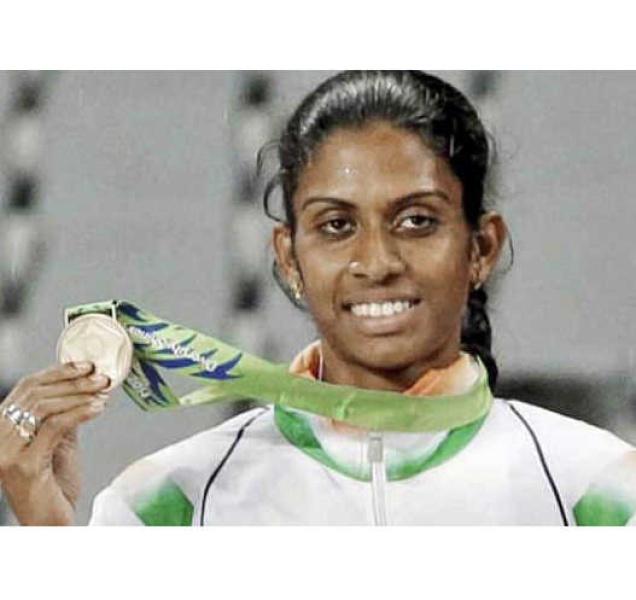
Athlete M.R. Poovamma.— PHOTO: By Special Arrangement
Athlete M.R. Poovamma, winner of the 2015 Arjuna award for her contributions in the field of athletics, is the ‘Coorg Person of the Year, 2015.’
Machettira Raju Poovamma, (25), a native of Kodagu, won the gold medal inwomen’s 4×400 meters relay at the 2014 Asian Games in Incheon, South Korea and clinched a silver in the 400m race in the Asian Championships at Wuhan, China, last June.
Ms. Poovamma participated in the 2008 Beijing Olympics and is currently ranked No.2 in Asia in the 400 meter category.
She was chosen as the ‘Coorg Person of the Year, 2015’ in a poll conducted by www.coorgtourisminfo.com, according to a release.
Daughter of M. G. Raju and Jaji, Poovamma completed her bachelor’s degree in business management from SDM College of Business Management, Mangaluru.
The past winners of this award include Dr. Kavery Nambisan, novelist (2005), Dr. Boverianda Nanjamma Chinnappa, researcher (2006); Robin Uthappa, cricketer (2007), Joshna Chinappa, squash player (2014), the release stated.
source: http://www.thehindu.com / The Hindu / Home> National> Karnataka / by R. Krishna Kumar / Mysuru – January 18th, 2016
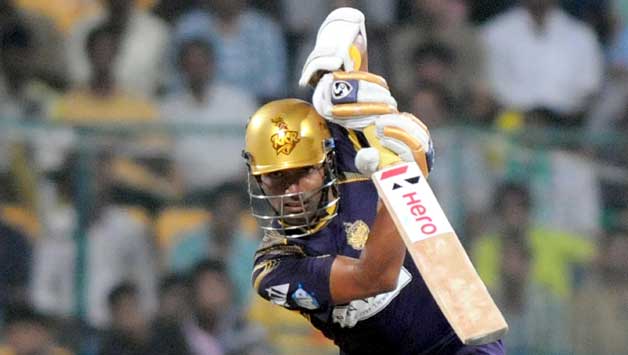
Robin Uthappa has become the first batsman to register over 1,000 runs in the Syed Mushtaq Ali Trophy. This is testimony to the Karnataka batsman’s explosive abilities with the bat which have also made him a prominent name in the Indian Premier League (IPL). Uthappa achieved the milestone en route his knock of 48 against Odisha which enabled Karnataka to take an easy six wicket win. Uthappa is a Karnataka stalwart and has been with the team for a long time now. In all, Uthappa has played 183 T20 matches including games for India and IPL teams and has scored an astonishing 4,665 runs at an average of 29.71.
Uthappa will hope that this milestone brings him in focus of the national selectors and perhaps an opportunity for him to make a comeback in the near future. Uthappa’s team Karnataka has not being doing too well in this edition of the Syed Mushtaq Ali Trophy. They have played five games and won only two while facing defeat in the other three.
Uthappa will hope that his milestone helps inspire Karnataka from here on and that they can pull off a miracle to stay alive in the tournament. Uthappa is a senior member in the Karnataka side and he holds a strong sway in the mood of the team. This feat will help brighten his mood and is likely to give the team bit of a psychological uplift. Uthappa has been a bright spot in Karnataka’s dull campaign having scored 205 runs in the five games so far at an average of 41 and strike-rate of a magnificent 139.45.
source: http://www.cricketcountry.com / Cricket Country / by CricketCountry Staff / January 09th, 2016
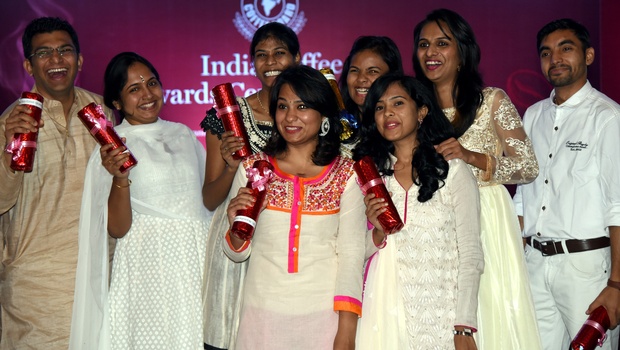
Students of PG Diploma in Coffee Quality Management during the India Coffee Awards Ceremony in Bengaluru on Thursday | NAGARAJA GADEKAL
Bengaluru :
The Coffee Board on Thursday conferred the Best Coffee Exporters’ Awards to the best exporters of green coffee, specialty coffee, instant coffee and roasted coffee.
Coffee Board chairperson Leena Nair said the since 1999-2000, the board has been presenting the awards to motivate, encourage and maximise export performances, especially to key destinations.
Indian coffee exports have been good over the past few years, touching three lakh metric tonnes annually. Of the 538 exporters, 128, who actively exported coffee during 2013-14, were judged by a jury for the awards.
Chief Secretary Arvind Jadhav, who was the chief guest during the ceremony, said the coffee sector needs to be given a boost to drive the economy of the state in a major way. “Coffee cultivation in the state is threatened by climate change, but proper research should be put in to mitigate the effect and produce top-end coffee,” he added.
India exported 2.99 lakh metric tonnes of coffee during 2013-14 with export earnings of $776 million (Rs 4,594 crore), covering more than 100 countries. Italy, Germany, Russia, Belgium, Turkey and Spain are the top six countries importing Indian coffee.
source: http://www.newindianexpress.com / The New Indian Express / Home> States> Karnataka / by Express News Service / January 08th, 2016
WELCOME. If you like what you see "SUBSCRIBE via EMAIL" to receive FREE regular UPDATES.
Read More »