Ahead of the Premier Badminton League, here’s your guide to one of India’s best shuttlers.
Ashwini Ponappa is one of the most talented badminton players in India
Indian badminton doubles star Ashwini Ponappa has already seen several memorable moments during the course of her career. Her successful partnership with Jwala Gutta in the doubles has brought India many laurels and they continue to be the pair on which the country’s doubles hopes are pinned on.
After first bursting on to the scene as an 18-year-old in 2007, Ponappa has made steady if not rapid strides in her career, and with Gutta will be a key component if India are to excel in the sport in Rio 2016.
Here are 10 things to know about the badminton ace:
1) Ashwini Ponnappa was born on the 18th of September, 1989 in Coorg, Karnataka. Her father was a national hockey player. However, she preferred badminton over hockey and started training in the sport.
2) She completed her schooling at St. Francis Xavier’s Girl’s High School in Bengaluru and moved to Hyderabad to pursue her bachelors degree.
3) Ponappa shot to fame when she won the Indian junior championships in 2001, as a 12-year old and then five years later, clinched the Gold at the South Asian Games to impress many an expert and supporter.
4) At the 2010 Commonwealth Games held in Delhi, she partnered Jwala Gutta to the Gold in the Women’s Doubles, with the two thereby becoming the first Indian pair to win a medal in that category at the event. Ponappa was also part of the team that won a silver in the Mixed Team event at the Games.
5) In 2011, Ponappa and Gutta came up with one of their finest performances when they won a bronze medal at the 2011 World Championships in Copenhagen, thereby becoming Indian doubles pair and only the second after Prakash Padukone(1983), to stand on the podium at the marquee event.
6) In 2012 Olympics, Ashwini-Jwala pair narrowly missed out on a quarterfinal berth by a difference of just one point, thus denying them a medal
7 ) In June 2015, Ashwini-Jwala pair won the Canada Open women’s doubles title by defeating the top-seeded Dutch pair of Eefje Muskens and Selena Piek. It was the pair’s first and only title in the year.
8) 2014 turned out to be a fruitful year for the duo as they won the silver medal in the Glasgow Commonwealth Games, and followed that up with Bronze medals in the Asian Games in Incheon and the Uber Cup in New Delhi.
9) Ponappa played for the Pune Pistons in the inaugural edition of the Indian Badminton League. In 2015, Bengaluru Top Guns chose her to represent their franchise in the Premier Badminton League(PBL).
10) The 26-year old is an animal lover and loves listening to music in her spare time.
source: http://www.sportskeeda.com / Sports Keeda.com / Home> Badminton / Premier Badminton League – Analysis / by Rohan Nagaraj / December 30th, 2015
‘It is a tragedy that British termed freedom fighters insurgents’
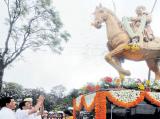
It is a tragedy that British termed freedom fighters like Subedar Guddemane Appayya Gowda, Sangolli Rayanna, Bhagath Singh insurgents. The historians who failed to understand it, also termed them insurgents, said MLA K G Bopaiah.
Speaking after inaugurating Subedar Guddemane Appayya Gowda Martyrs Day organised by the district administration, Kannada and Culture Department and Karnataka Arebhashe Samskrithi mathu Sahitya Academy here on Saturday, he said there were several uprisings against the British rule prior to Sepoy Mutiny of 1857. Guddemane Appayya Gowda had led an insurgency against the British.
He said that there are miscreants who try to divide the society. “Let us pledge to work towards the integrated development of the district and spread the messages of Guddemane Appayya Gowda and Field Marshal K M Cariappa.”
Kodagu district Kannada Sahitya Parishat president T P Ramesh said that those who have no knowledge about history can not create it.”
He said Appayya Gowda should not be restricted to a community. Karnataka Arebhashe Sahitya mathu Samskrithi Academy and Karnataka Kodava Academy should document the history of the district. Karnataka State Handicrafts Development Corporation Chairperson Veena Achaiah, Kodava Academy president B S Thammaiah, Madikeri CMC president Shreemathi Bangera were present.
source: http://www.deccanherald.com / Deccan Herald / Home> District / DHNS / Madikeri, November 01st, 2015
The world’s first barefoot marathon will be held in Kodagu on Dec. 5 and 6.
Melinda Soman, who recently completed the ‘Iron Man’ event will also take part in the marathon organised by Coorg Wellness Foundation.
This maiden run is expected to evolve into an annual event and is dedicated to conservation and well-being of environment and all its inhabitants in partnership with Coorg Wildlife Society.
The event includes the Barefoot mile; Tribal 10 kilometre run, Barefoot 21 kilometre run and the full marathon Barefoot 42 kilometre run.
Barefoot running enthusiasts may register at www.barefootmarathon.com or www.coorgwellnessfoundation.com. They can also contact: Nikki on Mob: 9845559452.
source: http://www.starofmysore.com / Star of Mysore / Home> Sports News / Monday – November 16th, 2015
The Srimangala Bhagavathi Temple committee president Mullanda Thimmaiah said that the temple would be renovated.
“The Temple has a history of 300 years. As per the directions of the temple chief priest, the old sanctum sanctorum is being renovated and the idol of the presiding deity Sri Bhagavathi as well as those of Lord Ganapathi and Kethurappa are being worshipped in a small enclosure in front of the temple,” said Thimmaiah.
Explaining further, the president said that a blueprint of the Theertha Mantapa had also been prepared and the ground-breaking ceremony had been conducted for the work.
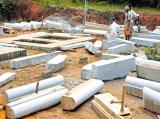
“Stone foundations have been laid for the new sanctum sanctorum and also the theertha mantapa. Stone pillars have been chiselled for the temple,” he added.
source: http://www.deccanherald.com / Deccan Herald / Home> District / DHNS, Madikeri – November 07th, 2015
It took a play-off to determine the winner of the Take Solutions India Masters, and even then there was only a couple of inches in it. S. Chikkarangappa’s 9-iron from 145 yards on the 18th sailed past the flag, bounced once on the green, and rolled sharply back.
It left him needing a birdie putt of some four feet to win the tie-breaker, and he nailed it. Moments earlier, Shubhankar Sharma had watched his birdie putt, from 10 feet, settle inches wide of the cup.
It was thus by the finest of margins that Chikkarangappa defended his title at the Eagleton Golf Resort on Saturday. Shubhankar — dogged to the end — and he returned an identical tally of 25-under-263 to force the first play-off hole, when the local favourite triumphed. That it went down to the wire was due to Shubhankar’s run of four birdies on the final four regulation holes, a passage of play that included one putt from 20 feet on the 16th.
S. Chikkarangappa with the trophy after winning the Take Solutions India Masters / Photo: Shreedutta Chidananda
Chikkarangappa, level with his opponent overnight, had eased into a two-shot lead by the seventh hole, after a hat-trick of birdies had followed a bogey on the fourth.
It appeared that advantage would be enough, but Shubhankar simply would not give up.
“Even I didn’t expect that he would make four out of four at the end,” Chikkarangappa said later. “But I was confident. I have been involved in three play-offs as a professional and I’ve now won all three.”
It was an emotional victory for the 22-year-old, who was in tears as he embraced his mother afterwards. “I’ve been through a bad patch these last three months. I had a back injury that made me fear for my career. Also, losing on my home course would have been very hurtful,” he said.
Chikkarangappa took home a cheque for Rs.13,65,000, which lifted him to first place on the PGTI Order of Merit.
The win was his second on the Asian Development Tour and seventh overall. Abhijit Chadha, who shot the day’s best of 10-under-62, finished the tournament in third place at 19-under-269.
Ashwini Sports Foundation, floatedby Olympian Ashwini Nachappa, takes a step closer to building itsworld-class facility in Coorg with inauguration of Shooting Rangeand Gymnasium at Gonikoppal, South Coorg.
Embassy Group, India’s leading real estate developer, haspartnered with Ashwini’s Sports Foundation (ASF) to launch thespanking new, world-class Embassy ASF 10m Shooting Range andGymnasium. It was inaugurated by Jitu Virwani, Chairman & ManagingDirector, Embassy Group and his wife Lina Virwani recently.
Arjuna Awardee, Ashwini, over the past decade, has been focusingon creating a unique approach to education that integrates sportswith academics at a very early age. Along with her husband DathaKaruambiah, she manages a school – KALS which put this approach intopractice. Talented athletes from this school are then absorbed intoASF, which then provides structured, world-class training through aunique 4-step model. More than 50 talented children have beenidentified and are training in Athletics and Hockey. With theEmbassy ASF Shooting Range, ASF will now addthis to its repertoire of sporting disciplines.
Speaking on the occasion, Jitu Virwani said that “we are verysupportive of Ashwini Nachappa’s and ASF’s efforts to popularizeshooting as a sport. We are extremely pleased to have collaboratedwith ASF to set up a facility that matches international standards.I am sure this shooting range will help many young rifle shootingaspirants develop their talent and become world beaters at nationaland international events. We stand committed to the vision of ASFand wish them all success in their future endeavours.”
Ashwini Nachappa said that “our intent at ASF is to create asustainable and replicable model that will enable talented athletesnot just in Coorg but from anywhere in the country to rise to theirfullest potential. I am hoping that in the next 5-7 years we areable to show results at the international level and be able toproduce world champions.
source: http://www.news.webindia123.com / WebIndia123 / News Home> India / Coorg, Thursday – October 29th, 2015
Hockey India, the apex body governing the sport in India has introduced Hockey Coorg as an Associate Member unit from the state of Karnataka. The state of Karnataka will now boast of two member units, where Hockey Karnataka themselves already operate as a Permanent Member unit while the latest entrant Hockey Coorg will operate as an Associate Member unit. The newly formed Hockey Coorg, will see Mr. PE Kalaiah spearheading the unit as the President.
Hockey India, which currently has 20 Permanent Member units, will have 28 Associate Member units with the formation of Hockey Coorg. Karnataka has traditionally been a major contributor to the sport of Hockey.
Hockey Coorg’s primary functionality will be to manage the large talent pool from the Coorg region of the state that in the past has produced some great players like BP Govinda, Arjun Halappa, AB Subbaiah and MP Ganesh. A few of the current players donning the national cap from Coorg are VR Raghunath, SV Sunil, SK Utthappa, Nikin Thimmiah and Nithin Thimmaiah.
With the formation of Hockey Coorg, the region can now participate in the National Championships as a separate team, helping India unearth a larger pool of talent for the future. Speaking on the development, Mohd. Mushtaque Ahmad, Secretary General, Hockey India said, “I am delighted to welcome Hockey Coorg as an Associate Member unit of Hockey India.
The region of Coorg has always given our country some exceptional athletes in the sport of hockey, and with the formation of this new unit, I am confident that we will be moving towards a formidable talent pool who only are going to help us carry forward the legacy and honour of the sport, bringing many laurels to the country.”
The governing body for hockey in the country, Hockey India, announced on Monday that Hockey Coorg will be inducted as an associate member in their set-up.
The move will now see Karnataka represented by two individual bodies; Hockey Karnataka and Hockey Coorg, and both units will be allowed to field teams at the National Championships.
“Hockey Coorg’s priority will remain the same and that is to nurture talent for the Karnataka side,” PE Kalaiah, president of Hockey Coorg, told Deccan Herald. “They (Hockey Karnataka) will have first refusal of right (players) from the talent pool and we will then give the remaining players a platform to improve their skills.
“The concept of this membership is not to attract boys who are playing in Bengaluru but originally are from Coorg, but rather to have a larger talent pool that remains in the State. Plenty of players are either on the fringe or ply their trade in different States. We might as well have them play for our State and remain at home,” he explained, while alleying any fears of change in dynamics of the functioning of HK.
Spotting talent
Hockey Coorg has 24 senior teams from different parts of Coorg that are affiliated to them but talent-spotting at the school level remains on top of their list of priorities. “Hockey Coorg’s first preference will be to conduct school-level tournaments and ensure that the players have the right infrastructure and opportunity to play. Presently, more than half the boys at the SAI camp in Bengaluru are from Coorg and have worked their way up the existing system,” added Kalaiah.
Sandeep Somesh, Joint Secretary of Hockey Karnataka, echoed Kalaiah’s sentiments on the subject.
“This is a move in the right direction for Hockey Karnataka as the players we nurture will have more opportunities to represent the State, since Hockey Coorg is an affiliated body and we will get to choose the best players from a larger group,” he noted.
Sandeep also dismissed any concerns of presence of two teams hampering the functioning of the body.
“Nothing changes,” he stressed. “Though Hockey Coorg will be an independent body, Hockey Karnataka remains the regulating body for hockey in the State.”
While both bodies will look to work in tandem in the near future, plans on infrastructure and other training processess are still in the pipeline.
“Hockey Coorg will work alongside us in the future but the roles for both bodies will be clearly defined and we will look to execute them,” remarked Somesh.
While divulging into the role that Hockey Coorg could carry out, the former India International spoke of Coorg being a perfect breeding ground for budding talent.
“We have seen that over the last several years, Coorg has produced some of the best players that the country has seen. I have no doubt that they will continue to do a fine job. They have been organising inter-school and inter-college tournaments as well as club-level tournaments from where players have been spotted and trained,” he pointed out.
source: http://www.deccanherald.com / Deccan Herald / Home> Sports / by Arjun Ganesh / DHNS – October 27th, 2015
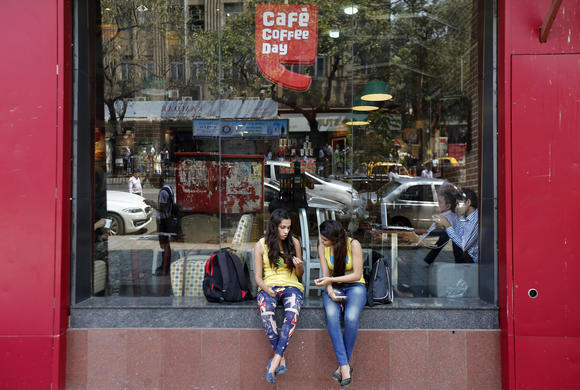
Girls sit at the window of a Cafe Coffee Day outlet in Mumbai, February 25, 2015. The firm behind Cafe Coffee Day, India’s biggest homegrown coffee chain, is set for a market debut that could value it at almost $1 billion, even as the country’s burgeoning cafe culture draws global giants Starbucks and McDonald’s. Cafe Coffee Day, a cafe pioneer in India, aims to list a 20 percent stake, raising roughly $200 million, within the next quarter, sources with direct knowledge of the plans said. Picture taken February 25, 2015. REUTERS/Shailesh Andrade / @ Reuters
New Delhi (NewsRise):
The owner of India’s largest coffee chain received bids for 1.2 times the shares it offered in the nation’s biggest initial public offering in three years, indicating that investors remain bullish on Prime Minister Narendra Modi’s efforts to revive economic growth.
Coffee Day Enterprises, which runs the Cafe Coffee Day outlets, received 31.3 million bids for the 25.8 million shares it offered, according to provisional data on the National Stock Exchange. The company aims to raise as much $176 million via the IPO.
A slew of companies, including India’s largest discount airline, have filed for IPOs this year, betting that Modi’s reforms and easing interest rates will revive growth in Asia’s third-largest economy. As many as 16 companies filed their draft prospectus with markets regulator the Securities and Exchange Board of India between July and September, the highest quarterly filing in four years, Business Standard newspaper reported.
“Improvement in the economic situation means that the appetite will pick up,” said Deven Choksey, managing director at K.R. Choksey Shares and Securities. “If quality papers come at a reasonable price, investors will be more than happy to purchase.”
Until Thursday, Coffee Day Enterprises had received bids for 75% of its shares on offer. Demand picked up after a lukewarm response on Wednesday, the opening day for subscription, led by bids from the so-called Qualified Institutional Buyers that included local banks and insurance companies.
Discount carrier IndiGo’s parent InterGlobe Aviation is likely to open the 25 billion rupee ($385 million) initial public offer on Oct. 26, Economic Times reported. Mumbai-based L&T plans to sell 17.5 million shares, or nearly 11% of outstanding stock of unit Larsen & Toubro Infotech. L&T, which currently holds 161.25 million shares in the unit, plans to raise around 15 billion rupees via the share sale.
Coffee Day Enterprises has been expanding outlets in recent years, betting that rising disposable incomes and increasing coffee consumption in the world’s second-most populous nation will boost revenues.
Analysts had largely advised investors to be cautious about the company’s financials and its complex structure, which includes a range of businesses from real estate to software services. Coffee Day’s other businesses have a history of weak returns on capital, they said.
From January to September this year, 15 companies had raised $992 million through IPOs in India, compared with $197 million last year and $235 million in 2013. The market is still a fraction of what it was in 2010, when 64 firms raised $8.34 billion, according to Prime Database.
source: http://www.asia.nikkei.com / Nikkei Asia Review / Home> Markets> Equities / October 16th, 2015
Prelude: In 1965, Pak under Field Marshal Ayub Khan having acquired modern aircrafts, tanks and other armament from USA, as a member of SEATO, planned to wrest J&K from India militarily. They imagined that the Indian Armed Forces were a demoralised lot after the drubbing we got from China in 1962 and political leadership had gone weak after Nehru’s death. Pakistan thought that it was a historic opportunity for them to use force against India to attain their objective.
Pak started off with a diversionary attack in Rann of Kutch and followed it up with ‘Op Gibralter’ to infiltrate a large force, led by officers into Kashmir Valley to disrupt communication, cause panic and take over the administration. Both these were not only defeated by Indian Armed Forces but they captured strategic Haji Pir Pass which was used by them for infiltration. Undaunted, they on 1st Sept. 1965, launched ‘Op Grand Slam’ with two major offensives along Chamb – Jurian and in Punjab along R. Beas to cut off J&K from the rest of India.
Mobilisation and Concentration
India lost no time in declaring Emergency and countering with ‘Op Riddle.’ My Battalion (Bn), 5 MARATHA LI had arrived in Baroda (Vadadora) a few days earlier after a long tenure in North East and was in the process of settling down, when at night on 1st Sept., we got orders to mobilise and move to Ahmedabad for further orders. As we were short of transport, we requisitioned some civil vehicles and moved out before the people of Baroda woke up.
At Ahmedabad, the GOC of 11 Inf Div. Maj. Gen. Naveen Rawlly, MC told us that our 30 Inf Bde was to carry out an offensive into Sind as a diversionary attack, in order to attract Pak reserve Division in W. Punjab and that we should move post-haste to our Concentration Area between Barmer and Gadra Road (Rajasthan). Thanks to the patriotism of the way side civil petrol stations, who supplied fuel to us merely by accepting written receipts, we were able to move non-stop and reach our destination the very next day — a distance of about 400 km; but we had to wait two more days for other units of the Bde to fetch up and prepare for the battles ahead. With just 7 years service, I was the senior most Coy Commander (C Coy) in my Bn and was the only officer in the Bde, trained in commando operations. Much was expected of me and I was confident of living up to the expectations.
Offensive commences
On 6th Sept., Brig Buppy Guha gave his orders for the capture of Gadra City, a medium sized town 5 kms inside Sind by the Bde. As per the intelligence provided by Muslim smugglers operating in the area, only Pak Rangers were operating against us and there were no regular Army in the area. The attack was to be launched next morning and my Coy was to infiltrate behind the enemy as a preliminary operation and establish a block behind Gadra City, before the attack.
My Coy was the first to cross the Sind border soon after sun set. We moved in single file with myself in front with compass in hand for navigation. We moved fast for about 14 kms to find a suitable place and by 4 am, I selected a place on track Gadra City — Kokrapara which was their nearest Railway Station close to the border. At dawn, I heard firing in Gadra City signifying that our Bde attack had started as planned. The escaping enemy could use any route in the open desert; but luckily 7 Pak soldiers walked into our ambush, unaware of our presence. We could have killed them; but they capitulated without any resistance. They were regular soldiers from Baluch Regiment and they had been in that area training in desert warfare for quite some time. This was contrary to the earlier information given by the smugglers, who were obviously pro-Pak. These were the first batch of PsOW captured by our Bde, who gave us valuable information. We treated them humanely as per Geneva Convention.
Advance towards Kokrapara and Air Attack
After the capture of Gadra City by the Bde, my Bn linked up with me and we were ordered to advance towards Kokrapara. As the track was unfit for heavy vehicles, we took only few 1 tonners to carry essential ammunition and water. As we were advancing, our column was attacked by two Pak Sabre 86 aircrafts due to which one our ammunition vehicle was blown up. From then on till the end of the war these aircrafts kept attacking us with impunity as our own IAF could not spare a single aircraft to our Sector!
By last light we reached a village called Sakarbu, with a biggish sand dune feature next to it where we firmed in. Next day, except my Coy, the rest of the Bn was withdrawn to Gadra City for its defence. Seeing us, the poor villagers of Sakarbu wanted to flee but I advised them that we were not a threat to their safety and they could lock up their houses, take their valuables and in an organised manner go towards Pak leaving behind few guards. I assured them that we had come there to meet the aggression of the Pak Army on our sacred land and we have no enmity but only goodwill towards them. I can never forget their expression of gratitude and their blessings “Kuda ap sab ko bala kare” (May God bless you all).
Aborted raid on Dali
A day later, my Coy too was pulled back to Gadra City to carry out a raid on Dali, which was a known enemy position in the interior. I was allotted trained camels from Rajasthan Armed Constabulary (RAC later converted into BSF) to carry 3 inch mortars and MMGs with ammunition and water. We moved cross-country away from the track to avoid air attacks. Enemy aircrafts did overfly, but could not notice us as our camels just sat down and froze like well-trained soldiers! This was my first experience with camels — they could move on the desert in the scorching heat without water for days. When we were in the striking distance of Dali and planning the raid at night, I had an urgent message to call off the raid and rush back to Gadra City to deal with a serious situation !
Clearing of Pak Road Block at Khadin
When I returned to Gadra City, I was told that an enemy motorised column was successful in entering Indian territory and capturing a RAC Post at Khadin which was half-way between Gadra Road, our nearest Indian Railway Station and Munabao, where the old defunct Railway line entered Pak territory. They had effectively cut off 3 GUARDS and B Coy from my Bn which were operating in Munabao. A squadron-less two troops of tanks from Skinners Horse (Sherman Tanks) under Maj. Chopra was to join us, to clear the enemy block at Khadin. We moved piggy back on the tanks. It was agreed between us that when we contact the enemy, we would jump off from the tanks, move on a flank to assault, while the tanks would take hull down position to give us covering fire. Unfortunately, four of the tanks got bogged down in the sand and we had to march on foot.
Only late in the evening, we contacted the enemy, who fired their mortars, 106 RCL (Anti tank) and MMGs at us from a high ground astride the track behind the Khadin village. A few thatched huts in the village were burning due to Pak fire and in the dark their tracer bullets were flying all over our heads. It was a spectacular sight to behold as though we were witnessing a Diwali extravaganza, even though the situation was grim with one of my jawan lying wounded due to the shelling. Due to darkness, the three tanks which managed to reach the area were useless, as they did not have night fighting capability. However, their mere presence could have scared the enemy.
We carried out aggressive patrolling on the flanks at night due to which the enemy got panicky and fled in the cover of darkness with their vehicles. Their vehicles had balloon tyres to move on the desert unlike ours. My company occupied the post without opposition by midnight. In the morning, Maj. Chopra without my knowledge, informed the Brigade from his wireless set that we had succeeded in clearing the road block and he was getting back to retrieve his tanks.
As for me, we had not yet accomplished the mission fully as the enemy had withdrawn only up to Sakarbu height, which was previously held by us and directing artillery fire on us. We had to evict them from there to ensure that route to Munabao was safe. So, I requested my Bn to send me mortars and MMGs for attack on them next night and myself took a small patrol towards Sakarbu using sand dunes as cover, to plan attack. Strangely, I saw and heard them scooting from there too during mid-day. After ensuring the position was abandoned by them, I used my initiative, in the absence of communication failure with the Bde, to handover Khadin Post to RAC personnel who were in hiding not far away during Pak occupation and had rejoined us after it was recaptured by us.
Thereafter, I moved my Company to occupy Sakarbu, which was tactically more important for us. The route to Munabao was thus opened and it was now safer. Next day, the Bde sent a coy of 1 Garh Rif to relieve my Coy at Sakarbu and was called back to Gadra City. I thought it was to give us time to rest and recoup but alas it was not to be!
My last Mission: When I reached Gadra City, our new Bde Cdr, Brig. Summanwar complimented me for my Coy’s action at Khadin and Sakarbu but said that he had sent composite force with 17 MADRAS, a part of my Bn under my CO and a Coy of 1 Garh Rifs, inland towards Dali to capture more areas. They had captured Jasse ke Par, Dali and Pirani ki Par; but as there was a complete breakdown of communication with them, he was anxious to know about the situation on that front. He, therefore, wanted me to take a strong patrol mounted on 1 ton vehicles with mors and MMGs to bring back correct information, so that he could plan further operation.
I had Capt. Sardesai from my Bn to assist me as my second in command. It took the whole night to get the ASC vehicles and patrol ready. We could set out only in the morning with me in the lead vehicle and Capt. Desai in the last. We had to move dispersed due to the threat of air attack. As I was nearing Dali, I could hear a lot of firing there which made me move faster than the speed of my convoy behind. From a higher ground, I descended on a flatter area which was being overlooked by a high sand dune short of Dali.
On the skyline I noticed some figures. I saw through my binoculars to find that they were wearing Khaki uniform — they were unmistakably Pakistanis! The best I could do was to halt my convoy at higher ground left behind and take up a defence. So, I instructed the driver to reverse the vehicle and I got down to have a better look at the enemy. Just then, they fired artillery at us and unfortunately one shell fragment hit my right leg and it started bleeding. Nk Shinde, who was with me while helping me back into the vehicle, saw an enemy jeep mounted with 106 RCL less than 70 yds away and he fired at it with his rifle. The enemy crew, obviously scared, reversed into a depression, fortunately never to raise their heads again.
As I got back into my vehicle, we saw another enemy MMG mounted jeep trying to encircle us from a flank; but we managed to escape by driving fast back to the higher ground, where Capt. Sardesai was waiting for me. Fortunately, my wound was not life-threatening. While my wound was being bandaged to stop the bleeding, I could discuss the situation with Capt. Sardesai. We decided to deploy the patrol into a defensive position. I planned to get back to Gadra City to personally brief the Bde Cdr and attend to my wound.
After thanking Nk Shinde (without whose help, unmindful of his own safety, I would not have been alive today!) and dictating a situation report to be sent to the Bde, I left for Gadra City and reached there at night. Brig. Summanwar personally met me in the vehicle. After explaining what had happened, I recommended that a stronger reinforcement should be sent to help our beleaguered force at Dali and beyond. He discussed this with the Div. Cdr. and instructed 2IC of my Bn, Col. Sable to take the balance of my Bn with additional troops to stabilise the situation. It was nice of the Bde Cdr to take personal interest to arrange a hot dinner for me and evacuate me in an ambulance.
Cease Fire and After
While being evacuated, I was informed that night on 23rd Sept., India had declared unilateral cease fire. After two weeks of hospitalisation at Ahmedabad MH to tend to my wound, I was given a month’s sick leave to go home to Madikeri, where my parents were anxiously waiting for me. However, with the permission of my father, who had served in Burma as an Army Doctor during World War II, I voluntarily got back to my Bn at Gadra City, 15 days before my leave was to expire.
Taking advantage of the unilateral declaration of cease fire, Pak wilfully had tried to grab some unoccupied area of ours in Rajasthan, which led to skirmishes and casualties on both sides. By the time I returned, the situation had stabilised. Our Bde had achieved its objective, against heavy odds by capturing large area in Sind, which came in handy during the negotiation which followed after Tashkent Agreement. My CO, Col. Rattan Singh was designated to attend a flag meeting with Pak to finalise the plan for vacating the captured areas by us. He took me with him and he was pleasantly surprised to find that his counterpart, the Pak Col. was an old course-mate of his at the Indian Military Academy, Dehradun! After recognising, they hugged each other and the meeting ended amicably!
By a coincidence, my Coy which was to enter first into Pak territory was also the last to vacate it. In this senseless war, where there were no winners or losers, the loss of Lt. Ronald Serrao, our Intelligence Officer, who was killed at Dali after the Cease Fire and our gallant JCOs and men, was too overwhelming.
After the war, my Bn moved to Jodhpur where our Bde became a part of newly raised 12 Inf Div, which was to specialise in Desert Warfare. Under the new GOC, Maj. Gen. Satinder Singh, we trained hard and developed concepts peculiar to desert warfare, which paid us handsome dividends during the 1971 War with Pak.
Conclusion
In this war, we learnt how not to wage a war! My Bde was launched into battle poorly equipped and trained in desert warfare without any air support. Battalions are meant to fight as a homogeneous whole; but we were frequently split into coys and pls columns and mixed up with other bns deep into the desert without administrative backing. This was a major flaw in the conduct of war at Bde level. Yet, we achieved more than what was expected of us.
In sum, the 1965 War, which Pak imposed on us ended in a stalemate but taught secular India never to trust our religiously indoctrinated neighbour. In 1971, we did better mainly because of the powerful personality of our then Army Chief, Field Marshal SHFJ Manekshaw, who had a direct access to the Prime Minister bypassing bureaucrats in the Ministry of Defence but emerging India can no longer depend upon such personalities. We should take institutional measures backed by appropriate allotment of finances to safeguard our internal and external security.
It is high time that the unbroken legacies set by our first Prime Minister, to appoint Defence Ministers who lack basic knowledge of Military, have a Ministry of Defence wholly staffed by bureaucrats who enjoy all authority without responsibility and not integrating the three Services, namely, the Army, the Navy and the Air Force under one Chief of Defence Staff to fight future wars should be ended. I do sincerely hope that our politicians and influential sections of our people, who as a rule never send their sons into the Armed Forces, realise their responsibility towards the Nation and take positive steps.
Jai Hind.
source: http://www.starofmysore.com / Star of Mysore / Home> Feature Articles / Saturday – October 10th, 2015
WELCOME. If you like what you see "SUBSCRIBE via EMAIL" to receive FREE regular UPDATES.
Read More »