Category Archives: Records, All

When the Pitch is Right

National Award-winning filmmaker Sandhya Kumar’s documentary looks at the Kodava hockey festival that takes place in Coorg every year
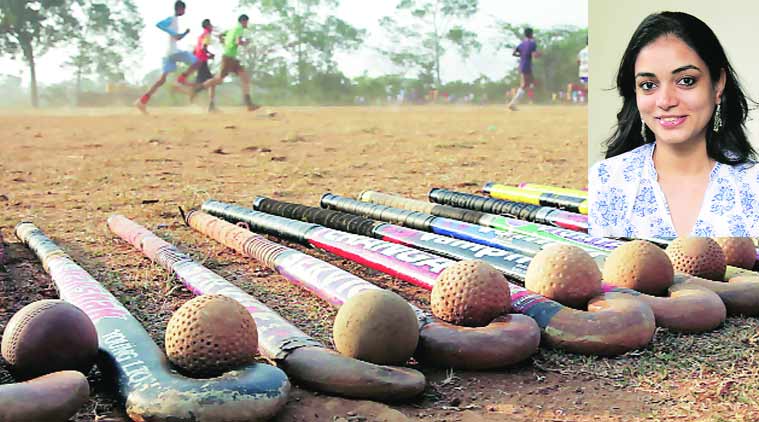
A still from Hockey in my Blood; filmmaker Sandhya Kumar

In the summer of 1997, the head of the Kuttappa family, Pandanda Kuttappa, hosted the first Kodava Hockey Festival in his village Karada in Coorg. The first edition of the hockey “tournament” for the Kodavas — a martial-tribal community that belongs to Coorg — had 60 families competing for the title. In the 18 years since, the annual event has grown to become the largest hockey tournament in the world, with over 200 Kodava families taking part in it.

It was in 2012 that National Award-winning documentary filmmaker Sandhya Kumar first heard of this tournament. While the subject intrigued her, it wasn’t until she visited Coorg for a wedding later that year that she decided to explore it through her work. Kumar then got on board Deepti Bopaiah, a Kodava keen to chronicle what had come to be a tradition among her people, and began research for her next project. After close to two years of work, the 52-minute documentary, Hockey in my Blood, is now complete. “India doesn’t offer much scope for releasing non-fiction films. So I hope to tie up with sports and educational organisations to screen it across venues in India apart from taking it to festivals,” says the Bangalore-based filmmaker whose docu short O Friend, This Waiting!, on Devadasis, won the National Award in 2013.

In Hockey in my Blood, Kumar tells the story of the tournament chiefly through the extensive preparations the Kodavas put into organising the festival. One of the key voices, therefore, is a member of the family that has been selected to host the festival in 2013. Considering it a big honour, he has quit his job four months ahead of the festival to oversee the preparations, such as sponsorships, readying the ground and other nitty-gritties. “The month-long event takes place every year between April and May. It’s soon after children’s exams and also when the work on coffee plantations is minimal. So it allows the Kodavas to practise and also attend the matches,” explains the 33-year-old.

The timing is important because the Kodavas living away from their ancestral land travel from wherever they are — even foreign shores — to Coorg in order to participate in the festival. Each year, close to 220 teams (family clans) participate in the tournament for a cash prize of Rs one lakh and the trophy.

Kumar says the national hockey team, over the years, has had over 50 Kodava players, and some have even been Olympians. “But how did hockey emerge to be such an important sport in Coorg is a question no one could answer, it’s as if it’s always been there,” Kumar says.
That there is no age or gender bar to participating is one of the biggest highlights of the tournament.

This is captured in the film through the voices of 16-year-old Prajwal, considered one of the strongest players on the Palanganda team, and Priya Bopanna, who was made the captain of her team the very first year she participated.

Kumar adds that married women, in fact, have the option of playing for their paternal or husband’s team and can choose their side every year.

However, most importantly, the documentary conveys that the festival, although taken seriously by the Kodavas, is mostly a means to have a good time, losing isn’t a big deal. “Many of them return to Coorg for the festival. It’s a way for them to strengthen their bond with their extended family and the ancestral land,” explains Kumar who is open to screening invitations through the titular Facebook page of the film.

source: http://www.indianexpress.com / The Indian Express / Home> Lifestyle / by Dipti Nagpaul D’Souza / June 05th, 2015
Miscellany – A shrine of bells and anecdotes

PalangalaKF12jun2015

A shrine of bells and anecdotes

Palangala, a remote village in Kodagu retains its pristine environment, despite creeping urbanisation. Palangala holds a special place in my heart since it is where my mother’s family lived. As children, we used to visit our maternal grandparents, and I have pleasant memories of this village.

One of the happy memories I have is that of a shrine atop a hill named Malethirke. My parents were devotees of this shrine and it was an annual tryst to visit the temple during our summer vacation. The only way to get to the temple those days was by walk through thick wooded mountain terrain. It used to be an arduous walk of more than a kilometre along a winding beaten path.

One particularly interesting story connected with this shrine is the attack by Tipu’s troops during the late eighteenth century. The Kodava warriors were outnumbered and were unable to stop the marauders. They hid in the forest and prayed for divine intervention. Their prayers were answered, and according to lore, swarms of rock-bees attacked the troops and chased them down the ghats. There is evidence of this attack in the form of remnant of an old sword which was abandoned by the soldiers.

I recently visited the shrine with my wife. There is now a reasonably motorable road to the top. The location of the shrine is serene and peaceful. It’s a temple to Lord Shiva, Parvathy and Ganesha. Legend has it that the Pandavas spent their ajnathavasa here. Lord Shiva is said to have appeared to the Pandavas at this spot. Three uneven stones represent Shiva, Parvathy, and Ganesha in an open tree-covered platform. This is the sanctum-sanctorum. There is no set structure. The priest puts it succinctly: “The sky is the roof of this temple, the mountains are the walls, trees are the adornments, and the birds provide the music.” There is also a pond nearby which has potable spring water.

Another interesting story is that of St Annes Church in Virajpet, which was first built in 1792 during Dodda Vira Rajendra’s reign, who welcomed the Christians displaced by Tipu. When the church was under construction, the spire kept collapsing every time it was built. The Italian architect could not figure out what was going wrong.

A local person advised the architect to make an offering of a bell to Malethirke temple, in order to overcome the problem. The architect followed this advice and was amazed when the spire stood steady at the first subsequent attempt. Even to this day, devotees take vows and offer bells to this temple. The surroundings of the temple is full of bells festooned around it.

Another form of offering by the devotees who take vows, is by way of earthenware figurines. There are piles of figurines of horses, cows, dogs, and human forms offered over the centuries. I took in the divine beauty of nature as the priest went about the various rituals. Savouring the payasam as prasada brought back happy memories of my earlier visits to this beautiful shrine.

source: http://www.deccanherald.com / Deccan Herald / Home> Supplements> Spectrum / by C P Belliappa / June 09th, 2015

Silver medals for Poovamma and Liksy

M.R. Poovamma. — FILE PHOTO

Femi Ogunode shatters his own Asian 100m record with a 9.91s

M.R. Poovamma, the fastest qualifier in the semifinals, retained her 400m silver while Liksy Joseph came up with an inspired performance for the heptathlon silver with a personal best as India’s women athletes did themselves proud at the 21st Asian athletics championship here on Thursday.

Purnima Hembram, a former Asian junior champion, followed Liksy for the women’s heptathlon bronze, and in the men’s section, G. Lakshmanan won the 5,000m bronze bettering his personal best by nearly 14 seconds.

Qatar’s Femi Ogunode did what he had been promising for some time by lowering his own Asian 100m record to a stunning 9.91s. That should make him the fifth fastest man in the world this year.

The Nigeria-born Ogunode had set the previous mark of 9.93 while winning the Asian Games gold in Incheon last year.

There were disappointments too for India, with both the country’s eight-metre long-jumpers, Ankit Sharma (7.76m) and K. Prem Kumar (7.69m) finishing fourth and fifth respectively.

Ankit was in the medal range for a brief while before going down. An eight-metre jump would have fetched them gold, for it was with a 7.96m that China’s Goa Xinglong took the top spot.

Poovamma, the Asian Games bronze medallist who has a personal best of 51.73s, was in fact quicker in Wednesday’s semifinal which she topped with 52.94s. Her silver, behind China’s Yang Huizhen, came in 53.07s.

Arokia Rajeev, also an Incheon Asiad bronze medallist, was seventh in the men’s 400m while Srabani Nanda was fifth in the women’s 100m.

The women’s sprint relay team finished fourth and the men sixth. Suprisingly Manikanda Arumugam, who had helped the team to qualify for the Asians in 39.11s in the controversial trials in Bengaluru recently, was not part of the men’s relay squad which finished in 39.67s.

Qatar’s Mohamad Al Garni, who had won the men’s 1,500m on Wednesday, completed a distance double by taking the 5,000m title.

The results:

Men: 100m: 1. Femi Ogunode (Qat) 9.91s [Asian record, OR: 9.93, own, 2014 Asiad, Korea], 2. Zhang Peimeng (Chn) 10.15, 3. Reza Ghasemi (Iri) 10.19. 400m: 1. Abdelilah Haroun Hassan (Qat) 44.68s, 2. Yousef Ahmed Masrahi (KSA) 45.14, 3. Sato Kentaro (Jpn) 46.09, 7. Arokia Rajeev (Ind) 46.65. 5,000m: 1. Mohamad Al Garni (Qat) 13:34.47s [MR, OR: 13:39.71], 2. Albert Rop (Brn) 13:35.26 [BMR], 3. G. Lakshmanan (Ind) 13:36.62 [BMR]. 4x100m relay: 1. China 39.04s, 2. Hong Kong 39.25, Taipei 39.35, 6. India (Jyothi Shankar Debnath, Krishna Kumar Rane, Amiya Kumar Mallick, Abdul Najeeb Qureshi) 39.67. Long jump: 1. Goa Xinglong (Chn) 7.96m, 2. Ted Hooper (Tpe) 7.80, 3. Tang Gongchen (Chn) 7.79, 4. Ankit Sharma (Ind) 7.76, 5. K. Prem Kumar (Ind) 7.69. Pole vault: 1. Zhang Wei (Chn) 5.60m, 2. Yamamoto Seito (Jpn) 5.50, 3. Huang Bokai (Chn) 5.50. Hammer throw: 1. Dilshod Nazarov (Tjk) 77.68m, 2. Ashraf Amgad Elseify (Qat) 76.03, Wan Yong (Chn) 73.40.

Women: 100m: 1. Fukushima Chisato (Jpn) 11.23s [MR, OR: 11.24], 2. Viktoriya Zyabkina (Kaz) 11.34, 3. Wei Yongli (Chn) 11.46, 5. Srabani Nanda (Ind) 11.48. 400m: 1. Yang Huizhen (Chn) 52.37s, 2. M.R. Poovamma (Ind) 53.07, 3. Anastassiya Kudinova (Kaz) 53.41. 5,000m: 1. Bethlhem Desalegn (UAE) 15:25.15s, 2. Alia Mohammed Saeed (UAE) 15:28.74, 3. Daria Maslova (Kgz) 15:42.82. 4x100m relay: 1. China 43.10s [MR, OR: 43.41], 2. Japan 44.14, 3. Thailand 44.73, 4. India (Sini Sahadevan, M.G. Padmini, Srabani Nanda, Dutee Chand) 45.72. Discus throw: 1. Su Xinyue (Chn) 63.90m, 2. Tan Jian (Chn) 62.97, 3. Lu Xiaoxin (Chn) 62.30, 6. Navjeet Kaur Dhillon (Ind) 51.66. Heptathlon: 1. Ekaterina Voronina (Uzb) 5,689 pts, 2. Liksy Joseph (Ind) 5,554, 3. Purnima Hembram (Ind) 5,511.

source: http://www.thehindu.com / The Hindu / Home> Sport> Other Sports / Wuhan – June 05th, 2015

MR Poovamma clinches silver in the 400m at the Asian Athletics Championships

Poovamma though missed the Olympic mark

India have bagged their second medal at the Asian Athletics Championships, that is currently being played in Wuhan, China with MR Poovamma clinching the silver in the 400m. event.

The Kodagu-born athlete clocked a timing of 53.07 and thereby clinched her second consecutive silver at the Asian Championships after her silver medal win at the 2013 edition of the Championships, that were held in Pune.

But her medal, here though, seems like it might have come at a cost as she fell behind the Olympic qualification mark by 1.07 seconds.

This is now India’s second medal after Inderjeet Singh won Gold on Day One of the competition with an effort of 20.41m.

source: http://www.sportskeeda.com / Sports Keeda / Home> Athletics> Asian Athletics Championship> News / by Shankar Narayan / June 04th, 2015

It is a mixed bag for candidates at GP polls

The counting of gram panchayat election held on May 29 was held at St Joseph’s High School in Madikeri on Friday.

Manjula of Hoskeri in Madikeri taluk has won by a mere margin of one vote. Congress supported candidate Hamsa had contested from two constituencies in Hodavada and won both the constituency. T H Amahhed of Napoklu won for the fifth time while Ameena won for the third time. Subhash Somaiah in Galibeedu GP won for the fourth time. AAP district convener Madetira Thimmaiah has won the election.

The election was held for 1,133 seats in 102 gram panchayat. There was neck and neck situation for Congress and BJP supported candidates in the district. Though BJP supported candidates had a upper hand in Madikeri, the Congress supported candidates performed well in Virajpet and Somwarpet taluks.

The supporters of SDPI and AAP have opened their account in the district.

There was 1,219 seats in 102 gram panchayats. No nominations were filed for three seats and 83 persons were nominated unopposed. The district had 3.50 lakh voters and the 2.50 lakh voters had exercised their franchise.

The counting was held till late night. The exact picture will be known by Saturday morning, according to polling officials. AAP supported candidates Madetira Thimmaiah, Vamana, Prathima have won in Kadagadalu panchayat. SDPI supported candidate Shamsheer won in Nelyahudikeri.

source: http://www.deccanherald.com / Deccan Herald / Home> District / DHNS – Madikeri, June 06th, 2015

A goal in mind

Over 50 Kodavas have represented India in international hockey. Photo: Abhilash Mandappa

Every summer, about 250 families from Kodagu go back home with an agenda: to compete against each other for a prized hockey cup

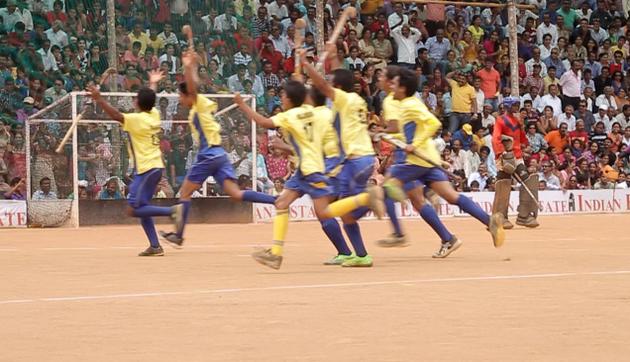
It’s a sultry Saturday in Virajpet, and the stands around the college grounds are packed with spectators. The teams in action, Chendanda and Palanganda, in orange and yellow respectively, pass, block, and swing their way to a tie, followed by a tense penalty shootout. After four failed attempts on either side, Palanganda’s Muthanna scores. The crowd erupts with wild cheering. It’s official: the Palanganda family has reclaimed victory at the 2015 Kodava Hockey Festival.

At a time when cricket monopolises our sporting imagination, the Kodava community commits itself to India’s national game with renewed vigour every summer. The annual Kodava Hockey Festival in Kodagu (also called Coorg) is now touted as the world’s largest field hockey tournament, with about 250 family-clans (okkas) participating every year.

Pandanda Kuttappa was inspired to start this tournament in his hometown after attending the 1982 Asian Games. The Indian hockey team then had many Kodava players and had already won eight Olympic gold medals, but the people in Kodagu could only hear about their players’ skill, techniques and wins over radio. “I wanted to create a hockey festival that would bring the Olympians to Kodagu. So people from all over Coorg or anyone interested could come, watch and observe their skills,” he says.

The festival started off in the 1990s in the village of Karada, with 60 family-clans competing. Over the next decade, at least 10 more teams would join in each year. “Often, the organisers would cook for the teams and dine with them, helping them rediscover lost family connections,” says Sandhya Kumar, who has made a documentary, Hockey in my Blood, on this unique tournament.

Now in its 19th year, the tournament is seeing a drop in turnout, particularly for the initial matches, says Kumar. “The stands are usually only around 30 per cent full until the quarterfinals, when things really start to heat up. After that it is packed with close to 10,000 people. It seems the tradition of families cooking and sharing food has died down over the years, but the competition seems to be getting fiercer,” she says.

Why do the Kodavas love hockey so much? Over the years, more than 50 Kodavas have represented India in international hockey, earning their district the title ‘Cradle of Indian hockey.’ The festival is clearly an extension of this love. “It isn’t clear why the love for hockey is so ingrained in Kodavas,” confesses Kumar. “When I explored the subject for the film, I realised it could be anything from colonial influences to the fact that the Kodavas are a very active and physically-fit clan.” Shot over two years in Kodagu and screened at this year’s hockey festival, the documentary chronicles the history of the tournament and the popular contenders.

The Palanganda family, which features prominently in the film, has won the cup five times and been runner-up twice. Spoiler alert: the winner in Hockey in my Blood is Anjaparavanda, which is a rare team with a woman player, Vishma Appaiah. Another woman player, Amulya Akkamma captained her Kongetira family team to reach the quarterfinals this year. “When the game is on, there is no question of special treatment because I am a girl. I push, shove, get pushed and shoved just like anyone else,” she says. “One of my biggest supporters is our goalkeeper, Harish Appanna. People like him are the reason young players like me are getting interested in hockey again. I hope a lot more young people play for their families in the future.”

It seems to be more than just love for hockey that draws these families to compete. Every year, different family-clans submit detailed proposals to the Kodava Hockey Academy to host the tournament.

Over time, it has become a matter of pride and honour to be the host. “I was on my toes all of last year,” says Rajiv Cariappa, convenor and treasurer at this year’s tournament. “With the contributions from the members of the Kuppanda clan, including women who married into other families, we raised a sizeable amount. We were able to put up LED TV walls for the matches and even played the ads of our sponsors, adding a new dimension of professionalism to the festival. With the leftover money, we are making contributions towards hockey training camps to encourage young players. Over the past three years, I have seen a surge in interest among the younger audience, which is great. This year, I heard, vehicles were parked up to a kilometre radius around the grounds. The stands and food stalls were packed, there was so much excitement in the air,” he adds.

Scenes from the Kodava Hockey Festival – 2015 at Kodagu. Photo: Abhilash Mandappa

In a lifetime, a Kodava will only get to see his or her family host the cup once — there are 800-odd family-clans in Kodagu — and this seems reason enough for family members to drop jobs, request extended leave at IT companies and even arrive from overseas to organise and participate in the games. The winning team gets a cash prize of ₹2 lakh, while the runners-up get one lakh.

The tournament is also ideal for talent spotting. Scouts from Sports Authority of India arrive here to select men and women players, some of whom can barely afford jerseys and equipment, and provide them training. Quite a few of them have gone on to become state and national players.

So is the festival finally about serious hockey or a family reunion? “It is primarily a reunion,” says BP Govinda, chief selector, Indian hockey team and former Olympian and Asian Games player. “The teams consist of people aged 12 to 40. Some are professional players, some are old-timers, and some are just playing their first competition. In my opinion, there may not be much serious hockey there, but it’s a lot of good fun.”

The documentary declares, “It is said that if a Kodava is not working on a coffee plantation, he is likely to be either in the Indian army, or playing field hockey.” Hockey’s popularity may be fading in much of India, but in the coffee-growing cradle of Kodagu, the sport is nurtured and loved.

Hockey in my Blood (a documentary in English and Koda-thak) will be screened in Bengaluru next month.

Tara Rachel Thomas is a Bengaluru-based writer

source: http://www.thehindubusinessline.com / Business Line / Home> Watch / by Tar Rachel Thomas / May 29th, 2015

Calling Kodagu Gowdas in city

Kodagu Gowda Samaja, which proposes to release a booklet containing details about Kodagu Gowdas residing in city has called upon those who have not given their details to the Samaja for inclusion in the booklet to provide the same before May 30.

This apart, the Samaja also plans to accept advertisements from people of the community to be printed in the booklet, which is in finishing stages, according to a press release.

source: http://www.starofmysore.com / Star of Mysore / Home> In Brief / Saturday – May 23rd, 2015

Tribute : Mundachadira Gangu Deviah, Founder-Director of Deviah Memorial Preparatory School

Mundachadira Gangu Deviah, Founder-Director of Deviah Memorial Preparatory School, Bittangala, Kodagu, passed away at the age of 80 on Feb.4, 2015. Here is a tribute to the great soul who started the boarding school at a time when there were no residential schools in Kodagu. Now read on…

Mrs. M.G. Deviah, the founder of Deviah Memorial Preparatory School in Bittangala, Kodagu, worked tirelessly for 35 years to make the school what it is today.

In 1981, at a time when there were no residential schools in Coorg, she made a bold and unprecedented decision to start a preparatory boarding school in memory of her husband. Children from the age of 4 were nurtured and prepared till the age of 11 to enter any school in India.

She was the pioneer of boarding school education for young children in Coorg, an inspiration to people who went on to start boarding schools. This was her service to Coorg.

Hundreds of children have passed through the portals of her school. She instilled in them values and ideals, courtesy, etiquette and respect. The children from her school have gone on to become chefs, special educators, lawyers, doctors, designers, engineers, professors, horticulturists, home-makers and planters. They all share a special bond with the school. Mrs. Deviah’s efforts were rewarded with the love and success of the children.

The school is committed to upholding her values and providing children with quality care and a good foundation at a highly affordable price.

We at Deviah Memorial Preparatory School deeply mourn her loss.

[Courtesy: Coffeeland News]
source: http://www.starofmysore.com / The Star of Mysore / Home> Feature Articles / March 22nd, 2015

1975 Men’s Hockey World Cup winning team completes 40 years

MensHockeyKF22mar2015

New Delhi:

40 years back, on 15 March 1975, the Indian men hockey team accomplished a historic feat against Pakistan in the finals of the 1975 Hockey World Cup wherein they beat the opponents 2-1 to earn the title of ‘Champions’. It was a moment of pride that day and it is a moment of pride for every Indian today. Remembering the occasion and the achievement, Hockey India congratulates the team who made this possible.

Led by Captain Ajit Pal Singh, the team left no stone unturned to ensure that they got the Cup home. The team was placed in Group B of the tournament where they played against West Germany, Australia, England, Argentina and Ghana. Winning 3 matches, losing 1 and drawing 1 in the pool phase, India advanced to the semi-finals to play against Malaysia wherein they beat them 3-2. They had a close contest against Pakistan in the finals and it was Ashok Kumar the all important winning goal helping India win the title that year.

Speaking on the proud occasion Dr. Narinder Batra, President, Hockey India said “After 40 years I still feel proud of the moment when we earned the title of Champions. I would like to congratulate each member of the winning squad and would like thank them that they made this day possible for every Indian. It is this feat 40 years back, which gives us the motivation that we can repeat history and win the title again.”

Ajit Pal Singh captained and led the team to victory during the 1975 World Cup. He even has to his credit of representing the prestigious tournament on three occasions where he represented the team for 1971 World Cup, Barcelona wherein the team bagged the Bronze and in 1973 World Cup, Amsterdam where they bought back the Silver. He even was part of two Olympics Games in Mexico 1968 (Bronze) and 1972 (Bronze). He won the Arjuna Award in 1970 and Padamshree in 1992 for his contribution to the sport from the Government of India.

Ashok Kumar, son of legendary Late Major Dhyan Chand is the first of two Indians who represented India for 4 World Cup tournaments which included Barcelona 1971 (Bronze), 1973 Amsterdam (Silver), Kuala Lumpur 1975 (Gold) and Buenos Aires 1978. He was also instrumental in scoring the winning goal for India against Pakistan in the finale of the 1975 World Cup. Mr. Ashok Kumar also participated in the two Olympic Games in Munich 1972 (Bronze) and Montreal 1976.

Mohd. Aslam Sher Khan, defender and his contribution during the 1975 World Cup cannot be forgotten. He even represented India during the Olympic Games in Munich 1972 (Bronze), Brig.

Harcharan Singh VSM also represented India at three World Cups in Barcelona 1971 (Bronze), Amsterdam 1973 (Silver) and Kuala Lumpur 1975 (Gold) alongwith one Olympic bronze medal in Munich 1972.

Leslie Fernandez whose goalkeeping is still talked about after so many years was also part of the World Cup winning squad.

Dhyan Chand Life Time Achievement Awardee Varinder Singh was also part of the Indian Team that won Silver Medal at the World Cup in Amsterdam 1973 and represented India at two Olympic Teams in 1972 (Bronze) and 1976.

Ashok Diwan a Dhyan Chand Life Time Achievement Awardee in 2002.

Michael Kindo who played at the full back position and was honored with the Arjuna Award for his achievements. He represented India at 3 World Cups which also included Barcelona 1971 (Bronze) and Amsterdam 1973 (Silver) alongwith one Olympic Games in Munich 1972 (Bronze).

BP Govinda, current Chairman of the Selection Committee of Hockey India apart from being a part of the winning team in 1975 was also in the team of World Cup in Amsterdam 1973 (Silver) alogwith two Olympic Games in Munich 1972 (Bronze) and Montreal 1976, Brig.

HJS Chimni who played at the centre forward position during the World Cup and whose contribution was vital for the win.

V J Phillips who captained India at the Buenos Aires World Cup in 1978 was crucial member of 1975 World Cup winning team and also represented India at the two Olympic Games in Munich 1972 (Bronze) and Montreal 1978.

Onkar Singh, youngest member of the World Cup 1975 winning team, later participated in the 1981 World Cup held at Mumbai.

Kaliah P.E. the talented inside forward was also a part of the winning squad.

Late Surjit Singh who played three World Cups in Amsterdam 1973 (Silver), Kuala- Lumpur 1975 and Mumbai 1982 finally has to his credit of ensuring that the team won the tournament in 1975. He also played two Olympic Games in Munich 1972 (Bronze) and Montreal 1976, he was one of those players who scored 4 Olympic goals and which a player will be proud of on any given day. He even was part of the 1978 Asian Games and where the team bagged the Silver medal.

Late Shivaji Pawar the great center forward was also instrumental in the win of the 1975 World Cup. Late Mohinder Singh was also one of the key player of the 1975 winning squad.

source: http://www.indiansportsnews.com / Indian Sports News / Home> Hockey / March 15th, 2015

‘My hard work paid off’

RobinUthappaKF22mar2015

Robin Uthappa emerged the highest run-getter in the country this Ranji season with 912 runs at 50.66 with two hundreds and five fifties. But that hardly makes for news. Uthappa has always been expected to score runs on his each visit to the crease. This season there was this unmistakable calmness about him, determined to make every outing count.

Uthappa spoke about the new angles of his batting and his role in the Karnataka dressing room in an interaction.

The highest run-getter of the season, your thoughts on a successful season?
It’s been good, But for me, I had set up a goal for myself of which I’ve fallen a few hundred runs short. I think I let myself down in a few innings. I got four zeroes this season and that kind of proved costly. But I’ve performed at a time when the team needed it and they have been important performances, so I’m happy. I am pretty happy to be the leading run-scorer in the Ranji Trophy. It’s something that was definitely a goal that I can strike off.

Now, do you feel settled as batsman after a few experiments last season?
Absolutely. I brought (Pravin) Amre sir three years ago, but now the batting is definitely settled. And that’s why I’m able to focus on wicketkeeping and put my energies in different areas and aspects of my game. I feel pretty confident about my batting and I just think it’s going from strength to strength. I just need to keep working, with my game and my skills. The focus has been to improve on aspects that are finer and I’ve been working on them. I think my work ethic has really improved over the last couple of years. I work pretty hard with my batting and my skills, and I spend a lot of time batting. Now, I put a value on my wicket.

Have you made an effort to understand the science of your batting?

It’s been a conscious decision to understand what I do when I bat. I want to understand what the method is to my madness. I think I’ve done that and I’ve figured out what my method is. I’ve spent time understanding that science. If I’ve made a mistake I know exactly where I’ve made a mistake. Sometimes I don’t even need to look at a video to understand what I’ve done wrong. You learn as you pay attention.

Is it good to analyse that deep or be more instinctive for someone who is a strokemaker?
See, I don’t over-analyse my innings. But I try to understand what went wrong and what I need to improve. If you want to remain consistent, you need to understand your batting and I think that’s what I’ve done. I’ve been pretty flexible. When it comes to T20s I play a lot of shots, when it comes to one-day cricket I monitor the way I go about the innings and I think I’ve kind of cracked how I want to approach four-day cricket.

So, how do you feel being part of two successive Ranji Trophy triumphs?
Last year was special because we won it after years. There was a little more pushing needed. This year, we were a lot more sure of our abilities and a lot more confident about winning. We knew we wanted to defend it and prove to ourselves and the other non-believers that it wasn’t just a one-off victory. So, I think we’ve got that stuff now. This bunch of boys, we have it in us to win domestic tournaments for a good five-seven years.

What is the guiding force behind this team’s success?
This team is like a family. We have each others’ backs. You will have 16-17 guys after your life if you say one thing to us. I think you got an example of that in the league match against Mumbai. When Siddhesh (Lad) threw the ball on C M Gautam, we had 15 of us standing there and said: ‘you just come in and bat, we’re going to eat you up.’ That’s the kind of unity we have in our side. We care for our unit. We’ll protect it no matter what. Staying together is what makes this team really successful.

source: http://www.deccanherald.com / Deccan Herald / Home> Sports / by G. UnniKrishnan / DHNS / March 14th, 2015