Category Archives: Records, All

Women of the UAE: Dr Mona Al Bahar, the champion of the vulnerable

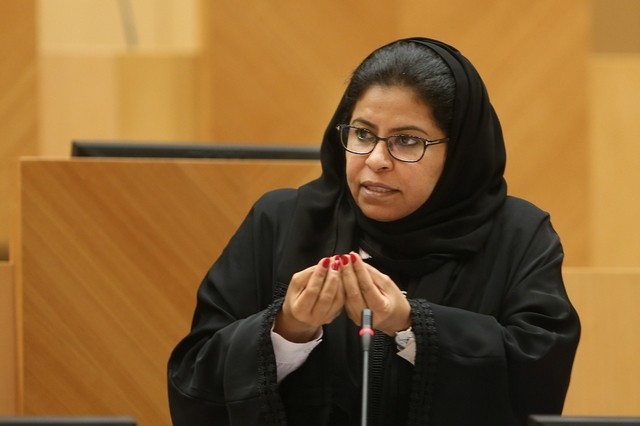
Dr Mona Al Bahar speaks passionately at an FNC session in Abu Dhabi. Delores Johnson / The National

Abu Dhabi :

Determination has been a major drive in Dr Mona Al Bahar’s career.

As a freshman at UAE University in the 1980s, she was keen to join the social services sector to help revive a profession where there was little or no enrolment of Emirati women.

And at age 18 established a society to assist Emiratis with special needs in Sharjah. Later she became the first Emirati social worker with a doctorate from a US university.

“There is a very negative view in the western world of Arab and Gulf women,” she said.

“They view women as opinionless and weak. I first felt this [while studying for her doctorate] at Ohio State University at the social service college.

“I felt they were all questioning if I could compete with other students as an Arab and a Gulf woman. Some asked me ‘Do you feel you can compete and continue?’ That was a big challenge and I took a decision to be an example and to prove not only myself, but the Arabic, Emirati women.”

In 1997, Dr Al Bahar obtained her doctoral degree and was awarded the Morris Cornell Distinguished Researcher Award. Her name was engraved at the university’s entrance alongside those of other winners.

Once back in the UAE, Dr Al Bahar returned to UAE University, where she worked as an assistant professor for several years.

Later, she returned to her home emirate of Dubai, where she joined the Dubai Foundation for Women and Children, which provides refuge and support to the most vulnerable.

In 2011, Dr Al Bahar then received an unexpected phone call. Sheikh Mohammed bin Rashid, Vice President and Ruler of Dubai, chose her as a Federal National Council member.

She is now one of the most vocal women on the council.

“Entering the FNC was a turning point in my career,” she said.

“It widened horizons and provided experience I would not have gained in any other entity or job.

“Working in the FNC carries its own challenges. And I, in all honesty, am thrilled with this experience because it helped me to discover sides of myself and my abilities I would not have been introduced to without this experience.”

She was one of the first to ask to join the council’s education, media and youth committee, where she was later elected chairwoman.

She also supported the country’s first children’s rights legislation and pushed the council to pass a controversial clause in the law allowing specialists unprecedented power to remove children from their homes if found to be in imminent danger. With the public, she has repeatedly tried to keep herself available to those who need her, even taking part in a public majlis to allow as many Emiratis to approach her as possible. As much as her profession has helped her in the FNC, her former students’ words serve as a testament to how important her decision to join her field was all those years ago.

“When a student comes to me and says ‘Thank you doctor, you changed a lot in my life’, I consider that a crown,” she said. “It is a drive and reassures me that my profession was the right choice.

“When I see a positive change in these students, either in their thinking or their personal life, that makes me love my profession more.” With her four-year term of office near its end, she is unsure of what life post-FNC will bring, but is confident it will involve academia and coffee.

“My passion for coffee drove me to establish a coffee museum with a few friends in Dubai,” she said.

“This project was an idea and a dream. With work, the dream became a reality.”

The museum is the first of its kind in the UAE and the second in the Middle East, in Al Fahidi, Bur Dubai, where visitors can learn about the origins of coffee.

source: http://www.thenational.ae / The National / Home> UAE> Arts & Lifestyle / by Ola Salem / March 07th, 2015
Kodagu readies for first-ever Mud Festival, Obstacle Racing

Obstacle racing, that pulsating mix of hyper-active adventure, rugged trekking, endurance walks through relentless woods is finally here. For the first time in this part of the world, the event will unfold as Earth Quest, a three-day Mud Festival in Coorg from April 17 to 19. A test of stamina, strength and skills, the race couldn’t have got tougher!

MudFestivalKF12mar2015

Running through rivers, ditches, hills, woods and open paddy fields, the race is inspired by the globally renowned Spartan Race. Devised by adventure travel buff Ricky Monnappa and wildlife photographer Uthaiah Cheppudira, the event has on its side, live music shows, art installations, flea markets and more.

For starters, obstacle racing has the contestants travel on foot and overcome a slew of physical challenges lined up as obstacles. Mud and trail runs are combined to make the races extremely tough to endure. The competitors are pushed to the limits of their mental and physical endurance.

Explained Monnappa, “Obstacles include, but are not limited to, climbing over walls, carrying heavy objects, traversing bodies of water, crawling under barbed wire, and jumping through fire.”

Many obstacles are similar to those used in military training, while others are unique to obstacle racing.

But why call it a mud festival? “For once, you are not actively trying to avoid the mud. Instead, you are told to go through it. Not only does traversing an obstacle course race while you are soaked with mud add a level of difficulty to your run, but it is downright fun. Admit it, your inner child comes out when there are giant mud puddles to splash in.” This is the Earth Quest rationale, as elaborated by Uthaiah.

Beyond adventure, the event is also designed as a platform for dynamic social gathering.
“The aspect of camaraderie within these races is the backbone of ongoing wellness. You can turn your training, your fitness, and your ‘working out’ into a social gathering, enabling a group of people to help you meet your fitness goals on an ongoing basis.”

The event has another key objective: Clean Coorg, a campaign to be executed jointly by the crew and participants. “Signboards with responsible tourism quotes will be placed all along the route. Travellers to the event will be educated on social media about responsible tourism. Recycled bins will be installed everywhere on the route map,” said Monnappa.

For more on the event, check the website: www.the-earthquest.com or log on to their Facebook page at: www.-facebook.com/theearthquest

source: http://www.deccanherald.com / Deccan Herald / Home> State / by Rasheed Kappan / DHNS – Bengaluru, March 05th, 2015

Amend Constitution to protect regional languages: Manu Baligar

The Supreme Court’s verdict that the State can’t impose medium of instruction has had an impact on regional languages.

The only alternative before the State government is to exert pressure on the Centre and bring in an amendment to the Constitution, said writer and Kannada and Culture department retired commissioner Manu Baligar.

Speaking after inaugurating Somwarpet taluk Kannada literary meet here on Sunday, he said that elected representatives and officials should bring in an amendment to the Constitution to protect regional languages.

“We need to empower Kannada language. The Kannada software needs to be further developed. The State government should implement the recommendations of the committee headed by Chidananda Gowda. Kannadigas are not only those who speak Kannada as their mother tongue but also those who have respect for Kannada land, water and language,” he said.

In his presidential address, Bacharaniyanda P Appanna said the State government should initiate measures to provide 50 per cent reservation in government jobs for all those who have studied in Kannada medium up to 10th standard.

“Today, we have Kannada medium schools in villages with all basic facilities. However, the schools have failed to attract students. People are obsessed with English language. This fascination has reached such limits that Kannada medium schools are closing down. Kannada Sahitya Parishat should conduct various competitions to promote Kannada. Kannada books library should be opened in all gram panchayat offices,” he added.

He remembered the contributions of John Michael, William Reev, Herman Mogling, and Rev Kittel to the development of Kannada language.

Kannada schools were opened in Kodagu in 1837. The rich people in Kodagu were fascinated towards English. However, it was teachers and experts from Mangaluru and Mysuru who contributed to the growth of Kannada in Kodagu, he added.
DH News Service

source: http://www.deccanherald.com / Deccan Herald / Home> District / by Nelyahudikeri (Somwarpet Taluk) / DHNS – March 01st, 2015

Rohan Bopanna, Daniel Nestor win Dubai ATP title

Dubai:

India’s Rohan Bopanna and his partner Daniel Nestor grabbed their second ATP title of the season by subduing Aisam-ul-haq Qureshi and Nenad Zimonjic in the summit clash of the Dubai Duty Free championships on Saturday.

The fourth-seeded Indo-Canadian combine raced to a 6-4 6-1 win in just 50 minutes against the unseeded Serbian-Pakistani team. It was Bopanna’s 12th career ATP doubles title and second with Nestor.

Bopanna and Nestor saved an early break chance in the opening set and never looked back after that.

They broke the rivals at the first available opportunity to pocket the first set and just ran away with the second to wrap up the match in a jiffy.

Bopanna and Nestor had won their first title in Sydney, early in the season.

The winners split USD 149,170 as prize money and earned 500 ranking points each.

source: http://www.ibnlive.in.com / IBN Live / Home> IBN Live> Tennis / Press Trust of India / February 28th, 2015

Noida-based barista brews his way to history

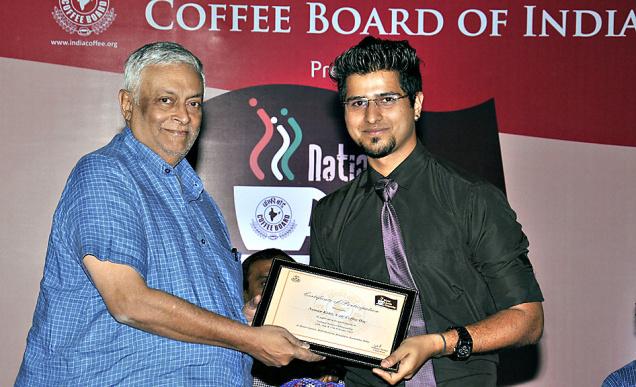
Naman Kohli claiming the National Barista Championship in Bengaluru on Friday.

A lot can happen over coffee and a 22-year-old Noida-based barista proved this as he brewed history on Friday. Cafe Coffee Day, Noida’s barista Naman Kohli became the youngest winner in the two-year history of the National Barista Championship, the finals of which were held here on Friday.

Naman’s signature brew ‘Pixel’, named after his pet dog, proved to be a gustatory delight, not only for the judges, but also veteran barista and World Barista Championship winner Vikram Khurana, who said, “The Pixel brew was nothing short of the magical brews of Rome and Milan, and could very well win the World Championship.”

Naman’s joys were compounded when Anil Kumar, Vice-Chairman, Coffee Board of India, announced that for the first time, the winner would be sent abroad to represent the country in the World Barista Championship. “I finally need to get a passport made,” said an ecstatic Naman.

The national championship commenced with the first round being held in New Delhi and Bengaluru, in which 12 of more than 55 baristas from the north and south regions were shortlisted to go neck-to-neck in the final round in the city. Each barista was given 15 minutes to brew four espressos, four cappuccinos and four signature brews of their choice.

source: http://www.thehindu.com / The Hindu / Home> News> Cities> Bengaluru / by Staff Reporter / Bengaluru – February 28th, 2015

Instant coffee definitely a Kiwi brew

http://www.3news.co.nz/nznews/instant-coffee-definitely-a-kiwi-brew-2015011518#axzz3ThL3V3wq

As the debate over who invented the flat white rumbles on, it’s a good time to highlight that instant coffee was actually invented in Invercargill.

For over a decade a Japanese scientist was credited with the invention, but just recently it’s been revealed that Southland spice and coffee merchant David Strang was actually the first to develop a powdered form of coffee in the 1800s.

“His claim to fame is the invention of instant coffee, an invention he patented in 1890, and that’s the earliest recorded patent for instant coffee in the world,” says Tracey Wedge of Southland Museum.

But Mr Strang’s role in coffee history was basically forgotten, until memories were reignited a few years ago when the Historic Places Trust registered his son James’ house.

Since then the Southland Museum has built an exhibition around Strang memorabilia, including some very old tins of some of the first ever instant soluble powdered coffee.

“It revolutionised coffee consumption around the world. Instant coffee became a household product,” says Ms Wedge.

Mr Strang is believed to have invented the powder by blowing hot, dry air over liquid coffee until it reduced.

While he admits Mr Strang’s invention was ground-breaking, coffee connoisseur Arjun Haszard doubts it would have tasted any good.

“By using heat on that coffee you’d see a lot of flavour deterioration, a lot of over-extraction and very horrible flavours coming out,” says Mr Haszard.

But even so, Invercargill locals were surprised to hear their town had a new claim to fame.

“Wow, there you go, you learn something new every day, don’t you,” said one local.
“It’s very clever, isn’t it,” said another.

While Southlanders have produced a handful of inventions, instant coffee is the only one to have gone completely global.

3 News
source: http://www.3news.co.nz / 3 News / by Kloe Palmer, Reporter / Thursday – January 15th, 2015

Report on ways to offset eco impact of power line in Kodagu taking shape

The State Forest department is preparing a report on ways to mitigate the impact on the environment in Kodagu, when the 400 KV high tension power line is laid.

The report on the environment mitigation plan comprises short-term and long-term measures.

The measures are being listed keeping in mind development and protection of green cover.

It will be sent to the government by the end of this week, which will then be forwarded to the Power Grid Corporation and the Union government for funds and approval, Principal Chief Conservator of Forests (wildlife) Vinay Luthra told Deccan Herald.

Some of the listed measures include organising anti-depredation camps, building better barriers, not disrupting the existing waterholes, providing natural fodder spaces for animals, not using weapons against animals and if carrying weapons, getting them registered with the Forest department to ensure that animals are not harmed, not coming in contact with animals, not indulging in afforestation activities, not camping inside forest areas, reducing loss of green cover as much as possible and in regard to work in forest areas, ensuring that all permissions have been obtained and following rules like no-stay inside the forest during night hours, not hunting, not entering restricted forest area without permission and so on.

The report plans to ensure that no human or animal casualty is reported, but in the last 30 days two people have died due to man-elephant conflict and one person sustained injuries while working near coffee estates.

The power line from Mysuru to Kozhikode will pass through Kodagu. Of the 210-km line, 50 km will pass through coffee and paddy fields in Kodagu and the rest is through pristine Western Ghats regions – touching borders of Nagarahole Tiger Reserve, Dubare and Devamachi Reserve Forests.

This line is part of the central power grid project and will supply power to many southern regions, including Bengaluru.

Due to protests, this project been delayed by over five years. Lines have already been laid till Mysuru and Kerala, except some patches in Wyanad. It was to be completed in 2007, but was stalled. Work started again in November 2014.

During a meeting of agitators from Kodagu and power corporation companies last week, Energy Minister D K Shivakumar affirmed that the project would not be held back or delayed further. Shivakumar said that the project was important for Bengaluru and industries, to ensure 22-hour power supply daily, especially during summers. But agitators from Kodagu said that it was a scam. C P Muthanna, a retired colonel in the Army and president of the Coorg Wildlife Society, pointed out that there was already a 220-KV line in the region, which can be upgraded to 400 KV and used, instead of occupying fresh land and axing over 50,000 trees for the new line.
DH News Service

source: http://www.deccanherald.com / Deccan Herald / Home> State / by Bosky Khanna, Bengaluru / DHNS – February 17th, 2015

Whose garden is this in the heart of our city?

Bengaluru :

Brigadier who carved the 22-acre Cariappa park out of defence land near MG Road slams colleagues for barring entry to public The man who opened the Army’s doors to Bengalureans has slammed his colleagues for barring the city’s residents from entering the Cariappa Memorial Park in the heart of the city.

(The 22-acre park was meant…)

The 22-acre park was meant to be the Army’s gift to the city but has been closed since 1998, two years after it was inaugurated. A board next to the now-abandoned park’s gate reads: `Restricted area’. The present Army establishment in the state says the park area, categorized as A1 defence land, cannot be made available to the public under Ministry of Defense guidelines.

Brigadier (Retd) Ashok Nagpaul, who established the park on defence land to foster closer interaction between the Army and public, said the Army cannot block entry into the park. “The land not only belongs to the defence but also to the people of Bengaluru,” said the former Commanding Officer for Karnataka and Kerala.

“There was 57 acres of land lying wasted. There were illegal activities like prostitution and other things that used to happen in that area, so I decided to build a parade ground and the park,” Nagpaul, 72, said over the phone from Pune.

A top Army official said that with defence land being rampantly encroached on, the Army cannot afford to give its land for public use.”In 1994 maybe people were not conscious about utilization of defence land, but consequent to which in lots of places we started losing defence land, and … very stringent guidelines were framed that you cannot use defence land for public purposes,” the official told ET, declining to be identified.

Until 1994, the park area was part of a larger parcel of land between Cubbon Road and MG Road.

source:http://www.articles.economictimes.indiatimes.com / The Economic Times / Home> Collection> MG Road / by ET Bureau / February 17th, 2015

Cariappa’s Rs 2.4cr is an unreal dream for family

Bengaluru :

Maruthi Nilaya, a modest dwelling in Bagalugunte, an area adjoining bustling Yeshwantpur, was just another house until Monday afternoon. The family of KC Cariappa, living in a first-floor house, was the typical financially struggling but happy foursome. But on Tuesday, there were curious glances and knowing smiles as people flocked to their home.

The search for Cariappa’s house didn’t take long as a child perched on a compound asked, “Cariappa mane huduktaa iddeera?” (Are you looking for Cariappa’s house?). Before waiting for a reply, he pointed towards the house. The skinny kid — like the other residents of the street and the country now — knew who Konganda Charamanna Cariappa is.

Life has taken a dramatic turn for the spinner, who was bought by Kolkata Knight Riders for a jaw-dropping Rs 2.4 crore — 24 times his base price. The family can’t believe it. After a tiring overnight bus journey from Shivamogga, where he played a league match, Cariappa sat down to watch the IPL auctions with his family.

When KKR first put the paddle up, he admitted, he clapped for himself. Every member of the close-knit family had tears of joy.

Prathima, Cariappa’s mother and a housewife, summed up the scene: “The auction apart, just to hear his name being called out was enough to make me cry. When the bidding was over, it felt unreal that he had commanded a price like that. It still feels like a dream, one which we hope will never end.”

In less than three minutes, the youngster, named after Field Marshal General K M Cariappa, went from a budding cricketer to a crorepati.

“We stay in a rented house for which we pay Rs 5,000 a month. We have lived here for 12 years and haven’t had enough resources to repair it. I first want to buy a house for my family. I want to give the rest of the money to my parents,” the 20-year-old told TOI.

Will he gift himself a mean machine? “No. I am not interested in bikes and cars. I spent all my time working towards my dream of making it big as a cricketer, so I had no time to dream about fancy vehicles. For me, it is just a mode of commuting. Until a year ago, when I bought a gearless two-wheeler, I travelled by bus,” said Cariappa, who has been mentored by former Ranji player Sudhindra Shinde.

Coming from a youngster who has just won a ticket to the glitzy world of IPL, the statement may seem shocking; but given his hard life, he knows the value of every penny earned. For Rs 10 per day is the pocket money he and his older brother, Nanaiah, receive.

“It was all we can afford, and our children know that. Cariappa would leave home at 4.30, change two buses and walk from Shivajinagar to reach Chinnaswamy Stadium by 6am. But he never complained. Both our children know hard pressed we are for money,” Pratima confided.

Four years ago, when Cariappa made it clear cricket was his true passion, his father, a Charmanna, a supervisor at Kodava Samaja, could not afford the Rs 6,500 that was required to enroll him in a coaching camp and buy a cricket kit. But the doting father from Virajpet dug into his meagre savings and borrowed from friends to ensure his son had the basics.

“When he first said he didn’t want to study, I was very worried because I know the importance of education. People around me asked me to discourage him and said talent alone would not get him anywhere. We needed political influence and money to see him go the distance. I didn’t have either. But he was adamant, and said the pads were his books, the bat his pen, and he would script his life’s path with a ball in hand,” Charmanna said.

Elaborating on his son’s struggle, the man who earns a little over Rs 20,000 a month said: “I often give Cariappa Rs 100 for fuel. After filling petrol, he has little money left. Although I rarely show emotions at home, I sit at work and worry if my son has eaten or how he will manage if his vehicle breaks down. My face brightened after the auction.”

Cariappa, for his part, has realigned his priorities. While his pre-Monday ambition was to play for Karnataka in the Ranji Trophy, he now wants to play for Team India.

For a youngster who has dared to dream, it surely is no lofty ambition.

source: http://www.timesofindia.indiatimes.com / The Times of India / Home> City> Bengaluru> Namma Metro / TNN / February 18th, 2015

Coorg girl and Kashmiri Boy win Clean & Clear Times Fresh Face 2014 in Mumbai

In a nail-biting national finale, MM Rashmika from MS Ramaiah College of Arts, Science and Commerce, and Zaid Shaikh from Ness Wadia College of Commerce were chosen the winners.

Akshay Kumar with winners

With the handsome Akshay and Rana in their midst and Ankit Tiwari closing the evening with a soulful show, the audience were in for a memorable evening. For the contest, the girls were dressed in creations by designer Masaba Gupta and Nisha Sainani, while the boys sported designer Kunal Rawal’s dapper outfits.

source: http://www.timesofindia.indiatimes.com / The Times of India / Home> Entertainment> Events / by Garima Sharma, TNN / January 28th, 2015