Category Archives: Records, All

Verbattle junior, senior at Mangalore on August 1, 2

Mangalore :

The Mangalore zonal selection for Verbattle Junior will be held on August 1 and the selection for the Verbattle senior competition will be held on August 2 here.

The zonal selection round will be held at Samruddhi Bhavan between 9.30 am to 1 pm and between 1.30 pm to 4 pm. The team that would emerge as the sole winner among hundreds of teams participating will be awarded a grand cash prize of Rs. 1 lakh in the Junior Category. The winning team from the Beginner level will receive Rs 30,000; the winning team from Senior Category will receive Rs 50,000.

Verbattle, the country’s largest and most successful inter-school debate competition conducted by Verbattle Foundation had kicked off its tenth edition with Verbattle Beginner competitions in Bangalore on July 21.

Verbattle will be hosted and supervised by Deepak Thimaya. This year, around 1,200 students of schools and colleges are expected to actively participate in the Verbattle competition.

The selection process for the first round of Verbattle is physically conducted for two days in each of the three zones of Karnataka, namely Mangalore, Hubli and Bangalore. The selected teams are then brought to Bangalore, 27 teams from each zone, and in a spread of three weeks, the ensuing events are conducted in Bangalore. The semi-finals and finals for Verbattle Junior and Senior will be held on August 22nd, 2014. The final debates will be moderated by Thimaya and judged by some of the eminent personalities from the state.

Deepak Thimaya said: In the last nine years, we have brought together thousands of school and college students on a common platform. We have given out Rs. 21 lakh as prize money since its inception. This year Verbattle aims to make the tournament bigger and a platform of great learning experience.

Till date Verbattle has conducted 20 state level competitions in Karnataka – nine Verbattle Junior and five Verbattle Senior and also five Verbattle Beginner competitions in Bangalore. For the first time a South India level competition – Verbattle South – was held in January, 2012 after state level competitions in Tamil Nadu, Andhra Pradesh and Kerala along with Verbattle Karnataka. Currently Verbattle is organizing state, regional, national and international competitions along with its other activities such as Verbattle Forum, Club and Leadership programs.

Schools and colleges interested to participate can register by logging on to www.verbattle.com.

source: http://www.timesofindia.indiatimes.com / The Times of India / Home> City> Mangalore / Stanley Pinto, TNN / July 30th, 2014
Vartika Katiyar is SP for Kodagu

Vartika Katiyar took charge as the new Superintendent of Police of Kodagu on Tuesday.

Earlier, she was the Additional Superintendent of Police of Gokak for one year, and she is the first woman holding the post of SP in Kodagu.

Speaking to presspersons at Madikeri, Ms. Katiyar said she was inspired to join the Indian Police Service to serve society and senior women police officers.

source: http://www.thehindu.com / The Hindu / Home> National> Karnataka / by Special Correspondent / Mysore – August 06th, 2014

‘Madikeri to get water from Kundamestri shortly’

The work on a temporary project to supply water from Kundamestri is nearing completion. The water from Kundamestri is likely to be supplied to the citizens of Madikeri by the week end.

Sand bunds have been laid to store water. The collected water will be supplied to Kootuhole through pipes. After filtering the water at a Filter house at Stuart Hill, water will be supplied to the citizens.

Madikeri reels under water crisis every year during summer. The work on Kundamestri project was initiated to mitigate water crisis.

However, owing to delay in release of funds, the work could not be completed. Now the estimated cost of the project has been escalated.

The Kundamestri project is being implemented by Karnataka Water Supply and Sewage Board. It will take another one year to complete the work.

Board Executive Engineer Balachandra has expressed confidence of completing the work. The project has been taken up keeping in mind the development of Madikeri in the next 50 years.

When the water level declines in Kootuhole, water will be supplied from Kundamestri to Kootuhole.

source: http://www.deccanherald.com / Deccan Herald / Home> District / Srikanth Kallammanavar / Madikeri – DHNS, July 26th, 2014

Undivided we Stand!

Udaka Mandala is Karnataka’s other place by the waters that became more famous as Ooty, or Ootacamund thanks to the Brits. Elsewhere, the denizens of John Bull’s Island changed Mumbai to Bombay and Beijing to Peking.

However, like the refreshing confluences of rivers, the close encounters of the cultural kind led to enriching mergers and acquisitions. A fine example is the Omkareshwara Temple at Madikeri, which is not far from the sacred confluence. King Lingarajendra built it in 1820 around a central pool using a mix of Islamic and Gothic styles.

The golden-domed shrine with its whitewashed walls and red borders is dedicated to Shiva in the form of a Linga brought from Benares. Both Lingarajendra and his predecessor Virarajendra are buried in a compound north of Madikeri.

Outwardly, these domed tombs with their short minarets look like Islamic monuments but they are richly embellished inside with Shaivite symbols and imagery. The syncretism that led to the creation of these memorials was definitely ahead of its times.

The revival of Indo-Saracenic style in Bombay, Madras, Calcutta and Delhi came later.

This required a spirit of amity and cultural convergence. This is best summed up in a quote from the Panchatantra engraved on the lintels of the Parliament building designed by Sir Edwin Lutyens and Herbert Baker some 20 years before Independence: “That one is mine and the other a stranger is the concept of little minds . But to the large-hearted , the world itself is their family.”

source: http://www.articles.economictimes.com / The Economic Times / Home> Collections> Bombay / by Vithal C. Nadkarni, ET Bureau / May 31st, 2013

Tata Coffee receives accolades at the Golden Peacock Awards 2014

Tata Coffee Limited, India’s coffee producer and exporter of gourmet coffee, announced its win at the Golden Peacock Awards 2014, for excellence in ‘Environment Management’ in the ‘Beverages’ category. Golden Peacock Environment Management Award (GPEMA) is the coveted recognition that organisations across India strive to achieve for environment management.

The award was presented as part of the two-day ‘ 16th World Congress on Environment Management’ in New Delhi on July 11 and 12, 2014. Tata Coffee was declared the winner amidst a distinguished gathering of business leaders, jurists, academics, environmentalists, economists, legislators and policy makers. Present as Guest of Honour was Atul Chaturvedi (IAS), Chairman – Public Enterprises Selection Board.

Hameed Huq, Managing Director, Tata Coffee Limited said, “It is a proud moment for the company to be applauded on a national platform such as the Golden Peacock Awards 2014. Tata Coffee has consistently been committed to environment protection and we rely and coexist with nature at our coffee plantations. We promote eco-tourism and sustainability. We are constantly improving the quality of coffee through sustainable practices and agronomy solutions.”

Tata Coffee has been revered for excellence in ‘Environment Management’ based on its system by conservation of water and energy resources and effective utilisation of renewable energy resources. Tata Coffee is also known as a carbon-negative company as it upholds its biodiversity conservation practices.

Tata Coffee has 19 coffee estates in India which produce varieties of Arabica and Robusta coffees. The plantations adopt sustainable practices in irrigation, water management, and pest control. The plantations have set up bee hives to increase the dwindling bee population and bee activity, which, in turn, will serve the purpose of cross pollination, especially for the Robusta coffee.

Sustainable practices have their benefits, including important certifications: among these, the Utz Kapeh certification, which validates that coffees from the Tata Coffee plantations have not been exposed to harmful chemicals and processes, and the Rainforest Alliance certification, which validates the company’s sourcing and growing practices. Tata Coffee was also the first plantation company in the world to get SA 8000 certification, which recognises a company’s fair employment practices.

This year’s awards were declared by the Awards Jury under the Chairmanship of Justice P. N. Bhagwati, former Chief Justice of India and Co-Chairmanship of Justice and UN Human Rights Commission and co-chaired by Justice (Dr.) Arijit Pasayat, Chairman, Authority for Advance Ruling (Customs, Central Excise and Service Tax) and former Judge, Supreme Court of India & former Chairman, Competition Appellate Tribunal of India & Authority for Advance Ruling (Customs, Central Excise & Service Tax) and Lt Gen J S Ahluwalia, PVSM (retd), President, Institute of Directors.The award for the Environment Management System (EMS) is a powerful tool to evaluate oneself in an ecological sphere.

source: http://www.hospitalitybizindia.com / Hospitality Biz India.com / Home> F&B Overview> F&B / by HBI Staff, Mumbai / Wednesday – July 16th, 2014

Madikeri Farmer Eyes Record With 41-ft Cane

Madikeri :

B Hoovaiah is a happy man. A stalk of sugarcane grown by Hoovaiah in Madikeri is all set to enter the Guinness Records as the tallest in the world. The earlier record, set in 2001, was held by Venkatesh Gowda of Kolar.

Hoovaiah, a BSNL tower operator in Convent Junction in Madikeri, has been protecting the cane for three years now. All the required inspections have been completed by expert committees and a team from Guinness is expected to arrive shortly, before an official announcement can be made.

Hoovaiah told Express that an expert team inspected the stalk and measured it at 41.1 feet.

He then formally approached the Guinness authorities, asking them to consider it for a world record.

Later, he received an acknowledgement from Guinness records in-charge, Era Norroy.

Hoovaiah, who served in the Indian Army for 26 years, lives at Bettathoor in Madikeri taluk and has served as a tower operator for 11 years.

He expressed happiness that the cane had been grown organically.

source: http://www.newindianexpress.com / The New Indian Express / home> States> Karnataka / by B C Dinesh / July 10th, 2014

Coffee Board projects record crop next season

ChartKF13jul2014

Growers sceptical due to prolonged dry period, borer menace

Chennai :
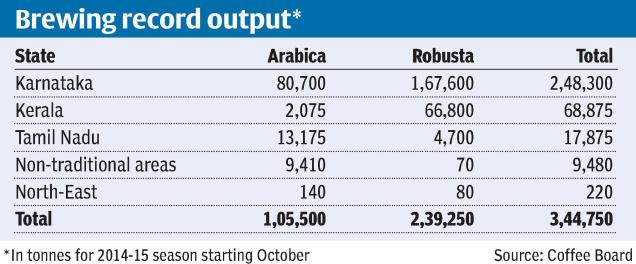
The Coffee Board has projected a record crop of 3.44 lakh tonnes (lt) for the new season beginning October, but growers are sceptical about the estimates.

According to the Coffee Board’s post-blossom estimate, Arabica output will be 1.05 lt and Robusta 2.34 lt. (The estimate of crop made after the coffee plant blossoms and spikes develop on the plant is the post-blossom estimate.)

This is against a revised estimate of 3.04 lt this season ending September (1.02 lt Arabica and 2.02 lt Robusta).

“I think this output could be difficult to achieve, especially with regard to Arabica. This is because even in best-maintained plantations, there is heavy infestation of the white stem borer,” said Anil K Bhandari, former president of the United Planters’ Association of Southern India, and an exporter.

Other opinions
“Such levels of production cannot come from the original area under coffee in the country. This year, most planters are complaining that their output will be down by at least 40 per cent as far as Arabica is concerned. In my own estates, the output will drop to 10 tonnes from 40 tonnes,” said Bose Mandanna, former Coffee Board Vice-Chairman and a planter in Kodagu, Karnataka.

Due to a prolonged dry season, the menace of the white stem borer, which has been wreaking havoc in coffee plantations over the past decade, is a serious threat this year.

“Maybe, the estimate put out by the Coffee Board was the situation prevalent during blossom. After that, there has been a tremendous loss in the estates due to the borer menace,” said Bhandari.

This year, coffee estates are reported to have received timely showers for blossoming of the coffee flower. Follow-up showers, required for growth of the plant, were also good before the borer menace spread panic.

According to the Board estimate, Karnataka will contribute 72 per cent of the coffee production next season, up from nearly 70 per cent this season. Output in Karnataka will be 2.48 lt (80,700 tonnes Arabica and 1.67 lt robusta) against 2.11 lt this season (78,440 tonnes Arabica and 1.32 lt Robusta).

Kodagu’s contribution will be 43 per cent with 20,150 tonnes of Arabica and 1.13 lt of Robusta (21,040 tonnes Arabica and 90,820 tonnes of Robusta). Last year, its contribution to the country’s coffee production was 36 per cent.

Fears of drought

“It is almost like a drought situation in Kodagu. It is unlikely that the district will provide so much coffee this year,” Mandanna said.

“It is likely that the Coffee Board could revise the estimate downwards after taking into account the effect of monsoon and other things. It should carry out another estimate later and put it out during October-November. That could perhaps reflect a correct picture,” Bhandari said.

According to plantation industry sources, for the last few years, the Coffee Board has been putting out a higher projection of the crop in its post-blossom estimate.

“This has been happening for sometime now. They come out with a higher figure and then revise it. Who gains from such estimates,?” a source wondered.

Last year, the Coffee Board initially estimated the crop at a record 3.47 lakh tonnes before pegging it finally at 3.04 lakh tonnes.

This season’s production estimate was lowered after heavy rains in the growing areas led to wet feet in coffee plants resulting in the roots growth freezing. This led to coffee berries falling off the plant, leading to loss.

“The Board has to revise its methodology in estimating the crop. Then, perhaps it could be nearer to reality,” the source said.

source: http://ww.thehindubusinessline.com / Business Line / Home> Markets> Commodities / by MR Subramani / Chennai – July 08th, 2014

CCTV cameras at Talacauvery, Bhagmandala

Deputy Commissioner Anurag Tiwari has said that CCTV cameras will be installed at religious centres of Talacauvery and Bhagmandala.

Chairing a meeting to discuss the second phase development works initiated in Sri Bhagandeshwara-Talacauvery temples, at Bhagamandala on Saturday, he said that there has been a rise in number of visitors visiting the temples. Hence, it was essential to install CCTV cameras for the security of the region.

The DC said that measures have been taken to construct a hall to serve meals for the devotees. He also directed the officials to identify land for the construction of Yatri Nivas.
He said that there was a need to ban use of plastics in and around the temple.

The use of leaves and taking bath in the river should also be banned. Measures should be taken to ensure that no waste water entered river Cauvery.

Temple committee and gram panchayat should identify space for parking vehicles at Bhagamandala Triveni Sangama and Talacauvery temple.

Temple development committee President Manu Muthappa said that there was need to improve basic facilities for the devotees and construct a hall to serve food for the devotees.

source: http://www.deccanherald.com / Deccan Herald / Home> District / Madikeri – DHNS, July 06th, 2014

Total deemed forest area in Kodagu may be ready soon

With the revenue, forest and land survey departments initiating the process of consolidating the land records of deemed forest in accordance with the survey number, a clear picture on the total area of deemed forest in Kodagu district is likely to be available in next 15 days.

According to sources, the decision to accumulate information on deemed forest has been taken in a district level meeting chaired by Deputy Commissioner Anurag Tiwari, based on the government’s order to re-examine deemed forest records.

Deemed forest is described as private land with features of the forest.

The government has already issued notification declaring various classifications of forests including reserve forest, protected/minor forest, sacred grove, Uruduve, sandal-teak reserve, village forest and Paisari. After collecting details about the already declared forest region, the officials are planning to examine private forest.

The deemed forest identified by the government in the past, comprised of Jamma Malai, Bane and C and D land.

The land records of these land was different with forest and revenue department documents, creating confusion not only among the public, but also in the government level.

In order to clear the confusion, the government has directed the district administration to specifically identify the notified forest and deemed forest.

It was based on this order, the deputy commissioner chaired a meeting to discuss the issue on Wednesday.

Additional Deputy Commissioner H Prasanna, Deputy Conservator of Forest Hnaumanthappa and Dhananjay, Land Records Deputy Director Mallikarjunaiah, tahsildars of Madikeri, Somwarpet and Virajpet and other officers were present in the meeting.

Background

In Godaverman case judgement, the Supreme Court had directed all the states to provide information about the forest land in their limits.

The court had specified to consider the word ‘forest’ as per its connotation in the dictionary.

According to the dictionary, forest implies a land spreading across at least 2.5 hectare with minimum 50 trees in it.

Accordingly, a large portion of private land in Kodagu district too comes under the purview of ‘forest’ as they are spread over 2.5 hectare land comprising more than 50 trees.

source: http://www.deccanherald.com / Deccan Herald / Home> District / by Shrikanth Kallammanavar / Madikeri – July 04th, 2014

Pages from history : Gandhiji’s visit to Coorg

by Prof. A.V. Narasimha Murthy, former Head, Department of Ancient History & Archaeology, University of Mysore

It is a matter of great joy to me that God has enabled me to come to this beautiful land of Coorg. Eversince I have come here, I have been simply drinking the natural beauty of this place; and I presume your hearts are as beautiful as your scenery. And yet there is lurking in my mind as to the beauty of your hearts; for I see that though there is not poisonous untouchability here that is found in plains; still there is some of it in your midst. For in your address you have said that temples are not open to Harijans. It is just like saying to some of his children ‘I give you food, clothing, housing but I won’t let you come to the sanctuary of my heart.’ Imagine what these children would feel. So long as you do not allow Harijans to enter the temples on the same terms as you do, I cannot say your hearts are beautiful. I wish therefore that you will take a lesson from nature and wash out that black spot from your hearts.” This is the first reaction of Gandhiji regarding the people of Coorg. A handsome compliment indeed!

Accidentally, I came across a book by Dr. G.A. Biradar and I was particularly impressed by a fine article regarding Gandhiji’s visit to Coorg in 1934. It is a well documented article and this narration is based on Biradar’s article.

Mahatma Gandhi was on a tour of Tamil Nadu and was camping at Madras in 1934. It was rumoured that Gandhiji would go to Bangalore and Mysore from there. P.I. Belliappa was a leading Congressman and was the editor of the newspaper Kodagu. He extended an invitation to Gandhiji to pay a visit to Coorg. Gandhiji readily agreed and accompanied by Harijan Sangha President Veerannagowda Patil and others, arrived at Gonikoppa in the evening of 22.2.1934 by car. Immediately he expressed a desire to visit the Harijan Colony. Then Gandhiji went to a village by name Kaikeri near Gonikoppa and saw the dwellings of the Harijans. Gandhiji addressed a meeting attended by about one thousand people, mostly women. A purse of Rs. 25 was presented to Gandhiji and the garland given to Gandhiji was auctioned for Rs. 3. Gandhiji spoke about the plight of the people in Bihar due to earthquake some days ago and requested people to contribute liberally for the relief fund. Then he made an appeal for the Harijan welfare fund, and requested the women to donate their gold jewellery and some ornaments were collected.

From there Gandhiji went to Ponnampet and visited Sarada Ashram and collected Rs. 22 and 1 anna. Then he went to Titimati and met some people and collected Rs. 39 and 9 annas as their contribution. Then he went to Hudikeri and addressed 800 people. The taluk Board Present Chendira Thammayya welcomed Gandhiji and presented a purse of Rs. 72 and 13 annas. The students of the local school did not lag behind and gave Rs. 2 and one anna collected amongst themselves. Gandhiji praised the Kodavas, which has been quoted in the beginning.

Then he returned to Ponnampet and stayed in the local Ramakrishna Ashram where Swami Shambavanandaji received him. He formed a Harijan Welfare Sangha. A purse of Rs. 220 was presented to Gandhiji. In his speech Gandhiji said that he is wedded to religion and he could not live for a single second without religion. His religion was based upon the equality of men and women without any distinction of caste or community. He further stated ‘I go further and say that every activity of man must be derived from religion, because religion means being bound to God and that is to say God rules every breath.’

Then he came to Virajpet and Muslims of that place met Gandhiji and presented an address in Urdu. Gandhiji was surprised to find a Urdu scholar in Coorg. Gandhiji stressed the need for Hindu-Muslim unity as most important. Then Gandhiji came to Basavanahalli in Somavarpet. On his way he stopped at Siddapur where a purse of Rs. 7 was given to him. At Jambur people gave him oranges and some cash. Then Gandhiji went to Manjunathayya’s house where two women removed their ornaments and gave them to Gandhiji. Another young woman removed her bangles and gave it to Gandhiji in the presence of her husband. Gandhiji asked the husband for his reaction. He said that the ornaments belong to her and she can take any decision regarding them. Gandhiji admired him and said you had acted wisely and asked his age. On learning that he was 30, Gandhiji said ‘at your age I did not act wisely; wisdom came later.’ Everybody had a hearty laughter. At Suntikoppa about 200 estate workers had gathered and Gandhiji addressed them and told them to work hard with sincerity and devotion and bring prosperity to the beautiful land.

Then Gandhiji reached Madikeri and went to Raja Seat. Knowing that Gandhiji would be visiting that place, about 4,000 people gathered there to have a glimpse of that great man about whom they had heard so much. He was presented with a purse of Rs. 760. Because of his appeal Gandhiji collected Rs. 82 towards Bihar fund. Gandhiji said that though the journey was strenuous it has given him happiness not because of the scenery of Coorg but because untouchability has a slight hold on the Kodavas.

The Harijans are slowly losing cultivable lands for various reasons. Hence, I call upon the Harijan Sevak Sangha to apply the necessary remedy in order to improve their economic condition. He also made a special mention of the Bihar earthquakes and requested people to donate liberally. He further said that Bihar is a sacred land because of the birth of Sita and Buddha. It would appear to me that God has selected that sacred land for removal of untouchability. Hence, I have asked my volunteers to approach you for contribution to Bihar relief fund. Amount is not important to me because it is a token of tangible sympathy to the suffering. Thus even a copper coin is valuable to me.

After finishing this programme at Raja Seat, Gandhiji went to the house of Smt. C.P. Nanjappa at Madikeri. Gandhiji and his entourage camped there for the night. Smt. Nanjappa presented Gandhiji with a silver cup and saucer and Belliappa gave a gold chain. A wooden tray was auctioned for Rs. 9. Gandhiji conducted a prayer meeting at her house and many Kodavas participated in it. Coorg Municipal President I.C. Subbayya announced that the total collection for the fund at Coorg was Rs. 2,000. Gandhiji slept for the night but got up at 2.45 am. Gandhiji wrote letters to Manilal and Sushila in which he wrote ‘we are in Coorg today. It is a small hilly tract below Mysore. It is a beautiful region, quite small in size. The population must be at the most 150 thousand. Now it is 6 am and at 7 am we will descend from the hilly tract and proceed to Mangalore.’

Some Congressmen tried to discuss the political situation of Coorg but Gandhiji avoided the issue. He said that he had come to Coorg to show his appreciation to the Kodavas because they are different from the entire country in matter of Harijan issue. Hence, I have come here for Harijan work and also seeing the beautiful land of nature and to meet the people of this land. Thus he refused to comment on the political condition of Coorg. For the Kodavas it was a great and memorable experience to see a person whom the entire country and even the world watched with respect and admiration. Thus, the leaders and people of Coorg felt sanctified by the visit of this great savant Gandhiji. Anyway this is a rare and memorable chapter in the modern history of Coorg.

source: http://www.starofmysore.com / Star of Mysore / Home> Feature Articles / June 28th, 2014