Category Archives: Records, All

Nanaiah’s parting request: make Council mandatory in every State

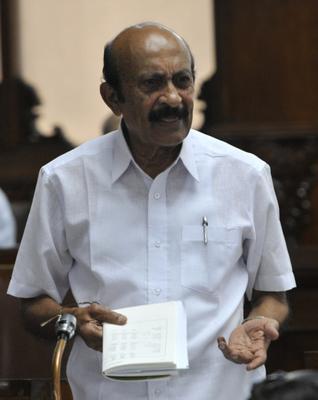
M.C. Nanaiah
M.C. Nanaiah

This will facilitate threadbare discussions on all legislations, he says

M.C. Nanaiah of the Janata Dal (Secular), on the day of his retirement on Monday, made an impassioned plea to Chairman of the Legislative Council D.H. Shankaramurthy in the Upper House to take up the issue of an amendment to the Constitution so asto have a Legislative Council in every State. This would facilitate threadbare discussions on all legislations.

Delivering his last speech as member of the House, Mr. Nanaiah said such an Act was necessary in view of the seriousness with which bills have to be discussed before their passage. He said that the Constituent Assembly had allowed Rajya Sabha to be a permanent House, while not extending the same facility to the Council in States. This lacuna must be corrected.

Giving a chronological history of the House, he said it came into existence in 1881 as Mysore Representative Assembly and became the Legislative Council in 1907. The Legislative Assembly came into being in 1952 after the first general elections. The Council is the oldest and has the natural right to continue, he said, arguing against the opinion of some who said the Upper House was not necessary.

He said Members of the Congress, Lower House, in the United States, used to say that “they pour the legislations into the senatorial saucer for cooling” and added that the American Congress members were of the view that the legislations vetted by the Senators were the only ones that could be considered as law.

He wanted Indian politicians to learn from such an observation.

Supporting M.V. Rajasekharan’s (Congress) criticism that moneybags were entering the portals of Parliament and State legislatures, Mr. Nanaiah reminded him that former Prime Minister A.B. Vajpayee had passed a remark before presspersons when they asked him about his government’s defeat by one vote in 1996: “There are commodities for sale in the market and brokers too, but I was not ready to purchase them.”

Mr. Rajasekharan (Congress), who also retired, expressed his happiness over his achievement as Union Minister of State for Planning during which he was instrumental in raising the plan outlay from around Rs.10,000 crore to Rs.13,000 crore.

The others who retired are S.R. Leela, Doddarange Gowda, M.R. Doreswamy, B.B. Shivappa, Bharati Shetty, K.V. Narayana Swamy, Siddaraju, K. Monappa Bhandari and A.H. Shivayogiswamy. Puttanna (JD-S) and K. Abdul Jabbar (Congress), who have been re-elected, have returned to the House.

source: http://www.thehindu.com / The Hindu / Home> News> National> Karnataka / by Special Correspondent / Banglaore – July 01st, 2014

Madikeri Palace is a ‘protected monument’

The Archeological Survey of India had declared Madikeri Palace as a ‘Protected Monument’ way back in 1920. The Palace was constructed by the Haleri rulers.

MadikeriKF30jun2014

With this, the row over ownership of the Palace has received a new twist.

H C N Odeyar, claiming to be the descendant of Haleri rulers had recently written to the Deputy Commissioner claiming the right over the ownership.

He had even questioned the ownership of the Palace. According to the available documents, the fort compound wall, and two huge artifacts of elephants belong to the ASI.

There is no reference to the ownership of the Palace. The land where the Palace is constructed is a paisari land (government land).

Hence, it had created confusion on the ownership of the Palace.

In the backdrop of Odeyar’s letter, Deputy Commissioner Anurag Tiwari had directed the Archeological Survey of India and Department of Archeology and Museum to produce the documents related to the Palace.

Accordingly, the ASI could get the notification of Coorg Chief Commissioner dated November 26, 1920. According to the notification, the Fort and two artifacts of elephants are protected monuments under Ancient Monuments Protection Act -1904.

To give a large space to the office of the Coorg Chief Commissioner, the palace was dropped from the notification of protected monument.

The notification on the Palace was denotified in 1924.

The DC has directed the ASI and Department of archeology and museum to procure documents on the handing over of the Palace and issue a fresh notification.

Heritage site

Deputy Commissioner said that the the Deputy Commissioner’s office and Zilla Panchayat office which are now functioning from the Palace building will be shifted shortly.

Once all the government offices are shifted, then the Palace building will be developed as a heritage site.
The ASI has been directed to prepare a blue print for the development of the Palace.

source: http://www.deccanherald.com / Deccan Herald / Home> District / by Srikanth Kallammanavar / Madikeri – DHNS, June 29th, 2014

‘Panel on deemed forest land to meet within a week’

The district-level committee formed to do a reality check of the deemed forest land in Kodagu district will convene its first meeting in a week and is likely to submit a comprehensive report to the government within six months.

The committee chaired by the deputy commissioner comprises of the deputy conservator of forest, deputy director of land records and officers from revenue and forest departments.

In order to verify the report submitted by an experts committee on deemed forest in 2002, the State government has formed district committee in district level, zonal committee in revenue level and state committee in state level.

According to sources, the district committee will conduct a survey in the district and prepare a report on deemed forest scenario in Kodagu. The functioning of the district committee will be supervised by the zonal committee and state committee on a time bound manner and give suggestions as and when required.

What is deemed forest

If a land has the features of forest, where trees are grown outside the purview of government recognised forest land, it is called as deemed forest. The experts committee formed in 2002 had put the deemed forest land figure in the State at 9,94,881 hectare. About 69,205 hectare deemed forest land identified in Kodagu district, also comprises of Bane, Paisari, Kumki Malai, C and D land and plantation.

It all started with the Supreme Court directing all states to provide information about the forest land, during the hearing of Godavarman Thirumalapad case in 1995. As per the order, the Karnataka government formed the first experts committee, which submitted the report to the government on April 2, 1997.

While submitting the report before the apex court, the government stated that it has completed the process of identifying the area which has been officially declared as forest land. The government requested additional time for identifying the forest land which has not been officially declared.

On observing the delay by the Karnataka government in submitting the report, the Central Empowered Committee of the SC took the government to task, following which the government revised the experts committee.

This second committee identified 33,24,854 hectare land as notified forest and 9,94,881 hectare as deemed forest. The committee, in fact, included even the barren forest land as deemed forest. It also included C and D land, Bane and Paisari.

Due to identifying even Paisari land as deemed forest in various districts including Kodagu, the government is neither able to take up various projects in this land, nor it can make sites to be distributed to poor. Even the work on providing basic facilities like construction of road can not be taken up.

In several cases, the revenue land (Paisari) which has been sanctioned to beneficiaries under Akrama Sakrama, is also considered in the list of deemed forest, due to which RTC can not be made in the name of beneficiaries. To solve the impeding problem the new committee has been formed for conducting a joint survey.

source: http://www.deccanherald.com / Deccan Herald / Home> District / by Shrikanth Kallammanavar / Madikeri, DHNS – June 19th, 2014

The story of the Coorg Education Fund and its mission

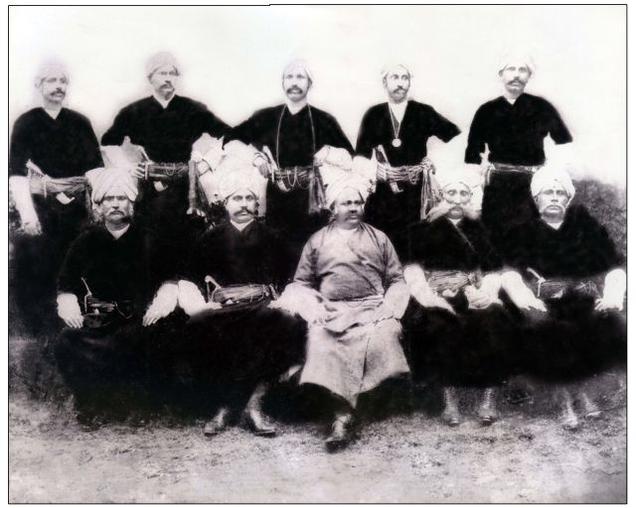
VISIONARIES: This group of 10 got together in 1863 and contributed and collected Rs. 7,305, to start the Kodava Education Endowment Fund./ by Special Arrangement / The Hindu

For a small agricultural community of approximately one hundred thousand, the Kodavas have added to India’s cultural and ethnic diversity through the uniqueness of their dress, customs, rituals, festivals, language and so on. Even more significant is the contribution of individual Kodavas to public life. They include a Field Marshal, a Chief of the Army Staff, a number of Generals, Air Marshals and senior naval officers. There have been Governors, Ministers, IFS and IAS officers, UN experts and Vice-Chancellors. They have brought credit to India in cricket, tennis, squash, athletics, and shuttle badminton as well. Rani Pooviah was part of the Cholamandal group of artists who pioneered the Madras Movement.

In this milieu, the work of the Coorg Education Fund (CEF) over a period of 150 years in the cause of education can only be described as an awesome activity initiated with remarkable foresight.

To better understand the value of the CEF it is necessary to place it in context. Coorg, or Kodagu as it is called, is today a district of Karnataka. It was ruled by local Rajas and came under British rule in 1834. Writing in Blackwoods Magazine in 1922, Hilton Brown of the Indian Civil Service, District Magistrate of Coorg, wrote of the identity of the Coorgs (now called Kodavas): “That is the standing riddle of South India ethnologists … barring all ethnology and arguing from common sense one would call Coorgs a separate people … they are a community of people whose customs, ceremonies, from birth to death, festivals, dress, language are quite different from those of other communities among Hindus.”

A survey done between 1815 and 1817 by Lt. Connor found that Coorgs were “addicted to husbandry, their only education consists in acquiring a practical knowledge of it.” It made the unflattering observation that they were an “unlettered and unaltered race.”

With the starting of an Anglo-Vernacular school and another in Kannada in 1835, the first steps towards introducing formal education were on. Subsequently more schools were opened. However, the mere opening of schools did not meet the objective of educating the community, as only children from affluent families could access them. Many bright children fell by the wayside due to lack of financial resources. To address this lacuna, a group of far-sighted and philanthropic elders of the community got together and sowed the seeds that grew into the CEF.

The credit for identifying the need to provide financial assistance to deserving children and encouraging them to enrol in educational institutions goes to Rev. Richter, the first Principal of the Mercara High School. He persuaded the British authorities to grant land that could be used to raise resources to provide financial assistance.

An extent of 150 acres was gifted, on which a coffee plantation was established in 1863. The income was used to provide student scholarships. Revenue from the estate was used to create the Mercara High School Endowment Education Fund. Separately, a group of 10 visionaries from the community got together with the idea of providing financial aid to needy students. Meeting in 1863, they made individual contributions and collected a princely sum of Rs. 7,305 which was used to establish the Kodava Education Endowment Fund. It now has a corpus of close to Rs.3 crore. They included Cheppudira Subbiah and Mathanda Appachanna.

In 1916, the two funds were merged and it became the Kodava Education Fund. It was administered by the Commissioner of Coorg assisted by eminent Kodavas. In 1954, the corpus was handed over to a committee comprising Kodavas. Thus was born the CEF. Its first president was Kodira T. Uthappa.

The CEF represents foresight and service rendered silently over the years, helping many a Kodava to blossom and contribute to society.

One of the beneficiaries of the fund was Pemanda Monappa, the father of the author. He was selected to join the police force under the British and was a well-known officer, also during the post-Independence period.

As a tribute to and recognition of the value of committed public service and integrity, this author has established a scholarship at Cambridge University in his name. Applicants should not have crossed 25 years. It is available for study leading to a Master’s in English literature, physical sciences, biological sciences (excluding medicine and veterinary science), economics, computer science, law, and technology. Details are at the Cambridge University website.

sonnabel@gmail.com

source: http://www.thehindu.com / The Hindu / Home> Opinion> Open Page / by P. M. Belliappa / May 25th, 2014

Kaliyanda family lifts Thathanda Hockey Cup

Kaliyanda team — winners of Thathanda Hockey Tournament.

Palanganda team which emerged runners-up in the Tourney.


Virajpet:

Kaliyanda team has won the Thathanda Hockey Tournament by defeating Palanganda team by 2-0 goals at the finals played at Junior College Grounds here yesterday.

The winning team got a cash prize of Rs. 1 lakh and the trophy and the runners-up received a cash prize of Rs. 50,000 and a trophy.

It may be recalled that Kaliyanda team had won the Pandanda Cup at the inaugural Kodava Hockey Namme in 1997.

The finals began with both the teams playing briskly but Biddappa of Kaliyanda team scored the first goal at the 10th minute itself.

In the second-half at the 23rd minute, Biddappa again second a goal to take the tally to 2-0 and Palanganda team could not fight back despite getting seven penalty corners.

Inanda Lala Aiyanna and Anjaparavanda Karyappa were the referees for the Tournament.

source: http://www.starofmysore.com / Star of Mysore / Home> Sports News / May 19th, 2014

Tata Global Beverages acquires Australian coffee firm Bronski Eleven

The company, which owns majority stake in public-listed Tata Coffee, has been looking to boost its presence in the coffee business and joined hands with Starbucks to help it launch in India.

Tata Global Beverages Ltd (TGBL), formerly known as Tata Tea, through its UK-based subsidiary, has acquired Australian firm Bronski Eleven Pty Ltd, for an undisclosed amount, as per a stock market disclosure.

“The investment is in line with the company’s strategic vision to become a leader in the good-for-you beverage segment in Australia and it also helps Tata Global Beverages to expand its portfolio to include high growth contemporary single serve business,” the company said in the filing.

Bronski Eleven is engaged in coffee business under the MAP brand, with presence in the roast and ground or R&G coffee and coffee in Pods (single service portions) segments in Australia.

We have contacted the company spokesperson for more details on the Australian firm and will update the copy as we hear from the firm.

Tata Global Beverages, the second-largest player in tea in the world, serves the consumers with its flagship brand, Tata Tea Premium and other brands like Tetley, Good Earth Teas and JEMČA. The firm originates over 65 per cent of the consolidated revenue from markets outside of India.

The company, which already owns majority stake in Tata Group’s public listed coffee company Tata Coffee, has been looking to boost its presence in the coffee business.

It had sealed a deal to bring Starbucks, the world’s largest coffee chain to India. The venture had rolled out outlets swiftly and has quickly emerged as one of the key players in the coffee chain business in the country. It competes with the likes of market leader Café Coffee Day, Barista Lavazza and Costa Coffee among others.

In another development, last November, Tata Global Beverages merged its packaged drinking water subsidiary Mount Everest Mineral Water Ltd, which operates through its premium brand Himalayan, with itself for increasing operational efficiency and better synergy between both businesses.

(Edited by Joby Puthuparampil Johnson)

source: http://www.vccircle.com / VC Circle / Home> M & A / by Bhawna Gupta / Monday – May 19th, 2014

Mysore flour mill owner gets possession of palace

Nagaraju’s dogged fight over a period of 18 years for his ancestral property began from scratch

Claiming to be a descendent of the erstwhile rulers of Kodagu, a flour mill owner from Mysore has now gained possession of the historic 17th century palace and fort which is predominantly in the heart of Madikeri town.

“My efforts of 18 years have ended with the President of India ordering that the palace belongs to me,” a beaming H C Nagaraju, the owner of the flour mill in Shivarampet, told Business Standard.

He has displayed a notice in his shop that says: “As per the order of His Excellency President of India, the Mercara Palace belongs to H C N Wadeyar.” It quotes the order No.F.No.1-204/2013-RTI (Hq) dated 26-9-2013, Government of India, Janpath, New Delhi.

This is the latest notice displayed in his shop to inform his customers of his successful fight, in addition to already putting up copies of other documents and photos of his forefathers belonging to the erstwhile Haleri dynasty of Kodagu.

Nagaraju’s dogged fight for his ancestral property began from scratch, from corresponding on the issue with a number of authorities like the Departments of Archaeology, and the state and Central governments and moving the courts. Before approaching the courts, he began to acquire documents from various sources, including the British Library in London to establish that he descended from the Haleri rulers.

“My father often told me that we belong to the Kodagu royal family and the Madikeri Palace belongs to us, based on what his father and grandfather had told him,” he said, narrating how he began to establish his right over the palace and the surrounding fort in Madikeri. “To establish what my forefathers were saying, we had swords, shields, palm leaf manuscripts in our house which my father gave away, finding them of no use,” he adds.

Calling himself H C N Wodeyar, he has displayed his claim he is the Maharaja of Coorg and owner of the Madikeri Palace. According to him, his lineage starts from Queen Devajammanni, wife of Lingaraja. The palace, which witnessed rebellious uprisings against the colonial rulers in 18th century, it presently houses the Kodagu’s Deputy Commissioner’s office within the fort.

“They have agreed to shift to a new place and hand over possession to me,” he said, adding he intends to convert his ancestral palace into a tourist attraction. Beside the palace stand two life-size statues of elephants that attract people who visit the monument.

Lingaraja succeeded the famed Dodda Veera Rendra Wodeyar (1780-1809), the hero from Kodagu history, as the Coorg Raja. His successor Viraraja was deposed in 1,834 following which the British annexed Kodagu and exiled the last of the rajas, bringing an end to the nearly two-century-long reign of the Haleri dynasty that came to power in the 17th century, in the district nestling amidst the lush Western Ghats, known for coffee and oranges, besides elephants.

source: http://www.business-standard.com / Business Standard / Home> Current Affairs> News> Et cetera / by Gouri Satya / Mysore – May 04th, 2014

CMC has no info on roads, population

Startling RTI reply reveals

In an astonishing revelation, the City Municipal Council has claimed of lacking information about the number of roads and streets and the population in particular road or street in Madikeri city.

The reply of the public relation officer of the Madikeri CMC to a Right to Information query filed by an individual, which is available with Deccan Herald, shows that the CMC lacks information on the population in CMC limits.

T C Thimmaiah, a resident of Dechur had filed an application under RTI to the CMC on January 20, seeking information.

He had sought information as he had complained on the creation of wards in the recent poll for Madikeri CMC was not according to the specific guidelines.

The people residing in his ward were included in the voters list of another ward. He also alleged that the area and population was not considered while constituting the wards.

“For example, the population in Ward No 17 is 465, while the population in Ward No 1 is 1,916. The population is almost four times more in Ward No 1 compared to Ward No 17.
Therefore, I filed the RTI with the CMC to know on what basis they had divided the wards,” he told Deccan Herald.

The CMC has 25 blocks which has been divided into 23 wards. He had sought information about the roads, streets, number of houses and population in particular area.

CMC Assistant Executive Engineer who is also the Public Information Officer, K M Ravikumar sent a reply to the RTI query on February 26, along with information about 23 wards attached to it. The reply note said that “the revenue department office of the CMC does not have any information about the roads, streets, number of houses and population in the said blocks.”

Wonderstruck T C Thimmaiah has said that it is ridiculous that the authorities have no information about the population based on which the election is held.

source: http://www.deccanherald.com / Deccan Herald / Home> District / by Srikanth Kallammanavar / DHNS – Madikeri, March 28th, 2014

King Wants to Take Over Kodagu Palace

H C N Wadiyar, the Maharaja of Coorg, has strongly objected to opening of Balamandira inside the Mercara Palace without his permission.

In a letter to the Kodagu Deputy Commissioner, he claimed he is the owner of the palace as his ancestors did not transfer it to the then Government of Mysore or the Government of India.

He said Archaeological Survey of India officials had stated that the fort at Madikeri and two masonry elephants are being protected by the ASI, adding state government offices are still functioning in the palace.

He clarified the British government had not given any letter pertaining to the transfer of the palace to the government.

He said he wants to take over the palace soon.

source: http://www.newindianexpress.com / The New Indian Express / Home> States> Karnataka / by Express News Service – Mysore / May 04th, 2014

Committee to study alternative routes for power line in Kodagu

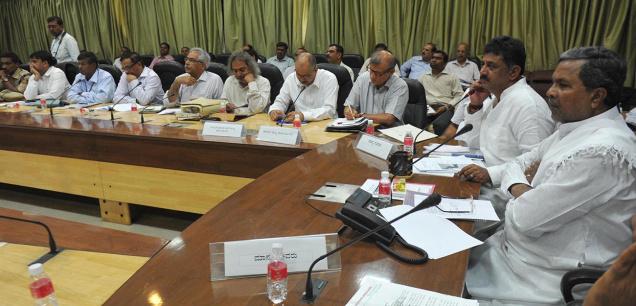
Chief Minister Siddaramaiah and Energy Minister D.K. Shivakumar at a meeting to discuss the power line project, in Bangalore on Tuesday /. Photo: Sampath Kumar G.P. / The Hindu

Expert panel to submit report in 15 days

Chief Minister Siddaramaiah has decided to constitute an experts’ committee to examine alternative possibilities to drawing a high-tension power line from the Kaiga nuclear power plant to Kerala through the catchment area of a tributary of the Cauvery in Kodagu.

The decision comes in the wake of prominent people from Kodagu opposing the project in its present form.

The proposed committee, to be headed by an expert from the Central Power Research Institute, will be given 15 days to look into the concerns of people of Kodagu and submit a report.

An assurance was given by the Chief Minister to legislators and environmental activists from Kodagu who met him at his home office here to seek a change in the route of the proposed power line pass, in public interest.

Coorg Wildlife Society president Col. C.P. Muthanna (retd.), who was part of the delegation that had more than a hour’s discussion with the Chief Minister, told reporters that the proposed committee would comprise wildlife ecologist R. Sukumar, Principal Chief Conservator of Forests, and water expert Rajendra Singh.

He alleged that the project, to be implemented by Power Grid Corporation of India Ltd., would result in devastation of 156 hectares of coffee estate and 104 hectares of paddy cultivation area near Virajpet besides 23 hectares of forests. “The area through which the proposed line is to pass has such a thick green cover that each acre of coffee plantation has 350 fully grown trees,” he said, and expressed concern that nearly 53,000 trees would have to be felled if the power line route was not changed.

He said that leaders from Kodagu had suggested that the power line be drawn underground through the “forest fire line” that runs for 23 km. This would also reduce the length of the power line, he said.

The Chief Minister assured the delegation of taking up the issue again for discussion after the experts’ committee submits its report, he said.

The former Speaker K.G. Bopaiah, MLA Appachu Ranjan and MLC M.C. Nanaiah were part of the delegation.

source: http://www.thehindu.com / The Hindu / Home> News> National> Karnataka / by Special Correspondent / Bangalore – April 30th, 2014