Category Archives: Records, All

Lakhs throng Talacauvery

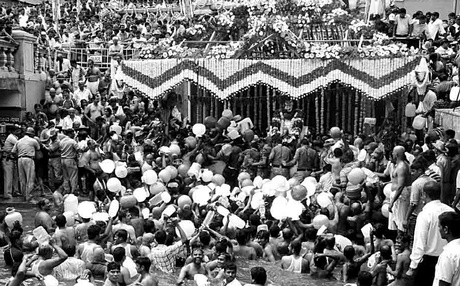
Devotees thronging Triveni Sangama at Talacauvery in Bhaghamandla on Thursday | Express photo

The Madikeri- Bhaghamandla- Talacauvery Road was jampacked from early Thursday as lakhs of devotees arrived for the ‘theerthodbhava’ near Brahmakundike.

It is believed that every year on this day at a specified time water from the Cauvery springs up in the form of a small fountain from ‘Brahmakundike’ at Talacauvery. And this water from this temporary fountain is considered to be holy.

A team of archakas, led by Ananthesh Kedilaya, announced the arrival of theerthodbhava at 12.01 pm, following which they sprinkled the holy water on the devotees near the Bramhakundike.

Kodagu police had enforced strict monitoring around the region to ensure that people do not enter Bramhakundike until after the theerthodbhava to prevent any untoward incidents such as a stampede.

SP M N Anucheth was seen standing near the pond and personally supervising arrangements with his subordinates.

Cultural programmes were performed by various artistes throughout the day. Ninada from Ponampet sang Kodava devotional songs while B A Ganesh from Shanthalli rendered Kannada devotional songs. Padmanabha and team from Melkote played the Nagaswara and Ramanajneya Bhajana team from Madikeri sung bhajans.

For the second consecutive year, the temple committee provided lunch for the devotees. MLA K G Bopaiah and Kodagu ZP vice-president B Usha Devamma supervised the catering arrangements.

The theerthodbhava was witnessed by the temple Thakka’s Kodi Madappa, Kodi Motaaiah, Balladka Appaji, MP A H Vishwanath, Deputy Commissioner Anurag Tiwari and others.

source: http://www.newindianexpress.com / The New Indian Express / Home> States> Karnataka / by Express News Service – Madikeri / October 18th, 2013

Readiscover : Stories from a sacred land

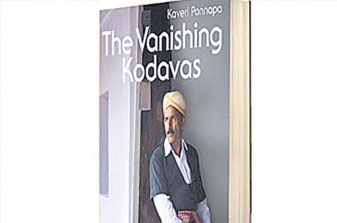
A fascinating picture of the people of Coorg, their origins, history, myths and traditions. The Vanishing Kodavas
By Kaveri Ponappa
Eminence Designs Pvt Ltd
Rs. 7500 PP360

The Vanishing Kodavas

Where the Coorgs came from, the enigma of their customs, social traditions, laws and dress are questions that have been debated ad infinitum. The Vanishing Kodavas by Kaveri Ponnapa is a work that not only answers these questions but also sheds light on the events that fashioned the people’s traditions and made them unique.
To do this, Ponnapa uses official records, correspondence, colonial accounts, the recorded history of the Rajahs of Kodagu or Coorg and the oral histories of the Kodava people themselves. The hauntingly beautiful backdrop of the wild, beautiful hills with their gurgling streams, dense forests, and abundant wildlife and flora serves as a canvas for stories about a people who made the hills of Coorg their home, and who, through their violent history, managed to preserve their ancient social customs, dress and way of life.

Replete with 300 colour plates, the book, which took Ponnapa 15 years to research, contains a wealth of information. Chapters tell stories of bygone eras, of myth and legends, of the tragic history of the people, of songs composed by warriors for whom routine violence was a way of life and of marriage rituals that were not only esoteric but also created to save a clan from extinction.

The reader is taken to a land that became almost sacred to its people — evident in the small, open-air shrines and large tracts set aside for worship – and into the heart of festivals dedicated to forest deities where trance and possession figure and oracles link the people to both their ancestors and their gods.

This is a book about a people who named the trees, shrubs, creepers and medicinal herbs, a people who created a rich oral tradition for themselves, worshipped their ancestors before all gods and danced before the spirits of the forest, and for whom upholding personal honour and that of one’s ancestry at all costs was the Kodava code.

Until recently the only source material for most contemporary accounts of Kodagu history were official manuals and gazetteer accounts. These were authored by missionaries and official historians of the East India Company and almost completely distorted the history of the Kodavas and obliterated the memory of the loyalty and affection the people felt for their kings.

The Vanishing Kodavas seeks to correct this image. It explores the unique role the tiny kingdom, ruled by Lingayat Rajahs, supported by a Council of Kodava Chieftains, played in the rise of the East India Company in southern India and focuses on a fast disappearing culture.

In The Vanishing Kodavas Ponnapa has created a volume of work that the reader will read, put away and revisit another day. Few writers can boast of making their work relevant to a general readership as well as to those for whom it will serve as a base for further academic studies.

Nalini Menon is a senior journalist

source: http://www.hindustantimes.com / Hindustan Times / Home> Books> Readiscover /by Nalini Menon, Hindustan Times / October 12th, 2013

Permission to sell Kodagu’s Jamma lands could lead to ecological disaster

The tiny hill district of Kodagu (Coorg) in Karnataka is facing an ecological disaster with the President of India giving his assent to a controversial legislation which allows the disposal and sale of Jamma lands in Kodagu located in the fragile Western Ghats. It is feared that the resultant denudation of the forests in the region could trigger an environmental damage with unpredictable consequences.

The repercussions of the legislation — The Karnataka Land Revenue (Third Amendment), Act, 2011, which received Presidential assent early this year after the bill was referred to the President by the Karnataka governor last year, will not only be severe on the Western Ghats region, considered as one of world’s bio-diversity hotspots, but will also take its toll on the customary laws, traditions and culture of the indigenous communities.

Jamma land tenure is unique to Kodagu district and it is estimated that the extent of ‘Jamma Baane’ land in Kodagu is around 2.55 lakh acres in possession of the local people — Kodavas, Amma-Kodavas, Heggades, Airis, Koyavas, Moplas and Gaudas. Jamma lands consist of wetland for growing paddy and the accompanying Baane land, initially used for cattle grazing and held free of assessment, now converted into coffee estates.

According to Sir J B Lyall, a British expert on tenures in Coorg who traced the origin of Jamma, it was originally a military tenure held on payment of half the assessment in consideration of military service. Jamma was granted under ‘sanads’ largely by the Coorg Rajas (1600 AD to 1834 AD) and to a smaller extent by the British till 1895 to the local inhabitants.

Hitherto, there was a ban on the sale of Jamma lands as the cultivator was only a ‘deemed owner’. The new legislation will confer the title of ‘occupant owner’ and allows the sale of land. The legislation, it is feared, will legitimise large scale denudation of trees and the formation of human settlements on Jamma Bane lands as there will be heavy influx of population from the neighbouring states. The presence of increased human habitation will have its impact on the adjoining forest land, its flora and fauna.

For generations, the life of the local communities, centered around the cultivation of the Jamma lands, the principal tenure in Kodagu. The Jamma lands could not be alienated as there was no provision for transferring the title of the property. The ownership was jointly held by the clan and it was managed by the head of the clan (Pattedara).

The issue went before the Karnataka high court and a full bench of the court held in its judgement delivered in October, 1993 that Jamma Baane landholders had limited privileges for cattle grazing, supply of firewood and timber for the domestic and agriculture purposes, but had no right to exploit the trees for commercial purposes, unless the holder had paid full timber value to the government. The court also held that the land-owner had no right to the sub-soil.

Customs and traditions

Once the ban on the sale of Jamma lands is lifted, the indigenous communities will be removed from their traditional Jamma holdings which formed the basis of their customs and traditions. The ‘ain-mane’ or the ancestral houses of the clans, was the focal point of all festivities and religious usages. It is feared that once the Jamma lands are sold to outsiders, the new land owners could lay claim to the ‘ain-manes,’ considered sacred to the local communities. This could lead to social tensions and law and order problem.

The biggest threat will come from the real estate mafia who were eyeing the Jamma lands all these years. With tourism boom in Kodagu, the local communities will be under pressure to sell their lands as the state will not have any control over them. It is learnt that already Jamma lands are being sold in anticipation of the new law taking effect.

The amendment to the Jamma tenure was effected during the previous BJP regime. The amendment was politically motivated and passed in haste without much debate in the Legislative Assembly, reportedly at the instance of the then Speaker K G Bopaiah who wanted to take political advantage. One of the reasons for Bopaiah’s re-election from the Virajpet constituency was on account of the political mileage he gained by getting the amendment passed.

The new amendment will create more problems than it hopes to solve. Those who drafted the amendment bill have failed to recognise the fact that apart from Jamma Baane lands, there are other types of Baanes — ‘Hithlu’ and ‘Sagu Baane’ lands.
Advocate K Sarojini Muthanna, who is knowledgeable on Jamma tenure matters, has suggested that the government should carry out further amendments to the Karnataka Land Revenue Act, 1964, devoting a separate chapter for the Jamma lands of Kodagu. The main support for the amendment has come from Akhila Kodava Samaja, representing a small section of the Kodavas. The president of the Samaja, Mathanda C Monnappa, opined that the amendment removed ‘irritants’ by way of government circulars which gave the impression that the land belonged to the government.

A large section of people, however, feel that in the interest of preserving the culture of Kodagu, and maintaining the ecological balance in the Western Ghats, the Siddaramaiah government should not give effect to the amendment to the Jamma land tenure.

source: http://www.deccanherald.com / Deccan Herald / Home> Panorama / by P.T.Bopanna / July 24th, 2013
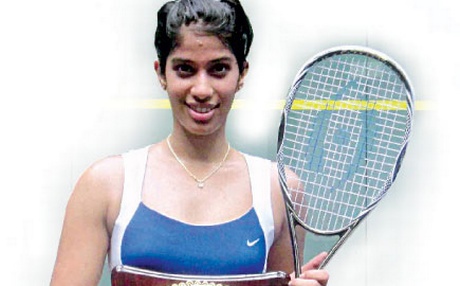
The original pin-up girl

Joshna Chinappa
Joshna Chinappa

Much before Dipika Pallikal swept the squash world with her feathery game and girly charms, there was Joshna Chinappa. Though injuries had taken toll on her career and impeded from achieving the heights she was capable of scaling, Joshna remains the true path-breaker of women’s squash in the country. Dipika only followed the blueprint, and improvised on it later.

When Joshna took baby-steps in the sport, randomly swishing and swiping the racquet in the MCC Courts, squash was still unglamorous, if not obscure. So much so that she winning the Junior British Open in 2005 went almost unnoticed. But when eventually her feats were acknowledged, they thrust unrealistic hopes on her. Credit to her that she lived up to most of it, though the hope-o-meter scale just exploded.

She took everything in her stride with a rare poise — the glam-bee image, the exaggerated spat with the Squash Racquets Federation of India, a dodgy knee that threatened a premature death to her career, world rankings that seemed forever struck in the mid-30s, the elusive WISPA title and so on and so forth. Her world seemed a peculiar blend of fame and frivolity. And then came the ultra-glamorous Dipika, pushing her almost to the sidelines, though Dipika herself reckons Joshna as her inspiration.

But Joshna just focused on her game so focused that such trivial distractions hardly distracted her. “Well, throughout my career, my focus hasn’t wavered. I have been through bad times and injuries, come across a lot of hurdles, but my passion for the game has never ceased. The sheer joy of getting onto the court keeps me up,” she told TNIE.

Persistence paid. WISPA titles followed. The injury healed. Rank-o-meter rose to a personal best of 25. Arjuna Award ensued. The year has seen an upswing. And Joshna is again smiling. “I think every athlete goes through a phase when you are beset with doubts. But you overcome it with hard work and persistence,” she stressed.

Now that she is almost back to her full fitness and treading a squash player’s perceived peak, Joshna looks forward to her career with a newfound optimism. “I haven’t set any specific targets as such. I just want to focus on my game at hand and do my best to overcome my opponent,” she said.

The Arjuna is a due acknowledgement of her accomplishments, but the world number 26 hopes it would spur more youngsters to pursuing the sport. “You need more youngsters to take up this game. Presently, it is popular only in a few cities like Chennai. But only if it reaches out to more centres will the game really take off,” she said. And not to forget, she is Indian squash’s first pin-up girl, though that’s not a tag she is overtly obsessed with.

source: http://www.newindianexpress.com / The New Indian Express / Home> Sport / by Sandip G / ENS / September 22nd, 2013

Business Line scribe wins award for reporting on agriculture

Hyderabad :

K.V. Kurmanath, Senior Assistant Editor, Business Line, has been conferred the ‘Rythu Nestam’ Award – 2013 for excellence in agricultural reporting.

Kurmanath has specialised in agricultural reporting and been writing for over two decades including the last 10 years in Business Line.

The awards have been instituted by agricultural monthly/daily, Rythu Nestam, on the occasion of its ninth anniversary. The categories of awards included farmers, agricultural scientists and journalists.

K. Rosaiah, Governor of Tamil Nadu, gave away the awards to the winners at a function here on Thursday.

source: http://www.thehindubusinessline.com / Business Line / Home> Industry> Agri-Biz / by the Hindu Bureau / September 26th, 2013

Flavour of India competition winners announced

Each year the Coffee Board of India (CBI) invites applications from the coffee growers of India for the annual cupping competition, The Flavor of India -The Fine Cup Award.

The competitions is held for Arabica (washed/unwashed), Robusta (washed/unwashed), and the Specialty coffees of Arabica and Robusta.

The outstanding coffees from the national level are chosen for the final cupping by the internationally jury consisting of eminent cup tasters from different countries.

In this, the 12th year of competition, the CBI received a total of 221 coffee samples. Out of these, 40 samples were selected for cup quality evaluation by the international jury in the finals held at Nice, France on the eve of SCAE World of coffee prestigious three-day event held in June.
CoffeeAwardsKF23sept2013

The winner of Best Arabica was the Pedabayalu Estate’s Arabica Plantation SLN-4.

The Poabs Estates’ Organic Arabica SLN-9 took out the Best Specialty Arabica prize, while the prize for the Best Specialty Robusta went to Harley B Estates’ Old Robusta.

The Best Robusta category was won by Margolly Estates’ Robusta Parchment AB.

The full details of the winners in all categories and regions can be found on CBI’s website: www.indiacoffee.org.

source: http://www.globalcoffeereview.com / Global Coffee Review / Home / Monday – September 16th, 2013

Need to conserve tribal languages stressed

Just like the way in which English is a threat to Kannada language, Kannada is posing a threat to minor languages in the state, said writer Abdul Rasheed.

Speaking at the valedictory of the ninth district Kannada literary meet here recently, he said along with Kannada, Kodava and tribal languages of Yarava, Jenukuruba, Bettakuruba, Malekudiya and other tribals are spoken in Kodagu.

“On the pretext of developing and conserving Kannada, we have neglected other languages,” he lamented.

“With the destruction of tribal culture, their languages are also on the verge of extinction. There is a need to strive for the development of minor languages.

Elected representatives are concerned about providing roads, water, and other infrastructure for tribal colonies, but not worried about conserving their culture and tradition. Culture, literature and life of tribals should be documented,” he said.

Assembly Speaker K G Bopaiah said: “Parents feel inferior, sending their children to government schools. The need for proficiency in English in changed scenario is agreed, but we need to give priority to the administrative language,” he said.
Writer Vishnu Bhat presided over the meet.

Poets meet

Thirteen poets recited their poems at the poets’ meet. The poems highlighted corruption, suppression of weaker sections, beauty of Kannada culture, etc. K V Ramakrishne Gowda presided over the poets’ meet.

Felicitation

Shaurya medal winner Ayyangeri School student K S Suhail and highest scorer in SSLC B P Maulya were felicitated at the valedictory function.

Resolutions

The two-day Kannada literary meet resolved to urge the government to constitute an expert committee to find out a reason for low admission rate in government schools despite introducing English from first standard itself.

The other resolutions are: Railway connectivity is essential to promote tourism in the district. So, the state government should impress upon the Union Railway Ministry to start works on the proposed Mysore-Kushalnagar railway line.

The government should ensure that farmers get scientific price for their crops. The government should distribute Kannada dictionaries, published by Kannada Sahitya Parishat, free of cost among government school children.

The resolutions were read out by District Kannada Sahitya Parishat honorary secretary B A Shamshuddin.

source: http://www.deccanherald.com / Deccan Herald / Home> District / DH News Service / Koodige (Kodagu Dist) / March 06th, 2013

Tributes paid to war hero Devayya

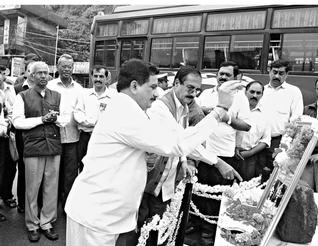
Virajpet MLA K.G. Bopaiah and others offering floral tributes to the portrait of Ajjamada Devayya at the Circle named after him in Madikeri on Saturday./ The Hindu

Rich tributes were paid to late Squadron Leader Ajjamada B. Devayya, a Kodava hero who showed exemplary courage to shoot down a Pakistani Supersonic F104 aircraft in the 1965 war under adverse conditions, at the Circle named after him at the private bus stand in Madikeri on Saturday. Sq. Ldr. Devayya carried out the attack on this day in 1965 to lay down his life for the nation.

Garland

Virajpet MLA K.G. Bopaiah, Ajjamada family members, officials, and guests garlanded the portrait of Devayya in the morning to remember the heroics of the war veteran with Mr. Bopaiah promising to find a suitable location to set up a statue in the city in honour of Devayya for upholding military traditions of Kodagu.

Sq. Ldr. Devayya was born on 24 Dec 1932. He was the only one among the members of the strike force who sacrificed his life for the nation after carrying out the task of attacking the Sargodha airfield in Pakistan on September 7, 1965.

This was revealed in a book written by English journalist John Fricker, after he was party to the description of an episode by the then Flight Lieutenant, Amjad Hussain, of Pakistan.

The private bus-stand circle in Madikeri was named after the war hero on September 7, 2009.

Sq. Ldr. Devayya was conferred with the Maha Vir Chakra for his illustrious service to the nation posthumously which was received by his wife Sundari from the President of India.

Delay

Though the State government sanctioned Rs. 5 lakh for setting up a statue of Devayya, the project was being delayed over a court order, he said. Efforts were on to talk to Bal Bhavan authorities to secure land to set up the statue of Devayya, he said. Deputy Commissioner Anurag Tewari, Ajjamada family members Karumbaiah, Katti Mandaiah, ex-servicemen, officials of Department of Sainik and Resettlement Board, Madikeri, were present.

source: http://www.thehindu.com / The Hindu / Home> National> Karnataka / by Special Correspondent / Madikeri – September 08th, 2013

On eve of Arjuna award ceremony, Joshna Chinappa wants boost for squash

Joshna Chinappa will receive the Arjuna award today, a recognition that has come after a long wait for the Chennai squash player.

The 25-year-old became the first Indian girl to win the prestigious British Junior under-19 title in 2003 and followed it up with a gold at the South Asian Federation Games gold in 2004.

Joshna Chinappa
Joshna Chinappa

Chinappa, currently ranked 27 in the world, spoke to MiD DAY on what the Arjuna award means to her and other aspects of the sport.

Excerpts:

What does the Arjuna award mean to you?
It means a lot to me. This is one of my biggest achievements. I have been recognised by the government and the feeling is special.

With you and Deepika Pallikal being the only two faces in Indian squash, what will it take for more of your kind to emerge?
Hopefully, there will be more kids taking up squash after us and pursuing it as a career. But for that, there has to be better structure to develop squash and reach out to all sections of people in different parts of the country. There is a need for good coaches, facilities, conducting tournaments all over the country and helping kids financially to play international as well as national tournaments.

How has the progress of you and Deepika changed the popularity of the sport in the past few years?
I think more people are aware of squash because of what Saurav Ghosal, Deepika Pallikal, Siddharth Suchde, Harinder Sandhu and myself have been doing on the international circuit. There have been some international events that have helped in bringing more recognition to the sport. Squash has grown a lot in Chennai, but needs to develop more in other parts of the country.

What needs to be done to give the sport a boost? It is restricted to cities and has not entered rural areas…
Squash is still a club-level sport in many cities and not everyone can afford a membership to play. We need to develop courts that are easily accessible at the grassroots level. Courts have to be built with the help of the central and state governments along with the federation. Also, a program to develop squash in particular areas. Hopefully, with a good plan, corporates will come on board to support squash and then we can see more kids
taking up the sport.

Since squash has been short-listed now for the Olympics, how difficult will it be for the federation to convince the International Olympic Committee for the final spot?
Squash being short-listed is amazing and hopefully, we can make it to the Olympics as it deserves to. But we are competing with wrestling which has a better chance of getting back in. I’m just hoping for the best.

source: http://www.mid-day.com / Mid Day / Home> Sports / by Sundari Iyer / Mumbai – August 31st, 2013

Ghosal, Chinappa emerge national champions

Reigning champions Saurav Ghosal and Joshna Chinappa successfully defended their singles titles in the men’s and women’s section respectively in the 61st National Squash Championship which concluded here today.

Top seed Ghosal lived up to his billing and posted a facile 11-2 11-1 11-7 victory over Mahesh Mangaonkar to win his record ninth national title and winner’s purse of Rs one lakh.

Chinappa too had it easy against youngster Aprarajita Balmurukan in the women’s section and won 11-8 11-9 11-6.

The title clash between Ghosal and Mahesh began with a long rally which raised the hopes that the youngster would challenge the might of the World No 20.

But Ghosal faced little resistance to wrap the issue in just about half an hour.

“It was not that easy. The scores suggest that it was a one-sided affair but Mahesh played quite well and shoed his potential. I was trying out few things but he was also good,” said Ghosal.

Chennai-girl Chinappa disposed off the challenge of Aparajita in just 30 minutes to win her 12th national crown. It was Aparajita who took the initial lead in the first two games but Chinappa’s vast experience came in handy for her.

“I was not complacent. I knew that with Deepika not here I would play against youngsters. Still, I don’t take things for granted. The girls need more of exposure to come good at higher levels,” said Chinappa after her win.

Results:

Mens: Final

Saurav Ghosal (1) def Mahesh Mangaonkar 11-2 11-1 11-7 . 3/4

Harinder Pal Singh Sandhu (2) def Ravi Dixit (3/4) 12-10 11-5 11-5.

Womens: Final

Joshana Chinappa (1) def Aparajitha Balamurukan (2) 11-8 11-9 11-6.

3/4

Sachika Ingale (3/4) def Janet Vidhi (3/4) 11-8 11-6 11-2.

source: http://www.business-standard.com / Business Standard / Home> PTI Stories> National> News / Press Trust of India / Jaipur, August 23rd, 2013