Category Archives: Records, All

Heaps of broken images

HERITAGE
Mookonda Kushalappa visits Moribetta in Kodagu and discovers that the hilltop has numerous megalithic structures. It is thought that these were more of commemorative value, built in remembrance of the dead.

In the north of Kodagu district, on the way from Madikeri towards Hassan is Moribetta, the ‘hill of the Maurya’. Local people are, however, not very familiar with that name. They know well the name of a sacred lake and a temple near the same hill, both dedicated to Goddess Honnamma.

As one approaches the place, one can spot two huge granite hills touching the sky. The bigger one is Gavibetta, while the smaller one is Moribetta. Green foliage surrounds the serene place. Coffee and other plantations make up the agrarian areas. The road leads one towards the large lake that lies between the two hills. This lake happens to be the largest one in the district. It is called Honnammana Kere, the lake of Honnamma. On the right side of the road are a couple of temples; the larger one is newly built and painted while the smaller one is in ruins. In fact, the older one is hardly distinguishable from the rocky background.

The ancient temple is built of stone blocks. Amidst these blocks which are overgrown with plants is an open doorway which is not quite discernable. In the darkness within is a stone nandi, the bull that carries Shiva, and a linga. The more modern temple is the temple of the goddess in front of the lake. Both the lake and this temple are named after the local goddess, Honnamma.

The lake temple
Legend has it that Honnamma was the youngest among an influential man’s daughters-in-law. When the father-in-law told his daughters-in-law that one of them had to sacrifice her life for the common good, it was only the youngest, Honnamma, who complied. She jumped into the lake and drowned. Ever since, the lake has never gone dry. It is after her death that she was revered as goddess Honnamma, the golden deity.
On the occasion of Gowri habba, a day before Ganesh Chaturthi, the place has throngs of people. As part of the festival, a bagina or an offering is made to the goddess. This is left afloat on the lake.

During this annual temple festival, pilgrims trek up Moribetta until they reach a spot marked by a flag near its summit. The lesser-known name of the village is Doddamalte. Gavibetta has a few caves and a stairway that leads to the summit. Villagers refrain from speaking much about the ‘other hill’, Moribetta, because of talk about it being an ancient site for human sacrifices.

Shrouded in mystery
Mystery shrouds the Moribetta hill. There are numerous megaliths, although in disarray, on the hilltop. There are 50 short dolmens or portholes on the granite hill. Each of them is an arrangement of four upright flat stones with a capstone and the eastern wall has a circular porthole. These granite slab dolmens stand around four or five feet high and the circular portholes are a little more than a foot in diameter.

While some are intact, others have been broken down. Many of these dolmens have been dismantled and destroyed by treasure hunters, grave diggers, stone cutters or neighbouring farmers. Some of them have taller orthostats (large stones standing upright) beside them. Interspersed between them are cairns or piles of stones.

No human remains were found in the portholes. Broken stone circles can also be found on the granite hilltop.

These structures on Moribetta didn’t hold any remains of the dead nor were they habitable. They were like miniature houses, but these abodes were too small to live in. They contained miniature utensils and goods. Some claimed that a pygmy race lived in them. In a 19th-century published article titled ‘Rude stone monuments in all countries’, Fergusson was mesmerised by these ‘miniature toys’ of Moribetta but doesn’t give an explanation for their size.

However, as no human remains were found in the place, it is thought that these were more of commemorative value, built in remembrance of the dead. To reduce expenses, all these that were built for the dead would have been made on a miniature scale, as they were not used for practical living purposes. Historians like B L Rice, Mackenzie, Rob Cole and K K Subbayya have already explored the hill extensively. Some locals call the structures on Moribetta Kodava Kote, ‘fort of the Kodavas’.

Epic connection
These cromlechs were associated with the Pandavas, the demigod heroes of the Mahabharatha. Locals called them ‘Pandava Pare’ as well, in the past. The same name is used for large stones that were used to lay steps that led to temples and large country houses in Kodagu. Now, however, it’s a forgotten place visited only during the annual temple feast of Honnamma on Gowri festival, a day before Ganesh Chaturthi.
Six miles from Somwarpet is another place called Morikallu, also known locally as ‘Pandava Bande’. This is a small granite hillock with six dolmens, of which four were well preserved and surrounded by paddy fields. Stone circles surround all these dolmens. The shrine of Male Sartavu, another Kodava temple, has six stones; they are said to have been dedicated to the five Pandava brothers and their wife Draupadi.

In South India, anything ancient or unknown would be quickly attributed to Brahma (Brahmagiri, the ‘hill of Brahma’ or Brahmadesam, the ‘country of Brahma’), the mythical Pandavas (places called ‘Pandava Pare’ or ‘Pandava Bande’) or the historical Mauryas (Moribetta ‘hill of the Maurya’ or Morikallu, ‘rock of the Maurya’).

According to Rob Cole’s book, Kodavas have an ancient belief that the Pandavas were the original owners of the earth who rented out land to agriculturists. On Bisu Changrandi (Vishu), also called Edmyaar 1, the new year of the Kodava calendar, Kodavas start farming their lands without fail. This is because they believed that if they don’t, then the Pandavas would come down from their celestial abode to reclaim their lands.

In his 1870-book ‘Gazetteer of Coorg’, Richter speaks of this picturesque tank, Honnammana kere, which is three miles from Somwarpet, but doesn’t mention its name. He talks of a version of the legend associated with the place. Malla Shetty of Yelusavirashime was the father-in-law who vowed to build this tank.

Sacrifice

But after its construction, there was still no water. It was suggested that animals be offered in sacrifice to appease the gods but to no avail. Goddess Ganga appeared in front of the merchant and asked him for a sacrifice. So he approached his daughter-in-law Akkony whose husband was away. Akkony took leave of her child and parents and entered the tank to drown in the rising water.

Her parents and husband got upset upon hearing this. Richter also writes about a stone inscription found in the place. It reads in Kannada, “King Andany has ordered this tank to be built on Tuesday the tenth day of the month of Phalguna in the year Parthiva.

“This was written by Venkadasya Mallia Bomarsia at the time of Basawalinga Deva Raja Vodea”.
Lately this stone inscription has been cemented on the ground in front of the new Honnamma temple.

King Andany mentioned here must have been a local ruler while the person mentioned at the end must have been the Lingayat (Basawalinga) Raja Devappa (Deva Raja Wodeyar, 1770-1774) of the Haleri dynasty

source: http://www.DeccanHerald.com / Home> Supplements> Spectrum by Mookonda Kushalappa / November 26th, 2012
Augustin, Shalon emerge champs

Augustin A of Kodagu and Shalon Joanne Pais of Dakshina Kannada emerged champions in the Under-17 boys and girls sections in the chess tournament for primary and secondary schools conducted by the Department of Public Instructions here on Tuesday.

Nikhilesh Holla of Dakshina Kannada won the boys under-14 title while the girls crown went to Ananya S of Kodagu.

The top five in each category will represent Karnataka in the School Games Federation of India’s National tournament in Maharashtra next month.

Final standings: Boys: Under-17: Augustin A (Kodagu) 7.5 points, 1; Pangal Gopalkrishna Nayak (Dakshina Kannada) 7.5, 2; Nikhil R Umesh (Shimoga) 7.5, 3; Varma Shabdik (Dakshina Kannada) 7, 4; Satvik M (Bangalore North) 7, 5. Under-14: Nikhilesh Holla (Dakshina Kannada) 8.5 points, 1; Shashwat S Mudenagudi (Dharwad) 8, 2; Dhyaan S Nayak (Karwar) 7.5, 3; Chirag Hirinja G J (Dakshina Kannada) 7, 4; Chiranth M D (Shimoga) 7, 5. Girls: Under-17: Shalon Joanne Pais (Dakshina Kannada) 8.5 points, 1; Gangamma B N (Mysore) 7.5, 2; Vani S Indrali (Dharwad) 7, 3; Sumathi K G (Mysore) 7, 4; Sanjana R (Shimoga) 7, 5. Under-14: Ananya S (Kodagu) 8 points, 1; Tulsi M (Mysore) 7.5, 2; Reesha Shenoy (Dakshina Kannada) 7.5, 3; Panchami Shenoy K (Dakshina Kannada) 7.5, 4; Swathi K Bhat (Dakshina Kannada) 7, 5.

source: http://www.DeccanHerald.com / Home> Sports / Udupi, DHNS / November 20th, 2012

A grand gesture by a Grand-Old-Man

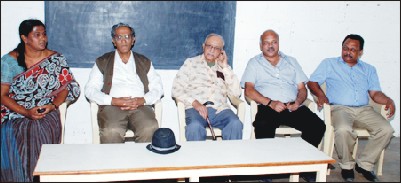
Rotary spirit in action, Rtn. PDG Col. B.M. Chengappa dontates Rs. 2 lakh

Caption: Rtn. PDG Col. B. M. Chengappa (centre) is seen with (from right) Rtn. Joseph Mathew, Rtn. Sunil Baliga, President, Rotary West School, Rtn. B.S. Sridhara Raj Urs and Rotary West School Head Mistress Latha Shivkumar.

Mysore, Nov. 20 :
At 94, he is as sprightly as a man in his thirties. With an ever-cheerful and positive attitude towards life, Col. B.M. Chengappa, after a distinguished Army career, has been actively engaged in running his cardamom plantation in Virajpet, Kodagu.

An ardent Rotarian, he served as the District Governor of Rotary Dist. 3180 in 1983-84 and continues to be a member of the Rotary Club of Mysore West.

Col. Chengappa was invited to visit Rotary West Schools run by Rotary West Association (RWA) in Saraswathipuram and Kanakadasa Nagar here on Nov. 16. He was taken around Kanakadasa Nagar campus by RWA President Rtn. Sunil Baliga where RWA is building a PU College apart from running a Higher Primary School.

Rtn. B.S. Sridhara Raj Urs explained to Col. Chengappa the workings of the institution and the need for funds to carry on the activities. In a grand gesture, Rtn. Col. Chengappa announced a donation of Rs. 2,00,000 on the spot to RWA. He also announced that he would contribute Rs. 1 lakh every year as long as he could. May his tribe increase.

source: http://www.StarofMysore.com / Home> General News / November 20th, 2012

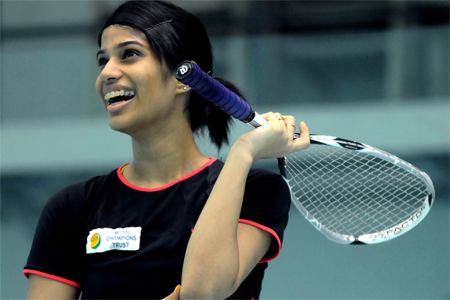
India in maiden quarterfinal of Women’s World Team Squash


New Delhi:
India created history by booking their maiden quarterfinal berth in the WSF Women’s World Team Squash Championship after an upset 2-1 victory over eighth seeds, The Netherlands at Nimes, France on Wednesday.

India, who had upset seventh seeds Ireland in their tournament opener before clinching pole position in Pool G, are taking part in the biennial tournament for the third time only.

They had finished 18th in their debut in 2002 and 11th last year.

Anaka Alankamony, the number three in the squad, gave 10th seeds India the lead with a resounding 3-0 (11-8, 11-6, 11-5) win over Milou van der Heij but it was even-steven with Indian number one Dipika Pallikal losing 8-11, 4-11, 3-11 to Natalie Grinham in the second game of the Round of 16 tie.

World number 13 Pallikal was outplayed by her stronger rival Natalie, who is currently ranked 11 in the world.

It was left to Joshna Chinappa to show that the top-spot finish in the pool was no fluke and she beat Orla Noom in a tense deciding game 5-11, 11-9, 8-1, 11-2, 11-3.

Earlier, India had thrashed Argentina 3-0 to clinch pole position in Pool G.

The event boasts of a record entry of 26 nations and is being staged simultaneously at both the eight-court Club des Costieres and La Parnasse Arena where, for the first time ever, action is taking place on three all-glass show courts.

Result: Round of 16: (10) India bt (8) The Netherlands 2-1 Anaka Alankamony bt Milou van der Heij 11-8, 11-6, 11-5; Natalie Grinham bt Dipika Pallikal 11-8, 11-4, 11-3; Joshna Chinappa bt Orla Noom 5-11, 11-9, 8-1, 11-2, 11-3.

source: http://www.articles.timesofindia.indiatimes.com / Home> Sports> More Sports / by PTI / November 14th, 2012

Bhupathi-Bopanna win Paris Masters

Mahesh Bhupathi and Rohan Bopanna clinched the Paris Master, their second title of the year, after scoring a hard-fought win over Aisam-ul-haq Qureshi and Jean-Julien Rojer, here today.

The fifth seed Indian pair, playing their fourth final of the season, struggled past the Pakistan-Dutch combination 7-6 (6) 6-3 in the summit clash, lasting one hour and 24 minutes.

Bhupathi and Bopanna had won the Dubai ATP event and ended runners-up at Cincinnati and Shanghai.

The Indians could not convert a single breakpoint of the six chances in the opening set but held nerves in the tie-breaker to take the lead.

They saved a crucial break chance in the second set and cashed in on both the chances on opponents’ serve to seal the win.

The Indians have already qualified for the season-ending finale, where they will make debut as a pair.

The 38-year-old Bhupathi is a four-time runner-up at the event, losing the final in 2010 with Max Mirnyi and 1997, ’99 and 2000 with Leander Paes.

Bopanna, 32, had made his debut at the year-end championships last year with Qureshi.

source: http://www.DeccanHerald.com / Home> Sports / by PTI / Paris, November 03rd, 2012

Temple mantap winners announced

Madikeri:

Manikanta Mahime Mantap of the Shri Kanchi Kamakshi temple bagged the first place in the Madikeri Dasara festival.

This was announced by the Madikeri Dasara Janothsava Committee here on Thursday. The other prize winners are mantap depicting the killing of Darigasura by Saptha Mathrikas of Sri Chowdeshwari temple (2nd prize) and Ganapathi becoming Gajamukha by Shri Kote Mahaganapthi temple (3rd prize). All the mantaps took part in the Shobha Yatra held from Wednesday night to Thursday morning.

A large number of people had gathered to watch the procession. There was also a stampede in which a person was injured. Police were also forced to resort to mild lathi charge to disburse the crowd.

Presiding over the Dasara function, Kodagu district in-charge minister M P Appachu Ranjan said he had instructed the district administration to stop the implementation of high tension electric line project work in south Kodagu which would affect the ecology. On cloud seeding in Kodagu, he said that he had spoken with to the ministry concerned not to conduct cloud seeding in Kodagu as it would affect the whole plantation area.

He also announced that for the construction of a swimming pool in Madikeri, for providing turfs in Somwarpet and Kudige, and also an indoor stadium in Madikeri, a special grant of Rs13 crore has been released by the government. State film academy president Tara took part in the event.

source: http://www.articles.timesofindia.indiatimes.com / Home> City> Mangalore / TNN, October 27th, 2012

Joshna Chinappa wins Penang Open squash title

Penang (Malaysia):

India’s top squash player Joshna Chinappa claimed the IJM Land Penang Open after defeating top seed and local favourite Siti Munirah Jusoh in straight games on Sunday.

(This was Chinappa’s seventh…)
Chinappa defeated her Malaysian opponent 11-9, 11-7, 11-1 in a 34-minute battle between the two top seeds at the Nicol David International Squash Centre. Both had dropped just one game en route to the final.

This was Chinappa’s seventh WSA World Tour title. It was the Indian who kept up her dominant form in the final, winning the first game narrowly.

Jusoh’s resilience waned as the match progressed and the gap in the score was more pronounced in the second game. The Malaysian could not keep pace with the Indian and could claim just one point from the third game.

Chinappa gained a walkover in her first round tie after Pakistani qualifier Zahab Khan withdrew injured.

The Indian later battled from a game down against number six seed Karman Siu to face another Hong Kong player in number three seed Carmen Lee in the semifinals.

source: http://www.articles.timesofindia.indiatimes.com / Home> Sports> More Sports /by PTI / October 28th, 2012

A tale of resistance & rewards

Heritage:

Three years after the British took over Kodagu, a rebellion against the rulers erupted in the region. Among the rebels was Guddemane Appayya. C P Belliappa charts the chronology of events immediately after the rebellion was quelled.

In 1837, three years after the British take-over of Kodagu, a rebellion erupted against the colonisers. This uprising is popularly known as ‘Amara Sulya da Katakai’. The primary reason for this revolt by some of the peasants in Sulya was their objection to the British collecting land tax in currency instead of in kind as was the practice during the reign of the rajas. There was also a rather mysterious individual named Kalyanaswamy who proclaimed himself a descendant of the Haleri rajas and claimed the throne of Kodagu.

The rebellious peasants rallied round him. Guddemane Appayya took command of the rebels. The entire uprising was not well organised and there was a great deal of confusion. However, it soon spread to Puttur and then right up to Mangalore, where some of the establishments of the East India Company were ransacked. Emboldened by their success, the rebels made a bid to attack Madikeri, the capital of Kodagu.

Three years of British administration had brought peace and stability in Kodagu and a majority of the people did not want this disturbed. Compared to the misrule of Chikka Veerarajendra, the administration was streamlined and there was equitable law. People-friendly policies were implemented in various fields. The alarmed British enlisted the support of Kodavas to quell the rebellion. The two dewans, Apparanda Bopanna and Chepudira Ponnappa, mustered the Kodavas, and within days the insurgency was put down. The British did not want any repetition of such revolts against their rule. Harsh punishments were meted out to those who took part in the rebellion. Amongst those executed were Kalyanaswamy and Guddemane Appayya.

After this operation was completed, a large amount of booty was collected from the rebels. The British offered the spoils of war to the Kodavas for having helped them. To the surprise of the British, Kodavas rejected sharing the war booty.

Awards for quelling rebellion

At the time, Colonel Mark Cubbon who was posted in Bangalore was also the Commissioner of Kodagu and Captain Le Hardy was the superintendent. It was Colonel Mark Cubbon who recommended to the then governor-general Lord Auckland that the gallant Kodavas should be suitably recognised for their distinguished service in quelling the rebellion. On Mark Cubbon’s recommendation, the following awards were presented: gold medals with gold chains worth Rs 400 to the two dewans, 12 gold medals with chains worth Rs 200 to subedhars and principal chiefs, 20 gold medals without chains for parpatigars and others of equal rank, 10 gold medals worth Rs 50 for peasants who supported the British, 200 silver medals worth Rs 10 for lower ranks and peasants.

Several bronze and copper medals were presented to the foot-soldiers. All these medals were two inches in diameter. They were cast in the same moulding with a Kodava warrior on the obverse and a trophy of Kodava arms on the reverse. Weights of the gold medals were adjusted by varying the thickness.

In addition, there were grants of land, Pegu ponies, fowling pieces (guns), shawls, clothes, turbans, etc.

But there was a 70-year-old subedhar named Monnaiah (spelt Moonien by the British) who rejected all that the British offered. He was crestfallen, because during the operation, he had lost his prized sword which was a gift from Dodda Veerarajendra. He wanted nothing other than replacement of the sword!

Mark Cubbon immediately acted on this request and had an exact replica made and presented to the subedhar. I wonder if this sword exists somewhere in one of the Kodava homes. Likewise, none of the gold and silver medallions are with any of the Kodava families.

However, I have one of the bronze medals, which was very kindly gifted to me by A Franklin, an avid art collector in Bangalore.

Franklin is also the proud owner of the autographed Bible that Queen Victoria presented to her god daughter Princess Victoria Gowramma of Coorg in 1852.

History has nevertheless come full circle. Recently an imposing statue of Guddemane Appayya on horse-back has been installed at the entrance to Madikeri town. He is recognised as one of the earliest freedom fighters.

source: http://www.DeccanHerald.com / Home> Supplements> Spectrum> Heritage / October 01st, 2012

I’m thrilled: Ashwini Ponnappa

Did you expect the Arjuna award this year?
Honestly, I didn’t think about it. I’ve been training extremely hard and trying to do my best in the game. I think my hard work paid off when Jwala and I won gold during the Commonwealth Games and then the bronze at the World Championship. My aim was to win a medal for the country during the London Olympics, but unfortunately that could not happen…

When Jwala and you missed out on the quarterfinal berth by a difference of just one point despite winning the match, it seemed as though the two of you had no clue as to what happened?
Yes, Jwala and I were unaware that we failed to make it to the quarterfinals despite winning the match. We knew we had to win by a certain margin, but the exact number eluded us. It was much after the match that we got to know of our fate. Plus, there was so much drama happening around that time…

Drama?
To be honest, a few countries did not play fair and we had to bear the consequences. The Chinese and Indonesians have always ruled the roost in badminton. Post our ouster, we lodged a formal protest, but it fell on deaf ears. Of course, the complaint was lodged a little late in the day. Gopi sir (Pullela Gopichand) too was very vocal about the issue. However, the decision was completely unfair. We have to work so hard to book a berth for ourselves at the Olympics. But there are countries like Australia, South Africa, Canada and others, who don’t really have to qualify as they get in through the Continental spot.

Heard that you won’t be teaming up with Jwala in the future?

That story is completely wrong. I’m not planning on changing my doubles partner. It’s just that Jwala is taking a break now and since I’ll be playing, I have to pair up with other players. We’ll be back soon.

What about playing singles?
It’s not easy to shift gears from doubles to singles and vice versa in a blink of an eye. Both formats need a lot of training and different sets of disciplines. I’m happy playing
doubles for now.

Saina, Jwala and you are credited with making the sport glamourous.
I’m flattered when people call me glamourous. When Saina broke into the scene, she brought along a lot of new fans of the sport. Ditto with Jwala and me. One has to be a good performer to get people into watching a sport which is not cricket. It’s nice to be well-dressed on court. Of course, people have loved watching us play and that’s a great thing.

source: http://www.articles.timesofindia.indiatimes.com / Home> Sports> More Sports / by Sarah Salvadore, TNN / August 30th, 2012

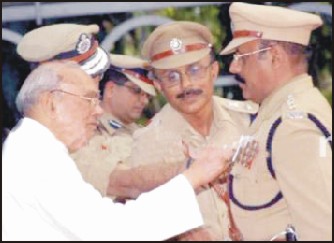
‘Tiger Ashok Kumar’ retires


Caption: A file photo of Governor H.R. Bhardwaj presenting President’s Medal to ACP B.B. Ashok Kumar.
Mysore, Aug. 2

ACP B.B. Ashok Kumar, nicknamed Tiger Ashok Kumar for his valorous feats, retired on Tuesday.

He earned the epithet of Tiger when he was PSI at Ulsoor Police Station, B’lore for chasing and catching chain-snatchers.

He won the President’s Medal thrice and CM’s medal once. Other Police officers who won the President’s Medal thrice are Shankar Bidari, Gopal Halsur and G.A. Bawa.

Biddanda Ashok Kumar, hails from Parane village in Kodagu.

He was a terror for criminals and is credited with 18 encounters. While being a part of STF to nab Veerappan, Ashok Kumar had slain 13 accomplices of the brigand and shot down three notorious anti-social elements.

His promotion to DCP was challenged by some at KAT. It is said that even though KAT favoured Ashok Kumar, he was deprived owing to petty politics.

Finally, when the order for promotion came last month, some petitioned against it at High Court. The court’s verdict was expected on the very day he was to retire. Ironically, the court deferred the verdict to a further date.

source: http://www.StarofMysore.com / General News / August 02nd, 2012