Category Archives: Science & Technology

Pollination merely one production factor

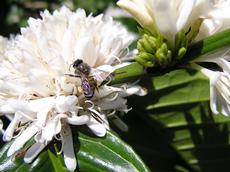
Bees of the Apis cerana (eastern honeybee) species pollinate coffee flowers. Farmers can increase the services of pollinating insects with particular cultivation methods. (Photo: J. Ghazoul / ETH Zurich)

By Peter Ruegg

No food for the human race without bees? It is not quite as straightforward as that. A case study by ecologists from ETH Zurich in a coffee-growing area in India reveals that pollinating insects are just one production factor among many. Farmers have several possibilities to increase their harvest.

All over the world, bees are dying and insect diversity is dwindling. Only recently, both the media and scientists expressed fears that insect pollination is in decline, which jeopardises food security. The (lack of) pollination has thus become a sound argument for the protection of species and natural habitats, and organic farming.

ETH-Zurich researchers from the group headed by Jaboury Ghazoul, professor of ecosystem management, set about investigating this argument by studying the influence of pollinator insects on coffee harvests in an agroforestry system at coffee plantations in the province of Kodagu in southern India. They also included soil and forest management, environmental factors such as water and soil fertility, and tree cover for the cultures in their study.

The research group thus obtained a different picture of the role of pollinators to the popular perception of this cultivation system of “no bees, no harvest”. According to their findings, pollinator bees are merely one production factor among many and to some extent coffee farmers can increase the productivity of their plantations independently of the insects. The results of the study have just been published in the journal PNAS.

Important but not the only factor
“Pollinators are important for coffee farmers,” stresses Ghazoul; “as far as effective coffee growing and increasing harvests are concerned, however, they are much less important than irrigation or liming, for instance.” This encapsulates one of the central findings from coffee farming in the Kodagu province.

Coffee is grown in a traditional agroforestry system in the region. As coffee plants must not be grown in direct sunlight, they are planted in the forest’s undergrowth or the shade of large, isolated trees. The coffee plants all bloom at the same time after heavy rains between February and March and three species of bee pollinate the flowers: the giant honeybee Apis dorsata, Apis cerana and the solitary wild bee Tetragonula iridipennis. The giant honeybee is the largest and most important pollinator, forming large colonies and needing the thick branches of tall trees to bear the weight of their nest.

Greater yield through irrigation and limestone
In order to harvest more coffee, however, the farmers have got other options than merely banking on the work of bees, as Ghazoul discovered. They can increase the yield through liming, irrespective of bee density. And instead of relying on rainfall, it is worth the farmers’ while to induce flowering with artificial irrigation. “It is particularly in a farmer’s interests to irrigate his plantations at a different time to other farmers in the vicinity,” says Ghazoul. After all, this will turn his plantations into bee magnets. This concentrated pollination increases the yield from the plantation enormously, the ETH-Zurich researchers reveal in their publication. It is a different story if the rain makes all the coffee plants in the region flower at the same time, however: the bees spread out over a wide area, the pollination is less effective and the harvest is poorer.

Trend towards deforestation
In an agroforestry system, the farmer also has another trick up his sleeve: felling trees or the forest to shed more light onto his coffee plants, which also increases the harvest. In doing so, however, he destroys the habitat of the giant honeybee (Apis dorsata).

A farmer who combines both courses of action is especially successful, initially unaffected by the disappearance of the large bees on his own plantation. Only when all farmers opt for this course of action do things take a turn for the worse. “From a plantation perspective, it makes sense to remove trees and increase yields,” says the ETH Zurich professor. “But if every farmer goes for the same option, they will all suffer the consequences of poor pollination because the giant honeybee will disappear.”

Sure enough, the researchers observed gradual deforestation in the Kodagu experiment area. Ghazoul is convinced that the farmers will lose Apis dorsata in the long run and thus – unless they take countermeasures – their valuable contribution towards coffee pollination. “It remains unclear whether the other two species of bee could compensate for this loss.” However, the farmers’ predicament is not hopeless, he says. They could domesticate Apis cerana, a very close relative of the European honeybee, and place beehives on the plantations, which would guarantee the pollination service without becoming dependent on Apis dorsata. The drawback: this absolves the farmers from their responsibility for the forest and trees. “The farmers are thus free to decide whether they want to have trees on their land or not,” stresses the ecologist, which spells bad news for nature conservation. “But good news for farmers. They have got possibilities to increase their harvest and sustain or even improve their existence.”

Unexpected threat from exotic tree species
The traditional forest trees face another danger. Farmers often replace felled local trees with the exotic Australian silver oak (Grevillea robusta), which provides the coffee plants with the shade they need. Moreover, it grows quickly and has a straight trunk, which farmers can use to grow pepper as the spice can be harvested more easily on the trunks. The sale of pepper and wood from the silver oaks is a way for the farmers to supplement their income.

However, the farmers are increasingly beginning to realise that the exotic tree also has its drawbacks. For one, its leaves barely decompose, covering the ground and coffee plants and thus becoming a breeding ground for harmful fungi and bacteria. It might also influence the nutrient cycle, which one of Ghazoul’s doctoral students is currently looking into. The silver oak leaves probably slows the nutrient cycle, preventing the coffee plants from receiving enough nitrogen in the long run, which eventually affects the harvest.

The example case of coffee growing in the province of Kodagu is interesting from a research perspective as it brings home how bees, farmers, their farming methods and natural occurrences influence and depend on each other. In this respect, the insects are not the sole influential factor in this agricultural system.

Ten principles for the reconciliation of nature and humankind
Teaming up with other scientists, ETH-Zurich professor Jaboury Ghazoul has defined ten principles that should help reconcile the conflicting interests of agriculture, nature conservation and other stakeholders with regard to a sustainable agricultural land use. The principles, which were published in the journal PNAS, include training farmers in cultivation methods that can be adapted to changing conditions. Another principle advocates taking different levels into consideration for a landscape approach, namely the landscape level itself and the individual farm level. In the example case in India, another principle is significant: the clarification of rights and responsibilities. For instance, the cultivated land belongs to the local farmers but not the trees, which belong to the state. This can cause conflicts. The principles should help to use an approach geared towards the landscape.

Further reading
Boreux V, Kushalappa CG, Vaast P, Ghazoul J. Interactive effects among ecosystem services and management practices on crop production: Pollination in coffee agroforestry systems. PNAS. 2013 May 21;110(21):8387-92. doi: 10.1073/pnas.1210590110. Epub 2013 May 13.

Sayer J, Sunderland T, Ghazoul J et al. Ten principles for a landscape approach to reconciling agriculture, conservation, and other competing land uses. PNAS 2013 110 (21) 8349-8356; published ahead of print May 21, 2013, doi:10.1073/pnas.1210595110.

source: http://www.ethlife.ethz.ch / ETH Life / Home> News Archive> Science / by Peter Ruegg / June 04th, 2013

Vittal Hegde gives insight on rain water harvesting

Mangalore :

“It is important to resolve water problems in the scenario of present climate change caused by huge carbon emissions. The important manifestations of climate change is global warming which causes global temperature to change,” said professor A Vittal Hegde from department of applied mechanics and Hydraulics, NITK.

He addressed the gathering after inaugurating the seminar of ‘water proofing and water harvesting’ organized by Kodagu Dakshina Kannada and Udupi Engineers Association (KDKUEA) at Hotel Ocean Pearl on Saturday April 6.

Addressing further, he said since the year 1700 after industrial revolution, climate change has been the cause of various issues. Due to regular changes in the level of carbon dioxide, there is a change in the atmosphere. The release of greenhouse gases leads to extreme events such as floods occur said the speaker giving an example of a recent flood that occured in Australia.

Considering the above problems, he said methodical support to local RWH should be provided to get a substantial amount of water. Briefing about rain water harvesting (RWH), he said it is accumulation and deposition of rain water for use before it reaches the aquifer.

In ancient India, people believed that forests were mother the of rivers; in fact a study from US indicated that 60% of fresh water comes from forest. The water bodies used to be maintained by the community around but after Independence, the government took full control over the water bodies and water supply.

Speaking about the benefits of RWH, Hegde said it improves water availability, improves quality of ground water, prevents soil erosion, flooding and more important is is that it saves water an dmoney for the future.

Concluding his talk, he said that every city/village should implement RWH for the benefit of the future generation. Unless it is been made mandatory, no one will implement it, thus government should support and take initiative, he added.

A Vishnu Bhat welcomed the gathering, Dr RG D’Souza compered while M Divakar Shetty delivered the vote of thanks.

HV Harish, president of KDKUEA, Hemanth K Jain, director, Kerakol India limited, DR S Srihari from the department of civil engineering in NITK Surathkal, Dr Lakshman Nandagiri, Dr Girish Kumar, U Nagendra Rao, Gajanana S Hegde among others were present.

source: http://www.daijiworld.com / Daiji World / Home / Daijiworld Media Network – Mangalore (VM) / Photographs: Spoorthi Ullal / Mangalore, April 06th, 2013

Centre plans boost for cardamom biz

Agriculture Minister Sharad Pawar reviews the functioning of Cardamom Research Centre in Madikeri, Karnataka

Agriculture Minister Sharad Pawar today reviewed the functioning of Cardamom Research Centre in Madikeri in Karnataka.

Pawar, who is on a two-day tour of the Indian Council of Agricultural Research (ICAR)-affliated institutes in Karnataka, is scheduled to return to Delhi on Saturday.

On Sunday last, Pawar had taken ill at a public function near Sangli in Maharashtra and had to be air-lifted to Pune. “He is fine now and travelling,” a close aide of Pawar said.

Cardamom Research Centre, Appangala, is located in Hervanadu village of Madikeri Taluk, Kodagu, Karnataka on the Madikeri- Bhagamandala Road, 8 km from Madikeri, in an area of 17.4 ha. The CRC Appangala is the only ICAR Research Centre working on cardamom, has been playing an important role in conducting research on cardamom and cardamom-based cropping systems, for increasing cardamom productivity.

During 2012, the centre celebrated its 50th anniversary and has been working closely with many stakeholders for development of the crop.

“I recall with nostalgia the day the centre was handed over to us in 1986 with “Queen of Spices” as the mandate crop. The release of the first IISR cardamom variety ‘Kodagu Suvasini’ in 1997 followed by ‘IISR Avinash’ and ‘IISR Vijetha’ in 2001 was a watershed in CRCs research agenda.

Subsequent research endeavours included our commitment to deliver technologies for sustainable use and evolve varieties tolerant to pests and diseases, climate change, drought etc not only for cardamom but also for black pepper. The technology to get sustainable production of black pepper despite delayed monsoon is well-accepted and appreciated by planters of this region.

Germplasm collection and conservation has always been our forte and the CRC now has in its fold around 436 accessions of cardamom, making it one of the largest germplasm collections in the world besides being the National Active Germplasm Site (NAGS),” M Anandaraj, Director, Indian Institute of Spices Research Said recently.

source: http://www.Business-Standard.com / Home> Markets> Commodities> Foods & Edible Oils / Press Trust of India / New Delhi, March 29th, 2013

Youth science awards presented

District-level youth science awards were presented to Virajpet Saint Annamma High School students K S Ajith (first) and Nelamakkada D Bopanna (second) and Gonikoppa’s Kalathmadu Lions High School student M C Manisha Utthappa (third prize) by Department of Science and Technology and Rajya Vijnana Parishat.

The awards carry cash prize of Rs 3,000, Rs 2,000 and Rs 1,000 respectively and were presented by ZP CEO K B Anjanappa and Additional DC Dr N Shivshankar.

K S Ajith has been selected to represent the district in the state level youth science competition.

source: http://www.DeccanHerald.com / Home> District / DHNS, Madikeri / March 27th, 2013

Coffee can reduce car crash risk – research

CoffeeCF21mar2013
Researchers linked drinking coffee to stay awake with a 63 per cent lower crash risk. Photo / Thinkstock\

Drinking caffeinated drinks like coffee significantly protects against crash risk for long-distance commercial drivers, new research suggests.

But University of Otago professor Jennie Connor warned that caffeine, while effective for short amounts of time, was not a solution to fatigue.

The research, published in the British Medical Journal, was undertaken in Australia between 2008 and 2011.

It compared 530 long-distance heavy vehicle drivers who crashed their vehicle on a long distance trip in the preceding 12 months, with 517 such drivers who had not crashed.

Researchers linked drinking coffee to stay awake with a 63 per cent lower crash risk.

“Long-distance commercial drivers who consume caffeinated substances such as coffee or energy drinks, to stay awake while driving, are significantly less likely to crash than those who do not, even though they drive longer distances and sleep less,” researchers said.

More than 40 per cent of drivers reported consuming substances containing caffeine for the sole purpose of staying awake.

Lead researcher Lisa Sharwood, from Sydney University, said the study suggested drivers were adapting their behaviour to manage fatigue.

“This may seem effective in enhancing their alertness, but it should be considered carefully in the context of a safe and healthy fatigue management strategy. Energy drinks and coffee certainly don’t replace the need for sleep,” she said.

That notion was shared by Professor Connor, head of preventive and social medicine at the Dunedin School of Medicine.

She had previously researched driver sleepiness and crashes in New Zealand, and said although caffeine was one of the most widely used substances by drivers to stay alert, its effect was short-lived.

“It has to be a substantial amount of caffeine to make a difference to alertness – about two cups of good coffee – and it wears off fairly quickly, after about 45 minutes. To make a significant difference to your ability to drive when sleepy, you need more than a cup of coffee.”

Drowsy drivers were impaired, like drunk drivers, even if they did not fall asleep at the wheel.

“That is to some extent reversible by caffeine for a short period of time. It will provide you with a little bit of extra alertness but it’s not the answer because an hour later you’re back in the same situation,” Professor Connor said.

source: http://www.nzherald.co.nz / The New Zealand Herald / Home> Life & Style> by Rosie Manins of the Otago Daily Times / Thursday, March 21st, 2013

Metal detector to check tourists in Raja Seat

Detector has been installed in the wake of Hyderabad bomb blasts

In the backdrop of bomb explosion in Hyderabad three days ago, the police have tightened security in Madikeri city which is one of the major tourism hubs in the State.

rajaseatKF02mar2013As a part of the improvised security measures, metal detector has been installed in Raja Seat garden that draws thousands of visitors from across the nation every day.

The police personnel have been posted in some of the key areas in the city including bus stands and tourism places. However, tight security is provided to Raja Seat on priority basis as large number of tourists throng to this garden, especially on week ends. The metal detector installed at the entry gate of the garden will function on three days in a week including Friday, Saturday and Sunday.

The Bomb Detection Squad which functions under Kodagu District Police Department has installed this metal detector. A team of nine personnel are operating in this squad and the personnel have undergone special training at a training centre in Bangalore.

In case a bomb is traced, a special Bomb Diffusing Squad will arrive from Bangalore to diffuse the bomb. According to the police sources, in the wake of bomb blasts in the nation, the number of police personnel guarding the Madikeri bus stand too has been increased. The general public who are accustomed to undergo examination from metal detector in bigger cities like Bangalore and Mysore, are co-operating in Madikeri too.

Speaking to Deccan Herald, Kodagu Superintendent of Police M N Anucheth said that metal detector has been installed at Raja Seat as a preventive measure in the wake of Hyderabad twin bomb blasts. “As the terrorists mostly target more populated areas, metal detectors are installed in such places. Raja Seat and bus stand are under special scrutiny in Madikeri,” he said.

source: http://www.DeccanHerald.com / Home> District / Madikeri, DHNS / February 24th, 2013

TOI Social Impact Awards: Wonder doctor’s success mantra

Mysore :
As a child M Jadeyegowda first saw Dr H Sudarshan dispense medicines to tribals at Biligiri Ranaga Hills near here. Initially, he stayed away from the doctor. Later, curiosity drew the tribal boy to the doctor. Dr Sudarshan and his Karuna Trust became the biggest influences on his life.

Other than providing medical help, Dr Sudarshan taught children in the tribal parts of Karnataka’s Chamarajnagar district. Jadeyegowda was a reluctant student. Today, he’s an assistant professor at Kodagu’s College of Forestry. “As a kid, I saw the doctor conduct surgeries with minimum facilities,” Jadeyegowda,43, says.

In October 2006, when the Vivekananda Girijana Kalyana Kendra (VGKK) — to which Karuna Trust is affiliated — celebrated silver jubilee, Jadeyegowda, MSc, shook hands with President Abdul Kalam. He was one of the six students who had attended the tribal school set up by the NGO 25 years back. Jadeye now heads VGKK and is a trustee of the Karuna Trust. “I’m more comfortable being recognised as a beneficiary,” he says. “Jadeye is a beneficiary of our health and education programmes. That helped him,” Dr Sudarshan says

source: http://www.timesofindia.indiatimes.com /Home> City> Mysore> TOI Social Impact Awards /by H M Aravind, TNN / February 01st, 2013

Tech wiz is ‘Coorg person of the year’

Google offered to buy his company, which he turned down

Vineet Devaiah, founder of a technology company which is set to offer tough competition to the controversial ‘Google Street View’ project is ‘Coorg Person of the Year, 2012’.

In fact Google had offered to buy out his company TeliportMe, but the Cornell educated CEO of the Palo Alto California-based start-up refused the offer, though Vineet had many a sleepless nights before turning down the once in a lifetime chance because “once you have said no, you cannot go back and ask them again.”

According to well-known technology website techcrunch.com, the Google buyout offer was in the range of $15-20 million, though Vineet is not prepared to comment on the amount.

He was selected ‘Coorg Person of the Year’ in a poll conducted by www.coorgtourisminfo.com, Kodagu’s first news portal, promoted by senior journalist P T Bopanna, said a release from the jouranlist.

Vineet, 26, son of Theetira Subramani and Latha, hailing from Kutta in Kodagu district of Karnataka State, has developed an Android application which focusses on creating virtual tours using 360 degree panoramas. Users can not only capture high-resolution 360 views, but can also share their images on Facebook and Twitter.

New application

Vineet likens his new application TeliportMe to Google Street View. “It is what TeliportMe will be in the next 5 to 6 years. The only difference between the two companies is that Google is paying billions of dollars to create it and we are getting it done for free… It’s kind of Wikipedia or crowd source imagery by people,” he noted.

Among the others who were nominated for this year’s ‘Coorg Person of the Year 2012’, include Commonwealth Games badminton gold medalist Machimanda Ashwini Ponnappa and noted environmentalist Col C P Muthanna, who has been waging a relentless battle to save the Western Ghats from the forest mafia in Kodagu. said the release.

source: http://www.DeccanHerald.com / Home> District / Mysore, DHNS / December 30th, 2012

And what about traditional healers?

All the medicines he gives are derived from herbs, collected from the forests and not chemically spiked.

The steady stream of patients has been increasing over the years for this ayurvedic practitioner, whose knowledge has been handed down the generations

The sick and anxious queue up every day at the clinic of a popular ayurvedic pandit in a north Kodagu village, hoping to find a solution to their ailments, and many undertake an arduous journey to reach this remote place nestled in coffee plantations.

His medicines — mostly herbs, powdered and packed in plastic covers — are handed out along with a pamphlet providing details about dosage and diet. The steady stream of patients has been increasing over the years for this ayurvedic practitioner, whose knowledge has been handed down the generations, but not through any formal method.

All the medicines he gives are derived from herbs, collected from the forests and not chemically spiked, he claims, telling patients to test them for heavy metals or steroid if they so wish.

“Most come after allopathic drugs fail to provide relief. Many come with faith in traditional knowledge,” he says.

There are thousands like him, claiming to use remedies handed down generations in a State that has rich biodiversity. Sources in the Department of Ayurveda, Yoga and Naturopathy, Unani, Siddha and Homoeopathy (AYUSH) estimate that there could be around 40,000 to 50,000 traditional healers, mostly in rural areas, in the State.

However, without a recognised degree, the medicines they prescribe have not gone through the rigours of modern testing methods.

The role of the traditional healer is thus a matter of debate. Lack of government-monitored system to test their medicines and validate their practice has also not helped.

No recognition

Officially, their role in the health system has not been recognised either by the Karnataka Medical Council or by the AYUSH Department. According to a senior official in the Drug Controller’s Office, prescribing allopathic medication without medical qualification is illegal under the Drug Rules and it is also illegal to prescribe ayurvedic drugs without recognition by the Directorate of AYUSH. AYUSH Department sources said that though no time-frame has been set, there is a loud thinking in the government to address issues pertaining to traditional medicine and healers as this knowledge is considered an important element in society that should not be lost.

source: http://www.TheHindu.com / Home> News> Cities> Bangalore / by Sharath S. Srivasta / Bangalore, December 04th, 2012

Forest staff, villagers to be immunised against monkey fever

Mysore, Dec. 5
A mass immunisation drive against monkey fever will be conducted by the Chamarajanagar health officials for the Forest Department personnel of Bandipur and the villagers in Maddur Colony in Bandipur Tiger Reserve (BTR) tomorrow, said BTR Director Kumar Pushkar.

Speaking to a newspaper yesterday, Pushkar, who has confirmed the monkey fever in Maddur forest range, said that there was no need to panic and the situation was under control. Blood samples of primates, suspected to have died of monkey fever, were sent to the National Institute of Virology, Pune.

Monkey fever, also known as Kyasanur Forest Disease (KFD), claimed the lives of eight Bonnet Macaques and two Langurs during last week. No more deaths of primates have been reported after that, Pushkar said and added that forest watchers working at Alegowdanakatte anti-poaching camp are in good health and there was nothing to be anxious about.

Five personnel of the camp had taken ill a few days ago with suspected monkey fever and were admitted to Gundlupet hospital for treatment.

Pushkar said vaccinations will be administered only for those aged between 6 and 65 years. Pregnant women and lactating mothers will not be vaccinated.

Meanwhile, Dr. R. Srinivas from Gundlupet and his team of medicos conducted a health check up for Maddur colony residents and found them to be free from any infection.

The vaccinations will be provided by Virus Diagnostic Laboratory (Shimoga). An expert team from Kyasanur forest of Shimoga (where KFD was first reported in 1957) will arrive in Chamarajanagar to assist the team.

Doctors have asked the forest authorities to take precautions before entering the forest like applying tick-repellent oil, which will be provided by the Department of Animal Husbandry at the veterinary hospitals. This will prevent the ticks, the carriers of KFD, from biting them. They have also been asked to bathe after returning from the forests.

Common symptoms of KFD are bleeding in nose and mouth, fluctuation in blood pressure and repeated fever.

source: http://www.StarofMysore.com / Home> General News / December 05th, 2012