Category Archives: World Opinion

Meet the brews beyond Chikmagalur on International Coffee Day

Non-traditional coffee growing regions in India are having a moment in the sun

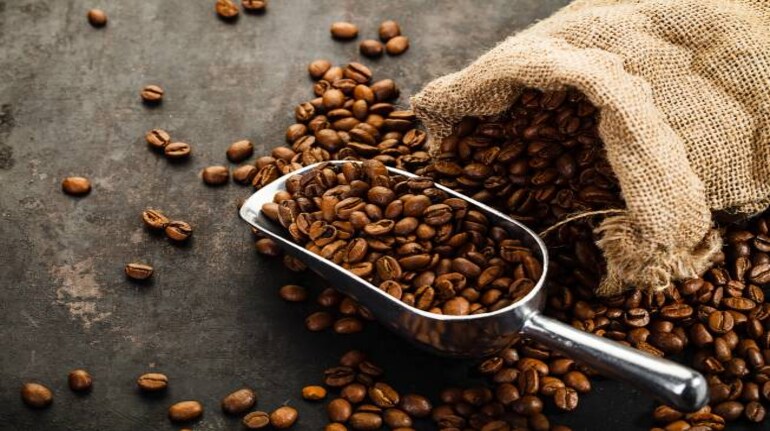
(Nathan Dumlao, Unsplash)

There was a time when coffee beans in India were assumed to have come from the South of India and the lush, verdant hills of Baba BudanGiri (regarded as the birthplace of coffee in India), Nilgiris and Kodagu in Karnataka that are known to be the key coffee producing regions in the country. Increasingly, places like Araku Valley near Visakhapatnam, Koraput in Odisha and Northeastern states such as Meghalaya and Nagaland as newer areas from where your favourite roasters have sourced their beans.

While coffee has traditionally been grown in South India and a majority of well-known estates continue to supply the bulk of coffee beans to roasteries across the country, the rise of these so-called non-traditional areas has been some time in the making. The coffee world took notice of this when Araku Coffee, that sources its beans from the eponymous valley comprising highlands of the Eastern Ghats, won the Gold Medal for the best coffee pod in the Prix Epicures OR 2018 Award in Paris, France, a first for any Indian coffee brand. The next year, a GI tag followed for Araku Valley coffee, giving its identity a permanent market and the scope to demand better price for its coffee.

What comes as a surprise is that just two decades ago, there was no Araku coffee and no market selling these coffees even though the region has a century-old relation to coffee plantation. Instead, tribals grew cash crops while the region was part of the Red Corridor for Naxal insurgency. This writer’s visit to Araku Valley by train in 2009 was suspended after major Naxal activity was detected the previous night with a high possibility of the tracks being blown apart, the station superintendent at the time informed.

Cooperatives like Girijan Co-operative Corporation and NGOs like Naandi Foundation worked with tribals in the region and over the years, a collective group effort with 10,000 farmers from 520 villages joined Araku’s coffee cooperative to cultivate 12,300 acres of land with world-class coffee. It has been described as the largest bio-dynamic coffee cooperative in the world.

“We empowered tribals to give us the best coffee and that led to a revolution in quality. Around 12 years ago, most coffees scored around 60 but today the score is over 85,” Manoj Kumar, CEO of Naandi Foundation and co-founder of Araku Coffee says. The widely accepted definition of specialty coffee is coffee scoring 80 points or above on a 100-point scale by the Speciality Coffee Association of America (SCAA).

To qualify as a specialty coffee, the beans have to be graded by certified coffee tasters known as Q graders. Coffee scoring 80–84.99 is graded Very Good, coffee that scores 85–89.99 is graded Excellent while Coffee scoring from 90–100 is graded Outstanding.

Araku’s success on the global stage set the stage for other places to bring out their coffees. Koraput, a region bordering Araku that finds itself in Odisha with issues related to Naxalism, has seen its fortunes rise as tribals engage in producing coffee that are wowing coffee lovers with its nuanced flavour profiles. “Coffee grown in forests like Koraput are semi wild grown coffees compared to coffee estates, which are a deliberate attempt to grow coffee. This biodynamic form of coffee is one of the key reasons coffee drinkers will find hints of Indian gooseberry and pepper that are also grown in the forest. This attribute has made Koraput coffee much sought after,” Debu Mishra, who started Tribe-O Koraput coffee and retailed with Mumbai-based Dope Coffee Roasters last year before expanding to other roasters says. When I tried this coffee last year, there was a natural acidity to the beans that can sometimes be difficult to discern with estate-grown coffees in my collection.

For its part, Dope Coffee expanded and bought 600 kilos of coffee from Durgamadhab estate in Koraput early this year after working with Tribe-O Project, Koraput. As Riyaaz Amlani, CEO of Dope Coffee says, “Customers today care where their coffee comes from. As roasters, it’s exciting to experiment with these beans that have great texture and density. Next year, we’re planning to help the estate with harvesting and post-harvesting processes as well.”

The Northeast, too, has seen local coffee brands grow. Meghalaya’s Smoky Falls Tribe Coffee sources the bean from farmers in the Jaintia hills and Khasi hills. Nagaland’s Été gets its beans from farmers in the state. Vivito Yeptho, co-founder and managing director of Nagaland Coffee Pvt Ltd, has found takers in his home state and few repeat customers across the country who buy their beans. “If you taste coffees from South India, they have distinct notes which are familiar to most. Then again, not everyone will enjoy Nagaland coffee that has a different taste profile with spicy notes,” he says.

Subko Coffee Roasters co-founder Rahul Reddy says: “The quality of the cup of coffee and its traceability is gaining traction. At Subko, we go by Lot numbers (specific quantities of beans collected from specific areas/portions, usually nanolots or microlots, on a coffee farm instead of picking all the coffee grown on the estate at one go) because everything is variable in coffee. The way I see it, as a roaster you are a curator of nuance,” adding that Garo Hills coffee from Meghalaya is among their highest-selling coffee.

The rise of coffee in non-traditional areas is still too small compared to overall coffee production in India. For example, of the 3,34,000 MTs of coffee produced in India in 2020-2021, only 11,500 MT came from non-traditional areas (comprising of North East, Odisha and Andhra Pradesh), according to the Coffee Board of India. However, coffee from these areas is projected to grow to 12,870 MTs for the 2021-2022 harvest season.

India’s most well-known roasters Blue Tokai has still to source coffee beans from these regions. Matt Chitharanjan, co-founder of Blue Tokai says that he would only consider selling coffees from non-traditional places if the coffee score crosses 82, which it hasn’t so far. “A coffee score below 82 is not unique for us. Then you’re just selling the coffee on its story. Araku is an exception but when we worked two years ago to elevate coffee scores in Andhra Pradesh we only saw a marginal improvement from 76 to 78. The real challenge is crossing that barrier.”

The rise of coffee in non-traditional areas is still too small compared to overall coffee production in India. For example, of the 3,34,000 MTs of coffee produced in India in 2020-2021, only 11,500 MT came from non-traditional areas (comprising of North East, Odisha and Andhra Pradesh), according to the Coffee Board of India. However, coffee from these areas is projected to grow to 12,870 MTs for the 2021-2022 harvest season.

India’s most well-known roasters Blue Tokai has still to source coffee beans from these regions. Matt Chitharanjan, co-founder of Blue Tokai says that he would only consider selling coffees from non-traditional places if the coffee score crosses 82, which it hasn’t so far. “A coffee score below 82 is not unique for us. Then you’re just selling the coffee on its story. Araku is an exception but when we worked two years ago to elevate coffee scores in Andhra Pradesh we only saw a marginal improvement from 76 to 78. The real challenge is crossing that barrier.”

Sunalini Menon, President, Coffeelab, Bengaluru says that the rise of coffees outside Chikmagalur can be attributed to a few reasons. According to her, “Talking about involving indigenous communities to produce coffee makes for a good story. Araku Coffee paved the way and made people realise that. The coffee from these regions has also seen simultaneous improvement. I am impressed with the how far coffee from Koraput has come. Finally, new coffee entrepreneurs need to stand out and sourcing coffees from non-traditional places is one surefire way of doing that.”

Beginner’s guide to buying coffee beyond Chikmagalur
1. Khar Single Estate Coffee from Nagaland Coffee
2. Durgamadhab Estate from Dope Coffee
3. Tribe Koraput Naturals from Dope Coffee
4. Garo Hills Experience Lot #2 from Subko Coffee Roasters
5. Tribe-O Project Koraput coffee from Marcs Coffees

Priyanko Sarkar is a Mumbai-based journalist and writer covering the beverage industry.

source: http://www.lifestyle.livemint.com / Mint Lounge / Home> Food> Drink / by Priyanko Sarkar / October 01st, 2021

8 Kodagu Soldiers In United Nations Peacekeeping Force

Madikeri:

Kodagu has the honour of having enriched our armed forces since ages. Now, eight soldiers from the district have been selected for the United Nation Peacekeeping Force in Lebanon. 

Soldiers who are currently serving in various regiments in the Army will join the camp soon.

Pemmanda S. Ravindra from Ponnampet, Karotira Lokesh from Pollibetta, Vinod Kalappa from Galibeedu; Ponnachettira Palangappa from Kalur village, Sathish. V. Doddaiah from Shanivarasanthe, Dinesh Pujari from Chamundeshwari Nagar in Madikeri, Deekshith Shetty from Bhagavathi Nagar and Bharath Pujari from Kaggodlu village.

The United Nations Peacekeeping Force is employed by the world organisation to maintain or re-establish peace in an area of armed conflict. More than 5,500 Indian military and Police personnel are serving in peace operations in Abyei, Cyprus, Democratic Republic of Congo, Lebanon, Middle East, Somalia, South Sudan and the Western Sahara. 

As of March 2021, a total of 19,075 personnel have been deployed in the UN mission in South Sudan.

Now the eight soldiers from Kodagu will take part in the UN Peacekeeping Forces camp in Lebanon.

source: http://www.starofmysore.com / Star of Mysore / Home> News / September 12th, 2021

Film on Field Marshal K M Cariappa to be made

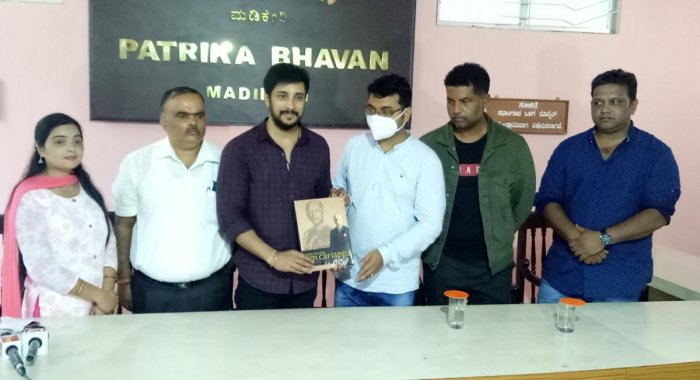
The team of a film on Field Marshal K M Cariappa, at Patrika Bhavan in Madikeri. Actor Prem, director Raghavendra and producer Arun Pradeep look on, among others.

Film director Raghavendra said that the family of Field Marshal K M Cariappa has given permission to Neo Cinema Samsthe to make a film on Cariappa.

Addressing reporters in Madikeri on Monday, he said that it will be his pride to direct the film. Actor Prem has been selected to play the lead role.

“Information has been obtained from Cariappa’s son Air Marshal Nanda Cariappa in Madikeri. The objective of the film is to narrate Field Marshal Cariappa’s valour to the entire world. The film is being made in Kannada, English and Hindi and is a big-budget movie,” he said.

Raghavendra further said that preparation will be done for eight months for screenplay and selection of places for shooting.

After the shooting, the film will hit screens in two years, he added.

Actor Prem said that Kodagu is a land of patriotism and culture.

If two children take birth in a Kodava family, one is sent to the army and another is chosen for agriculture. The life of Field Marshal K M Cariappa makes everyone proud, he said.

Madikeri CMC former member Veenakshi, film producer Arun Pradeep and distributor Anand were present, among others.

source: http://www.deccanherald.com / Deccan Herald / Home> State> Mangaluru / by DHNS, Madikeri / September 27th, 2021

FIBA Women’s Asia Cup 2021 : Kodagu Girl In Indian Team

Madikeri:

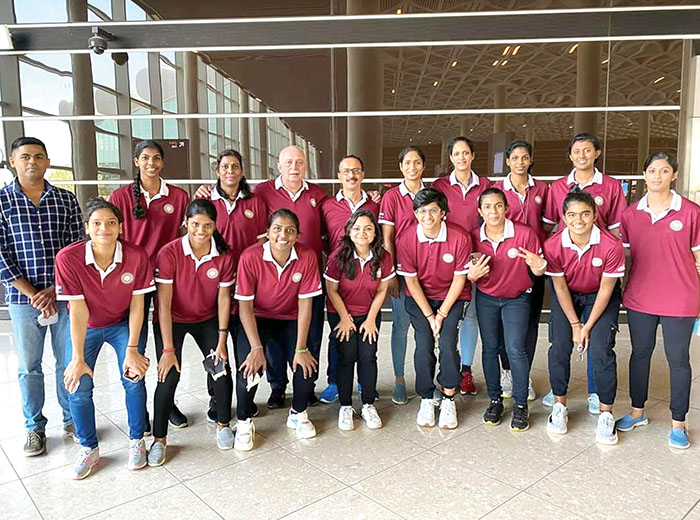
Power Forward from Kodagu Navaneetha Pattemane Udayakumar will be a part of the Indian team in the FIBA Women’s Asia Cup Basketball Tournament, scheduled to commence in Amman, Jordan, on Sept. 27.

The Indian team is placed in ‘Group A’ alongside Japan, Korea and New Zealand and the Indian squad will be led by Shireen Limaye. The squad comprises Shireen Limaye (captain), Madhu Kumari, Sruthi Arvind, S. Pushpa, P.U. Navaneetha, S. Sathiya, M. Nishanthi, Vaishnavi Yadav, Sreekala Rani, Anumaria, Stephy Nixon and S.M. Sahana. 

Standing 5-foot-10 inches tall, Navaneetha has been an outstanding performer in women’s basketball in the country. She has represented India in the FIBA Asia Women’s Basketball Championships and is employed with South Western Railways (SWR), Mysuru.

Before joining SWR, Navaneetha was  trained at the DYES Sports Hostel, Mysuru. She is the recipient of the prestigious ‘Ekalavya Award’ and Karnataka Olympic Association (KOA) Award for her feats in the sport. 

Navaneetha is the daughter of P.P. Udayakumar and P.U. Girija, who are residents at Suntikoppa, Kodagu. She married K.M. Adarsh from Mysuru this year, who is serving in the Indian Army.

Initially encouraged by her parents, Navaneetha joined Sports School, Vidyanagar, and later on joined Sports Hostel, Mysuru, in 2006. Initially, she was coached by B.S. Girish, SAK Basketball coach and DYES & SAK Basketball coach M.B. Patil at DYES, Mysuru.

A forward, Navaneetha is an attacking player and impresses with her skilful play. She began her career by representing Karnataka in the School Nationals held at Punjab in 2008 and from then on, has never looked back. She has represented the State in the Women’s Nationals, Youth Nationals from 2009 till 2010 and in 2011, she represented the State in the Senior and Junior Nationals in Delhi.

She represented the Mysore University in the Inter-University Championships in 2011-12 at Kannur and has been a regular in the team from then on. In 2009-10, her excellent play in the Nationals earned her the Indian cap when she donned Indian colours in the 1st FIBA Asia U-16 Championships held in Pune. She also took part in the NBA All India Tournament held at Delhi in 2001-12. She took part in the Junior Indian and Youth Indian camp held at Delhi and Tamil Nadu.

source: http://www.starofmysore.com / Star of Mysore / Home> Sports/ September 20th, 2021

Centre to simplify Coffee Act to promote ease of doing biz

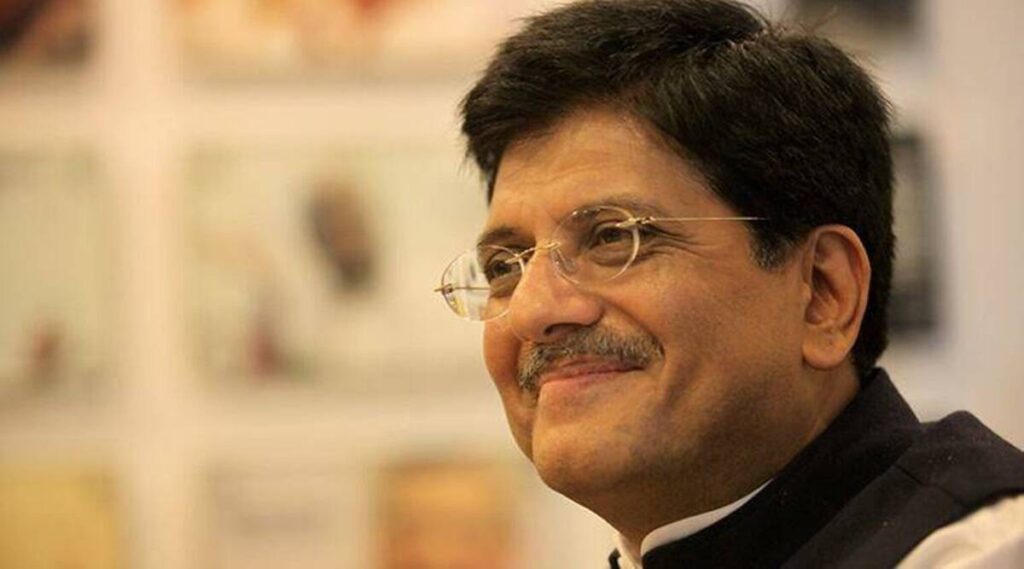
The issue was discussed, among other things, in an interaction of Commerce Minister Piyush Goyal with coffee growers, roasters, exporters and other stakeholders at Coffee Board Head Office, Bengaluru.

Commerce Minister Piyush Goyal. (File)

The government will relook at the coffee law to make it suitable as per the present needs of the sector and facilitate its growth, the commerce ministry said on Saturday.

The issue was discussed, among other things, in an interaction of Commerce Minister Piyush Goyal  with coffee growers, roasters, exporters and other stakeholders at Coffee Board Head Office, Bengaluru.

Coffee growers expressed concerns over losing their lands in view of the notices issued by banks under the Securitisation and Reconstruction of Financial Assets and Enforcement of Security Interest (SARFAESI) Act.

source: http://www.indianexpress.com / The Indian Express / Home> India / by ENS, Economic Bureau, New Delhi / September 19th, 2021

Prasad Bidapa Joins Advisory Board Of Pearl Academy

Pearl Academy welcomes Bengaluru based fashion connoisseur Prasad Bidapa on its academic advisory board.

India’s leading creative education institution, Pearl Academy, today announced that fashion and image expert Prasad Bidapa has joined the academic advisory board of its Bengaluru campus.

The advisory board, with eminent veterans from diverse creative fields, is responsible for bringing industry insights and global best practices that can be incorporated into the curriculum and pedagogy to ensure that the students receive the most relevant education.

On joining the Pearl Academy Bengaluru advisory board, Prasad Bidapa said, “I strongly believe that contributing to the education of the youth is one of the best ways to make your years of expertise and experience count and hence, I am delighted to collaborate with Pearl Academy.

The institute’s seriousness towards nurturing creative minds in a way that prepares them for professional lives while retaining their unique identity and passion for the chosen craft is exemplary.

I am looking forward to engaging with the young creators, innovators, dreamers and disrupters. My mission is to sensitize our young minds into appreciating & using the vast wealth of our indigenous textiles & techniques, and helping them achieve global recognition”.  

With 40 years of experience, Prasad is undoubtedly amongst the iconic fashion gurus of India.

He has been revolutionizing the fashion industry by curating various high-profile fashion events like India Men’s Fashion Week, Colombo Fashion Week and Rajasthan Heritage Week.

He is also committed to the cause of reviving the traditional textiles of India. 

source: http://www.bweducation.businessworld.in / BW Education / Home / by BW Online Bureau / September 02nd, 2021

Explained | Why coffee prices are soaring

Adverse weather, strict lockdowns because of the COVID-19 pandemic and severe logistical bottlenecks have disrupted the global coffee market making your morning brew dearer.

The global shortage is a blessing for India where FY21 output jumped 12%. India is the world’s seventh-largest coffee producer but not a major consumer, and exporters have better availability of containers compared with Vietnam and South America and are getting good prices (Image: Shutterstock)

Global coffee prices are soaring because of lower availability from the main producing countries, which has created a demand-supply mismatch in the international market for the beverage.

Adverse weather, strict lockdowns because of the COVID-19 pandemic and severe logistical bottlenecks have disrupted the global coffee market and raised prices to multi-year highs for both varieties of coffee — Robusta that has more caffeine and a stronger, bitter taste, as well as the Arabica grade that has a smoother and sweeter taste.

Moneycontrol looks at what is driving the international coffee market and what it means for India.

Sharply rising prices

Robusta coffee futures soared to more than $2,000 per tonne last week, having risen about 50 percent this year; while in July the Arabica grade had risen to the highest since November 2014, making the beverage more costly around the world. Robusta prices had been slightly lower than Arabica for more than a year but last week’s move brought them on par with Arabica.

Brazil ignited the coffee market

Coffee prices started rising because of adverse weather in Brazil, the world’s biggest producer of the bean for the last 150 years. Output in the country is expected to fall to the lowest in nearly two decades.

After erratic rainfall, the Brazilian crop was hit by extremely cold weather, which damages coffee plants. Many coffee plants in Brazil developed spots on their leaves as the cold weather was the worst since 1994.

The coffee crop is even more vulnerable to damage when a cold spell hits the plants that have already been weakened by a drought. The damage is so severe that some plantations in Brazil may need to plant a new crop, which will take years to mature.

Other major producers

Supply from Vietnam, the second-biggest producer, has been disrupted by lockdowns because of rising COVID-19 cases. The government has imposed a lockdown in Ho Chi Minh City, a coffee exporting hub, while movement of the beans from plantations to cities is also affected. As a result, Vietnamese coffee is unable to reach consumers around the world.

The third-largest producer, Colombia, also has problems. Supply was disrupted because of a series of anti-government protests in the country, which raised Colombian prices to a record in May this year and affected supply as well as the market sentiment globally.

Logistics adds to the woes

Like various other commodities and goods, coffee is also suffering from very high freight costs and shortage of containers. The problem is quite severe in South America and is raising the cost of Brazilian and Colombian coffee. There are several cases of vessels not being available despite being booked in advance, which creates sudden supply glitches.

Implications for India

The global shortage is a blessing for India, which is the world’s seventh-largest coffee producer but not a major consumer as the country’s favourite beverage is tea.

India produces mostly the Arabica variety of coffee, 70 percent of which is exported. Exporters are getting good prices and the output in 2020-21 increased by 12 percent, according to data from the Coffee Board.

Indian exporters also have better availability of containers compared with Vietnam and South America. This is because containers coming in with cashew imports are being used to ship out coffee, traders say. Indian coffee imports have increased about 10 percent so far this year.

Outlook

Prices may rise further as concerns about the weather continue to dog the market. Arabica coffee futures rose on August 30 because of forecasts of adverse weather, indicating more stress for beleaguered crops in top supplier Brazil, according to a Bloomberg report. Key producing regions in Brazil are forecast to face adverse weather in the coming weeks, it said. This can further increase global coffee prices.

(The author is an independent journalist)

source: http://www.moneycontrol.com / MoneyControl.com / Home> News> Business / by Himangshu Watts / September 01st, 2021

Changes in rainfall pattern affects Arabica coffee variety in Karnataka’s Kodagu

While the price of Arabica variety has increased in the international market, many planters of Kodagu are reluctant to maintain this variety of the crop.

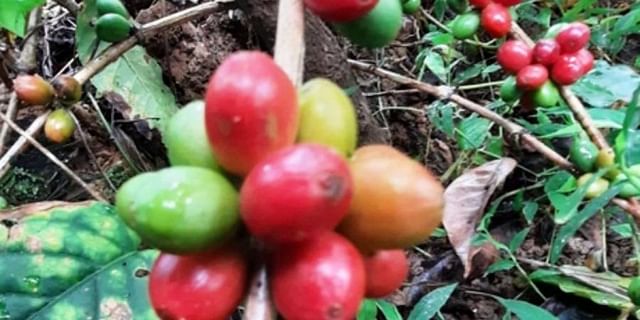
Arabica coffee plant (Photo| EPS)

Madikeri :

The changing rainfall and weather pattern in Kodagu is affecting the coffee plantations – especially the Arabica variety of coffee.

While the price of Arabica variety has increased in the international market, many planters of Kodagu are reluctant to maintain this variety of the crop due to the challenges faced following the changing weather patterns.

“Coffee growers in the district have faced immense losses since the past three years. And the Arabica variety of coffee has become unmanageable and a small coffee grower cannot sustain this crop anymore,” shared K Subbaiah, a coffee grower in Chettalli.

He had grown Arabica varieties of plants across eight acres of land and he explained, “I had taken up inter-cropping of Arabica and Robusta varieties across 11 acre. However, I have removed all the Arabica crops in the nearly eight acre estate as I am unable to sustain these crops.”

He shared that the untimely rains has resulted in the Arabica crops yielding beans way before the picking period. “The coffee beans have ripened during this August. How can one pick these beans in the rain and where can one dry these beans?” he questioned.

The Arabica variety normally bore ripened beans in the month of September and they were to be picked during November. However, the changing rain pattern has immensely affected the crop and like Subbaiah, many small coffee growers are removing the Arabica crop variety following immense losses, despite the hike in the price in the international market.  

Former vice president of Coffee Board, Dr Kaverappa shared that the Arabica variety is increasingly prone to black rot disease, resulting in its downfall. “Arabica variety is increasingly found in the North Kodagu belt. However, the untimely rains and floods have affected the crops. While there is an immense shortage of Arabic beans and demand for the same has increased in the international market, the production of Arabica variety is less in the district due to the challenges faced by the growers in marinating these varieties,” he explained.

He hoped for the government’s support to the coffee sector and said that insurance to coffee crops and reintroduction of subsidies to the machineries must be enabled to promote and support the sector.

source: http://www.newindianexpress.com / The New Indian Express / Home> States>Karnataka / by Pragna GR, Express News Service / August 29th, 2021

Neelakurinji blooms beckon tourists, chopper rides on offer

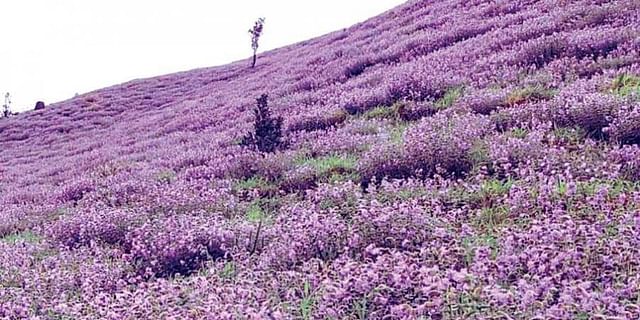
The mass blooming of the Neelakurinji flower (Strobilanthes kunthiana) in Kodagu district is giving the much-needed boost to the state’s tourism sector.

Neelakurunji flowers bloom at a hillock in Kodagu district | forest department

Bengaluru:

The mass blooming of Neelakurngi in Coorg has made it a rallying point for wildlife enthusiasts, botanists, photographers and tourists.

The blooming at the hillocks of Mandalpatti and Kote Betta in Kodagu, tourism has also taken up the north. Since the blooming has happened for the first time in a such a massive scale and is after 12 years, more so after tourism activities have opened up after the pandemic, every one are heading to India’s Scotland to see them. 

The new entrant in the list to draw tourists is heli- tourism. As the state government and the tourism department are trying the revive the long pending heli- tourism, a firm in Bengaluru has undertaken a heli- ride to Kodagu and surrounding areas, giving an areal view of the blooming Neelakurunji flowers on the hillocks. 

Govind Nair, Director, Thumby Aviation Private Limited said already one trip from Yelahanka air base to Coorg was done earlier this week. Now it is being offered as a part of the Nowhere trip to Coorg, a package tour, where a detour to Mandalapatti will be done. 

Tourism packages and inineraries are being revamped on the go, depending upon the blooming and withering of the flowers. But since it is a once in 12 years sighting, many resorts are offering a visit to the region as a part of the package, to draw more crowds. 

Trekking and flying has now taken the front seat to draw tourists. Even as the recent guidelines of the ministry of aviation states that drones are prohibited over national  parks, wildlife sanctuaries and other eco- sensitive places, conservationists and foresters object to helicopters flyover over the region. They point not just is the area a fragile Western Ghats region, little is know the species in Kodagu and so all precaution should be exercised to safeguard them. 

Botanists point that utmost care should be taken in the area as the flowering in this part of Western Ghats has not been recorded and documented. Karnataka as around 45 species of Kurunjis and in different altitudes different species have been recorded. Each species blooms at different intervals like once in six years, nine years, 11 or 12 years. So administration must ensure that tourism and footfall is limited to the region, so that they are well protected. 

source: http://www.newindianexpress.com / The New Indian Express / Home> Cities> Bengaluru / by Bosky Khanna, Express News Service / August 27th, 2021

‘Only Rightful Constitutional Recognition Can Save Kodavas’

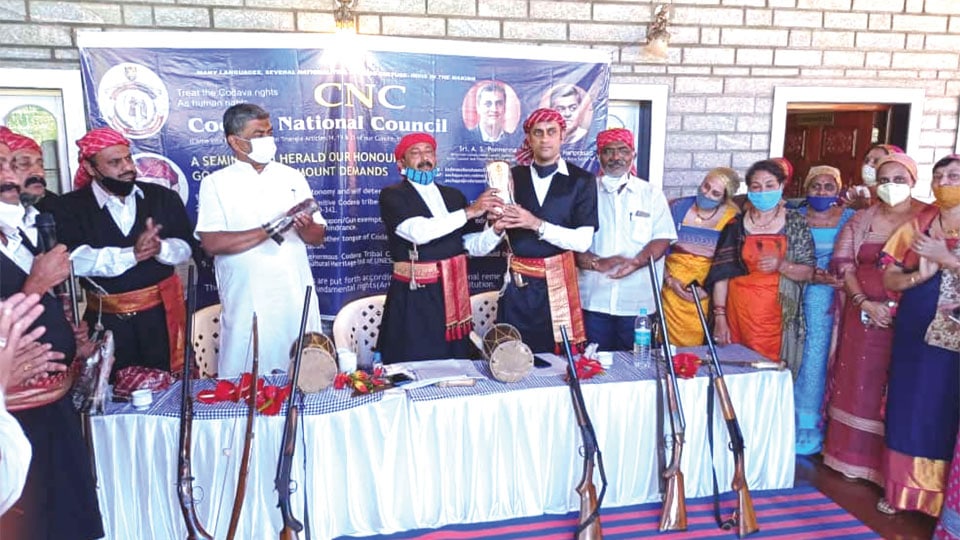
Senior Congress leader B.K. Hariprasad speaks at CNC seminar

Madikeri: 

Kodavas have been agitating for over two decades seeking the grant of their Constitutionally-guaranteed rights and only these rights and privileges can guarantee the survival of this rare community, opined MLC and senior Congress leader B.K. Hariprasad.

He was addressing a seminar on Kodava rights, demands and aspirations. The event was organised by Codava National Council (CNC) at a private resort in Murnad recently. 

“Kodava community must get special recognition under Article 371 (k). The community deserves recognition in the Scheduled Tribe list as their lifestyle, custom, traditions, practices and festivals reflect the tribal spirit,” he noted. 

CNC’s demand and claim for geo-political Autonomy is most legitimate, logical, feasible and deserving in all sense among any other demands, he opined. The Kodava tribe which is facing the threat of extinction should be enlisted under Scheduled Tribes of the Indian Constitution. “The Government should take measures to protect the tradition of Kodavas. Provision of ST tag is necessary in this regard,” he added.

On this occasion, ‘Codava Rathna’ award was conferred on Hariprasad and eminent jurist A.S. Ponnanna. The main purpose of this award is to recognise and respect those who go out of their way even risking their well-established career for the cause of the Kodava community.

Hariprasad had raised the community’s aspirations in the Parliament and in the Legislative Council. Also, he moved a “Private Member Constitution Amendment Bill 2016” to include Kodava language in the 8th schedule of the Constitution. He advocated the grant of ST tag to Kodavas and also argued that the gun licence exemption should be continued to Kodavas forever and should not be restricted to 10 years. 

According to CNC President N.U. Nachappa, certain resolutions were passed at the seminar to safeguard the genus of Kodava tribe and its civilisation. The community fulfils the definition of indigenous people promulgated by the United Nations through various declarations and steps must be taken in this regard to protect it.

“By trait, Kodavas are tribals and by our miniscule size of population, we are a minority in all senses. That is tribal, racial, ethnic, linguistic and national minority. We have every criteria and right to claim for empowerment defined for various indigenous tribes, minority groups and ethno linguistic nationals enshrined in the UN Charter,” he added.

“We are indigenous primitive tribe and it is our fundamental human right and freedom to exercise internal political self-determination right and to have geo-political autonomy in our own defined, indivisible traditional homeland,” he demanded. High Court advocate Lakkavalli Manjunath, Political Science lecturer Dr. P.E. Somaiah and others were present.

source: http://www.starofmysore.com / Star of Mysore / Home> News / August 22nd, 2021