Category Archives: World Opinion

Unbound: Visionary Women Collecting Textiles

Two Temple Place, London
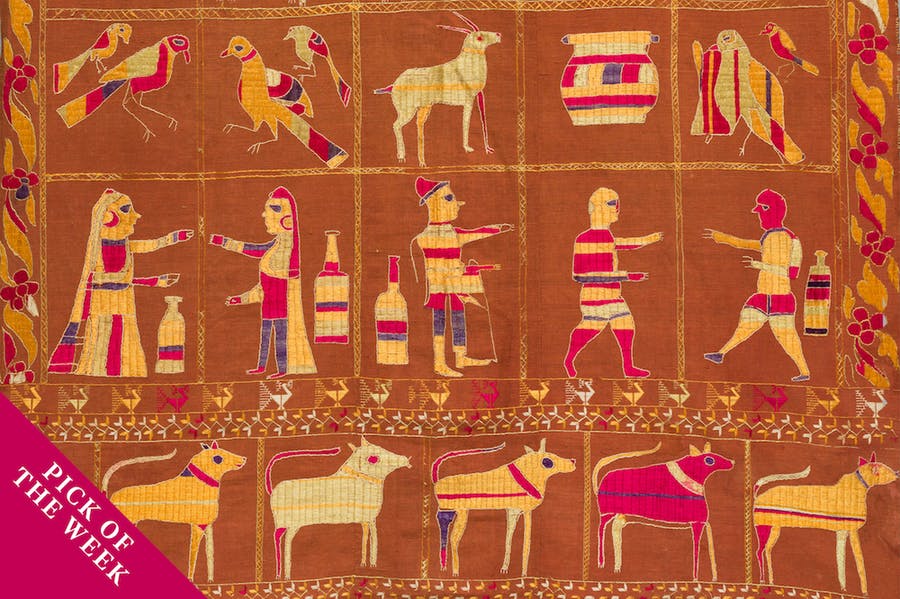
Phulkari (detail; early 20th century), unknown maker. Photo: Paul Tucker; © Bradford Museums and Galleries

Seven women who collected textiles during the 20th century are the focus of this exhibition, which considers how the collections they formed – ranging from Balkan costumes to South Asian saris – helped to assert the status of these materials as works of art. Find out more from Two Temple Place’s website.

Preview the exhibition below | View Apollo’s Art Diary here

Giubba (19th century), Albania. Photo: Calderdale Museums Collection, Halifax

The artist and writer Edith Durham (1863–1944) travelled widely across the Balkans in early 20th century, becoming renowned for her anthropological reports on life in Serbia, Albania and Kosovo. In 1935, her collection of Balkan costume and jewellery – including this giubba, a traditional robe worn by Albanian women – was donated in 1935 to the Bankfield Museum in Halifax, where it remains to this day.
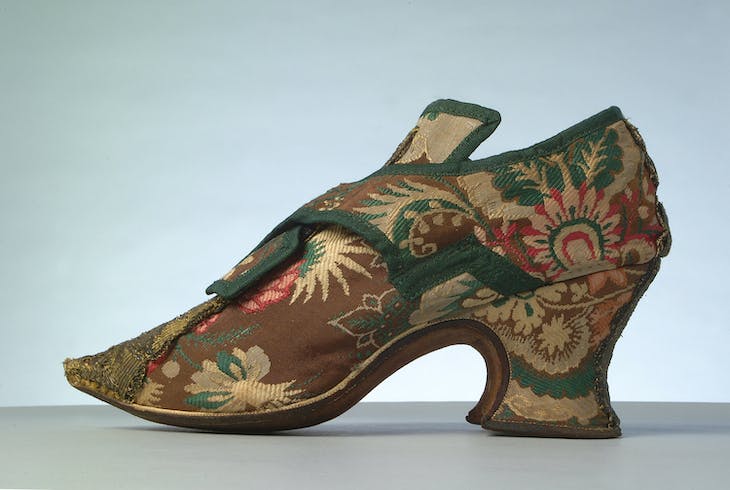
Brocade shoe without clog (1735–45), unknown maker. Photo: John Chase Photography/The Olive Matthews Collection, Chertsey Museum

Drawn to historic fashion from a young age, Olive Matthews built up a significant collection of more than 4,000 objects over the course of her lifetime – being careful always to stick to a budget of no more than £5 per item. She focused particularly on delicate needlework and embroidery – as seen on this shoe of brocaded silk from the 18th century.

Curtain with jungle repeat pattern (n.d.), Enid Marx. Photo: Harminder Judge/Compton Verney

Along with her friend Margaret Lambert, Enid Marx amassed a major collection of English folk art after 1932, although by this time she was already a renowned textile artist in her own right, having studied alongside Eric Ravilious and Edward Bawden at the Royal College of Art in the 1920s. In the exhibition, examples of her own work – such as this repeating pattern, reminiscent of animal hide – are on show alongside objects from her collection.

Phulkari (early 20th century), unknown maker. Photo: Paul Tucker; © Bradford Museums and Galleries

From 1985–98, Nima Poovaya-Smith was senior keeper of international arts at Bradford Art Galleries and Museums, during which time she established the transcultural gallery at Cartwright Hall. She built up a collection at the gallery that reflected Bradford’s history of textile manufacture and explored the influence on it of fabrics from across the world – in particular southern Asia. This colourful cloth is an example of phulkari (‘floral work’ in Punjabi), so-called because of the embroidered patterns that extend over every inch of the fabric.

Event website

source: http://www.apollo-magazine.com / Apollo / Home> Whats On / January 25th – April 19th, 2020
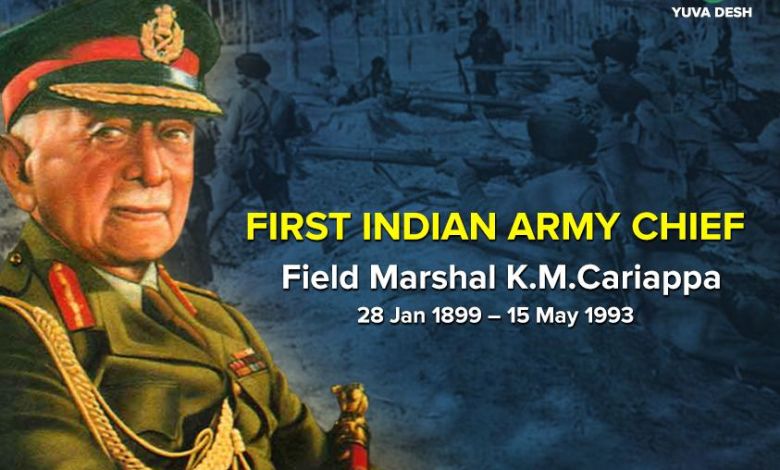
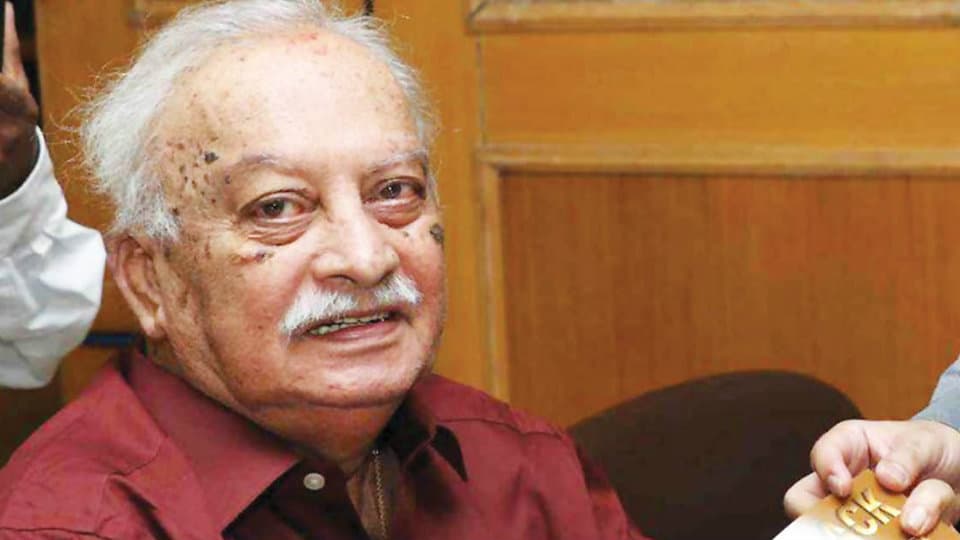
Who was Field Marshal KM Cariappa?

CariappaKF22jan2020

KM Cariappa is a man known for many firsts, but most importantly, he is known as the man who took charge of the Indian Army from its last British Commander in Chief, General Sir Roy Bucher. Born on January 28, 1899, in Coorg, Cariappa completed his education at Central High School at Madikeri and went on to study at the Presidency College in Madras.

However, Cariappa began his Army stint under the British and was among the few selected for the first batch of KCIOs (King’s Commissioned Indian Officers) at the Daly Cadet College in Indore and was commissioned in the Carnatic Infantry. He was in active service with the 37 (Prince of Wales) Dogra in Mesopotamia (present-day Iraq) and then posted to the 2nd Rajput Light Infantry (Queen Victoria’s Own). Cariappa went on to become the first Indian officer to undergo the course at Staff College, Quetta in 1933. In 1946, he got promoted as the Brigadier of the Frontier Brigade Group.

By Indian independence, Cariappa saw action in Iraq, Syria, Iran and Burma and became the first Indian Officer to be given command of a unit in 1942. He went on to receive many awards and accolades in his career spanning three decades. He received the prestigious Order of the British Empire (OBE) for his role in Burma against the Japanese during the Second World War.

In 1947, Cariappa became the first Indian to be selected to undergo a training course at Imperial Defence College, Camberly, UK. His role during the Partition is rarely mentioned, during which he oversaw the division of the Army. Cariappa also led the Indian forces on the Western Front during the Indo-Pak War of 1947 and successfully recaptured Zojila, Drass and Kargil and established a linkup with Leh.

On January 15, 1949, Cariappa became the first Commander-in-Chief of the Indian Army. He held the five-star rank of field marshal, the highest honour in the Indian Army, which Sam Manekshaw is the only other officer to have held.

source: http://www.defenceaviationpost.com / Defence Aviation Post / Home> Defence> Indian Army / source: Indian Express / January 20th, 2020

Rohan Bopanna-Wesley Koolhof Win Qatar Open Title

Veteran tennis star Rohan Bopanna won the $1,465,260 Qatar Open with men’s doubles partner Wesley Koolhof.

Veteran tennis star Rohan Bopanna won the $1,465,260 Qatar Open with men’s doubles partner Wesley Koolhof of the Netherlands with a come from behind win in the final on Friday. The pair beat British-Mexican pair of Luke Bambridge and Santiago Gonzalez 3-6, 6-2, 10-6 to clinch the title.

Third-seeded pair Bopanna and Koolhof had reached the final earlier after beating second seeds Henri Kontinen and Franco Skugor 7-5, 6-2. The title win hands them 250 ATP points and a prize money of $76,870.

Unseeded Bambridge and Gonzalez, on the other hand, had got the better of Denmark’s Frederik Nielsen and Tim Puetz of Germany 2-6 6-2 10-4 in the semis to get to the final themselves.

source: http://www.sports.ndtv.com / NDTV Sports / Home> Tennis> News / by Indo-Asian News Service / January 11h, 2020

India’s First World Coffee Conference In Bengaluru From Sept. 7

Three-day event at Bangalore Palace to be organised by London-based International Coffee Organisation

IndiasFirstKF02jan2020

Madikeri:

Bengaluru will host the fifth edition of the World Coffee Conference (WCC), a high-profile international event, between Sept. 7 and 9 in 2020. Earlier editions were held in the UK, Brazil, Guatemala and Ethiopia.

The three-day event that will be held at the sprawling Bangalore Palace will be put together by London-based International Coffee Organization (ICO), Ministry of Commerce and Industries, Coffee Board of India and India Coffee Trust (ICT), which is a forum for coffee growers and exporters.

The event is themed ‘Sustainability Through Consumption’ and will celebrate all things of coffee in an immersive experience with the conference addressed by international speakers, coffee exhibition, buyer-seller meets, competitions and awards, skill building workshops, amongst many others.

ICT President Anil Kumar Bhandari told reporters in Madikeri yesterday that the prestigious WCC coming to India for the first time means huge international recognition for Indian coffee. The Who’s Who from the world of coffee will be descending on Bengaluru for this event. This will give a fillip to the Indian cuppa in the global market. Over Rs. 15 crore is being spent to organise the conference, he added.

The participants will include the world’s leading coffee brands and café chains, retailers, roasters, equipment manufacturers, coffee organisations from round the globe, policy makers, industry captains, exporters, manufacturers and a whole host of players associated with the commodity.

Conference attendees

Around 3,000 international delegates from 80 countries, 2,000 Indian delegates, over 1,00,000 coffee growers and exporters, representatives of HORECA (Hotel/Restaurant/Café sector) and hundreds of coffee connoisseurs are expected. There will be more than 100 speakers, 150 exhibitors and over 300 business-to-business and business-to-consumer meeting.

Coffee being the world’s most favourite beverage with 2.5 billion cups consumed every single day is produced in about 70 countries most of them belonging to the developing countries like Africa, Latin America and Asia. India is the sixth largest producer of coffee in the world, accounting for about 5 percent of world coffee production.

Innovation to conference

At the conference, the Coffee Board of India and the International Coffee Organisation (ICO) will bring in innovation to the conference and expo by crowd-sourcing ideas from citizens. They will look at ways that will make Indian coffee a brand that is recognised worldwide and formulate ways to make India a sustainable destination for coffee.

Methods will be explored to make coffee farmers stakeholders in the value chain as this will have a positive impact on the 25 million families who depend on coffee cultivation the world over. “This is a great opportunity that India has got and the organisers will welcome to India participants from more than 80 countries for the expo and conference,” Bhandari said.

Connecting with growers

India is also emerging as the major coffee consuming country. The Government of India has also a strong focus on increasing coffee plantation and the global community also desires to connect with coffee growers in India and Asia and WCC-2020 offers an opportunity to explore India and Asia to the global coffee community.

Bengaluru is the coffee capital of India and produces nearly 70 percent of India’s coffee that is produced in Kodagu, Malnad, Hassan and Chikkamagalur. As the theme of WCC-2020 is sustainably through consumption because the world coffee production is increasing and having a negative impact on coffee prices, this can be offset by increasing consumption, therefore consumption is the key to sustainability. The focus will be on economic, agriculture, commercial, environmental, social and cultural impact.

source: http://www.starofmysore.com / Star of Mysore / Home> News / December 31st, 2019

IBM brings weather forecasting model for governments, industries, farmers

IBM has launched a global high-resolution atmospheric forecasting system, IBM GRAF, saying more accurate weather forecasting can help governments and companies greatly improve their operations. IBM said GRAF can help bridge the gap between Indian …

New Delhi :

As many as 94% of top Indian business leaders believe climate change and adverse weather conditions have had a negative impact on business operations while around 72% believe they disrupt local economy, a study by IBM and The Weather Company shows.

The report released on Thursday also said a significant number of Indian citizens said they were not confident about the local weather forecasts.

IBM has launched a global high-resolution atmospheric forecasting system, IBM GRAF, saying more accurate weather forecasting can help governments and companies greatly improve their operations.

“We work with 168 different governments today around the world, and we are in touch with Indian government as well,” said Cameron Clayton, general manager at IBM Watson Media and Weather. “We want to work on providing accurate forecasts as it has a massive impact on the GDP.”

IBM said GRAF can help bridge the gap between Indian forecasting system and global models.

The 15-day weather forecasts released in India start from 80% accuracy and by the end of the 13th day the accuracy percentage falls to 50%, Cameron said. IBM GRAF claims to keep the accuracy levels consistent throughout the 15-day.

“In the tests we ran, our model is around 30% more accurate (than Indian system) and we have so far designed to issue 12 million pieces of forecast information through IBM GRAF, which will improve the forecast quality massively in India,” Cameron said. “While we have collaborated with various governments across the country, we believe that the only way to get there is through public-private partnership.”

IBM is keen to present its forecasting models to India through a publicprivate partnership agreement.

IBM said its weather forecasting models have helped farmers in Kenya receive crop insurance in less than three days.

The company has received some interests from private insurers in India, too.

“Insurance companies are slowly consuming our data, mostly historic and advisory, to make better decisions,” said Himanshu Goyal, India sales and alliances lead at IBM. Two insurance companies in the country are using its models, he said without naming them.

Several businesses in sectors ranging from aviation to agriculture, have welcomed IBM GRAF.

Tata Coffee is leveraging IBM weather prediction products to receive accurate forecasts, soil moisture and soil temperature information for better results.

“In the aviation industry, our models have helped bring down turbulence by 50%, and the same capability is being brought to India,” Cameron said.

source: http://www.economictimes.indiatimes.com / The Econonmic Times / Home> Business News> News> Economic News> Agriculture / by Bhavya Dilipkumar, ET Bureau / December 13th, 2019

Decathlon Champion, Sports Achiever: Dr. C.M. Muthaiah No More

DrMuthaiahKF25dec2019

One of India’s leading Sports Administrators, five-time National Decathlon Champion, senior sports achiever in National and International arena and the first person in Kodava community to secure a Doctoral degree in Sports, Dr. C.M. Muthaiah passed away in Bengaluru on Dec. 5. He was 87.

Dr. Codanda Madappa Muthaiah was born in Madikeri on April 30, 1932 and had secured gold medal (first rank) in M.Sc. Biomechanics from Germany. Despite his education in Science, he had deep interest in sports and Muthaiah was involved in Decathlon, Long Jump and High Jump and had achieved National and International-level recognitions.

From 1956 till 1960, Dr. Muthaiah had won National-level and Asian-level championships. He had won the National Championship crown five times and recognising his achievements, he was bestowed the title “Golden Shoe” in 1977. One of his biggest regret was his narrowly missing the Decathlon Medal in the Tokyo Asian Games in 1958. Dr. Muthaiah was instrumental in bringing the Sports Authority of India, South Centre, to Bengaluru.

After dedicating his youth to the cause of sports, Codanda Muthaiah served the field as a Coach and Sports Officer. He went on to become a Senior First Grade Coach at Netaji Subhas National Institute of Sports commonly known as National Institute of Sports (NIS), the Sports Training Centre at Patiala in 1962. He later served as the chief of NIS, an Academic Wing of Sports Authority of India and Asia’s largest Sports Institute in Patiala, Punjab.

Dr. Muthaiah had also served as the Director General of the Sports Department of the Union Government and in 1982, he was conferred the ‘Asiad Vishist Jyothi’ for his contribution to Asian Games and Rajyotsava Award in 2013.

He was appointed as the Technical Advisor when the Asian Games was organised in New Delhi in 1982 and had served as Technical Director to various other National and International Games.

He also served as the Secretary General of Asian Track and Field Research Centre. After retirement, he was residing at Jayamahal Extension in Bengaluru. He is survived by wife Parvathi and a daughter.

source: http://www.starofmysore.com / Star of Mysore / Home> Sports / December 13th, 2019

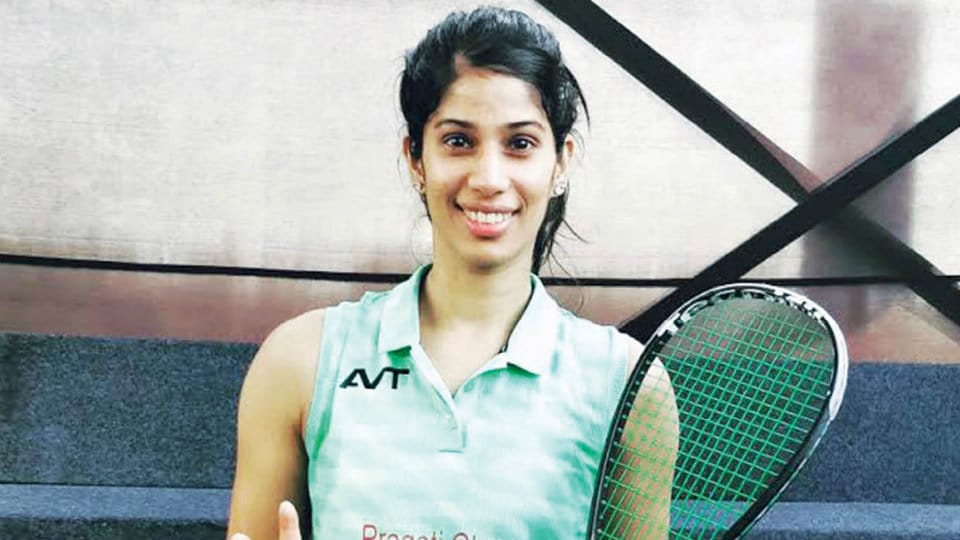
Joshna Chinappa Nominated For Sportstar ACES Awards – 2020

JoshnaChinnappaKF22dec2019

The International Squash player Joshna Chinappa from Kodagu has been nominated for the Sportstar ACES Awards – 2020.

Joshna is nominated for the ‘Sportswoman of the Year’ award in the Racquet Sports category along with P.V. Sindhu (Badminton) and Archana Kamath (Table Tennis).

Nominees for ‘Sportsman of the Year’ award in the Racquet Sports category are G. Sathiyan (Table Tennis), G. Prajnesh (Tennis) and Saurav Ghosal (Squash).

The top two contenders from each category, based on popular vote, will be sent to a jury panel, which will then decide the winner.

To vote, log on: sportstar.the hindu.com/aces-awards or give a missed call to 044-71055000.

Joshna Chinappa, who reached a career-high world ranking of World No.10 in July 2016, was the first Indian to win the British Squash Championship title in 2003 in the U-19 category and was also the youngest Indian women’s national champion.

At the 2014 Commonwealth Games, Joshna, along with Dipika Pallikal Karthik, won the Squash Women’s Doubles Gold Medal, making it India’s first ever Commonwealth Games medal in the sport.

Currently training at the Indian Squash Academy, Chennai, Joshna is the daughter of Kuttanda Anjan Chinappa and Sunitha of Pollibetta, Kodagu.

source: http://www.starofmysore.com / Star of Mysore / Home> Sports / December 21st, 2019

Portable Memorials: Portrait Miniatures

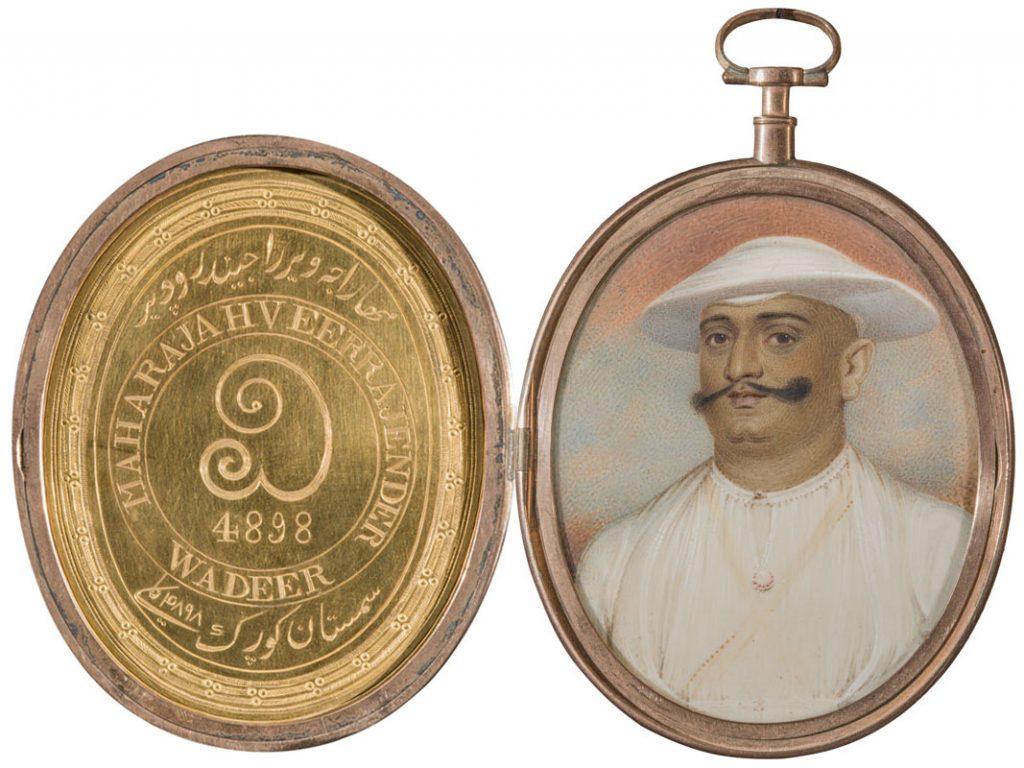
Attributed to Ozias Humphry (British, 1742–1810), Dodda Vira Raja (or, Vira Rajendra Wodeyar), Ruler of Coorg 1780-1809, c. 1787. Watercolor on ivory. Gift of Shirley Latter Kaufmann in memory of Harry and Anna Latter, 74.649.

New Orleans, LA :

The New Orleans Museum of Art (NOMA) presents the museum’s Latter-Schlesinger Collection of Portrait Miniatures. Cradled in the palm of the hand or worn close to the heart, portrait miniatures were never intended for public consumption, but rather, functioned as personal tokens of affection, love, or memorial. Drawing from NOMA’s permanent collection, the installation of more than 100 portrait miniatures is now on view in the Lupin Foundation Decorative Arts Galleries on the museum’s second floor.

“NOMA’s Latter-Schlesinger Collection of Portrait Miniatures, given in 1974 by Shirley Latter Kaufmann in honor of her parents, Harry and Anna Latter, is one of the singularly important collections at this museum,” said Susan Taylor, NOMA’s Montine McDaniel Freeman Director. “Ranging from the court of Henry VIII to Napoleonic France, the collection includes masterful examples of the important artists and techniques used in the art of miniature portraits.”

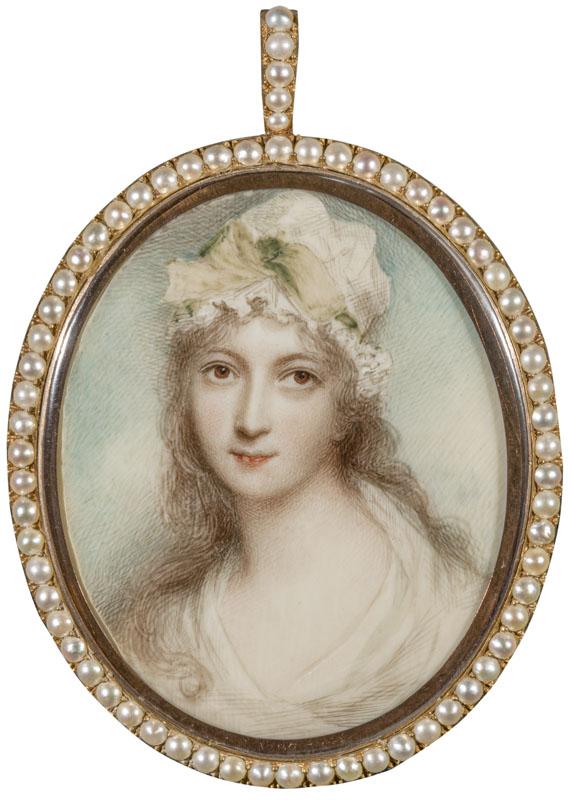
Andrew Plimer (British, 1763–1837), Henrietta Ponsonby, Countess of Bessborough, c. 1795. Watercolor on ivory, frame with pearls. Gift of Shirley Latter Kaufmann in memory of Harry and Anna Latter, 74.654.

Portrait miniatures were the passion of New Orleans collectors Harry and Anna Latter. In 1957, the Latters traveled to London to oversee a government project and dedicated the trip to the pursuit of English portrait miniatures. After her parent’s passing, Kaufmann gifted the comprehensive collection to NOMA, where she was a trustee for more than twenty years and board president in 1978. The family continues Kaufmann’s tradition of supporting the museum through the Milton H. Latter Educational and Charitable Foundation, which sponsored the design and fabrication of a custom cabinet for the magnificent collection.

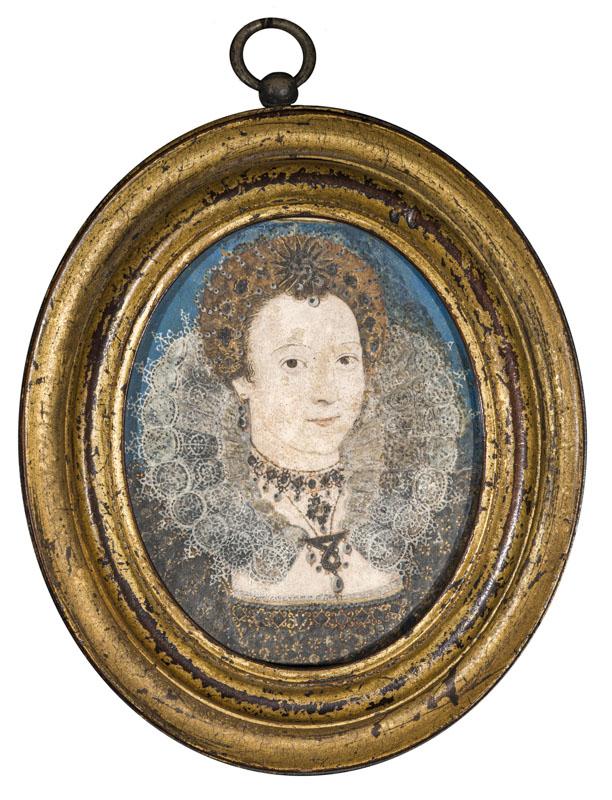
Nicholas Hilliard (English, 1547–1619), Portrait of an Elizabethan Court Lady, c. 1590. Watercolor on parchment. Gift of Shirley Latter Kaufmann in memory of Harry and Anna Latter, 74.337.

Portrait miniatures feature details of historic lace, jewelry, ornate hairstyles, royal adornments and military regalia, all executed by the artist sometimes using a single hair as a brush. The earliest 16th-century miniatures were painted with watercolor onto vellum (animal skin) or cardstock, but by the 18th-century heyday of portrait miniatures, artists painted on thin sheets of ivory for a natural luminescence to the watercolor portraits. NOMA’s collection includes master miniature artists Nicholas Hilliard (English, 1547-1619), John Hoskins the Elder (English, c.1590-1665), Samuel Cooper (English, 1609-1672), Richard Cosway (British, 1742-1821), and George Engleheart (British, 1752-1829). On view are examples of portraits framed with the sitter’s hair, intricately arranged and braided, and two “lover’s eye” miniatures, capturing just an intimate close-up of the sitter’s eye, recognizable only to her dearest confidants.

A tablet produced by NOMA details the stories behind these portrait miniatures, with the stories of royalty and historic celebrities, the highly-skilled craft of miniature painting, and the Latter family collection.

NOMA’s installation was made possible with the support of the Milton H. Latter Educational and Charitable Foundation.

source: http://www.artandobject.com / Art & Object / Home> Museum / December 11th, 2019

…Brew his own destiny

From setting up his own business to embracing different cultures and understanding spirituality — Marc Tormo tells CE that India has helped him…

Marc is a travel and nature enthusiast

How far can one go in search of coffee? Apparently, from Spain to India. Marc Tormo did exactly that in 1997 when he moved to Auroville in Puducherry. CE talks to Tormo, the founder of Marc’s Coffee in Auroville, about his love for coffee, opening up to spirituality and raising kids in India

What brought you to India?
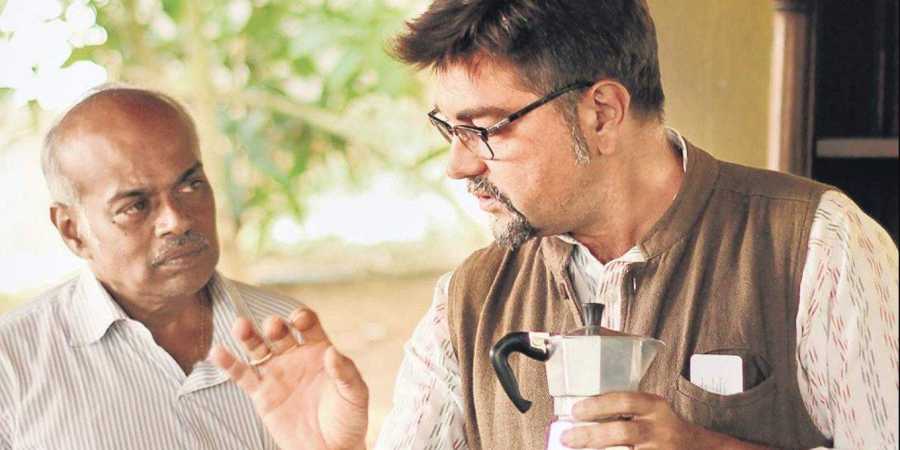
I come from a place called Catalonia in Spain. I was into the business of coffee there where I had a speciality coffee shop. I came to India a few times when I was 19 years old to understand about coffee and I found out about coffee plantations in the southern part of India. People were not aware of the entire process of coffee-making. I understood this method and helped people trace the journey of the coffee they were drinking. Finally, in 2008, we launched Marc’s coffee here in Auroville. Before setting up the coffee place, I had to put in a lot of research on not just coffee but the farmers, their psyche among other things. After setting it up, it took us five years to pick up speed. But it was a pleasant cultural change. Europe is more materialistic. People here are spiritual. Auroville allows me to explore that part as well. My children were born and raised here. India is now second home. Plus, we have a cosmopolitan environment here at Auroville. There are Koreans and Spaniards and many others here.

How do you keep in touch with your roots?
My children can speak Catalan very well which is the dialect from the region I come from. They have learned Tamil, French, Catalan, Spanish and English. We make it a point to visit Spain every year. I like to keep all the goodness of the Spanish culture. People from my region are adventurous and entrepreneurial. I would like to retain all that. But spirituality is something I understood after living in India.

How do you and your family spend time together?
I love to cook, especially for my family. We all spend time cooking. I like making paneer butter masala, khichdis and chapatis. We make a mix of Spanish and Indian cuisines at home. We travel a lot. I take them on my trips to coffee plantations. But this is not just so that they understand coffee but also they understand people and cultural diversity wherever they go. I like to spend time gardening with my children.

What are your interests apart from coffee?
I love to sing, I love to listen to music and be with nature. Life in Auroville lets me enjoy all of this. I can work and be in the midst of nature and pursue my interests.

Auroville is considered to have deep spiritual roots. What is your experience of spirituality?
Auroville has taught me the concept of unity with diversity. We have people from different cultures living here. It has helped me understand the inner meanings. One of the things living in Auroville has helped me with is understand myself and have a holistic view of anything.

One half of India is populated with tea lovers. Have you ever thought of shifting your beverage loyalties?
I have nothing against tea. But I feel coffee has not been studied enough. I chose to focus on coffee. Coffee needs a lot of support to reach everybody so that everyone understands coffee. That is why I chose coffee.

What are your favourite destinations in India?

I love the Western Ghats. Wayanad, Coorg, Mysuru and Chikmaglur are some of my favourite destinations. I am a coffee lover and a nature lover. I like to see wildlife.

Marc will be conducting a Coffee workshop till December 9 at Old Kents Estate, Coorg

source: http://www.newindianexpress.com / The New Indian Express / Home> Cities> Chennai / by Veena Mani / Express News Service / December 07th, 2019

Merging border with dance

New Delhi, (IANS) :

Rasaja Foundation, in collaboration with Business & Community Foundation (BCF) will organise a discussion ”Merging Border” with artists Lata Pada (Sampradaya Dance Creations, Canada), Dr I Wayan Dibia (scholar, author and dance choreographer, Indonesia), Shila Mehta (Nupur Zankar Academy of Performing Arts, New Jersey, Belgium and Mumbai) and Hema Rajagopalan (Natya Dance Theatre, Chicago) followed by ”Nimitta” a solo kathak performance by Shila Mehta, portraying “Shikhandi” from Mahabharat on December 12 at Sri Aurobindo Society in New Delhi.

”PRALAYA”, a collaboration in Bharatanatyam and Baliness dance by Sampradaya Dance Creations, Canada, a modern retelling of the Mahabharata with special focus on the game of dice between the Pandavas and the Kauravas will be staged on December 13 at Kamani Auditorium in the capital.

The presentation, conceptulised and directed by Lata Pada, includes choreography by Lata Pada & I Wayan Dibia, music by Praveen D. Rao, costume Design by Sandhya Raman, visual Design by Jacques Collin and lighting design by Deepa Dharmadhikari.

Their Indo–Balinese collaboration that premiered in Toronto in November 2016 and went on to do an eight-city tour in Canada, has now begun its international tour across seven cities in India and a stint in South East Asia-Indonesia.

–IANS / Sukant/prs
source: http://www.outlookindia.com / Outlook / Home> The News Scroll / December 10th, 2019