Rohan Bopanna-Divij Sharan clinch Gold in Asian Games Men’s Tennis Doubles
This is the fifth Gold medal for India in the Men‘s Doubles (Tennis) since the Asian Games started.
Indian doubles pair of Rohan Bopanna and Divij Sharan beat Kazakhstan‘s Aleksandr Bublik and Denis Yevseyev in the Men‘s Tennis Doubles on Friday to secure India‘s 6th Gold (22nd Overall) at the Asian Games.
The Indian doubles pair thrashed the Kazakhstan duo 6-3, 6-4 to win the Gold.
Earlier, Bopanna and Sharan got the better of Japan‘s Uesugi K and Shimabukuro S 4-6, 6-3, 10-8 on Thursday after a nervy tie-breaker to reach the finals.
This is the fifth Gold medal for India in the Men‘s Doubles (Tennis) since the Asian Games started.
Previously, the team that won gold for India in Men‘s Doubles (Tennis) were – Gaurav Natekar/Leander Paes (1994, Hiroshima), Mahesh Bhupathi/Leander Paes (2002 Busan), Mahesh Bhupathi, Leander Paes (2006, Doha), and Somdev Devvarman, Sanam Singh (2010, Guangzhou).
On Thursday, Prajnesh Gunneswaran ensured another podium finish for India when he beat Korea’s Soonwoo Kwon 6(2)-7, 6-4, 7-6(8) to enter the semifinals of Tennis Men’s Singles.
In Tennis, Ankita Raina had to settle for a Bronze medal on Thursday after she lost 4-6, 6(6)-7 after a tough tie-breaker against China’s Zhang Shuai.
source: http://www.hermannherald.com / Hermann Herald / Home / October 14th, 2018
Inspiration drawn from fashion capitals like Paris or Japan in the business of design is routine. However, when you hear of a handbag collection that is inspired by the Kodagu district of Karnataka, the offbeat element is intriguing. Bengaluru-based luxury handbag label, Aranyani, has launched a line of totes, hobos and clutches that narrate design influenced by Kodagu’s landscape and culture.
“This collection tells the story of Kodagu, its flora and fauna, and culture seen through the eyes of its princess Victoria Gowramma, the first Indian royal to have landed in Britain in 1952. The bags are made with goat’s leather and handloom from Salem,” said CEO Haresh Mirpuri, who launched the label a year ago.
“Kodagu is known for its 250 species of birds like peacocks and birds of paradise that have translated into our design story in the form of motifs and colour schemes. The waterfalls of the mountain province, the nari-mangala or tiger wedding culture and medallions worn by brides at their wedding have been woven into the collection story,” he explained.
Interestingly, Mirpuri was stranded in flood-stricken Kodagu while working on this collection. “My brand draws inspiration from nature for all our lines. Stranded in Kodagu during its recent heavy monsoon and witnessing the devastation first-hand made me realize that we need to be serious and champion the cause of nature,” he said.
The Bengaluru brand has a celebrity client list that includes names like Hollywood singer Vanessa Williams and Bollywood actor Chitrangada Singh and comes in the price range of Rs 8000-75000.
Currently, it is retailed at flagship stores in Bengaluru, Surat and New York. Soon, they will expand to Delhi and Bali.
source: http://www.economictimes.indiatimes.com / The Economic Times / Home> Panache / by Smita Balram, Economic Times Bureau / October 11th, 2018
A look at the variety of factors that go into brewing a truly green cup, from direct trade to responsible single-estate players.
Coffee is the most valuable legally-traded commodity in the world, second only to oil.
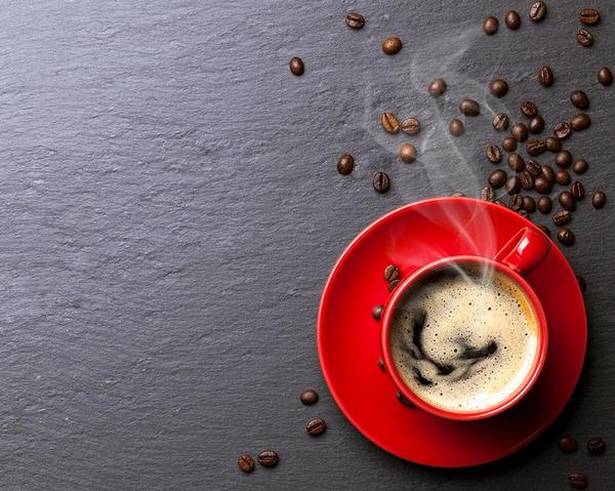
It is estimated that 2.25 billion cups of coffee are consumed each day, worldwide. Ironically, the poorest countries in the world (Guatemala, Ethiopia, Peru and Honduras are some of the top producers of coffee) are growing it, while it’s the richest who are drinking it (the top five coffee consumers are all European countries)… and at prices that get more absurd every day.
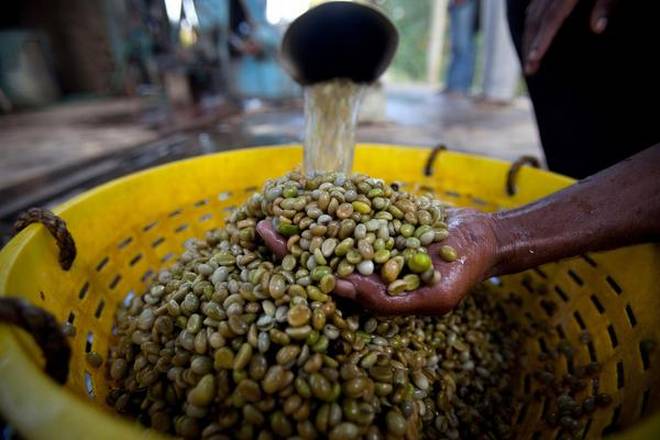
It is important to know that the coffee sold at retail is a different economic product from wholesale coffee, traded on the commodity exchange as green beans. And therein lies the rub. The money goes to those that process it. Coffee needs to be hulled, dried, roasted and ground before you can drink it. A big, shiny roaster inside your café means you can charge more than double what the farmer who grew the bean got for it. British charity Oxfam says the price of raw coffee exported from producer countries accounts for less than 7 % of the eventual cost of coffee to Western consumers.
The organic perspective
While certified organic coffee is sold at a premium, lower yields mean that farmers do not always profit in a meaningful way from obtaining certification, so most forgo it completely.
Fair Trade is a good option because the middlemen in coffee are so notorious. Coffee importers provide credit to certified farmers to help them stay out of debt with coffee buyers. But, the certification itself is expensive and there are several brands that practise fair trade without certification.
There are more than a few brands in India that make sustainable, fair trade, organic coffee nowadays. Black Baza is one of them. Founder Arshiya Bose, having done a PhD in the brew, believes a healthy ecosystem creates the best coffee. Black Baza supports their farmers with regular field research on healthy ecosystem indicators: spiders are the pest-control and butterflies, the pollinators. Not only is their coffee organic but the tree cover under which the coffee is grown also has to be 80% natural forest trees.
Organic coffee is mostly always shade-grown because of the large amounts of pesticide and fertilisers required to grow coffee under the sun. Indian coffee competes with large-scale, high-tech coffee estates in Central and South America, which were razed rainforests to begin with. They became so completely stripped of nutrients that in many areas of Brazil, the land could no longer be used for agriculture.
Little wonder that sun-grown coffee is the third most heavily sprayed crop in the world.
A constant struggle
I spoke to Kishore Cariappa of the famed Cariappa Coffee in Kodaikanal (with its own café). Their organic, single-estate, single-origin coffee, is easily one of the best in the country.
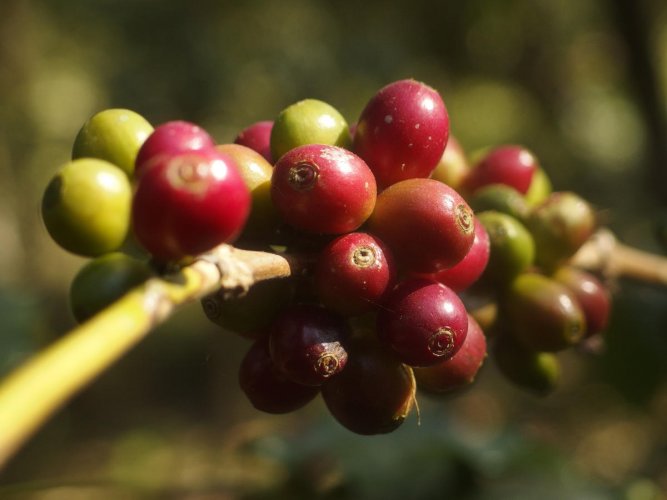
Kishore is a stickler for detail. Because the coffee is naturally rain-fed — with no artificial irrigation — the beans all ripen at different times. This means harvesting takes place several times to ensure only ripe berries are picked. It’s time-consuming and labour-intensive, but the only way you can compete with larger coffee companies.
His state-of-the-art roasting and processing machinery was bought to handle 200 acres of coffee. He had dreamt of starting a co-op of the farms in his village — tribal people that grew coffee organically under the shade of forest trees. He had even set up a system by which the farmers would get a monthly salary instead of the once-a-year bumper price that comes with the crop. But all the farmers in his village had already given their coffee out on five-10-year contracts to a clan of local coffee buyers.
“Educated farmers keep track of the prices in London and know what price to demand. But the average farmer doesn’t. They are not exposed to the Internet and their holdings are too small for export. Add to that the fact that they get an income only once a year, so they borrow money from this consortium of buyers and have their coffee locked on contract. This way, the international market prices don’t apply to them any more,” he says.
Kishore decided to go ahead with growing his own coffee and quickly realised that the only way to make money being a coffee farmer was to start his own café. It’s no dream job, though. “Growing sustainable coffee is hard. Organic coffee is so much more labour-intensive; which means expensive. To export, you need 20 tonnes per batch at least to fill a container. Coffee has to be fresh, even the green beans, so you have to send it in batches which is another added cost.”
Direct trade, where coffee roasters directly purchase from farmers, is also a socially sustainable choice. There’s no set standard, and there are no certifications. Roasters directly negotiate prices with the farmers, who typically earn a higher premium for their product. Blue Tokai coffee bags come with a detailed card on the farmer and the farm on which the coffee you ordered, was grown.
We are blessed to be growing some of the finest coffee in the world, and there are now plenty of brands that do it well. Keep it local, nourish our coffee traditions and support those that are making a difference.
source: http://www.thehindu.com / The Hindu / Home> Life & Style> Food / by Simrit Malhi / October 04th, 2018
Mullayanagiri [mool-ya-na-gi-ree] is a mouthful not only for those people who don’t speak either of the four languages of the five Southern Indian states, but even for most Indians who are unfamiliar with the region.
At an elevation of 1,930 meters, Mullayanagiri is the highest mountain peak in the Southwestern Indian state of Karnataka, in the Chikmagalur district. The peak forms a part of the Baba Budan range of mountains, which are part of the greater Western Ghats. The names of Chikmagalur and Baba Budan will resonate with most of the Indian populace for its association with coffee and salubrious weather.
Chikamagalur, the lesser-known, quaint hill town, became the first recorded place in India to cultivate coffee when it was introduced to hillsides from Yemen around the mid to late 1600s. As the story goes, seven beans of coffee were smuggled out of Yemen’s town of Mocha by an Indian hermit named Baba Budan.
Baba Budan then planted these in the hills of Chikmagalur. No one is sure of how much and how well these foreign beans grew in the time following, but coffee cultivation was seriously undertaken in the 18th Century by British entrepreneurs who turned forests in Southern India into commercial coffee plantations.
In fact, coffee was cultivated long before tea, mainly in Northern India. This is a relatively unknown fact, as India is perceived to be a tea-drinking nation and does have excellent tea gardens in Darjeeling, Bengal and Assam.
“Coffee was an established commercial crop by the turn of the 19th Century and was exported to Europe via London,” said Anil Bhandari, president of the India Coffee Trust, a nonprofit organization that promotes coffee consumption. “By the early 1940s, Indian Arabica coffee — or Mysore coffee, as it was known then — had established itself in the European market and had a branding all of its own. However… WWII and the loss of the European market during that phase caused the unique branding of Mysore coffee to disappear from buyers’ consciousness.”
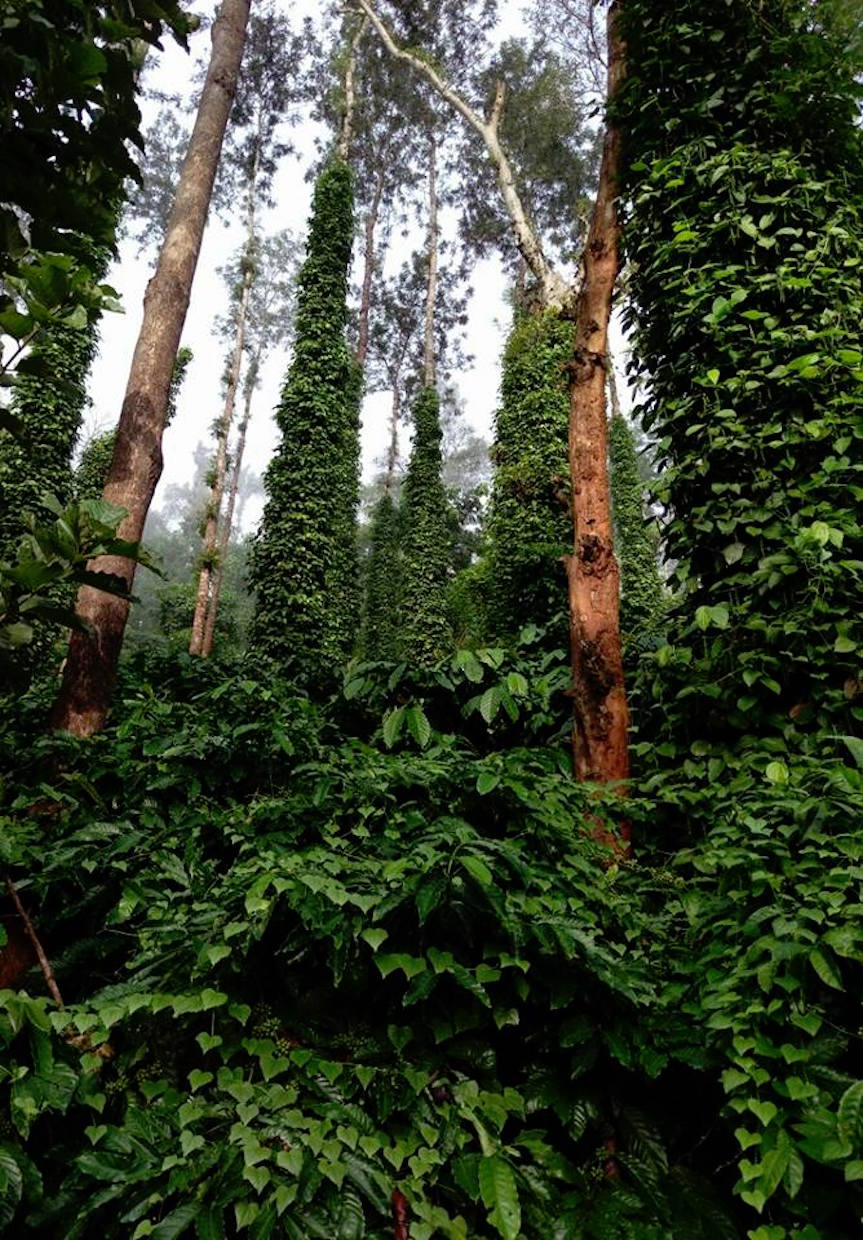
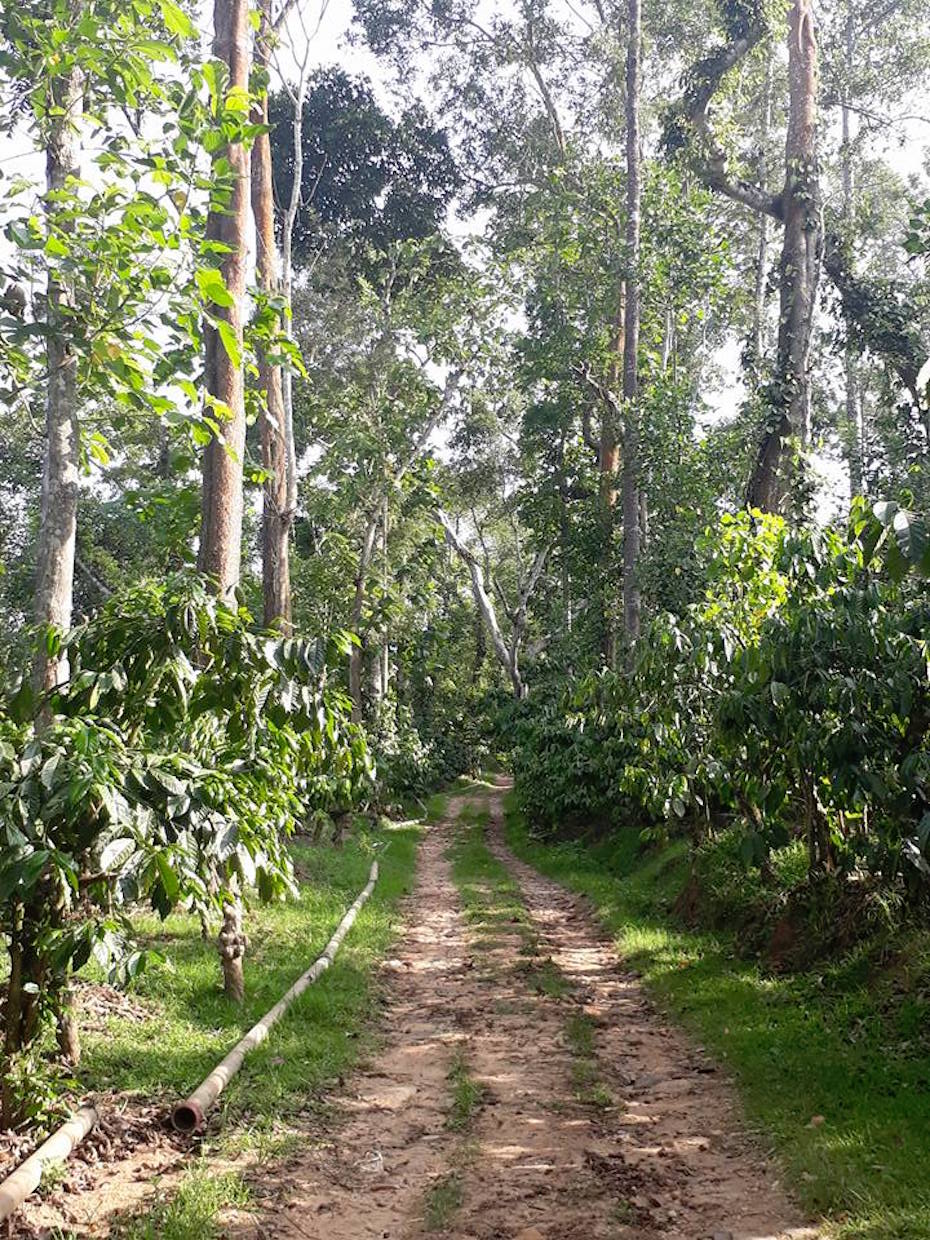
Coffee grown in the forests of India, the world’s sixth largest producer of coffee, is cultivated under thick canopies in the Western Ghats — a UNESCO World Heritage site and one of the world’s most important biodiversity hotspots.
In the 2016-17 season, India produced 5.5 million bags of coffee. A majority of the country’s coffee is grown in the three southern states of Karnataka, Tamil Nadu, and Kerala, followed by Andhra Pradesh and Telangana, which was a part of Andhra Pradesh until recently.
Nearly 65 percent of the total production comes from Karnataka, while Tamil Nadu contributes approximately 15 percent, and Kerala makes up around 20 percent. It has been estimated that there are more than 210,000 coffee producers in India, the majority of whom are smallhoder farmers with plots around two hectares.
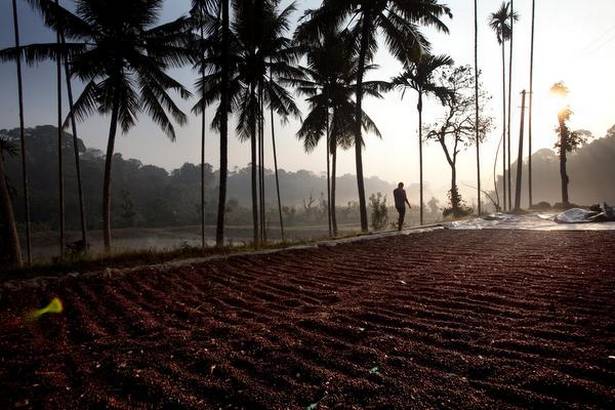
As in most producing countries, India processes coffee by the washed (or wet) method as well as the natural (or dry) method.
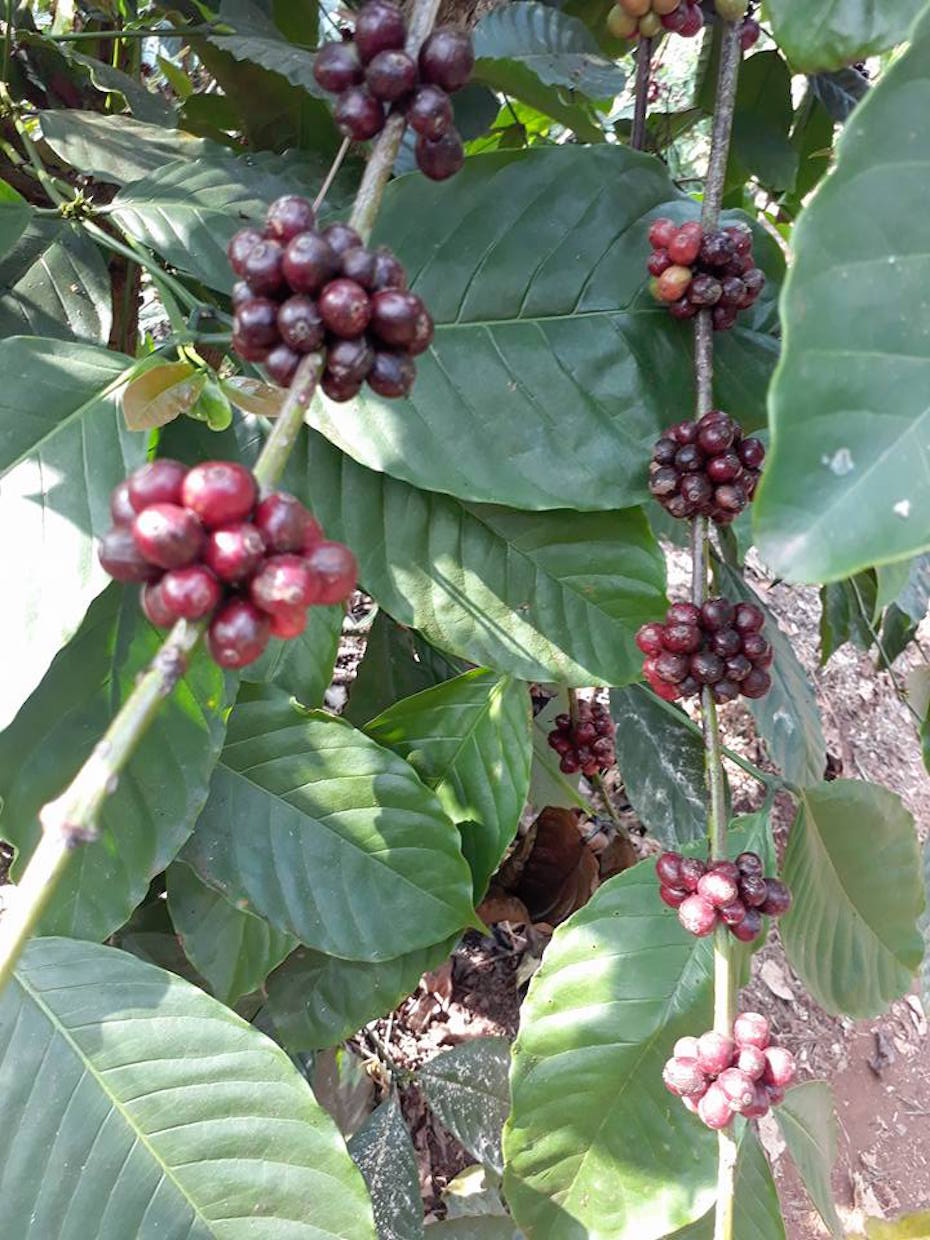
India is renowned for its unique shade-grown coffee. The two commercially important species of coffee, Arabica and Robusta, are grown under heavy shade that is believed to contribute to the flavor profile of the coffee to the coffee, along with other influences such as the monsoons, spices that grow around coffee, and the various fauna that thrive alongside it.
Within this bio-diverse growing environment, the mixture of vegetation prevents soil erosion and fallen leaves decompose to become rich humus, thereby retaining the forest ecosystem. The Indian Rainforest-grown Arabica is unique in its properties and sought after for its flavor and characteristics, as these are grown at higher altitudes.
Increasingly, the industry is shifting towards sustainable farming practices, and more estates have become certified by Rainforest Alliance-UTZ and Fairtrade. Organic coffee is also of increasing interest, especially for coffee grown on tribal land, which represents about 42 percent of the coffee area in India. In these areas, coffee is managed in traditional ways, often organically.
Most of India’s coffee exports go to Europe, Japan and the Middle East, while many global consumers remain unaware of the complexities and quality that fine Indian coffee from Southern estates can offer. The name “Coffee of India” is only used as an indication of origin at the export level, when packages are shipped from India to the country of destination.
“Indian coffee, particularly the Robusta parchment and cherry, continue to see good demand from Italian buyers,” said Ramesh Rajah, the president of the Coffee Exporters Association of India. “Of concern is the falling Arabica production due to extremely low prices prevailing in the international market, as well as the recent flood damage, which is still being assessed.”
Rigid control of quality and grade designations by India Coffee Board, an agency of the Government of India, ensures the export of only the finest and the most aromatic of India’s hand-picked coffee beans.
Encouragement for the local coffee industry comes not only from the Coffee Board of India, but from nonprofit bodies such as the India Coffee Trust that are working towards fortifying and intensifying these efforts.
“The India Coffee Trust is the result of a general consensus among the stakeholders of the Indian coffee industry to create a nonprofit organization that discusses and promotes Indian coffee,” Bhandari said. “Assisting the Trust with the objective of creating a wider global outreach and visibility of India’s fine Shade Grown coffees is the Indian Coffee Collective. Together, our primary mandate is to promote India’s shade-grown coffees and it’s long standing history with the humble brown bean.”
With a goal of raising awareness around preserving and promoting the values of coffee culture in India, the India International Coffee Festival — jointly organized by the India Coffee Trust and Coffee Board of India — took place in Bengaluru in January 2018. The four-day attracted more than 5,000 local, national, and international visitors.
The next festival is scheduled for 2020. Time will tell where Indian coffee will be by then.
source: http://www.dailycoffeenews.com / Daily Coffee News (by Roast Magazine) / by Anamika Ghosh / October 02nd, 2018
Crop grown in Kodagu, C’magaluru, Bababudangiri among 5 varieties being considered for the GI tag.
Soon, coffee grown in Kodagu, Chikkamagaluru and Bababudangiri will get geographical indication (GI) tag, said Srivatsa Krishna, CEO and secretary, Coffee Board, on Monday.
Speaking to reporters on the sidelines of ‘Naya Bharat: Coffee Par Soch,’ as part of International Coffee Day, he said that the Board had applied for GI tag for coffee grown in five southern regions, based on their uniqueness. Of these five places, three are from Karnataka. The list also comprises coffee grown in Araku valley (Andhra Pradesh) and Wayanad (Kerala). The GI tag is likely to come by January 2019.
This is the first time that GI tag has been applied for coffee-growing regions. In 2008, GI tag was obtained for Monsoon Malabar coffee blend. “The idea of doing this is to recognise the coffee, promote the brand and increase local sales. Over 70% of India’s coffee is grown in Karnataka, but the market needs to be strengthened,” he said.
To increase the production of coffee, regain the market position and encourage farmers, Mahatma Gandhi National Rural Employment Act funds will be helpful, Krishna said.
“I request the Coffee Board to tie up with zilla panchayats to recoup and expand the areas. Funds for coffee planters under MGNREGA will be given, on the lines of mulberry and sericulture,” he said. Krishna said the floods in Kodagu had an impact on coffee production, but things were improving.
On the occasion, the Board announced the launch of Atal Incubation Centre at Coffee Board in Bengaluru. This centre will help startups and coffee growers to become entrepreneurs. The centre is set up under the Atal Innovation Mission (AIM) to nurture innovative startup businesses.
So far, in India, 20 centres have been established, Coffee Board is the 21st and the first such in India, said R Ramanan, mission director, AIM. This centre is being set up in partnership with Nasscom and FKCCI.
The Coffee Board also announced its partnership with Ernst and Young for ‘The Future of Coffee-Roadmap’, and with National Institute of Public Finance and Policy for a study on subsidies for Coffee Industry.
source: http://www.deccanherald.com / Deccan Herald / Home> State> Top Karnataka Stories / by Bosky Khanna, DH News Service / October 01st, 2018
Chef Lionel Giraud on the gourmet product which was created along with Alexis Muñoz
Chef Lionel Giraud became a Lavazza Chef Ambassador in 2016, and, since then, has taken great pleasure in exploiting all its facets. However, after two years as a Chef Ambassador, Lionel decided to infuse two most essential elements of Italian cooking — coffee and organic olive oil. Lionel Giraud chose to work alongside Alexis Muñoz, a famous olive oil producer. Alexis Muñoz rose to the challenge and created high quality oil, which is completely organic.
Lavazza’s coffee with olive oil is produced in a limited edition and sold in 25cl bottles. Excerpts from an interview:
How would you describe the aromatic notes that emerge from the combination of coffee and olive oil?
After weeks of research and testing, we finally found the perfect match: an amazing olive oil both subtle and spicy with a fruity taste, combined with a Lavazza coffee with a strong and delicate flavour.
The feedback from the restaurant’s customers is positive. They are very surprised to see how different the perception can be, depending on the way you try the oil. For instance, on a slice of toast, it is the fruity taste that stands out, while on other foods, it is the coffee note which will first be perceived.
Coffee is now used to give flavour especially to soups. Do you think that coffee oil could further improve these tastes?
Of course the addition of some qualitative fat always improves the taste and brings stronger flavours to the dish.
What have you learned from your years of experience with a clientèle with diverse profiles?
Today, customers want a light coffee with 50% Arabica and 50% Robusta. The restaurant’s customers are very keen on the Tierra coffee.
How would you assess how your customers enjoy their coffee?
Today, customers have a better knowledge of coffee, its production method and the different ways of preparing it. It is all about a product that has to be enjoyed and that arouses curiosity and discussion. As a result, it is more appreciated than it used to be.
What would be the best way to introduce someone to coffee?
I personally like to include roasted grains in my preparations. For example, I introduced my children to coffee by adding grated roasted coffee beans to a silky mashed potato. It removes the bitterness from the coffee.
source: http://www.thehindu.com / The Hindu / Home> Life & Style> Food / by Prabalika M. Borah / September 28th, 2018
Coffee cupping, exhibition of coffee berries to be held.
The Coffee Board of India, in association with Way Win, a farmer-producer company in the coffee sector in Wayanad, and Vikaspaedia, an initiative of the Union Ministry of Electronics and Information Technology, is organising various programmes to mark International Coffee Day on October 1.
Ports Minister Kadannappally Ramachandran will inaugurate the programme at the Town Hall here at 10 a.m. on the day.
Coffee Board Deputy director (Research) Vijayalakshmi will deliver the keynote address on the occasion.
Coffee cupping, a practice of observing the tastes and aromas of different brewed coffee varieties, would be the major attraction of the programme, organisers said in a release here on Thursday.
Exhibition of various types of coffee berries will also be held.
source: http://www.thehindu.com / The Hindu / Home> National> Kerala / by Staff Reporter / Kalpetta – September 28th, 2018
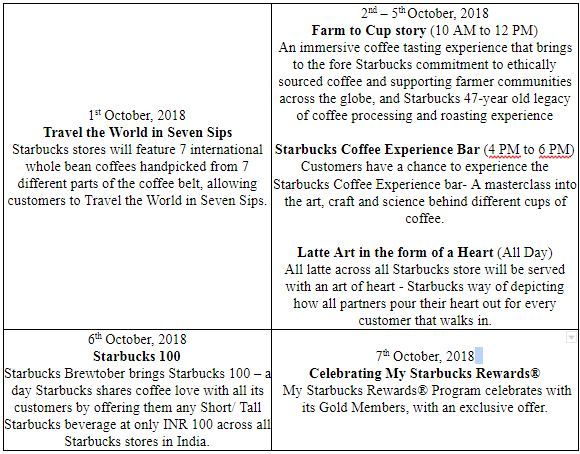
Tata Starbucks in India is taking its coffee heritage and inspiration to celebrate International Coffee Week this year with coffee-forward experiences and special promotions across its stores.
Recognised in delivering consistent, authentic in-store experiences, rooted in high-quality Arabica coffee, Tata Starbucks is celebrating the art of coffee from heritage to brewed innovation over a seven-day celebration titled ‘Starbucks Brewtober’, beginning October 1.
To celebrate coffee, Starbucks stores, which bring to life the Third Place experience, will feature seven international whole bean coffees handpicked from seven different parts of the coffee belt, allowing customers to ‘Travel the World in Seven Sips’ this International Coffee Day- October 1.
Other experiential activities during the week include ‘Farm to Cup’ story – an immersive coffee tasting experience that brings to the fore Starbucks’ commitment to ethically sourced coffee and its 47-year old legacy of coffee processing and roasting; ‘Starbucks Coffee Experience Bar’- a masterclass into the art, craft and science behind different cups of coffee and ‘Latte Art’ – a showcase of the craft of Starbucks partners.
On October 6, Starbucks Brewtober brings ‘Starbucks 100’ – a day Starbucks shares coffee love with all its customers by offering them any short/ tall Starbucks beverage at only Rs 100 across all its stores in India.
Continuing with the celebrations, Starbucks is also offering My Starbucks Rewards Gold Members an exclusive offer on October 7.
“At Starbucks ,we take great pride and joy in partnering with customers on their journey of coffee exploration and are committed to delivering an unparalleled coffee experience. With ‘Starbucks Brewtober’, Tata Starbucks commemorates coffee with a week-long celebration. ‘Starbucks Brewtober’ offers coffee lovers a unique way of celebrating coffee, starting with various immersive coffee experiences to the big day of ‘Starbucks 100’ – a day when Starbucks shares coffee love with its customers by offering all its short/ tall handcrafted beverages for only Rs 100,” said Veetika Deoras, Head – Marketing, Category, Digital and Loyalty at Tata Starbucks Limited.
“We hope to celebrate coffee and the spirit of Starbucks through the week and look forward to welcoming our customers in our stores,” she added.
International Coffee Week will be celebrated across all Starbucks stores in India from October 1 to 7, 2018.
SOURCE: ANI
source: http://www.siasat.com / The Siasat Daily / Home / by Syed Qayam Ali / September 26th, 2018
Gulshan Devaiah is getting all the praises at the prestigious Toronto International Film Festival (TIFF) 2018 for his performance in the upcoming Vasan Bala directorial ‘Mard Ko Dard Nahi Hota’ (‘The Man Who Feels No Pain’). The actor’s film which premiered at the TIFF 2018 has gone on to win the Grolsch People’s Choice Midnight Madness section award after beating big-budget Hollywood franchises like ‘Halloween’ and ‘Predator’.
Gulshan is playing a double role in the film — a mysterious Karate Master named Mani and his psychotic twin named Jimmy. His dual performance is being lauded by the critics and audiences with Gulshan being called “an irreplaceable component to the film who brings great energy to every scene he is in”.
“Vasan and I worked again after his first film ‘Peddlers’. Vasan is a fabulous talent. I am so happy for him that ‘MKDNH’ was so widely appreciated by the audiences and critics in Toronto where they were demanding a sequel. I am so overwhelmed by what people are saying and writing about our film and my performances,” says Gulshan.
‘Mard Ko Dard Nahi Hota’ is Gulshan and director Vasan Bala’s second collaboration after the 2012 crime thriller film ‘Peddlers’.
source: http://www.freepressjournal.in / The Free Press Journal / Home> Entertainment / by FPJ Bureau / September 25th, 2018
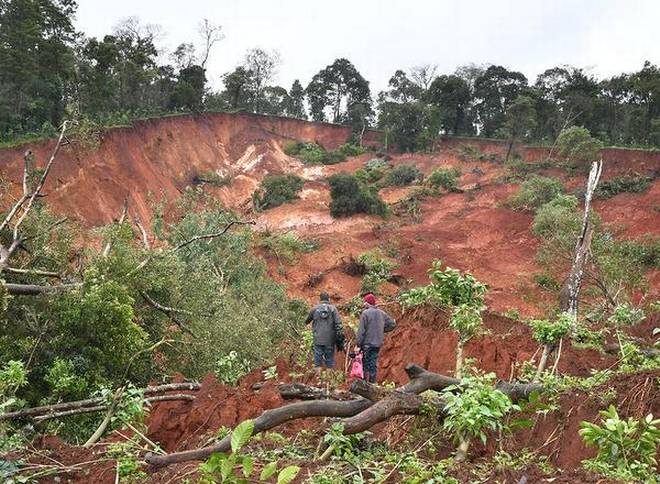
“A forestdepleted Kodagu basin will have reduced capacity to capture and store rainwater.” It is a picture of destruction in Hattihole near Somwarpet, Kodagu, after the floods. | Photo Credit: Sampath Kumar G.P.
Protecting the Kodagu watershed is essential to ensure the water security of three States
We require water for everything: drinking, growing crops, producing electricity and industrial production. With the world population projected to grow to about 10 billion by 2050, according to the United Nations, and with climate change discernible, both the quantity and quality of freshwater will become critical, affecting health, food security, and economic well-being. A 2015 UN report, Water for a Sustainable World, pointed out that the gap between the availability of water and our need for water is only going to increase.
Projects in the river basin
The growing demand on freshwater resources demonstrates the need for sustainable management of water. In this context, projects that are being contemplated, such as the laying of multiple railway tracks in the critical Cauvery river basin in Kodagu district, Karnataka, are not only economically unviable but also ecologically damaging. Mega projects pose a clear threat to the long-term water security of the three States that depend on the Cauvery (Karnataka, Kerala and Tamil Nadu), and exacerbate the threat posed by seasonal droughts and floods.
The Cauvery basin drains an area of about 81,000 sq. km. Originating in Talakaveri, Kodagu, the river irrigates agricultural fields, generates electricity, and provides drinking water to downstream communities across south India. The Cauvery and its tributaries contribute the bulk of water to the Krishna Raja Sagara dam near Mysuru, the primary water source for Bengaluru. However, increasing development pressure from the transportation and construction sectors poses a severe threat to the forests, riverbeds, wildlife and agricultural lands. This March, for the first time in decades, towns such as Virajpet in Kodagu faced a severe shortage of drinking water. The continuing loss of forest cover and illegal sand mining from river beds endanger water and food security for all the downstream communities in the Cauvery basin.
The three proposed railway plans have major implications. One, all the tracks will cut through large swaths of agricultural farms and fields as well as Protected and Reserve Forests that are spread across Kodagu and Mangaluru districts of Karnataka, and Wayanad and Kannur districts of Kerala. Along this sparsely populated area, transportation needs can be met by simply improving existing roads at a fraction of the monetary and ecological cost of the proposed railways. In fact, in its feasibility report of the Mysuru-Thalassery line, the Delhi Metro Rail Corporation stated that the project would not be beneficial to the State. In response to protests by the people of Kodagu in February, the plan to build the Mysuru-Thalassery line was scrapped in March. However, if history is any guide, plans to build the tracks will reemerge in time.
Two, they will affect the Western Ghats, one of the most biodiverse regions on earth. Kodagu has about 45% forest cover and about 30% agroforestry systems (coffee plantations and paddy fields). Between 2013 and 2015, a high-tension power line linking Mysuru and Kozhikode resulted in the loss of about 50,000 trees in Kodagu alone. If the proposed railway lines are constructed, they would conservatively result in tree loss that is 10 times more than this. Forests help capture rainfall, reduce run-off and soil erosion, recharge groundwater aquifers, mitigate flooding, support local communities, and provide refuge for native flora and fauna. Raised railway tracks will also impede wildlife and could result in the deaths of endangered animals such as elephants. Most importantly, a forest-depleted Kodagu basin will have reduced capacity to capture and store rainwater. Even without the railway tracks, a satellite-based report titled India State of Forests 2017 noted that Kodagu lost 102 sq. km. of tree cover in just two years.
Variable monsoon
The Kodagu basin receives heavy rainfall, mainly during the southwest monsoon (June-September), that feeds the Cauvery. However, studies by the Indian Institute of Tropical Meteorology and others, published in the journal Nature, have found evidence for increasingly variable monsoon rainfall. Thus, we can expect to experience more extreme floods as well as droughts in the future. These are scenarios that make preserving forest cover more vital in order to mitigate the collateral effects of these extreme events.
During this year’s southwest monsoon season, Kodagu received twice as much annual rainfall as usual and with greater intensity. This resulted in landslides and floods. A recent study of nearly 5,000 landslides around the world, published in Earth and Space Science News (Eos), has revealed that activities like construction, illegal mining and hill cutting are increasingly responsible for the uptick in fatal landslides, particularly in Asia. It will be hard to claim that the uncontrolled development and forest clearance in the steep slopes of the Western Ghats in recent years has not been a factor in the tragedy that just unfolded in Kodagu, and in the coastal districts of Kerala. With 100-year storms likely to become more frequent as the climate becomes warmer, business as usual is sure to increasingly endanger lives and property.
Erratic monsoon rains can cause flooding, droughts, water and food security. Preserving existing forests in the watershed provides an effective ‘insurance policy’ for reducing the effect of floods and droughts while recharging groundwater across the Cauvery river basin. Nature has reported that diminished access to water resources increases the risk of social unrest, political instability, intensified refugee flows and armed conflicts, even within borders. The variable nature of monsoons makes India one of the most vulnerable regions to water-related disasters associated with climate change and extreme weather events. According to a BBC report, Bengaluru is likely to run out of drinking water in the next decade. Economists should estimate the monetary and human cost of cities like Bengaluru becoming dry, and implement policies focused on achieving and maintaining sustainable water resources.
We are at the start of the UN Decade for Water, which emphasises water security for all. Everyone lives in a watershed, yet water remains a remote concept for those who consume it the most — people, industries and farmers. There are no substitutes for water as the very basis for life. Protecting the Cauvery’s source is essential for the sustained well-being of the entire basin and of the three States that the river nourishes. In fact, good water governance of the nation’s watersheds will be key to its sustainable future. We can begin by saving Cauvery’s cradle.
Bopaiah Biddanda is Professor of Water Resources at the Robert B. Annis Water Resources Institute, U.S.
source: http://www.thehindu.com / The Hindu / Home> Opinion> Comment / by Bopaiah Biddanda / September 24th, 2018
WELCOME. If you like what you see "SUBSCRIBE via EMAIL" to receive FREE regular UPDATES.
Read More »